rear seat GMC SIERRA 2008 Owner's Manual
[x] Cancel search | Manufacturer: GMC, Model Year: 2008, Model line: SIERRA, Model: GMC SIERRA 2008Pages: 578, PDF Size: 6.47 MB
Page 1 of 578
Seats and Restraint Systems........................... 1-1
Front Seats
............................................... 1-3
Rear Seats
..............................................1-12
Safety Belts
.............................................1-14
Child Restraints
.......................................1-35
Airbag System
.........................................1-68
Restraint System Check
............................1-87
Features and Controls..................................... 2-1
Keys
........................................................ 2-3
Doors and Locks
......................................2-10
Windows
.................................................2-15
Theft-Deterrent Systems
............................2-18
Starting and Operating Your Vehicle
...........2-22
Mirrors
....................................................2-55
Object Detection Systems
..........................2-63
OnStar
®System
......................................2-65
Universal Home Remote System
................2-68
Storage Areas
.........................................2-74
Sunroof
..................................................2-79
Instrument Panel............................................. 3-1
Instrument Panel Overview
.......................... 3-4
Climate Controls
......................................3-25
Warning Lights, Gages, and Indicators
........3-34
Driver Information Center (DIC)
..................3-54
Audio System(s)
.......................................3-80Driving Your Vehicle....................................... 4-1
Your Driving, the Road, and Your Vehicle
..... 4-2
Towing
...................................................4-50
Service and Appearance Care.......................... 5-1
Service
..................................................... 5-4
Fuel
......................................................... 5-6
Checking Things Under the Hood
...............5-12
Rear Axle
...............................................5-51
Four-Wheel Drive
.....................................5-52
Front Axle
...............................................5-54
Noise Control System
...............................5-56
Headlamp Aiming
.....................................5-56
Bulb Replacement
....................................5-59
Windshield Wiper Blade Replacement
.........5-65
Tires
......................................................5-66
Appearance Care
...................................5-112
Vehicle Identication
...............................5-121
Electrical System
....................................5-122
Capacities and Specications
...................5-130
Maintenance Schedule..................................... 6-1
Maintenance Schedule
................................ 6-2
Customer Assistance Information.................... 7-1
Customer Assistance and Information
........... 7-2
Reporting Safety Defects
...........................7-14
Vehicle Data Recording and Privacy
...........7-16
Index................................................................ 1
2008 GMC Sierra Owner ManualM
Page 2 of 578
GENERAL MOTORS, GM, the GM Emblem, GMC, the
GMC Truck Emblem, and the name SIERRA are
registered trademarks of General Motors Corporation.
This manual includes the latest information at the time it
was printed. We reserve the right to make changes
after that time without further notice. For vehicles rst
sold in Canada, substitute the name “General Motors of
Canada Limited” for GMC whenever it appears in this
manual.
This manual describes features that may be available in
this model, but your vehicle may not have all of them.
For example, more than one entertainment system may
be offered or your vehicle may have been ordered
without a front passenger or rear seats.
Keep this manual in the vehicle for quick reference.
Canadian Owners
A French language copy of this manual can be obtained
from your dealer/retailer or from:
Helm, Incorporated
P.O. Box 07130
Detroit, MI 48207
1-800-551-4123
www.helminc.com
Propriétaires Canadiens
On peut obtenir un exemplaire de ce guide en français
auprès de concessionnaire ou à l’adresse suivante:
Helm Incorporated
P.O. Box 07130
Detroit, MI 48207
1-800-551-4123
www.helminc.com
Litho in U.S.A.
Part No. 15854802 A First Printing
©2007 General Motors Corporation. All Rights Reserved.
ii
Page 5 of 578
Front Seats......................................................1-3
Manual Seats................................................1-3
Power Seats..................................................1-4
Manual Lumbar..............................................1-5
Power Lumbar...............................................1-5
Heated Seats.................................................1-6
Memory Seat, Mirrors, and Pedals....................1-6
Reclining Seatbacks........................................1-8
Head Restraints............................................1-10
Seatback Latches.........................................1-11
Center Seat.................................................1-12
Rear Seats.....................................................1-12
Rear Seat Operation (Full Bench)...................1-12
Rear Seat Operation (Split Bench)..................1-13
Safety Belts...................................................1-14
Safety Belts: They Are for Everyone................1-14
How to Wear Safety Belts Properly.................1-19
Lap-Shoulder Belt.........................................1-28
Safety Belt Use During Pregnancy..................1-33
Lap Belt (Crew and Extended Cab).................1-34
Safety Belt Extender.....................................1-35Child Restraints.............................................1-35
Older Children..............................................1-35
Infants and Young Children............................1-38
Child Restraint Systems.................................1-42
Where to Put the Restraint.............................1-44
Lower Anchors and Tethers for Children
(LATCH)..................................................1-45
Securing a Child Restraint in a Rear Seat
Position...................................................1-55
Securing a Child Restraint in the Center Front
Seat Position............................................1-57
Securing a Child Restraint in the Right Front
Seat Position (With Airbag Off Switch)..........1-58
Securing a Child Restraint in the Right Front
Seat Position (With Passenger Sensing
System)...................................................1-62
Securing a Child Restraint in the Right
Front Seat Position (Heavy Duty Crew
Cab Only)...............................................
.1-66
Section 1 Seats and Restraint Systems
1-1
Page 7 of 578
Front Seats
Manual Seats
{CAUTION:
You can lose control of the vehicle if you try to
adjust a manual driver’s seat while the vehicle
is moving. The sudden movement could startle
and confuse you, or make you push a pedal
when you do not want to. Adjust the driver’s
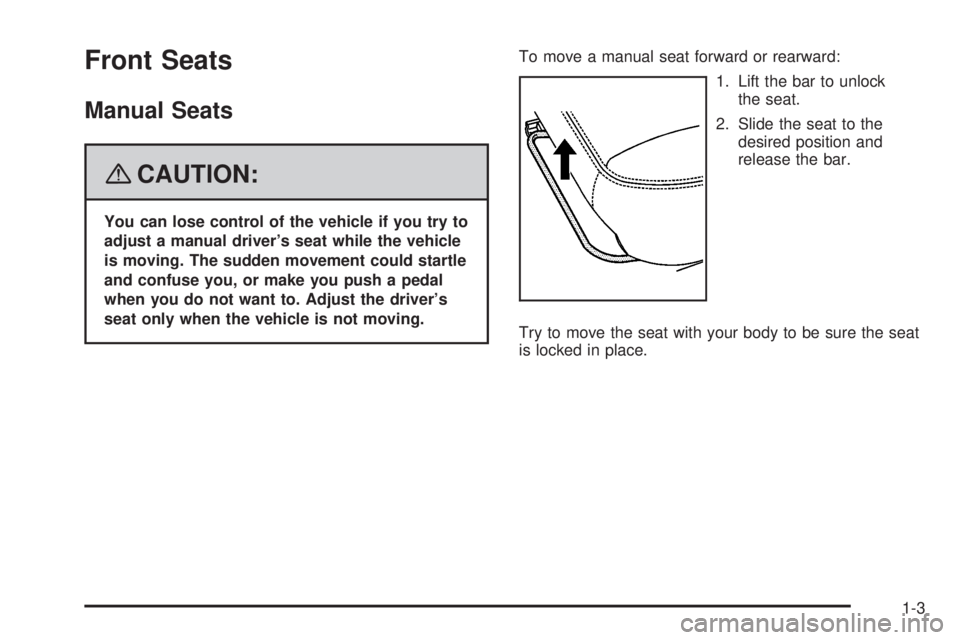
seat only when the vehicle is not moving.To move a manual seat forward or rearward:
1. Lift the bar to unlock
the seat.
2. Slide the seat to the
desired position and
release the bar.
Try to move the seat with your body to be sure the seat
is locked in place.
1-3
Page 8 of 578
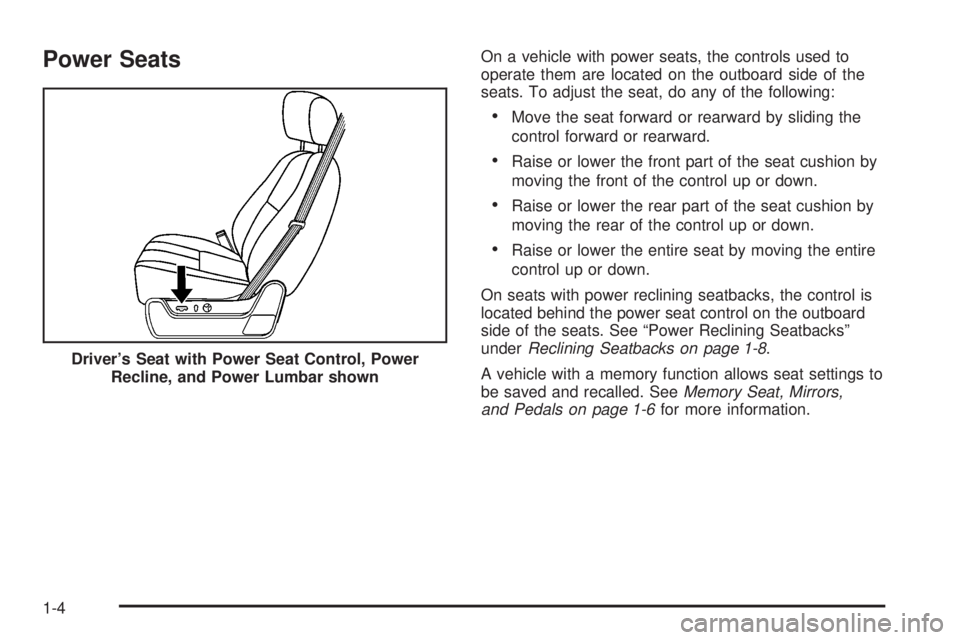
Power SeatsOn a vehicle with power seats, the controls used to
operate them are located on the outboard side of the
seats. To adjust the seat, do any of the following:
Move the seat forward or rearward by sliding the
control forward or rearward.
Raise or lower the front part of the seat cushion by
moving the front of the control up or down.
Raise or lower the rear part of the seat cushion by
moving the rear of the control up or down.
Raise or lower the entire seat by moving the entire
control up or down.
On seats with power reclining seatbacks, the control is
located behind the power seat control on the outboard
side of the seats. See “Power Reclining Seatbacks”
underReclining Seatbacks on page 1-8.
A vehicle with a memory function allows seat settings to
be saved and recalled. SeeMemory Seat, Mirrors,
and Pedals on page 1-6for more information. Driver’s Seat with Power Seat Control, Power
Recline, and Power Lumbar shown
1-4
Page 9 of 578
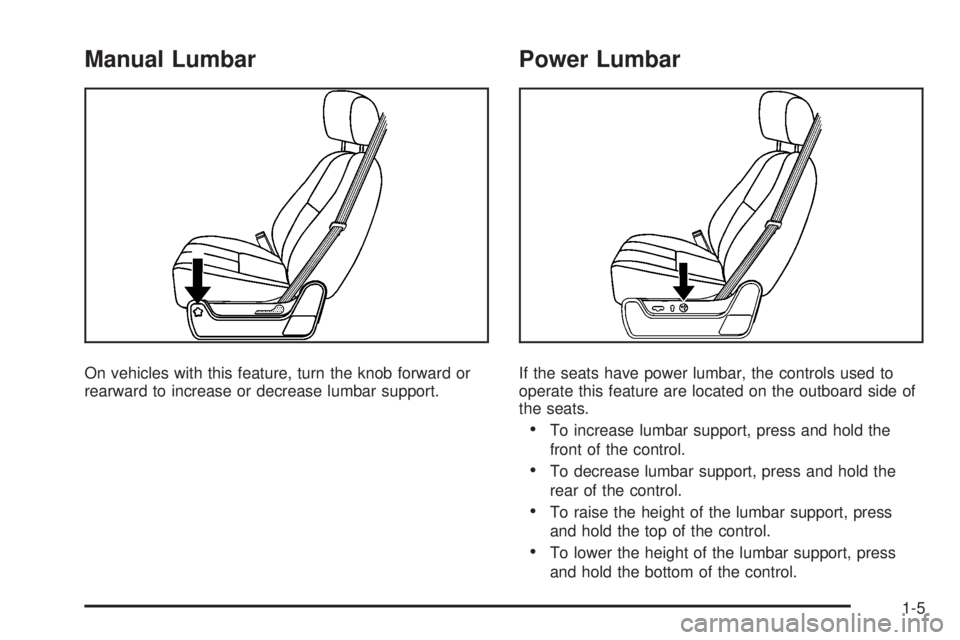
Manual Lumbar
On vehicles with this feature, turn the knob forward or
rearward to increase or decrease lumbar support.
Power Lumbar
If the seats have power lumbar, the controls used to
operate this feature are located on the outboard side of
the seats.
To increase lumbar support, press and hold the
front of the control.
To decrease lumbar support, press and hold the
rear of the control.
To raise the height of the lumbar support, press
and hold the top of the control.
To lower the height of the lumbar support, press
and hold the bottom of the control.
1-5
Page 14 of 578
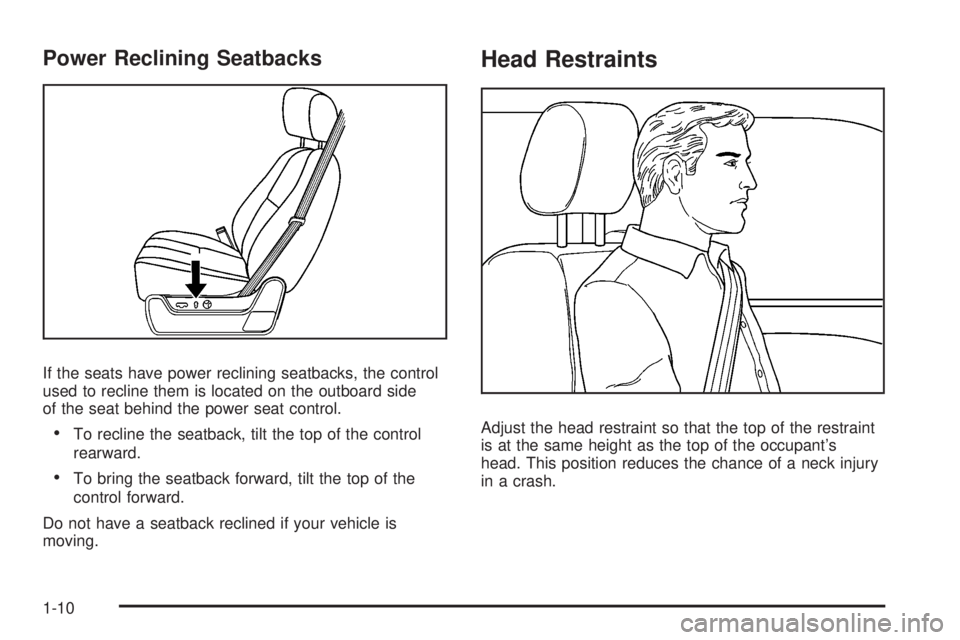
Power Reclining Seatbacks
If the seats have power reclining seatbacks, the control
used to recline them is located on the outboard side
of the seat behind the power seat control.
To recline the seatback, tilt the top of the control
rearward.
To bring the seatback forward, tilt the top of the
control forward.
Do not have a seatback reclined if your vehicle is
moving.
Head Restraints
Adjust the head restraint so that the top of the restraint
is at the same height as the top of the occupant’s
head. This position reduces the chance of a neck injury
in a crash.
1-10
Page 15 of 578
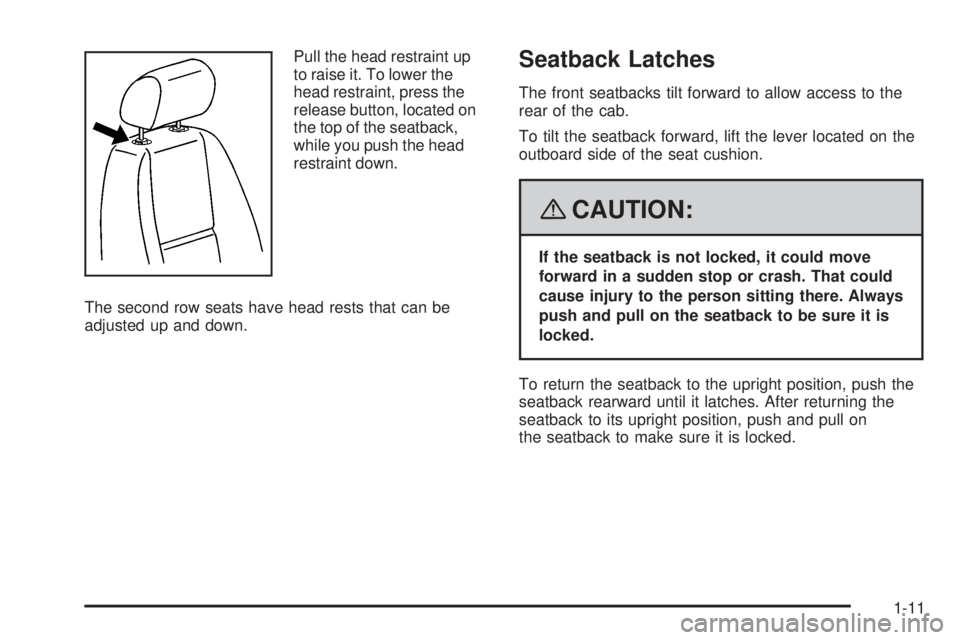
Pull the head restraint up
to raise it. To lower the
head restraint, press the
release button, located on
the top of the seatback,
while you push the head
restraint down.
The second row seats have head rests that can be
adjusted up and down.Seatback Latches
The front seatbacks tilt forward to allow access to the
rear of the cab.
To tilt the seatback forward, lift the lever located on the
outboard side of the seat cushion.
{CAUTION:
If the seatback is not locked, it could move
forward in a sudden stop or crash. That could
cause injury to the person sitting there. Always
push and pull on the seatback to be sure it is
locked.
To return the seatback to the upright position, push the
seatback rearward until it latches. After returning the
seatback to its upright position, push and pull on
the seatback to make sure it is locked.
1-11
Page 16 of 578
Center Seat
Your vehicle may have a front center seat. The seatback
doubles as an armrest and cupholder/storage area for
the driver and passenger when the center seat is
not used. Do not use it as a seating position when the
seatback is folded down.
Rear Seats
Rear Seat Operation (Full Bench)
Folding the Rear Seat
To fold the seat up, do the following:
Notice:Folding a rear seat with the safety belts
still fastened may cause damage to the seat or the
safety belts. Always unbuckle the safety belts
and return them to their normal stowed position
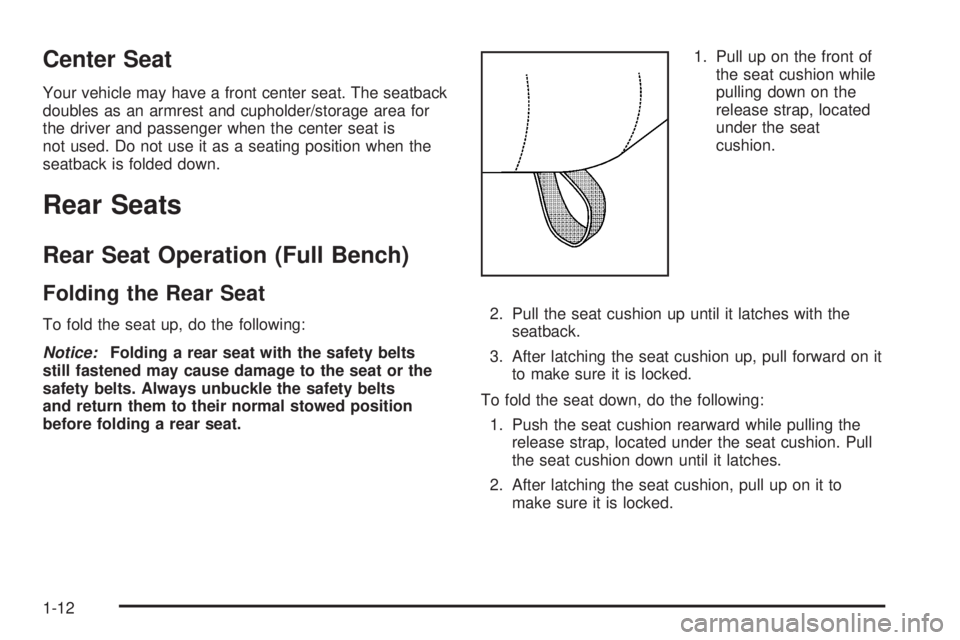
before folding a rear seat.1. Pull up on the front of
the seat cushion while
pulling down on the
release strap, located
under the seat
cushion.
2. Pull the seat cushion up until it latches with the
seatback.
3. After latching the seat cushion up, pull forward on it
to make sure it is locked.
To fold the seat down, do the following:
1. Push the seat cushion rearward while pulling the
release strap, located under the seat cushion. Pull
the seat cushion down until it latches.
2. After latching the seat cushion, pull up on it to
make sure it is locked.
1-12
Page 17 of 578
Rear Seat Operation (Split Bench)
Folding Rear Seat
On a vehicle with a second row 60/40 split seat
either side of the rear seat may be folded for added
cargo space.
Notice:Folding a rear seat with the safety belts
still fastened may cause damage to the seat or the
safety belts. Always unbuckle the safety belts
and return them to their normal stowed position
before folding a rear seat.
Make sure that nothing is on the seat.
To fold the seat, slowly pull the seat cushion up.
To return the seat to the normal seating position, slowly
pull the seat cushion down.
{CAUTION:
A safety belt that is improperly routed, not
properly attached, or twisted will not provide
the protection needed in a crash. The person
wearing the belt could be seriously injured.
After raising the rear seatback, always check
to be sure that the safety belts are properly
routed and attached, and are not twisted.
1-13