check engine GMC SIERRA 2010 Workshop Manual
[x] Cancel search | Manufacturer: GMC, Model Year: 2010, Model line: SIERRA, Model: GMC SIERRA 2010Pages: 630, PDF Size: 4.65 MB
Page 493 of 630
6. Check that the jumper cables do not have loose ormissing insulation. If they do, you could get a
shock. The vehicles could be damaged too.
Before you connect the cables, here are some
basic things you should know. Positive (+) will go to
positive (+) or to a remote positive (+) terminal if
the vehicle has one. Negative (−) will go to a
heavy, unpainted metal engine part or to a remote
negative (−) terminal if the vehicle has one.
Do not connect positive (+) to negative (−) or you
will get a short that would damage the battery and
maybe other parts too. And do not connect the
negative (−) cable to the negative (−) terminal on
the dead battery because this can cause sparks.
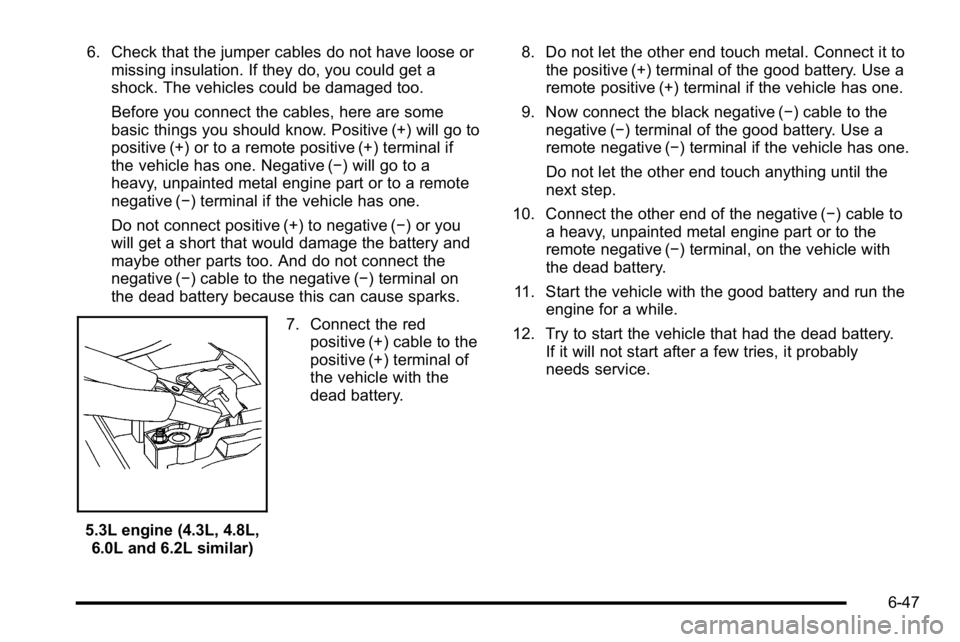
5.3L engine (4.3L, 4.8L,6.0L and 6.2L similar) 7. Connect the red
positive (+) cable to the
positive (+) terminal of
the vehicle with the
dead battery. 8. Do not let the other end touch metal. Connect it to
the positive (+) terminal of the good battery. Use a
remote positive (+) terminal if the vehicle has one.
9. Now connect the black negative (−) cable to the negative (−) terminal of the good battery. Use a
remote negative (−) terminal if the vehicle has one.
Do not let the other end touch anything until the
next step.
10. Connect the other end of the negative (−) cable to a heavy, unpainted metal engine part or to the
remote negative (−) terminal, on the vehicle with
the dead battery.
11. Start the vehicle with the good battery and run the engine for a while.
12. Try to start the vehicle that had the dead battery. If it will not start after a few tries, it probably
needs service.
6-47
Page 494 of 630
Notice:If the jumper cables are connected or
removed in the wrong order, electrical shorting may
occur and damage the vehicle. The repairs would
not be covered by the vehicle warranty. Always
connect and remove the jumper cables in the
correct order, making sure that the cables do
not touch each other or other metal.
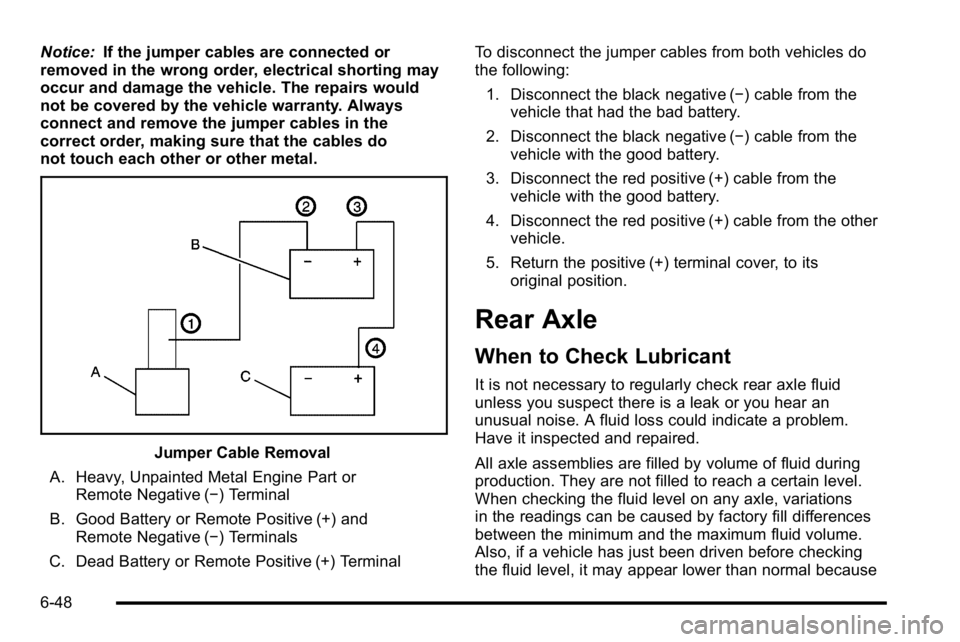
Jumper Cable Removal
A. Heavy, Unpainted Metal Engine Part or Remote Negative (−) Terminal
B. Good Battery or Remote Positive (+) and Remote Negative (−) Terminals
C. Dead Battery or Remote Positive (+) Terminal To disconnect the jumper cables from both vehicles do
the following:
1. Disconnect the black negative (−) cable from the vehicle that had the bad battery.
2. Disconnect the black negative (−) cable from the vehicle with the good battery.
3. Disconnect the red positive (+) cable from the vehicle with the good battery.
4. Disconnect the red positive (+) cable from the other vehicle.
5. Return the positive (+) terminal cover, to its original position.
Rear Axle
When to Check Lubricant
It is not necessary to regularly check rear axle fluid
unless you suspect there is a leak or you hear an
unusual noise. A fluid loss could indicate a problem.
Have it inspected and repaired.
All axle assemblies are filled by volume of fluid during
production. They are not filled to reach a certain level.
When checking the fluid level on any axle, variations
in the readings can be caused by factory fill differences
between the minimum and the maximum fluid volume.
Also, if a vehicle has just been driven before checking
the fluid level, it may appear lower than normal because
6-48
Page 495 of 630
fluid has traveled out along the axle tubes and has not
drained back to the sump area. Therefore, a reading
taken five minutes after the vehicle has been driven will
appear to have a lower fluid level than a vehicle that
has been stationary for an hour or two. Remember that
the rear axle assembly must be supported to get a
true reading.
How to Check Lubricant
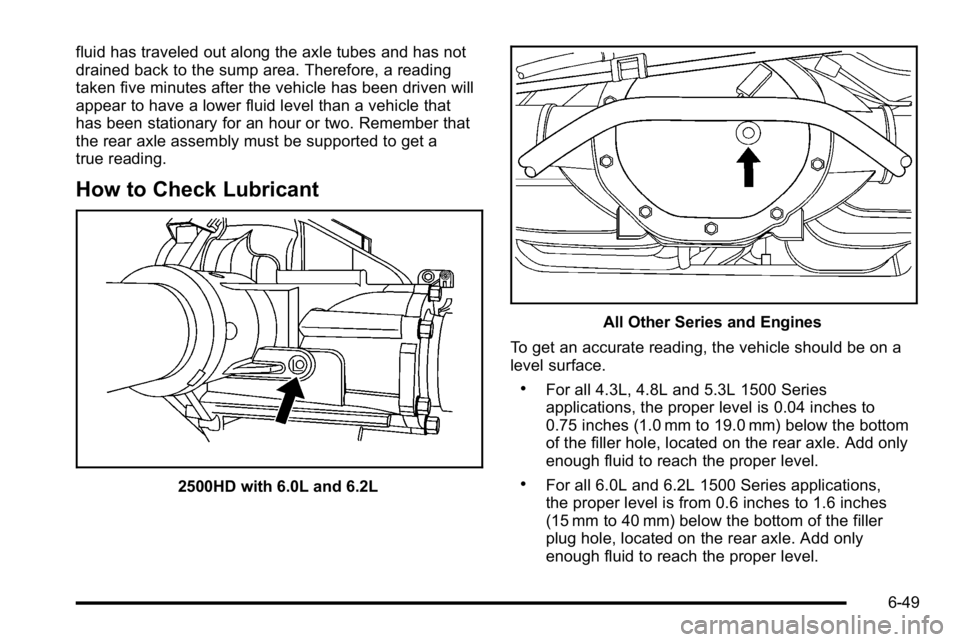
2500HD with 6.0L and 6.2L
All Other Series and Engines
To get an accurate reading, the vehicle should be on a
level surface.
.For all 4.3L, 4.8L and 5.3L 1500 Series
applications, the proper level is 0.04 inches to
0.75 inches (1.0 mm to 19.0 mm) below the bottom
of the filler hole, located on the rear axle. Add only
enough fluid to reach the proper level.
.For all 6.0L and 6.2L 1500 Series applications,
the proper level is from 0.6 inches to 1.6 inches
(15 mm to 40 mm) below the bottom of the filler
plug hole, located on the rear axle. Add only
enough fluid to reach the proper level.
6-49
Page 563 of 630
Vehicle Identification
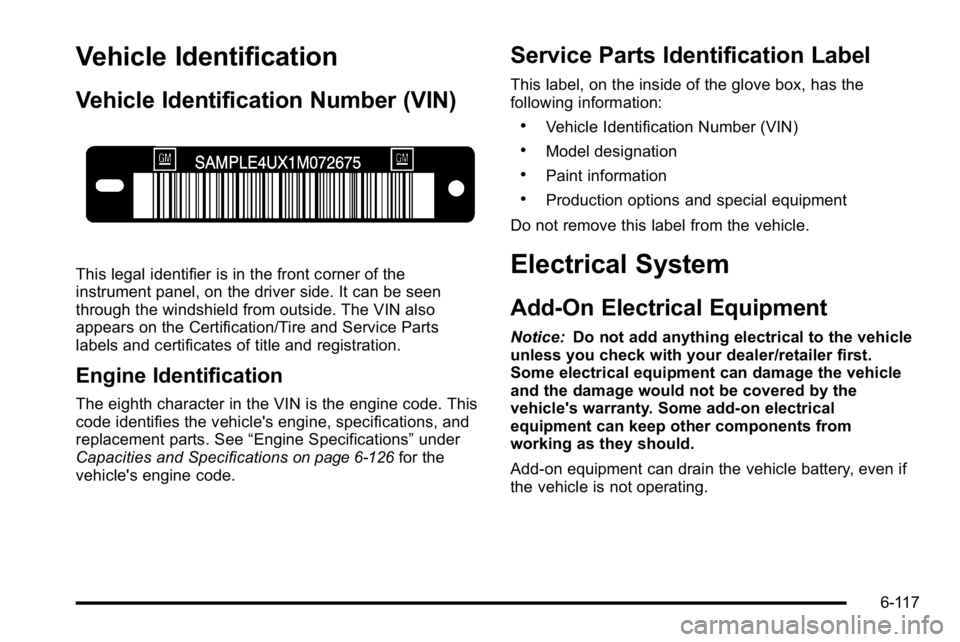
Vehicle Identification Number (VIN)
This legal identifier is in the front corner of the
instrument panel, on the driver side. It can be seen
through the windshield from outside. The VIN also
appears on the Certification/Tire and Service Parts
labels and certificates of title and registration.
Engine Identification
The eighth character in the VIN is the engine code. This
code identifies the vehicle's engine, specifications, and
replacement parts. See“Engine Specifications”under
Capacities and Specifications
on page 6‑126for the
vehicle's engine code.
Service Parts Identification Label
This label, on the inside of the glove box, has the
following information:
.Vehicle Identification Number (VIN)
.Model designation
.Paint information
.Production options and special equipment
Do not remove this label from the vehicle.
Electrical System
Add-On Electrical Equipment
Notice: Do not add anything electrical to the vehicle
unless you check with your dealer/retailer first.
Some electrical equipment can damage the vehicle
and the damage would not be covered by the
vehicle's warranty. Some add-on electrical
equipment can keep other components from
working as they should.
Add-on equipment can drain the vehicle battery, even if
the vehicle is not operating.
6-117
Page 575 of 630
Section 7 Maintenance Schedule
Maintenance Schedule. . . . . . . . . . . . . . . . . . . . . . . . . . . . 7-2
Introduction . . . . . . . . . . . . . . . . . . . . . . . . . . . . . . . . . . . . . 7-2
Scheduled Maintenance . . . . . . . . . . . . . . . . . . . . . . . . 7-3
Owner Checks and Services . . . . . . . . . . . . . . . . . . . 7-11 Recommended Fluids and Lubricants . . . . . . . . . . 7-12
Maintenance Replacement Parts . . . . . . . . . . . . . . 7-15
Engine Drive Belt Routing . . . . . . . . . . . . . . . . . . . . . 7-16
Maintenance Record . . . . . . . . . . . . . . . . . . . . . . . . . . . 7-17
7-1
Page 576 of 630
Maintenance Schedule
Introduction
This maintenance section applies to vehicles with a
gasoline engine. For diesel engine vehicles, see the
maintenance schedule section in the DURAMAX Diesel
manual.
Notice:Maintenance intervals, checks, inspections,
recommended fluids, and lubricants are necessary
to keep this vehicle in good working condition.
Damage caused by failure to follow scheduled
maintenance might not be covered by the vehicle
warranty.
Proper vehicle maintenance helps to keep the vehicle
in good working condition, improves fuel economy, and
reduces vehicle emissions for better air quality. Because of all the different ways people use vehicles,
maintenance needs vary. The vehicle might need
more frequent checks and services. Please read the
information under Scheduled Maintenance. To keep the
vehicle in good condition, see your dealer/retailer.
The maintenance schedule is for vehicles that:
.carry passengers and cargo within recommended
limits on the Tire and Loading Information label.
See
Loading the Vehicle on page 5‑30.
.are driven on reasonable road surfaces within legal
driving limits.
.are driven off‐road in the recommended manner.
SeeOff-Road Driving on page 5‑11.
.use the recommended fuel. See Gasoline Octaneon page 6‑7.
7-2
Page 578 of 630
When the Change Engine Oil Soon message
displays, certain services, checks, and inspections are
required. The services described for MaintenanceI
should be performed at every engine oil change.
The services described for Maintenance IIshould be
performed when:
.Maintenance Iwas performed the last time the
engine oil was changed.
.It has been 10 months or more since the Change
Engine Oil Soon message has displayed or since
the last service.
Maintenance I
.Change engine oil and filter. See Engine Oilon
page 6‑18. An Emission Control Service.
.Engine coolant level check. See Engine Coolanton page 6‑31.
.Windshield washer fluid level check. See
Windshield Washer Fluid on page 6‑38.
.Tire inflation check. SeeInflation - Tire Pressureon page 6‑72.
.Tire wear inspection. See Tire Inspection and
Rotation on page 6‑80.
.Rotate tires. See Tire Inspection and Rotationon
page 6‑80.
.Fluids visual leak check (or every 12 months,
whichever occurs first). A leak in any system
must be repaired and the fluid level checked.
.Engine air cleaner filter inspection (vehicles
driven in dusty conditions only). See Engine Air
Cleaner/Filter on page 6‑21.
.Brake system inspection (or every 12 months,
whichever occurs first).
.For vehicles with Allison Transmission®only:
At the first engine oil change only, replace external
transmission filter.
Maintenance II
.Perform all services described in Maintenance I.
.Steering and suspension inspection. Visual
inspection for damaged, loose, or missing parts or
signs of wear.
.Lubricate the front suspension, steering linkage,
and parking brake cable guides. Control arm
ball joints on 2500/3500 series vehicles require
lubrication but should not be lubricated unless their
temperature is−12°C (10°F) or higher, or they
could be damaged. Control arm ball joints on
1500 series vehicles are maintenance‐free.
Vehicles used under severe commercial operating
conditions require lubrication on a regular basis
every 5 000 km/3,000 miles.
7-4
Page 579 of 630
.Engine cooling system inspection. Visual
inspection of hoses, pipes, fittings, and clamps and
replacement, if needed.
.Windshield wiper blade inspection for wear,
cracking, or contamination and windshield and
wiper blade cleaning, if contaminated. See
Windshield and Wiper Blades
on page 6‑114.
Worn or damaged wiper blade replacement.
See Windshield Wiper Blade Replacement
on
page 6‑63.
.Body hinges and latches, key lock cylinders,
folding seat hardware, and tailgate hinges,
linkage, and handle pivot points lubrication.
See Recommended Fluids and Lubricants
on
page 7‑12. More frequent lubrication may be
required when vehicle is exposed to a corrosive
environment. Applying silicone grease on
weatherstrips with a clean cloth makes them last
longer, seal better, and not stick or squeak.
.Restraint system component check. See Checking
the Restraint Systems on page 2‑93.
.Automatic transmission fluid level check and
adding fluid, if needed. See Automatic
Transmission Fluid (4-Speed Transmission)
on
page 6‑23or Automatic Transmission Fluid
(6-Speed Transmission) on page 6‑26.
.Four‐wheel drive vehicles: Transfer case fluid level
check and adding fluid, if needed.
.Engine air cleaner filter inspection. See Engine Air
Cleaner/Filter on page 6‑21.
.Vehicles with diesel engine or GVWR above
4 536 kg (10,000 lbs) only: Shields inspection for
damage or looseness. Adjust or replace as
required. This is a Noise Emission Control Service.
Applicable to vehicles sold in the United States
and recommended for vehicles sold in Canada.
Additional Required Services
At the First 160 km/100 Miles, 1 600 km/
1,000 Miles, and 10 000 km/6,000 Miles
.For vehicles with dual wheels: Check dual wheel
nut torque. For proper torque, see Capacities and
Specifications on page 6‑126.
At Each Fuel Stop
.Engine oil level check. See Engine Oilon
page 6‑18.
.Engine coolant level check. See Engine Coolanton page 6‑31.
.Windshield washer fluid level check. See
Windshield Washer Fluid on page 6‑38.
7-5
Page 580 of 630
Once a Month
.Tire inflation check. SeeInflation - Tire Pressureon page 6‑72.
.Tire wear inspection. See Tire Inspection and
Rotation on page 6‑80.
Once a Year
.Starter switch check. See Owner Checks and
Services on page 7‑11.
.Parking brake and automatic transmission P (Park)
mechanism check. See Owner Checks and
Services on page 7‑11.
.Automatic transmission shiftlock control system
check. See Owner Checks and Serviceson
page 7‑11.
.Ignition transmission lock check. See Owner
Checks and Services on page 7‑11.
.Engine cooling system and pressure cap pressure
check. Radiator and air conditioning condenser
outside cleaning. See Cooling System
on
page 6‑30.
.Exhaust system and nearby heat shields
inspection for loose or damaged components.
.Accelerator pedal check for damage, high effort,
or binding. Replace if needed.
First Engine Oil Change After Every
40 000 km/25,000 Miles
.Fuel system inspection for damage or leaks.
.Four‐wheel drive only: Transfer case fluid change
(extreme duty service) for vehicles mainly driven
off‐road in four‐wheel drive. Vehicles used for
farming, mining, forestry, Department of Natural
Resources (DNR), and snow plowing occupations
meet this definition. Check vent hose at transfer
case for kinks and proper installation. Check to be
sure vent hose is unobstructed, clear, and free of
debris. During any maintenance, if a power washer
is used to clean mud and dirt from the underbody,
care should be taken to not directly spray the
transfer case output seals. High pressure water
can overcome the seals and contaminate the
transfer case fluid. Contaminated fluid will
decrease the life of the transfer case and should
be replaced.
7-6
Page 581 of 630
First Engine Oil Change After Every
80 000 km/50,000 Miles
.Engine air cleaner filter replacement. SeeEngine
Air Cleaner/Filter on page 6‑21.
.Automatic transmission fluid change (severe
service) for vehicles with Gross Vehicle Weight
Rating (GVWR) over 3 901 kg (8,600 lbs) or mainly
driven in heavy city traffic in hot weather, in hilly or
mountainous terrain, when frequently towing a
trailer, or used for taxi, police, or delivery service.
See Automatic Transmission Fluid (4-Speed
Transmission)
on page 6‑23or Automatic
Transmission Fluid (6-Speed Transmission)on
page 6‑26.
.Four‐wheel drive only: Transfer case fluid change
(severe service) for vehicles mainly driven when
frequently towing a trailer, or used for taxi, police,
or delivery service. Check vent hose at transfer
case for kinks and proper installation. Check to be
sure vent hose is unobstructed, clear, and free of
debris. During any maintenance, if a power washer is used to clean mud and dirt from the underbody,
care should be taken to not directly spray the
transfer case output seals. High pressure water
can overcome the seals and contaminate the
transfer case fluid. Contaminated fluid will
decrease the life of the transfer case and should
be replaced.
.Evaporative control system inspection. Check all
fuel and vapor lines and hoses for proper hook‐up,
routing, and condition. Check that the purge valve,
if the vehicle has one, works properly. Replace as
needed.
An Emission Control Service. The U.S.
Environmental Protection Agency or the California
Air Resources Board has determined that the
failure to perform this maintenance item will not
nullify the emission warranty or limit recall liability
prior to the completion of the vehicle's useful life.
We, however, urge that all recommended
maintenance services be performed at the
indicated intervals and the maintenance be
recorded.
7-7