engine coolant GMC SIERRA 2017 User Guide
[x] Cancel search | Manufacturer: GMC, Model Year: 2017, Model line: SIERRA, Model: GMC SIERRA 2017Pages: 511, PDF Size: 5.21 MB
Page 323 of 511
GMC Sierra/Sierra Denali Owner Manual (GMNA-Localizing-U.S./Canada/
Mexico-9955992) - 2017 - crc - 4/18/17
322 Driving and Operating
When towing at high altitude on
steep uphill grades, consider the
following: Engine coolant will boil at
a lower temperature than at normal
altitudes. If the engine is turned off
immediately after towing at high
altitude on steep uphill grades, the
vehicle may show signs similar to
engine overheating. To avoid this,
let the engine run while parked,
preferably on level ground, with the
transmission in P (Park) for a few
minutes before turning the engine
off. If the overheat warning comes
on, seeEngine Overheating 0376.
Parking on Hills
{Warning
Parking the vehicle on a hill with
the trailer attached can be
dangerous. If something goes
wrong, the rig could start to move.
People can be injured, and both
the vehicle and the trailer can be
damaged. When possible, always
park the rig on a flat surface. If parking the rig on a hill:
1. Press the brake pedal, but do not shift into P (Park) yet. Turn
the wheels into the curb if
facing downhill or into traffic if
facing uphill.
2. Have someone place chocks under the trailer wheels.
3. When the wheel chocks are in place, release the regular
brakes until the chocks absorb
the load.
4. Reapply the brake pedal. Then apply the parking brake and
shift into P (Park).
5. Release the brake pedal.Leaving After Parking on a Hill
1. Apply and hold the brake pedal.
2. Start the engine.
3. Shift into a gear.
4. Release the parking brake. 5. Let up on the brake pedal.
6. Drive slowly until the trailer is
clear of the chocks.
7. Stop and have someone pick up and store the chocks.
Maintenance when Trailer
Towing
The vehicle needs service more
often when pulling a trailer. See
Maintenance Schedule 0455.
Things that are especially important
in trailer operation are automatic
transmission fluid, engine oil, axle
lubricant, belts, cooling system, and
brake system. It is a good idea to
inspect these before and during
the trip.
Check periodically to see that all
hitch nuts and bolts are tight.
Page 352 of 511
GMC Sierra/Sierra Denali Owner Manual (GMNA-Localizing-U.S./Canada/
Mexico-9955992) - 2017 - crc - 4/18/17
Driving and Operating 351
Caution (Continued)
damaged if either the front or rear
axle ratings or the Gross Vehicle
Weight Rating (GVWR) are
exceeded.
The plow the vehicle can carry
depends on many things, such as:
. The options the vehicle came
with, and the weight of those
options.
. The weight and number of
passengers to be carried.
. The weight of items added to the
vehicle, like a tool box or
truck cap.
. The total weight of any
additional cargo to be carried.
For example, if the snow plow
weighs 318 kg (700 lb), the total
weight of all occupants and cargo
inside the cab should not exceed
135 kg (300 lb). This means that you
may only be able to carry one
passenger. Even this may be too much if there is other equipment
already adding to the weight of the
vehicle.
To safely carry a snow plow on the
vehicle:
.
Follow all aftermarket snow plow
manufacturer ’s instructions for
the operation and transportation
of the snow plow.
. With a snow plow attached, the
engine coolant temperature
gauge may show a higher
temperature than while driving
without one. The snow plow
could block the airflow to the
radiator. This could be more
noticeable as vehicle speed
increases. At speeds above
72 km (45 mph), this may cause
the engine coolant to overheat.
. To increase the airflow, move the
snow plow blade postion.
. If driving more than 24 km
(15 mi), angle the plow blade
position.
. Make sure the weight on the
front and rear axles does not
exceed the axle rating for each. .
For the front axle, if more cargo
or passengers must be carried,
appropriate counter ballast must
be installed rear of the rear axle.
Counter ballast must be properly
secured so it will not move
during driving.
. Rear ballast may be required to
ensure a proper front and rear
weight distribution ratio, even
though the actual weight at the
front axle may be less than the
front axle rating.
. The snow plow manufacturer or
installer can assist in
determining the amount of rear
ballast required, to help make
sure the snow plow/vehicle
combination does not exceed
the GVW rating, the front and
rear axle ratings, and the front
and rear weight distribution ratio.
. The total vehicle must not
exceed the GVW rating.
Front axle reserve capacity is the
difference between the Gross Axle
Weight Rating (GAWR) and the front
axle weight of the vehicle with full
fuel and passengers. This is the
Page 356 of 511
GMC Sierra/Sierra Denali Owner Manual (GMNA-Localizing-U.S./Canada/
Mexico-9955992) - 2017 - crc - 4/18/17
Vehicle Care 355
Vehicle Care
General Information
General Information . . . . . . . . . . 356
California Proposition65 Warning . . . . . . . . . . . . . . . . . 357
California Perchlorate Materials Requirements . . . . . 357
Accessories and Modifications . . . . . . . . . . . . . . . . 357
Vehicle Checks
Doing Your OwnService Work . . . . . . . . . . . . . . . 358
Hood . . . . . . . . . . . . . . . . . . . . . . . . . 358
Engine Compartment Overview . . . . . . . . . . . . . . . . . . . . 359
Engine Oil . . . . . . . . . . . . . . . . . . . . 364
Engine Oil Life System . . . . . . . 367
Automatic Transmission Fluid (6 Speed Transmission) . . . . . 368
Automatic Transmission Fluid (8 Speed Transmission) . . . . . 371
Engine Air Cleaner/Filter . . . . . . 371
Cooling System . . . . . . . . . . . . . . 372
Engine Coolant . . . . . . . . . . . . . . . 374
Engine Overheating . . . . . . . . . . 376
Overheated Engine Protection Operating Mode . . . . . . . . . . . . . 378
Engine Fan . . . . . . . . . . . . . . . . . . . 378 Power Steering Fluid (1500
Series) . . . . . . . . . . . . . . . . . . . . . . 379
Power Steering Fluid (2500/ 3500 Series) . . . . . . . . . . . . . . . . 379
Washer Fluid . . . . . . . . . . . . . . . . . 380
Brakes . . . . . . . . . . . . . . . . . . . . . . . 381
Brake Fluid . . . . . . . . . . . . . . . . . . . 381
Battery - North America . . . . . . 383
Four-Wheel Drive . . . . . . . . . . . . . 383
Front Axle . . . . . . . . . . . . . . . . . . . . 384
Rear Axle . . . . . . . . . . . . . . . . . . . . 385
Noise Control System . . . . . . . . 386
Starter Switch Check . . . . . . . . . 387
Automatic Transmission Shift
Lock Control Function
Check . . . . . . . . . . . . . . . . . . . . . . . 387
Ignition Transmission Lock Check . . . . . . . . . . . . . . . . . . . . . . . 388
Park Brake and P (Park) Mechanism Check . . . . . . . . . . 388
Wiper Blade Replacement . . . . 388
Glass Replacement . . . . . . . . . . 389
Headlamp Aiming
Headlamp Aiming . . . . . . . . . . . . 389
Bulb Replacement
Bulb Replacement . . . . . . . . . . . . 389
Halogen Bulbs . . . . . . . . . . . . . . . . 389
High Intensity Discharge (HID) Lighting . . . . . . . . . . . . . . . . . . . . . 390 LED Lighting . . . . . . . . . . . . . . . . . 390
Taillamps, Turn Signal,
Stoplamps, and Back-Up
Lamps . . . . . . . . . . . . . . . . . . . . . . 390
Center High-Mounted
Stoplamp (CHMSL) and
Cargo Lamp . . . . . . . . . . . . . . . . . 391
Replacement Bulbs . . . . . . . . . . . 392
Electrical System
High Voltage Devices and Wiring . . . . . . . . . . . . . . . . . . . . . . . 392
Electrical System Overload . . . 392
Fuses . . . . . . . . . . . . . . . . . . . . . . . . 393
Engine Compartment Fuse Block . . . . . . . . . . . . . . . . . . . . . . . . 393
Instrument Panel Fuse Block
(Right) . . . . . . . . . . . . . . . . . . . . . . 396
Instrument Panel Fuse Block (Left) . . . . . . . . . . . . . . . . . 398
Wheels and Tires
Tires . . . . . . . . . . . . . . . . . . . . . . . . . . 400
All-Season Tires . . . . . . . . . . . . . . 401
Winter Tires . . . . . . . . . . . . . . . . . . 401
Low-Profile Tires . . . . . . . . . . . . . 402
All-Terrain Tires . . . . . . . . . . . . . . . 402
Tire Sidewall Labeling . . . . . . . . 402
Tire Designations . . . . . . . . . . . . . 405
Tire Terminology andDefinitions . . . . . . . . . . . . . . . . . . 406
Page 361 of 511

GMC Sierra/Sierra Denali Owner Manual (GMNA-Localizing-U.S./Canada/
Mexico-9955992) - 2017 - crc - 4/18/17
360 Vehicle Care
1. Positive (+) Terminal. SeeJump Starting - North America
0435.
2. Battery - North America 0383.
3. Coolant Surge Tank and Pressure Cap. See Cooling
System 0372.
4. Engine Air Cleaner/Filter 0371.
5. Automatic Transmission Dipstick (If Equipped). See
“How to Check Automatic
Transmission Fluid” under
Automatic Transmission Fluid
(6 Speed Transmission) 0368
or Automatic Transmission
Fluid (8 Speed Transmission)
0 371.
6. Remote Negative (–) Location. See Jump Starting - North
America 0435.
7. Engine Cooling Fans (Out of View). See Cooling System
0 372.
8. Engine Oil Fill Cap. See “When
to Add Engine Oil” under
Engine Oil 0364. 9. Engine Oil Dipstick. See
“Checking Engine Oil” under
Engine Oil 0364.
10. Brake Fluid Reservoir. See Brake Fluid 0381.
11. Windshield Washer Fluid Reservoir. See “Adding Washer
Fluid” under Washer Fluid
0 380.
12. Engine Compartment Fuse
Block 0393.
Page 363 of 511

GMC Sierra/Sierra Denali Owner Manual (GMNA-Localizing-U.S./Canada/
Mexico-9955992) - 2017 - crc - 4/18/17
362 Vehicle Care
1. Positive (+) Terminal. SeeJump Starting - North America
0435.
2. Battery - North America 0383.
3. Coolant Surge Tank and Pressure Cap. See Cooling
System 0372.
4. Engine Air Cleaner/Filter 0371.
5. Automatic Transmission Dipstick (If Equipped). See
“How to Check Automatic
Transmission Fluid” under
Automatic Transmission Fluid
(6 Speed Transmission) 0368
or Automatic Transmission
Fluid (8 Speed Transmission)
0 371.
6. Remote Negative (–) Location (Out of View). See Jump
Starting - North America 0435.
7. Engine Cooling Fans (Out of View). See Cooling System
0 372.
8. Engine Oil Fill Cap. See “When
to Add Engine Oil” under
Engine Oil 0364. 9. Engine Oil Dipstick. See
“Checking Engine Oil” under
Engine Oil 0364.
10. Windshield Washer Fluid Reservoir. See “Adding Washer
Fluid” under Washer Fluid
0 380.
11. Brake Fluid Reservoir. See Brake Fluid 0381.
12. Engine Compartment Fuse
Block 0393.
Page 365 of 511
GMC Sierra/Sierra Denali Owner Manual (GMNA-Localizing-U.S./Canada/
Mexico-9955992) - 2017 - crc - 4/18/17
364 Vehicle Care
1. Positive (+) Terminal. SeeJump Starting - North America
0435.
2. Battery - North America 0383.
3. Coolant Surge Tank and Pressure Cap. See Cooling
System 0372.
4. Engine Air Cleaner/Filter 0371.
5. Automatic Transmission Dipstick (If Equipped). See
“How to Check Automatic
Transmission Fluid” under
Automatic Transmission Fluid
(6 Speed Transmission) 0368
or Automatic Transmission
Fluid (8 Speed Transmission)
0 371.
6. Engine Oil Dipstick. See “Checking Engine Oil” under
Engine Oil 0364.
7. Engine Oil Fill Cap. See “When
to Add Engine Oil” under
Engine Oil 0364.
8. Engine Cooling Fan (Out of View). See Cooling System
0 372. 9. Remote Negative (–) Location.
See Jump Starting - North
America 0435.
10. Power Steering Fluid Reservoir.
SeePower Steering Fluid
(1500 Series) 0379 orPower
Steering Fluid (2500/3500
Series) 0379.
11. Windshield Washer Fluid Reservoir. See “Adding Washer
Fluid” under Washer Fluid
0 380.
12. Brake Fluid Reservoir. See Brake Fluid 0381.
13. Auxiliary Battery (If Equipped). SeeBattery - North America
0 383.
14. Engine Compartment Fuse
Block 0393.
If the vehicle has a diesel engine
and/or an Allison Transmission, see
the Duramax diesel supplement.
For an eAssist vehicle, see the
Silverado/Sierra supplement.Engine Oil
For diesel engine vehicles, see
“Engine Oil” in the Duramax diesel
supplement.
To ensure proper engine
performance and long life, careful
attention must be paid to engine oil.
Following these simple, but
important steps will help protect
your investment:
. Use engine oil approved to the
proper specification and of the
proper viscosity grade. See
“Selecting the Right Engine Oil”
in this section.
. Check the engine oil level
regularly and maintain the
proper oil level. See “Checking
Engine Oil” and“When to Add
Engine Oil” in this section.
. Change the engine oil at the
appropriate time. See Engine Oil
Life System 0367.
. Always dispose of engine oil
properly. See “What to Do with
Used Oil” in this section.
Page 374 of 511
GMC Sierra/Sierra Denali Owner Manual (GMNA-Localizing-U.S./Canada/
Mexico-9955992) - 2017 - crc - 4/18/17
Vehicle Care 373
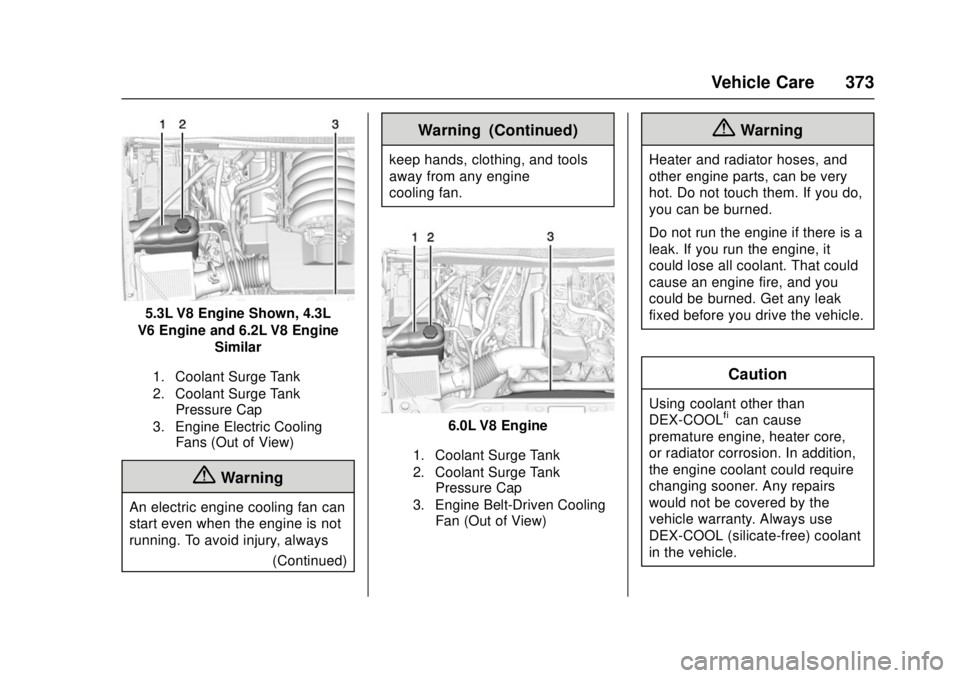
5.3L V8 Engine Shown, 4.3L
V6 Engine and 6.2L V8 Engine Similar
1. Coolant Surge Tank
2. Coolant Surge TankPressure Cap
3. Engine Electric Cooling Fans (Out of View)
{Warning
An electric engine cooling fan can
start even when the engine is not
running. To avoid injury, always
(Continued)
Warning (Continued)
keep hands, clothing, and tools
away from any engine
cooling fan.
6.0L V8 Engine
1. Coolant Surge Tank
2. Coolant Surge TankPressure Cap
3. Engine Belt-Driven Cooling Fan (Out of View)
{Warning
Heater and radiator hoses, and
other engine parts, can be very
hot. Do not touch them. If you do,
you can be burned.
Do not run the engine if there is a
leak. If you run the engine, it
could lose all coolant. That could
cause an engine fire, and you
could be burned. Get any leak
fixed before you drive the vehicle.
Caution
Using coolant other than
DEX-COOL®can cause
premature engine, heater core,
or radiator corrosion. In addition,
the engine coolant could require
changing sooner. Any repairs
would not be covered by the
vehicle warranty. Always use
DEX-COOL (silicate-free) coolant
in the vehicle.
Page 375 of 511
GMC Sierra/Sierra Denali Owner Manual (GMNA-Localizing-U.S./Canada/
Mexico-9955992) - 2017 - crc - 4/18/17
374 Vehicle Care
Engine Coolant
The cooling system in the vehicle is
filled with DEX-COOL®engine
coolant. This coolant is designed to
remain in the vehicle for 5 years or
240 000 km (150,000 mi), whichever
occurs first.
The following explains the cooling
system and how to check and add
coolant when it is low. If there is a
problem with engine overheating,
see Engine Overheating 0376.
What to Use
{Warning
Adding only plain water or some
other liquid to the cooling system
can be dangerous. Plain water
and other liquids, can boil before
the proper coolant mixture will.
The coolant warning system is set
for the proper coolant mixture.
With plain water or the wrong
mixture, the engine could get too
hot but you would not get the
(Continued)
Warning (Continued)
overheat warning. The engine
could catch fire and you or others
could be burned. Use a 50/
50 mixture of clean, drinkable
water and DEX-COOL coolant.
Use a 50/50 mixture of clean,
drinkable water and DEX-COOL
coolant. If using this mixture,
nothing else needs to be added.
This mixture:
. Gives freezing protection down
to−37 °C (−34 °F), outside
temperature.
. Gives boiling protection up to
129 °C (265 °F), engine
temperature.
. Protects against rust and
corrosion.
. Will not damage aluminum parts.
. Helps keep the proper engine
temperature.
Caution
If improper coolant mixture,
inhibitors, or additives are used in
the vehicle cooling system, the
engine could overheat and be
damaged. Too much water in the
mixture can freeze and crack
engine cooling parts. The repairs
would not be covered by the
vehicle warranty. Use only the
proper mixture of engine coolant
for the cooling system. See
Recommended Fluids and
Lubricants 0464.
Never dispose of engine coolant by
putting it in the trash, or by pouring
it on the ground, or into sewers,
streams, or bodies of water. Have
the coolant changed by an
authorized service center, familiar
with legal requirements regarding
used coolant disposal. This will help
protect the environment and your
health.
Page 376 of 511
GMC Sierra/Sierra Denali Owner Manual (GMNA-Localizing-U.S./Canada/
Mexico-9955992) - 2017 - crc - 4/18/17
Vehicle Care 375
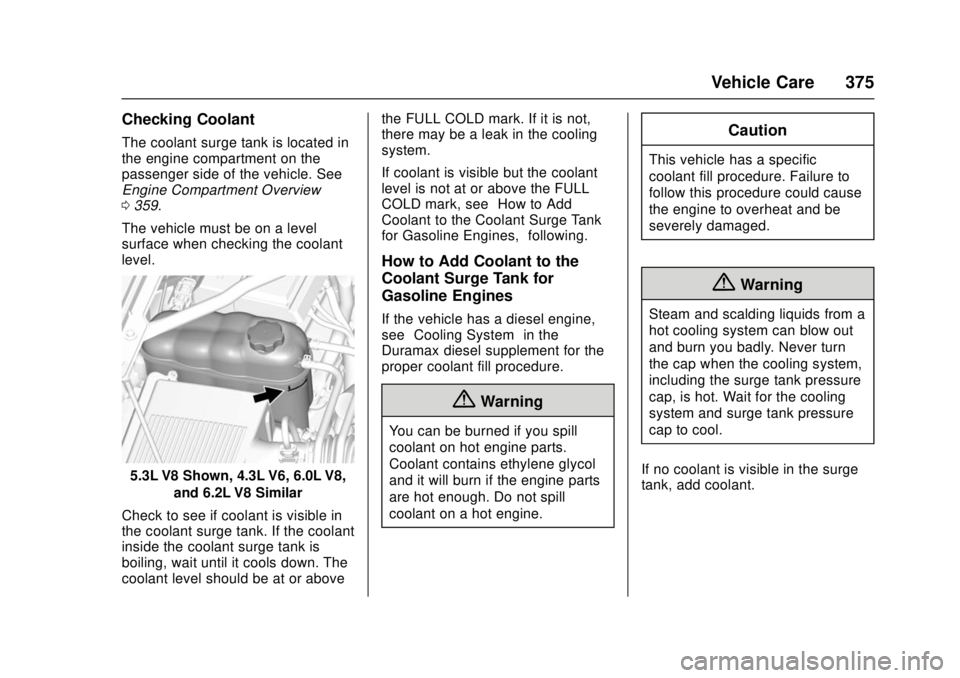
Checking Coolant
The coolant surge tank is located in
the engine compartment on the
passenger side of the vehicle. See
Engine Compartment Overview
0359.
The vehicle must be on a level
surface when checking the coolant
level.
5.3L V8 Shown, 4.3L V6, 6.0L V8, and 6.2L V8 Similar
Check to see if coolant is visible in
the coolant surge tank. If the coolant
inside the coolant surge tank is
boiling, wait until it cools down. The
coolant level should be at or above the FULL COLD mark. If it is not,
there may be a leak in the cooling
system.
If coolant is visible but the coolant
level is not at or above the FULL
COLD mark, see
“How to Add
Coolant to the Coolant Surge Tank
for Gasoline Engines,” following.
How to Add Coolant to the
Coolant Surge Tank for
Gasoline Engines
If the vehicle has a diesel engine,
see“Cooling System” in the
Duramax diesel supplement for the
proper coolant fill procedure.
{Warning
You can be burned if you spill
coolant on hot engine parts.
Coolant contains ethylene glycol
and it will burn if the engine parts
are hot enough. Do not spill
coolant on a hot engine.
Caution
This vehicle has a specific
coolant fill procedure. Failure to
follow this procedure could cause
the engine to overheat and be
severely damaged.
{Warning
Steam and scalding liquids from a
hot cooling system can blow out
and burn you badly. Never turn
the cap when the cooling system,
including the surge tank pressure
cap, is hot. Wait for the cooling
system and surge tank pressure
cap to cool.
If no coolant is visible in the surge
tank, add coolant.
Page 377 of 511
GMC Sierra/Sierra Denali Owner Manual (GMNA-Localizing-U.S./Canada/
Mexico-9955992) - 2017 - crc - 4/18/17
376 Vehicle Care
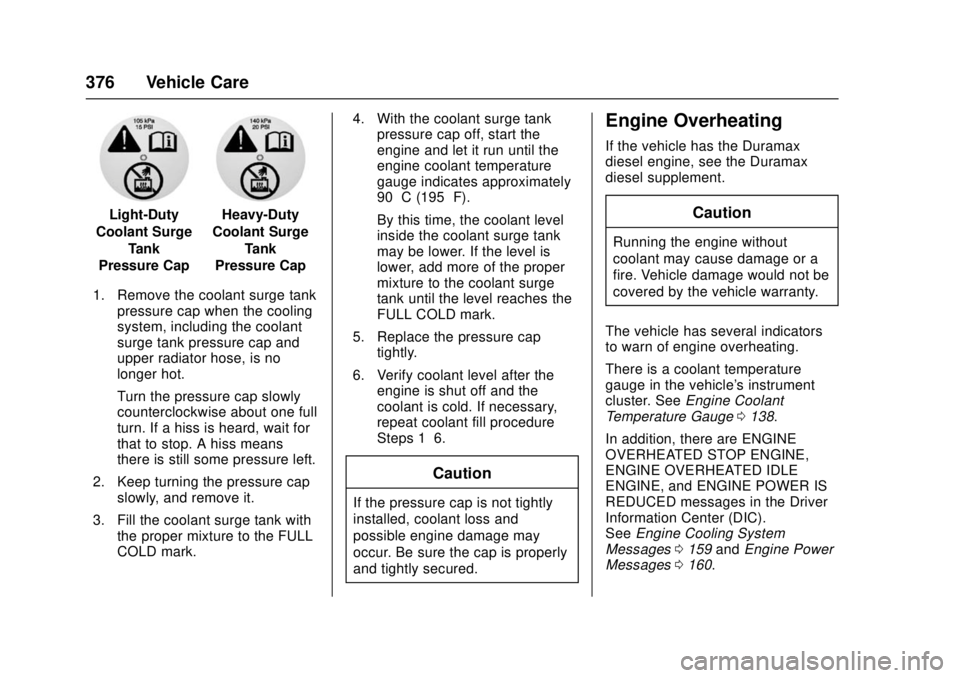
Light-Duty
Coolant Surge Tank
Pressure CapHeavy-Duty
Coolant Surge Tank
Pressure Cap
1. Remove the coolant surge tank pressure cap when the cooling
system, including the coolant
surge tank pressure cap and
upper radiator hose, is no
longer hot.
Turn the pressure cap slowly
counterclockwise about one full
turn. If a hiss is heard, wait for
that to stop. A hiss means
there is still some pressure left.
2. Keep turning the pressure cap slowly, and remove it.
3. Fill the coolant surge tank with the proper mixture to the FULL
COLD mark. 4. With the coolant surge tank
pressure cap off, start the
engine and let it run until the
engine coolant temperature
gauge indicates approximately
90 °C (195 °F).
By this time, the coolant level
inside the coolant surge tank
may be lower. If the level is
lower, add more of the proper
mixture to the coolant surge
tank until the level reaches the
FULL COLD mark.
5. Replace the pressure cap tightly.
6. Verify coolant level after the engine is shut off and the
coolant is cold. If necessary,
repeat coolant fill procedure
Steps 1–6.
Caution
If the pressure cap is not tightly
installed, coolant loss and
possible engine damage may
occur. Be sure the cap is properly
and tightly secured.
Engine Overheating
If the vehicle has the Duramax
diesel engine, see the Duramax
diesel supplement.
Caution
Running the engine without
coolant may cause damage or a
fire. Vehicle damage would not be
covered by the vehicle warranty.
The vehicle has several indicators
to warn of engine overheating.
There is a coolant temperature
gauge in the vehicle's instrument
cluster. See Engine Coolant
Temperature Gauge 0138.
In addition, there are ENGINE
OVERHEATED STOP ENGINE,
ENGINE OVERHEATED IDLE
ENGINE, and ENGINE POWER IS
REDUCED messages in the Driver
Information Center (DIC).
See Engine Cooling System
Messages 0159 andEngine Power
Messages 0160.