wheel GMC SIERRA CLASSIC 2007 Owners Manual
[x] Cancel search | Manufacturer: GMC, Model Year: 2007, Model line: SIERRA CLASSIC, Model: GMC SIERRA CLASSIC 2007Pages: 674, PDF Size: 3.5 MB
Page 444 of 674
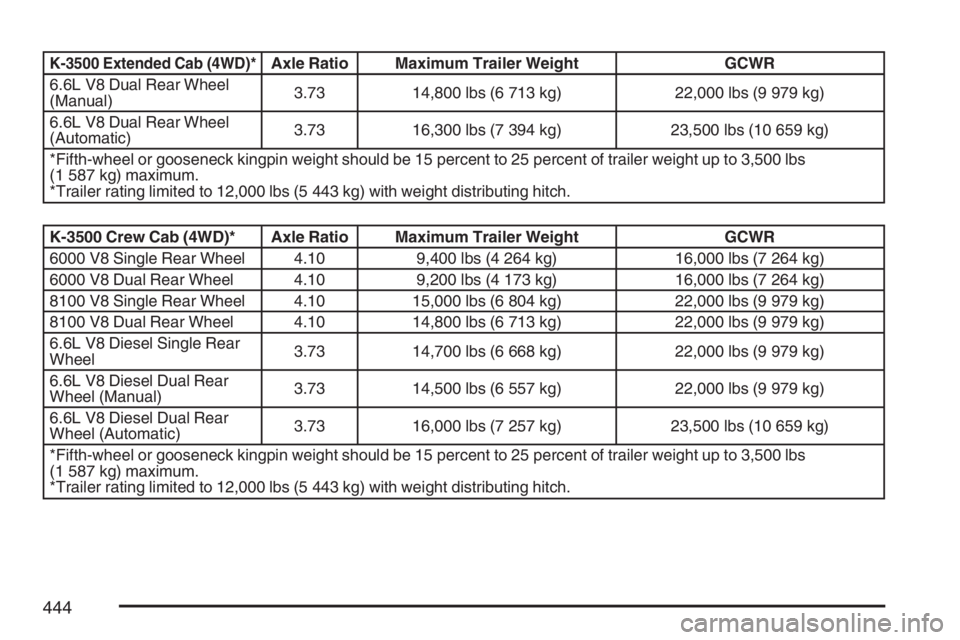
K-3500 Extended Cab (4WD)*Axle Ratio Maximum Trailer Weight GCWR
6.6L V8 Dual Rear Wheel
(Manual)3.73 14,800 lbs (6 713 kg) 22,000 lbs (9 979 kg)
6.6L V8 Dual Rear Wheel
(Automatic)3.73 16,300 lbs (7 394 kg) 23,500 lbs (10 659 kg)
*Fifth-wheel or gooseneck kingpin weight should be 15 percent to 25 percent of trailer weight up to 3,500 lbs
(1 587 kg) maximum.
*Trailer rating limited to 12,000 lbs (5 443 kg) with weight distributing hitch.
K-3500 Crew Cab (4WD)* Axle Ratio Maximum Trailer Weight GCWR
6000 V8 Single Rear Wheel 4.10 9,400 lbs (4 264 kg) 16,000 lbs (7 264 kg)
6000 V8 Dual Rear Wheel 4.10 9,200 lbs (4 173 kg) 16,000 lbs (7 264 kg)
8100 V8 Single Rear Wheel 4.10 15,000 lbs (6 804 kg) 22,000 lbs (9 979 kg)
8100 V8 Dual Rear Wheel 4.10 14,800 lbs (6 713 kg) 22,000 lbs (9 979 kg)
6.6L V8 Diesel Single Rear
Wheel3.73 14,700 lbs (6 668 kg) 22,000 lbs (9 979 kg)
6.6L V8 Diesel Dual Rear
Wheel (Manual)3.73 14,500 lbs (6 557 kg) 22,000 lbs (9 979 kg)
6.6L V8 Diesel Dual Rear
Wheel (Automatic)3.73 16,000 lbs (7 257 kg) 23,500 lbs (10 659 kg)
*Fifth-wheel or gooseneck kingpin weight should be 15 percent to 25 percent of trailer weight up to 3,500 lbs
(1 587 kg) maximum.
*Trailer rating limited to 12,000 lbs (5 443 kg) with weight distributing hitch.
444
Page 446 of 674
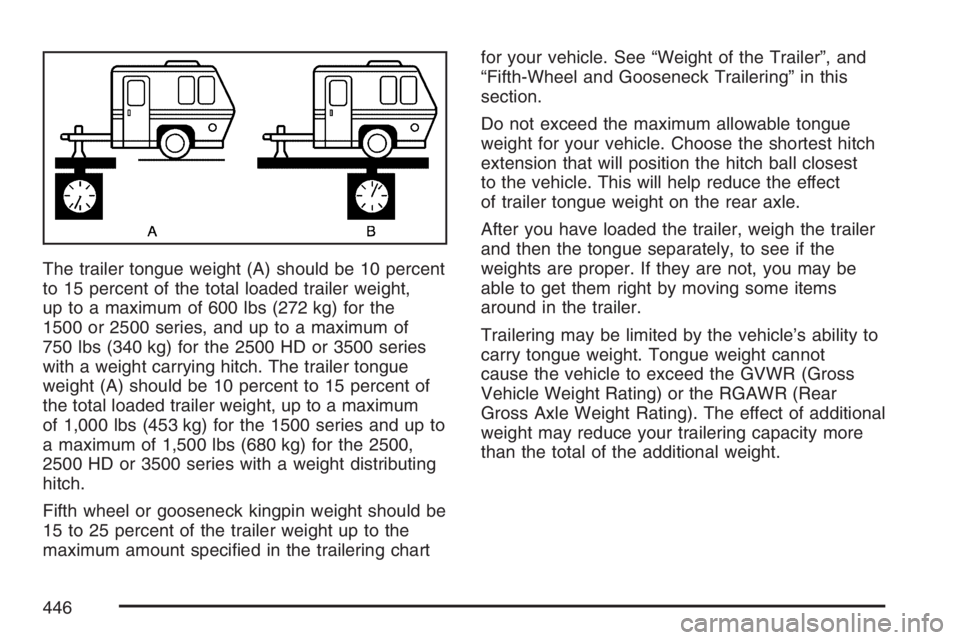
The trailer tongue weight (A) should be 10 percent
to 15 percent of the total loaded trailer weight,
up to a maximum of 600 lbs (272 kg) for the
1500 or 2500 series, and up to a maximum of
750 lbs (340 kg) for the 2500 HD or 3500 series
with a weight carrying hitch. The trailer tongue
weight (A) should be 10 percent to 15 percent of
the total loaded trailer weight, up to a maximum
of 1,000 lbs (453 kg) for the 1500 series and up to
a maximum of 1,500 lbs (680 kg) for the 2500,
2500 HD or 3500 series with a weight distributing
hitch.
Fifth wheel or gooseneck kingpin weight should be
15 to 25 percent of the trailer weight up to the
maximum amount specied in the trailering chartfor your vehicle. See “Weight of the Trailer”, and
“Fifth-Wheel and Gooseneck Trailering” in this
section.
Do not exceed the maximum allowable tongue
weight for your vehicle. Choose the shortest hitch
extension that will position the hitch ball closest
to the vehicle. This will help reduce the effect
of trailer tongue weight on the rear axle.
After you have loaded the trailer, weigh the trailer
and then the tongue separately, to see if the
weights are proper. If they are not, you may be
able to get them right by moving some items
around in the trailer.
Trailering may be limited by the vehicle’s ability to
carry tongue weight. Tongue weight cannot
cause the vehicle to exceed the GVWR (Gross
Vehicle Weight Rating) or the RGAWR (Rear
Gross Axle Weight Rating). The effect of additional
weight may reduce your trailering capacity more
than the total of the additional weight.
446
Page 449 of 674
Weight-Distributing Hitches and Weight
Carrying Hitches
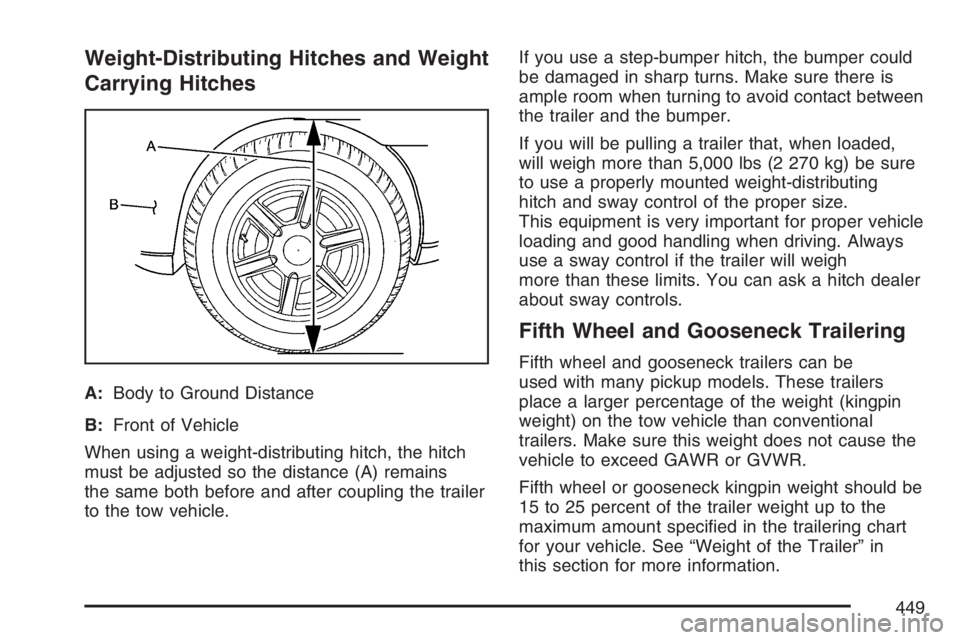
A:Body to Ground Distance
B:Front of Vehicle
When using a weight-distributing hitch, the hitch
must be adjusted so the distance (A) remains
the same both before and after coupling the trailer
to the tow vehicle.If you use a step-bumper hitch, the bumper could
be damaged in sharp turns. Make sure there is
ample room when turning to avoid contact between
the trailer and the bumper.
If you will be pulling a trailer that, when loaded,
will weigh more than 5,000 lbs (2 270 kg) be sure
to use a properly mounted weight-distributing
hitch and sway control of the proper size.
This equipment is very important for proper vehicle
loading and good handling when driving. Always
use a sway control if the trailer will weigh
more than these limits. You can ask a hitch dealer
about sway controls.
Fifth Wheel and Gooseneck Trailering
Fifth wheel and gooseneck trailers can be
used with many pickup models. These trailers
place a larger percentage of the weight (kingpin
weight) on the tow vehicle than conventional
trailers. Make sure this weight does not cause the
vehicle to exceed GAWR or GVWR.
Fifth wheel or gooseneck kingpin weight should be
15 to 25 percent of the trailer weight up to the
maximum amount specied in the trailering chart
for your vehicle. See “Weight of the Trailer” in
this section for more information.
449
Page 450 of 674
The hitch should be located in the pickup bed so
that it’s centerline is over or slightly in front of the
rear axle. Take care that it is not so far forward that
it will contact the back of the cab in sharp turns.
This is especially important for short box pickups.
Trailer pin box extensions and sliding fth wheel
hitch assemblies can help this condition. There
should be at least six inches of clearance between
the top of the pickup box and the bottom of the
trailer shelf that extends over the box.
Make sure the hitch is attached to the tow vehicle
frame rails. Do not use the pickup box for support.
Safety Chains
You should always attach chains between your
vehicle and your trailer. Cross the safety chains
under the tongue of the trailer to help prevent the
tongue from contacting the road if it becomes
separated from the hitch. Instructions about safety
chains may be provided by the hitch manufacturer
or by the trailer manufacturer. If you are towing a
trailer up to 5,000 lbs (2 271 kg) with a
factory-installed step bumper, you may attach the
safety chains to the attaching points on the bumper.
If you are towing a trailer up to your vehicle’s trailer
rating limit you may attach the safety chains to the
attaching point on the hitch platform. If you aretowing with an aftermarket hitch follow the trailer or
hitch manufacturer’s recommendation for attaching
safety chains. Always leave just enough slack so
you can turn with your rig. Never allow safety
chains to drag on the ground.
Trailer Brakes
If your trailer weighs more than 2,000 lbs (900 kg)
loaded, then it needs its own brakes – and they
must be adequate. Be sure to read and follow the
instructions for the trailer brakes so you’ll be
able to install, adjust and maintain them properly.
Your trailer brake system can tap into the
vehicle’s hydraulic brake system only if:
The trailer parts can withstand 3,000 psi
(20 650 kPa) of pressure.
The trailer’s brake system will use less than
0.02 cubic inch (0.3 cc) of uid from your
vehicle’s master cylinder. Otherwise,
both braking systems won’t work well. You
could even lose your brakes.
If everything checks out this far, make the brake tap
at the port on the master cylinder that sends the
uid to the rear brakes. But don’t use copper tubing
for this. If you do, it will bend and nally break off.
Use steel brake tubing.
450
Page 452 of 674
Before you start, check all trailer hitch parts and
attachments, safety chains, electrical connector,
lamps, tires and mirror adjustment. If the trailer has
electric brakes, start your vehicle and trailer
moving and then apply the trailer brake controller
by hand to be sure the brakes are working.
This lets you check your electrical connection at
the same time.
During your trip, check occasionally to be sure
that the load is secure, and that the lamps and any
trailer brakes are still working.
While towing a trailer or when exposed to long
periods of sunshine, the oor of the truck bed may
become very warm. Avoid putting items in the
truck bed that might be affected by high ambient
temperatures.
Following Distance
Stay at least twice as far behind the vehicle ahead
as you would when driving your vehicle without
a trailer. This can help you avoid situations
that require heavy braking and sudden turns.
Passing
You’ll need more passing distance up ahead when
you’re towing a trailer. And, because you’re a
good deal longer, you’ll need to go much farther
beyond the passed vehicle before you can
return to your lane.
Backing Up
Hold the bottom of the steering wheel with
one hand. Then, to move the trailer to the left, just
move that hand to the left. To move the trailer to the
right, move your hand to the right. Always back up
slowly and, if possible, have someone guide you.
Making Turns
Notice:Making very sharp turns while
trailering could cause the trailer to come in
contact with the vehicle. Your vehicle could be
damaged. Avoid making very sharp turns
while trailering.
When you’re turning with a trailer, make wider
turns than normal. Do this so your trailer
won’t strike soft shoulders, curbs, road signs,
trees or other objects. Avoid jerky or sudden
maneuvers. Signal well in advance.
452
Page 454 of 674
Parking on Hills
{CAUTION:
You really should not park your vehicle,
with a trailer attached, on a hill. If
something goes wrong, your rig could
start to move. People can be injured, and
both your vehicle and the trailer can be
damaged.
But if you ever have to park your rig on a hill,
here’s how to do it:
1. Apply your regular brakes, but don’t shift into
PARK (P) yet for an automatic transmission,
or into gear for a manual transmission.
2. Have someone place chocks under the trailer
wheels.
3. When the wheel chocks are in place, release
the regular brakes until the chocks absorb
the load.4. Reapply the regular brakes. Then apply your
parking brake and shift into PARK (P) for an
automatic transmission, or REVERSE (R) for a
manual transmission.
5. If you have a four-wheel-drive vehicle, be sure
the transfer case is in a drive gear and not in
NEUTRAL.
6. Release the regular brakes.
{CAUTION:
It can be dangerous to get out of your
vehicle if the automatic transmission shift
lever is not fully in PARK (P) with the
parking brake rmly set. Your vehicle
can roll.
If you have left the engine running, the
vehicle can move suddenly. You or others
could be injured. To be sure your vehicle
will not move, even when you are on fairly
level ground, use the steps that follow.
CAUTION: (Continued)
454
Page 455 of 674
CAUTION: (Continued)
Always put the automatic transmission
shift lever fully in PARK (P) with the
parking brake rmly set. If you have a
manual transmission, turn the engine off
and rmly set the parking brake.
If the transfer case on four-wheel-drive
vehicles is in NEUTRAL, your vehicle will
be free to roll, even if your automatic
transmission shift lever is in PARK (P).
So, be sure the transfer case is in a drive
gear — not in NEUTRAL.
When You Are Ready to Leave After
Parking on a Hill
1. Apply your regular brakes and hold the pedal
down while you:
Start your engine
Shift into a gear
Release the parking brake
2. Let up on the brake pedal.
3. Drive slowly until the trailer is clear of the
chocks.
4. Stop and have someone pick up and store the
chocks.
455
Page 458 of 674
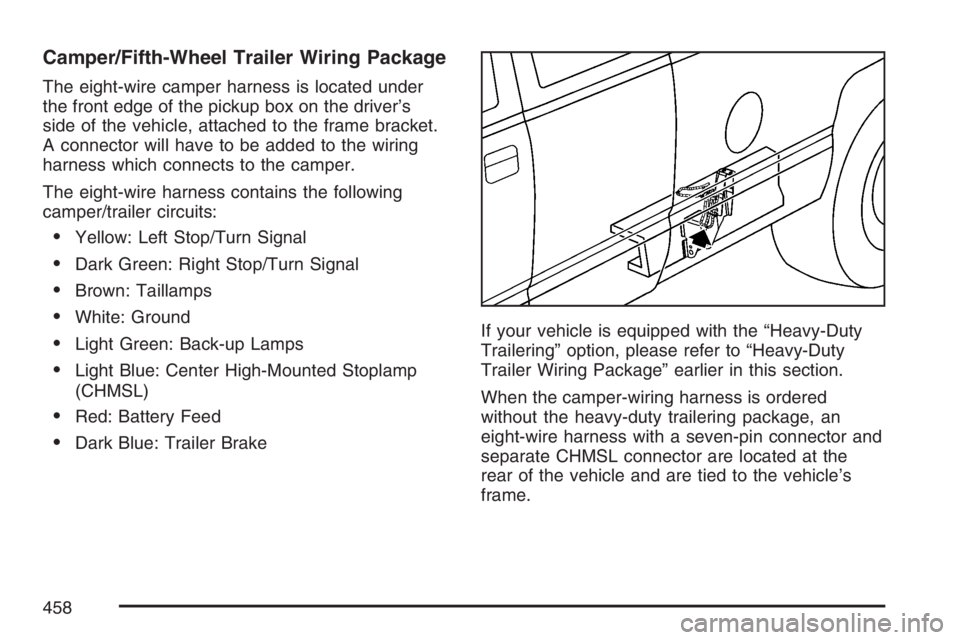
Camper/Fifth-Wheel Trailer Wiring Package
The eight-wire camper harness is located under
the front edge of the pickup box on the driver’s
side of the vehicle, attached to the frame bracket.
A connector will have to be added to the wiring
harness which connects to the camper.
The eight-wire harness contains the following
camper/trailer circuits:
Yellow: Left Stop/Turn Signal
Dark Green: Right Stop/Turn Signal
Brown: Taillamps
White: Ground
Light Green: Back-up Lamps
Light Blue: Center High-Mounted Stoplamp
(CHMSL)
Red: Battery Feed
Dark Blue: Trailer BrakeIf your vehicle is equipped with the “Heavy-Duty
Trailering” option, please refer to “Heavy-Duty
Trailer Wiring Package” earlier in this section.
When the camper-wiring harness is ordered
without the heavy-duty trailering package, an
eight-wire harness with a seven-pin connector and
separate CHMSL connector are located at the
rear of the vehicle and are tied to the vehicle’s
frame.
458
Page 465 of 674
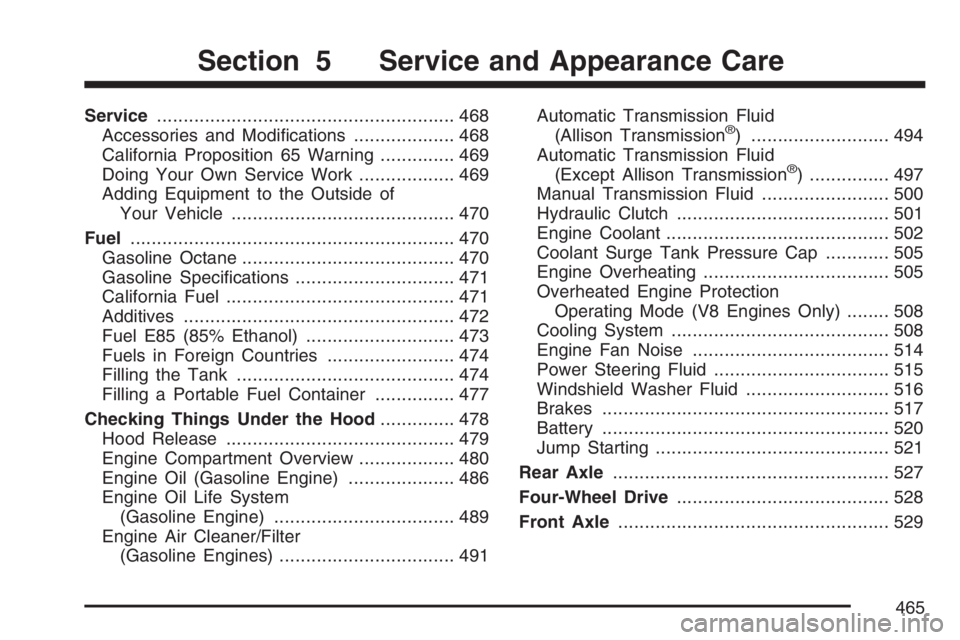
Service........................................................ 468
Accessories and Modications................... 468
California Proposition 65 Warning.............. 469
Doing Your Own Service Work.................. 469
Adding Equipment to the Outside of
Your Vehicle.......................................... 470
Fuel............................................................. 470
Gasoline Octane........................................ 470
Gasoline Specications.............................. 471
California Fuel........................................... 471
Additives................................................... 472
Fuel E85 (85% Ethanol)............................ 473
Fuels in Foreign Countries........................ 474
Filling the Tank......................................... 474
Filling a Portable Fuel Container............... 477
Checking Things Under the Hood.............. 478
Hood Release........................................... 479
Engine Compartment Overview.................. 480
Engine Oil (Gasoline Engine).................... 486
Engine Oil Life System
(Gasoline Engine).................................. 489
Engine Air Cleaner/Filter
(Gasoline Engines)................................. 491Automatic Transmission Fluid
(Allison Transmission®) .......................... 494
Automatic Transmission Fluid
(Except Allison Transmission
®) ............... 497
Manual Transmission Fluid........................ 500
Hydraulic Clutch........................................ 501
Engine Coolant.......................................... 502
Coolant Surge Tank Pressure Cap............ 505
Engine Overheating................................... 505
Overheated Engine Protection
Operating Mode (V8 Engines Only)........ 508
Cooling System......................................... 508
Engine Fan Noise..................................... 514
Power Steering Fluid ................................. 515
Windshield Washer Fluid........................... 516
Brakes...................................................... 517
Battery...................................................... 520
Jump Starting............................................ 521
Rear Axle.................................................... 527
Four-Wheel Drive........................................ 528
Front Axle................................................... 529
Section 5 Service and Appearance Care
465
Page 466 of 674
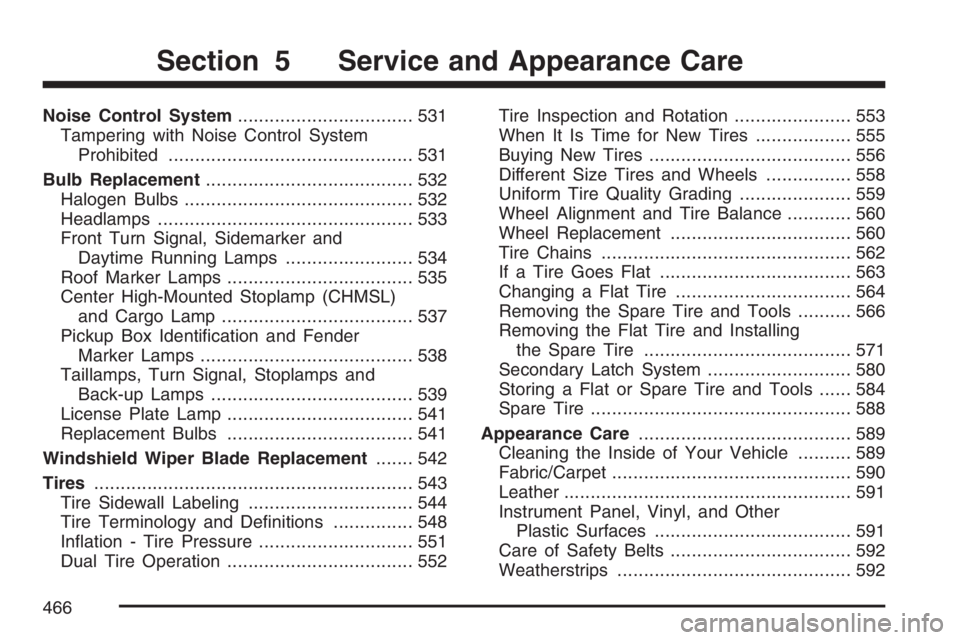
Noise Control System................................. 531
Tampering with Noise Control System
Prohibited.............................................. 531
Bulb Replacement....................................... 532
Halogen Bulbs........................................... 532
Headlamps................................................ 533
Front Turn Signal, Sidemarker and
Daytime Running Lamps........................ 534
Roof Marker Lamps................................... 535
Center High-Mounted Stoplamp (CHMSL)
and Cargo Lamp.................................... 537
Pickup Box Identication and Fender
Marker Lamps........................................ 538
Taillamps, Turn Signal, Stoplamps and
Back-up Lamps...................................... 539
License Plate Lamp................................... 541
Replacement Bulbs................................... 541
Windshield Wiper Blade Replacement....... 542
Tires............................................................ 543
Tire Sidewall Labeling............................... 544
Tire Terminology and Denitions............... 548
Ination - Tire Pressure............................. 551
Dual Tire Operation................................... 552Tire Inspection and Rotation...................... 553
When It Is Time for New Tires.................. 555
Buying New Tires...................................... 556
Different Size Tires and Wheels................ 558
Uniform Tire Quality Grading..................... 559
Wheel Alignment and Tire Balance............ 560
Wheel Replacement.................................. 560
Tire Chains............................................... 562
If a Tire Goes Flat.................................... 563
Changing a Flat Tire................................. 564
Removing the Spare Tire and Tools.......... 566
Removing the Flat Tire and Installing
the Spare Tire....................................... 571
Secondary Latch System........................... 580
Storing a Flat or Spare Tire and Tools...... 584
Spare Tire................................................. 588
Appearance Care........................................ 589
Cleaning the Inside of Your Vehicle.......... 589
Fabric/Carpet............................................. 590
Leather...................................................... 591
Instrument Panel, Vinyl, and Other
Plastic Surfaces..................................... 591
Care of Safety Belts.................................. 592
Weatherstrips............................................ 592
Section 5 Service and Appearance Care
466