torque GMC SIERRA CLASSIC 2007 User Guide
[x] Cancel search | Manufacturer: GMC, Model Year: 2007, Model line: SIERRA CLASSIC, Model: GMC SIERRA CLASSIC 2007Pages: 674, PDF Size: 3.5 MB
Page 461 of 674
Power Take-Off (PTO)
Before using a Power Take-Off (PTO), if equipped,
refer to the manufacturer’s or installer’s instructions.
To engage a PTO on a vehicle with a manual
transmission do the following:
1. Hold the clutch pedal down.
2. Set the parking brake.
3. Shift the transmission into NEUTRAL.
4. Engage the PTO. Refer to the manufacturer’s
or installer’s for instructions on electrically
engaged PTOs.
5. For mobile operations, shift the transmission
into the gear you want, apply the regular
brakes and release the parking brake.
For stationary operations, leave the parking
brake applied.
6. Release the clutch and regular brakes as you
normally would. When the clutch is released,
the PTO will start.
7. Turn the PTO rotary switch to ON.To engage a PTO on a vehicle with an automatic
transmission do the following:
1. For stationary use shift the transmission into
PARK (P).
2. Turn the PTO rotary switch ON.
3. If the engine speed is below the PTO engage
speed limit, the PTO will start. The blinking
LED on the PTO control switch indicates PTO
engage is requested. When PTO engages the
LED will switch from blinking to a steady light.
To use PTO speed control in Preset Mode (Factory
Setting) do the following:
1. Engage the PTO.
2. Select PARK (P) or NEUTRAL (N) range.
Apply the parking brake if NEUTRAL (N) is
selected. Torque Converter Clutch (TCC)
is not available in NEUTRAL (N) and is
available only in PARK (P) when engine speed
is above 1,100 rpm.
3. Make sure your foot is off the brake pedal
(and off the clutch on vehicles equipped
with a manual transmission).
4. Select the desired engine speed for PTO
operation. Read the following preset mode
information regarding operation.
461
Page 519 of 674
Brake Wear
Your vehicle has front disc brakes and may have
rear drum brakes or rear disc brakes.
Disc brake pads have built-in wear indicators that
make a high-pitched warning sound when the
brake pads are worn and new pads are needed.
The sound may come and go or be heard all
the time your vehicle is moving, except when you
are pushing on the brake pedal rmly.
{CAUTION:
The brake wear warning sound means that
soon your brakes will not work well. That
could lead to an accident. When you hear
the brake wear warning sound, have your
vehicle serviced.
Notice:Continuing to drive with worn-out
brake pads could result in costly brake repair.
Some driving conditions or climates may cause
a brake squeal when the brakes are rst applied or
lightly applied. This does not mean something is
wrong with your brakes.Properly torqued wheel nuts are necessary to help
prevent brake pulsation. When tires are rotated,
inspect brake pads for wear and evenly tighten
wheel nuts in the proper sequence to GM torque
specications.
If you have rear drum brakes, they do not have
wear indicators, but if you ever hear a rear brake
rubbing noise, have the rear brake linings
inspected immediately. Rear brake drums should
be removed and inspected each time the tires
are removed for rotation or changing. Drum brakes
have an inspection hole to inspect lining wear
during scheduled maintenance. When you have
the front brake pads replaced, have the rear
brakes inspected, too.
Brake linings should always be replaced as
complete axle sets.
Brake Pedal Travel
See your dealer if the brake pedal does not return
to normal height, or if there is a rapid increase in
pedal travel. This could be a sign of brake trouble.
Brake Adjustment
Every time you make a brake stop, your brakes
adjust for wear.
519
Page 552 of 674
How to Check
Use a good quality pocket-type gage to check
tire pressure. You cannot tell if your tires are
properly inated simply by looking at them.
Radial tires may look properly inated even when
they’re underinated. Check the tire’s ination
pressure when the tires are cold. Cold means your
vehicle has been sitting for at least three hours
or driven no more than 1 mile (1.6 km).
Remove the valve cap from the tire valve stem.
Press the tire gage rmly onto the valve to
get a pressure measurement. If the cold tire
ination pressure matches the recommended
pressure on the Tire and Loading Information
label, no further adjustment is necessary. If the
ination pressure is low, add air until you reach the
recommended amount.
If you overll the tire, release air by pushing on
the metal stem in the center of the tire valve.
Recheck the tire pressure with the tire gage.
Be sure to put the valve caps back on the valve
stems. They help prevent leaks by keeping out dirt
and moisture.
Dual Tire Operation
When the vehicle is new, or whenever a wheel,
wheel bolt or wheel nut is replaced, check the
wheel nut torque after 100, 1,000 and 6,000 miles
(160, 1 600 and 10 000 km) of driving. For proper
torque and wheel nut tightening information, see
Removing the Spare Tire and Tools on page 566.
The outer tire on a dual wheel setup generally
wears faster than the inner tire. Your tires will wear
more evenly and last longer if you rotate the
tires periodically, seeTire Inspection and Rotation
on page 553. Also seeScheduled Maintenance
(Gasoline Engine) on page 617.
{CAUTION:
If you operate your vehicle with a tire
that is badly underinated, the tire can
overheat. An overheated tire can lose air
suddenly or catch re. You or others
could be injured. Be sure all tires
(including the spare) are properly inated.
SeeInation - Tire Pressure on page 551, for
information on proper tire ination.
552
Page 554 of 674
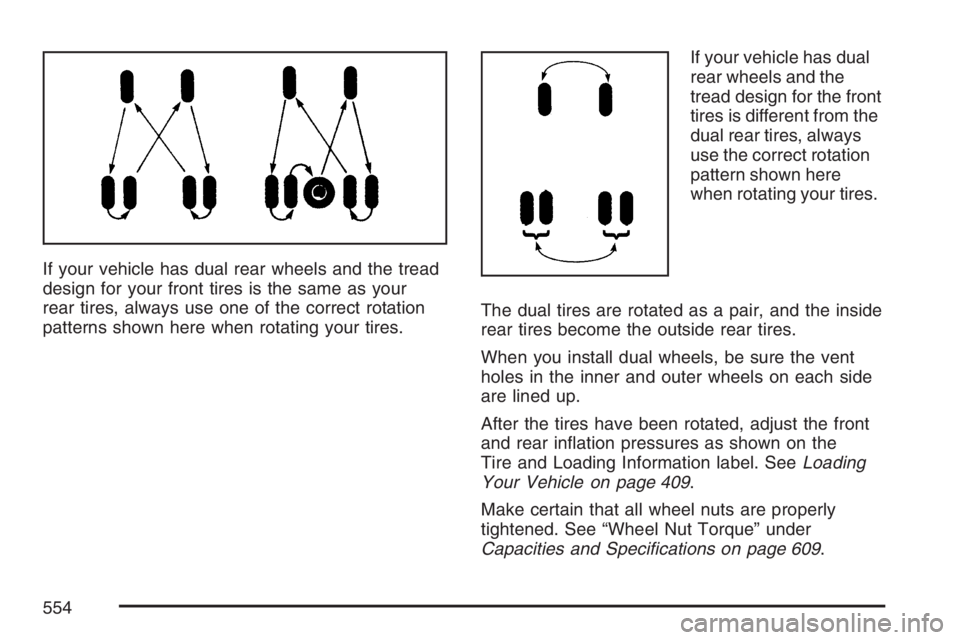
If your vehicle has dual rear wheels and the tread
design for your front tires is the same as your
rear tires, always use one of the correct rotation
patterns shown here when rotating your tires.If your vehicle has dual
rear wheels and the
tread design for the front
tires is different from the
dual rear tires, always
use the correct rotation
pattern shown here
when rotating your tires.
The dual tires are rotated as a pair, and the inside
rear tires become the outside rear tires.
When you install dual wheels, be sure the vent
holes in the inner and outer wheels on each side
are lined up.
After the tires have been rotated, adjust the front
and rear ination pressures as shown on the
Tire and Loading Information label. SeeLoading
Your Vehicle on page 409.
Make certain that all wheel nuts are properly
tightened. See “Wheel Nut Torque” under
Capacities and Specications on page 609.
554
Page 561 of 674
Each new wheel should have the same
load-carrying capacity, diameter, width, offset
and be mounted the same way as the one
it replaces.
If you need to replace any of your wheels, wheel
bolts or wheel nuts, replace them only with
new GM original equipment parts. This way,
you will be sure to have the right wheel, wheel
bolts and wheel nuts for your vehicle.
{CAUTION:
Using the wrong replacement wheels,
wheel bolts, or wheel nuts on your vehicle
can be dangerous. It could affect the
braking and handling of your vehicle,
make your tires lose air and make you
lose control. You could have a collision in
which you or others could be injured.
Always use the correct wheel, wheel bolts,
and wheel nuts for replacement.Notice:The wrong wheel can also cause
problems with bearing life, brake cooling,
speedometer or odometer calibration,
headlamp aim, bumper height, vehicle ground
clearance, and tire or tire chain clearance
to the body and chassis.
Whenever a wheel, wheel bolt or wheel nut is
replaced on a dual wheel setup, check the wheel
nut torque after 100, 1,000 and 6,000 miles
(160, 1 600 and 10 000 km) of driving. For proper
torque, see “Wheel Nut Torque” underCapacities
and Specications on page 609.
SeeChanging a Flat Tire on page 564for more
information.
561
Page 579 of 674

{CAUTION:
Incorrect wheel nuts or improperly
tightened wheel nuts can cause the wheel
to come loose and even come off. This
could lead to an accident. Be sure to use
the correct wheel nuts. If you have to
replace them, be sure to get new GM
original equipment wheel nuts. Stop
somewhere as soon as you can and have
the nuts tightened with a torque wrench to
the proper torque specication. See
Capacities and Specifications on page 609
for wheel nut torque specication.
Notice:Improperly tightened wheel nuts can
lead to brake pulsation and rotor damage.
To avoid expensive brake repairs, evenly
tighten the wheel nuts in the proper sequence
and to the proper torque specication. See
Capacities and Specifications on page 609for
the wheel nut torque specication.12. Tighten the nuts rmly in a crisscross
sequence as shown by turning the wheel
wrench clockwise.
When you reinstall the regular wheel and tire, you
must also reinstall either the center cap, or
bolt-on hub cap, depending on what your vehicle
is equipped with. For center caps, place the
cap on the wheel and tap it into place until it seats
ush with the wheel. The cap only goes on one
way. Be sure to line up the tab on the center cap
with the indentation on the wheel. For bolt-on
hub caps, align the plastic nut caps with the wheel
nuts and then tighten by hand. Then use the
wheel wrench to tighten.
579
Page 611 of 674
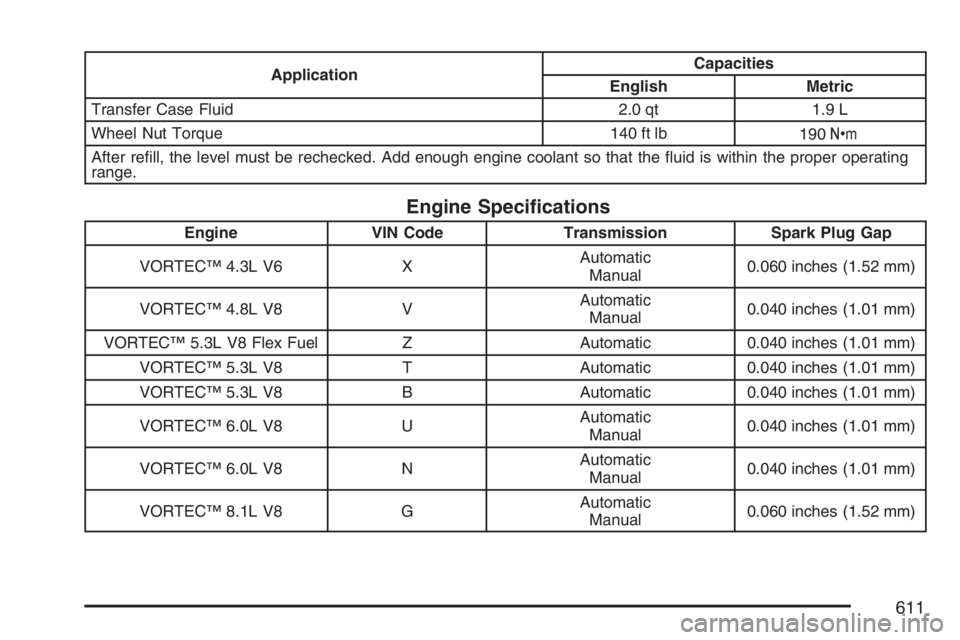
ApplicationCapacities
English Metric
Transfer Case Fluid 2.0 qt 1.9 L
Wheel Nut Torque 140 ft lb
190Y
After rell, the level must be rechecked. Add enough engine coolant so that the uid is within the proper operating
range.
Engine Specications
Engine VIN Code Transmission Spark Plug Gap
VORTEC™ 4.3L V6 XAutomatic
Manual0.060 inches (1.52 mm)
VORTEC™ 4.8L V8 VAutomatic
Manual0.040 inches (1.01 mm)
VORTEC™ 5.3L V8 Flex Fuel Z Automatic 0.040 inches (1.01 mm)
VORTEC™ 5.3L V8 T Automatic 0.040 inches (1.01 mm)
VORTEC™ 5.3L V8 B Automatic 0.040 inches (1.01 mm)
VORTEC™ 6.0L V8 UAutomatic
Manual0.040 inches (1.01 mm)
VORTEC™ 6.0L V8 NAutomatic
Manual0.040 inches (1.01 mm)
VORTEC™ 8.1L V8 GAutomatic
Manual0.060 inches (1.52 mm)
611
Page 625 of 674
(k)Inspect system. Check all fuel and vapor lines
and hoses for proper hook-up, routing, and
condition. Check that the purge valve, if the vehicle
has one, works properly.
(m)Change automatic transmission uid and
external transmission lter if the vehicle is mainly
driven under one or more of these conditions:
In heavy city traffic where the outside
temperature regularly reaches 90°F (32°C) or
higher.
In hilly or mountainous terrain.
When doing frequent trailer towing.
Uses such as found in taxi, police, or delivery
service.
(n)Vehicles with diesel engine or with GVWR
above 10,000 lbs (4 536 kg) only: Inspect shields
for damage or looseness. Adjust or replace as
required. This is a Noise Emission Control Service.
Applicable to vehicles sold in the United States
and recommended for vehicles sold in Canada.
(p)If you drive regularly under dusty conditions,
inspect the lter or change indicator (if equipped)
at each engine oil change.(q)Visually inspect belt for fraying, excessive
cracks, or obvious damage. Replace belt if
necessary.
Owner Checks and Services
These owner checks and services should be
performed at the intervals specied to help
ensure the safety, dependability, and emission
control performance of your vehicle. Your
GM Goodwrench
®dealer can assist you with
these checks and services.
Be sure any necessary repairs are completed at
once. Whenever any uids or lubricants are added
to your vehicle, make sure they are the proper
ones, as shown inRecommended Fluids and
Lubricants on page 629.
At the First 100, 1,000 and 6,000
Miles (160, 1 600 and 10 000 km)
Check dual wheel nut torque. For proper torque,
seeCapacities and Specications on page 609.
625