brake GMC SIERRA CLASSIC 2007 Owner's Guide
[x] Cancel search | Manufacturer: GMC, Model Year: 2007, Model line: SIERRA CLASSIC, Model: GMC SIERRA CLASSIC 2007Pages: 674, PDF Size: 3.5 MB
Page 218 of 674
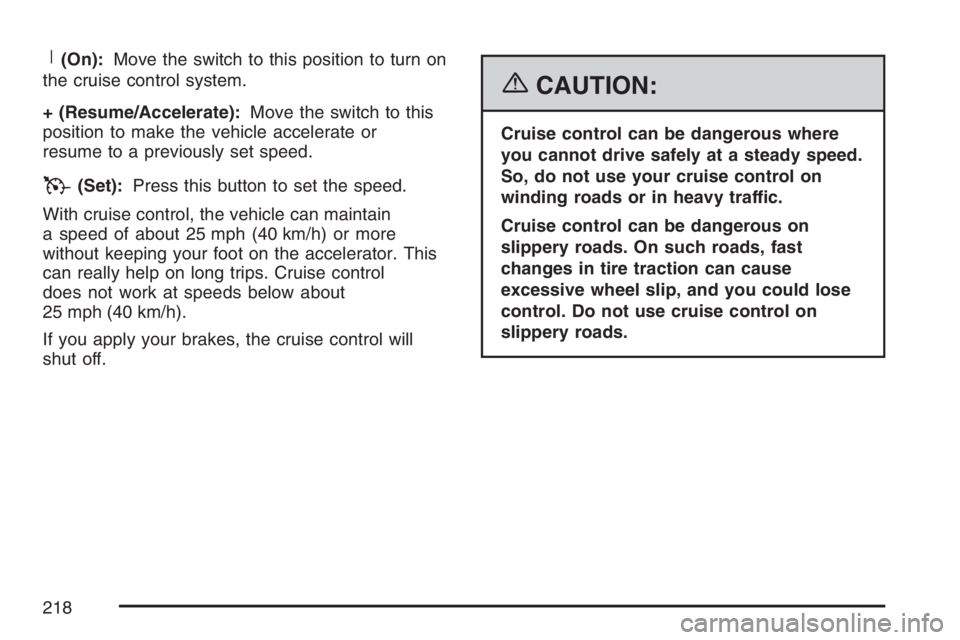
R(On):Move the switch to this position to turn on
the cruise control system.
+ (Resume/Accelerate):Move the switch to this
position to make the vehicle accelerate or
resume to a previously set speed.
T(Set):Press this button to set the speed.
With cruise control, the vehicle can maintain
a speed of about 25 mph (40 km/h) or more
without keeping your foot on the accelerator. This
can really help on long trips. Cruise control
does not work at speeds below about
25 mph (40 km/h).
If you apply your brakes, the cruise control will
shut off.
{CAUTION:
Cruise control can be dangerous where
you cannot drive safely at a steady speed.
So, do not use your cruise control on
winding roads or in heavy traffic.
Cruise control can be dangerous on
slippery roads. On such roads, fast
changes in tire traction can cause
excessive wheel slip, and you could lose
control. Do not use cruise control on
slippery roads.
218
Page 219 of 674
Setting Cruise Control
{CAUTION:
If you leave your cruise control on when
you are not using cruise, you might hit a
button and go into cruise when you do
not want to. You could be startled and
even lose control. Keep the cruise control
switch off until you want to use cruise
control.
1. Move the cruise control switch to on.
2. Get up to the speed you want.
3. Press the set button at the end of the lever
and release it.
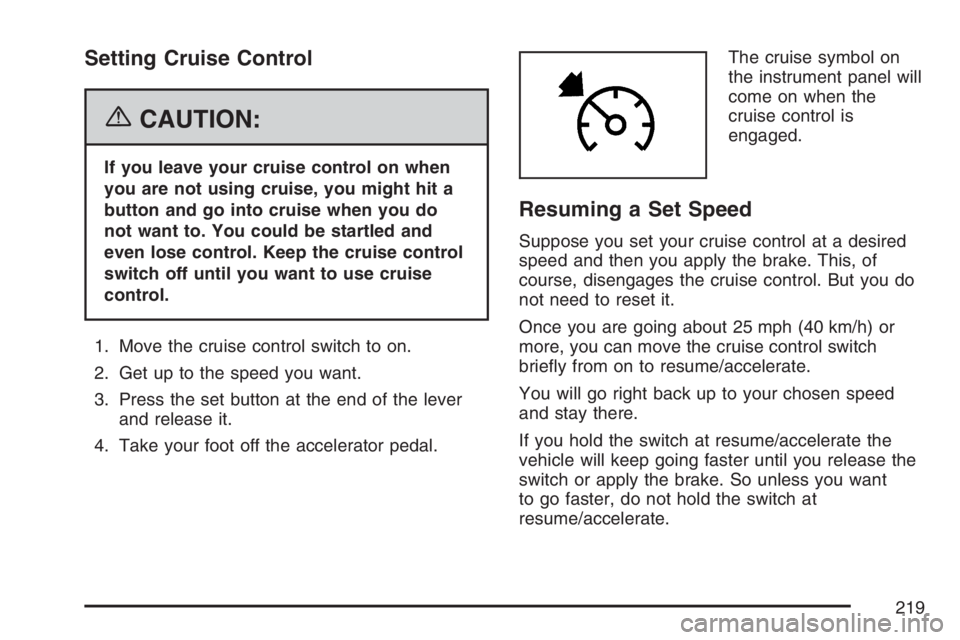
4. Take your foot off the accelerator pedal.The cruise symbol on
the instrument panel will
come on when the
cruise control is
engaged.
Resuming a Set Speed
Suppose you set your cruise control at a desired
speed and then you apply the brake. This, of
course, disengages the cruise control. But you do
not need to reset it.
Once you are going about 25 mph (40 km/h) or
more, you can move the cruise control switch
briey from on to resume/accelerate.
You will go right back up to your chosen speed
and stay there.
If you hold the switch at resume/accelerate the
vehicle will keep going faster until you release the
switch or apply the brake. So unless you want
to go faster, do not hold the switch at
resume/accelerate.
219
Page 220 of 674
Increasing Speed While Using
Cruise Control
There are two ways to go to a higher speed:
Use the accelerator pedal to get to the higher
speed. Press the set button, then release the
set button and the accelerator pedal. You
will now cruise at the higher speed. If
the accelerator pedal is held longer than
60 seconds, cruise control will turn off.
Move the cruise switch from on to resume/
accelerate. Hold it there until you get up to the
speed you want, and then release the it. To
increase your speed in very small amounts,
move the switch briey to resume/accelerate.
Each time you do this, your vehicle will go
about 1 mph (1.6 km/h) faster.
Reducing Speed While Using
Cruise Control
Press in the set button until you reach the
desired lower speed, then release it.
To slow down in very small amounts, briey
press the set button. Each time you do this,
you will go about 1 mph (1.6 km/h) slower.
Passing Another Vehicle While Using
Cruise Control
Use the accelerator pedal to increase your speed.
When you take your foot off the pedal, your
vehicle will slow down to the cruise control speed
you set earlier.
Using Cruise Control on Hills
How well your cruise control will work on hills
depends upon your speed, load and the steepness
of the hills. When going up steep hills, you may
want to step on the accelerator pedal to maintain
your speed. When going downhill, you may
have to brake or shift to a lower gear to keep your
speed down. Of course, applying the brake
takes you out of cruise control. Many drivers nd
this to be too much trouble and do not use
cruise control on steep hills.
220
Page 221 of 674
Ending Cruise Control
There are four ways to turn off the cruise control:
Step lightly on the brake pedal,
Move the cruise control switch to off, or
Shift the transmission to NEUTRAL (N).
Hold the accelerator pedal for 60 seconds or
longer.
Erasing Speed Memory
When you turn off the cruise control or the
ignition, your cruise control set speed memory is
erased.
Headlamps
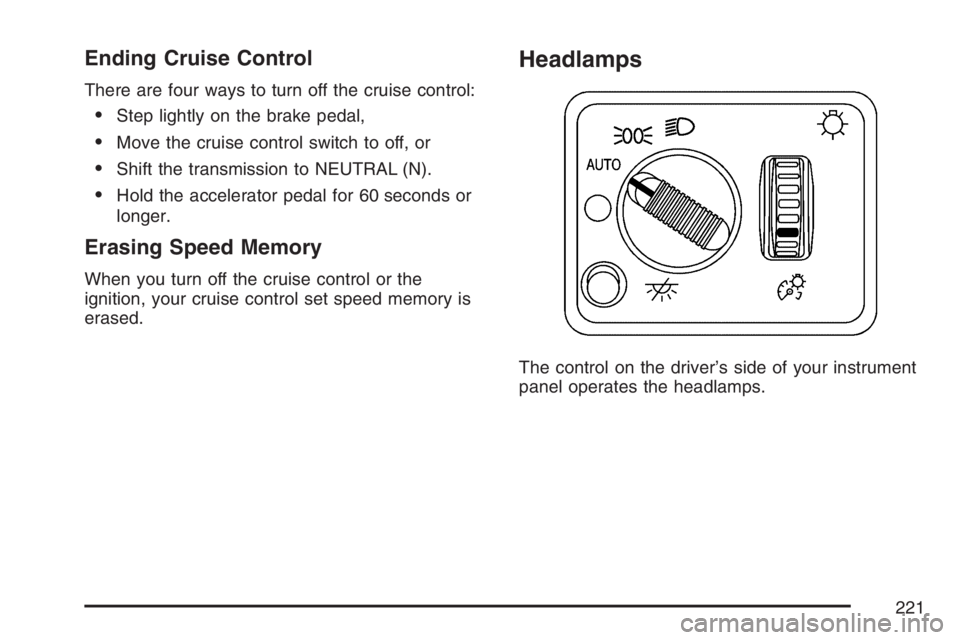
The control on the driver’s side of your instrument
panel operates the headlamps.
221
Page 254 of 674
This condition is normal since the charging system
is not able to provide full power at engine idle.
As engine speeds are increased, this condition
should correct itself as higher engine speeds allow
the charging system to create maximum power.
You can only drive for a short time with the reading
in either warning zone. If you must drive, turn off
all unnecessary accessories.
Readings in either warning zone indicate a
possible problem in the electrical system. Have
the vehicle serviced as soon as possible.
Up-Shift Light
(Manual Transmission)
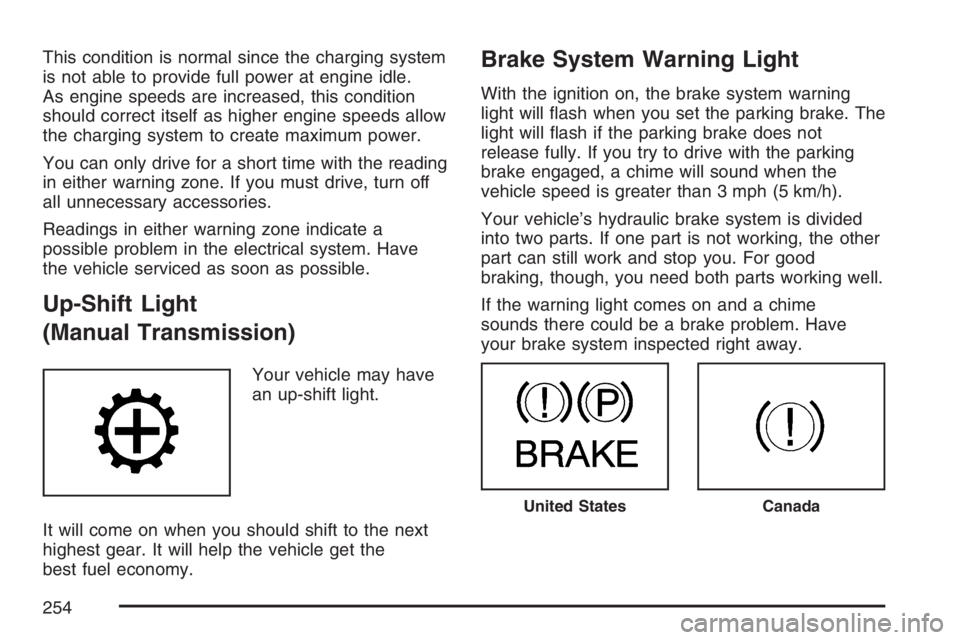
Your vehicle may have
an up-shift light.
It will come on when you should shift to the next
highest gear. It will help the vehicle get the
best fuel economy.
Brake System Warning Light
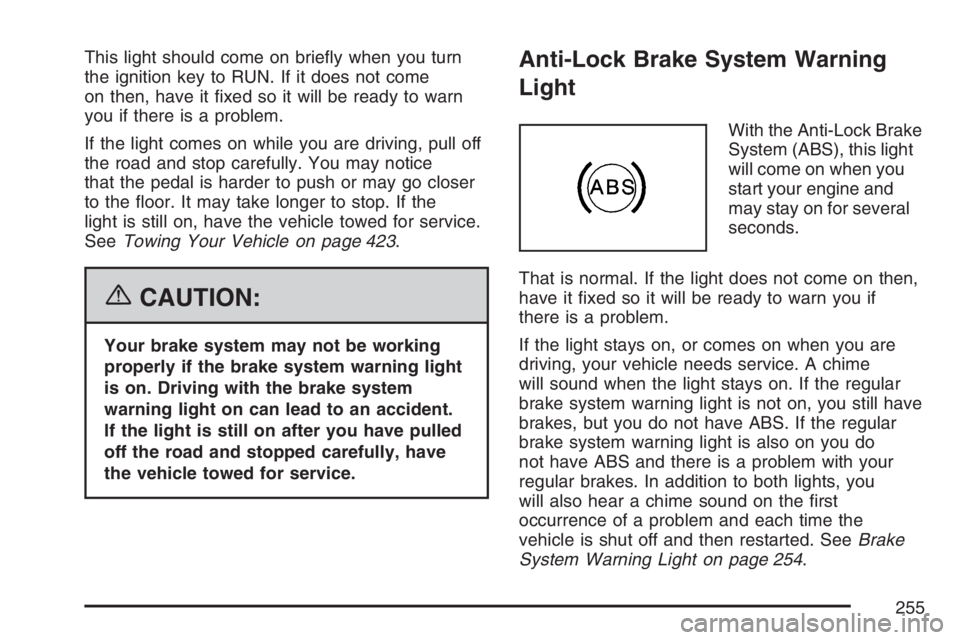
With the ignition on, the brake system warning
light will ash when you set the parking brake. The
light will ash if the parking brake does not
release fully. If you try to drive with the parking
brake engaged, a chime will sound when the
vehicle speed is greater than 3 mph (5 km/h).
Your vehicle’s hydraulic brake system is divided
into two parts. If one part is not working, the other
part can still work and stop you. For good
braking, though, you need both parts working well.
If the warning light comes on and a chime
sounds there could be a brake problem. Have
your brake system inspected right away.
United StatesCanada
254
Page 255 of 674
This light should come on briey when you turn
the ignition key to RUN. If it does not come
on then, have it xed so it will be ready to warn
you if there is a problem.
If the light comes on while you are driving, pull off
the road and stop carefully. You may notice
that the pedal is harder to push or may go closer
to the oor. It may take longer to stop. If the
light is still on, have the vehicle towed for service.
SeeTowing Your Vehicle on page 423.
{CAUTION:
Your brake system may not be working
properly if the brake system warning light
is on. Driving with the brake system
warning light on can lead to an accident.
If the light is still on after you have pulled
off the road and stopped carefully, have
the vehicle towed for service.
Anti-Lock Brake System Warning
Light
With the Anti-Lock Brake
System (ABS), this light
will come on when you
start your engine and
may stay on for several
seconds.
That is normal. If the light does not come on then,
have it xed so it will be ready to warn you if
there is a problem.
If the light stays on, or comes on when you are
driving, your vehicle needs service. A chime
will sound when the light stays on. If the regular
brake system warning light is not on, you still have
brakes, but you do not have ABS. If the regular
brake system warning light is also on you do
not have ABS and there is a problem with your
regular brakes. In addition to both lights, you
will also hear a chime sound on the rst
occurrence of a problem and each time the
vehicle is shut off and then restarted. SeeBrake
System Warning Light on page 254.
255
Page 257 of 674
Transmission Temperature Gage
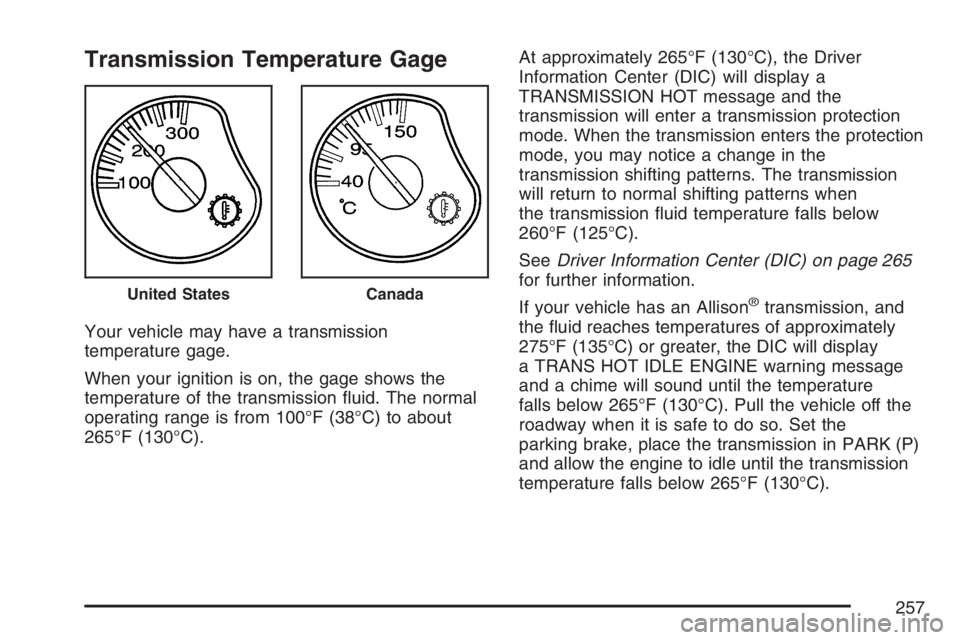
Your vehicle may have a transmission
temperature gage.
When your ignition is on, the gage shows the
temperature of the transmission uid. The normal
operating range is from 100°F (38°C) to about
265°F (130°C).At approximately 265°F (130°C), the Driver
Information Center (DIC) will display a
TRANSMISSION HOT message and the
transmission will enter a transmission protection
mode. When the transmission enters the protection
mode, you may notice a change in the
transmission shifting patterns. The transmission
will return to normal shifting patterns when
the transmission uid temperature falls below
260°F (125°C).
SeeDriver Information Center (DIC) on page 265
for further information.
If your vehicle has an Allison
®transmission, and
the uid reaches temperatures of approximately
275°F (135°C) or greater, the DIC will display
a TRANS HOT IDLE ENGINE warning message
and a chime will sound until the temperature
falls below 265°F (130°C). Pull the vehicle off the
roadway when it is safe to do so. Set the
parking brake, place the transmission in PARK (P)
and allow the engine to idle until the transmission
temperature falls below 265°F (130°C).United StatesCanada
257
Page 273 of 674
DRIVER DOOR AJAR
If the driver’s door is not fully closed, this message
will appear on the display and you will hear a
chime. Stop and turn off the vehicle, check
the door for obstructions, and close the door again.
Check to see if the message still appears on the
DIC. Pressing any of the four DIC buttons will
acknowledge the message and clear it from the
DIC display. If your vehicle does not have the four
DIC buttons, pressing the trip odometer reset
stem will acknowledge the message and clear it
from the DIC display.
ENGINE COOLANT HOT
If the cooling system temperature gets hot, this
message will appear in the DIC. Turn off the
air conditioning. If the message is still on, or if the
engine coolant temperature gage continues to
rise, pull the vehicle over when it is safe to do so.
SeeEngine Coolant Temperature Gage on
page 256for more information. Stop the vehicle
and let the engine idle in PARK (P) for a few
minutes, or NEUTRAL with the parking brake set
for manual transmissions, to allow the coolant
to reach a safe temperature. This message
will clear when the coolant temperature drops to
safe operating temperature.
ENGINE OVERHEATED
Notice:If you drive your vehicle while the
engine is overheating, severe engine damage
may occur. If an overheat warning appears
on the instrument panel cluster and/or
DIC, stop the vehicle as soon as possible.
Do not increase the engine speed above
normal idling speed. SeeEngine Overheating
on page 505for more information.
If the engine cooling system reaches unsafe
temperatures for operation, this message
will appear in the DIC and you will hear a chime.
Stop and turn off the vehicle as soon as it is
safe to do so to avoid severe damage. This
message will clear when the engine has cooled to
a safe operating temperature.
273
Page 278 of 674
SERVICE BRAKE BOOSTER
{CAUTION:
Your brake system may not be working
properly if the SERVICE BRAKE
BOOSTER message is displayed.
If the brake system warning light is also
on, you should have the vehicle towed for
service. SeeBrake System Warning Light
on page 254.
If the brake system warning light is not
on, you still have brakes, but the
supplemental brake assist system on
vehicles with rear disc brakes may not
operate properly. In the event of a vacuum
loss, you may not have vacuum power
assist for braking. The brake pedal will be
harder to push and it will take longer to
stop. If you continue to drive with this
message displayed it can lead to a crash.
Have the brake system serviced as soon
as possible.If your vehicle has vacuum assist power brakes,
this message will be displayed on the DIC
when there is a problem with the Supplemental
Brake Assist system. If the message is displayed
immediately after starting the vehicle or the
message appears while driving, the Supplemental
Brake Assist system needs service. See your
dealer. SeeBrake System Warning Light on
page 254for additional information.
SERVICE BRAKE SYSTEM
If there is a problem with the brake system, this
message will be displayed on the DIC. If this
message appears, stop as soon as possible and
turn off the vehicle. Restart the vehicle and
check for the message on the DIC display. If the
message is still displayed or appears again
when you begin driving, the brake system needs
service. See your dealer.
278
Page 290 of 674
While your vehicle is parked:
Familiarize yourself with all of its controls.
Familiarize yourself with its operation.
Set up your audio system by presetting your
favorite radio stations, setting the tone, and
adjusting the speakers. Then, when driving
conditions permit, you can tune to your favorite
radio stations using the presets and steering
wheel controls if the vehicle has them.
Notice:Before adding any sound equipment
to your vehicle, such as an audio system,
CD player, CB radio, mobile telephone,
or two-way radio, make sure that it can be
added by checking with your dealer. Also,
check federal rules covering mobile radio and
telephone units. If sound equipment can be
added, it is very important to do it properly.
Added sound equipment may interfere with the
operation of your vehicle’s engine, radio, or
other systems, and even damage them.
Your vehicle’s systems may interfere with the
operation of sound equipment that has
been added.Notice:The chime signals related to safety
belts, parking brake, and other functions
of your vehicle operate through the
radio/entertainment system. If that equipment
is replaced or additional equipment is added
to your vehicle, the chimes may not work. Make
sure that replacement or additional equipment
is compatible with your vehicle before
installing it. SeeAccessories and Modifications
on page 468.
Your vehicle has a feature called Retained
Accessory Power (RAP). With RAP, the audio
system can be played even after the ignition
is turned off. SeeRetained Accessory Power
(RAP) on page 137for more information.
Setting the Time for Radios without
Radio Data Systems (RDS)
Press and hold HR (hour) until the correct hour
appears on the display. Press and hold MIN
(minute) until the correct minute appears on the
display. There is an initial two-second delay before
the clock goes into time-set mode. Display the
time with the ignition off, by pressing RCL (recall),
HR, or MIN.
290