cooling GMC SIERRA DENALI 2003 User Guide
[x] Cancel search | Manufacturer: GMC, Model Year: 2003, Model line: SIERRA DENALI, Model: GMC SIERRA DENALI 2003Pages: 428, PDF Size: 20.35 MB
Page 299 of 428
Cooling System
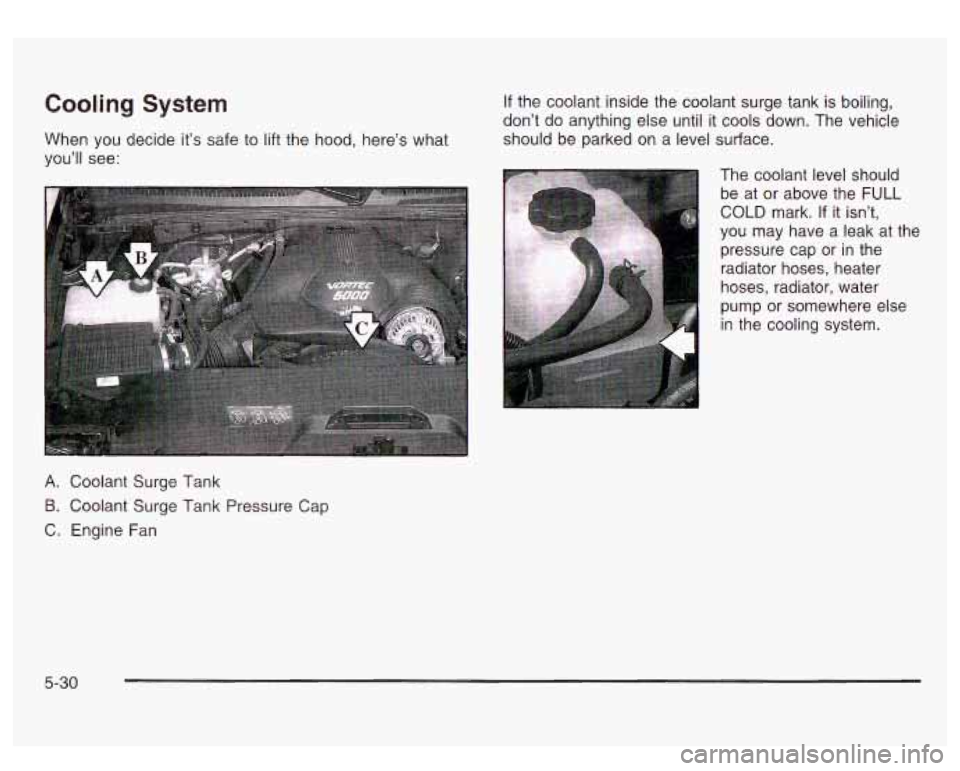
When you decide it's safe to lift the hood, here's what
you'll see:
If the coolant inside the coolant surge tank is boiling,
don't do anything else until it cools down. The vehicle
should be parked on a level surface.
A. Coolant Surge Tank
B. Coolant Surge Tank Pressure Cap
C. Engine Fan The coolant level should
be at
or above the FULL
COLD mark. If it isn't,
you may have a leak at the
rn*:A.~~ z,=7j_ . %%A" %!!:..- pressure cap or in the
*^" radiator hoses, heater
hoses, radiator, water
pump or somewhere else
in the cooling system.
I
5-30
Page 300 of 428
I
Heater and radiator hoses, and other engine
parts, can be very hot. Don’t touch them.
If you do, you can be burned.
Don’t run the engine if there
is a leak. If you
run the engine,
it could lose all coolant.
That could cause an engine fire, and you could
be burned. Get any leak fixed before you drive
the vehicle.
If there seems to be no leak, start the engine again.
The engine cooling fan speed should increase when idle
speed
is doubled by pushing the accelerator pedal
down.
If it doesn’t, your vehicle needs service. Turn off
the engine.
Notice: Engine damage from running your engine
without coolant isn’t covered by your warranty.
See “Overheated Engine Protection Operating
Mode”
in the Index for information on driving to
a safe place in an emergency.
Notice: When adding coolant, it is important that
you use only
DEX-COOL@ (silicate-free) coolant.
If coolant other than DEX-COOL@
is added to
the system, premature engine, heater core or
radiator corrosion may result.
In addition, the engine
coolant will require change sooner
- at 30,000 miles
(50 000 km) or 24 months, whichever occurs first.
Damage caused by the use of coolant other
than DEX-COOL@ is not covered by your new
vehicle warranty.
5-31
Page 301 of 428
How to Add Coolant to the Coolant
Surge Tank
If you haven’t found a problem yet, check to see if coolant
is visible in the surge tank.
If coolant is visible but the
coolant level isn’t at or above the
FULL COLD mark, add
a
50/50 mixture of clean, drinkable waterand
DEX-COOL@ coolant at the coolant surge tank, but be
sure the cooling system, including the coolant surge tank
pressure cap, is cool before you do it. See Engine
Coolant on
page 5-24 for more information.
/;1 CAUTIC I:
Steam and scaldin, ,iquids from a hot coa ....g
system can blow out and burn you badly.
They are under pressure, and if you turn the
coolant surge tank pressure cap
- even a
little
- they can come out at high speed.
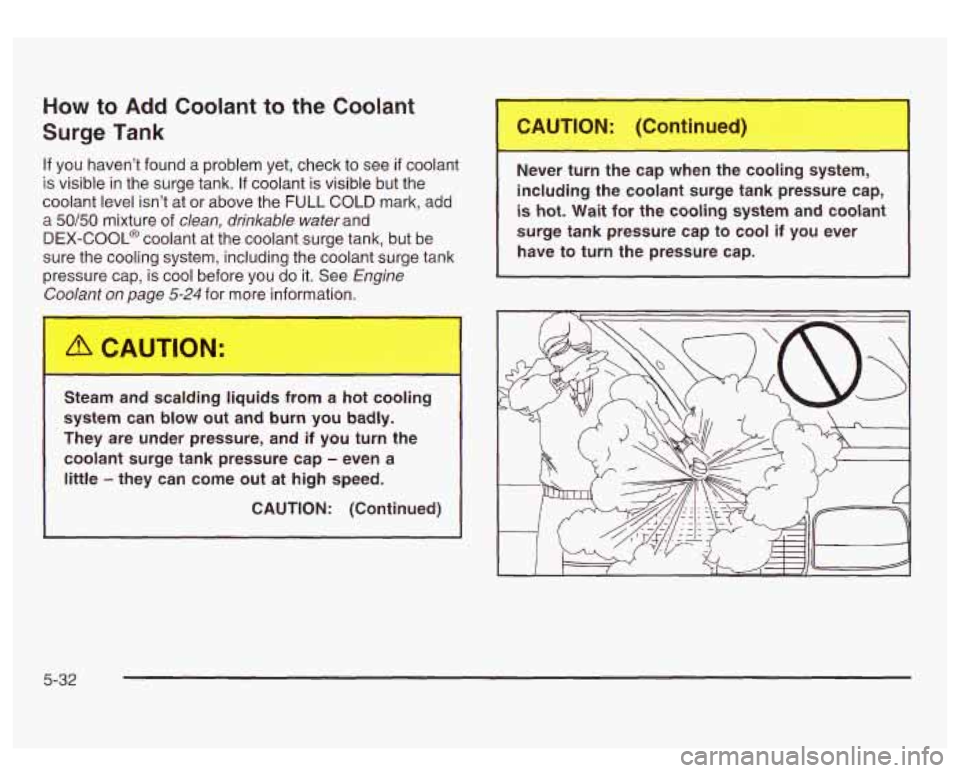
CAUTION: (Continued) Never
turn the cap when the cooling
system,
including the coolant surge tank pressure cap,
is hot. Wait for the cooling system and coolant
surge tank pressure cap to cool if you ever have to turn the pressure cap.
5-32
Page 303 of 428
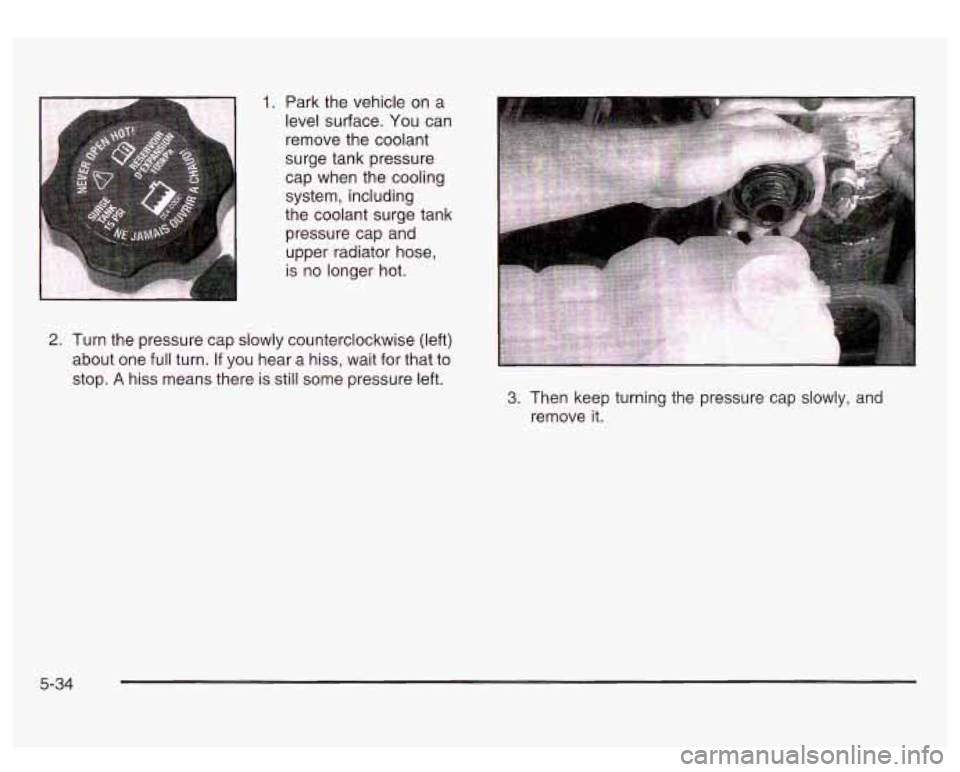
1. Park the vehicle on a
level surface. You can
remove the coolant
surge tank pressure
cap when the cooling
system, including
the coolant surge tank pressure cap and
upper radiator hose,
is no longer hot.
2. Turn the pressure cap slowly counterclockwise (left)
about one full turn.
If you hear a hiss, wait for that to
stop.
A hiss means there is still some pressure left.
3. Then keep turning the pressure cap slowly, and
remove
it.
5-34
Page 304 of 428
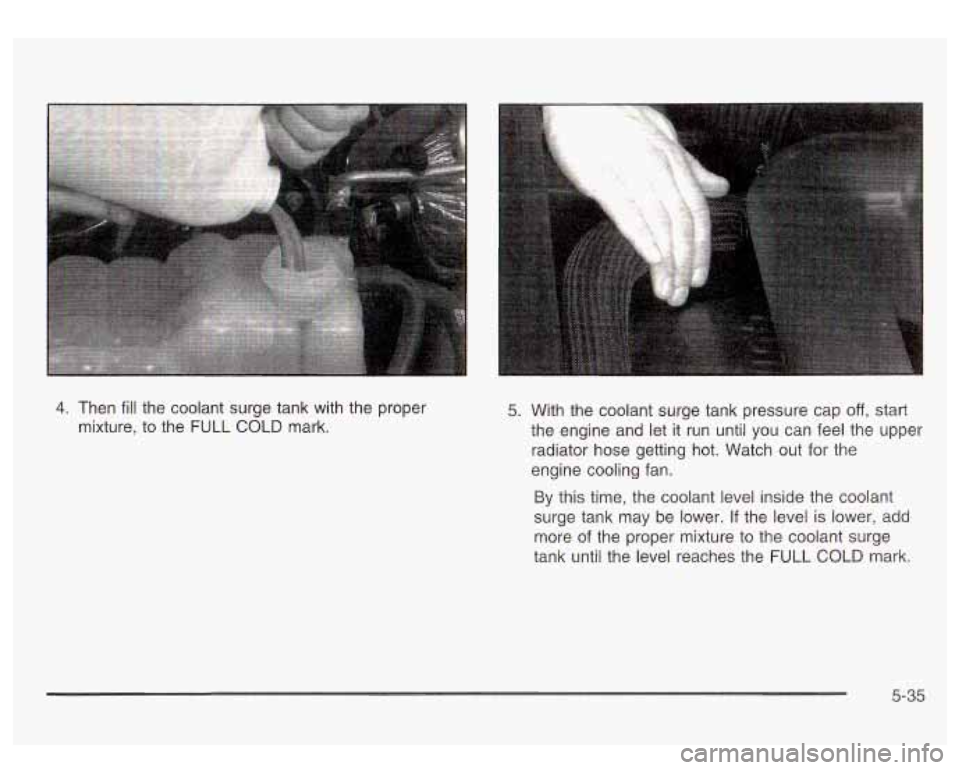
4. Then fill the coolant surge tank with the proper
mixture, to the FULL COLD mark. 5. With the coolant surge tank pressure cap off, start
the engine and let
it run until you can feel the upper
radiator hose getting hot. Watch out for the
engine cooling fan.
By this time, the coolant level inside the coolant
surge tank may be lower. If the level is lower, add
more
of the proper mixture to the coolant surge
tank until the level reaches the FULL COLD mark.
5-35
Page 305 of 428
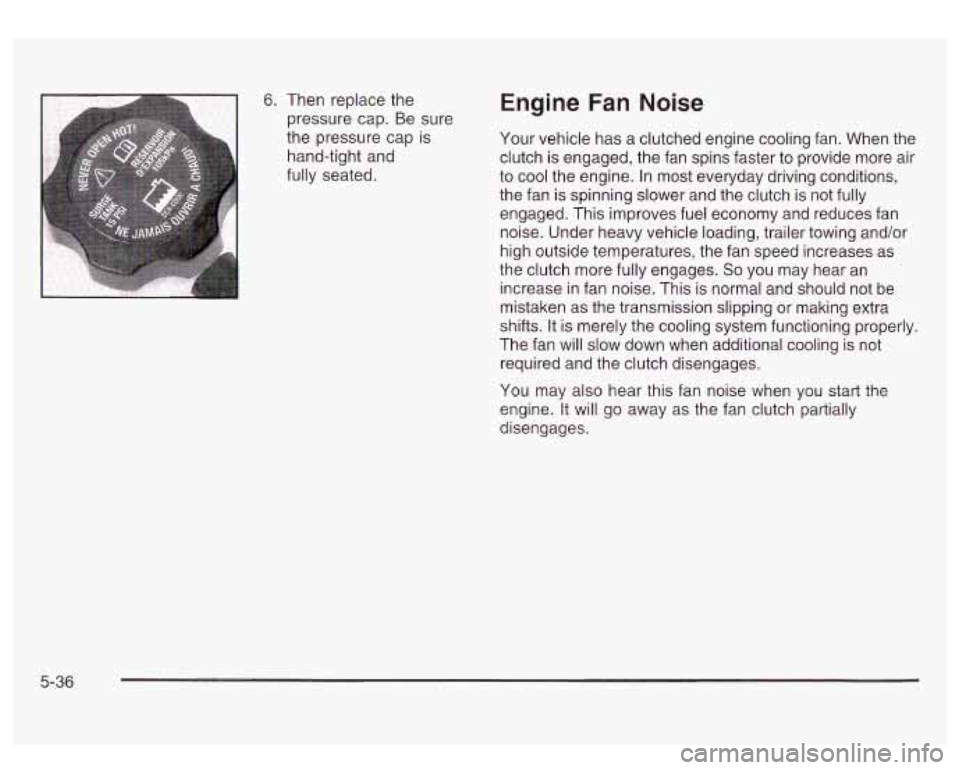
6. Then replace the
pressure cap. Be sure
the pressure cap is
hand-tight and
fully seated. Engine Fan Noise
Your vehicle has a clutched engine cooling fan. When the
clutch is engaged, the fan spins faster to provide more air
to cool the engine. In most everyday driving conditions,
the fan is spinning slower and the clutch is not fully
engaged. This improves fuel economy and reduces fan
noise. Under heavy vehicle loading, trailer towing and/or
high outside temperatures, the fan speed increases as
the clutch more fully engages.
So you may hear an
increase in fan noise. This is normal and should not be
mistaken as the transmission slipping or making extra
shifts. It
is merely the cooling system functioning properly.
The fan will slow down when additional cooling is not
required and the clutch disengages.
You may also hear this fan noise when you start the
engine. It will go away as the fan clutch partially
disengages.
5-36
Page 336 of 428
Wheel Alignment and Tire Balance
The wheels on your vehicle were aligned and balanced
carefully at the factory to give you the longest tire life
and best overall performance.
Scheduled wheel alignment and wheel balancing are
not needed. However,
if you notice unusual tire wear or
your vehicle pulling one way or the other, the alignment
may need to be reset.
If you notice your vehicle
vibrating when driving on a smooth road, your wheels
may need to be rebalanced.
Wheel Replacement
Replace any wheel that is bent, cracked, or badly rusted
or corroded.
If wheel nuts keep coming loose, the
wheel, wheel bolts and wheel nuts should be replaced.
If the wheel leaks air, replace it (except some
aluminum wheels, which can sometimes be repaired).
See your dealer
if any of these conditions exist.
Your dealer will know the kind of wheel you need.
Each new wheel should have the same load-carrying
capacity, diameter, width, offset and be mounted
the same way as the one it replaces.
If you need to replace any
of your wheels, wheel bolts
or wheel nuts, replace them only with new
GM
original equipment parts. This way, you will be sure to
have the right wheel, wheel bolts and wheel nuts
for your vehicle. Usin,
__ __ wrong replacement wheels,
whc
bolts or wheel nuts on your vehicle can be
dangerous.
It could affect the braking and
handling
of your vehicle, make your tires lose
air and make you
lose control. You could have
a collision
in which you or others could be
injured. Always use the correct wheel, wheel
bolts and wheel nuts
for replacement.
Notice: The wrong wheel can also cause problems
with bearing life, brake cooling, speedometer or
odometer calibration, headlamp aim, bumper height,
vehicle ground clearance and tire clearance to the
body and chassis.
See
Changing a Flat Tire on page 5-69 for more
information.
5-67
Page 373 of 428
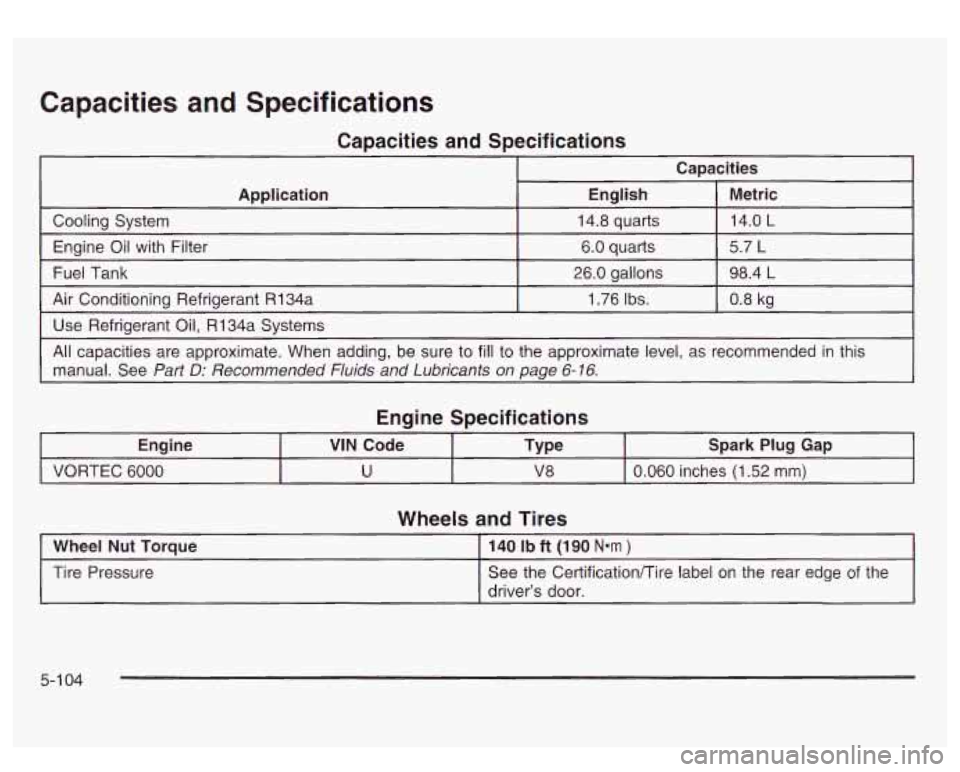
Capacities and Specifications
Capacities and Specifications
Capacities
Application
All capacities are approximate. When adding, be sure to
fill to the approximate level, as recommended in this
Use
Refrigerant Oil, R134a Systems 0.8
kg
1.76 Ibs.
Air Conditioning Refrigerant R134a 98.4
L 26.0 gallons
Fuel
Tank 5.7
L 6.0 quarts
Engine Oil
with Filter 14.0
L 14.8 quarts
Cooling
System Metric
English
manual. See
Part D: Recommended Fluids and Lubricants on page 6-16.
Engine Specifications
Engine Spark Plug Gap
Type
VIN Code
VORTEC 6000
0.060 inches (1.52 mm) V8
U
Wheels and Tires
Wheel Nut Torque
See the CertificationKire label on the rear edge of the
Tire
Pressure 140 Ib ft (190 N*m )
driver’s door.
5-1 04
Page 376 of 428
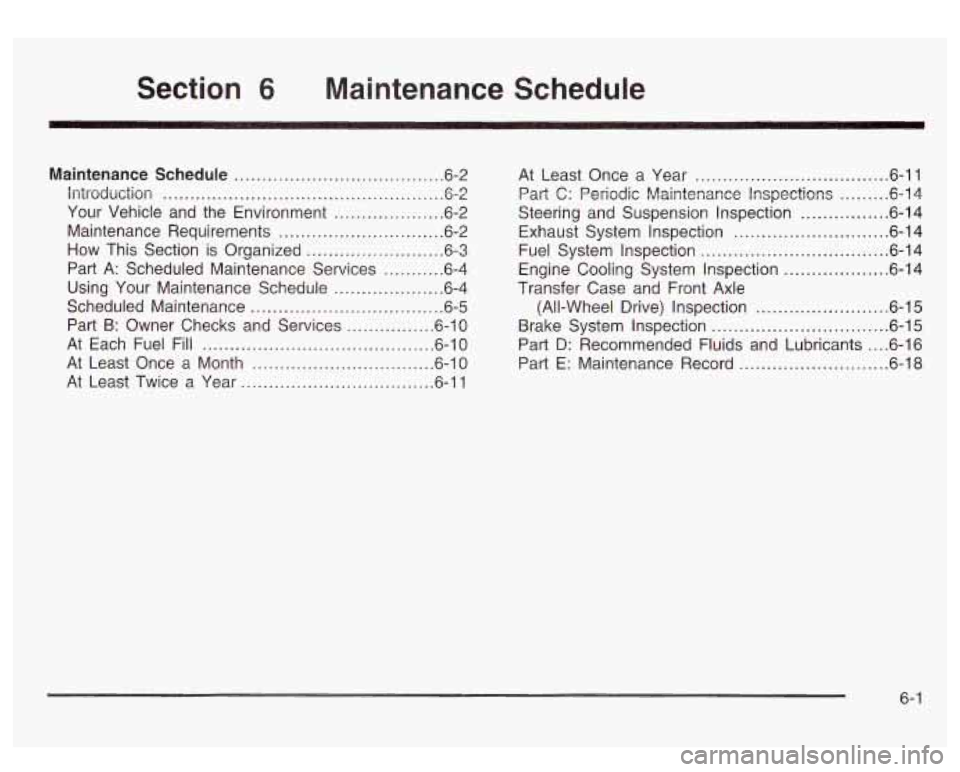
Section 6 Maintenance Schedule
Maintenance Schedule ...................................... 6.2
introduction
................................................... 6.2
Your Vehicle and the Environment
.................... 6-2
Maintenance Requirements
.............................. 6-2
How This Section is Organized
......................... 6-3
Part A: Scheduled Maintenance Services
........... 6-4
Using Your Maintenance Schedule
.................... 6-4
Scheduled Maintenance
................................... 6-5
Part
B: Owner Checks and Services ................ 6-10
At Each Fuel Fill
.......................................... 6-10
At Least Once a Month
................ ......... 6-10
At Least Twice a Year
............................... 6-11 At Least
Once a Year
................................... 6-11
Part
C: Periodic Maintenance Inspections ......... 6.14
Steering and Suspension Inspection
................ 6.14
Exhaust System inspection
............................ 6-14
Fuel System Inspection
.................................. 6.14
Engine Cooling System inspection
................... 6.14
(All-Wheel Drive) Inspection
........................ 6.15
Brake System Inspection
................................ 6.15
Part
D: Recommended Fluids and Lubricants .... 6-16
Part E: Maintenance Record
........................... 6.18
Transfer Case and
Front Axle
6- 1
Page 384 of 428
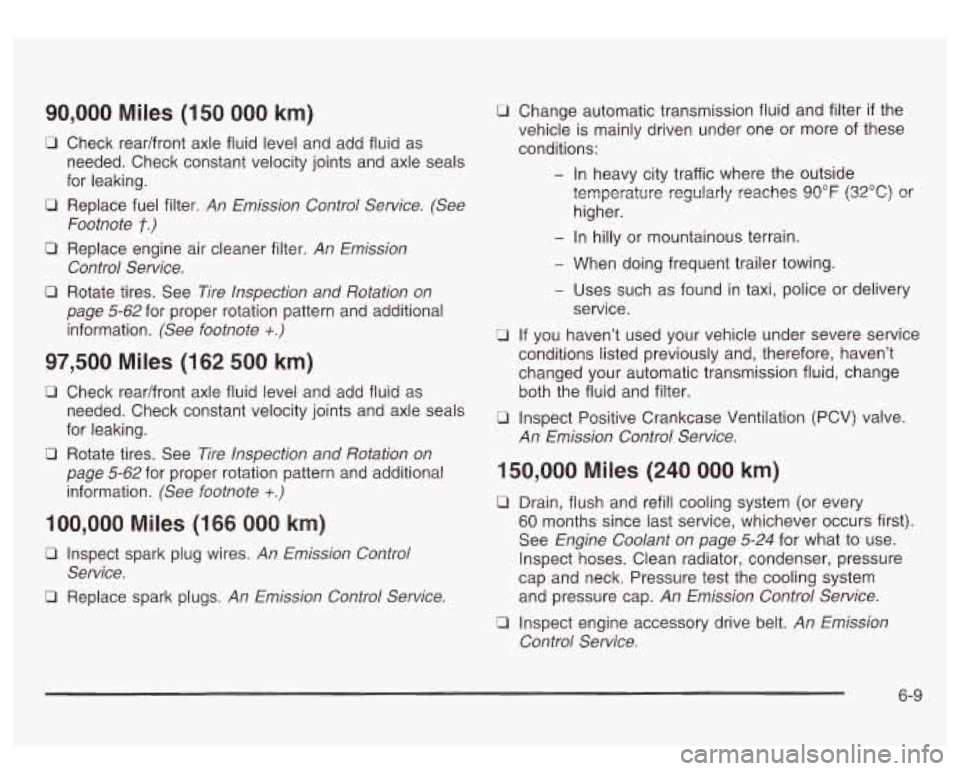
90,000 Miles (150 000 km)
0 Check readfront axle fluid level and add fluid as
needed. Check constant velocity joints and axle seals
for leaking.
0 Replace fuel filter. An Emission Control Service. (See
Footnote
t.)
0 Replace engine air cleaner filter. An Emission
Control Service.
0 Rotate tires. See Tire Inspection and Rotation on
page 5-62
for proper rotation pattern and additional
information.
(See footnote +.)
97,500 Miles (162 500 km)
c[I Check readfront axle fluid level and add fluid as
needed. Check constant velocity joints and axle seals
for leaking.
page 5-62 for proper rotation pattern and additional
information.
(See footnote +.)
0 Rotate tires. See Tire Inspection and Rotation on
100,000 Miles (166 000 km)
0 Inspect spark plug wires. An Emission Control
0 Replace spark plugs. An Emission Control Service.
Service.
0 Change automatic
transmission fluid and filter if the
vehicle
is mainly driven under one or more of these
conditions:
- In heavy city traffic where the outside
temperature regularly reaches
90°F (32°C) or
higher.
- In hilly or mountainous terrain.
- When doing frequent trailer towing.
- Uses such as found in taxi, police or delivery
service.
0 If you haven’t used your vehicle under severe service
conditions listed previously and, therefore, haven’t
changed your automatic transmission fluid, change
both the fluid and filter.
0 Inspect Positive Crankcase Ventilation (PCV) valve.
An Emission Control Service.
150,000 Miles (240 000 km)
0 Drain, flush and refill cooling system (or every
60 months since last service, whichever occurs first).
See
Engine Coolant on page 5-24 for what to use.
Inspect hoses. Clean radiator, condenser, pressure
cap and neck. Pressure test the cooling system
and pressure cap.
An Emission Control Service.
0 Inspect engine accessory drive belt. An Emission
Control Service.
6-9