ECO mode GMC SIERRA DENALI 2004 Owner's Manual
[x] Cancel search | Manufacturer: GMC, Model Year: 2004, Model line: SIERRA DENALI, Model: GMC SIERRA DENALI 2004Pages: 452, PDF Size: 3.02 MB
Page 232 of 452
QUADRASTEERŸ
The QUADRASTEERŸ System has a control and
diagnostic module that monitors and records current
system status and operational information.
If your vehicle is equipped with the 4 Wheel Steer
system it has the ability to steer the vehicle with all four
wheels.
Once the 4 Wheel Steer mode is selected, it is
recommended to leave the vehicle in this mode at all
times, and during all driving and weather conditions.
You can select this mode at any speed, however, if you
are turning the system will not engage until the turn
is complete.
The 4 Wheel Steer system is equipped with three
different driving modes:
·Two wheel steering (2)
·Four wheel steering (4)
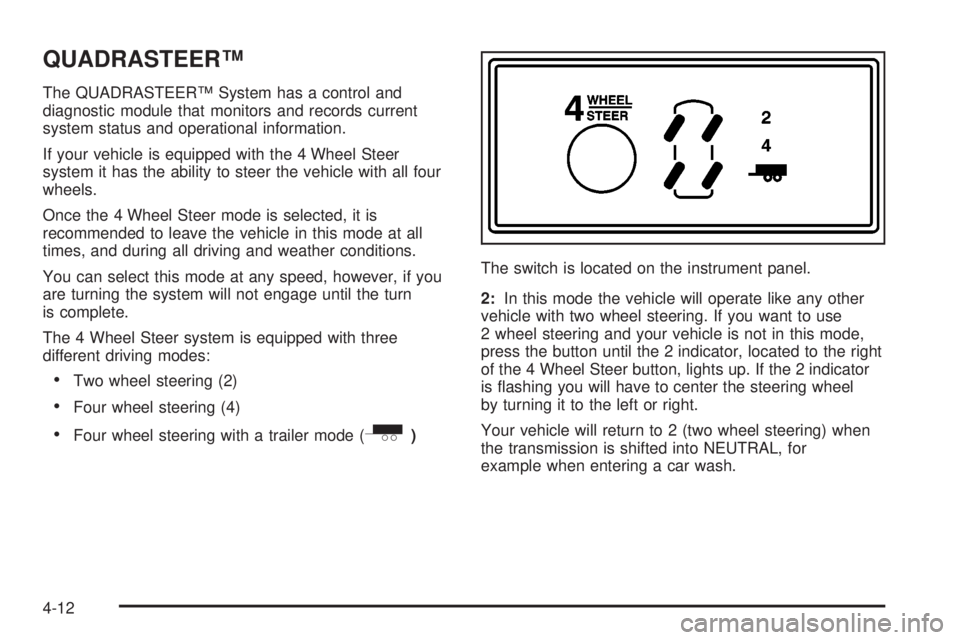
·Four wheel steering with a trailer mode (_)The switch is located on the instrument panel.
2:In this mode the vehicle will operate like any other
vehicle with two wheel steering. If you want to use
2 wheel steering and your vehicle is not in this mode,
press the button until the 2 indicator, located to the right
of the 4 Wheel Steer button, lights up. If the 2 indicator
is ¯ashing you will have to center the steering wheel
by turning it to the left or right.
Your vehicle will return to 2 (two wheel steering) when
the transmission is shifted into NEUTRAL, for
example when entering a car wash.
4-12
Page 234 of 452
_(4 Wheel Steer tow mode):When towing a
trailer the 4 wheel steer tow mode provides enhanced
stability allowing the trailer to follow the path of the
tow vehicle more closely, especially during lane
changes.
In this mode the system operates much like the 4 mode,
but is enhanced for trailer towing. It is recommended
for all types and weights of trailers.
To engage the 4 wheel steer tow mode, press the 4
Wheel Steer button until the 4 and tow indicators light up
on the instrument panel. If the tow indicator is ¯ashing
you will have to center the steering wheel by turning it to
the left or right. While in the 4 wheel steer tow mode,
it is possible the steering wheel may be slightly off
center. For more information, see
Towing a Trailer on
page 4-58.
Car Washes for
QUADRASTEERŸ Equipped Vehicles
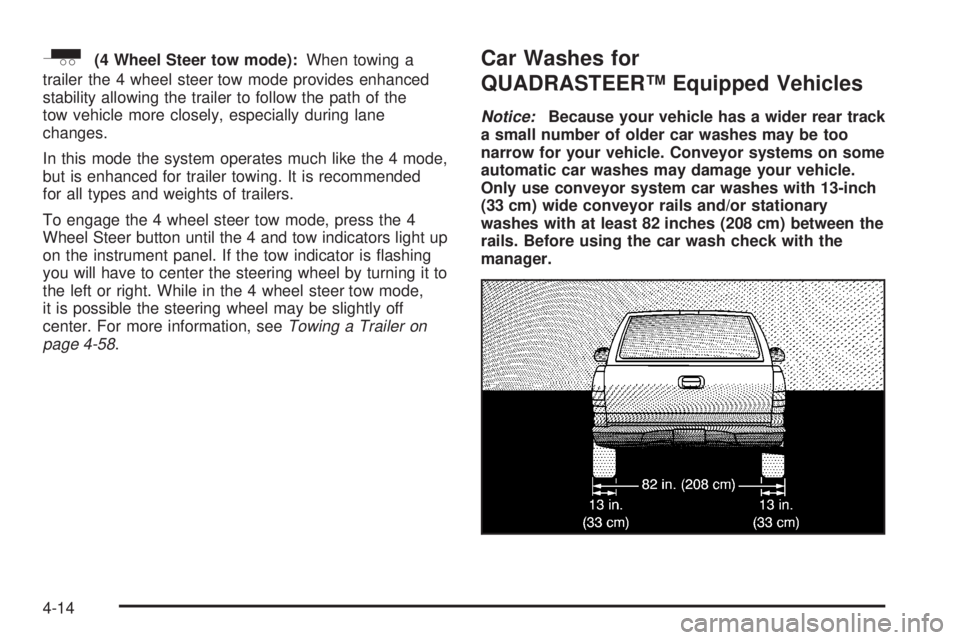
Notice:Because your vehicle has a wider rear track
a small number of older car washes may be too
narrow for your vehicle. Conveyor systems on some
automatic car washes may damage your vehicle.
Only use conveyor system car washes with 13-inch
(33 cm) wide conveyor rails and/or stationary
washes with at least 82 inches (208 cm) between the
rails. Before using the car wash check with the
manager.
4-14
Page 280 of 452
Tow/Haul Mode
Tow/Haul is a feature that assists when pulling a heavy
trailer or a large or heavy load. The purpose of the
Tow/Haul mode is to:
·Reduce the frequency and improve the predictability
of transmission shifts when pulling a heavy trailer or
a large or heavy load.
·Provide the same solid shift feel when pulling a
heavy trailer or a large or heavy load as when
the vehicle is unloaded.
·Improve control of vehicle speed while requiring
less throttle pedal activity when pulling a heavy
trailer or a large or heavy load.
Your vehicle may be equipped with a switch at the end
of the shift lever which when pressed enables
Tow/Haul. When the switch is pressed, a light on the
instrument panel will illuminate to indicate that Tow/Haul
has been selected. Tow/Haul may be turned off by
pressing the switch again, at which time the indicator
light on the instrument panel will turn off. The vehicle will
automatically turn off Tow/Haul every time it is started.Tow/Haul is designed to be most effective when
the vehicle and trailer combined weight is at least
75 percent of the vehicle's Gross Combined Weight
Rating (GCWR). See Weight of the Trailer later in this
section. Tow/haul is most useful under the following
driving conditions:
·When pulling a heavy trailer or a large or heavy
load through rolling terrain.
·When pulling a heavy trailer or a large or heavy
load in stop and go traffic.
·When pulling a heavy trailer or a large or heavy
load in busy parking lots where improved low
speed control of the vehicle is desired.
Operating the vehicle in Tow/Haul when lightly loaded
or with no trailer at all will not cause damage. However,
there is no bene®t to the selection of Tow/Haul when
the vehicle is unloaded. Such a selection when unloaded
may result in unpleasant engine and transmission
driving characteristics and reduced fuel economy.
Tow/Haul is recommended only when pulling a heavy
trailer or a large or heavy load.
4-60
Page 358 of 452
Outward Facing Sidewall:The side of a asymmetrical
tire that has a particular side that faces outward
when mounted on a vehicle. The side of the tire that
contains a whitewall, bears white lettering or bears
manufacturer, brand and or model name molding that is
higher or deeper than the same moldings on the
other sidewall of the tire.
Passenger (P-Metric) Tire:A tire used on passenger
cars and some light duty trucks and multipurpose
vehicles.
Recommended In¯ation Pressure:Vehicle
manufacturer's recommended tire in¯ation pressure and
shown on the tire placard. See
In¯ation - Tire Pressure
on page 5-67andLoading Your Vehicle on page 4-48.
Radial Ply tire:A pneumatic tire in which the ply cords
that extend to the beads are laid at 90 degrees to the
centerline of the tread.
Rim:A metal support for a tire and upon which the tire
beads are seated.
Sidewall:The portion of a tire between the tread and
the bead.
Speed Rating:An alphanumeric code assigned to a
tire indicating the maximum speed at which a tire
can operate.
Traction:The friction between the tire and the road
surface. The amount of grip provided.Tread:The portion of a tire that comes into contact
with the road.
Treadwear Indicators:Narrow bands, sometimes
called ªwear bars,º that show across the tread of a tire
when only 2/32 inch of tread remains. See
When It
Is Time for New Tires on page 5-69.
UTQGS:Uniform Tire Quality Grading Standards, a tire
information system that provides consumers with
ratings for a tire's traction, temperature and treadwear.
Ratings are determined by tire manufacturers using
government testing procedures. The ratings are molded
into the sidewall of the tire. See
Uniform Tire Quality
Grading on page 5-71.
Vehicle Capacity Weight:The number of designated
seating positions multiplied by 150 lbs. (68 kg) plus
the rated cargo load. See
Loading Your Vehicle
on page 4-48.
Vehicle Maximum Load on the Tire:Load on an
individual tire due to curb weight, accessory weight,
occupant weight and cargo weight.
Vehicle Placard:A label permanently attached to a
vehicle showing the original equipment tire size
and recommended in¯ation pressure. See
Loading Your
Vehicle on page 4-48.
5-66
Page 431 of 452
For prompt and efficient assistance when calling, please
provide the following to the Roadside Assistance
Representative:
·Your name, home address, and home telephone
number
·Telephone number of your location
·Location of the vehicle
·Model, year, color, and license plate number
·Mileage, Vehicle Identi®cation Number, and delivery
date of the vehicle
·Description of the problem
While we hope you never have the occasion to use our
service, it is added security while traveling for you
and your family. Remember, we are only a phone call
away. GMC Roadside Assistance: 1-800-462-8782,
text telephone (TTY) users, call 1-888-889-2438.
GMC reserves the right to limit services or
reimbursement to an owner or driver when, in GMC's
judgement, the claims become excessive in frequency or
type of occurrence.
Roadside Assistance is not part of or included in the
coverage provided by the New Vehicle Limited Warranty.
GMC reserves the right to make any changes or
discontinue the Roadside Assistance program at any
time without noti®cation.
Canadian Roadside Assistance
Vehicles purchased in Canada have an extensive
roadside assistance program accessible from anywhere
in Canada or the United States. Please refer to the
Warranty and Owner Assistance Information book.
Courtesy Transportation
GMC has always exempli®ed quality and value in its
offering of motor vehicles. To enhance your ownership
experience, we and our participating dealers are
proud to offer Courtesy Transportation, a customer
support program for new vehicles.
The Courtesy Transportation program is offered to retail
purchase/lease customers in conjunction with the
Bumper-to-Bumper coverage provided by the New
Vehicle Limited Warranty. Several transportation options
are available when warranty repairs are required.
This will reduce your inconvenience during warranty
repairs.
Plan Ahead When Possible
When your vehicle requires warranty service, you
should contact your dealer and request an appointment.
By scheduling a service appointment and advising
your service consultant of your transportation needs,
your dealer can help minimize your inconvenience.
7-7
Page 433 of 452
Additional Program Information
Courtesy Transportation is available during the
Bumper-to-Bumper warranty coverage period, but itis
notpart of the New Vehicle Limited Warranty. A
separate booklet entitledWarranty and Owner
Assistance Informationfurnished with each new vehicle
provides detailed warranty coverage information.
Courtesy Transportation is available only at participating
dealers and all program options, such as shuttle
service, may not be available at every dealer. Please
contact your dealer for speci®c information about
availability. All Courtesy Transportation arrangements
will be administered by appropriate dealer personnel.
Canadian Vehicles:For warranty repairs during
the Complete Vehicle Coverage period of the General
Motors of Canada New Vehicle Limited Warranty,
alternative transportation may be available under the
Courtesy Transportation Program. Please consult
your dealer for details.
General Motors reserves the right to unilaterally modify,
change or discontinue Courtesy Transportation at
any time and to resolve all questions of claim eligibility
pursuant to the terms and conditions described
herein at its sole discretion.
Vehicle Data Collection and Event
Data Records
Your vehicle, like other modern motor vehicles, has a
number of sophisticated computer systems that monitor
and control several aspects of the vehicle's
performance. Your vehicle uses on-board vehicle
computers to monitor emission control components to
optimize fuel economy, to monitor conditions for
airbag deployment and, if so equipped, to provide
anti-lock braking and to help the driver control the
vehicle in difficult driving situations. Some information
may be stored during regular operations to facilitate
repair of detected malfunctions; other information
is stored only in a crash or near crash event by
computer systems commonly called event data
recorders (EDR).
In a crash or near crash event, computer systems, such
as the Airbag Sensing and Diagnostic Module (SDM)
in your vehicle may record information about the
condition of the vehicle and how it was operated, such
as engine speed, brake applications, throttle position,
vehicle speed, seat belt usage, airbag readiness, airbag
performance data, and the severity of a collision. This
information has been used to improve vehicle crash
performance and may be used to improve crash
performance of future vehicles and driving safety.
7-9
Page 446 of 452
N
Navigation/Radio System..................................3-79
New Vehicle Break-In......................................2-18
Normal Maintenance Replacement Parts............6-15
O
Odometer......................................................3-29
Off-Road Recovery..........................................4-15
Oil
Engine.......................................................5-11
Pressure Gage............................................3-43
OIL LIFE RESET............................................3-60
OIL PRESSURE LOW.....................................3-60
Older Children, Restraints................................1-29
Online Owner Center........................................ 7-3
OnStar
žPersonal Calling.................................2-37
OnStaržServices............................................2-37
OnStaržSteering Wheel Controls......................2-38
OnStaržSystem.............................................2-36
OnStaržVirtual Advisor....................................2-37
Operating Your All-Wheel-Drive Vehicle Off
Paved Roads..............................................4-18
Other Warning Devices...................................... 3-4
Outlet Adjustment............................................3-26
Outside
Automatic Dimming Mirror.............................2-35
Convex Mirror.............................................2-36
Curb View Assist Mirrors..............................2-35Outside (cont.)
Heated Mirrors............................................2-36
Power Foldaway Mirrors...............................2-34
Power Mirrors.............................................2-34
Overheated Engine Protection
Operating Mode..........................................5-25
Owner Checks and Services.............................. 6-9
Owners, Canadian............................................... ii
Owner's Information........................................7-12
P
Park (P)
Shifting Into................................................2-26
Shifting Out of............................................2-28
Parking
Brake........................................................2-25
Over Things That Burn.................................2-29
Parking on Hills..............................................4-67
Passenger Air Bag Indicator.............................2-33
Passenger Air Bag Status Indicator...................3-33
PASSENGER DOOR AJAR..............................3-60
Passenger Sensing System..............................1-73
Passing.................................................4-15, 4-66
Passlock
ž......................................................2-17
Payload.........................................................4-54
Personalization Button.....................................3-50
Pickup Conversion to Chassis Cab....................4-57
Plan Ahead When Possible................................ 7-7
10
Page 450 of 452
Theft-Deterrent Systems...................................2-15
Content Theft-Deterrent................................2-16
Passlock
ž...................................................2-17
TIGHTEN FUEL CAP......................................3-62
Tilt Wheel........................................................ 3-5
Tire Sidewall Labeling......................................5-60
Tire Size.......................................................5-63
Tire Terminology and De®nitions........................5-64
Tires.............................................................5-59
Buying New Tires........................................5-70
Chains.......................................................5-74
Changing a Flat Tire....................................5-76
If a Tire Goes Flat.......................................5-75
In¯ation - Tire Pressure................................5-67
Inspection and Rotation................................5-68
Spare Tire..................................................5-95
Uniform Tire Quality Grading.........................5-71
Wheel Alignment and Tire Balance.................5-72
Wheel Replacement.....................................5-73
When It Is Time for New Tires......................5-69
To Use the Engine Coolant Heater....................2-21
Tonneau Cover...............................................2-43
Top Strap......................................................1-40
Top Strap Anchor Location...............................1-42
Torque Lock...................................................2-28
Total Weight on Your Vehicle's Tires..................4-63
Tow/Haul Mode...............................................2-24
Tow/Haul Mode Light.......................................3-44Towing
Recreational Vehicle.....................................4-48
Towing a Trailer..........................................4-58
Your Vehicle...............................................4-48
Traction
Manual Selectable Ride................................. 4-9
TRACTION ACTIVE........................................3-63
Trailer
Recommendations.......................................4-57
Trailer Brakes.................................................4-64
Trailer Wiring Harness.....................................4-69
Transfer Case................................................5-46
Transmission
Fluid, Automatic...........................................5-18
Temperature Gage.......................................3-39
TRANSMISSION HOT.....................................3-63
Transmission Operation, Automatic....................2-22
Transmission, Transaxle, Transfer Case Unit
Repair Manual............................................7-11
Transportation Options...................................... 7-8
Traveling to Remote Areas...............................4-20
Trip Information Button....................................3-47
Trip Odometer................................................3-29
Truck-Camper Loading Information....................4-55
Turn and Lane Change Signals.......................... 3-6
TURN SIGNAL ON.........................................3-63
Turn Signal/Multifunction Lever........................... 3-5
Turn Signals When Towing a Trailer..................4-66
Two-Tiered Loading.........................................4-54
14