radiator GMC SIERRA DENALI 2010 Owners Manual
[x] Cancel search | Manufacturer: GMC, Model Year: 2010, Model line: SIERRA DENALI, Model: GMC SIERRA DENALI 2010Pages: 550, PDF Size: 4.17 MB
Page 403 of 550
{WARNING:
Heater and radiator hoses, and other engine
parts, can be very hot. Do not touch them. If you
do, you can be burned.
Do not run the engine if there is a leak. If you run
the engine, it could lose all coolant. That could
cause an engine fire, and you could be burned.
Get any leak fixed before you drive the vehicle.
Notice: Using coolant other than DEX-COOL
®can
cause premature engine, heater core, or radiator
corrosion. In addition, the engine coolant could
require changing sooner, at 50 000 km (30,000 miles)
or 24 months, whichever occurs first. Any repairs
would not be covered by the vehicle warranty.
Always use DEX-COOL
®(silicate-free) coolant in the
vehicle.
Engine Coolant
The cooling system in the vehicle is filled with
DEX-COOL®engine coolant. This coolant is designed
to remain in the vehicle for five years or 150,000 miles
(240 000 km), whichever occurs first.
The following explains the cooling system and how to
check and add coolant when it is low. If there is a
problem with engine overheating, see Engine
Overheating on page 6‑34.
6-29
Page 404 of 550
What to Use
{WARNING:
Adding only plain water to the cooling system can
be dangerous. Plain water, or some other liquid
such as alcohol, can boil before the proper
coolant mixture will. The vehicle's coolant warning
system is set for the proper coolant mixture. With
plain water or the wrong mixture, the engine could
get too hot but you would not get the overheat
warning. The engine could catch fire and you or
others could be burned. Use a 50/50 mixture of
clean, drinkable water and DEX-COOL
®coolant.Use a 50/50 mixture of clean, drinkable water and
DEX-COOL
®coolant. If using this mixture, nothing else
needs to be added. This mixture:
.Gives freezing protection down to −34°F (−37°C),
outside temperature.
.Gives boiling protection up to 265°F (129°C),
engine temperature.
.Protects against rust and corrosion.
.Will not damage aluminum parts.
.Helps keep the proper engine temperature.
Notice: If an improper coolant mixture is used, the
engine could overheat and be badly damaged. The
repair cost would not be covered by the vehicle
warranty. Too much water in the mixture can freeze
and crack the engine, radiator, heater core, and
other parts.
Notice: If extra inhibitors and/or additives are used
in the vehicle's cooling system, the vehicle could be
damaged. Use only the proper mixture of the engine
coolant listed in this manual for the cooling system.
See Recommended Fluids and Lubricants
on
page 7‑11for more information.
6-30
Page 407 of 550
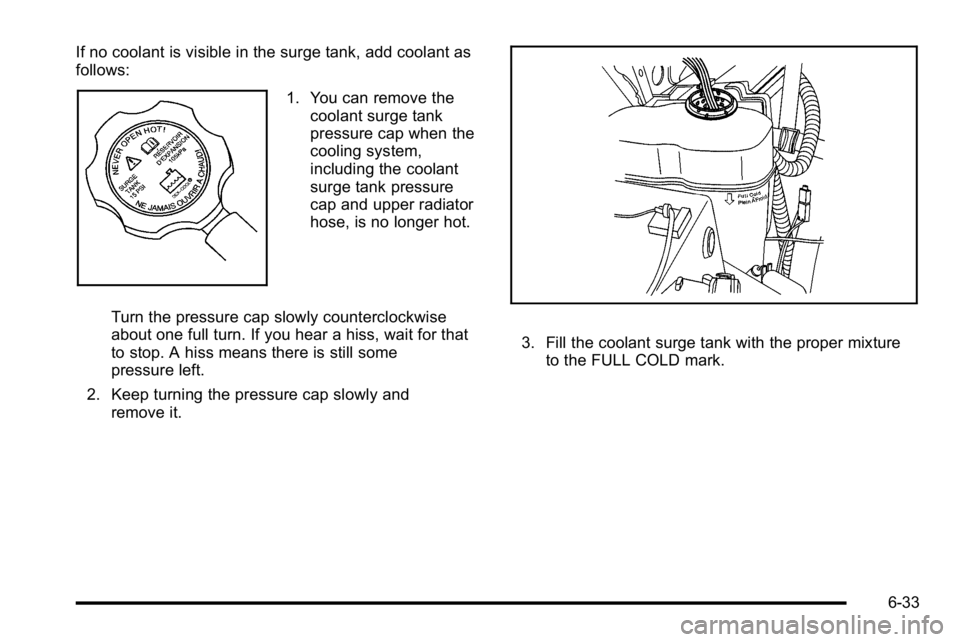
If no coolant is visible in the surge tank, add coolant as
follows:
1. You can remove thecoolant surge tank
pressure cap when the
cooling system,
including the coolant
surge tank pressure
cap and upper radiator
hose, is no longer hot.
Turn the pressure cap slowly counterclockwise
about one full turn. If you hear a hiss, wait for that
to stop. A hiss means there is still some
pressure left.
2. Keep turning the pressure cap slowly and remove it.
3. Fill the coolant surge tank with the proper mixtureto the FULL COLD mark.
6-33
Page 408 of 550
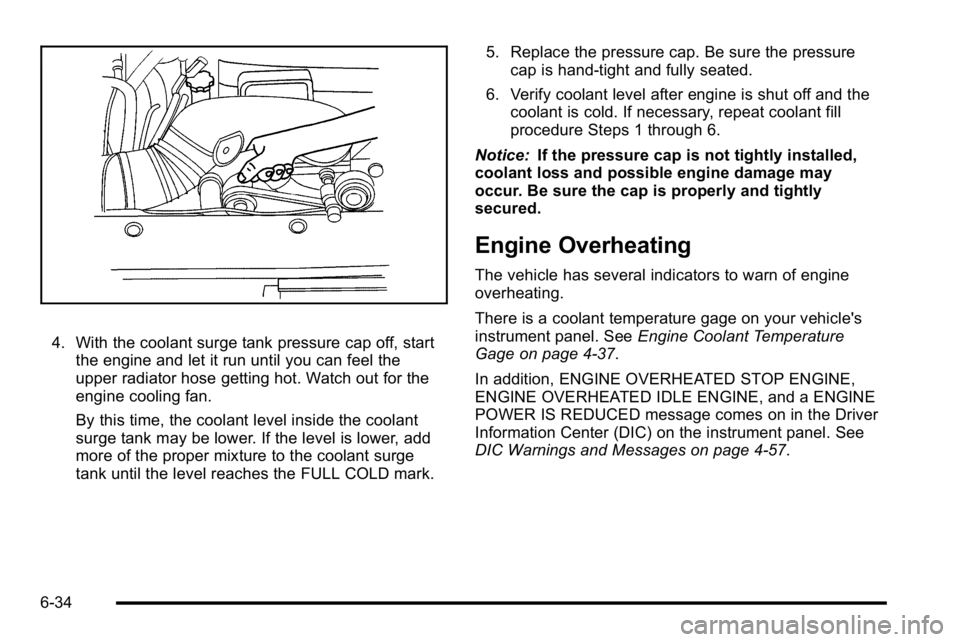
4. With the coolant surge tank pressure cap off, startthe engine and let it run until you can feel the
upper radiator hose getting hot. Watch out for the
engine cooling fan.
By this time, the coolant level inside the coolant
surge tank may be lower. If the level is lower, add
more of the proper mixture to the coolant surge
tank until the level reaches the FULL COLD mark. 5. Replace the pressure cap. Be sure the pressure
cap is hand-tight and fully seated.
6. Verify coolant level after engine is shut off and the coolant is cold. If necessary, repeat coolant fill
procedure Steps 1 through 6.
Notice: If the pressure cap is not tightly installed,
coolant loss and possible engine damage may
occur. Be sure the cap is properly and tightly
secured.
Engine Overheating
The vehicle has several indicators to warn of engine
overheating.
There is a coolant temperature gage on your vehicle's
instrument panel. See Engine Coolant Temperature
Gage on page 4‑37.
In addition, ENGINE OVERHEATED STOP ENGINE,
ENGINE OVERHEATED IDLE ENGINE, and a ENGINE
POWER IS REDUCED message comes on in the Driver
Information Center (DIC) on the instrument panel. See
DIC Warnings and Messages on page 4‑57.
6-34
Page 501 of 550
Additional Required Services
At Each Fuel Stop
.Engine oil level check. SeeEngine Oilon
page 6‑18.
.Engine coolant level check. See Engine Coolanton page 6‑29.
.Windshield washer fluid level check. See
Windshield Washer Fluid on page 6‑39.
Once a Month
.Tire inflation check. SeeInflation - Tire Pressureon page 6‑71.
.Tire wear inspection. See Tire Inspection and
Rotation on page 6‑78.
Once a Year
.Starter switch check. See Owner Checks and
Services on page 7‑9.
.Parking brake and automatic transmission P (Park)
mechanism check. See Owner Checks and
Services on page 7‑9.
.Automatic transmission shiftlock control system
check. See Owner Checks and Serviceson
page 7‑9.
.Ignition transmission lock check. See Owner
Checks and Services on page 7‑9.
.Engine cooling system and pressure cap pressure
check. Radiator and air conditioning condenser
outside cleaning. See Cooling System
on
page 6‑28.
.Exhaust system and nearby heat shields
inspection for loose or damaged components.
.Accelerator pedal check for damage, high effort,
or binding. Replace if needed.
7-5
Page 503 of 550
First Engine Oil Change After Every
160 000 km/100,000 Miles
.Automatic transmission fluid change (normal
service). SeeAutomatic Transmission Fluidon
page 6‑24.
.Transfer case fluid change (normal service). Check
vent hose at transfer case for kinks and proper
installation. Check to be sure vent hose is
unobstructed, clear, and free of debris. During any
maintenance, if a power washer is used to clean
mud and dirt from the underbody, care should be
taken to not directly spray the transfer case output
seals. High pressure water can overcome the seals
and contaminate the transfer case fluid.
Contaminated fluid will decrease the life of the
transfer case and should be replaced.
.Spark plug replacement and spark plug wires
inspection. An Emission Control Service.
First Engine Oil Change After Every
240 000 km/150,000 Miles
.Engine cooling system drain, flush, and refill,
cooling system and cap pressure check, and
cleaning of outside of radiator and air conditioning
condenser (or every 5 years, whichever occurs
first). SeeEngine Coolant
on page 6‑29.An
Emission Control Service.
.Engine accessory drive belt inspection for fraying,
excessive cracks, or obvious damage and
replacement, if needed. An Emission Control
Service.
7-7