steering GMC SONOMA 2004 Owner's Guide
[x] Cancel search | Manufacturer: GMC, Model Year: 2004, Model line: SONOMA, Model: GMC SONOMA 2004Pages: 412, PDF Size: 4.16 MB
Page 308 of 412
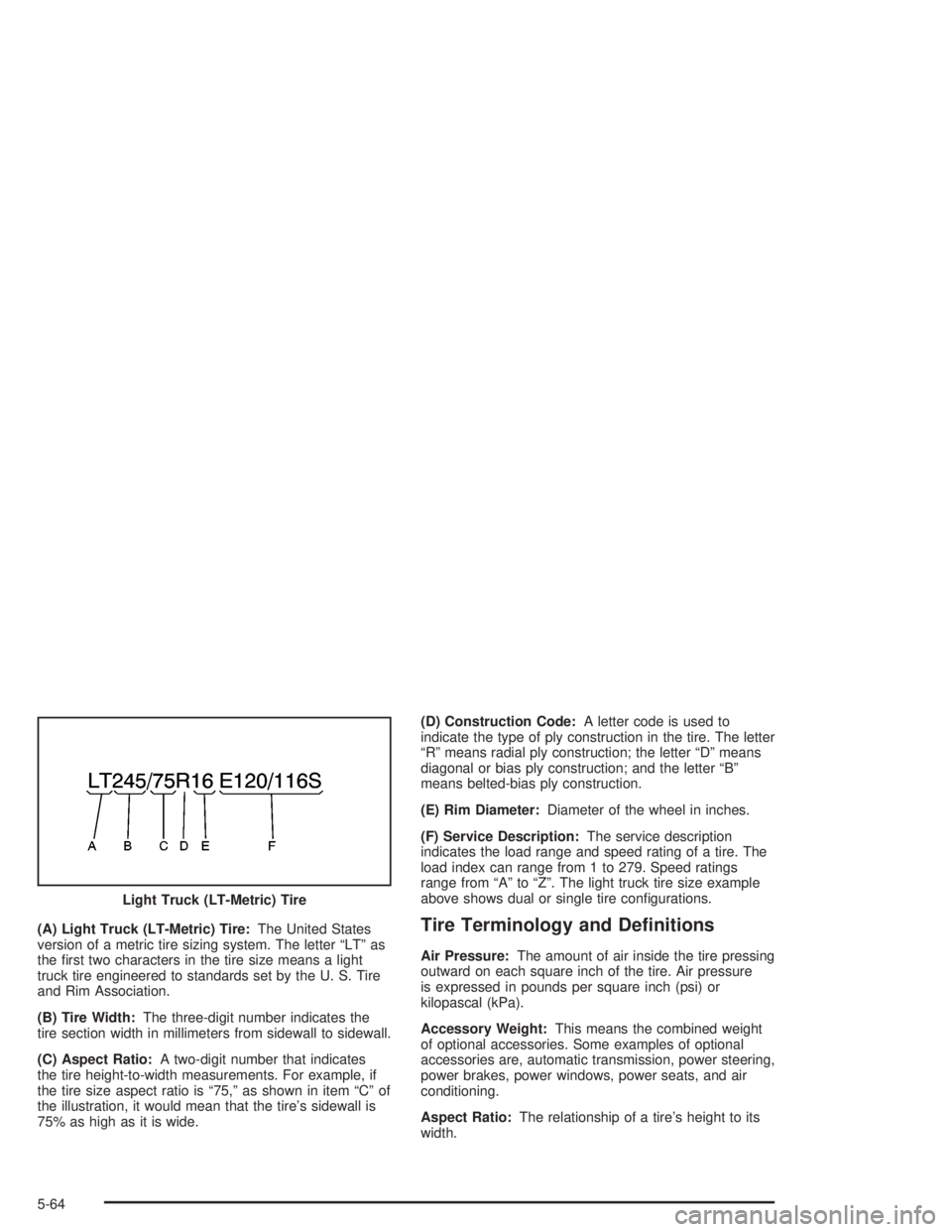
(A) Light Truck (LT-Metric) Tire:The United States
version of a metric tire sizing system. The letter “LT” as
the first two characters in the tire size means a light
truck tire engineered to standards set by the U. S. Tire
and Rim Association.
(B) Tire Width:The three-digit number indicates the
tire section width in millimeters from sidewall to sidewall.
(C) Aspect Ratio:A two-digit number that indicates
the tire height-to-width measurements. For example, if
the tire size aspect ratio is “75,” as shown in item “C” of
the illustration, it would mean that the tire’s sidewall is
75% as high as it is wide.(D) Construction Code:A letter code is used to
indicate the type of ply construction in the tire. The letter
“R” means radial ply construction; the letter “D” means
diagonal or bias ply construction; and the letter “B”
means belted-bias ply construction.
(E) Rim Diameter:Diameter of the wheel in inches.
(F) Service Description:The service description
indicates the load range and speed rating of a tire. The
load index can range from 1 to 279. Speed ratings
range from “A” to “Z”. The light truck tire size example
above shows dual or single tire configurations.Tire Terminology and Denitions
Air Pressure:The amount of air inside the tire pressing
outward on each square inch of the tire. Air pressure
is expressed in pounds per square inch (psi) or
kilopascal (kPa).
Accessory Weight:This means the combined weight
of optional accessories. Some examples of optional
accessories are, automatic transmission, power steering,
power brakes, power windows, power seats, and air
conditioning.
Aspect Ratio:The relationship of a tire’s height to its
width. Light Truck (LT-Metric) Tire
5-64
Page 318 of 412
Tire Chains
{CAUTION:
Don’t use tire chains. There’s not enough
clearance. Tire chains used on a vehicle without
the proper amount of clearance can cause
damage to the brakes, suspension or other
vehicle parts. The area damaged by the tire
chains could cause you to lose control of your
vehicle and you or others may be injured in a
crash. Use another type of traction device only
if its manufacturer recommends it for use on
your vehicle and tire size combination and road
conditions. Follow that manufacturer’s
instructions. To help avoid damage to your
vehicle, drive slowly, readjust or remove the
device if it’s contacting your vehicle, and don’t
spin your wheels. If you do nd traction devices
that will t, install them on the rear tires.
If a Tire Goes Flat
It’s unusual for a tire to “blowout” while you’re driving,
especially if you maintain your tires properly. If air goes
out of a tire, it’s much more likely to leak out slowly.
But if you should ever have a “blowout,” here are a few
tips about what to expect and what to do:
If a front tire fails, the flat tire will create a drag that
pulls the vehicle toward that side. Take your foot off the
accelerator pedal and grip the steering wheel firmly.
Steer to maintain lane position, and then gently brake to
a stop well out of the traffic lane.
A rear blowout, particularly on a curve, acts much like a
skid and may require the same correction you’d use
in a skid. In any rear blowout, remove your foot from the
accelerator pedal. Get the vehicle under control by
steering the way you want the vehicle to go. It may be
very bumpy and noisy, but you can still steer. Gently
brake to a stop, well off the road if possible.
5-74
Page 341 of 412
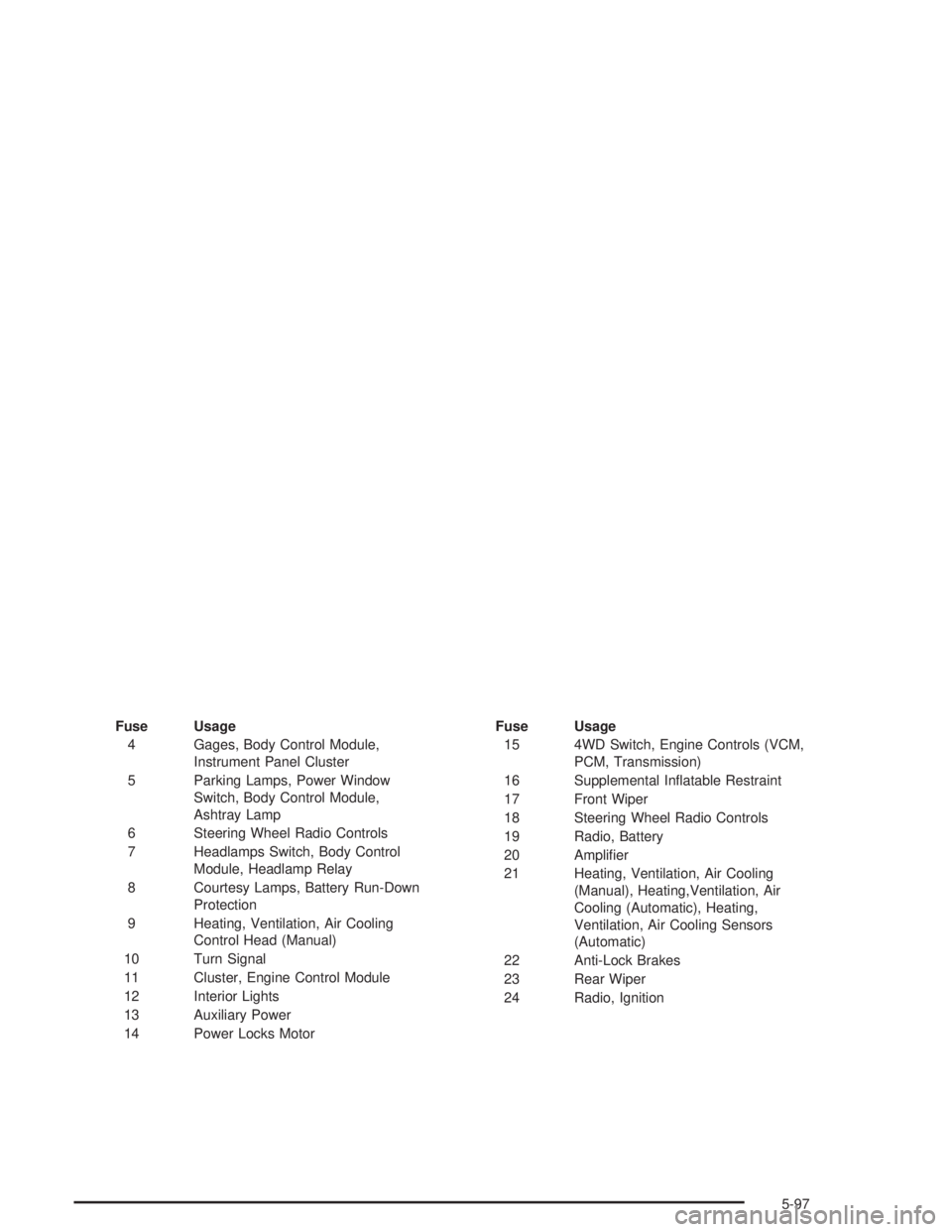
Fuse Usage
4 Gages, Body Control Module,
Instrument Panel Cluster
5 Parking Lamps, Power Window
Switch, Body Control Module,
Ashtray Lamp
6 Steering Wheel Radio Controls
7 Headlamps Switch, Body Control
Module, Headlamp Relay
8 Courtesy Lamps, Battery Run-Down
Protection
9 Heating, Ventilation, Air Cooling
Control Head (Manual)
10 Turn Signal
11 Cluster, Engine Control Module
12 Interior Lights
13 Auxiliary Power
14 Power Locks MotorFuse Usage
15 4WD Switch, Engine Controls (VCM,
PCM, Transmission)
16 Supplemental Inflatable Restraint
17 Front Wiper
18 Steering Wheel Radio Controls
19 Radio, Battery
20 Amplifier
21 Heating, Ventilation, Air Cooling
(Manual), Heating,Ventilation, Air
Cooling (Automatic), Heating,
Ventilation, Air Cooling Sensors
(Automatic)
22 Anti-Lock Brakes
23 Rear Wiper
24 Radio, Ignition
5-97
Page 347 of 412
Maintenance Schedule......................................6-2
Introduction...................................................6-2
Maintenance Requirements..............................6-2
Your Vehicle and the Environment....................6-2
How This Section is Organized.........................6-3
Part A: Scheduled Maintenance Services...........6-4
Using Your Maintenance Schedule....................6-4
Selecting the Right Schedule...........................6-5
Short Trip/City Scheduled Maintenance..............6-6
Long Trip/Highway Scheduled Maintenance......6-17
Part B: Owner Checks and Services................6-25
At Each Fuel Fill..........................................6-25
At Least Once a Month.................................6-25
At Least Twice a Year...................................6-26
At Least Four Times a Year...........................6-27At Least Once a Year...................................6-27
Part C: Periodic Maintenance Inspections.........6-30
Steering, Suspension and Front Drive Axle
Boot and Seal Inspection............................6-30
Exhaust System Inspection............................6-30
Fuel System Inspection..................................6-30
Engine Cooling System Inspection...................6-30
Throttle System Inspection.............................6-31
Transfer Case and Front Axle (Four-Wheel
Drive) Inspection.......................................6-31
Brake System Inspection................................6-31
Part D: Recommended Fluids and Lubricants. . . .6-32
Normal Maintenance Replacement Parts..........6-34
Engine Drive Belt Routing..............................6-35
Part E: Maintenance Record...........................6-36
Section 6 Maintenance Schedule
6-1
Page 353 of 412
Footnotes
†The U.S. Environmental Protection Agency or the
California Air Resources Board has determined that the
failure to perform this maintenance item will not nullify
the emission warranty or limit recall liability prior to
the completion of the vehicle’s useful life. We, however,
urge that all recommended maintenance services be
performed at the indicated intervals and the
maintenance be recorded.
#Lubricate the front suspension, ball joints, steering
linkage, parking brake cable guides, propshaft splines,
universal joints, constant velocity joint and brake
pedal springs.
+A good time to check your brakes is during tire
rotation. See Brake System Inspection on page 6-31.
**Drive axle service. See Part D: Recommended
Fluids and Lubricants on page 6-32 for proper lubricant
to use:
•Check uid level and add uid as needed. If driving
in dusty areas or when towing a trailer, drain uid
and rell every 15,000 miles (25 000 km).
•If your vehicle has a locking differential, drain uid
and rell at rst engine oil change.
•More frequent lubrication may be required for
heavy-duty or off-road use.
3,000 Miles (5 000 km)
❑Change engine oil and filter (or every 3 months,
whichever occurs first).An Emission Control Service.
❑Lubricate chassis components (or every 3 months,
whichever occurs first).(See footnote #.)
❑Check rear/front axle fluid level and add fluid as
needed. Check constant velocity joints and axle seals
for leaking.(See footnote **.)
6,000 Miles (10 000 km)
❑Change engine oil and filter (or every 3 months,
whichever occurs first).An Emission Control Service.
❑Lubricate chassis components (or every 3 months,
whichever occurs first).(See footnote #.)
❑Check rear/front axle fluid level and add fluid as
needed. Check constant velocity joints and axle seals
for leaking.(See Footnote **.)
❑Rotate tires. SeeTire Inspection and Rotation on
page 5-68for proper rotation pattern and additional
information.(See footnote +.)
6-7
Page 363 of 412
99,000 Miles (165 000 km)
❑Change engine oil and filter (or every 3 months,
whichever occurs first).An Emission Control Service.
❑Lubricate chassis components (or every 3 months,
whichever occurs first).(See footnote #.)
❑Check rear/front axle fluid level and add fluid as
needed. Check constant velocity joints and axle seals
for leaking.(See footnote **.)
100,000 Miles (166 000 km)
❑Inspect spark plug wires.An Emission Control
Service.
❑Replace spark plugs.An Emission Control Service.
❑If you have not used your vehicle under severe
service conditions listed previously and, therefore,
have not changed your automatic transmission fluid,
change both the fluid and filter.
❑Inspect Positive Crankcase Ventilation (PCV) valve.
An Emission Control Service.
150,000 Miles (240 000 km)
❑Drain, flush and refill cooling system (or every
60 months since last service, whichever occurs first).
SeeEngine Coolant on page 5-23for what to use.
Inspect hoses. Clean radiator, condenser, pressure
cap and neck. Pressure test cooling system and
pressure cap.An Emission Control Service.
❑Inspect engine accessory drive belt.An Emission
Control Service.
Long Trip/Highway Scheduled
Maintenance
The services shown in this schedule up to 100,000 miles
(166 000 km) should be repeated after 100,000 miles
(166 000 km) at the same intervals for the life of
this vehicle. The services shown at 150,000 miles
(240 000 km) should be repeated at the same interval
after 150,000 miles (240 000 km) for the life of this
vehicle.
SeePart B: Owner Checks and Services on page 6-25
andPart C: Periodic Maintenance Inspections on
page 6-30.
Footnotes
†The U.S. Environmental Protection Agency or the
California Air Resources Board has determined that the
failure to perform this maintenance item will not nullify
the emission warranty or limit recall liability prior to
the completion of the vehicle’s useful life. We, however,
urge that all recommended maintenance services be
performed at the indicated intervals and the
maintenance be recorded.
#Lubricate the front suspension, ball joints, steering
linkage, parking brake cable guides, propshaft splines,
universal joints, constant velocity joint and brake
pedal springs.
6-17
Page 376 of 412
Part C: Periodic Maintenance
Inspections
Listed in this part are inspections and services which
should be performed at least twice a year (for instance,
each spring and fall).You should let your dealer’s
service department do these jobs. Make sure any
necessary repairs are completed at once.
Proper procedures to perform these services may be
found in a service manual. SeeService Publications
Ordering Information on page 7-11.
Steering, Suspension and Front
Drive Axle Boot and Seal Inspection
Inspect the front and rear suspension and steering
system for damaged, loose or missing parts, signs of
wear or lack of lubrication. Inspect the power steering
lines and hoses for proper hook-up, binding, leaks,
cracks, chafing, etc. Clean and then inspect the drive
axle boot seals for damage, tears or leakage. Replace
seals if necessary.
Exhaust System Inspection
Inspect the complete exhaust system. Inspect the body
near the exhaust system. Look for broken, damaged,
missing or out-of-position parts as well as open seams,
holes, loose connections or other conditions which
could cause a heat build-up in the floor pan or could let
exhaust fumes into the vehicle. SeeEngine Exhaust
on page 2-29.
Fuel System Inspection
Inspect the complete fuel system for damage or leaks.
Engine Cooling System Inspection
Inspect the hoses and have them replaced if they
are cracked, swollen or deteriorated. Inspect all pipes,
fittings and clamps; replace as needed. Clean the
outside of the radiator and air conditioning condenser.
To help ensure proper operation, a pressure test of
the cooling system and pressure cap is recommended
at least once a year.
6-30
Page 378 of 412
Part D: Recommended Fluids and
Lubricants
Fluids and lubricants identified below by name, part
number or specification may be obtained from your
dealer.
Usage Fluid/Lubricant
Engine OilEngine oil which meets GM
Standard GM6094M and displays
the American Petroleum Institute
Certified for Gasoline Engines
starburst symbol. To determine the
proper viscosity for your vehicle’s
engine, seeEngine Oil on
page 5-13.
Engine Coolant50/50 mixture of clean, drinkable
water and use only DEX-COOL
®
Coolant. SeeEngine Coolant on
page 5-23.
Hydraulic Brake
SystemDelco Supreme 11
®Brake Fluid or
equivalent DOT-3 brake fluid.
Windshield
Washer SolventGM Optikleen
®Washer Solvent.
Usage Fluid/Lubricant
Power Steering
SystemGM Power Steering Fluid (GM Part
No. U.S. 89021184, in Canada
89021186).
Automatic
TransmissionDEXRON
®-III Automatic
Transmission Fluid.
Key Lock
CylindersMulti-Purpose Lubricant, Superlube
®
(GM Part No. U.S. 12346241, in
Canada 10953474).
Chassis
LubricationChassis Lubricant (GM Part No.
U.S. 12377985, in Canada
88901242) or lubricant meeting
requirements of NLGI #2, Category
LB or GC-LB.
Front Wheel
BearingsWheel bearing lubricant meeting
requirements of NLGI #2, Category
GC or GC-LB (GM Part No. U.S.
1051344, in Canada 993037).
Front and Rear
Axle (Standard
Differential)SAE 80W-90 Axle Lubricant (GM
Part No. U.S. 1052271, in Canada
10950849).
6-32
Page 395 of 412
To contact NHTSA, you may either call the Auto Safety
Hotline toll-free at 1-800-424-9393 (or 366-0123 in
the Washington, D.C. area) or write to:
NHTSA, U.S. Department of Transportation
Washington, D.C. 20590
You can also obtain other information about motor
vehicle safety from the hotline.
Reporting Safety Defects to the
Canadian Government
If you live in Canada, and you believe that your vehicle
has a safety defect, you should immediately notify
Transport Canada, in addition to notifying General
Motors of Canada Limited. You may write to:
Transport Canada
330 Sparks Street
Tower C
Ottawa, Ontario K1A 0N5
Reporting Safety Defects to General
Motors
In addition to notifying NHTSA (or Transport Canada) in
a situation like this, we certainly hope you’ll notify us.
Please call us at 1-800-GMC-8782 (1-800-462-8782), or
write:
Pontiac-GMC Customer Assistance Center
P.O. Box 33172
Detroit, MI 48232-5172
In Canada, please call us at 1-800-263-3777 (English)
or 1-800-263-7854 (French). Or, write:
General Motors of Canada Limited
Customer Communication Centre, 163-005
1908 Colonel Sam Drive
Oshawa, Ontario L1H 8P7
Service Publications Ordering
Information
Service Manuals
Service Manuals have the diagnosis and repair
information on engines, transmission, axle, suspension,
brakes, electrical, steering, body, etc.
RETAIL SELL PRICE: $120.00
7-11
Page 402 of 412
F
Filter
Engine Air Cleaner......................................5-18
Finding a Program Type (PTY) Station...............3-52
Finding a Program Type (PTY) Station
(RDS and XM™).................................3-42, 3-63
Finding a Station....................3-37, 3-40, 3-50, 3-61
Finish Care....................................................5-90
Finish Damage...............................................5-92
Fixed Mast Antenna........................................3-76
Flash-to-Pass Feature....................................... 3-7
Flat Tire........................................................5-74
Flat Tire, Changing.........................................5-75
Fluid
Automatic Transmission................................5-19
Power Steering...........................................5-35
Windshield Washer......................................5-36
FM Stereo.....................................................3-74
Fog Lamps....................................................3-14
Following Distance..........................................4-61
Footnotes................................................6-7, 6-17
Four-Wheel Drive....................................2-22, 5-46
Front Axle......................................................5-47
Front Map Lamps...........................................3-15
Front Storage Area.........................................2-40Fuel............................................................... 5-4
Additives...................................................... 5-6
California Fuel.............................................. 5-5
Filling a Portable Fuel Container..................... 5-9
Filling Your Tank........................................... 5-7
Fuels in Foreign Countries.............................. 5-6
Gage.........................................................3-34
Gasoline Octane........................................... 5-4
Gasoline Specifications.................................. 5-5
Low Warning Light.......................................3-35
System Inspection.......................................6-30
Fuses
Fuses and Circuit Breakers...........................5-95
Windshield Wiper.........................................5-95
G
Gage
Check Gages Warning Light..........................3-34
Engine Coolant Temperature.........................3-28
Fuel..........................................................3-34
Oil Pressure...............................................3-32
Speedometer..............................................3-24
Tachometer.................................................3-24
Voltmeter Gage...........................................3-26
Garment Hooks..............................................2-40
6