coolant level GMC SONOMA 2004 Owner's Manual
[x] Cancel search | Manufacturer: GMC, Model Year: 2004, Model line: SONOMA, Model: GMC SONOMA 2004Pages: 412, PDF Size: 4.16 MB
Page 122 of 412
Climate Controls
Climate Control System
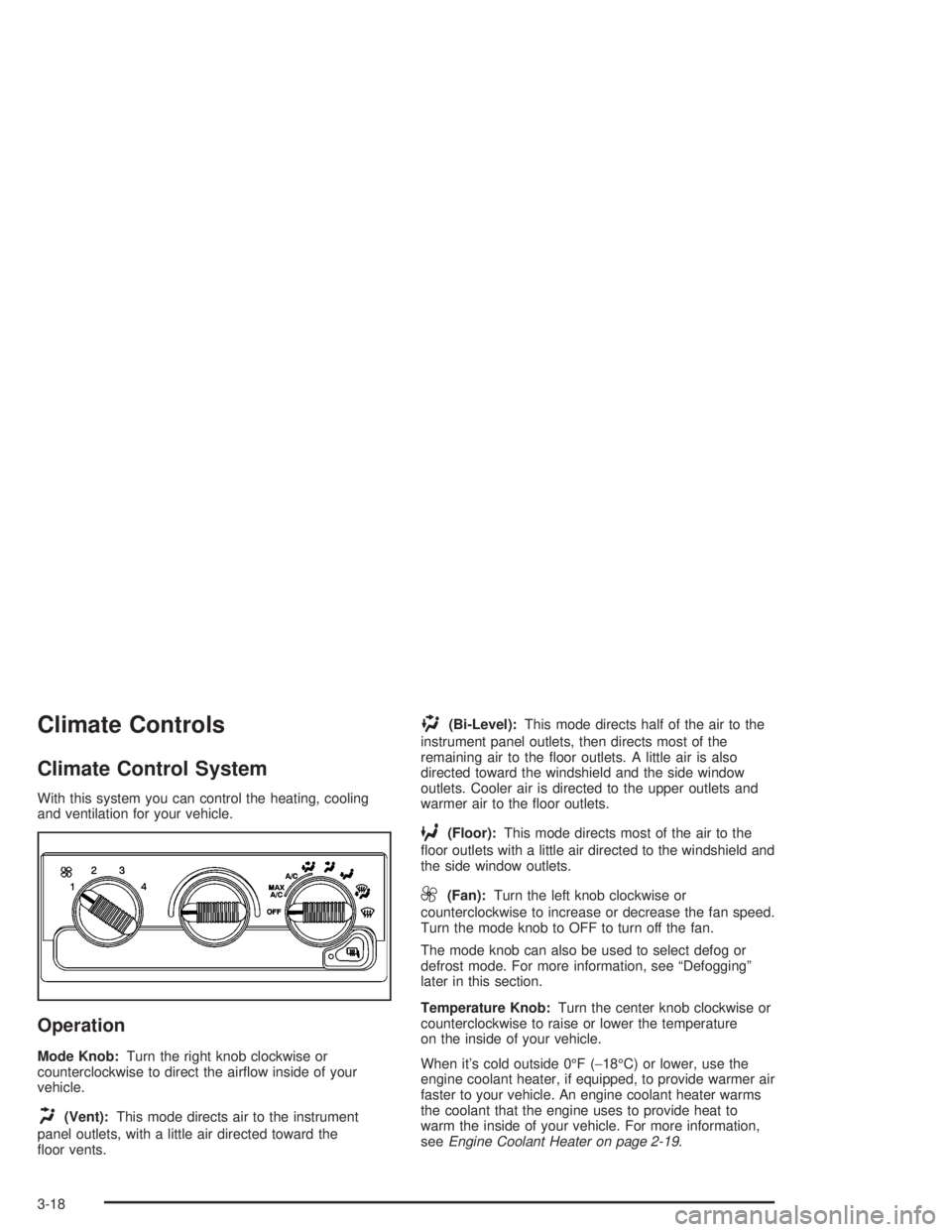
With this system you can control the heating, cooling
and ventilation for your vehicle.
Operation
Mode Knob:Turn the right knob clockwise or
counterclockwise to direct the airflow inside of your
vehicle.
H(Vent):This mode directs air to the instrument
panel outlets, with a little air directed toward the
floor vents.
)(Bi-Level):This mode directs half of the air to the
instrument panel outlets, then directs most of the
remaining air to the floor outlets. A little air is also
directed toward the windshield and the side window
outlets. Cooler air is directed to the upper outlets and
warmer air to the floor outlets.
6(Floor):This mode directs most of the air to the
floor outlets with a little air directed to the windshield and
the side window outlets.
9(Fan):Turn the left knob clockwise or
counterclockwise to increase or decrease the fan speed.
Turn the mode knob to OFF to turn off the fan.
The mode knob can also be used to select defog or
defrost mode. For more information, see “Defogging”
later in this section.
Temperature Knob:Turn the center knob clockwise or
counterclockwise to raise or lower the temperature
on the inside of your vehicle.
When it’s cold outside 0°F (−18°C) or lower, use the
engine coolant heater, if equipped, to provide warmer air
faster to your vehicle. An engine coolant heater warms
the coolant that the engine uses to provide heat to
warm the inside of your vehicle. For more information,
seeEngine Coolant Heater on page 2-19.
3-18
Page 242 of 412
When towing a trailer, the arrows on your instrument
panel will flash for turns even if the bulbs on the trailer
are burned out. Thus, you may think drivers behind
you are seeing your signal when they are not. It’s
important to check occasionally to be sure the trailer
bulbs are still working.
Driving On Grades
Reduce speed and shift to a lower gear before you start
down a long or steep downgrade. If you don’t shift
down, you might have to use your brakes so much that
they would get hot and no longer work well.
You should use THIRD (3) when towing a trailer.
Operating your vehicle in THIRD (3) when towing a
trailer will minimize heat buildup and extend the life of
your transmission.
When towing at high altitude on steep uphill grades,
consider the following: Engine coolant will boil at a lower
temperature than at normal altitudes. If you turn your
engine off immediately after towing at high altitude
on steep uphill grades, your vehicle may show signs
similar to engine overheating. To avoid this, let the
engine run while parked (preferably on level ground)
with the automatic transmission in PARK (P) (or
the manual transmission out of gear and the parking
brake applied) for a few minutes before turning the
engine off. If you do get the overheat warning,
seeEngine Overheating on page 5-26.
Parking on Hills
{CAUTION:
You really should not park your vehicle, with a
trailer attached, on a hill. If something goes
wrong, your rig could start to move. People
can be injured, and both your vehicle and the
trailer can be damaged.
But if you ever have to park your rig on a hill, here’s
how to do it:
1. Apply your regular brakes, but don’t shift into
PARK (P) yet, or into gear for a manual
transmission. When parking uphill, turn your wheels
away from the curb. When parking downhill, turn
your wheels into the curb.
2. Have someone place chocks under the
trailer wheels.
3. When the wheel chocks are in place, release the
regular brakes until the chocks absorb the load.
4-62
Page 257 of 412
A. Battery. SeeBattery on page 5-40for more
information.
B. Coolant Recovery Tank. SeeEngine Coolant on
page 5-23for more information.
C. Engine Oil Dipstick. SeeEngine Oil on page 5-13for
more information.
D. Engine Oil Fill. SeeEngine Oil on page 5-13for
more information.
E. Automatic Transmission Dipstick. SeeAutomatic
Transmission Fluid on page 5-19for more
information.
F. Power Steering Reservoir. SeePower Steering Fluid
on page 5-35for more information.
G. Brake Master Cylinder Reservoir. SeeBrakes on
page 5-37for more information.
H. Engine Air Cleaner/Filter. SeeEngine Air
Cleaner/Filter on page 5-18for more information.
I. Engine Compartment Fuse Block. SeeFuses
and Circuit Breakers on page 5-95for more
information.
J. Windshield Washer Fluid Reservoir. SeeWindshield
Washer Fluid on page 5-36for more information.Engine Oil
Checking Engine Oil
It is a good idea to check your engine oil every time you
get fuel. In order to get an accurate reading, the oil
must be warm and the vehicle must be on level ground.
The engine oil dipstick handle is a yellow loop. See
Engine Compartment Overview on page 5-12for
the location of the engine oil dipstick.
Turn off the engine and give the oil several minutes to
drain back into the oil pan. If you do not do this, the
oil dipstick might not show the actual level.
5-13
Page 269 of 412
Checking Coolant
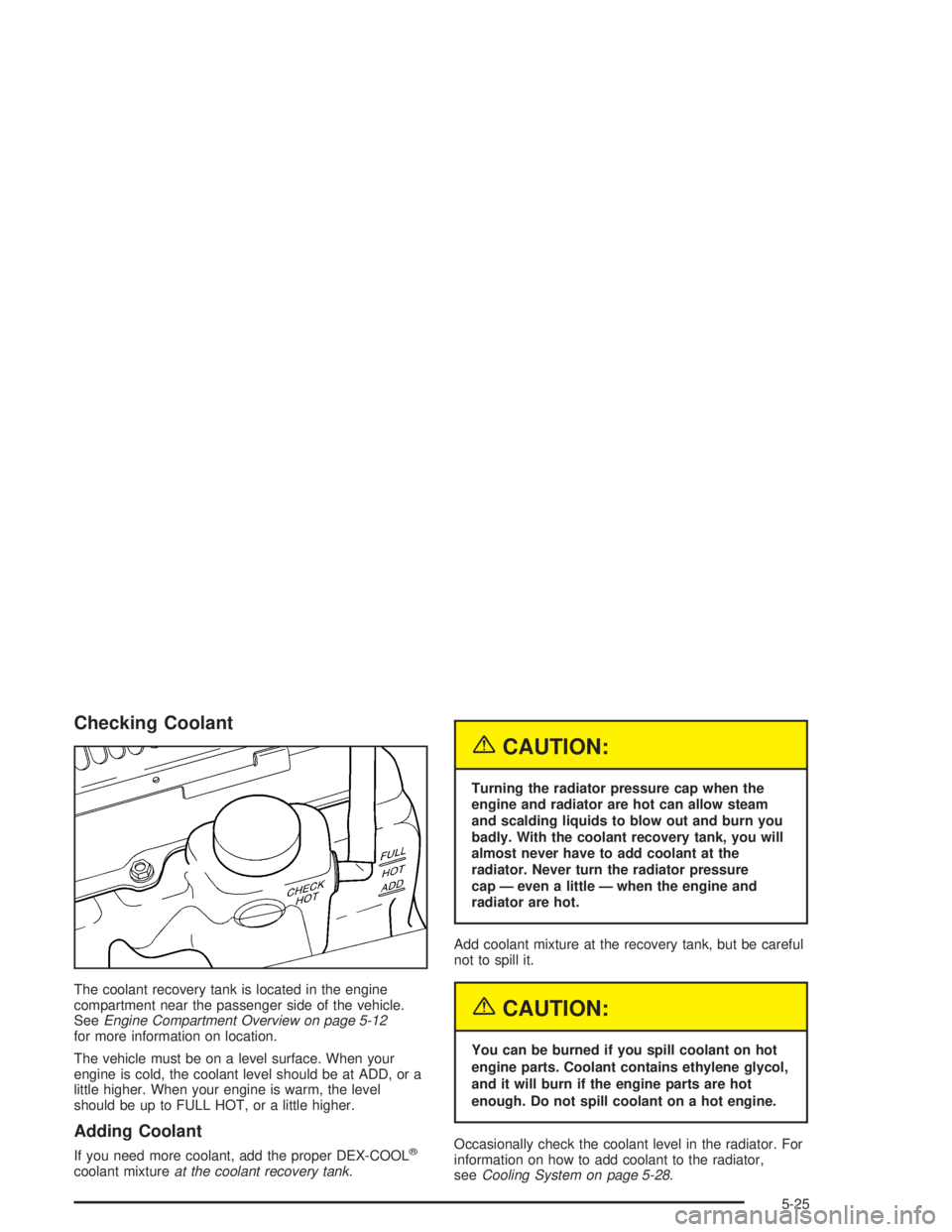
The coolant recovery tank is located in the engine
compartment near the passenger side of the vehicle.
SeeEngine Compartment Overview on page 5-12
for more information on location.
The vehicle must be on a level surface. When your
engine is cold, the coolant level should be at ADD, or a
little higher. When your engine is warm, the level
should be up to FULL HOT, or a little higher.
Adding Coolant
If you need more coolant, add the proper DEX-COOL®
coolant mixtureat the coolant recovery tank.
{CAUTION:
Turning the radiator pressure cap when the
engine and radiator are hot can allow steam
and scalding liquids to blow out and burn you
badly. With the coolant recovery tank, you will
almost never have to add coolant at the
radiator. Never turn the radiator pressure
cap — even a little — when the engine and
radiator are hot.
Add coolant mixture at the recovery tank, but be careful
not to spill it.
{CAUTION:
You can be burned if you spill coolant on hot
engine parts. Coolant contains ethylene glycol,
and it will burn if the engine parts are hot
enough. Do not spill coolant on a hot engine.
Occasionally check the coolant level in the radiator. For
information on how to add coolant to the radiator,
seeCooling System on page 5-28.
5-25
Page 272 of 412
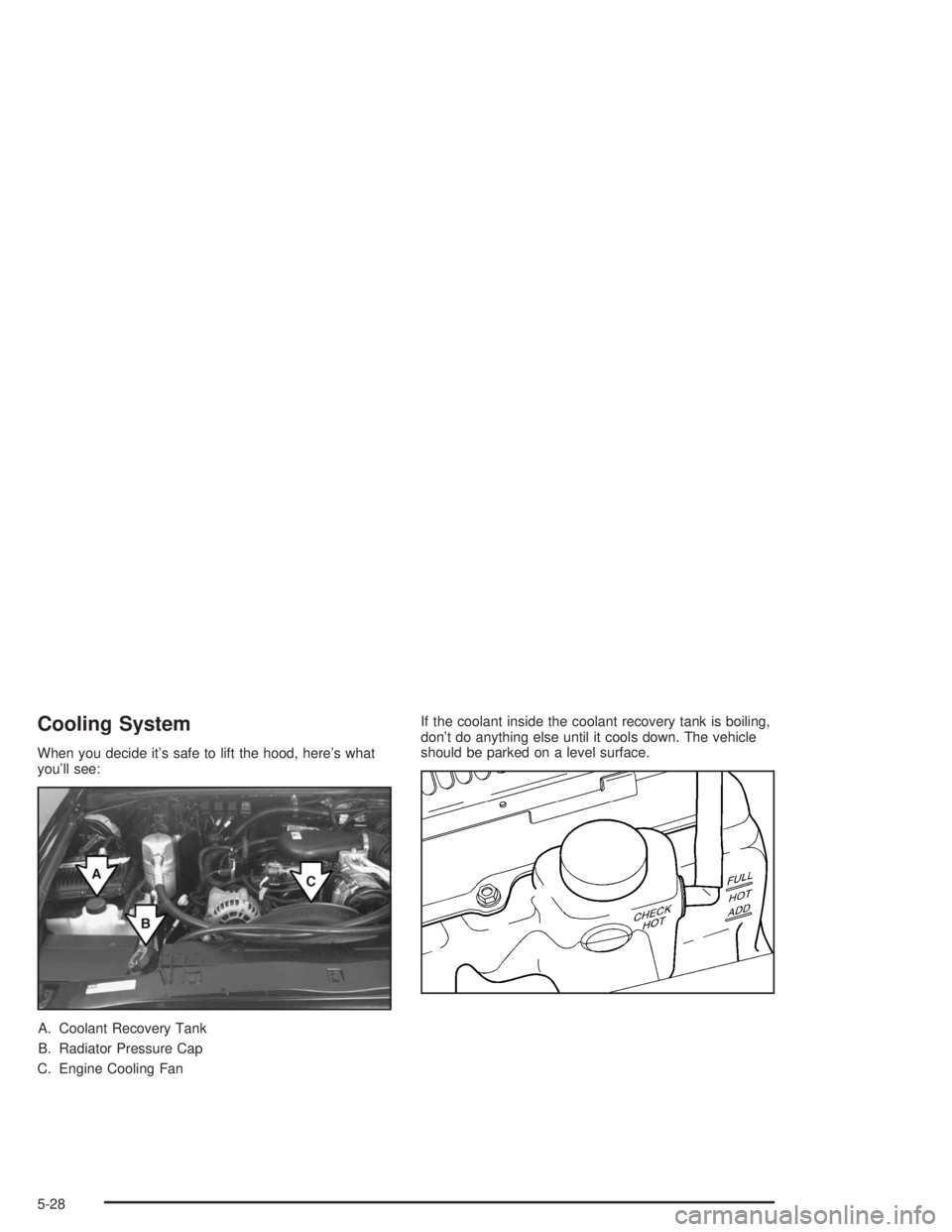
Cooling System
When you decide it’s safe to lift the hood, here’s what
you’ll see:
A. Coolant Recovery Tank
B. Radiator Pressure Cap
C. Engine Cooling FanIf the coolant inside the coolant recovery tank is boiling,
don’t do anything else until it cools down. The vehicle
should be parked on a level surface.
5-28
Page 273 of 412
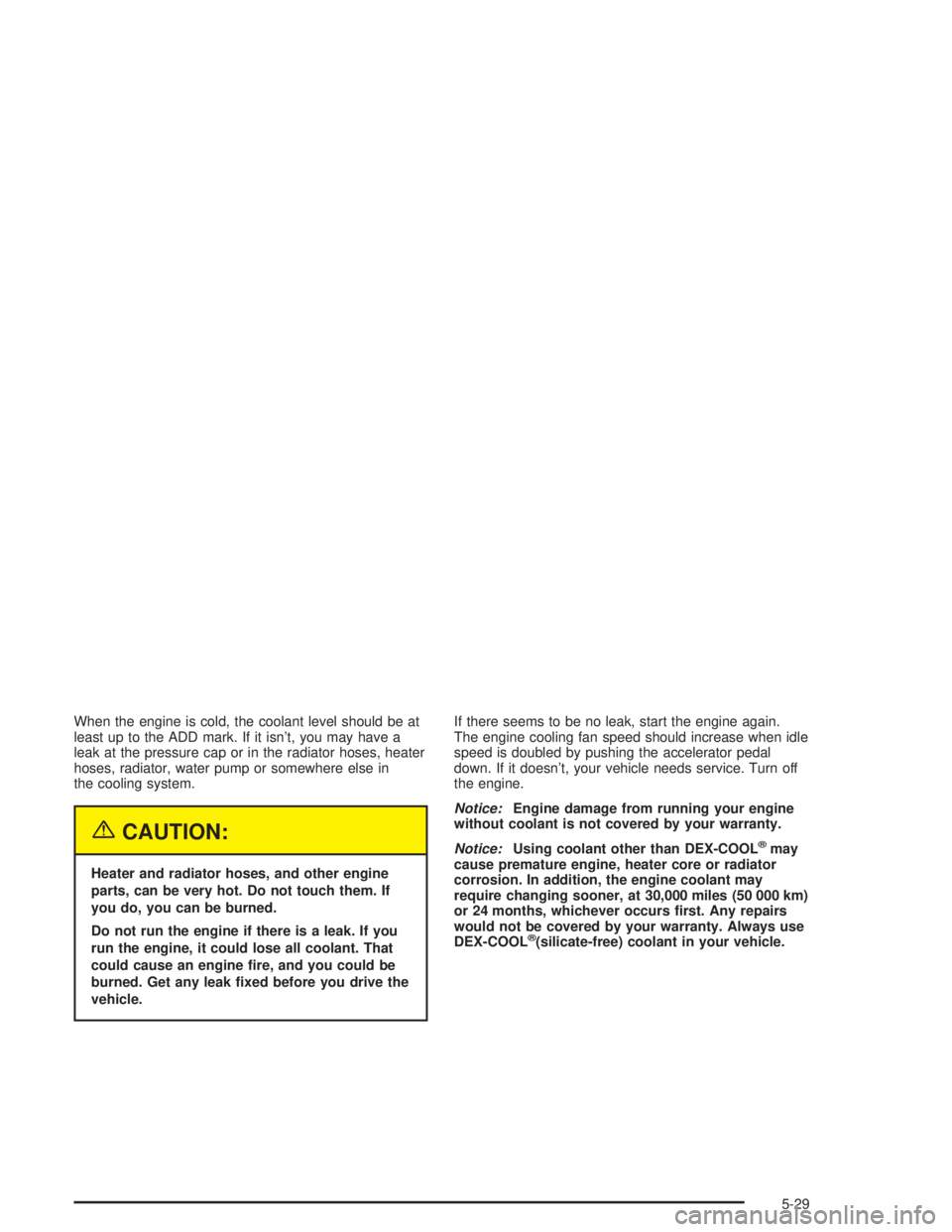
When the engine is cold, the coolant level should be at
least up to the ADD mark. If it isn’t, you may have a
leak at the pressure cap or in the radiator hoses, heater
hoses, radiator, water pump or somewhere else in
the cooling system.
{CAUTION:
Heater and radiator hoses, and other engine
parts, can be very hot. Do not touch them. If
you do, you can be burned.
Do not run the engine if there is a leak. If you
run the engine, it could lose all coolant. That
could cause an engine re, and you could be
burned. Get any leak xed before you drive the
vehicle.If there seems to be no leak, start the engine again.
The engine cooling fan speed should increase when idle
speed is doubled by pushing the accelerator pedal
down. If it doesn’t, your vehicle needs service. Turn off
the engine.
Notice:Engine damage from running your engine
without coolant is not covered by your warranty.
Notice:Using coolant other than DEX-COOL
®may
cause premature engine, heater core or radiator
corrosion. In addition, the engine coolant may
require changing sooner, at 30,000 miles (50 000 km)
or 24 months, whichever occurs rst. Any repairs
would not be covered by your warranty. Always use
DEX-COOL
®(silicate-free) coolant in your vehicle.
5-29
Page 274 of 412
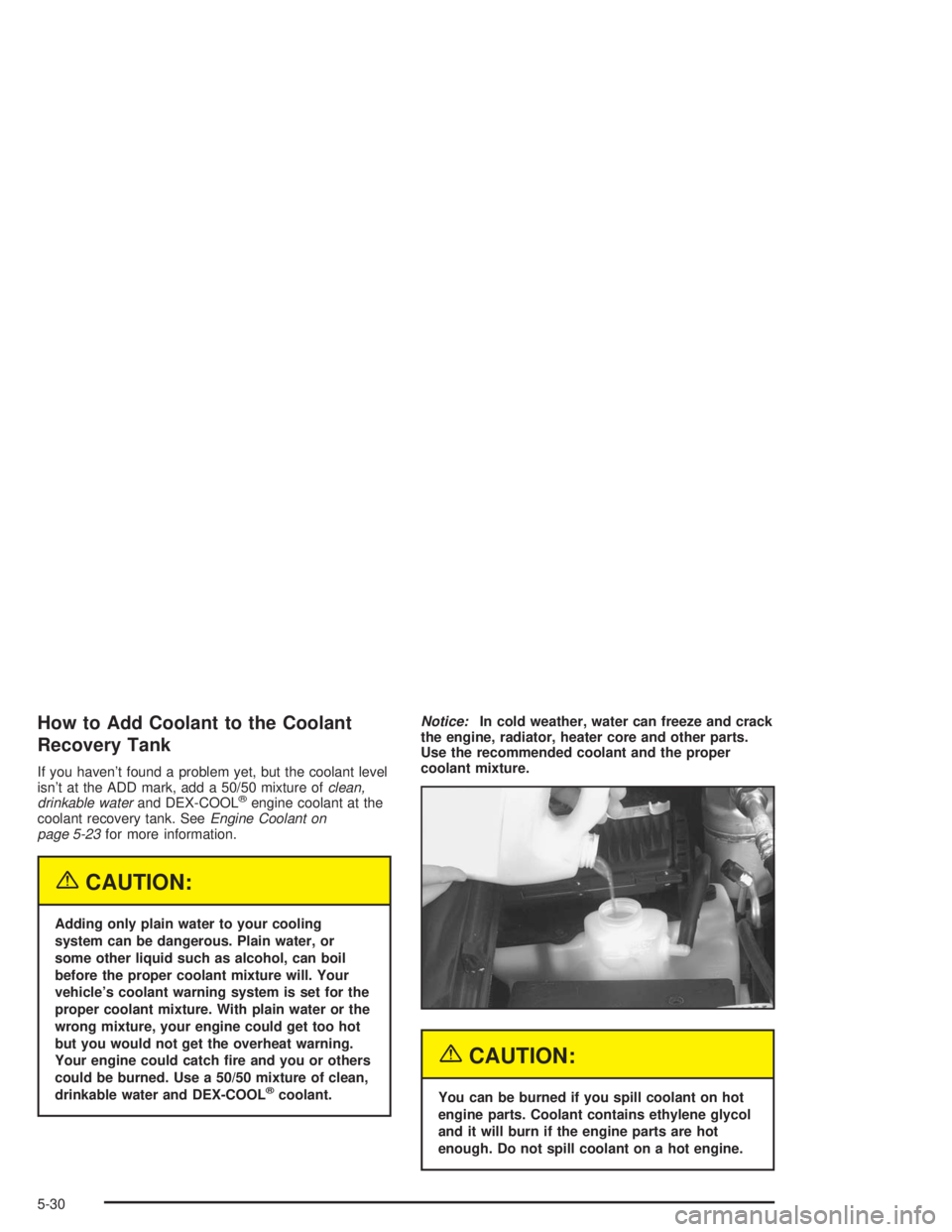
How to Add Coolant to the Coolant
Recovery Tank
If you haven’t found a problem yet, but the coolant level
isn’t at the ADD mark, add a 50/50 mixture ofclean,
drinkable waterand DEX-COOL
®engine coolant at the
coolant recovery tank. SeeEngine Coolant on
page 5-23for more information.
{CAUTION:
Adding only plain water to your cooling
system can be dangerous. Plain water, or
some other liquid such as alcohol, can boil
before the proper coolant mixture will. Your
vehicle’s coolant warning system is set for the
proper coolant mixture. With plain water or the
wrong mixture, your engine could get too hot
but you would not get the overheat warning.
Your engine could catch re and you or others
could be burned. Use a 50/50 mixture of clean,
drinkable water and DEX-COOL
®coolant.Notice:In cold weather, water can freeze and crack
the engine, radiator, heater core and other parts.
Use the recommended coolant and the proper
coolant mixture.
{CAUTION:
You can be burned if you spill coolant on hot
engine parts. Coolant contains ethylene glycol
and it will burn if the engine parts are hot
enough. Do not spill coolant on a hot engine.
5-30
Page 278 of 412
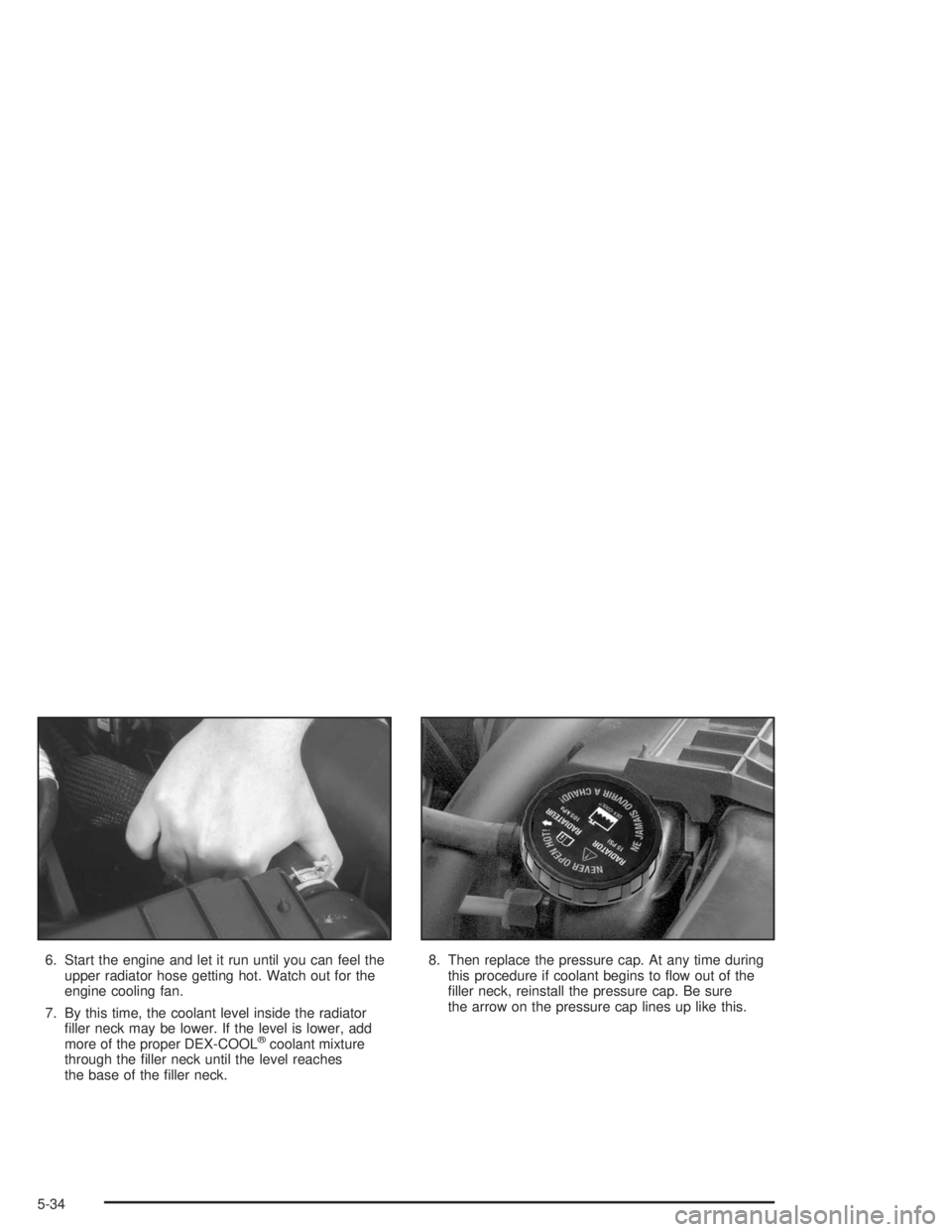
6. Start the engine and let it run until you can feel the
upper radiator hose getting hot. Watch out for the
engine cooling fan.
7. By this time, the coolant level inside the radiator
filler neck may be lower. If the level is lower, add
more of the proper DEX-COOL
®coolant mixture
through the filler neck until the level reaches
the base of the filler neck.8. Then replace the pressure cap. At any time during
this procedure if coolant begins to flow out of the
filler neck, reinstall the pressure cap. Be sure
the arrow on the pressure cap lines up like this.
5-34
Page 280 of 412
How to Check Power Steering Fluid
Turn the key off, let the engine compartment cool down,
wipe the cap and the top of the reservoir clean, then
unscrew the cap and wipe the dipstick with a clean rag.
Replace the cap and completely tighten it. Then remove
the cap again and look at the fluid level on the dipstick.
The level should be between the ADD and FULL marks.
If necessary, add only enough fluid to bring the level
up to the proper range.
What to Use
To determine what kind of fluid to use, seePart D:
Recommended Fluids and Lubricants on page 6-32.
Always use the proper fluid. Failure to use the proper
fluid can cause leaks and damage hoses and seals.
Windshield Washer Fluid
What to Use
When you need windshield washer fluid, be sure to read
the manufacturer’s instructions before use. If you will
be operating your vehicle in an area where the
temperature may fall below freezing, use a fluid that has
sufficient protection against freezing. SeeEngine
Compartment Overview on page 5-12for reservoir
location.
Adding Washer Fluid
Open the cap with the
washer symbol on it.
SeeEngine Compartment Overview on page 5-12for
more information on locationt. Add washer fluid until the
tank is full.
Notice:
When using concentrated washer uid, follow
the manufacturer’s instructions for adding water.
Do not mix water with ready-to-use washer uid.
Water can cause the solution to freeze and
damage your washer uid tank and other parts of
the washer system. Also, water does not clean as
well as washer uid.
Fill your washer uid tank only three-quarters full
when it is very cold. This allows for expansion if
freezing occurs, which could damage the tank if
it is completely full.
Do not use engine coolant (antifreeze) in your
windshield washer. It can damage your washer
system and paint.
5-36
Page 363 of 412
99,000 Miles (165 000 km)
❑Change engine oil and filter (or every 3 months,
whichever occurs first).An Emission Control Service.
❑Lubricate chassis components (or every 3 months,
whichever occurs first).(See footnote #.)
❑Check rear/front axle fluid level and add fluid as
needed. Check constant velocity joints and axle seals
for leaking.(See footnote **.)
100,000 Miles (166 000 km)
❑Inspect spark plug wires.An Emission Control
Service.
❑Replace spark plugs.An Emission Control Service.
❑If you have not used your vehicle under severe
service conditions listed previously and, therefore,
have not changed your automatic transmission fluid,
change both the fluid and filter.
❑Inspect Positive Crankcase Ventilation (PCV) valve.
An Emission Control Service.
150,000 Miles (240 000 km)
❑Drain, flush and refill cooling system (or every
60 months since last service, whichever occurs first).
SeeEngine Coolant on page 5-23for what to use.
Inspect hoses. Clean radiator, condenser, pressure
cap and neck. Pressure test cooling system and
pressure cap.An Emission Control Service.
❑Inspect engine accessory drive belt.An Emission
Control Service.
Long Trip/Highway Scheduled
Maintenance
The services shown in this schedule up to 100,000 miles
(166 000 km) should be repeated after 100,000 miles
(166 000 km) at the same intervals for the life of
this vehicle. The services shown at 150,000 miles
(240 000 km) should be repeated at the same interval
after 150,000 miles (240 000 km) for the life of this
vehicle.
SeePart B: Owner Checks and Services on page 6-25
andPart C: Periodic Maintenance Inspections on
page 6-30.
Footnotes
†The U.S. Environmental Protection Agency or the
California Air Resources Board has determined that the
failure to perform this maintenance item will not nullify
the emission warranty or limit recall liability prior to
the completion of the vehicle’s useful life. We, however,
urge that all recommended maintenance services be
performed at the indicated intervals and the
maintenance be recorded.
#Lubricate the front suspension, ball joints, steering
linkage, parking brake cable guides, propshaft splines,
universal joints, constant velocity joint and brake
pedal springs.
6-17