tire monitor GMC TERRAIN 2010 User Guide
[x] Cancel search | Manufacturer: GMC, Model Year: 2010, Model line: TERRAIN, Model: GMC TERRAIN 2010Pages: 410, PDF Size: 2.55 MB
Page 334 of 410
9-60 Vehicle Care
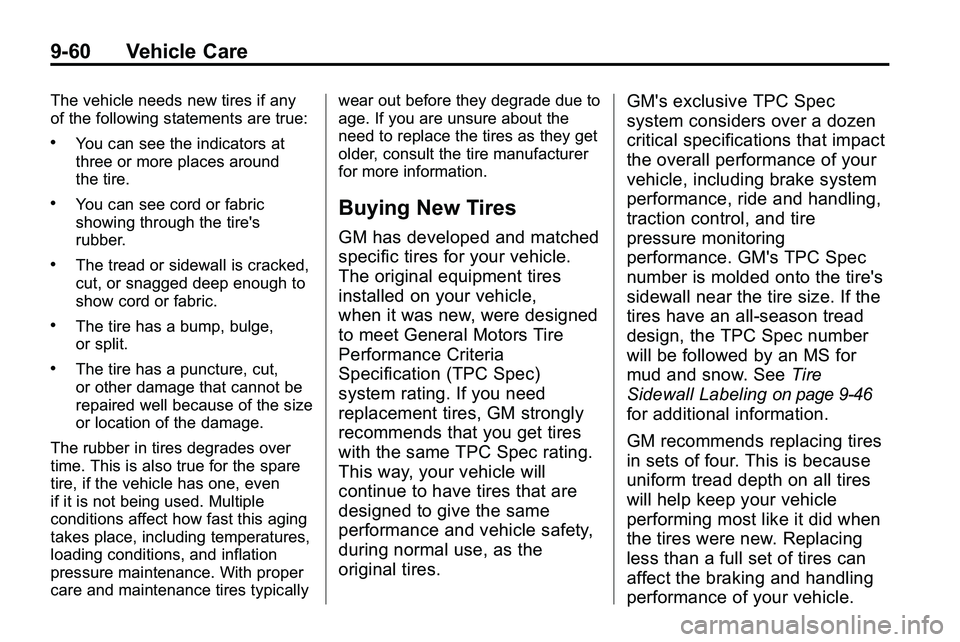
The vehicle needs new tires if any
of the following statements are true:
.You can see the indicators at
three or more places around
the tire.
.You can see cord or fabric
showing through the tire's
rubber.
.The tread or sidewall is cracked,
cut, or snagged deep enough to
show cord or fabric.
.The tire has a bump, bulge,
or split.
.The tire has a puncture, cut,
or other damage that cannot be
repaired well because of the size
or location of the damage.
The rubber in tires degrades over
time. This is also true for the spare
tire, if the vehicle has one, even
if it is not being used. Multiple
conditions affect how fast this aging
takes place, including temperatures,
loading conditions, and inflation
pressure maintenance. With proper
care and maintenance tires typically wear out before they degrade due to
age. If you are unsure about the
need to replace the tires as they get
older, consult the tire manufacturer
for more information.
Buying New Tires
GM has developed and matched
specific tires for your vehicle.
The original equipment tires
installed on your vehicle,
when it was new, were designed
to meet General Motors Tire
Performance Criteria
Specification (TPC Spec)
system rating. If you need
replacement tires, GM strongly
recommends that you get tires
with the same TPC Spec rating.
This way, your vehicle will
continue to have tires that are
designed to give the same
performance and vehicle safety,
during normal use, as the
original tires.
GM's exclusive TPC Spec
system considers over a dozen
critical specifications that impact
the overall performance of your
vehicle, including brake system
performance, ride and handling,
traction control, and tire
pressure monitoring
performance. GM's TPC Spec
number is molded onto the tire's
sidewall near the tire size. If the
tires have an all‐season tread
design, the TPC Spec number
will be followed by an MS for
mud and snow. See
Tire
Sidewall Labeling
on page 9‑46
for additional information.
GM recommends replacing tires
in sets of four. This is because
uniform tread depth on all tires
will help keep your vehicle
performing most like it did when
the tires were new. Replacing
less than a full set of tires can
affect the braking and handling
performance of your vehicle.
Page 335 of 410
Vehicle Care 9-61
SeeTire Inspectionon page 9‑58
andTire Rotationon page 9‑58
for information on proper tire
rotation.
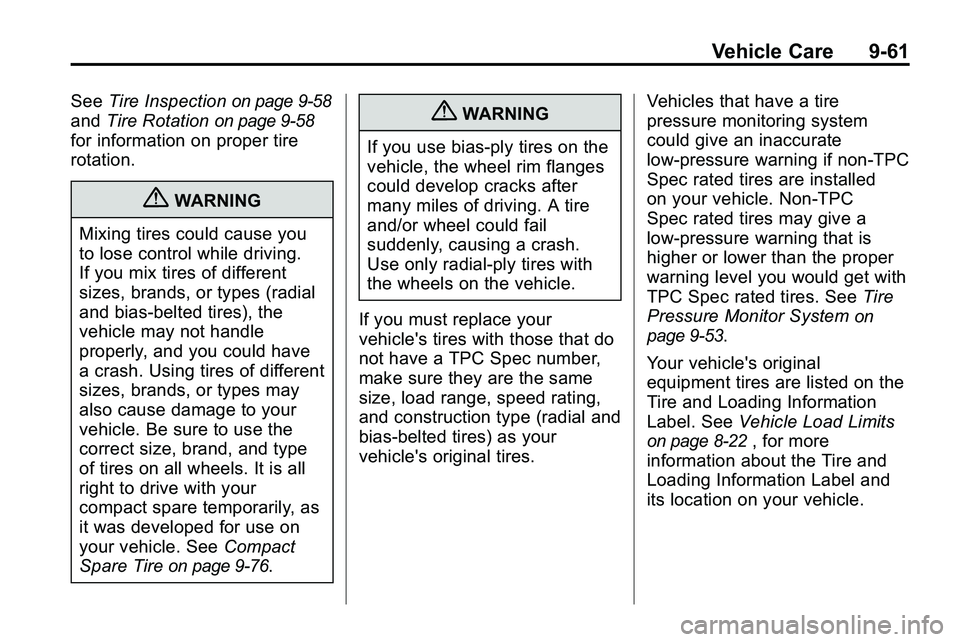
{WARNING
Mixing tires could cause you
to lose control while driving.
If you mix tires of different
sizes, brands, or types (radial
and bias-belted tires), the
vehicle may not handle
properly, and you could have
a crash. Using tires of different
sizes, brands, or types may
also cause damage to your
vehicle. Be sure to use the
correct size, brand, and type
of tires on all wheels. It is all
right to drive with your
compact spare temporarily, as
it was developed for use on
your vehicle. See Compact
Spare Tire
on page 9‑76.
{WARNING
If you use bias-ply tires on the
vehicle, the wheel rim flanges
could develop cracks after
many miles of driving. A tire
and/or wheel could fail
suddenly, causing a crash.
Use only radial-ply tires with
the wheels on the vehicle.
If you must replace your
vehicle's tires with those that do
not have a TPC Spec number,
make sure they are the same
size, load range, speed rating,
and construction type (radial and
bias‐belted tires) as your
vehicle's original tires. Vehicles that have a tire
pressure monitoring system
could give an inaccurate
low‐pressure warning if non‐TPC
Spec rated tires are installed
on your vehicle. Non‐TPC
Spec rated tires may give a
low‐pressure warning that is
higher or lower than the proper
warning level you would get with
TPC Spec rated tires. See
Tire
Pressure Monitor System
on
page 9‑53
.
Your vehicle's original
equipment tires are listed on the
Tire and Loading Information
Label. See Vehicle Load Limits
on page 8‑22, for more
information about the Tire and
Loading Information Label and
its location on your vehicle.
Page 339 of 410

Vehicle Care 9-65
Wheel Replacement
Replace any wheel that is bent,
cracked, or badly rusted or
corroded. If wheel nuts keep coming
loose, the wheel, wheel bolts, and
wheel nuts should be replaced.
If the wheel leaks air, replace it
(except some aluminum wheels,
which can sometimes be repaired).
See your dealer/retailer if any of
these conditions exist.
Your dealer/retailer will know the
kind of wheel you need.
Each new wheel should have the
same load-carrying capacity,
diameter, width, offset, and be
mounted the same way as the
one it replaces.If you need to replace any of the
wheels, wheel bolts, wheel nuts,
or Tire Pressure Monitor System
(TPMS) sensors, replace them only
with new GM original equipment
parts. This way, you will be sure to
have the right wheel, wheel bolts,
wheel nuts, and TPMS sensors for
the vehicle.
{WARNING
Using the wrong replacement
wheels, wheel bolts, or wheel
nuts on your vehicle can be
dangerous. It could affect the
braking and handling of your
vehicle, make your tires lose air
and make you lose control. You
could have a collision in which
you or others could be injured.
Always use the correct wheel,
wheel bolts, and wheel nuts for
replacement.Notice:
The wrong wheel can
also cause problems with bearing
life, brake cooling, speedometer
or odometer calibration,
headlamp aim, bumper height,
vehicle ground clearance, and
tire or tire chain clearance to the
body and chassis.
See If a Tire Goes Flat
on
page 9‑67for more information.
Page 398 of 410

12-16 Customer Information
GM will not access this data or
share it with others except: with the
consent of the vehicle owner or,
if the vehicle is leased, with the
consent of the lessee; in response
to an official request of police or
similar government office; as part of
GM's defense of litigation through
the discovery process; or, as
required by law. Data that GM
collects or receives may also be
used for GM research needs or may
be made available to others for
research purposes, where a need is
shown and the data is not tied to a
specific vehicle or vehicle owner.
OnStar®
If your vehicle has OnStar and you
subscribe to the OnStar services,
please refer to the OnStar Terms
and Conditions for information on
data collection and use. See also
OnStar
®Systemon page 4‑41in
this manual for more information.
Navigation System
If your vehicle has a navigation
system, use of the system may
result in the storage of destinations,
addresses, telephone numbers, and
other trip information. Refer to the
navigation system operating manual
for information on stored data and
for deletion instructions.
Radio Frequency
Identification (RFID)
RFID technology is used in some
vehicles for functions such as tire
pressure monitoring and ignition
system security, as well as in
connection with conveniences such
as key fobs for remote door locking/
unlocking and starting, and
in-vehicle transmitters for garage
door openers. RFID technology in
GM vehicles does not use or record
personal information or link with any
other GM system containing
personal information.
Radio Frequency
Statement
This vehicle has systems that
operate on a radio frequency that
comply with Part 15 of the Federal
Communications Commission (FCC)
Rules and with RSS-210/211 of
Industry Canada.
Operation is subject to the following
two conditions:
1. The device may not cause interference.
2. The device must accept any interference received, including
interference that may cause
undesired operation of the
device.
Changes or modifications to any of
these systems by other than an
authorized service facility could void
authorization to use this equipment.
Page 405 of 410
INDEX i-7
Lights (cont.)Fog Lamps . . . . . . . . . . . . . . . . . . . 4-25
Fuel Economy . . . . . . . . . . . . . . . . 4-23
High-Beam On . . . . . . . . . . . . . . . . 4-24
High/Low Beam Changer . . . . . . 5-2
Low Fuel Warning . . . . . . . . . . . . 4-24
Safety Belt Reminders . . . . . . . . 4-14
Security . . . . . . . . . . . . . . . . . . . . . . 4-24
Tire Pressure . . . . . . . . . . . . . . . . . 4-22
Traction Control System
(TCS)/StabiliTrak
®. . . . . . . . . . 4-21
Traction Off . . . . . . . . . . . . . . . . . . . 4-21
Locks Door . . . . . . . . . . . . . . . . . . . . . . . . . . . 1-6
Power Door . . . . . . . . . . . . . . . . . . . . 1-7
Safety . . . . . . . . . . . . . . . . . . . . . . . . . 1-8
Loss of Control . . . . . . . . . . . . . . . . . 8-7
Low Fuel Warning Light . . . . . . . . 4-24
Lower Anchors and Tethers for Children (LATCH
SYSTEM) . . . . . . . . . . . . . . . . . . . . 2-49
Lumbar Adjustment . . . . . . . . . . . . . 2-5 Front Seats . . . . . . . . . . . . . . . . . . . . 2-5
M
Maintenance
Records . . . . . . . . . . . . . . . . . . . . 10-10
Maintenance Schedule Recommended Fluids andLubricants . . . . . . . . . . . . . . . . . . . 10-7
Scheduled Maintenance . . . . . . 10-2
Malfunction Indicator Lamp . . . . 4-17
Manual Mode . . . . . . . . . . . . . . . . . . 8-37
Mass Storage Media (MEM) . . . 6-24
Messages Airbag System . . . . . . . . . . . . . . . . 4-34
Anti-Theft Alarm System . . . . . . 4-34
Battery Voltage andCharging . . . . . . . . . . . . . . . . . . . . 4-29
Brake System . . . . . . . . . . . . . . . . 4-30
Compass . . . . . . . . . . . . . . . . . . . . . 4-30
Door Ajar . . . . . . . . . . . . . . . . . . . . . 4-30
Engine Cooling System . . . . . . . 4-31
Engine Oil . . . . . . . . . . . . . . . . . . . . 4-31
Engine Power . . . . . . . . . . . . . . . . 4-32
Fuel System . . . . . . . . . . . . . . . . . . 4-32 Messages (cont.)
Key and Lock . . . . . . . . . . . . . . . . . 4-33
Object Detection System . . . . . 4-33
Ride Control System . . . . . . . . . . 4-33
Safety Belt . . . . . . . . . . . . . . . . . . . . 4-34
Service Vehicle . . . . . . . . . . . . . . . 4-34
Tire . . . . . . . . . . . . . . . . . . . . . . . . . . . 4-35
Transmission . . . . . . . . . . . . . . . . . 4-35
Vehicle . . . . . . . . . . . . . . . . . . . . . . . 4-29
Vehicle Reminder . . . . . . . . . . . . . 4-36
Washer Fluid . . . . . . . . . . . . . . . . . 4-36
Mirrors Automatic DimmingRearview . . . . . . . . . . . . . . . . . . . . 1-16
Convex . . . . . . . . . . . . . . . . . . . . . . . 1-14
Heated . . . . . . . . . . . . . . . . . . . . . . . 1-15
Park Tilt . . . . . . . . . . . . . . . . . . . . . . 1-15
Power . . . . . . . . . . . . . . . . . . . . . . . . 1-15
Monitor System, Tire Pressure . . . . . . . . . . . . . . . . . . . . . 9-53
Multi-Band Antenna . . . . . . . . . . . . 6-18
Page 409 of 410
INDEX i-11
Starter Switch Check . . . . . . . . . . 9-26
Starting the Engine . . . . . . . . . . . . 8-29
Steering . . . . . . . . . . . . . . . . . . . . . . . . 8-5Fluid, Power . . . . . . . . . . . . . . . . . . 9-21
Wheel Adjustment . . . . . . . . . . . . . 4-6
Wheel Controls . . . . . . . . . . . . . . . . 4-6
Stoplamps and Back-Up Lamps
Bulb Replacement . . . . . . . . . . . . 9-34
Storage Mass Media (MEM) . . . . . . . . . . . 6-24
Storage Areas
Center Console . . . . . . . . . . . . . . . . 3-1
Convenience Net . . . . . . . . . . . . . . 3-2
Glove Box . . . . . . . . . . . . . . . . . . . . . 3-1
Instrument Panel . . . . . . . . . . . . . . 3-1
Roof Rack System . . . . . . . . . . . . . 3-2
Stuck Vehicle . . . . . . . . . . . . . . . . . . 8-22
Sun Visors . . . . . . . . . . . . . . . . . . . . . 1-18
Sunroof . . . . . . . . . . . . . . . . . . . . . . . . 1-19
Symbols . . . . . . . . . . . . . . . . . . . . . . . . . . iv
System Roof Rack . . . . . . . . . . . . . . . . . . . . . 3-2
System Check Automatic TransmissionShiftlock Control . . . . . . . . . . . . 9-27T
Tachometer . . . . . . . . . . . . . . . . . . . . 4-13
Taillamps
Bulb Replacement . . . . . . . . . . . . 9-34
Text Telephone (TTY) Users . . . 12-4
Theft-Deterrent Systems . . . . . . . 1-13 Immobilizer . . . . . . . . . . . . . . . . . . . 1-13
Time . . . . . . . . . . . . . . . . . . . . . . 4-9, 4-10
Tires Buying New Tires . . . . . . . . . . . . . 9-60
Chains . . . . . . . . . . . . . . . . . . . . . . . . 9-66
Changing . . . . . . . . . . . . . . . . . . . . . 9-69
Compact Spare . . . . . . . . . . . . . . . 9-76
Designations . . . . . . . . . . . . . . . . . 9-48
Different Size . . . . . . . . . . . . . . . . . 9-62
If a Tire Goes Flat . . . . . . . . . . . . 9-67
Inflation Monitor System . . . . . . 9-55
Inspection . . . . . . . . . . . . . . . . . . . . 9-58
Messages . . . . . . . . . . . . . . . . . . . . 4-35
Pressure Light . . . . . . . . . . . . . . . . 4-22
Pressure Monitor System . . . . . 9-53
Rotation . . . . . . . . . . . . . . . . . . . . . . 9-58
Sidewall Labeling . . . . . . . . . . . . . 9-46
Terminology andDefinitions . . . . . . . . . . . . . . . . . . . 9-49 Tires (cont.)
Uniform Tire Quality
Grading . . . . . . . . . . . . . . . . . . . . . 9-62
Wheel Alignment and Tire
Balance . . . . . . . . . . . . . . . . . . . . . 9-64
Wheel Replacement . . . . . . . . . . 9-65
When It Is Time for New Tires . . . . . . . . . . . . . . . . . . . . . . . . 9-59
Towing
Driving Characteristics . . . . . . . . 8-58
Equipment . . . . . . . . . . . . . . . . . . . . 8-65
General Information . . . . . . . . . . 8-58
Recreational Vehicle . . . . . . . . . . 9-81
Trailer . . . . . . . . . . . . . . . . . . . . . . . . 8-62
Trailer Sway Control (TSC) . . . 8-66
Vehicle . . . . . . . . . . . . . . . . . . . . . . . 9-81
Traction Control System (TCS) . . . . . . . . 8-41
Control System (TCS)/
StabiliTrak
®Light . . . . . . . . . . . . 4-21
Off Light . . . . . . . . . . . . . . . . . . . . . . 4-21
Trailer Sway Control (TSC) . . . . . . . . . . 8-66
Trailer Towing . . . . . . . . . . . . . . . . . 8-62