brakes GMC TERRAIN 2010 Owner's Guide
[x] Cancel search | Manufacturer: GMC, Model Year: 2010, Model line: TERRAIN, Model: GMC TERRAIN 2010Pages: 410, PDF Size: 2.55 MB
Page 283 of 410
Vehicle Care 9-9
A.Engine Air Cleaner/Filteron
page 9‑13.
B. Power Steering Fluid
(2.4L L4 Engine)
on page 9‑21orPower Steering Fluid
(3.0L V6 Engine) on page 9‑21.
C. Engine Oil Fill Cap. See Engine
Oil on page 9‑10.
D. Engine Cover on page 9‑9.
E. Engine Oil Dipstick (out of view). See Engine Oil on page 9‑10.
F. Brake Fluid Reservoir. See Brakes on page 9‑23. G.
Engine Compartment Fuse
Block on page 9‑39.
H. Remote Positive (+) Terminal. See Battery on page 9‑25.
I. Remote Negative (−) Terminal. See Battery on page 9‑25.
J. Battery on page 9‑25.
K. Engine Coolant Surge Tank and Pressure Cap. See Engine
Coolant on page 9‑16.
L. Windshield Washer Fluid Reservoir. See Washer Fluid
on
page 9‑22.
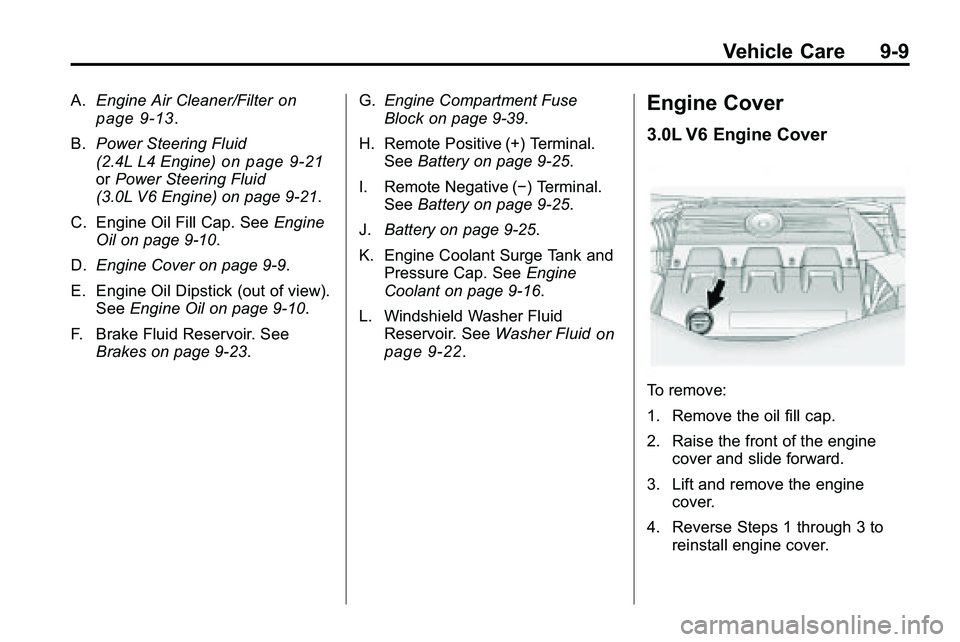
Engine Cover
3.0L V6 Engine Cover
To remove:
1. Remove the oil fill cap.
2. Raise the front of the engine
cover and slide forward.
3. Lift and remove the engine cover.
4. Reverse Steps 1 through 3 to reinstall engine cover.
Page 297 of 410
Vehicle Care 9-23
Brakes
This vehicle has disc brakes. Disc
brake pads have built-in wear
indicators that make a high-pitched
warning sound when the brake pads
are worn and new pads are needed.
The sound can come and go or be
heard all the time the vehicle is
moving, except when applying the
brake pedal firmly.
{WARNING
The brake wear warning sound
means that soon the brakes will
not work well. That could lead to
an accident. When the brake
wear warning sound is heard,
have the vehicle serviced.
Notice: Continuing to drive with
worn-out brake pads could result
in costly brake repair. Some driving conditions or climates
can cause a brake squeal when the
brakes are first applied or lightly
applied. This does not mean
something is wrong with the brakes.
Properly torqued wheel nuts are
necessary to help prevent brake
pulsation. When tires are rotated,
inspect brake pads for wear and
evenly tighten wheel nuts in the
proper sequence to torque
specifications in
Capacities and
Specifications on page 11‑2.
Brake linings should always be
replaced as complete axle sets.
Brake Pedal Travel
See your dealer/retailer if the brake
pedal does not return to normal
height, or if there is a rapid increase
in pedal travel. This could be a
sign that brake service might be
required.
Brake Adjustment
Every time the brakes are applied,
with or without the vehicle moving,
the brakes adjust for wear.
Replacing Brake System Parts
The braking system on a vehicle is
complex. Its many parts have to be
of top quality and work well together
if the vehicle is to have really good
braking. The vehicle was designed
and tested with top-quality brake
parts. When parts of the braking
system are replaced, be sure to get
new, approved replacement parts.
If this is not done, the brakes might
not work properly. For example,
installing disc brake pads that are
wrong for the vehicle, can change
the balance between the front and
rear brakes —for the worse. The
braking performance expected can
change in many other ways if the
wrong replacement brake parts are
installed.
Page 298 of 410

9-24 Vehicle Care
Brake Fluid
The brake master cylinder reservoir
is filled with DOT 3 brake fluid as
indicated on the reservoir cap. See
Engine Compartment Overview
on
page 9‑6for the location of the
reservoir.
There are only two reasons why the
brake fluid level in the reservoir
might go down:
.The brake fluid level goes down
because of normal brake lining
wear. When new linings are
installed, the fluid level goes
back up.
.A fluid leak in the brake
hydraulic system can also cause
a low fluid level. Have the brake
hydraulic system fixed, since a
leak means that sooner or later
the brakes will not work well.
Do not top off the brake fluid.
Adding fluid does not correct a leak.
If fluid is added when the linings are
worn, there will be too much fluid
when new brake linings are
installed. Add or remove brake fluid,
as necessary, only when work is
done on the brake hydraulic system.
{WARNING
If too much brake fluid is added, it
can spill on the engine and burn,
if the engine is hot enough. You
or others could be burned, and
the vehicle could be damaged.
Add brake fluid only when work is
done on the brake hydraulic
system. When the brake fluid falls to a low
level, the brake warning light comes
on. See
Brake System Warning
Light on page 4‑19.
What to Add
Use only new DOT 3 brake fluid
from a sealed container. See
Recommended Fluids and
Lubricants on page 10‑7.
Always clean the brake fluid
reservoir cap and the area around
the cap before removing it. This
helps keep dirt from entering the
reservoir.{WARNING
With the wrong kind of fluid in the
brake hydraulic system, the
brakes might not work well. This
could cause a crash. Always use
the proper brake fluid.
Page 323 of 410

Vehicle Care 9-49
Tire Terminology and
Definitions
Air Pressure:The amount of
air inside the tire pressing
outward on each square inch
of the tire. Air pressure is
expressed in psi (pounds per
square inch) or kPa (kilopascal).
Accessory Weight
:This
means the combined weight
of optional accessories.
Some examples of optional
accessories are, automatic
transmission, power steering,
power brakes, power windows,
power seats, and air
conditioning.
Aspect Ratio
:The relationship
of a tire's height to its width. Belt
:A rubber coated layer of
cords that is located between
the plies and the tread. Cords
may be made from steel or other
reinforcing materials.
Bead
:The tire bead contains
steel wires wrapped by steel
cords that hold the tire onto
the rim.
Bias Ply Tire
:A pneumatic tire
in which the plies are laid at
alternate angles less than
90 degrees to the centerline of
the tread.
Cold Tire Pressure
:The
amount of air pressure in a tire,
measured in psi (pounds per
square inch) or kPa (kilopascal)
before a tire has built up heat
from driving. See Tire Pressure
on page 9‑52. Curb Weight
:The weight of a
motor vehicle with standard and
optional equipment including the
maximum capacity of fuel, oil,
and coolant, but without
passengers and cargo.
DOT Markings
:A code molded
into the sidewall of a tire
signifying that the tire is in
compliance with the U.S.
Department of Transportation
(DOT) motor vehicle safety
standards. The DOT code
includes the Tire Identification
Number (TIN), an alphanumeric
designator which can also
identify the tire manufacturer,
production plant, brand, and
date of production.
GVWR
:Gross Vehicle Weight
Rating. See Vehicle Load Limits
on page 8‑22.
Page 336 of 410

9-62 Vehicle Care
Different Size Tires and
Wheels
If you add wheels or tires that are a
different size than your original
equipment wheels and tires, this
could affect the way your vehicle
performs, including its braking, ride
and handling characteristics,
stability, and resistance to rollover.
Additionally, if your vehicle has
electronic systems such as anti‐lock
brakes, rollover airbags, traction
control, and electronic stability
control, the performance of these
systems can be affected.
{WARNING
If you add different sized wheels,
your vehicle may not provide an
acceptable level of performance
and safety if tires not
recommended for those wheels
are selected. You may increase
the chance that you will crash and
suffer serious injury. Only use GM
specific wheel and tire systems
developed for your vehicle, and
have them properly installed by a
GM certified technician.
See Buying New Tires
on
page 9‑60and Accessories and
Modificationson page 9‑3for
additional information.
Uniform Tire Quality
Grading
Quality grades can be found
where applicable on the tire
sidewall between tread shoulder
and maximum section width.
For example:
Treadwear 200 Traction AA
Temperature A
The following information relates
to the system developed by the
United States National Highway
Traffic Safety Administration
(NHTSA), which grades tires
by treadwear, traction, and
temperature performance. This
applies only to vehicles sold in
the United States. The grades
are molded on the sidewalls
of most passenger car tires.
Page 340 of 410
9-66 Vehicle Care
Used Replacement Wheels
{WARNING
Putting a used wheel on the
vehicle is dangerous. You cannot
know how it has been used or
how far it has been driven.
It could fail suddenly and cause a
crash. If you have to replace a
wheel, use a new GM original
equipment wheel.
Tire Chains
{WARNING
Do not use tire chains. There is
not enough clearance. Tire chains
used on a vehicle without the
proper amount of clearance can
cause damage to the brakes,
suspension or other vehicle parts.
The area damaged by the tire
chains could cause you to lose
control of the vehicle and you or
others may be injured in a crash.(Continued)
WARNING (Continued)
Use another type of traction
device only if its manufacturer
recommends it for use on the
vehicle and tire size combination
and road conditions. Follow that
manufacturer's instructions. To
help avoid damage to the vehicle,
drive slowly, readjust or remove
the device if it is contacting the
vehicle, and do not spin the
vehicle's wheels. If you do find
traction devices that will fit, install
them on the front tires.
Page 394 of 410
12-12 Customer Information
Managing the Vehicle Damage
Repair Process
In the event that your vehicle
requires damage repairs, GM
recommends that you take an active
role in its repair. If you have a
pre-determined repair facility of
choice, take your vehicle there,
or have it towed there. Specify to
the facility that any required
replacement collision parts be
original equipment parts, either new
Genuine GM parts or recycled
original GM parts. Remember,
recycled parts will not be covered by
your GM vehicle warranty.
Insurance pays the bill for the repair,
but you must live with the repair.
Depending on your policy limits,
your insurance company mayinitially value the repair using
aftermarket parts. Discuss this with
your repair professional, and insist
on Genuine GM parts. Remember if
your vehicle is leased you may be
obligated to have the vehicle
repaired with Genuine GM parts,
even if your insurance coverage
does not pay the full cost.
If another party's insurance
company is paying for the repairs,
you are not obligated to accept a
repair valuation based on that
insurance company's collision policy
repair limits, as you have no
contractual limits with that company.
In such cases, you can have control
of the repair and parts choices as
long as cost stays within reasonable
limits.
Service Publications
Ordering Information
Service Manuals
Service Manuals have the diagnosis
and repair information on engines,
transmission, axle, suspension,
brakes, electrical, steering,
body, etc.
Service Bulletins
Service Bulletins give additional
technical service information
needed to knowledgeably service
General Motors cars and trucks.
Each bulletin contains instructions
to assist in the diagnosis and
service of your vehicle.
Page 400 of 410
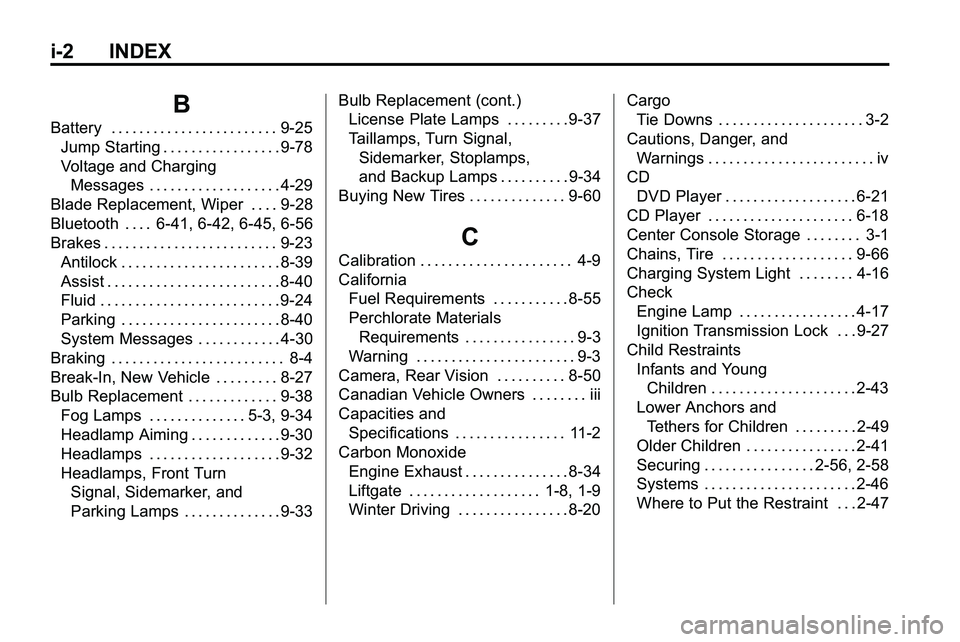
i-2 INDEX
B
Battery . . . . . . . . . . . . . . . . . . . . . . . . 9-25Jump Starting . . . . . . . . . . . . . . . . . 9-78
Voltage and ChargingMessages . . . . . . . . . . . . . . . . . . . 4-29
Blade Replacement, Wiper . . . . 9-28
Bluetooth . . . . 6-41, 6-42, 6-45, 6-56
Brakes . . . . . . . . . . . . . . . . . . . . . . . . . 9-23 Antilock . . . . . . . . . . . . . . . . . . . . . . . 8-39
Assist . . . . . . . . . . . . . . . . . . . . . . . . . 8-40
Fluid . . . . . . . . . . . . . . . . . . . . . . . . . . 9-24
Parking . . . . . . . . . . . . . . . . . . . . . . . 8-40
System Messages . . . . . . . . . . . . 4-30
Braking . . . . . . . . . . . . . . . . . . . . . . . . . 8-4
Break-In, New Vehicle . . . . . . . . . 8-27
Bulb Replacement . . . . . . . . . . . . . 9-38 Fog Lamps . . . . . . . . . . . . . . 5-3, 9-34
Headlamp Aiming . . . . . . . . . . . . . 9-30
Headlamps . . . . . . . . . . . . . . . . . . . 9-32
Headlamps, Front TurnSignal, Sidemarker, and
Parking Lamps . . . . . . . . . . . . . . 9-33 Bulb Replacement (cont.)
License Plate Lamps . . . . . . . . . 9-37
Taillamps, Turn Signal,
Sidemarker, Stoplamps,
and Backup Lamps . . . . . . . . . . 9-34
Buying New Tires . . . . . . . . . . . . . . 9-60
C
Calibration . . . . . . . . . . . . . . . . . . . . . . 4-9
California Fuel Requirements . . . . . . . . . . . 8-55
Perchlorate Materials
Requirements . . . . . . . . . . . . . . . . 9-3
Warning . . . . . . . . . . . . . . . . . . . . . . . 9-3
Camera, Rear Vision . . . . . . . . . . 8-50
Canadian Vehicle Owners . . . . . . . . iii
Capacities and Specifications . . . . . . . . . . . . . . . . 11-2
Carbon Monoxide Engine Exhaust . . . . . . . . . . . . . . . 8-34
Liftgate . . . . . . . . . . . . . . . . . . . 1-8, 1-9
Winter Driving . . . . . . . . . . . . . . . . 8-20 Cargo
Tie Downs . . . . . . . . . . . . . . . . . . . . . 3-2
Cautions, Danger, and Warnings . . . . . . . . . . . . . . . . . . . . . . . . iv
CD DVD Player . . . . . . . . . . . . . . . . . . . 6-21
CD Player . . . . . . . . . . . . . . . . . . . . . 6-18
Center Console Storage . . . . . . . . 3-1
Chains, Tire . . . . . . . . . . . . . . . . . . . 9-66
Charging System Light . . . . . . . . 4-16
Check
Engine Lamp . . . . . . . . . . . . . . . . . 4-17
Ignition Transmission Lock . . . 9-27
Child Restraints Infants and YoungChildren . . . . . . . . . . . . . . . . . . . . . 2-43
Lower Anchors and Tethers for Children . . . . . . . . . 2-49
Older Children . . . . . . . . . . . . . . . . 2-41
Securing . . . . . . . . . . . . . . . . 2-56, 2-58
Systems . . . . . . . . . . . . . . . . . . . . . . 2-46
Where to Put the Restraint . . . 2-47
Page 402 of 410
i-4 INDEX
E
ECO Button . . . . . . . . . . . . . . . . . . . 8-38
Economy ModeFuel . . . . . . . . . . . . . . . . . . . . . . . . . . 8-38
Electrical Equipment, Add-On . . . . . . . . . . . . . . . . . . . . . . 8-66
Electrical System
Engine Compartment FuseBlock . . . . . . . . . . . . . . . . . . . . . . . . 9-39
Fuses . . . . . . . . . . . . . . . . . . . . . . . . 9-38
Instrument Panel Fuse Block . . . . . . . . . . . . . . . . . . . . . . . . 9-42
Engine Air Cleaner/Filter . . . . . . . . . . . . . 9-13
Check and Service EngineSoon Lamp . . . . . . . . . . . . . . . . . . 4-17
Compartment Overview . . . . . . . . 9-6
Coolant . . . . . . . . . . . . . . . . . . . . . . . 9-16
Coolant Heater . . . . . . . . . . . . . . . 8-31
Coolant Temperature Gauge . . . . . . . . . . . . . . . . . . . . . . 4-14 Engine (cont.)
Cooling System . . . . . . . . . . . . . . . 9-15
Cooling System Messages . . . 4-31
Cover . . . . . . . . . . . . . . . . . . . . . . . . . . 9-9
Drive Belt Routing . . . . . . . . . . . . 11-4
Exhaust . . . . . . . . . . . . . . . . . . . . . . 8-34
Overheating . . . . . . . . . . . . . . . . . . 9-20
Power Messages . . . . . . . . . . . . . 4-32
Pressure Light . . . . . . . . . . . . . . . . 4-23
Running While Parked . . . . . . . . 8-34
Starting . . . . . . . . . . . . . . . . . . . . . . . 8-29
Engine Oil Life System . . . . . . . . . . . . . . . . . . . 9-12
Messages . . . . . . . . . . . . . . . . . . . . 4-31
Entry Lighting . . . . . . . . . . . . . . . . . . . 5-4
Equipment, Towing . . . . . . . . . . . . 8-65
Event Data Recorders . . . . . . . . 12-15
Extender, Safety Belt . . . . . . . . . . 2-23
Exterior Lamp Controls . . . . . . . . . 5-1
F
Filter Engine Air Cleaner . . . . . . . . . . . 9-13
Flash-to-Pass . . . . . . . . . . . . . . . . . . . 5-2
Flashers, Hazard Warning . . . . . . 5-3
Flat Tire . . . . . . . . . . . . . . . . . . . . . . . 9-67
Flat Tire, Changing . . . . . . . . . . . . 9-69
Fluid Automatic Transmission . . . . . . 9-13
Brakes . . . . . . . . . . . . . . . . . . . . . . . . 9-24
Power Steering . . . . . . . . . . . . . . . 9-21
Washer . . . . . . . . . . . . . . . . . . . . . . . 9-22
Fog Lamps Bulb Replacement . . . . . . . 5-3, 9-34
Light . . . . . . . . . . . . . . . . . . . . . . . . . . 4-25
Front Seats
Adjustment . . . . . . . . . . . . . . . . . . . . 2-3
Heated . . . . . . . . . . . . . . . . . . . . . . . . 2-7