belt GMC YUKON 2003 Service Manual
[x] Cancel search | Manufacturer: GMC, Model Year: 2003, Model line: YUKON, Model: GMC YUKON 2003Pages: 520, PDF Size: 2.92 MB
Page 74 of 520
You’ll be using the lap-shoulder belt. SeeTop Strap on
page 1-54if the child restraint has one. Be sure to
follow the instructions that came with the child restraint.
Secure the child in the child restraint when and as
the instructions say.
1. Because your vehicle has a right front passenger
air bag, always move the seat as far back as it will
go before securing a forward-facing child restraint.
SeePower Seats on page 1-4orManual Seats
on page 1-3.
If your vehicle has the passenger sensing system
and you are using a rear-facing child restraint in this
seat, make sure the frontal air bag is off. See
Passenger Sensing System on page 1-81.
When the passenger sensing system has turned off
the right front passenger’s frontal air bag, the off
indicator on the inside rearview mirror will light and
stay lit when you turn the ignition to RUN or
START.
2. Put the restraint on the seat.
3. Pick up the latch plate, and run the lap and shoulder
portions of the vehicle’s safety belt through or
around the restraint. The child restraint instructions
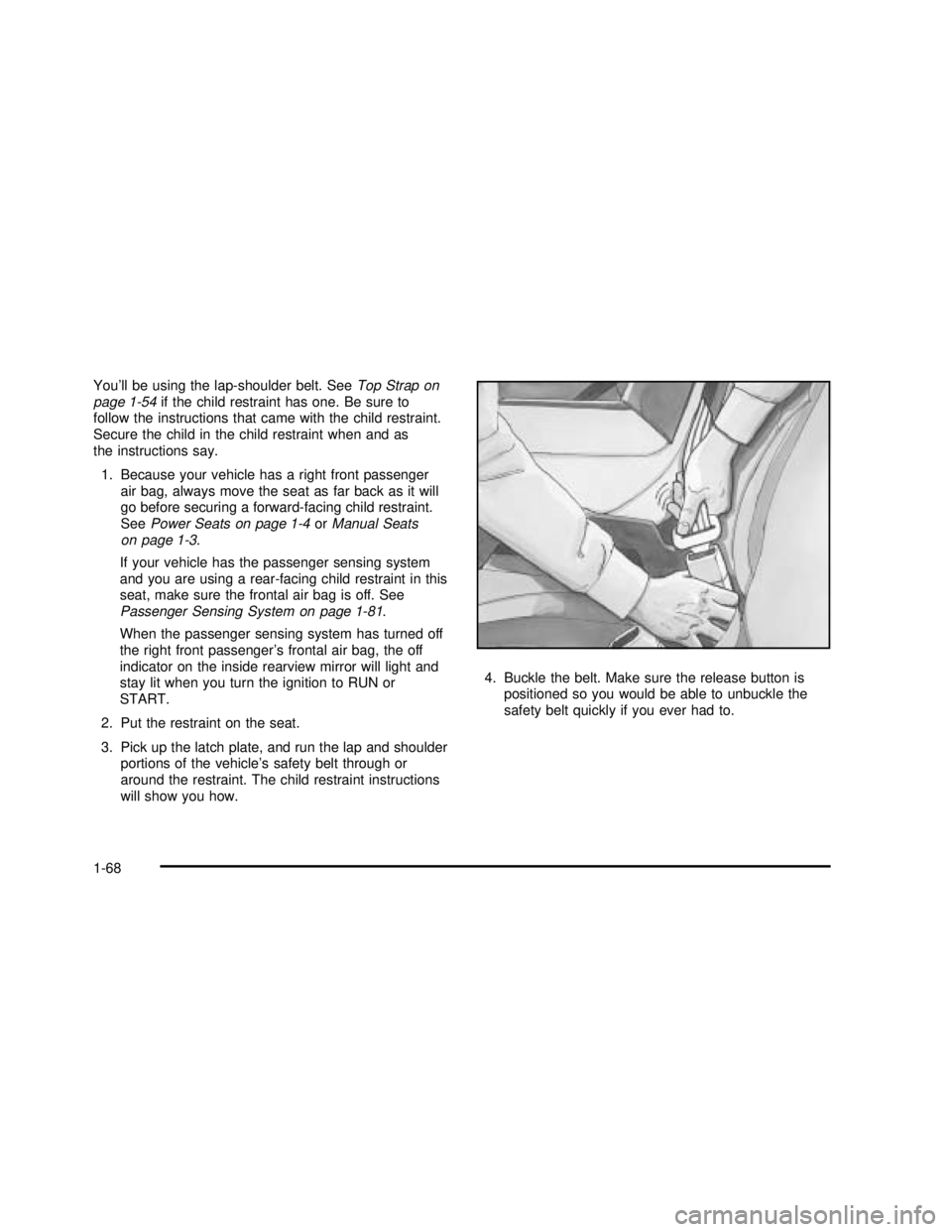
will show you how.4. Buckle the belt. Make sure the release button is
positioned so you would be able to unbuckle the
safety belt quickly if you ever had to.
1-68
2003 - Yukon/Yukon XL
Page 75 of 520
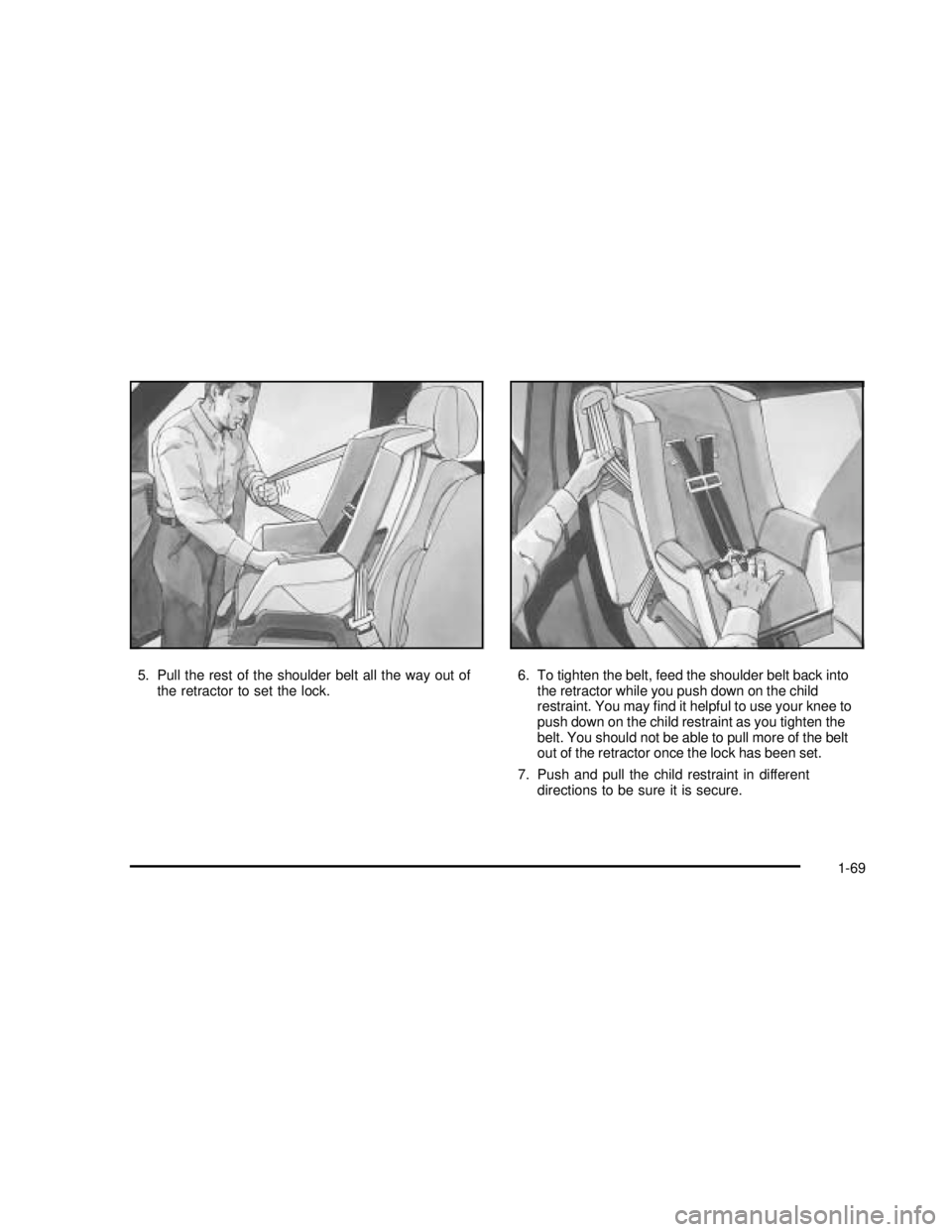
5. Pull the rest of the shoulder belt all the way out of
the retractor to set the lock.6. To tighten the belt, feed the shoulder belt back into
the retractor while you push down on the child
restraint. You mayfind it helpful to use your knee to
push down on the child restraint as you tighten the
belt. You should not be able to pull more of the belt
out of the retractor once the lock has been set.
7. Push and pull the child restraint in different
directions to be sure it is secure.
1-69
2003 - Yukon/Yukon XL
Page 76 of 520

8. If your vehicle has the passenger sensing system
and you’re using a rear-facing child restraint in this
seat, check to be sure the right front passenger’s
frontal air bag is off before you begin to drive. If the
air bag has been turned off, the off indicator will light
and stay lit when the key is turned to RUN or START.
If the on indicator is lit, the passenger’s frontal air
bag has not been turned off. If this ever happens,
turn the vehicle off, unbuckle the safety belt
and perform the steps to install the rear-facing
restraint again. After restarting the vehicle, if the air
bag still doesn’t turn off, install the infant restraint
in a rear seat position of the vehicle and have your
vehicle serviced as soon as possible.
To remove the child restraint, just unbuckle the vehicle’s
safety belt and let it go back all the way. The safety
belt will move freely again and be ready to work for an
adult or larger child passenger.Air Bag Systems
This part explains the frontal and side impact air bag
systems.
Your vehicle has air bags–a frontal air bag for the
driver and another frontal air bag for the right front
passenger. Your vehicle may also have a side impact
air bag. Side impact air bags are available for the driver
and right front passenger.
If your vehicle has a side impact air bag for the driver, the
words AIR BAG will appear on the air bag covering on the
side of the driver’s seatback closest to the door.
1-70
2003 - Yukon/Yukon XL
Page 78 of 520
Here are the most important things to know about the
air bag systems:
{CAUTION:
You can be severely injured or killed in a crash
if you aren’t wearing your safety belt — even if
you have air bags. Wearing your safety belt
during a crash helps reduce your chance of
hitting things inside the vehicle or being ejected
from it. Air bags are designed to work with
safety belts but don’t replace them.
Frontal air bags for the driver and right front
passenger are designed to deploy only in
moderate to severe frontal and near frontal
crashes. They aren’t designed to inflate at all in
rollover, rear or low-speed frontal crashes, or in
many side crashes. And, for some unrestrained
occupants, frontal air bags may provide less
protection in frontal crashes than more forceful
air bags have provided in the past.
CAUTION: (Continued)
CAUTION: (Continued)
The side impact air bags for the driver and right
front passenger are designed to inflate only in
moderate to severe crashes where something
hits the side of your vehicle. They aren’t
designed to inflate in frontal, in rollover or in
rear crashes.
Everyone in your vehicle should wear a safety
belt properly — whether or not there’s an air
bag for that person.
1-72
2003 - Yukon/Yukon XL
Page 79 of 520
{CAUTION:
Both frontal and side impact air bags inflate
with great force, faster than the blink of an
eye. If you’re too close to an inflating air bag,
as you would be if you were leaning forward, it
could seriously injure you. Safety belts help
keep you in position for air bag inflation before
and during a crash. Always wear your safety
belt, even with frontal air bags. The driver
should sit as far back as possible while still
maintaining control of the vehicle. Front
occupants should not lean on or sleep against
the door.
{CAUTION:
Anyone who is up against, or very close to,
any air bag when it inflates can be seriously
injured or killed. Air bags plus lap-shoulder
belts offer the best protection for adults, but
not for young children and infants. Neither the
vehicle’s safety belt system nor its air bag
system is designed for them. Young children
and infants need the protection that a child
restraint system can provide. Always secure
children properly in your vehicle. To read how,
see the part of this manual called “Older
Children” or “Infants and Young Children”.
1-73
2003 - Yukon/Yukon XL
Page 83 of 520

In addition, your vehicle has“dual stage”frontal air bags,
which adjust the amount of restraint according to crash
severity. For moderate frontal impacts, these air bags
inflate at a level less than full deployment. For more
severe frontal impacts, full deployment occurs. If the front
of your vehicle goes straight into a wall that doesn’t move
or deform, the threshold level for the reduced deployment
is about 10 to 16 mph (16 to 25 km/h), and the threshold
level for a full deployment is about 20 to 25 mph
(32 to 40 km/h). The threshold level can vary, however,
with specific vehicle design, so that it can be somewhat
above or below this range.
If your vehicle strikes something that will move or
deform, such as a parked car, the threshold level will be
higher. The driver’s and right front passenger’s frontal
air bags are not designed to inflate in rollovers, rear
impacts, or in many side impacts because inflation
would not help the occupant.
Seat Position Sensors
Vehicles with dual stage air bags are also equipped with
special sensors which enable the sensing system to
monitor the position of both the driver and passenger
front seats. The seat position sensor provides
information which is used to determine if the air bags
should deploy at a reduced level or at full depoyment.
Side Impact Air Bags
Your vehicle may or may not have a side impact air
bag. SeeAir Bag Systems on page 1-70. Side impact air
bags are designed to inflate in moderate to severe
side crashes. A side impact air bag will inflate if
the crash severity is above the system’s designed
“threshold level.”The threshold level can vary with
specific vehicle design. Side impact air bags are
not designed to inflate in frontal or near-frontal impacts,
rollovers or rear impacts, because inflation would not
help the occupant. A side impact air bag will only deploy
on the side of the vehicle that is struck.
Air Bag Systems
In any particular crash, no one can say whether an air
bag should have inflated simply because of the damage
to a vehicle or because of what the repair costs were.
For frontal air bags, inflation is determined by the angle
of the impact and how quickly the vehicle slows down
in frontal and near-frontal impacts. For side impact
air bags, inflation is determined by the location
and severity of the impact.
The air bag system is designed to work properly under
a wide range of conditions, including off-road usage.
Observe safe driving speeds, especially on rough
terrain. As always, wear your safety belt. See Off-Road
Driving with Your Four-Wheel Drive Vehicle in the
Index for tips on off-road driving.
1-77
2003 - Yukon/Yukon XL
Page 84 of 520

What Makes an Air Bag Inflate?
In an impact of sufficient severity, the air bag sensing
system detects that the vehicle is in a crash. For
both frontal and side impact air bags, the sensing
system triggers a release of gas from the inflator, which
inflates the air bag. The inflator, the air bag and
related hardware are all part of the air bag modules.
Frontal air bag modules are located inside the steering
wheel and instrument panel. For vehicles with side
impact air bags, the air bag modules are located in the
seatback closest to the driver’s and/or right front
passenger’s door.
HowDoes an Air Bag Restrain?
In moderate to severe frontal or near frontal collisions,
even belted occupants can contact the steering wheel or
the instrument panel. In moderate to severe side
collisions, even belted occupants can contact the inside
of the vehicle. The air bag supplements the protection
provided by safety belts. Air bags distribute the force of
the impact more evenly over the occupant’s upper
body, stopping the occupant more gradually. But thefrontal air bags would not help you in many types of
collisions, including rollovers, rear impacts, and
many side impacts, primarily because an occupant’s
motion is not toward the air bag. Side impact air bags
would not help you in many types of collisions,
including frontal or near frontal collisions, rollovers, and
rear impacts, primarily because an occupant’s motion
is not toward those air bags. Air bags should never
be regarded as anything more than a supplement to
safety belts, and then only in moderate to severe frontal
or near-frontal collisions for the driver’s and right front
passenger’s frontal air bags, and only in moderate
to severe side collisions for vehicles with a driver’s and
right front passenger’s side impact air bag.
1-78
2003 - Yukon/Yukon XL
Page 86 of 520

In many crashes severe enough to inflate an air bag,
windshields are broken by vehicle deformation.
Additional windshield breakage may also occur from the
right front passenger air bag.
•Air bags are designed to inflate only once. After an
air bag inflates, you’ll need some new parts for your
air bag system. If you don’t get them, the air bag
system won’t be there to help protect you in another
crash. A new system will include air bag modules
and possibly other parts. The service manual for your
vehicle covers the need to replace other parts.
•Your vehicle is equipped with electronic frontal
sensors which help the sensing system distinguish
between a moderate and a more severe frontal
impact. Your vehicle is also equipped with a crash
sensing and diagnostic module, which records
information about the frontal air bag system. The
module records information about the readiness of
the system and when the system commands are bag
inflation. It records the status of the driver’s safety
belt usage in a crash in which the air bag deploys or
a crash in which the air bag nearly deploys. The
module also records speed, engine RPM, brake and
throttle data.
•Let only qualified technicians work on your air bag
systems. Improper service can mean that an air bag
system won’t work properly. See your dealer for
service.
Notice:If you damage the covering for the driver’s
or the right front passenger’s air bag, or the air bag
covering on the driver’s and right front passenger’s
seatback, the bag may not work properly. You may
have to replace the air bag module in the steering
wheel, both the air bag module and the instrument
panel for the right front passenger’s air bag, or both
the air bag module and seatback for the driver’s and
right front passenger’s side impact air bag. Do not
open or break the air bag coverings.
1-80
2003 - Yukon/Yukon XL
Page 88 of 520

The passenger sensing system works with sensors that
are part of the right front passenger’s seat and safety
belt. The sensors are designed to detect the presence of
a properly-seated occupant and determine if the
passenger’s frontal air bag should be enabled (may
inflate) or not.
Accident statistics show that children are safer if they
are restrained in the rear rather than the front seat.
General Motors, therefore, recommends that child
restraints be secured in a rear seat, including an infant
riding in a rear-facing infant seat, a child riding in a
forward-facing child seat and an older child riding in a
booster seat. Never put a child in rear-facing child
restraint in the right front passenger seat unless your
vehicle has the passenger sensing system and the
passenger air bag status indicator shows off. Never put
a rear-facing child restraint in the right front passenger
seat unless the air bag is off.
{CAUTION:
A child in a rear-facing child restraint can be
seriously injured or killed if the right front
passenger’s air bag inflates. This is because
the back of the rear-facing child restraint
would be very close to the inflating air bag. Be
sure the air bag is off before using a
rear-facing child restraint in the right front seat
position.
Even though the passenger sensing system is
designed to turn off the passenger’s frontal air
bag if the system detects a rear-facing child
restraint, no system is fail-safe, and no one
can guarantee that an air bag will not deploy
under some unusual circumstance, even
though it is turned off. General Motors,
therefore, recommends that rear-facing child
restraints be secured in the rear seat whenever
possible, even if the air bag is off.
1-82
2003 - Yukon/Yukon XL
Page 89 of 520

The passenger sensing system is designed to turn off
the right front passenger’s frontal air bag if:
•the right front passenger seat is unoccupied
•the system determines that an infant is present in a
rear-facing infant seat
•the system determines that a small child is present
in a forward-facing child restraint
•the system determines that a small child is present
in a booster seat
•a right front passenger takes his/her weight off of
the seat for a period of time
•the right front passenger seat is occupied by a
smaller person, such as a child who has outgrown
child restraints
•or if there is a critical problem with the air bag
system or the passenger sensing system.
When the passenger sensing system has turned off the
passenger’s frontal air bag, the off indicator will light
and stay lit to remind you that the air bag is off.
The passenger sensing system is designed to turn off
the passenger’s frontal air bag when a rear facing infant
seat, a forward-facing child restraint or a booster seatis detected. If the child restraint has been installed and
the on indicator is lit, turn the vehicle off, remove
the child restraint from the vehicle and reinstall the
restraint following the child restraint manufacturer’s
directions and refer toSecuring a Child Restraint in the
Right Front Seat Position on page 1-66of this manual.
If after reinstalling the child restraint and restarting
the vehicle, the on indicator is still lit, secure the child in
the child restraint in a rear seat position in the vehicle
and check with your dealer.
The passenger sensing system is designed to enable
(may inflate) the right front passenger’s frontal air
bag anytime the system senses that a person of adult
size is sitting properly in the right front passenger’s seat.
When the passenger sensing system has allowed the
air bag to be enabled, the on indicator will light and stay
lit to remind you that the air bag is active.
For some children who have outgrown child restraints
and for very small adults, the passenger sensing system
may or may not turn off the right front passenger’s
frontal air bag, depending upon the person’s seating
posture and body build. Everyone in your vehicle
who has outgrown child restraints should wear a safety
belt properly—whether or not there is an air bag
for that person.
1-83
2003 - Yukon/Yukon XL