seats GMC YUKON 2004 User Guide
[x] Cancel search | Manufacturer: GMC, Model Year: 2004, Model line: YUKON, Model: GMC YUKON 2004Pages: 554, PDF Size: 5.21 MB
Page 26 of 554
Replacing the Bench Seat
{CAUTION:
If the seatback isn’t locked, it could move
forward in a sudden stop or crash. That could
cause injury to the person sitting there. Always
press rearward on the seatback to be sure it is
locked.
{CAUTION:
A seat that isn’t locked into place properly can
move around in a collision or sudden stop.
People in the vehicle could be injured. Be sure
to lock the seat into place properly when
installing it.
{CAUTION:
A safety belt that is improperly routed, not
properly attached, or twisted won’t provide the
protection needed in a crash. The person
wearing the belt could be seriously injured.
After raising the rear seatback, always check
to be sure that the safety belts are properly
routed and attached, and are not twisted.
To reinstall the full bench seat, do the following:
1. While holding the rear of the seat up, slide the front
wheels into the slots on the oor. The front latches
should lock into place. If the latches do not lock,
try tilting the rear of the seats upwards.
2. Once the latches are engaged, let the seat drop
into place. Release the lever labeled 1 to return
the seat to its upright position.
3. Push and pull on the seat to make sure it is locked
into place. The seatback cannot be raised to the
upright position unless the seat is secured to
the oor.
1-20
Page 27 of 554
Bucket Seats
If your vehicle has bucket seats, the seatbacks can be
reclined and the seats can be folded to give you
more cargo room.
Reclining the Seatbacks
On the extended models with bucket seats, the
seatbacks can be reclined. To adjust the seatback do
the following:
1. Pull forward the lever located at the base of the seat.
2. Release the lever to lock the seatback where you
want it. If you pull the lever without pushing on the
seatback, the seatback will go to an upright
position.
Folding the Seatbacks
{CAUTION:
If the seatback isn’t locked, it could move
forward in a sudden stop or crash. That could
cause injury to the person sitting there. Always
press rearward on the seatback to be sure it is
locked.
The seatbacks on the bucket seats may be folded
forward to give you more cargo space.
On extended models with rear bucket seats, the head
restraints need to be removed in order to fold the
rear seats. To do this follow these directions:
1. Lift the head restraints up until they stop.
2. Press in the button on the side of the head restraint
guide cap and lift up on the head restraint.
3. Do the same for the other cap.
The head restraint can be removed and stored in the
space provided in the folded up seat cushion.
1-21
Page 28 of 554
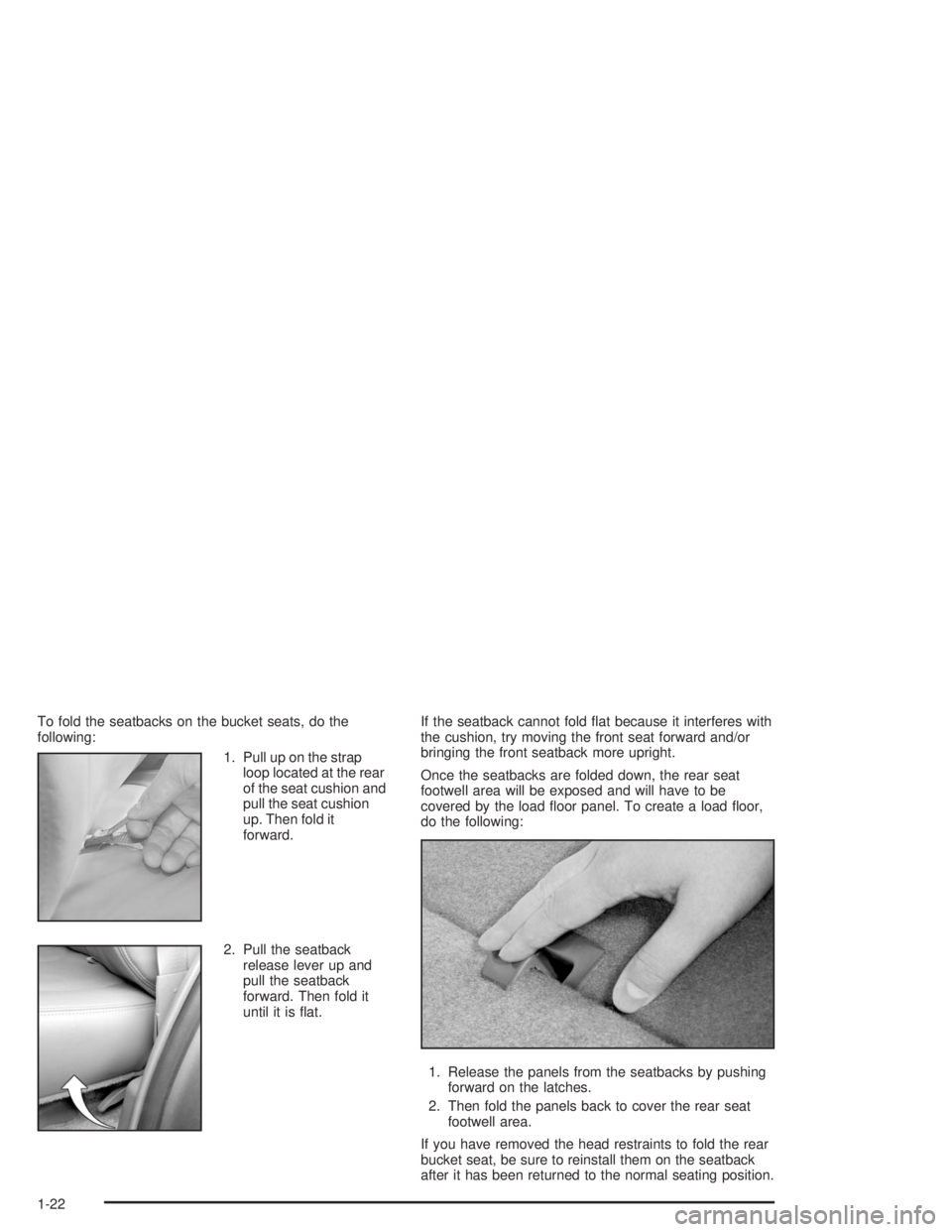
To fold the seatbacks on the bucket seats, do the
following:
1. Pull up on the strap
loop located at the rear
of the seat cushion and
pull the seat cushion
up. Then fold it
forward.
2. Pull the seatback
release lever up and
pull the seatback
forward. Then fold it
until it is at.If the seatback cannot fold at because it interferes with
the cushion, try moving the front seat forward and/or
bringing the front seatback more upright.
Once the seatbacks are folded down, the rear seat
footwell area will be exposed and will have to be
covered by the load oor panel. To create a load oor,
do the following:
1. Release the panels from the seatbacks by pushing
forward on the latches.
2. Then fold the panels back to cover the rear seat
footwell area.
If you have removed the head restraints to fold the rear
bucket seat, be sure to reinstall them on the seatback
after it has been returned to the normal seating position.
1-22
Page 29 of 554
Safety Belts
Safety Belts: They Are for Everyone
This part of the manual tells you how to use safety
belts properly. It also tells you some things you should
not do with safety belts.
{CAUTION:
Don’t let anyone ride where he or she can’t
wear a safety belt properly. If you are in a
crash and you’re not wearing a safety belt,
your injuries can be much worse. You can hit
things inside the vehicle or be ejected from it.
You can be seriously injured or killed. In the
same crash, you might not be, if you are
buckled up. Always fasten your safety belt,
and check that your passengers’ belts are
fastened properly too.
{CAUTION:
It is extremely dangerous to ride in a cargo
area, inside or outside of a vehicle. In a
collision, people riding in these areas are more
likely to be seriously injured or killed. Do not
allow people to ride in any area of your vehicle
that is not equipped with seats and safety
belts. Be sure everyone in your vehicle is in a
seat and using a safety belt properly.
Your vehicle has a light
that comes on as a
reminder to buckle up. See
Safety Belt Reminder
Light on page 3-42.
In most states and in all Canadian provinces, the law
says to wear safety belts. Here’s why:They work.
1-23
Page 35 of 554
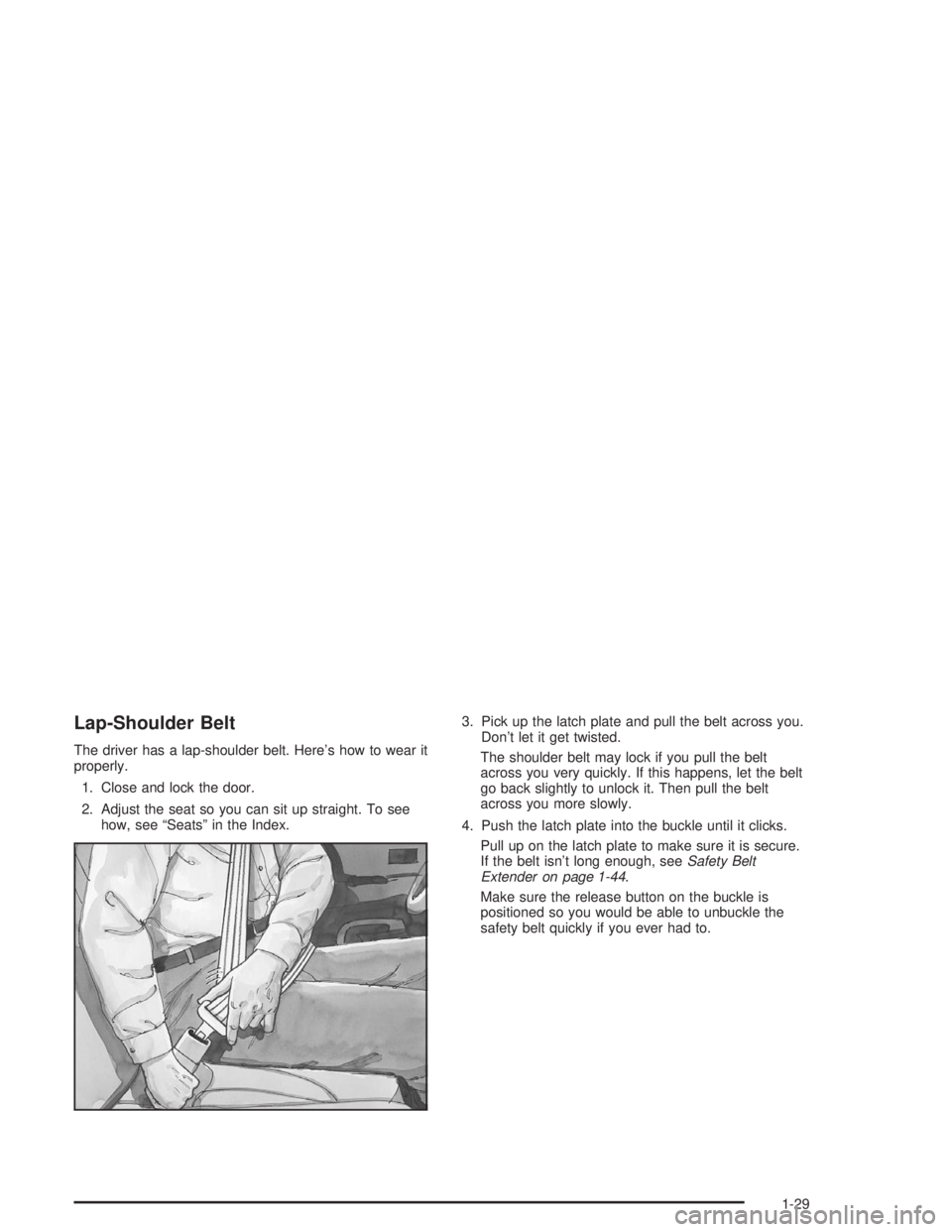
Lap-Shoulder Belt
The driver has a lap-shoulder belt. Here’s how to wear it
properly.
1. Close and lock the door.
2. Adjust the seat so you can sit up straight. To see
how, see “Seats” in the Index.3. Pick up the latch plate and pull the belt across you.
Don’t let it get twisted.
The shoulder belt may lock if you pull the belt
across you very quickly. If this happens, let the belt
go back slightly to unlock it. Then pull the belt
across you more slowly.
4. Push the latch plate into the buckle until it clicks.
Pull up on the latch plate to make sure it is secure.
If the belt isn’t long enough, seeSafety Belt
Extender on page 1-44.
Make sure the release button on the buckle is
positioned so you would be able to unbuckle the
safety belt quickly if you ever had to.
1-29
Page 43 of 554
The best way to protect the fetus is to protect the
mother. When a safety belt is worn properly, it’s more
likely that the fetus won’t be hurt in a crash. For
pregnant women, as for anyone, the key to making
safety belts effective is wearing them properly.
Right Front Passenger Position
To learn how to wear the right front passenger’s safety
belt properly, seeDriver Position on page 1-28.
The right front passenger’s safety belt works the same
way as the driver’s safety belt—except for one thing.
If you ever pull the shoulder portion of the belt out all the
way, you will engage the child restraint locking feature
which may turn off the passenger’s frontal air bag. If this
happens unintentionally, just let the belt go back all
the way and start again.
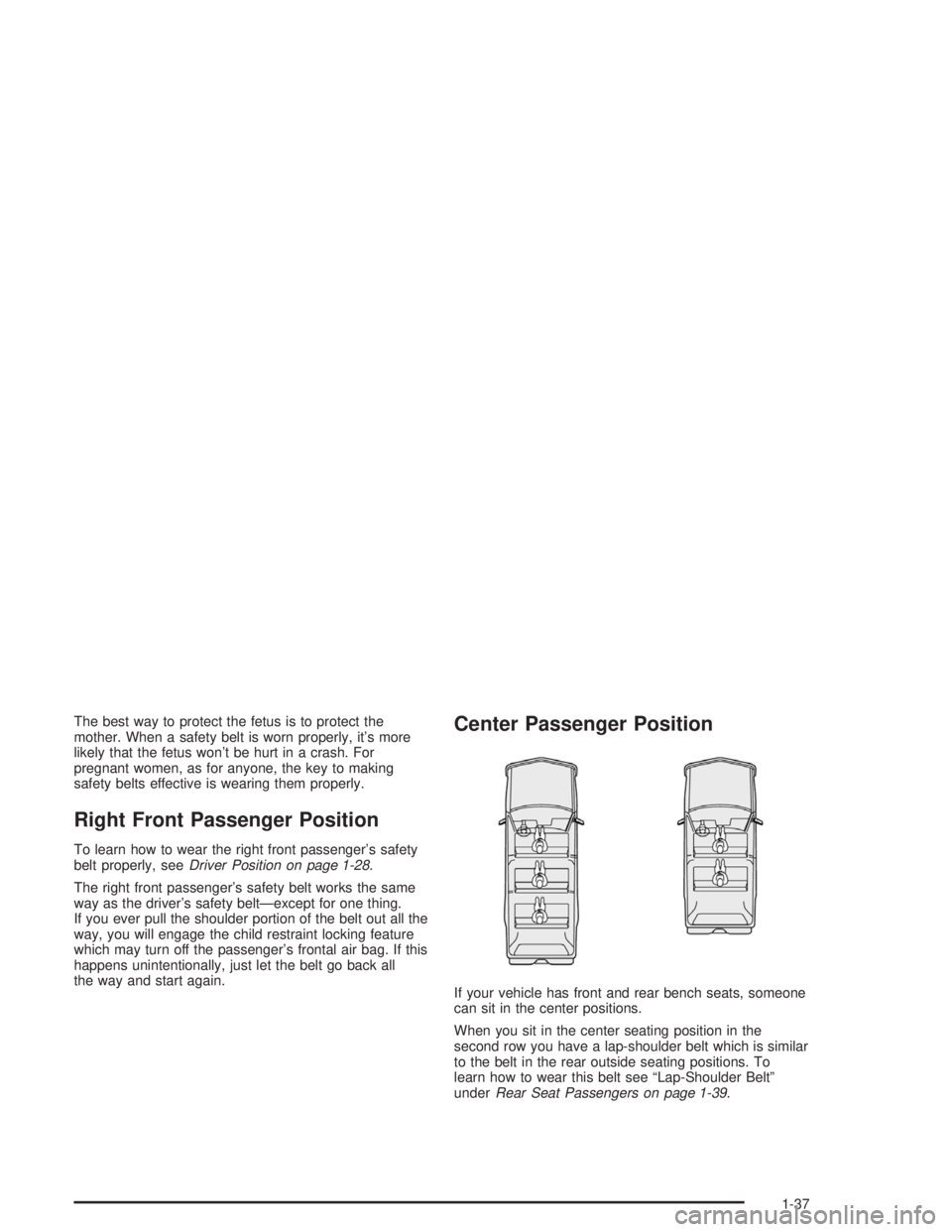
Center Passenger Position
If your vehicle has front and rear bench seats, someone
can sit in the center positions.
When you sit in the center seating position in the
second row you have a lap-shoulder belt which is similar
to the belt in the rear outside seating positions. To
learn how to wear this belt see “Lap-Shoulder Belt”
underRear Seat Passengers on page 1-39.
1-37
Page 48 of 554
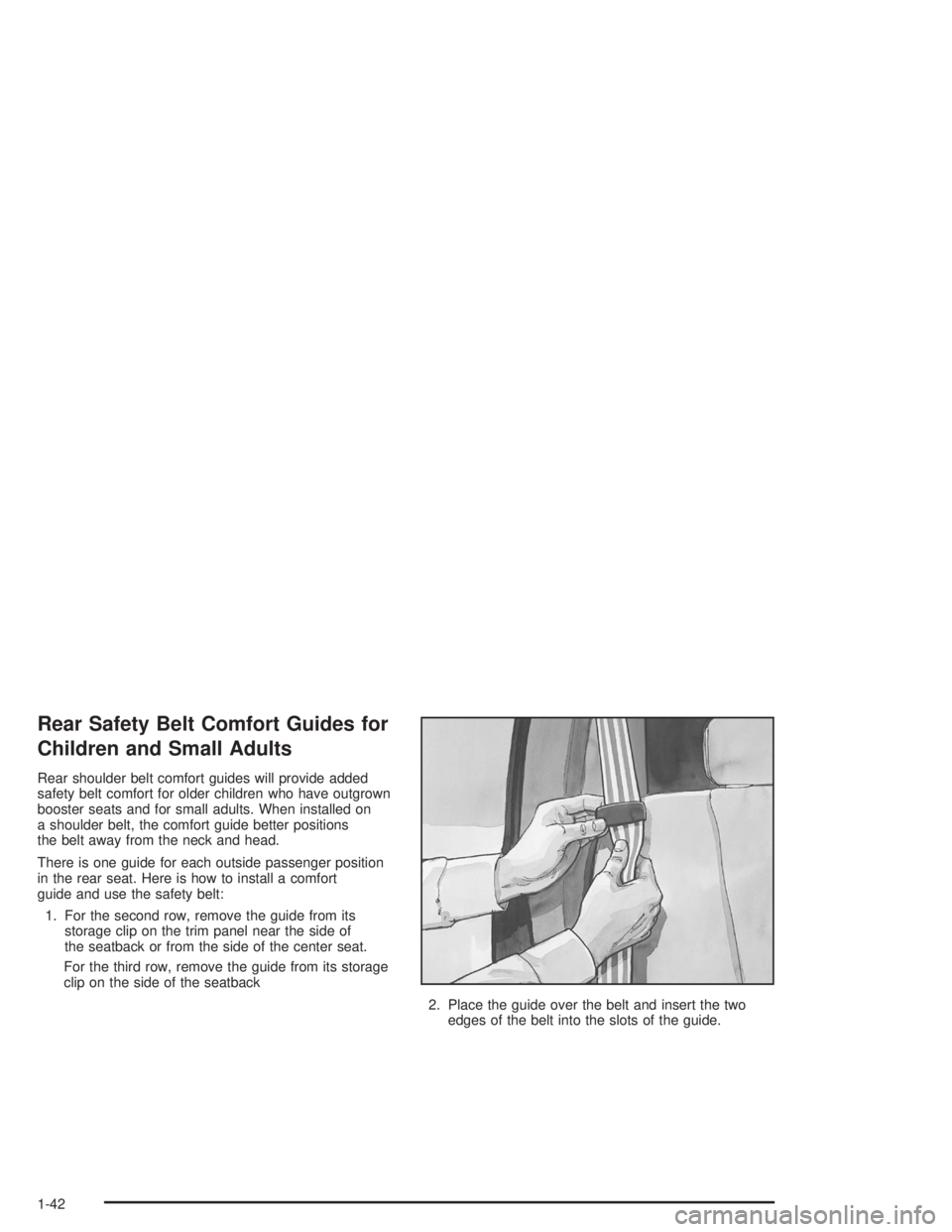
Rear Safety Belt Comfort Guides for
Children and Small Adults
Rear shoulder belt comfort guides will provide added
safety belt comfort for older children who have outgrown
booster seats and for small adults. When installed on
a shoulder belt, the comfort guide better positions
the belt away from the neck and head.
There is one guide for each outside passenger position
in the rear seat. Here is how to install a comfort
guide and use the safety belt:
1. For the second row, remove the guide from its
storage clip on the trim panel near the side of
the seatback or from the side of the center seat.
For the third row, remove the guide from its storage
clip on the side of the seatback
2. Place the guide over the belt and insert the two
edges of the belt into the slots of the guide.
1-42
Page 51 of 554
Child Restraints
Older Children
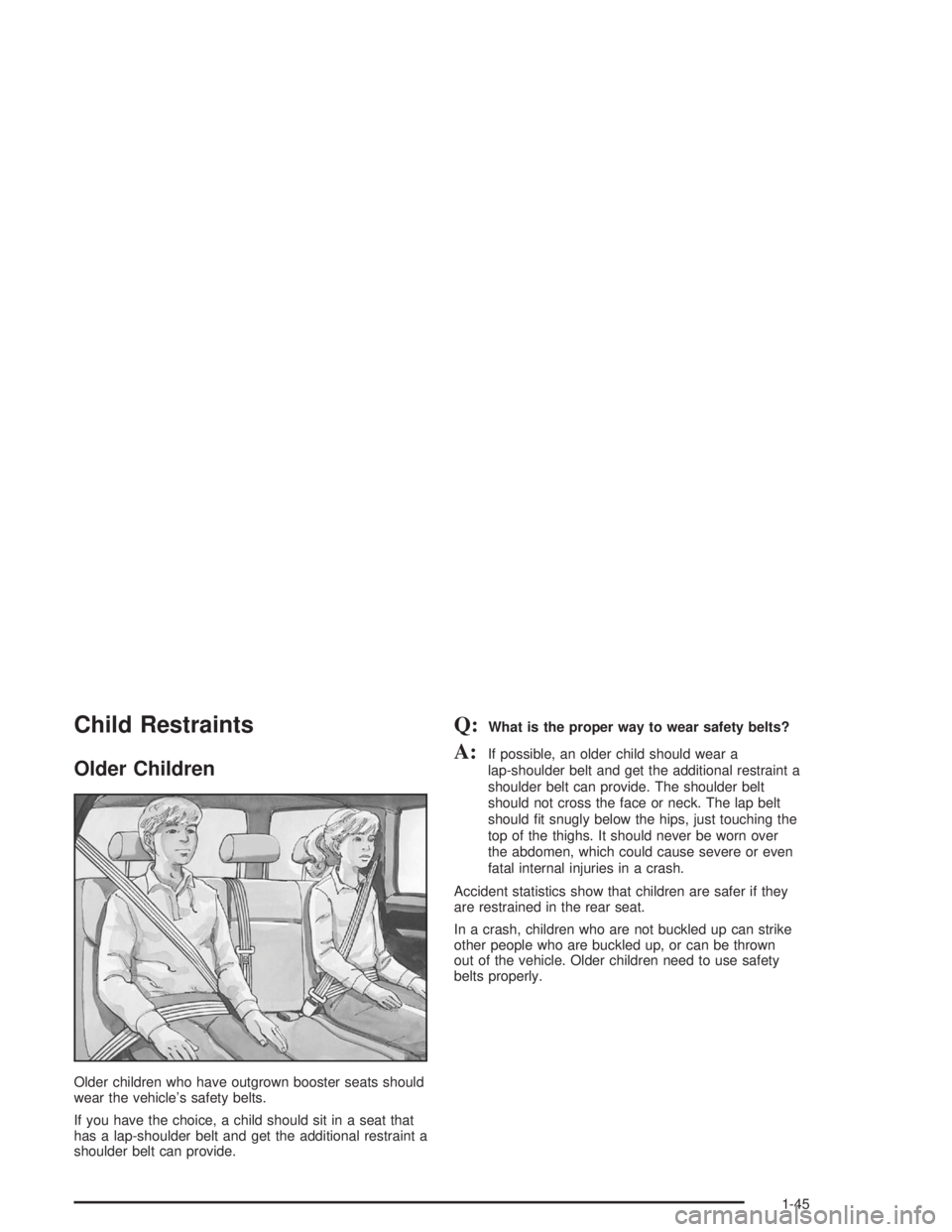
Older children who have outgrown booster seats should
wear the vehicle’s safety belts.
If you have the choice, a child should sit in a seat that
has a lap-shoulder belt and get the additional restraint a
shoulder belt can provide.
Q:What is the proper way to wear safety belts?
A:If possible, an older child should wear a
lap-shoulder belt and get the additional restraint a
shoulder belt can provide. The shoulder belt
should not cross the face or neck. The lap belt
should t snugly below the hips, just touching the
top of the thighs. It should never be worn over
the abdomen, which could cause severe or even
fatal internal injuries in a crash.
Accident statistics show that children are safer if they
are restrained in the rear seat.
In a crash, children who are not buckled up can strike
other people who are buckled up, or can be thrown
out of the vehicle. Older children need to use safety
belts properly.
1-45
Page 59 of 554
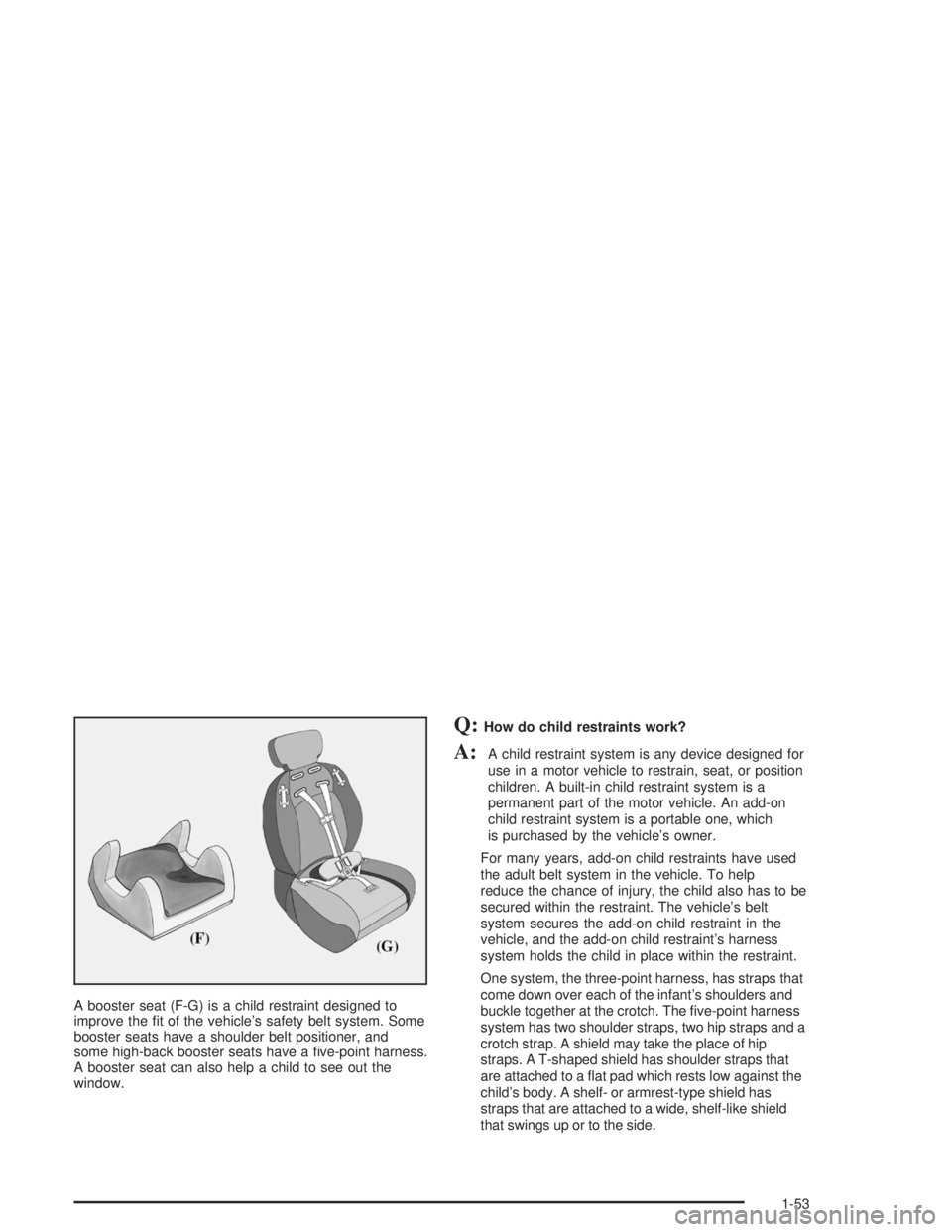
A booster seat (F-G) is a child restraint designed to
improve the t of the vehicle’s safety belt system. Some
booster seats have a shoulder belt positioner, and
some high-back booster seats have a ve-point harness.
A booster seat can also help a child to see out the
window.
Q:How do child restraints work?
A:A child restraint system is any device designed for
use in a motor vehicle to restrain, seat, or position
children. A built-in child restraint system is a
permanent part of the motor vehicle. An add-on
child restraint system is a portable one, which
is purchased by the vehicle’s owner.
For many years, add-on child restraints have used
the adult belt system in the vehicle. To help
reduce the chance of injury, the child also has to be
secured within the restraint. The vehicle’s belt
system secures the add-on child restraint in the
vehicle, and the add-on child restraint’s harness
system holds the child in place within the restraint.
One system, the three-point harness, has straps that
come down over each of the infant’s shoulders and
buckle together at the crotch. The ve-point harness
system has two shoulder straps, two hip straps and a
crotch strap. A shield may take the place of hip
straps. A T-shaped shield has shoulder straps that
are attached to a at pad which rests low against the
child’s body. A shelf- or armrest-type shield has
straps that are attached to a wide, shelf-like shield
that swings up or to the side.
1-53
Page 63 of 554
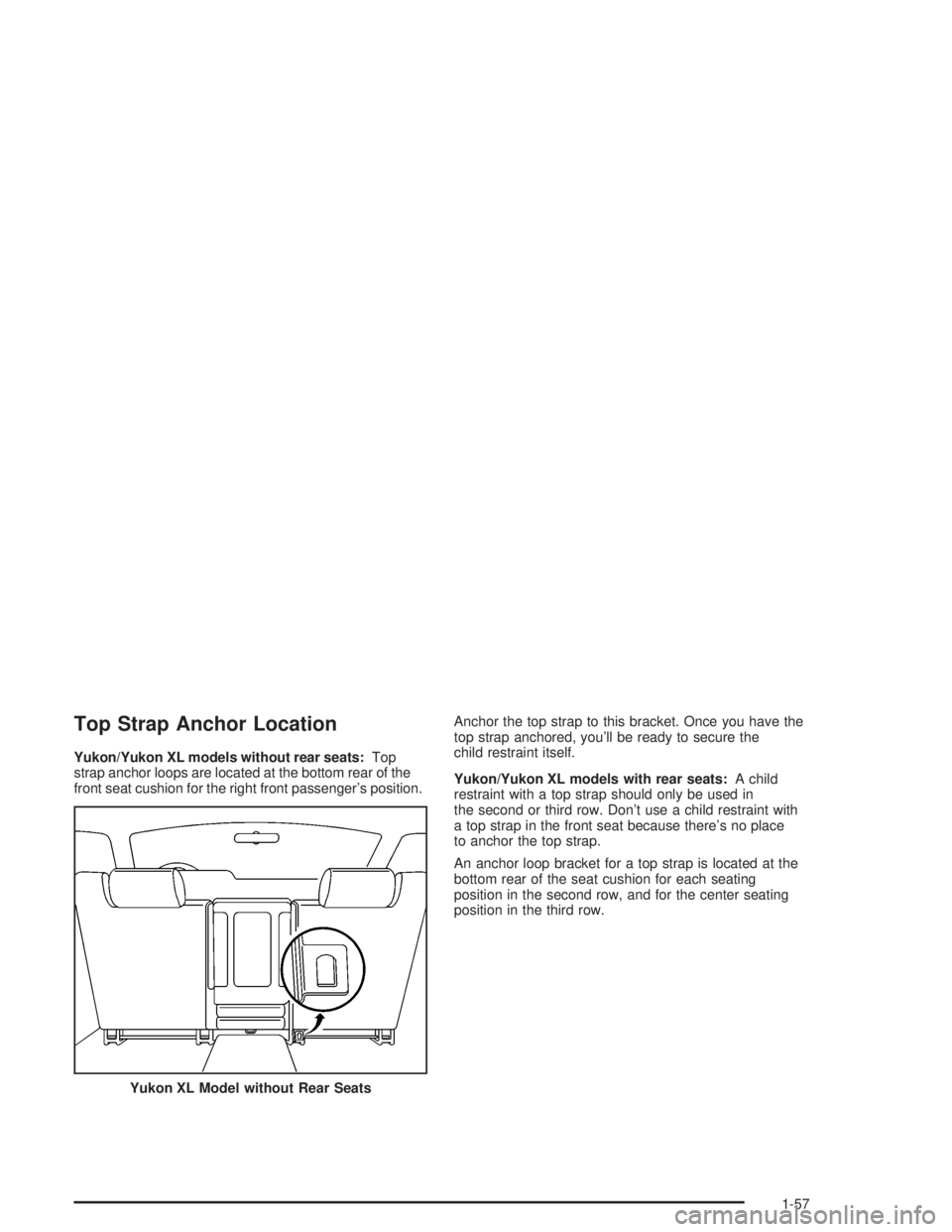
Top Strap Anchor Location
Yukon/Yukon XL models without rear seats:Top
strap anchor loops are located at the bottom rear of the
front seat cushion for the right front passenger’s position.Anchor the top strap to this bracket. Once you have the
top strap anchored, you’ll be ready to secure the
child restraint itself.
Yukon/Yukon XL models with rear seats:A child
restraint with a top strap should only be used in
the second or third row. Don’t use a child restraint with
a top strap in the front seat because there’s no place
to anchor the top strap.
An anchor loop bracket for a top strap is located at the
bottom rear of the seat cushion for each seating
position in the second row, and for the center seating
position in the third row.
Yukon XL Model without Rear Seats
1-57