air conditioning GMC YUKON 2006 User Guide
[x] Cancel search | Manufacturer: GMC, Model Year: 2006, Model line: YUKON, Model: GMC YUKON 2006Pages: 540, PDF Size: 3.14 MB
Page 219 of 540
DRIVER DOOR AJAR
If the driver’s door is not fully closed, this message
will appear on the display and you will hear a chime.
Stop and turn off the vehicle, check the door for
obstacles, and close the door again. Check to see if the
message still appears on the DIC. Pressing any of the
four DIC buttons will acknowledge the message and clear
it from the DIC display. If your vehicle does not have the
four DIC buttons, pressing the trip odometer reset stem
will acknowledge the message and clear it from the
DIC display.
ENGINE COOLANT HOT
If the cooling system temperature gets hot, this message
will appear in the DIC. Turn off the air conditioning. If the
message is still on, or if the engine coolant temperature
gage continues to rise, pull the vehicle over when it is
safe to do so. SeeEngine Coolant Temperature Gage on
page 3-43for more information. Stop the vehicle and let
the engine idle in PARK (P) for a few minutes to allow the
coolant to reach a safe temperature. This message will
clear when the coolant temperature drops to a safe
operating temperature. Pressing any of the four DIC
buttons will acknowledge the message and clear it
from the DIC display. If your vehicle does not have the
four DIC buttons, pressing the trip odometer reset stem
will acknowledge the message and clear it from the
DIC display.
ENGINE OVERHEATED
Notice:If you drive your vehicle while the engine
is overheating, severe engine damage may occur.
If an overheat warning appears on the instrument
panel cluster and/or DIC, stop the vehicle as soon as
possible. Do not increase the engine speed above
normal idling speed. SeeEngine Overheating
on page 5-28for more information.
If the engine cooling system reaches unsafe
temperatures for operation, this message will appear in
the DIC and you will hear a chime. Stop and turn off
the vehicle as soon as it is safe to do so to avoid severe
damage. This message will clear when the engine
has cooled to a safe operating temperature.
FUEL LEVEL LOW
If the fuel level is low, this message will appear on the
DIC and you will hear a chime. Refuel as soon as
possible. Pressing any of the four DIC buttons will
acknowledge the message and clear it from the
DIC display. If your vehicle does not have the four DIC
buttons, pressing the trip odometer reset stem will
acknowledge the message and clear it from the DIC
display. SeeFuel Gage on page 3-51,Fuel on page 5-4,
andLow Fuel Warning Light on page 3-51.
3-59
Page 409 of 540
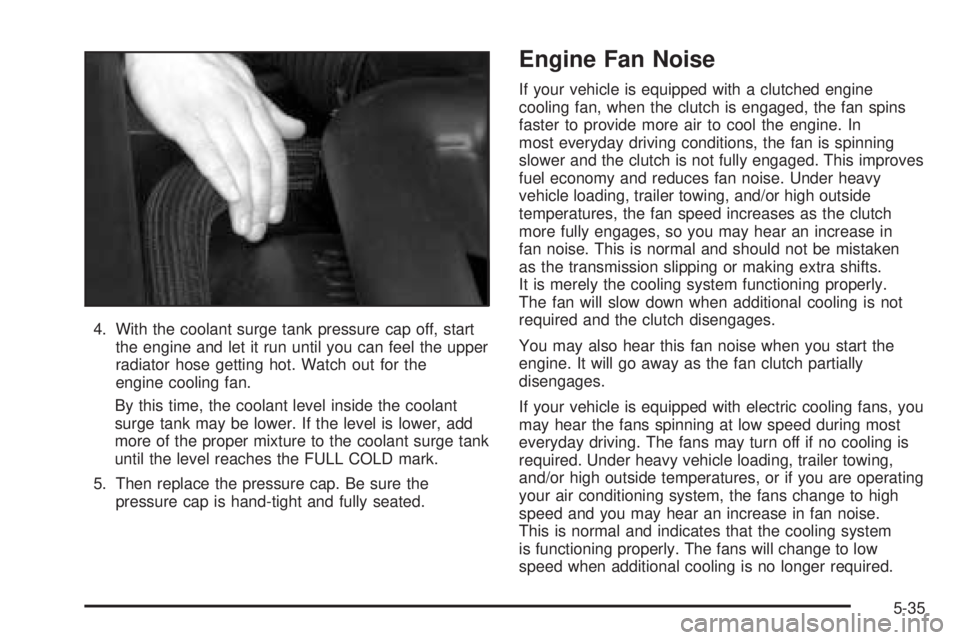
4. With the coolant surge tank pressure cap off, start
the engine and let it run until you can feel the upper
radiator hose getting hot. Watch out for the
engine cooling fan.
By this time, the coolant level inside the coolant
surge tank may be lower. If the level is lower, add
more of the proper mixture to the coolant surge tank
until the level reaches the FULL COLD mark.
5. Then replace the pressure cap. Be sure the
pressure cap is hand-tight and fully seated.
Engine Fan Noise
If your vehicle is equipped with a clutched engine
cooling fan, when the clutch is engaged, the fan spins
faster to provide more air to cool the engine. In
most everyday driving conditions, the fan is spinning
slower and the clutch is not fully engaged. This improves
fuel economy and reduces fan noise. Under heavy
vehicle loading, trailer towing, and/or high outside
temperatures, the fan speed increases as the clutch
more fully engages, so you may hear an increase in
fan noise. This is normal and should not be mistaken
as the transmission slipping or making extra shifts.
It is merely the cooling system functioning properly.
The fan will slow down when additional cooling is not
required and the clutch disengages.
You may also hear this fan noise when you start the
engine. It will go away as the fan clutch partially
disengages.
If your vehicle is equipped with electric cooling fans, you
may hear the fans spinning at low speed during most
everyday driving. The fans may turn off if no cooling is
required. Under heavy vehicle loading, trailer towing,
and/or high outside temperatures, or if you are operating
your air conditioning system, the fans change to high
speed and you may hear an increase in fan noise.
This is normal and indicates that the cooling system
is functioning properly. The fans will change to low
speed when additional cooling is no longer required.
5-35
Page 435 of 540
Tire Terminology and Denitions
Air Pressure:The amount of air inside the tire pressing
outward on each square inch of the tire. Air pressure
is expressed in pounds per square inch (psi) or
kilopascal (kPa).
Accessory Weight:This means the combined weight
of optional accessories. Some examples of optional
accessories are, automatic transmission, power steering,
power brakes, power windows, power seats, and
air conditioning.
Aspect Ratio:The relationship of a tire’s height to
its width.
Belt:A rubber coated layer of cords that is located
between the plies and the tread. Cords may be made
from steel or other reinforcing materials.
Bead:The tire bead contains steel wires wrapped by
steel cords that hold the tire onto the rim.
Bias Ply Tire:A pneumatic tire in which the plies are
laid at alternate angles less than 90 degrees to the
centerline of the tread.
Cold Ination Pressure:The amount of air pressure
in a tire, measured in pounds per square inch (psi)
or kilopascals (kPa) before a tire has built up heat from
driving. SeeInation - Tire Pressure on page 5-63.Curb Weight:This means the weight of a motor
vehicle with standard and optional equipment including
the maximum capacity of fuel, oil and coolant, but
without passengers and cargo.
DOT Markings:A code molded into the sidewall of a
tire signifying that the tire is in compliance with the
U.S. Department of Transportation (DOT) motor vehicle
safety standards. The DOT code includes the Tire
Identication Number (TIN), an alphanumeric designator
which can also identify the tire manufacturer, production
plant, brand and date of production.
GVWR:Gross Vehicle Weight Rating, seeLoading
Your Vehicle on page 4-46.
GAWR FRT:Gross Axle Weight Rating for the front
axle, seeLoading Your Vehicle on page 4-46.
GAWR RR:Gross Axle Weight Rating for the rear axle,
seeLoading Your Vehicle on page 4-46.
Intended Outboard Sidewall:The side of an
asymmetrical tire, that must always face outward when
mounted on a vehicle.
Kilopascal (kPa):The metric unit for air pressure.
Light Truck (LT-Metric) Tire:A tire used on light duty
trucks and some multipurpose passenger vehicles.
Load Index:An assigned number ranging from 1 to 279
that corresponds to the load carrying capacity of a tire.
5-61
Page 486 of 540
Fuses Usage
PCM 1 Powertrain Control Module
ETC/ECMElectronic Throttle Control,
Electronic Brake Controller
IGN EInstrument Panel Cluster,
Air Conditioning Relay,
Turn Signal/Hazard Switch,
Starter Relay
RTDElectronic Suspension
Control, Automatic Level
Control (ALC) Exhaust
TRL B/U Backup Lamps Trailer Wiring
F/PMP Fuel Pump (Relay)
B/U LPBack-up Lamps, Automatic
Transmission Shift Lock
Control System
RR DEFOG Rear Window Defogger
HDLP-HI Headlamp High Beam Relay
PRIME Not Used
AIRBAGSupplemental Inatable
Restraint System
FRT PARKFront Parking Lamps,
Sidemarker Lamps
DRLDaytime Running Lamps
(Relay)
SEO IGN Rear Defog RelayFuses Usage
TBC IGN1 Truck Body Controller Ignition
HI HDLP-LTDriver’s Side High Beam
Headlamp
LH HID Not Used
DRL Daytime Running Lamps
RVC Regulated Voltage Control
IPC/DICInstrument Panel Cluster/
Driver Information Center
HVAC/ECAS Climate Control Controller
CIG LTR Cigarette Lighter
HI HDLP-RTPassenger’s Side High Beam
Headlamp
HDLP-LOW Headlamp Low Beam Relay
A/C COMPAir Conditioning Compressor
Relay
A/C COMP Air Conditioning Compressor
TCMB Transmission Control Module
RR WPR Rear Wiper/Washer
RADIO Audio System
SEO B1Mid Bussed Electrical Center,
Universal Home Remote
System, Rear Heated Seats
LO HDLP-LTDriver’s Side Headlamp
Low Beam
5-112
Page 498 of 540
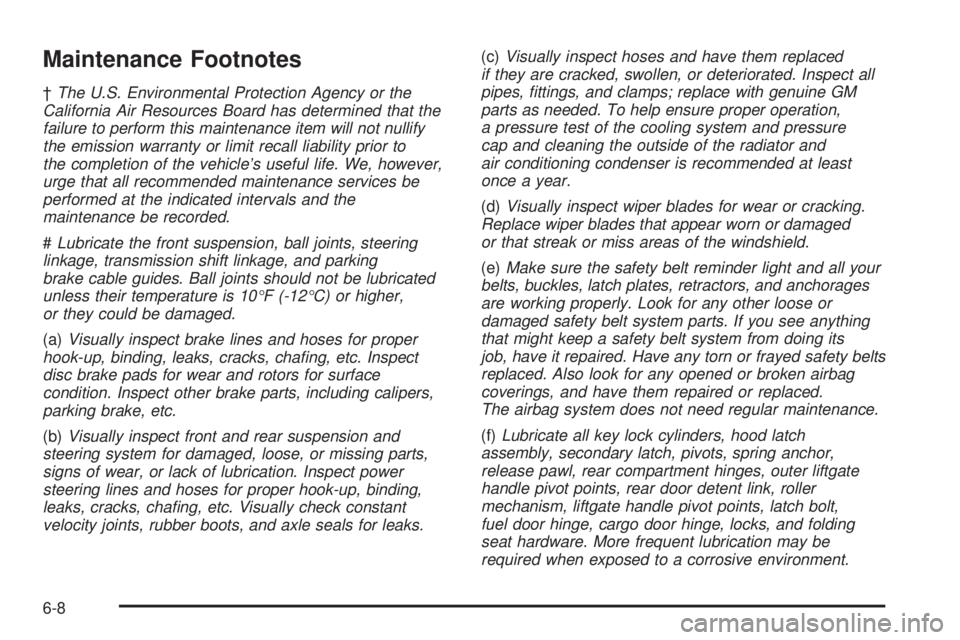
Maintenance Footnotes
†The U.S. Environmental Protection Agency or the
California Air Resources Board has determined that the
failure to perform this maintenance item will not nullify
the emission warranty or limit recall liability prior to
the completion of the vehicle’s useful life. We, however,
urge that all recommended maintenance services be
performed at the indicated intervals and the
maintenance be recorded.
#Lubricate the front suspension, ball joints, steering
linkage, transmission shift linkage, and parking
brake cable guides. Ball joints should not be lubricated
unless their temperature is 10°F (-12°C) or higher,
or they could be damaged.
(a)Visually inspect brake lines and hoses for proper
hook-up, binding, leaks, cracks, chang, etc. Inspect
disc brake pads for wear and rotors for surface
condition. Inspect other brake parts, including calipers,
parking brake, etc.
(b)Visually inspect front and rear suspension and
steering system for damaged, loose, or missing parts,
signs of wear, or lack of lubrication. Inspect power
steering lines and hoses for proper hook-up, binding,
leaks, cracks, chang, etc. Visually check constant
velocity joints, rubber boots, and axle seals for leaks.(c)Visually inspect hoses and have them replaced
if they are cracked, swollen, or deteriorated. Inspect all
pipes, ttings, and clamps; replace with genuine GM
parts as needed. To help ensure proper operation,
a pressure test of the cooling system and pressure
cap and cleaning the outside of the radiator and
air conditioning condenser is recommended at least
once a year.
(d)Visually inspect wiper blades for wear or cracking.
Replace wiper blades that appear worn or damaged
or that streak or miss areas of the windshield.
(e)Make sure the safety belt reminder light and all your
belts, buckles, latch plates, retractors, and anchorages
are working properly. Look for any other loose or
damaged safety belt system parts. If you see anything
that might keep a safety belt system from doing its
job, have it repaired. Have any torn or frayed safety belts
replaced. Also look for any opened or broken airbag
coverings, and have them repaired or replaced.
The airbag system does not need regular maintenance.
(f)Lubricate all key lock cylinders, hood latch
assembly, secondary latch, pivots, spring anchor,
release pawl, rear compartment hinges, outer liftgate
handle pivot points, rear door detent link, roller
mechanism, liftgate handle pivot points, latch bolt,
fuel door hinge, cargo door hinge, locks, and folding
seat hardware. More frequent lubrication may be
required when exposed to a corrosive environment.
6-8
Page 527 of 540
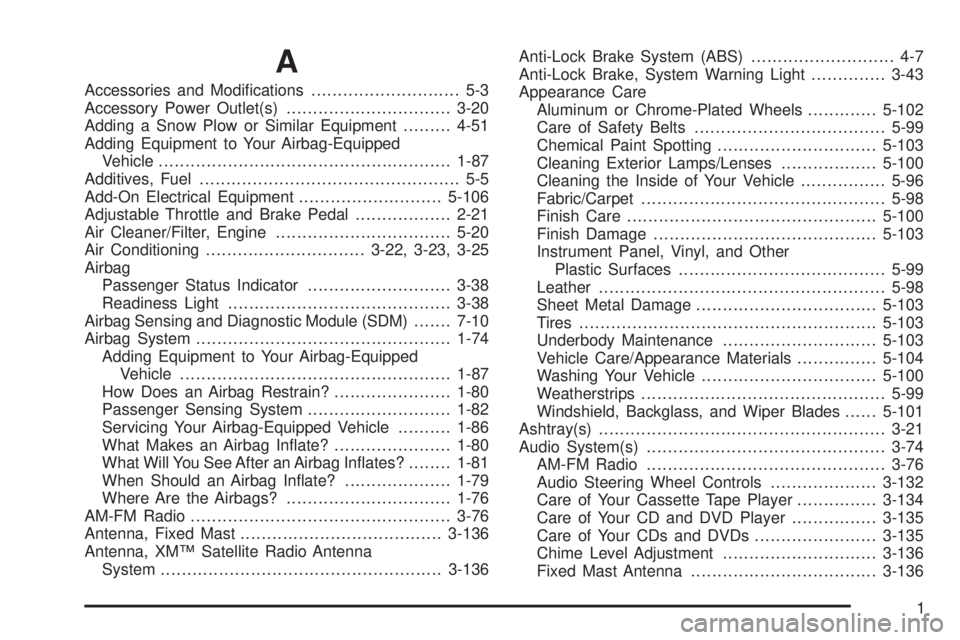
A
Accessories and Modications............................ 5-3
Accessory Power Outlet(s)...............................3-20
Adding a Snow Plow or Similar Equipment.........4-51
Adding Equipment to Your Airbag-Equipped
Vehicle.......................................................1-87
Additives, Fuel................................................. 5-5
Add-On Electrical Equipment...........................5-106
Adjustable Throttle and Brake Pedal..................2-21
Air Cleaner/Filter, Engine.................................5-20
Air Conditioning..............................3-22, 3-23, 3-25
Airbag
Passenger Status Indicator...........................3-38
Readiness Light..........................................3-38
Airbag Sensing and Diagnostic Module (SDM).......7-10
Airbag System................................................1-74
Adding Equipment to Your Airbag-Equipped
Vehicle...................................................1-87
How Does an Airbag Restrain?......................1-80
Passenger Sensing System...........................1-82
Servicing Your Airbag-Equipped Vehicle..........1-86
What Makes an Airbag Inate?......................1-80
What Will You See After an Airbag Inates?........1-81
When Should an Airbag Inate?....................1-79
Where Are the Airbags?...............................1-76
AM-FM Radio.................................................3-76
Antenna, Fixed Mast......................................3-136
Antenna, XM™ Satellite Radio Antenna
System.....................................................3-136Anti-Lock Brake System (ABS)........................... 4-7
Anti-Lock Brake, System Warning Light..............3-43
Appearance Care
Aluminum or Chrome-Plated Wheels.............5-102
Care of Safety Belts....................................5-99
Chemical Paint Spotting..............................5-103
Cleaning Exterior Lamps/Lenses..................5-100
Cleaning the Inside of Your Vehicle................5-96
Fabric/Carpet..............................................5-98
Finish Care...............................................5-100
Finish Damage..........................................5-103
Instrument Panel, Vinyl, and Other
Plastic Surfaces.......................................5-99
Leather......................................................5-98
Sheet Metal Damage..................................5-103
Tires........................................................5-103
Underbody Maintenance.............................5-103
Vehicle Care/Appearance Materials...............5-104
Washing Your Vehicle.................................5-100
Weatherstrips..............................................5-99
Windshield, Backglass, and Wiper Blades......5-101
Ashtray(s)......................................................3-21
Audio System(s).............................................3-74
AM-FM Radio.............................................3-76
Audio Steering Wheel Controls....................3-132
Care of Your Cassette Tape Player...............3-134
Care of Your CD and DVD Player................3-135
Care of Your CDs and DVDs.......................3-135
Chime Level Adjustment.............................3-136
Fixed Mast Antenna...................................3-136
1
Page 529 of 540
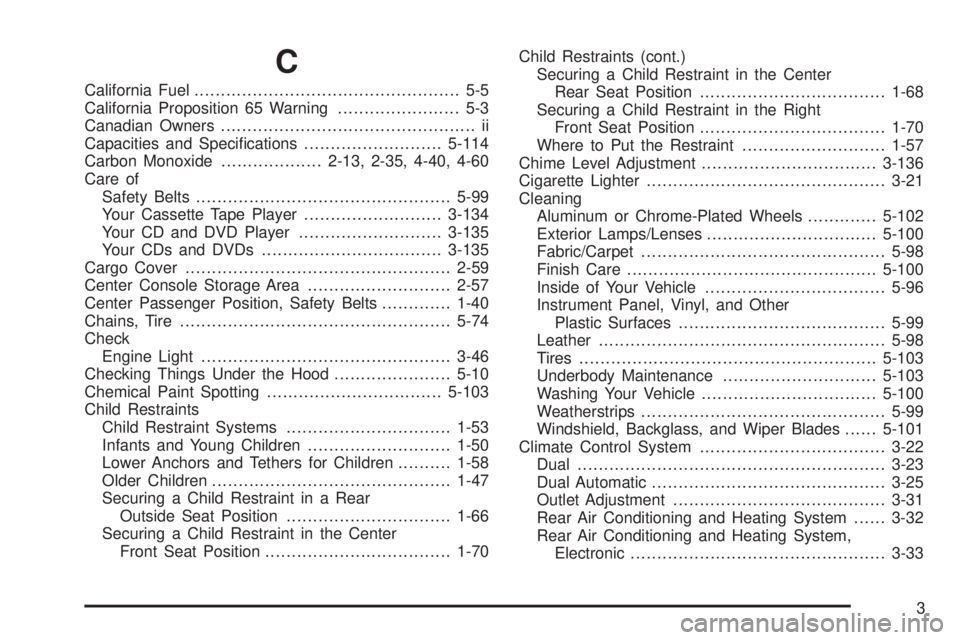
C
California Fuel.................................................. 5-5
California Proposition 65 Warning....................... 5-3
Canadian Owners................................................ ii
Capacities and Specications..........................5-114
Carbon Monoxide...................2-13, 2-35, 4-40, 4-60
Care of
Safety Belts................................................5-99
Your Cassette Tape Player..........................3-134
Your CD and DVD Player...........................3-135
Your CDs and DVDs..................................3-135
Cargo Cover..................................................2-59
Center Console Storage Area...........................2-57
Center Passenger Position, Safety Belts.............1-40
Chains, Tire...................................................5-74
Check
Engine Light...............................................3-46
Checking Things Under the Hood......................5-10
Chemical Paint Spotting.................................5-103
Child Restraints
Child Restraint Systems...............................1-53
Infants and Young Children...........................1-50
Lower Anchors and Tethers for Children..........1-58
Older Children.............................................1-47
Securing a Child Restraint in a Rear
Outside Seat Position...............................1-66
Securing a Child Restraint in the Center
Front Seat Position...................................1-70Child Restraints (cont.)
Securing a Child Restraint in the Center
Rear Seat Position...................................1-68
Securing a Child Restraint in the Right
Front Seat Position...................................1-70
Where to Put the Restraint...........................1-57
Chime Level Adjustment.................................3-136
Cigarette Lighter.............................................3-21
Cleaning
Aluminum or Chrome-Plated Wheels.............5-102
Exterior Lamps/Lenses................................5-100
Fabric/Carpet..............................................5-98
Finish Care...............................................5-100
Inside of Your Vehicle..................................5-96
Instrument Panel, Vinyl, and Other
Plastic Surfaces.......................................5-99
Leather......................................................5-98
Tires........................................................5-103
Underbody Maintenance.............................5-103
Washing Your Vehicle.................................5-100
Weatherstrips..............................................5-99
Windshield, Backglass, and Wiper Blades......5-101
Climate Control System...................................3-22
Dual..........................................................3-23
Dual Automatic............................................3-25
Outlet Adjustment........................................3-31
Rear Air Conditioning and Heating System......3-32
Rear Air Conditioning and Heating System,
Electronic................................................3-33
3
Page 536 of 540
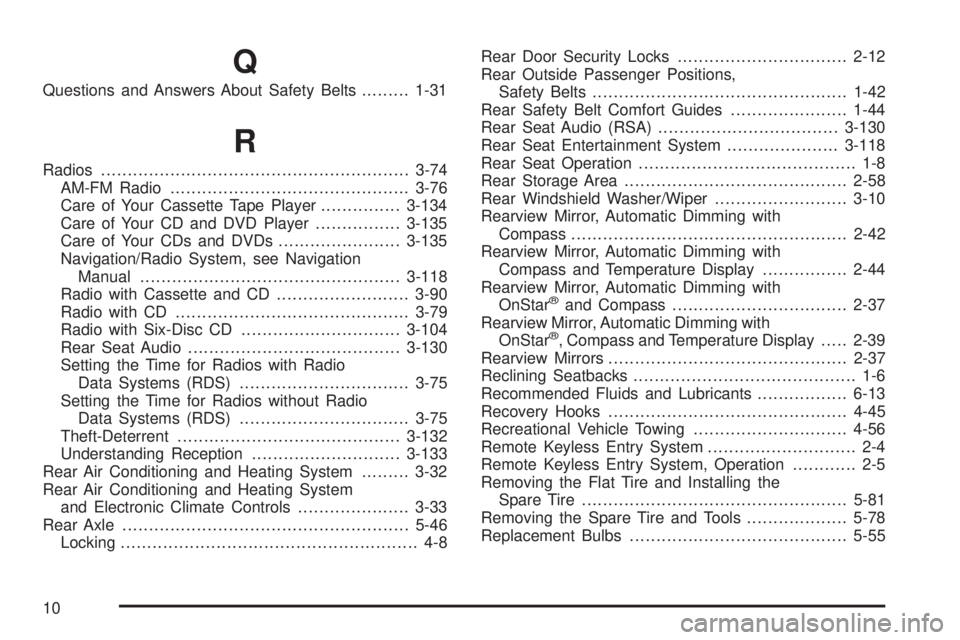
Q
Questions and Answers About Safety Belts.........1-31
R
Radios..........................................................3-74
AM-FM Radio.............................................3-76
Care of Your Cassette Tape Player...............3-134
Care of Your CD and DVD Player................3-135
Care of Your CDs and DVDs.......................3-135
Navigation/Radio System, see Navigation
Manual.................................................3-118
Radio with Cassette and CD.........................3-90
Radio with CD............................................3-79
Radio with Six-Disc CD..............................3-104
Rear Seat Audio........................................3-130
Setting the Time for Radios with Radio
Data Systems (RDS)................................3-75
Setting the Time for Radios without Radio
Data Systems (RDS)................................3-75
Theft-Deterrent..........................................3-132
Understanding Reception............................3-133
Rear Air Conditioning and Heating System.........3-32
Rear Air Conditioning and Heating System
and Electronic Climate Controls.....................3-33
Rear Axle......................................................5-46
Locking........................................................ 4-8Rear Door Security Locks................................2-12
Rear Outside Passenger Positions,
Safety Belts................................................1-42
Rear Safety Belt Comfort Guides......................1-44
Rear Seat Audio (RSA)..................................3-130
Rear Seat Entertainment System.....................3-118
Rear Seat Operation......................................... 1-8
Rear Storage Area..........................................2-58
Rear Windshield Washer/Wiper.........................3-10
Rearview Mirror, Automatic Dimming with
Compass....................................................2-42
Rearview Mirror, Automatic Dimming with
Compass and Temperature Display................2-44
Rearview Mirror, Automatic Dimming with
OnStar
®and Compass.................................2-37
Rearview Mirror, Automatic Dimming with
OnStar
®, Compass and Temperature Display.....2-39
Rearview Mirrors.............................................2-37
Reclining Seatbacks.......................................... 1-6
Recommended Fluids and Lubricants.................6-13
Recovery Hooks.............................................4-45
Recreational Vehicle Towing.............................4-56
Remote Keyless Entry System............................ 2-4
Remote Keyless Entry System, Operation............ 2-5
Removing the Flat Tire and Installing the
Spare Tire..................................................5-81
Removing the Spare Tire and Tools...................5-78
Replacement Bulbs.........................................5-55
10