hose GMC YUKON 2006 Owner's Guide
[x] Cancel search | Manufacturer: GMC, Model Year: 2006, Model line: YUKON, Model: GMC YUKON 2006Pages: 540, PDF Size: 3.14 MB
Page 398 of 540

Then, without shutting off the engine, follow these steps:
The transmission dipstick
handle with this graphic is
located at the rear of
the engine compartment,
on the passenger’s
side of the vehicle.
SeeEngine Compartment Overview on page 5-12for
more information on location.
1. Flip the handle up and then pull out the dipstick
and wipe it with a clean rag or paper towel.
2. Push it back in all the way, wait three seconds
and then pull it back out again.3. Check both sides of the dipstick, and read the lower
level. The uid level must be in the COLD area,
below the cross-hatched area, for a cold check or in
the HOT or cross-hatched area for a hot check.
Be sure to keep the dipstick pointed down to get
an accurate reading.
4. If the uid level is in the acceptable range, push the
dipstick back in all the way; then ip the handle
down to lock the dipstick in place.
Consistency of Readings
Always check the uid level at least twice using the
procedure described previously. Consistency (repeatable
readings) is important to maintaining proper uid level.
If inconsistent readings persist, check the transmission
breather hose to be sure it is clean and unclogged.
If readings are still inconsistent, contact your dealer.
5-24
Page 406 of 540
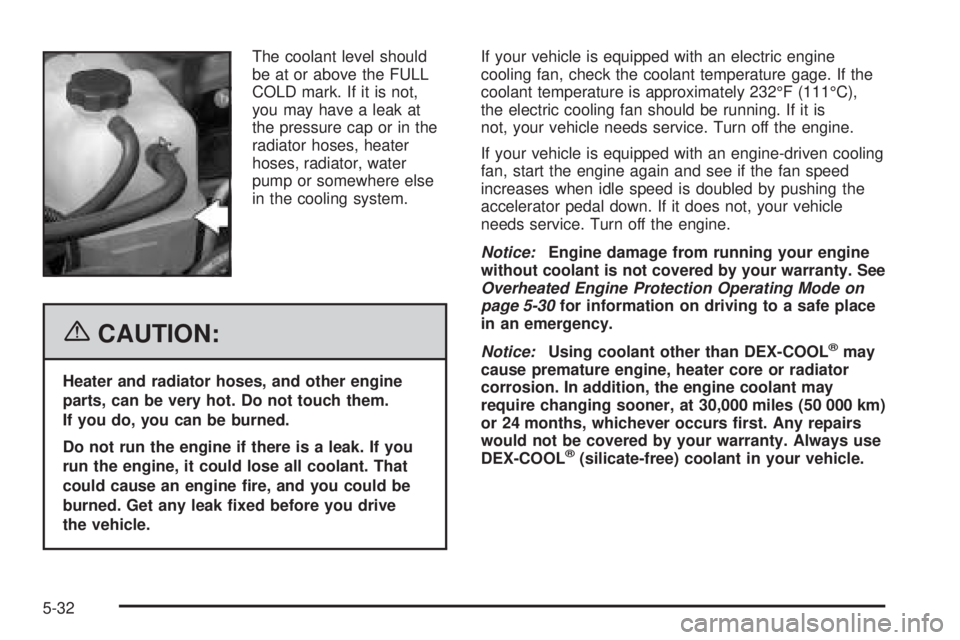
The coolant level should
be at or above the FULL
COLD mark. If it is not,
you may have a leak at
the pressure cap or in the
radiator hoses, heater
hoses, radiator, water
pump or somewhere else
in the cooling system.
{CAUTION:
Heater and radiator hoses, and other engine
parts, can be very hot. Do not touch them.
If you do, you can be burned.
Do not run the engine if there is a leak. If you
run the engine, it could lose all coolant. That
could cause an engine re, and you could be
burned. Get any leak xed before you drive
the vehicle.If your vehicle is equipped with an electric engine
cooling fan, check the coolant temperature gage. If the
coolant temperature is approximately 232°F (111°C),
the electric cooling fan should be running. If it is
not, your vehicle needs service. Turn off the engine.
If your vehicle is equipped with an engine-driven cooling
fan, start the engine again and see if the fan speed
increases when idle speed is doubled by pushing the
accelerator pedal down. If it does not, your vehicle
needs service. Turn off the engine.
Notice:Engine damage from running your engine
without coolant is not covered by your warranty. See
Overheated Engine Protection Operating Mode on
page 5-30for information on driving to a safe place
in an emergency.
Notice:Using coolant other than DEX-COOL
®may
cause premature engine, heater core or radiator
corrosion. In addition, the engine coolant may
require changing sooner, at 30,000 miles (50 000 km)
or 24 months, whichever occurs rst. Any repairs
would not be covered by your warranty. Always use
DEX-COOL
®(silicate-free) coolant in your vehicle.
5-32
Page 408 of 540
{CAUTION:
You can be burned if you spill coolant on hot
engine parts. Coolant contains ethylene glycol
and it will burn if the engine parts are hot
enough. Do not spill coolant on a hot engine.
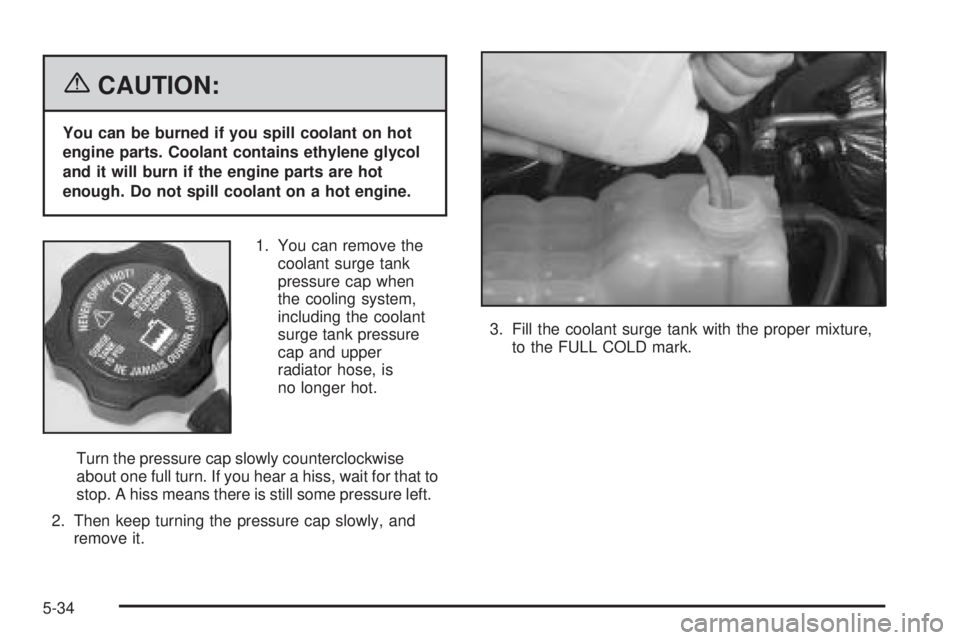
1. You can remove the
coolant surge tank
pressure cap when
the cooling system,
including the coolant
surge tank pressure
cap and upper
radiator hose, is
no longer hot.
Turn the pressure cap slowly counterclockwise
about one full turn. If you hear a hiss, wait for that to
stop. A hiss means there is still some pressure left.
2. Then keep turning the pressure cap slowly, and
remove it.3. Fill the coolant surge tank with the proper mixture,
to the FULL COLD mark.
5-34
Page 409 of 540
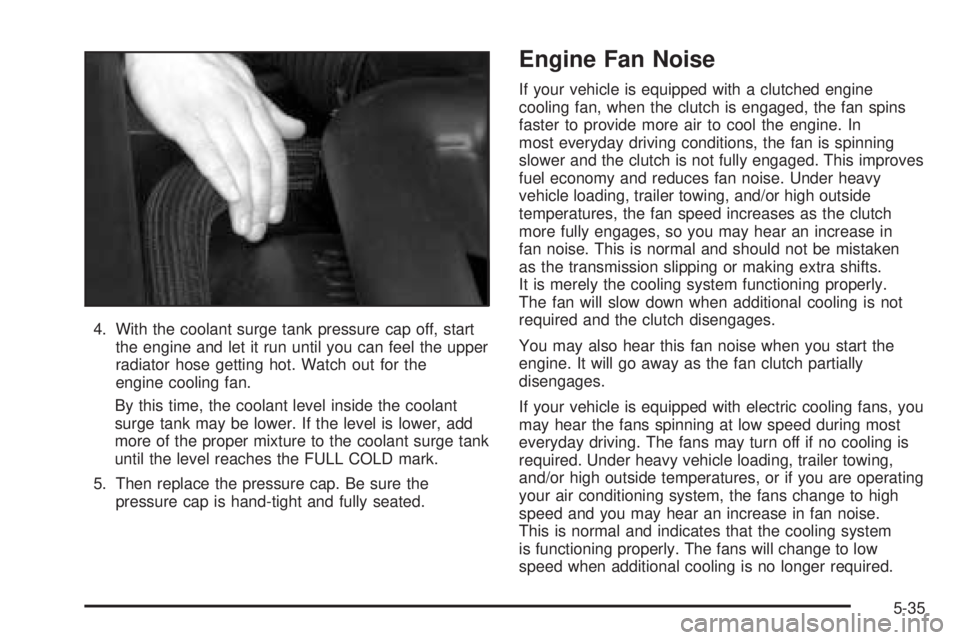
4. With the coolant surge tank pressure cap off, start
the engine and let it run until you can feel the upper
radiator hose getting hot. Watch out for the
engine cooling fan.
By this time, the coolant level inside the coolant
surge tank may be lower. If the level is lower, add
more of the proper mixture to the coolant surge tank
until the level reaches the FULL COLD mark.
5. Then replace the pressure cap. Be sure the
pressure cap is hand-tight and fully seated.
Engine Fan Noise
If your vehicle is equipped with a clutched engine
cooling fan, when the clutch is engaged, the fan spins
faster to provide more air to cool the engine. In
most everyday driving conditions, the fan is spinning
slower and the clutch is not fully engaged. This improves
fuel economy and reduces fan noise. Under heavy
vehicle loading, trailer towing, and/or high outside
temperatures, the fan speed increases as the clutch
more fully engages, so you may hear an increase in
fan noise. This is normal and should not be mistaken
as the transmission slipping or making extra shifts.
It is merely the cooling system functioning properly.
The fan will slow down when additional cooling is not
required and the clutch disengages.
You may also hear this fan noise when you start the
engine. It will go away as the fan clutch partially
disengages.
If your vehicle is equipped with electric cooling fans, you
may hear the fans spinning at low speed during most
everyday driving. The fans may turn off if no cooling is
required. Under heavy vehicle loading, trailer towing,
and/or high outside temperatures, or if you are operating
your air conditioning system, the fans change to high
speed and you may hear an increase in fan noise.
This is normal and indicates that the cooling system
is functioning properly. The fans will change to low
speed when additional cooling is no longer required.
5-35
Page 410 of 540

Power Steering Fluid
SeeEngine Compartment
Overview on page 5-12
for reservoir location.
When to Check Power Steering Fluid
It is not necessary to regularly check power steering uid
unless you suspect there is a leak in the system or
you hear an unusual noise. A uid loss in this system
could indicate a problem. Have the system inspected
and repaired.
How to Check Power Steering Fluid
To check the power steering uid, do the following:
1. Turn the key off and let the engine compartment
cool down.
2. Wipe the cap and the top of the reservoir clean.
3. Unscrew the cap and wipe the dipstick with a
clean rag.
4. Replace the cap and completely tighten it.
5. Remove the cap again and look at the uid level
on the dipstick.
The level should be at the FULL COLD mark.
If necessary, add only enough uid to bring the
level up to the mark.
What to Use
To determine what kind of uid to use, see
Recommended Fluids and Lubricants on page 6-13.
Always use the proper uid. Failure to use the proper
uid can cause leaks and damage hoses and seals.
5-36
Page 439 of 540
Each tire, including the spare (if provided), should be
checked monthly when cold and inated to the ination
pressure recommended by the vehicle manufacturer
on the vehicle placard or tire ination pressure label.
(If your vehicle has tires of a different size than the
size indicated on the vehicle placard or tire ination
pressure label, you should determine the proper
ination pressure for those tires.)
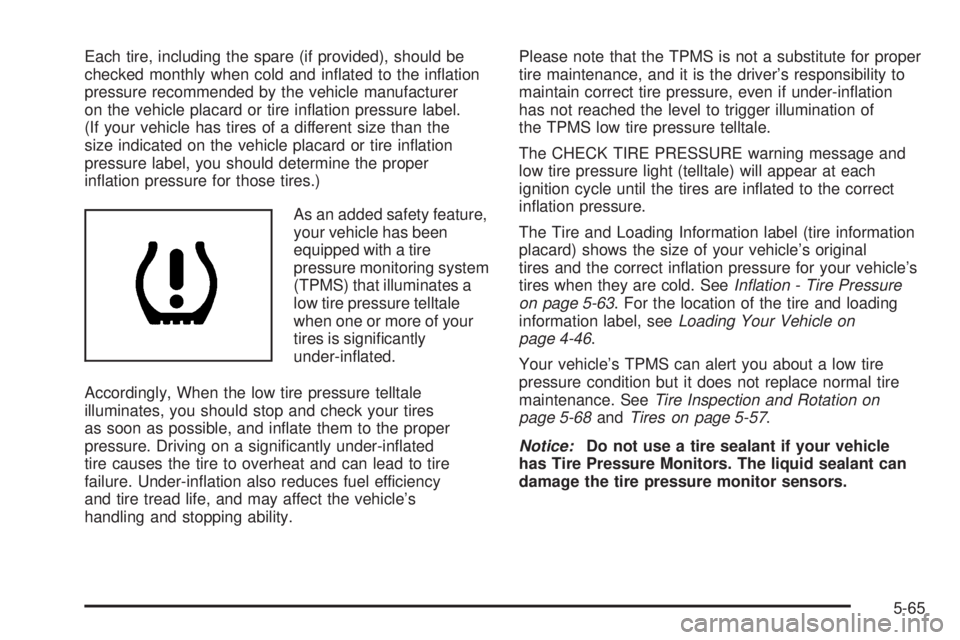
As an added safety feature,
your vehicle has been
equipped with a tire
pressure monitoring system
(TPMS) that illuminates a
low tire pressure telltale
when one or more of your
tires is signicantly
under-inated.
Accordingly, When the low tire pressure telltale
illuminates, you should stop and check your tires
as soon as possible, and inate them to the proper
pressure. Driving on a signicantly under-inated
tire causes the tire to overheat and can lead to tire
failure. Under-ination also reduces fuel efficiency
and tire tread life, and may affect the vehicle’s
handling and stopping ability.Please note that the TPMS is not a substitute for proper
tire maintenance, and it is the driver’s responsibility to
maintain correct tire pressure, even if under-ination
has not reached the level to trigger illumination of
the TPMS low tire pressure telltale.
The CHECK TIRE PRESSURE warning message and
low tire pressure light (telltale) will appear at each
ignition cycle until the tires are inated to the correct
ination pressure.
The Tire and Loading Information label (tire information
placard) shows the size of your vehicle’s original
tires and the correct ination pressure for your vehicle’s
tires when they are cold. SeeInation - Tire Pressure
on page 5-63. For the location of the tire and loading
information label, seeLoading Your Vehicle on
page 4-46.
Your vehicle’s TPMS can alert you about a low tire
pressure condition but it does not replace normal tire
maintenance. SeeTire Inspection and Rotation on
page 5-68andTires on page 5-57.
Notice:Do not use a tire sealant if your vehicle
has Tire Pressure Monitors. The liquid sealant can
damage the tire pressure monitor sensors.
5-65
Page 444 of 540

Buying New Tires
GM has developed and matched specic tires for your
vehicle. The original equipment tires installed on
your vehicle, when it was new, were designed to meet
General Motors Tire Performance Criteria Specication
(TPC spec) system rating. If you need replacement
tires, GM strongly recommends that you get tires with
the same TPC Spec rating. This way, your vehicle
will continue to have tires that are designed to give the
same performance and vehicle safety, during normal
use, as the original tires.
GM’s exclusive TPC Spec system considers over a
dozen critical specications that impact the overall
performance of your vehicle, including brake system
performance, ride and handling, traction control, and
tire pressure monitoring performance. GM’s TPC Spec
number is molded onto the tire’s sidewall by the tire
manufacturer. If the tires have an all-season tread
design, the TPC spec number will be followed by an
MS for mud and snow. SeeTire Sidewall Labeling
on page 5-58for additional information.{CAUTION:
Mixing tires could cause you to lose control
while driving. If you mix tires of different sizes,
brands or types (radial and bias-belted tires),
the vehicle may not handle properly, and you
could have a crash. Using tires of different
sizes, brands or types may also cause damage
to your vehicle. Be sure to use the same size,
brand, and type tires on all wheels.
Your vehicle may have a different size spare
than the road tires (those originally installed
on your vehicle). When new, your vehicle
included a spare tire and wheel assembly with
a similar overall diameter as your vehicle’s
road tires and wheels, so it is all right to drive
on it. Because this spare was developed for
use on your vehicle, it will not affect vehicle
handling.
5-70
Page 445 of 540

{CAUTION:
If you use bias-ply tires on your vehicle, the
wheel rim anges could develop cracks after
many miles of driving. A tire and/or wheel
could fail suddenly, causing a crash. Use only
radial-ply tires with the wheels on your vehicle.
If you must replace your vehicle’s tires with those
that do not have a TPC Spec number, make sure
they are the same size, load range, speed rating, and
construction type (radial and bias-belted tires) as
your vehicle’s original tires.
Vehicles that have a tire pressure monitoring system
may give an inaccurate low-pressure warning if non-TPC
spec rated tires are installed on your vehicle. Non-TPC
Spec rated tires may give a low-pressure warning
that is higher or lower than the proper warning level
you would get with TPC Spec rated tires. SeeTire
Pressure Monitor System on page 5-64.
Your vehicle’s original equipment tires are listed on
the Tire and Loading Information Label. This label
is attached to the vehicle’s center pillar (B-pillar). See
Loading Your Vehicle on page 4-46, for more information
about the Tire and Loading Information Label and its
location on your vehicle.
Different Size Tires and Wheels
If you add wheels or tires that are a different size than
your original equipment wheels and tires, this may affect
the way your vehicle performs, including its braking,
ride and handling characteristics, stability and resistance
to rollover. Additionally, if your vehicle has electronic
systems such as, antilock brakes; traction control; and
electronic stability control, the performance of these
systems can be affected.
{CAUTION:
If you add different sized wheels, your
vehicle may not provide an acceptable level
of performance and safety if tires not
recommended for those wheels are selected.
You may increase the chance that you will
crash and suffer serious injury. Only use
GM specic wheel and tire systems developed
for your vehicle, and have them properly
installed by a GM certied technician.
SeeBuying New Tires on page 5-70andAccessories
and Modications on page 5-3for additional information.
5-71
Page 446 of 540
Uniform Tire Quality Grading
Quality grades can be found where applicable on the
tire sidewall between tread shoulder and maximum
section width. For example:
Treadwear 200 Traction AA Temperature A
The following information relates to the system
developed by the United States National Highway
Traffic Safety Administration, which grades tires by
treadwear, traction and temperature performance.
(This applies only to vehicles sold in the United States.)
The grades are molded on the sidewalls of most
passenger car tires. The Uniform Tire Quality Grading
system does not apply to deep tread, winter-type
snow tires, space-saver or temporary use spare tires,
tires with nominal rim diameters of 10 to 12 inches
(25 to 30 cm), or to some limited-production tires.
While the tires available on General Motors passenger
cars and light trucks may vary with respect to these
grades, they must also conform to federal safety
requirements and additional General Motors Tire
Performance Criteria (TPC) standards.
Treadwear
The treadwear grade is a comparative rating based on
the wear rate of the tire when tested under controlled
conditions on a specied government test course.
For example, a tire graded 150 would wear one and
a half (1.5) times as well on the government course as
a tire graded 100. The relative performance of tires
depends upon the actual conditions of their use,
however, and may depart signicantly from the norm
due to variations in driving habits, service practices and
differences in road characteristics and climate.
Traction – AA, A, B, C
The traction grades, from highest to lowest, are AA,
A, B, and C. Those grades represent the tire’s ability to
stop on wet pavement as measured under controlled
conditions on specied government test surfaces
of asphalt and concrete. A tire marked C may have
poor traction performance. Warning: The traction
grade assigned to this tire is based on straight-ahead
braking traction tests, and does not include acceleration,
cornering, hydroplaning, or peak traction characteristics.
5-72
Page 472 of 540
Fabric/Carpet
Use a vacuum cleaner with a soft brush attachment
frequently to remove dust and loose dirt. A canister
vacuum with a beater bar in the nozzle may only
be used on oor carpet and carpeted oor mats.
For soils, always try to remove them rst with plain
water or club soda. Before cleaning, gently remove
as much of the soil as possible using one of the
following techniques:
For liquids: gently blot the remaining soil with a
paper towel. Allow the soil to absorb into the
paper towel until no more can be removed.
For solid dry soils: remove as much as possible
and then vacuum.
To clean, use the following instructions:
1. Saturate a lint-free, clean white cloth with water
or club soda.
2. Wring the cloth to remove excess moisture.
3. Start on the outside edge of the soil and gently rub
toward the center. Continue cleaning, using a clean
area of the cloth each time it becomes soiled.
4. Continue to gently rub the soiled area until the
cleaning cloth remains clean.
5. If the soil is not completely removed, use a mild
soap solution and repeat the cleaning process
that was used with plain water.If any of the soil remains, a commercial fabric cleaner or
spot lifter may be necessary. When a commercial
upholstery cleaner or spot lifter is to be used, test a
small hidden area for colorfastness rst. If the locally
cleaned area gives any impression that a ring formation
may result, clean the entire surface.
After the cleaning process has been completed, a paper
towel can be used to blot excess moisture from the
fabric or carpet.
Leather
A soft cloth dampened with water may be used to
remove dust. If a more thorough cleaning is necessary,
a soft cloth dampened with a mild soap solution can
be used. Allow the leather to dry naturally. Do not use
heat to dry. Never use steam to clean leather. Never
use spot lifters or spot removers on leather. Many
commercial leather cleaners and coatings that are sold
to preserve and protect leather may permanently
change the appearance and feel of your leather and are
not recommended. Do not use silicone or wax-based
products, or those containing organic solvents to clean
your vehicle’s interior because they can alter the
appearance by increasing the gloss in a non-uniform
manner. Never use shoe polish on your leather.
5-98