service GMC YUKON 2008 Repair Manual
[x] Cancel search | Manufacturer: GMC, Model Year: 2008, Model line: YUKON, Model: GMC YUKON 2008Pages: 546, PDF Size: 6.4 MB
Page 370 of 546
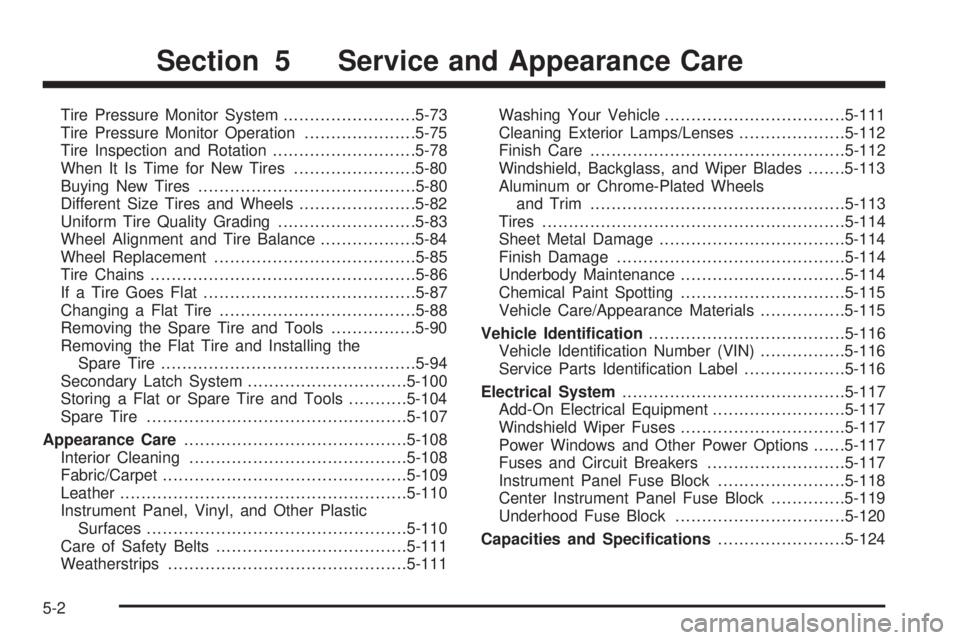
Tire Pressure Monitor System.........................5-73
Tire Pressure Monitor Operation.....................5-75
Tire Inspection and Rotation...........................5-78
When It Is Time for New Tires.......................5-80
Buying New Tires.........................................5-80
Different Size Tires and Wheels......................5-82
Uniform Tire Quality Grading..........................5-83
Wheel Alignment and Tire Balance..................5-84
Wheel Replacement......................................5-85
Tire Chains..................................................5-86
If a Tire Goes Flat........................................5-87
Changing a Flat Tire.....................................5-88
Removing the Spare Tire and Tools................5-90
Removing the Flat Tire and Installing the
Spare Tire................................................5-94
Secondary Latch System..............................5-100
Storing a Flat or Spare Tire and Tools...........5-104
Spare Tire.................................................5-107
Appearance Care..........................................5-108
Interior Cleaning.........................................5-108
Fabric/Carpet..............................................5-109
Leather......................................................5-110
Instrument Panel, Vinyl, and Other Plastic
Surfaces.................................................5-110
Care of Safety Belts....................................5-111
Weatherstrips.............................................5-111Washing Your Vehicle..................................5-111
Cleaning Exterior Lamps/Lenses....................5-112
Finish Care................................................5-112
Windshield, Backglass, and Wiper Blades.......5-113
Aluminum or Chrome-Plated Wheels
and Trim................................................5-113
Tires.........................................................5-114
Sheet Metal Damage...................................5-114
Finish Damage...........................................5-114
Underbody Maintenance..............................
.5-114
Chemical Paint Spotting...............................5-115
Vehicle Care/Appearance Materials................5-115
Vehicle Identication.....................................5-116
Vehicle Identication Number (VIN)................5-116
Service Parts Identication Label...................5-116
Electrical System..........................................5-117
Add-On Electrical Equipment.........................5-117
Windshield Wiper Fuses...............................5-117
Power Windows and Other Power Options......5-117
Fuses and Circuit Breakers..........................5-117
Instrument Panel Fuse Block........................5-118
Center Instrument Panel Fuse Block..............5-119
Underhood Fuse Block................................5-120
Capacities and Specications........................5-124
Section 5 Service and Appearance Care
5-2
Page 371 of 546
Service
For service and parts needs, visit your dealer/retailer.
You will receive genuine GM parts and GM-trained and
supported service people.
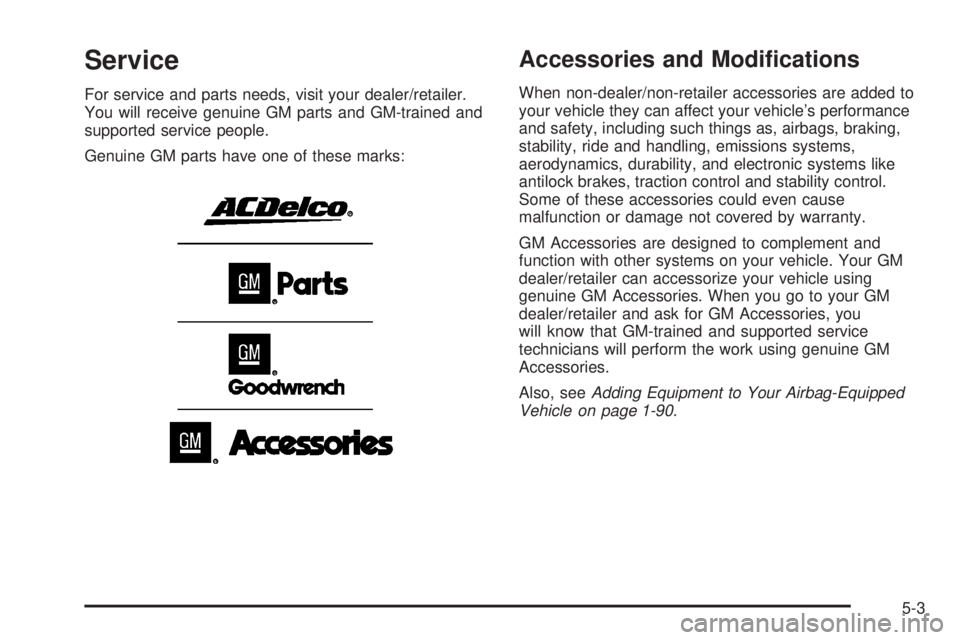
Genuine GM parts have one of these marks:
Accessories and Modications
When non-dealer/non-retailer accessories are added to
your vehicle they can affect your vehicle’s performance
and safety, including such things as, airbags, braking,
stability, ride and handling, emissions systems,
aerodynamics, durability, and electronic systems like
antilock brakes, traction control and stability control.
Some of these accessories could even cause
malfunction or damage not covered by warranty.
GM Accessories are designed to complement and
function with other systems on your vehicle. Your GM
dealer/retailer can accessorize your vehicle using
genuine GM Accessories. When you go to your GM
dealer/retailer and ask for GM Accessories, you
will know that GM-trained and supported service
technicians will perform the work using genuine GM
Accessories.
Also, seeAdding Equipment to Your Airbag-Equipped
Vehicle on page 1-90.
5-3
Page 372 of 546
California Proposition 65 Warning
Most motor vehicles, including this one, contain and/or
emit chemicals known to the State of California to
cause cancer and birth defects or other reproductive
harm. Engine exhaust, many parts and systems
(including some inside the vehicle), many uids, and
some component wear by-products contain and/or emit
these chemicals.
California Perchlorate Materials
Requirements
Certain types of automotive applications, such as airbag
initiators, seat belt pretensioners, and lithium batteries
contained in remote keyless entry transmitters, may
contain perchlorate materials. Special handling may be
necessary. For additional information, see
www.dtsc.ca.gov/hazardouswaste/perchlorate.
Doing Your Own Service Work
If your vehicle is a Two-mode Hybrid, see the Two-mode
Hybrid manual for more information.
{CAUTION:
You can be injured and your vehicle could be
damaged if you try to do service work on a
vehicle without knowing enough about it.
Be sure you have sufficient knowledge,
experience, the proper replacement parts,
and tools before you attempt any vehicle
maintenance task.
Be sure to use the proper nuts, bolts, and
other fasteners. English and metric
fasteners can be easily confused. If you
use the wrong fasteners, parts can later
break or fall off. You could be hurt.
If you want to do some of your own service work, you
should use the proper service manual. It tells you much
more about how to service your vehicle than this
manual can. To order the proper service manual, see
Service Publications Ordering Information on page 7-15.
5-4
Page 373 of 546
Your vehicle has an airbag system. Before attempting to
do your own service work, seeServicing Your
Airbag-Equipped Vehicle on page 1-90.
You should keep a record with all parts receipts and list
the mileage and the date of any service work you
perform. SeeMaintenance Record on page 6-17.
Adding Equipment to the Outside of
Your Vehicle
Things you might add to the outside of your vehicle can
affect the airow around it. This can cause wind
noise and can affect fuel economy and windshield
washer performance. Check with your dealer/retailer
before adding equipment to the outside of your vehicle.
Fuel
Use of the recommended fuel is an important part of the
proper maintenance of your vehicle. To help keep the
engine clean and maintain optimum vehicle
performance, we recommend the use of gasoline
advertised as TOP TIER Detergent Gasoline.The 8th digit of the Vehicle Identication Number (VIN)
shows the code letter or number that identies your
vehicle’s engine. The VIN is at the top left of the
instrument panel. SeeVehicle Identification Number
(VIN) on page 5-116.
If your vehicle has the 5.3L V8 engine (VIN Code 0) or the
5.3L V8 engine (VIN Code 3), you can use either regular
unleaded gasoline or ethanol fuel containing up to
85% ethanol (E85); also seeFuel E85 (85% Ethanol) on
page 5-7. In all other engines, use only regular unleaded
gasoline.
Gasoline Octane
Use regular unleaded gasoline with a posted octane
rating of 87 or higher. If the octane rating is less than 87,
you might notice an audible knocking noise when you
drive, commonly referred to as spark knock. If this
occurs, use a gasoline rated at 87 octane or higher as
soon as possible. If you are using gasoline rated at
87 octane or higher and you hear heavy knocking, the
engine needs service.
5-5
Page 375 of 546
Notice:Your vehicle was not designed for fuel that
contains methanol. Do not use fuel containing
methanol. It can corrode metal parts in the fuel
system and also damage plastic and rubber parts.
That damage would not be covered under your
warranty.
Some gasolines that are not reformulated for low
emissions can contain an octane-enhancing additive
called methylcyclopentadienyl manganese tricarbonyl
(MMT); ask the attendant where you buy gasoline
whether the fuel contains MMT. We recommend against
the use of such gasolines. Fuels containing MMT can
reduce the life of spark plugs and the performance of the
emission control system could be affected. The
malfunction indicator lamp might turn on. If this occurs,
return to your dealer/retailer for service.Fuel E85 (85% Ethanol)
The 8th digit of the Vehicle Identication Number (VIN)
shows the code letter or number that identies your
vehicle’s engine. The VIN is at the top left of the
instrument panel. SeeVehicle Identification Number
(VIN) on page 5-116.
If your vehicle has the 5.3L V8 engine (Code 0) or the
5.3L V8 engine (Code 3), you can use either regular
unleaded gasoline or ethanol fuel containing up to
85% ethanol (E85); also seeFuel on page 5-5.Inall
other engines, use only the unleaded gasoline described
underGasoline Octane on page 5-5.
Only vehicles that have the 5.3L V8 engine (Code 0) or
the 5.3L V8 engine (Code 3) can use 85% ethanol
fuel (E85). We encourage the use of E85 in vehicles that
are designed to use it. The ethanol in E85 is a
“renewable” fuel, meaning it is made from renewable
sources such as corn and other crops.
Many service stations will not have an 85% ethanol fuel
(E85) pump available. The U. S. Department of
Energy has an alternative fuels website
(www.eere.energy.gov/afdc/infrastructure/locator.html)
that can help you nd E85 fuel. Those stations that
do have E85 should have a label indicating ethanol
content. Do not use the fuel if the ethanol content
is greater than 85%.
5-7
Page 386 of 546

Engine Oil Additives
Do not add anything to the oil. The recommended oils
with the starburst symbol that meet GM Standard
GM6094M are all you need for good performance and
engine protection.
Engine Oil Life System
When to Change Engine Oil
Your vehicle has a computer system that lets you know
when to change the engine oil and lter. This is
based on engine revolutions and engine temperature,
and not on mileage. Based on driving conditions,
the mileage at which an oil change will be indicated can
vary considerably. For the oil life system to work
properly, you must reset the system every time the oil is
changed.
When the system has calculated that oil life has been
diminished, it will indicate that an oil change is
necessary. A CHANGE ENGINE OIL SOON message
will come on. SeeDIC Warnings and Messages on
page 3-64. Change the oil as soon as possible within the
next 600 miles (1 000 km). It is possible that, if youare driving under the best conditions, the oil life system
might not indicate that an oil change is necessary for
over a year. However, the engine oil and lter must be
changed at least once a year and at this time the
system must be reset. Your dealer/retailer has trained
service people who will perform this work using genuine
parts and reset the system. It is also important to
check the oil regularly and keep it at the proper level.
If the system is ever reset accidentally, you must change
the oil at 3,000 miles (5 000 km) since your last oil
change. Remember to reset the oil life system whenever
the oil is changed.
How to Reset the Engine Oil Life
System
The Engine Oil Life System calculates when to change
the engine oil and lter based on vehicle use.
Whenever the oil is changed, reset the system so it can
calculate when the next oil change is required. If a
situation occurs where you change the oil prior
to a CHANGE ENGINE OIL SOON message coming
on, reset the system.
5-18
Page 387 of 546
Always reset the engine oil life to 100% after every oil
change. It will not reset itself. To reset the Engine
Oil Life System:
1. Display the OIL LIFE REMAINING on the DIC. If
your vehicle does not have DIC buttons, the
vehicle must be in PARK (P) to access this display.
SeeDIC Operation and Displays (With DIC
Buttons) on page 3-56orDIC Operation and
Displays (Without DIC Buttons) on page 3-61.
2. Press and hold the SET/RESET button on the DIC,
or the trip odometer reset stem if your vehicle does
not have DIC buttons, for more than ve seconds.
The oil life will change to 100%.
If the CHANGE ENGINE OIL SOON message comes
back on when you start your vehicle, the Engine Oil Life
System has not reset. Repeat the procedure.
What to Do with Used Oil
Used engine oil contains certain elements that can be
unhealthy for your skin and could even cause cancer.
Do not let used oil stay on your skin for very long. Clean
your skin and nails with soap and water, or a good
hand cleaner. Wash or properly dispose of clothing or
rags containing used engine oil. See the manufacturer’s
warnings about the use and disposal of oil products.Used oil can be a threat to the environment. If you
change your own oil, be sure to drain all the oil from the
lter before disposal. Never dispose of oil by putting it
in the trash, pouring it on the ground, into sewers, or into
streams or bodies of water. Instead, recycle it by
taking it to a place that collects used oil. If you have a
problem properly disposing of used oil, ask your
dealer/retailer, a service station, or a local recycling
center for help.
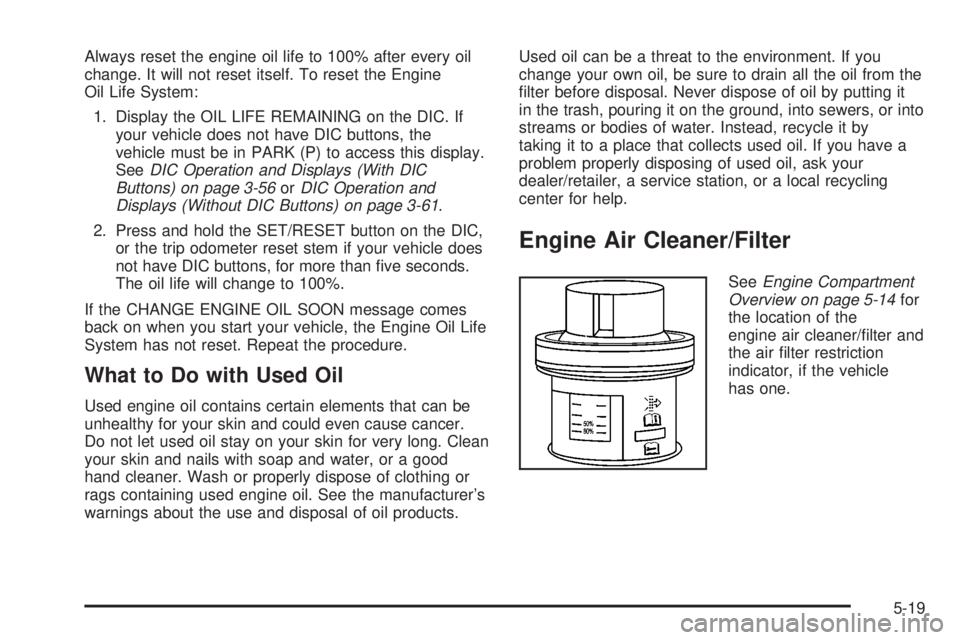
Engine Air Cleaner/Filter
SeeEngine Compartment
Overview on page 5-14for
the location of the
engine air cleaner/lter and
the air lter restriction
indicator, if the vehicle
has one.
5-19
Page 390 of 546
Automatic Transmission Fluid
(4-Speed Transmission)
When to Check and Change Automatic
Transmission Fluid
A good time to check your automatic transmission uid
level is when the engine oil is changed.
Change the uid and lter at the intervals listed in
Additional Required Services on page 6-6, and be sure
to use the transmission uid listed inRecommended
Fluids and Lubricants on page 6-13.
How to Check Automatic
Transmission Fluid
Because this operation can be a little difficult, you may
choose to have this done at the dealer/retailer service
department.
If you do it yourself, be sure to follow all the instructions
here, or you could get a false reading on the dipstick.
Notice:Too much or too little uid can damage
your transmission. Too much can mean that some
of the uid could come out and fall on hot engine
parts or exhaust system parts, starting a re.
Too little uid could cause the transmission to
overheat. Be sure to get an accurate reading if you
check your transmission uid.Wait at least 30 minutes before checking the
transmission uid level if you have been driving:
When outside temperatures are above 90°F (32°C).
At high speed for quite a while.
In heavy traffic — especially in hot weather.
While pulling a trailer.
To get the right reading, the uid should be at normal
operating temperature, which is 180°F to 200°F
(82°C to 93°C).
Get the vehicle warmed up by driving about 15 miles
(24 km) when outside temperatures are above 50°F
(10°C). If it is colder than 50°F (10°C), drive the vehicle
in THIRD (3) until the engine temperature gage
moves and then remains steady for 10 minutes.
A cold uid check can be made after the vehicle has
been sitting for eight hours or more with the engine off,
but this is used only as a reference. Let the engine
run at idle for ve minutes if outside temperatures are
50°F (10°C) or more. If it is colder than 50°F (10°C), you
may have to idle the engine longer. Should the uid
level be low during this cold check, you must check the
uid hot before adding uid. Checking the uid hot
will give you a more accurate reading of the uid level.
5-22
Page 392 of 546
Consistency of Readings
Always check the uid level at least twice using the
procedure described previously. Consistency (repeatable
readings) is important to maintaining proper uid
level. If readings are still inconsistent, contact your
dealer/retailer.
How to Add Automatic
Transmission Fluid
Refer to the Maintenance Schedule to determine what
kind of transmission uid to use. SeeRecommended
Fluids and Lubricants on page 6-13.
Using a funnel, add uid down the transmission dipstick
tube only after checking the transmission uid while it
is hot. A cold check is used only as a reference. If
the uid level is low, add only enough of the proper uid
to bring the level up to the HOT area for a hot check.
It does not take much uid, generally less than one pint
(0.5 L). Do not overll.Notice:Use of the incorrect automatic transmission
uid may damage your vehicle, and the damages
may not be covered by your warranty. Always
use the automatic transmission uid listed in
Recommended Fluids and Lubricants on page 6-13.
After adding uid, recheck the uid level as
described under “How to Check Automatic
Transmission Fluid,” earlier in this section.
When the correct uid level is obtained, push the
dipstick back in all the way; then ip the handle
down to lock the dipstick in place.
Automatic Transmission Fluid
(6-Speed Transmission)
When to Check and Change Automatic
Transmission Fluid
It is usually not necessary to check the transmission
uid level. The only reason for uid loss is a
transmission leak or overheating the transmission. If you
suspect a small leak, then use the following checking
procedures to check the uid level. However, if there is a
large leak, then it may be necessary to have the
vehicle towed to a dealer/retailer service department
and have it repaired before driving the vehicle further.
5-24
Page 396 of 546

Consistency of Readings
Always check the uid level at least twice using the
procedures described. Consistency (repeatable
readings) is important to maintaining proper uid level. If
uid is added, it may take 15 minutes or longer to
obtain an accurate reading because of residual uid
draining down the dipstick tube. If inconsistent readings
persist, check the transmission breather to be sure it
is clean and not clogged. If readings are still
inconsistent, contact your dealer/retailer.
Engine Coolant
The cooling system in your vehicle is lled with
DEX-COOL®engine coolant. This coolant is designed
to remain in your vehicle for ve years or 150,000 miles
(240 000 km), whichever occurs rst, if you add only
DEX-COOL
®extended life coolant.
The following explains your cooling system and how to
add coolant when it is low. If you have a problem
with engine overheating, seeEngine Overheating on
page 5-31.A 50/50 mixture of clean, drinkable water and
DEX-COOL
®coolant will:
Give freezing protection down to−34°F (−37°C).
Give boiling protection up to 265°F (129°C).
Protect against rust and corrosion.
Help keep the proper engine temperature.
Let the warning lights and gages work as they
should.
Notice:Using coolant other than DEX-COOL
®may
cause premature engine, heater core, or radiator
corrosion. In addition, the engine coolant may
require changing sooner, at the rst maintenance
service after each 30,000 miles (50 000 km) or
24 months, whichever occurs rst. Any repairs
would not be covered by your warranty. Always use
DEX-COOL
®(silicate-free) coolant in your vehicle.
5-28