belt GMC YUKON 2010 User Guide
[x] Cancel search | Manufacturer: GMC, Model Year: 2010, Model line: YUKON, Model: GMC YUKON 2010Pages: 614, PDF Size: 3.55 MB
Page 60 of 614
To return the seatback to an upright position, do the
following:1. Lift the lever fully without applying pressure to the seatback and the seatback will return to the upright
position.
{WARNING:
If either seatback is not locked, it could move
forward in a sudden stop or crash. That could
cause injury to the person sitting there. Always
push and pull on the seatbacks to be sure they
are locked.
2. Push and pull on the seatback to make sure it is locked.
Manual Fold and Tumble Feature
Folding and Tumbling the Seat(s)
To fold and tumble the seat, do the following:
1. Make sure that there is nothing under, in front of, or on the seat.
Notice: Folding a rear seat with the safety belts
still fastened may cause damage to the seat or the
safety belts. Always unbuckle the safety belts and
return them to their normal stowed position before
folding a rear seat.
2-22
Page 62 of 614
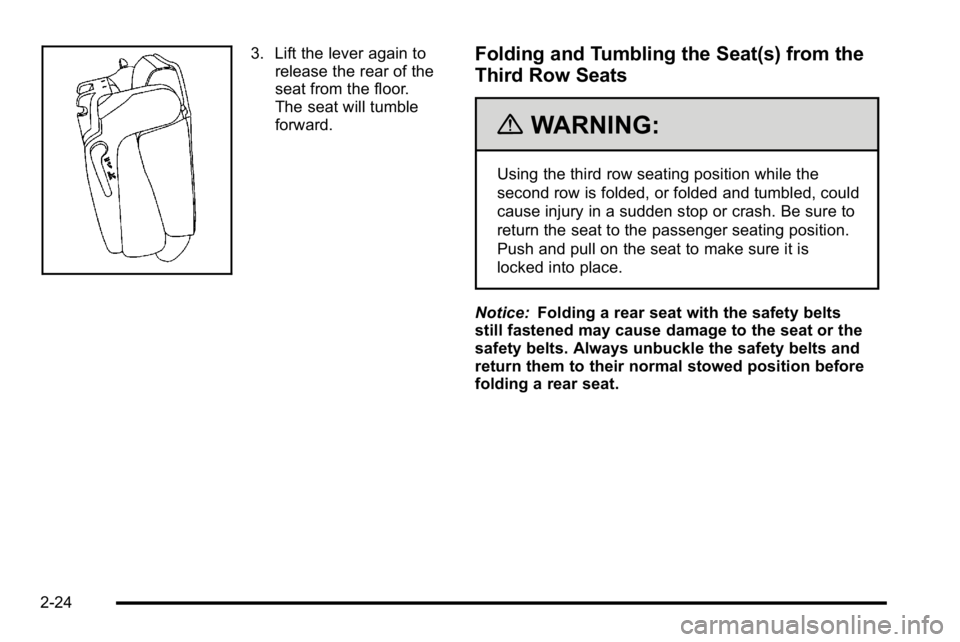
3. Lift the lever again torelease the rear of the
seat from the floor.
The seat will tumble
forward.Folding and Tumbling the Seat(s) from the
Third Row Seats
{WARNING:
Using the third row seating position while the
second row is folded, or folded and tumbled, could
cause injury in a sudden stop or crash. Be sure to
return the seat to the passenger seating position.
Push and pull on the seat to make sure it is
locked into place.
Notice: Folding a rear seat with the safety belts
still fastened may cause damage to the seat or the
safety belts. Always unbuckle the safety belts and
return them to their normal stowed position before
folding a rear seat.
2-24
Page 64 of 614
Folding and Tumbling the Second Row
Seat(s) from the Third Row Seats or
Outside
{WARNING:
Using the third row seating position while the
second row is folded, or folded and tumbled, could
cause injury in a sudden stop or crash. Be sure to
return the seat to the passenger seating position.
Push and pull on the seat to make sure it is
locked into place.
To fold and tumble the seat from the third row seats,
if your vehicle has them, do the following: 1. Make sure that there is nothing under, in front of, or on the seat.
Notice: Folding a rear seat with the safety belts
still fastened may cause damage to the seat or the
safety belts. Always unbuckle the safety belts and
return them to their normal stowed position before
folding a rear seat.
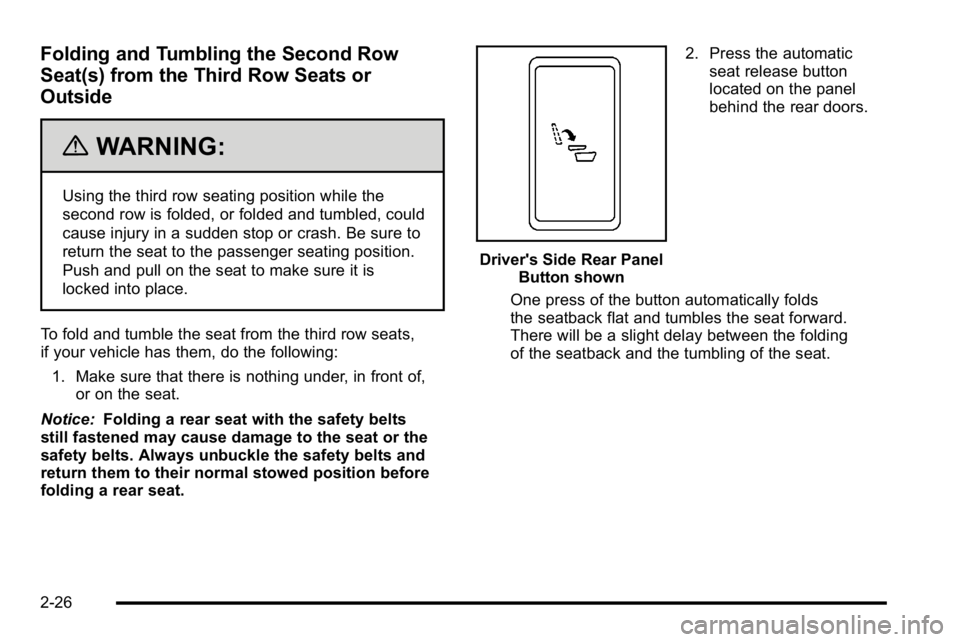
Driver's Side Rear Panel Button shown 2. Press the automatic
seat release button
located on the panel
behind the rear doors.
One press of the button automatically folds
the seatback flat and tumbles the seat forward.
There will be a slight delay between the folding
of the seatback and the tumbling of the seat.
2-26
Page 65 of 614
Returning the Seat(s) to the Sitting
Position
To return the seat to the sitting position, do the
following:1. Pull the seat down until it latches to the floor. The seatback cannot be raised if the seat is not
latched to the floor.
{WARNING:
If either seatback is not locked, it could move
forward in a sudden stop or crash. That could
cause injury to the person sitting there. Always
push and pull on the seatbacks to be sure they
are locked.
2. Lift the seatback and push it rearward. Push and pull on the seatback to make sure it is locked.
Third Row Seat
If the vehicle has a third row seat, the seatback(s)
can be folded and the entire seat can be tumbled,
or removed from the vehicle.
Folding the Seatback(s)
To fold the seatback, do the following:
1. Open the liftgate to access the controls for the seat.
2. Remove all items on the seat cushion.
Notice: Folding a rear seat with the safety belts
still fastened may cause damage to the seat or the
safety belts. Always unbuckle the safety belts and
return them to their normal stowed position before
folding a rear seat.
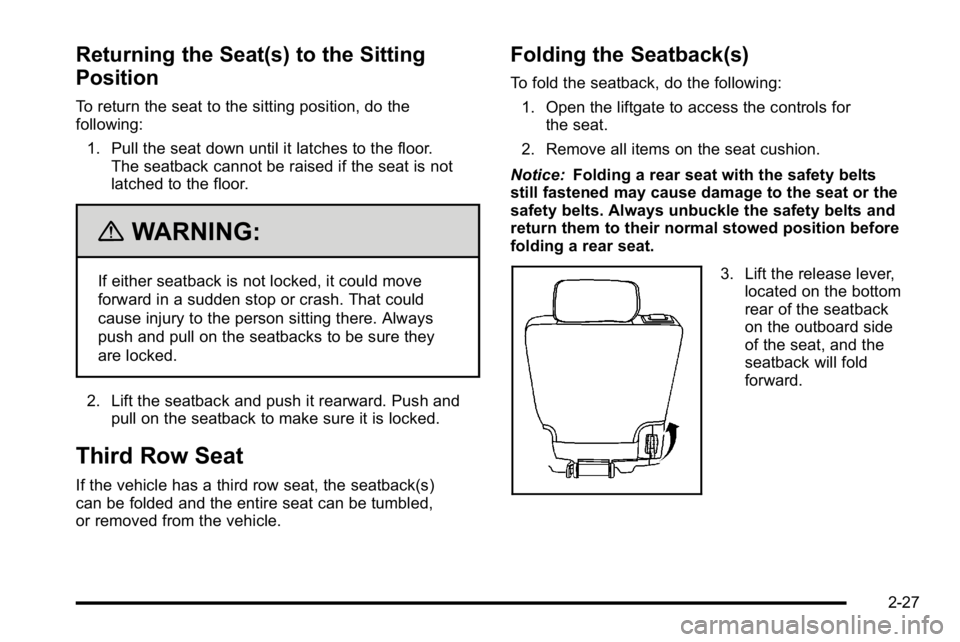
3. Lift the release lever, located on the bottom
rear of the seatback
on the outboard side
of the seat, and the
seatback will fold
forward.
2-27
Page 69 of 614

4. Push and pull on the seat to make sure it is lockedinto place. The seatback cannot be raised to the
upright position unless the seat is secured to the
floor.
5. Pull up on the seatback until it locks into the upright position.
{WARNING:
If either seatback is not locked, it could move
forward in a sudden stop or crash. That could
cause injury to the person sitting there. Always
push and pull on the seatbacks to be sure they
are locked.
6. Push and pull on the seatback to make sure it is locked.
{WARNING:
A safety belt that is improperly routed, not
properly attached, or twisted will not provide the
protection needed in a crash. The person wearing
the belt could be seriously injured. After raising
the rear seatback, always check to be sure that
the safety belts are properly routed and attached,
and are not twisted.
7. Make sure the safety belts are returned to the original position over the seatbacks.
2-31
Page 70 of 614
Safety Belts
Safety Belts: They Are for Everyone
This section of the manual describes how to use safety
belts properly. It also describes some things not to do
with safety belts.
{WARNING:
Do not let anyone ride where a safety belt cannot
be worn properly. In a crash, if you or your
passenger(s) are not wearing safety belts, the
injuries can be much worse. You can hit things
inside the vehicle harder or be ejected from the
vehicle. You and your passenger(s) can be
seriously injured or killed. In the same crash, you
might not be, if you are buckled up. Always fasten
your safety belt, and check that your passenger(s)
are restrained properly too.
{WARNING:
It is extremely dangerous to ride in a cargo area,
inside or outside of a vehicle. In a collision,
people riding in these areas are more likely to
be seriously injured or killed. Do not allow people
to ride in any area of your vehicle that is not
equipped with seats and safety belts. Be sure
everyone in your vehicle is in a seat and using a
safety belt properly.
This vehicle has indicators as a reminder to buckle the
safety belts. See Safety Belt Reminders
on page 4‑31for additional information.
2-32
Page 71 of 614
In most states and in all Canadian provinces, the law
requires wearing safety belts. Here is why:
You never know if you will be in a crash. If you do have
a crash, you do not know if it will be a serious one.
A few crashes are mild, and some crashes can be
so serious that even buckled up, a person would not
survive. But most crashes are in between. In many of
them, people who buckle up can survive and sometimes
walk away. Without safety belts, they could have been
badly hurt or killed.
After more than 40 years of safety belts in vehicles,
the facts are clear. In most crashes buckling up does
matter ... a lot!Why Safety Belts Work
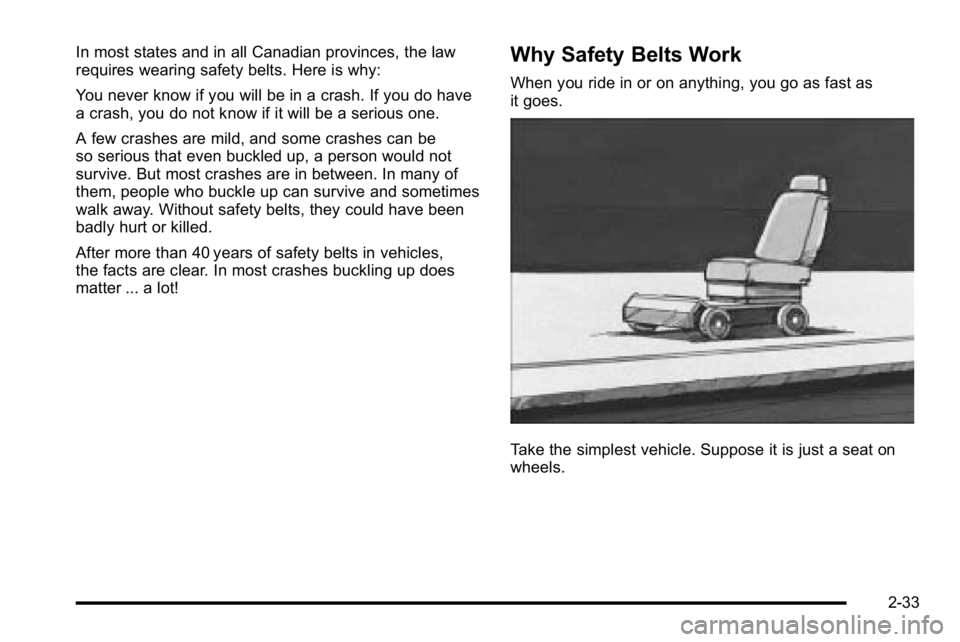
When you ride in or on anything, you go as fast as
it goes.
Take the simplest vehicle. Suppose it is just a seat on
wheels.
2-33
Page 74 of 614

or the safety belts!
With safety belts, you slow down as the vehicle does.
You get more time to stop. You stop over more distance,
and your strongest bones take the forces. That is why
safety belts make such good sense.
Questions and Answers About Safety
Belts
Q: Will I be trapped in the vehicle after a crash if Iam wearing a safety belt?
A: You could be—whether you are wearing a safety
belt or not. But your chance of being conscious
during and after an accident, so you canunbuckle
and get out, is muchgreater if you are belted. And
you can unbuckle a safety belt, even if you are
upside down.
Q: If my vehicle has airbags, why should I have to wear safety belts?
A: Airbags are supplemental systems only; so they
work withsafety belts —not instead of them.
Whether or not an airbag is provided, all occupants
still have to buckle up to get the most protection.
That is true not only in frontal collisions, but
especially in side and other collisions.
2-36
Page 75 of 614
Q: If I am a good driver, and I never drive far fromhome, why should I wear safety belts?
A: You may be an excellent driver, but if you are in a
crash —even one that is not your fault —you and
your passenger(s) can be hurt. Being a good driver
does not protect you from things beyond your
control, such as bad drivers.
Most accidents occur within 25 miles (40 km) of
home. And the greatest number of serious injuries
and deaths occur at speeds of less than 40 mph
(65 km/h).
Safety belts are for everyone.How to Wear Safety Belts Properly
This section is only for people of adult size.
Be aware that there are special things to know about
safety belts and children. And there are different rules
for smaller children and infants. If a child will be riding in
the vehicle, see Older Children
on page 2‑55orInfants
and Young Childrenon page 2‑59. Follow those rules
for everyone's protection.
It is very important for all occupants to buckle up.
Statistics show that unbelted people are hurt more often
in crashes than those who are wearing safety belts.
Occupants who are not buckled up can be thrown out of
the vehicle in a crash. And they can strike others in the
vehicle who are wearing safety belts.
First, before you or your passenger(s) wear a safety
belt, there is important information you should know.
2-37
Page 76 of 614
Sit up straight and always keep your feet on the floor
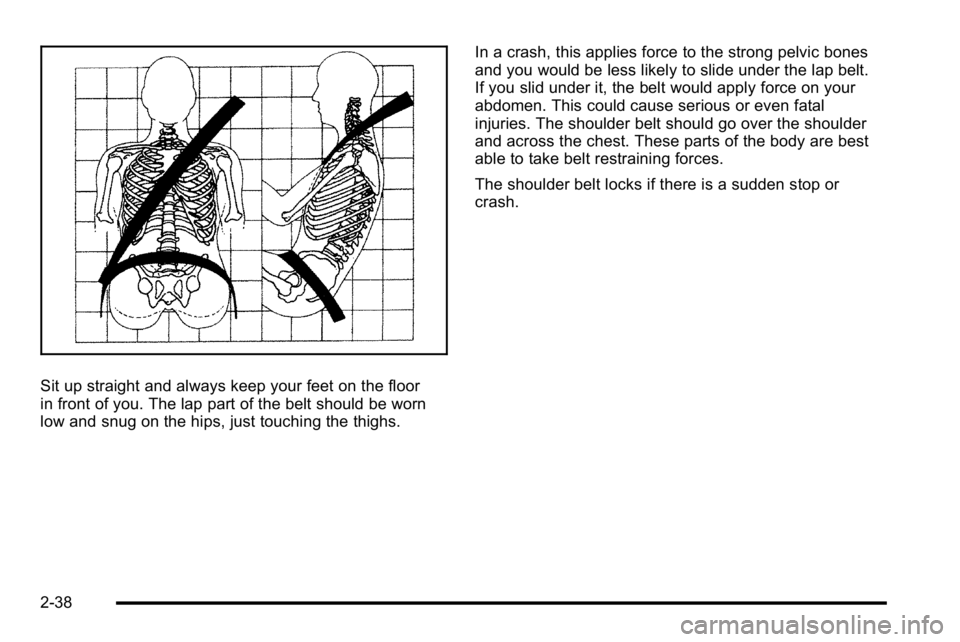
in front of you. The lap part of the belt should be worn
low and snug on the hips, just touching the thighs.In a crash, this applies force to the strong pelvic bones
and you would be less likely to slide under the lap belt.
If you slid under it, the belt would apply force on your
abdomen. This could cause serious or even fatal
injuries. The shoulder belt should go over the shoulder
and across the chest. These parts of the body are best
able to take belt restraining forces.
The shoulder belt locks if there is a sudden stop or
crash.
2-38