clock GMC YUKON 2010 Owner's Guide
[x] Cancel search | Manufacturer: GMC, Model Year: 2010, Model line: YUKON, Model: GMC YUKON 2010Pages: 614, PDF Size: 3.55 MB
Page 489 of 614
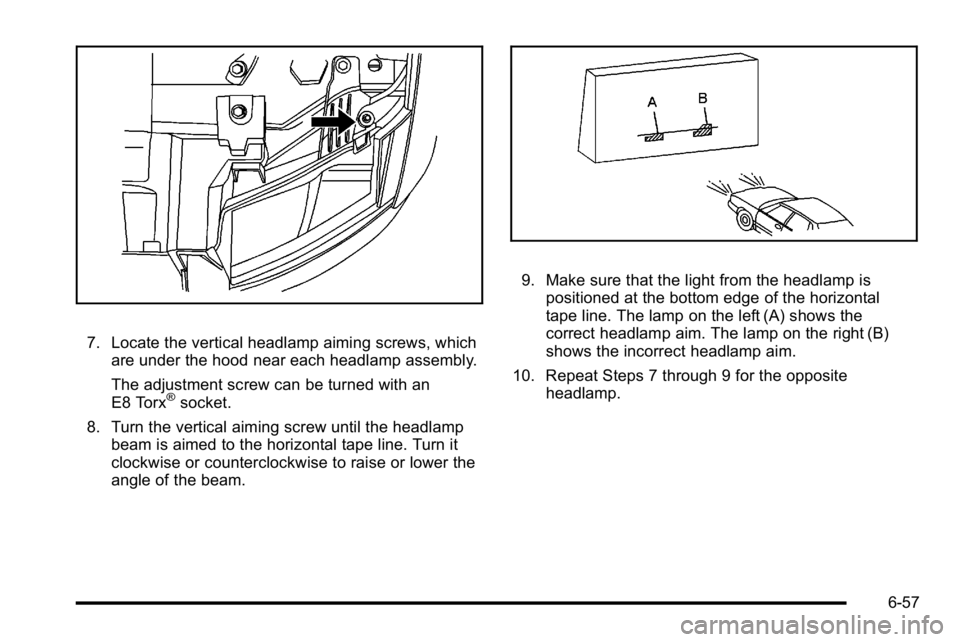
7. Locate the vertical headlamp aiming screws, whichare under the hood near each headlamp assembly.
The adjustment screw can be turned with an
E8 Torx
®socket.
8. Turn the vertical aiming screw until the headlamp beam is aimed to the horizontal tape line. Turn it
clockwise or counterclockwise to raise or lower the
angle of the beam.
9. Make sure that the light from the headlamp is
positioned at the bottom edge of the horizontal
tape line. The lamp on the left (A) shows the
correct headlamp aim. The lamp on the right (B)
shows the incorrect headlamp aim.
10. Repeat Steps 7 through 9 for the opposite headlamp.
6-57
Page 491 of 614

To replace one of these bulbs:1. Open the liftgate. See Power Liftgate
on
page 3‑15.
2. Remove the two screws from the
taillamp assembly.
3. Pull the taillamp assembly rearward until you disengage the inner pins on the taillamp assembly
from the vehicle. 4. Press the release tab, if bulb socket has one, and
turn the bulb socket counterclockwise to remove it
from the taillamp assembly.
5. Pull the old bulb straight out from the bulb socket.
6. Press a new bulb into the bulb socket and insert it into the taillamp assembly. Turn the bulb socket
clockwise into the taillamp assembly until it clicks.
7. Reinstall the taillamp assembly. When reinstalling, make sure to line up the pins on the taillamp
assembly with the vehicle. If you do not do this,
you will not be able correctly install the taillamp
assembly.
6-59
Page 492 of 614
License Plate Lamp
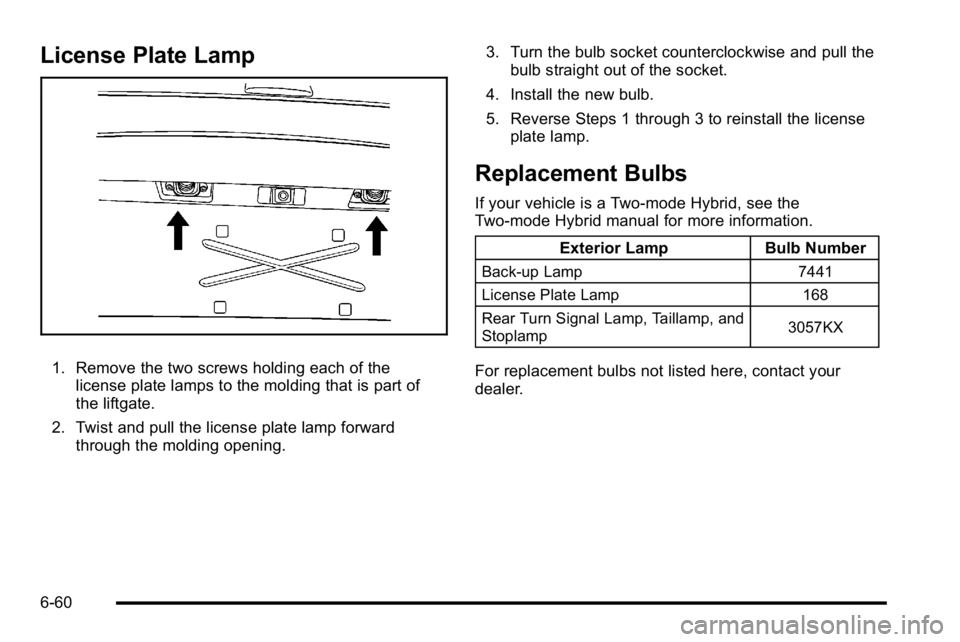
1. Remove the two screws holding each of thelicense plate lamps to the molding that is part of
the liftgate.
2. Twist and pull the license plate lamp forward through the molding opening. 3. Turn the bulb socket counterclockwise and pull the
bulb straight out of the socket.
4. Install the new bulb.
5. Reverse Steps 1 through 3 to reinstall the license plate lamp.
Replacement Bulbs
If your vehicle is a Two-mode Hybrid, see the
Two-mode Hybrid manual for more information.
Exterior Lamp Bulb Number
Back-up Lamp 7441
License Plate Lamp 168
Rear Turn Signal Lamp, Taillamp, and
Stoplamp 3057KX
For replacement bulbs not listed here, contact your
dealer.
6-60
Page 522 of 614

2. Remove the wing nut (B) used to retain the toolbag by turning it counterclockwise.
3. Turn the knob (A) on the jack counterclockwise to release the jack and wheel blocks from the
bracket.
4. Remove the wheel blocks and the wheel block retainer by turning the wing nut (C)
counterclockwise. The tools you will be using include the following:
A. Jack
B. Wheel Blocks
C. Jack Handle D. Jack Handle Extensions
E. Wheel Wrench
6-90
Page 523 of 614
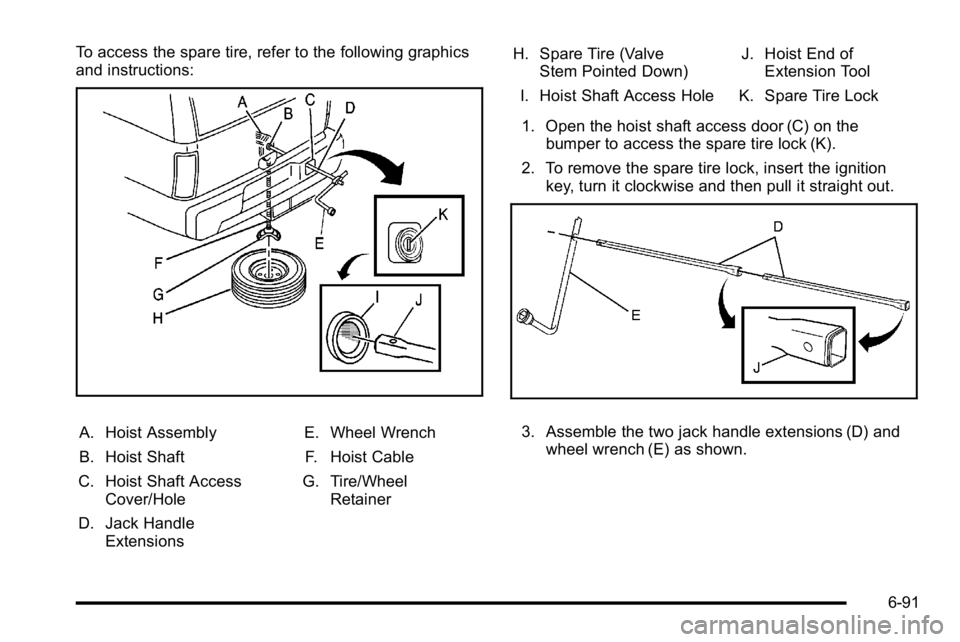
To access the spare tire, refer to the following graphics
and instructions:
A. Hoist Assembly
B. Hoist Shaft
C. Hoist Shaft Access Cover/Hole
D. Jack Handle Extensions E. Wheel Wrench
F. Hoist Cable
G. Tire/Wheel Retainer H. Spare Tire (Valve
Stem Pointed Down)
I. Hoist Shaft Access Hole J. Hoist End of
Extension Tool
K. Spare Tire Lock
1. Open the hoist shaft access door (C) on the bumper to access the spare tire lock (K).
2. To remove the spare tire lock, insert the ignition key, turn it clockwise and then pull it straight out.3. Assemble the two jack handle extensions (D) andwheel wrench (E) as shown.
6-91
Page 524 of 614
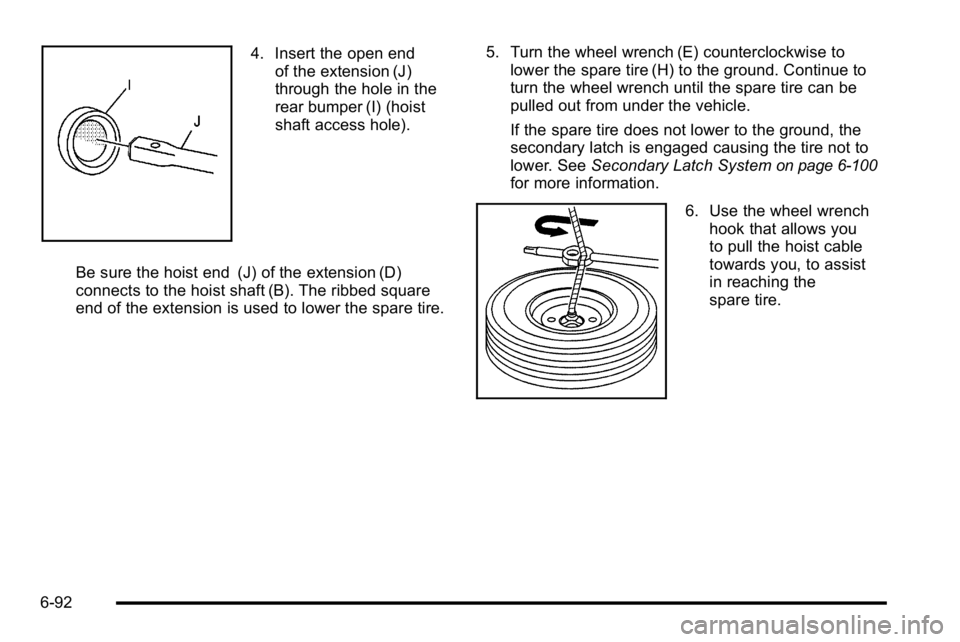
4. Insert the open endof the extension (J)
through the hole in the
rear bumper (I) (hoist
shaft access hole).
Be sure the hoist end (J) of the extension (D)
connects to the hoist shaft (B). The ribbed square
end of the extension is used to lower the spare tire. 5. Turn the wheel wrench (E) counterclockwise to
lower the spare tire (H) to the ground. Continue to
turn the wheel wrench until the spare tire can be
pulled out from under the vehicle.
If the spare tire does not lower to the ground, the
secondary latch is engaged causing the tire not to
lower. See Secondary Latch System
on page 6‑100for more information.
6. Use the wheel wrench
hook that allows you
to pull the hoist cable
towards you, to assist
in reaching the
spare tire.
6-92
Page 526 of 614
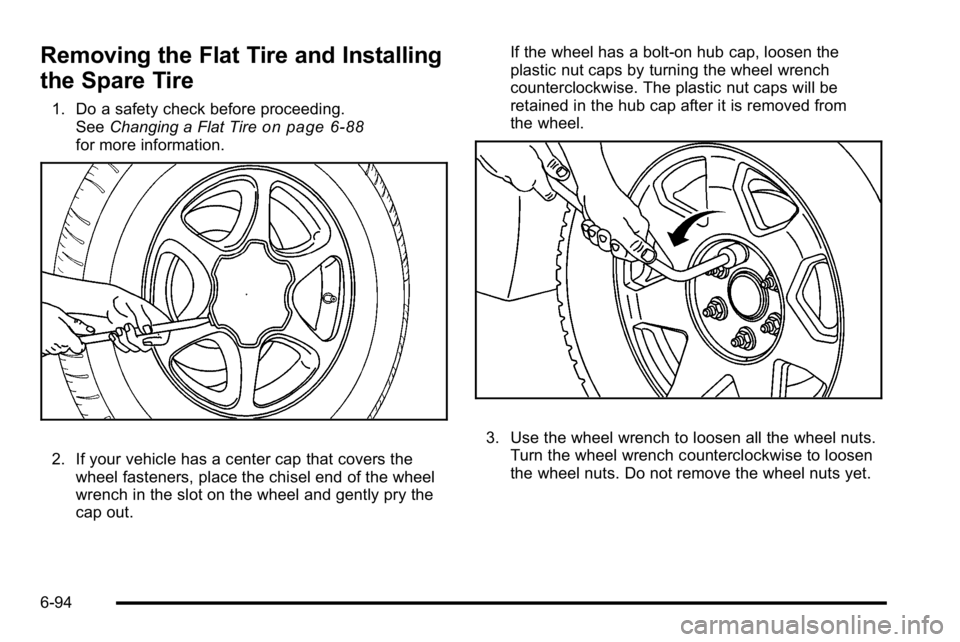
Removing the Flat Tire and Installing
the Spare Tire
1. Do a safety check before proceeding.See Changing a Flat Tireon page 6‑88for more information.
2. If your vehicle has a center cap that covers the
wheel fasteners, place the chisel end of the wheel
wrench in the slot on the wheel and gently pry the
cap out. If the wheel has a bolt-on hub cap, loosen the
plastic nut caps by turning the wheel wrench
counterclockwise. The plastic nut caps will be
retained in the hub cap after it is removed from
the wheel.
3. Use the wheel wrench to loosen all the wheel nuts.
Turn the wheel wrench counterclockwise to loosen
the wheel nuts. Do not remove the wheel nuts yet.
6-94
Page 528 of 614
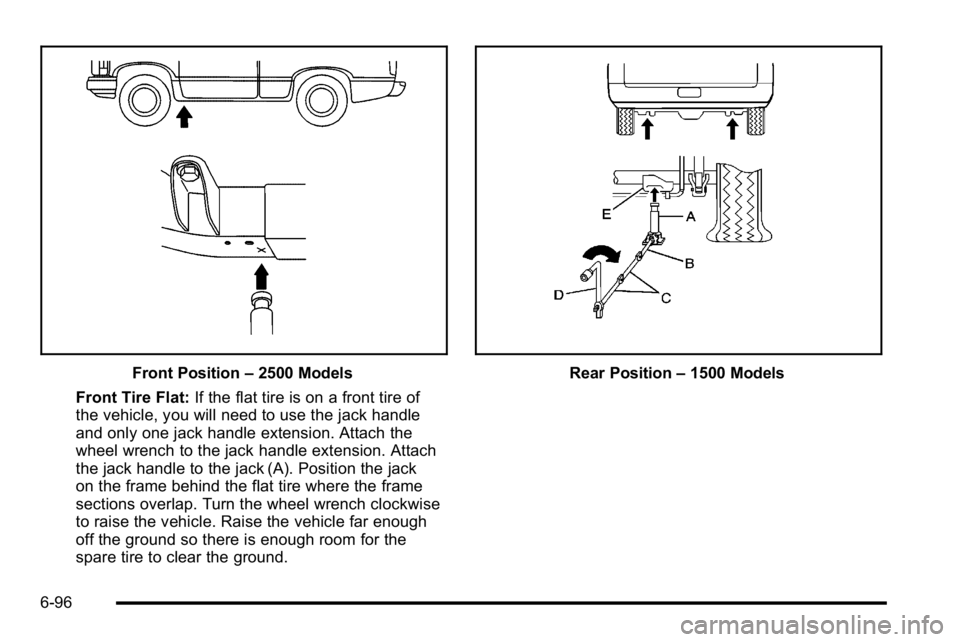
Front Position–2500 Models
Front Tire Flat: If the flat tire is on a front tire of
the vehicle, you will need to use the jack handle
and only one jack handle extension. Attach the
wheel wrench to the jack handle extension. Attach
the jack handle to the jack (A). Position the jack
on the frame behind the flat tire where the frame
sections overlap. Turn the wheel wrench clockwise
to raise the vehicle. Raise the vehicle far enough
off the ground so there is enough room for the
spare tire to clear the ground.Rear Position –1500 Models
6-96
Page 529 of 614
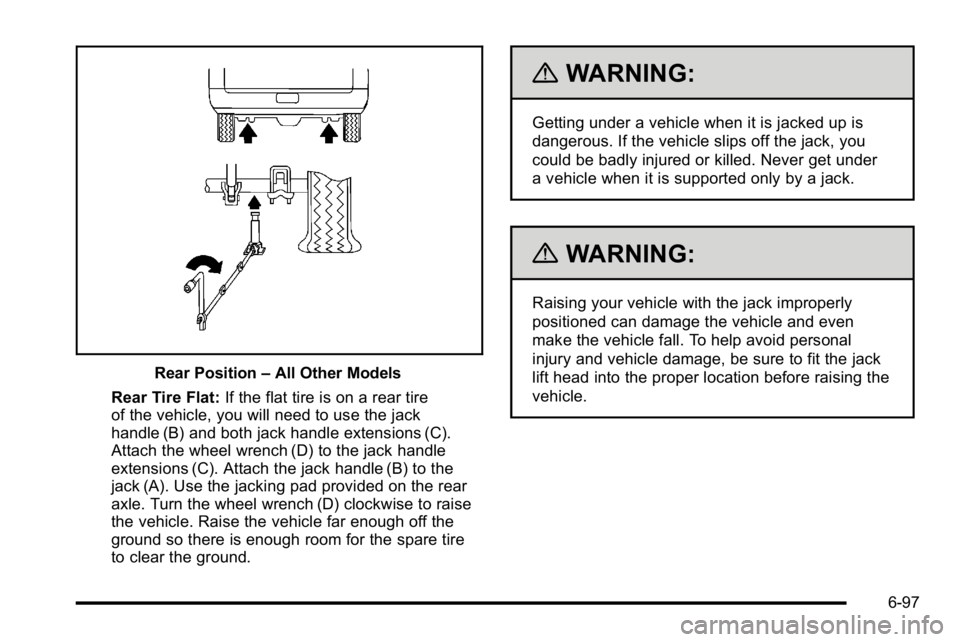
Rear Position–All Other Models
Rear Tire Flat: If the flat tire is on a rear tire
of the vehicle, you will need to use the jack
handle (B) and both jack handle extensions (C).
Attach the wheel wrench (D) to the jack handle
extensions (C). Attach the jack handle (B) to the
jack (A). Use the jacking pad provided on the rear
axle. Turn the wheel wrench (D) clockwise to raise
the vehicle. Raise the vehicle far enough off the
ground so there is enough room for the spare tire
to clear the ground.
{WARNING:
Getting under a vehicle when it is jacked up is
dangerous. If the vehicle slips off the jack, you
could be badly injured or killed. Never get under
a vehicle when it is supported only by a jack.
{WARNING:
Raising your vehicle with the jack improperly
positioned can damage the vehicle and even
make the vehicle fall. To help avoid personal
injury and vehicle damage, be sure to fit the jack
lift head into the proper location before raising the
vehicle.
6-97
Page 531 of 614
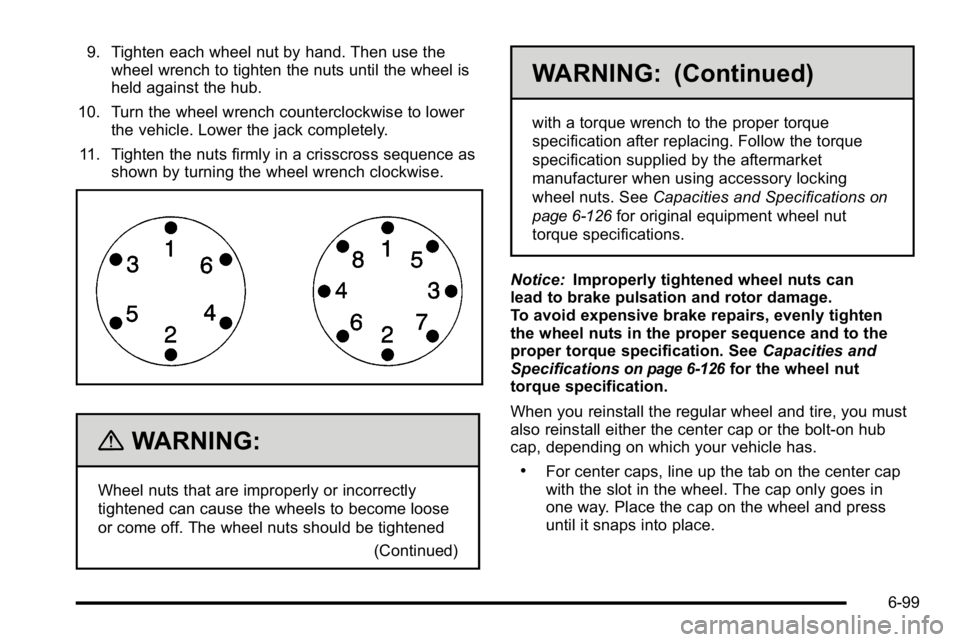
9. Tighten each wheel nut by hand. Then use thewheel wrench to tighten the nuts until the wheel is
held against the hub.
10. Turn the wheel wrench counterclockwise to lower the vehicle. Lower the jack completely.
11. Tighten the nuts firmly in a crisscross sequence as shown by turning the wheel wrench clockwise.
{WARNING:
Wheel nuts that are improperly or incorrectly
tightened can cause the wheels to become loose
or come off. The wheel nuts should be tightened
(Continued)
WARNING: (Continued)
with a torque wrench to the proper torque
specification after replacing. Follow the torque
specification supplied by the aftermarket
manufacturer when using accessory locking
wheel nuts. SeeCapacities and Specifications
on
page 6‑126
for original equipment wheel nut
torque specifications.
Notice: Improperly tightened wheel nuts can
lead to brake pulsation and rotor damage.
To avoid expensive brake repairs, evenly tighten
the wheel nuts in the proper sequence and to the
proper torque specification. See Capacities and
Specifications
on page 6‑126for the wheel nut
torque specification.
When you reinstall the regular wheel and tire, you must
also reinstall either the center cap or the bolt-on hub
cap, depending on which your vehicle has.
.For center caps, line up the tab on the center cap
with the slot in the wheel. The cap only goes in
one way. Place the cap on the wheel and press
until it snaps into place.
6-99