service GMC YUKON 2018 Workshop Manual
[x] Cancel search | Manufacturer: GMC, Model Year: 2018, Model line: YUKON, Model: GMC YUKON 2018Pages: 431, PDF Size: 6.08 MB
Page 280 of 431
GMC Yukon/Yukon XL/Denali Owner Manual (GMNA-Localizing-U.S./
Canada/Mexico-11349262) - 2018 - CRC - 11/3/17
Driving and Operating 279
Conversions and
Add-Ons
Add-On Electrical
Equipment
{Warning
The Data Link Connector (DLC) is
used for vehicle service
and Emission Inspection/
Maintenance testing. See
Malfunction Indicator Lamp
(Check Engine Light)0146.
A device connected to the DLC —
such as an aftermarket fleet or
driver-behavior tracking device —
may interfere with vehicle
systems. This could affect vehicle
operation and cause a crash.
Such devices may also access
information stored in the vehicle’s
systems.
Caution
Some electrical equipment can
damage the vehicle or cause
components to not work and
would not be covered by the
vehicle warranty. Always check
with your dealer before adding
electrical equipment.
Add-on equipment can drain the
vehicle's 12-volt battery, even if the
vehicle is not operating.
The vehicle has an airbag system.
Before attempting to add anything
electrical to the vehicle, see
Servicing the Airbag-Equipped
Vehicle 098 and Adding Equipment
to the Airbag-Equipped Vehicle
0 98.
Page 281 of 431
GMC Yukon/Yukon XL/Denali Owner Manual (GMNA-Localizing-U.S./
Canada/Mexico-11349262) - 2018 - CRC - 11/3/17
280 Vehicle Care
Vehicle Care
General Information
General Information . . . . . . . . . . 281
California Proposition65 Warning . . . . . . . . . . . . . . . . . 281
California Perchlorate Materials Requirements . . . . . 282
Accessories and Modifications . . . . . . . . . . . . . . . . 282
Vehicle Checks
Doing Your OwnService Work . . . . . . . . . . . . . . . 282
Hood . . . . . . . . . . . . . . . . . . . . . . . . . 283
Engine Compartment Overview . . . . . . . . . . . . . . . . . . . . 284
Engine Oil . . . . . . . . . . . . . . . . . . . . 287
Engine Oil Life System . . . . . . . 289
Automatic Transmission Fluid (6 Speed Transmission) . . . . . 290
Automatic Transmission Fluid (8 and 10 Speed
Transmission) . . . . . . . . . . . . . . . 293
Engine Air Cleaner/Filter . . . . . . 294
Cooling System . . . . . . . . . . . . . . 295
Engine Overheating . . . . . . . . . . 298
Engine Fan . . . . . . . . . . . . . . . . . . . 300
Washer Fluid . . . . . . . . . . . . . . . . . 300 Brakes . . . . . . . . . . . . . . . . . . . . . . . 301
Brake Fluid . . . . . . . . . . . . . . . . . . . 302
Battery - North America . . . . . . 303
Four-Wheel Drive . . . . . . . . . . . . . 303
Front Axle . . . . . . . . . . . . . . . . . . . . 304
Rear Axle . . . . . . . . . . . . . . . . . . . . 305
Noise Control System . . . . . . . . 305
Starter Switch Check . . . . . . . . . 306
Automatic Transmission Shift
Lock Control Function
Check . . . . . . . . . . . . . . . . . . . . . . . 307
Ignition Transmission Lock Check . . . . . . . . . . . . . . . . . . . . . . . 307
Park Brake and P (Park) Mechanism Check . . . . . . . . . . 307
Wiper Blade Replacement . . . . 308
Glass Replacement . . . . . . . . . . 309
Windshield Replacement . . . . . 309
Gas Strut(s) . . . . . . . . . . . . . . . . . . 309
Headlamp Aiming
Headlamp Aiming . . . . . . . . . . . . 310
Bulb Replacement
Bulb Replacement . . . . . . . . . . . . 311
High Intensity Discharge (HID) Lighting . . . . . . . . . . . . . . . . . . . . . 311
LED Lighting . . . . . . . . . . . . . . . . . . 311
Fog Lamps . . . . . . . . . . . . . . . . . . . 311
Back-Up Lamps . . . . . . . . . . . . . . 311
License Plate Lamp . . . . . . . . . . 312
Electrical System
Electrical System Overload . . . 313
Fuses and Circuit Breakers . . . 313
Engine Compartment Fuse Block . . . . . . . . . . . . . . . . . . . . . . . . 314
Instrument Panel Fuse
Block (Left) . . . . . . . . . . . . . . . . . 318
Instrument Panel Fuse Block (Right) . . . . . . . . . . . . . . . . . . . . . . 321
Rear Compartment Fuse Block . . . . . . . . . . . . . . . . . . . . . . . . 323
Wheels and Tires
Tires . . . . . . . . . . . . . . . . . . . . . . . . . . 324
All-Season Tires . . . . . . . . . . . . . . 325
Winter Tires . . . . . . . . . . . . . . . . . . 325
Low-Profile Tires . . . . . . . . . . . . . 326
All-Terrain Tires . . . . . . . . . . . . . . . 326
Tire Sidewall Labeling . . . . . . . . 326
Tire Designations . . . . . . . . . . . . . 327
Tire Terminology andDefinitions . . . . . . . . . . . . . . . . . . 328
Tire Pressure . . . . . . . . . . . . . . . . . 331
Tire Pressure for High-Speed Operation . . . . . . . . . . . . . . . . . . . 332
Tire Pressure Monitor System . . . . . . . . . . . . . . . . . . . . . . 333
Tire Pressure Monitor Operation . . . . . . . . . . . . . . . . . . . 334
Tire Inspection . . . . . . . . . . . . . . . . 337
Page 282 of 431
GMC Yukon/Yukon XL/Denali Owner Manual (GMNA-Localizing-U.S./
Canada/Mexico-11349262) - 2018 - CRC - 11/3/17
Vehicle Care 281
Tire Rotation . . . . . . . . . . . . . . . . . 338
When It Is Time for NewTires . . . . . . . . . . . . . . . . . . . . . . . . 339
Buying New Tires . . . . . . . . . . . . . 340
Different Size Tires and Wheels . . . . . . . . . . . . . . . . . . . . . . 341
Uniform Tire Quality Grading . . . . . . . . . . . . . . . . . . . . . 342
Wheel Alignment and Tire Balance . . . . . . . . . . . . . . . . . . . . . 343
Wheel Replacement . . . . . . . . . . 343
Tire Chains . . . . . . . . . . . . . . . . . . . 344
If a Tire Goes Flat . . . . . . . . . . . . 345
Tire Changing . . . . . . . . . . . . . . . . 346
Full-Size Spare Tire . . . . . . . . . . 355
Jump Starting
Jump Starting - North America . . . . . . . . . . . . . . . . . . . . . 356
Towing the Vehicle
Towing the Vehicle . . . . . . . . . . . 360
Recreational VehicleTowing . . . . . . . . . . . . . . . . . . . . . . 360
Appearance Care
Exterior Care . . . . . . . . . . . . . . . . . 365
Interior Care . . . . . . . . . . . . . . . . . . 369
Floor Mats . . . . . . . . . . . . . . . . . . . . 373
General Information
For service and parts needs, visit
your dealer. You will receive
genuine GM parts and GM-trained
and supported service people.
Genuine GM parts have one of
these marks:
California Proposition
65 Warning
{Warning
Most motor vehicles, including
this one, as well as many of its
service parts and fluids, contain
and/or emit chemicals known to
the State of California to cause
cancer and birth defects or other
reproductive harm. Engine
exhaust, many parts and
systems, many fluids, and some
component wear by-products
contain and/or emit these
chemicals. For more information
go to www.P65Warnings.ca.gov/
passenger-vehicle.
See Battery - North America 0303
and Jump Starting - North America
0 356 and the back cover.
Page 283 of 431
GMC Yukon/Yukon XL/Denali Owner Manual (GMNA-Localizing-U.S./
Canada/Mexico-11349262) - 2018 - CRC - 11/3/17
282 Vehicle Care
California Perchlorate
Materials Requirements
Certain types of automotive
applications, such as airbag
initiators, seat belt pretensioners,
and lithium batteries contained in
Remote Keyless Entry transmitters,
may contain perchlorate materials.
Special handling may be necessary.
For additional information, see
www.dtsc.ca.gov/hazardouswaste/
perchlorate.
Accessories and
Modifications
Adding non-dealer accessories or
making modifications to the vehicle
can affect vehicle performance and
safety, including such things as
airbags, braking, stability, ride and
handling, emissions systems,
aerodynamics, durability, and
electronic systems like antilock
brakes, traction control, and stability
control. These accessories or
modifications could even cause
malfunction or damage not covered
by the vehicle warranty.Damage to suspension components
caused by modifying vehicle height
outside of factory settings will not be
covered by the vehicle warranty.
Damage to vehicle components
resulting from modifications or the
installation or use of non-GM
certified parts, including control
module or software modifications, is
not covered under the terms of the
vehicle warranty and may affect
remaining warranty coverage for
affected parts.
GM Accessories are designed to
complement and function with other
systems on the vehicle. See your
dealer to accessorize the vehicle
using genuine GM Accessories
installed by a dealer technician.
Also, see
Adding Equipment to the
Airbag-Equipped Vehicle 098.
Vehicle Checks
Doing Your Own
Service Work
{Warning
It can be dangerous to work on
your vehicle if you do not have
the proper knowledge, service
manual, tools, or parts. Always
follow owner ’s manual procedures
and consult the service manual
for your vehicle before doing any
service work.
If doing some of your own service
work, use the proper service
manual. It tells you much more
about how to service the vehicle
than this manual can. To order the
proper service manual, see Service
Publications Ordering Information
0 401.
Page 284 of 431
GMC Yukon/Yukon XL/Denali Owner Manual (GMNA-Localizing-U.S./
Canada/Mexico-11349262) - 2018 - CRC - 11/3/17
Vehicle Care 283
This vehicle has an airbag system.
Before attempting to do your own
service work, seeServicing the
Airbag-Equipped Vehicle 098.
Keep a record with all parts receipts
and list the mileage and the date of
any service work performed. See
Maintenance Records 0387.
Caution
Even small amounts of
contamination can cause damage
to vehicle systems. Do not allow
contaminants to contact the fluids,
reservoir caps, or dipsticks.
Hood
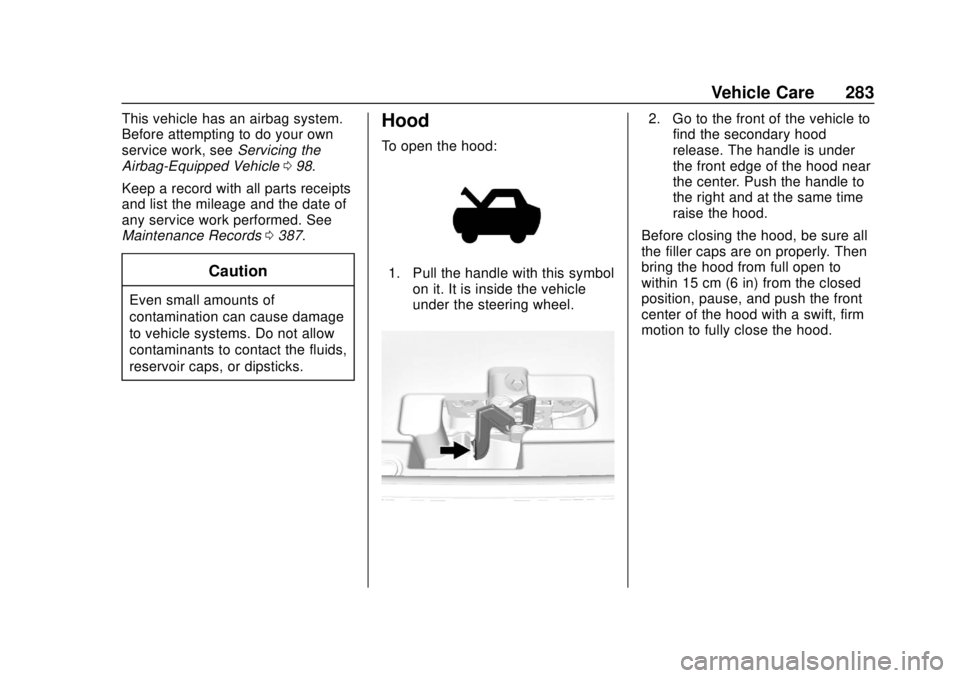
To open the hood:
1. Pull the handle with this symbol
on it. It is inside the vehicle
under the steering wheel.
2. Go to the front of the vehicle tofind the secondary hood
release. The handle is under
the front edge of the hood near
the center. Push the handle to
the right and at the same time
raise the hood.
Before closing the hood, be sure all
the filler caps are on properly. Then
bring the hood from full open to
within 15 cm (6 in) from the closed
position, pause, and push the front
center of the hood with a swift, firm
motion to fully close the hood.
Page 289 of 431
GMC Yukon/Yukon XL/Denali Owner Manual (GMNA-Localizing-U.S./
Canada/Mexico-11349262) - 2018 - CRC - 11/3/17
288 Vehicle Care
engine oil level on steep grades
or too soon after engine shutoff
can result in incorrect readings.
Accuracy improves when
checking a cold engine prior to
starting. Remove the dipstick
and check the level.
. If unable to wait two hours, the
engine must be off for at least
15 minutes if the engine is
warm, or at least 30 minutes if
the engine is not warm. Pull out
the dipstick, wipe it with a clean
paper towel or cloth, then push it
back in all the way. Remove it
again, keeping the tip down, and
check the level.
When to Add Engine Oil
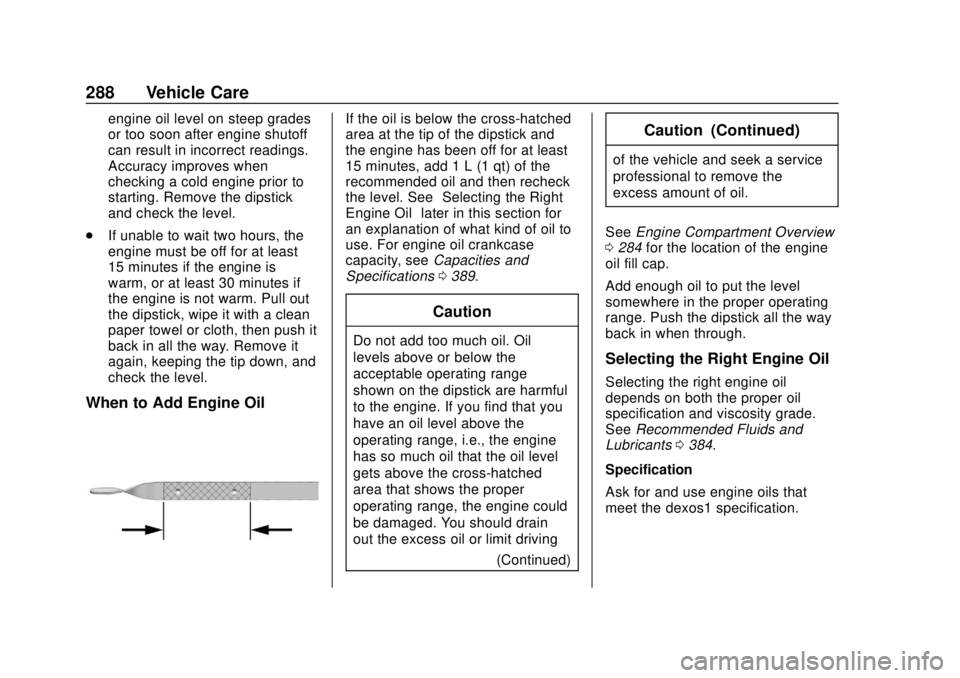
If the oil is below the cross-hatched
area at the tip of the dipstick and
the engine has been off for at least
15 minutes, add 1 L (1 qt) of the
recommended oil and then recheck
the level. See “Selecting the Right
Engine Oil” later in this section for
an explanation of what kind of oil to
use. For engine oil crankcase
capacity, see Capacities and
Specifications 0389.
Caution
Do not add too much oil. Oil
levels above or below the
acceptable operating range
shown on the dipstick are harmful
to the engine. If you find that you
have an oil level above the
operating range, i.e., the engine
has so much oil that the oil level
gets above the cross-hatched
area that shows the proper
operating range, the engine could
be damaged. You should drain
out the excess oil or limit driving
(Continued)
Caution (Continued)
of the vehicle and seek a service
professional to remove the
excess amount of oil.
See Engine Compartment Overview
0 284 for the location of the engine
oil fill cap.
Add enough oil to put the level
somewhere in the proper operating
range. Push the dipstick all the way
back in when through.
Selecting the Right Engine Oil
Selecting the right engine oil
depends on both the proper oil
specification and viscosity grade.
See Recommended Fluids and
Lubricants 0384.
Specification
Ask for and use engine oils that
meet the dexos1 specification.
Page 291 of 431
GMC Yukon/Yukon XL/Denali Owner Manual (GMNA-Localizing-U.S./
Canada/Mexico-11349262) - 2018 - CRC - 11/3/17
290 Vehicle Care
best conditions, the oil life system
may indicate that an oil change is
not necessary for up to a year. The
engine oil and filter must be
changed at least once a year and,
at this time, the system must be
reset. Your dealer has trained
service people who will perform this
work and reset the system. It is also
important to check the oil regularly
over the course of an oil drain
interval and keep it at the proper
level.
If the system is ever reset
accidentally, the oil must be
changed at 5 000 km (3,000 mi)
since the last oil change.
Remember to reset the oil life
system whenever the oil is changed.
How to Reset the Engine Oil
Life System
Reset the system whenever the
engine oil is changed so that the
system can calculate the next
engine oil change. Always reset the
engine oil life to 100% after every oil
change. It will not reset itself. To
reset the engine oil life system:1. Display the REMAINING OIL
LIFE on the DIC. See Driver
Information Center (DIC) 0154.
2. Press and hold
V. The oil life
will change to 100%.
The oil life system can also be reset
as follows: 1. Display the REMAINING OIL LIFE on the DIC. See Driver
Information Center (DIC) 0154.
2. Fully press the accelerator pedal slowly three times within
five seconds.
3. Display the REMAINING OIL LIFE on the DIC. If the display
shows 100%, the system is
reset.
If the CHANGE ENGINE OIL SOON
message comes back on when the
vehicle is started and/or the
REMAINING OIL LIFE is near 0%,
the engine oil life system has not
been reset. Repeat the procedure.
Automatic Transmission
Fluid (6 Speed
Transmission)
When to Check and Change
Automatic Transmission Fluid
It is usually not necessary to check
the transmission fluid level. The only
reason for fluid loss is a
transmission leak or overheated
transmission. If a small leak is
suspected, then use the following
checking procedures to check the
fluid level. However, if there is a
large leak, then it may be necessary
to have the vehicle towed to a
dealer service department and have
it repaired before driving the vehicle
further.
Caution
Use of the incorrect automatic
transmission fluid may damage
the vehicle, and the damage may
not be covered by the vehicle
warranty. Always use the (Continued)
Page 294 of 431
GMC Yukon/Yukon XL/Denali Owner Manual (GMNA-Localizing-U.S./
Canada/Mexico-11349262) - 2018 - CRC - 11/3/17
Vehicle Care 293
2. Flip the handle up, then pull outthe dipstick and wipe it with a
clean rag or paper towel.
3. Install the dipstick by pushing it back in all the way; wait
three seconds, and then pull it
back out again.
4. Check both sides of the dipstick and read the lower
level. Repeat the check
procedure to verify the reading.
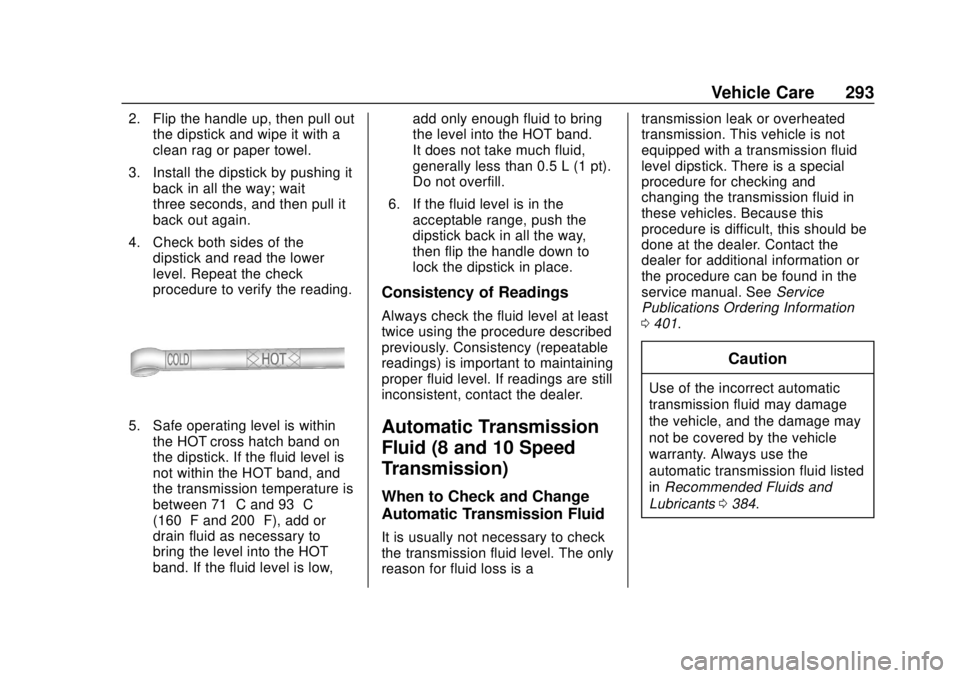
5. Safe operating level is within
the HOT cross hatch band on
the dipstick. If the fluid level is
not within the HOT band, and
the transmission temperature is
between 71 °C and 93 °C
(160 °F and 200 °F), add or
drain fluid as necessary to
bring the level into the HOT
band. If the fluid level is low, add only enough fluid to bring
the level into the HOT band.
It does not take much fluid,
generally less than 0.5 L (1 pt).
Do not overfill.
6. If the fluid level is in the acceptable range, push the
dipstick back in all the way,
then flip the handle down to
lock the dipstick in place.
Consistency of Readings
Always check the fluid level at least
twice using the procedure described
previously. Consistency (repeatable
readings) is important to maintaining
proper fluid level. If readings are still
inconsistent, contact the dealer.
Automatic Transmission
Fluid (8 and 10 Speed
Transmission)
When to Check and Change
Automatic Transmission Fluid
It is usually not necessary to check
the transmission fluid level. The only
reason for fluid loss is a transmission leak or overheated
transmission. This vehicle is not
equipped with a transmission fluid
level dipstick. There is a special
procedure for checking and
changing the transmission fluid in
these vehicles. Because this
procedure is difficult, this should be
done at the dealer. Contact the
dealer for additional information or
the procedure can be found in the
service manual. See
Service
Publications Ordering Information
0 401.
Caution
Use of the incorrect automatic
transmission fluid may damage
the vehicle, and the damage may
not be covered by the vehicle
warranty. Always use the
automatic transmission fluid listed
in Recommended Fluids and
Lubricants 0384.
Page 297 of 431
GMC Yukon/Yukon XL/Denali Owner Manual (GMNA-Localizing-U.S./
Canada/Mexico-11349262) - 2018 - CRC - 11/3/17
296 Vehicle Care
What to Use
{Warning
Plain water, or other liquids such
as alcohol, can boil before the
proper coolant mixture will. With
plain water or the wrong mixture,
the engine could get too hot but
there would not be an overheat
warning. The engine could catch
fire and you or others could be
burned.
Use a 50/50 mixture of clean,
drinkable water and DEX-COOL
coolant. This mixture:
. Gives freezing protection down
to−37 °C (−34 °F), outside
temperature
. Gives boiling protection up to
129 °C (265 °F), engine
temperature
. Protects against rust and
corrosion
. Will not damage aluminum parts .
Helps keep the proper engine
temperatureCaution
Do not use anything other than a
mix of DEX-COOL coolant that
meets GM Standard
GMW3420 and clean, drinkable
water. Anything else can cause
damage to the engine cooling
system and the vehicle, which
would not be covered by the
vehicle warranty.
Never dispose of engine coolant by
putting it in the trash, or by pouring
it on the ground, or into sewers,
streams, or bodies of water. Have
the coolant changed by an
authorized service center, familiar
with legal requirements regarding
used coolant disposal. This will help
protect the environment and your
health.
Checking Coolant
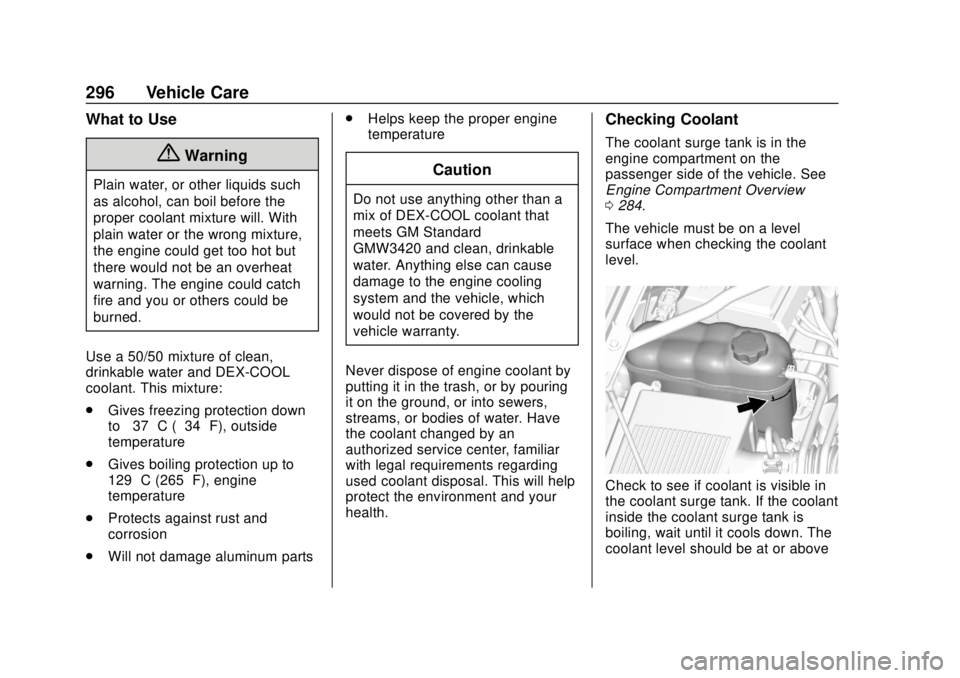
The coolant surge tank is in the
engine compartment on the
passenger side of the vehicle. See
Engine Compartment Overview
0 284.
The vehicle must be on a level
surface when checking the coolant
level.
Check to see if coolant is visible in
the coolant surge tank. If the coolant
inside the coolant surge tank is
boiling, wait until it cools down. The
coolant level should be at or above
Page 299 of 431
GMC Yukon/Yukon XL/Denali Owner Manual (GMNA-Localizing-U.S./
Canada/Mexico-11349262) - 2018 - CRC - 11/3/17
298 Vehicle Care
Turn the pressure cap slowly
counterclockwise about one full
turn. If a hiss is heard, wait for
that to stop. A hiss means
there is still some pressure left.
2. Keep turning the pressure cap slowly, and remove it.
3. Fill the coolant surge tank with the proper mixture to the full
cold mark.
4. With the coolant surge tank pressure cap off, start the
engine and let it run until the
engine coolant temperature
gauge indicates approximately
90 °C (195 °F).
By this time, the coolant level
inside the coolant surge tank
may be lower. If the level is
lower, add more of the proper
mixture to the coolant surge
tank until the level reaches the
full cold mark.
5. Replace the pressure cap tightly. 6. Verify coolant level after the
engine is shut off and the
coolant is cold. If necessary,
repeat coolant fill procedure
Steps 1–6.
Caution
If the pressure cap is not tightly
installed, coolant loss and engine
damage may occur. Be sure the
cap is properly and tightly
secured.
Engine Overheating
Caution
Do not run the engine if there is a
leak in the engine cooling system.
This can cause a loss of all
coolant and can damage the
system and vehicle. Have any
leaks fixed right away.
The vehicle has several indicators
to warn of engine overheating. There is a coolant temperature
gauge in the vehicle's instrument
cluster. See
Engine Coolant
Temperature Gauge 0141.
In addition, there are ENGINE
OVERHEATED STOP ENGINE,
ENGINE OVERHEATED IDLE
ENGINE, and ENGINE POWER IS
REDUCED messages in the Driver
Information Center (DIC).
If the decision is made not to lift the
hood when this warning appears,
get service help right away. See
Roadside Assistance Program
0 396.
If the decision is made to lift the
hood, make sure the vehicle is
parked on a level surface.
Check to see if the engine cooling
fan(s) are running. If the engine is
overheating, the fans should be
running. If they are not, do not
continue to run the engine. Have the
vehicle serviced.