buttons GMC YUKON DENALI 2003 User Guide
[x] Cancel search | Manufacturer: GMC, Model Year: 2003, Model line: YUKON DENALI, Model: GMC YUKON DENALI 2003Pages: 447, PDF Size: 21.97 MB
Page 143 of 447
The seat, throttle and brake pedals and mirror positions
can also be recalled when placing the key in the
ignition
if programmed to do so through the Driver
Information Center (DIC). See
DIC Operation and
Displays on page
3-43.
To stop recall movement of the memory seat feature at
any time, press one
of the memory buttons or power
seat controls.
Easy Exit Seat
The controls for this memory function are located on the
driver's door.
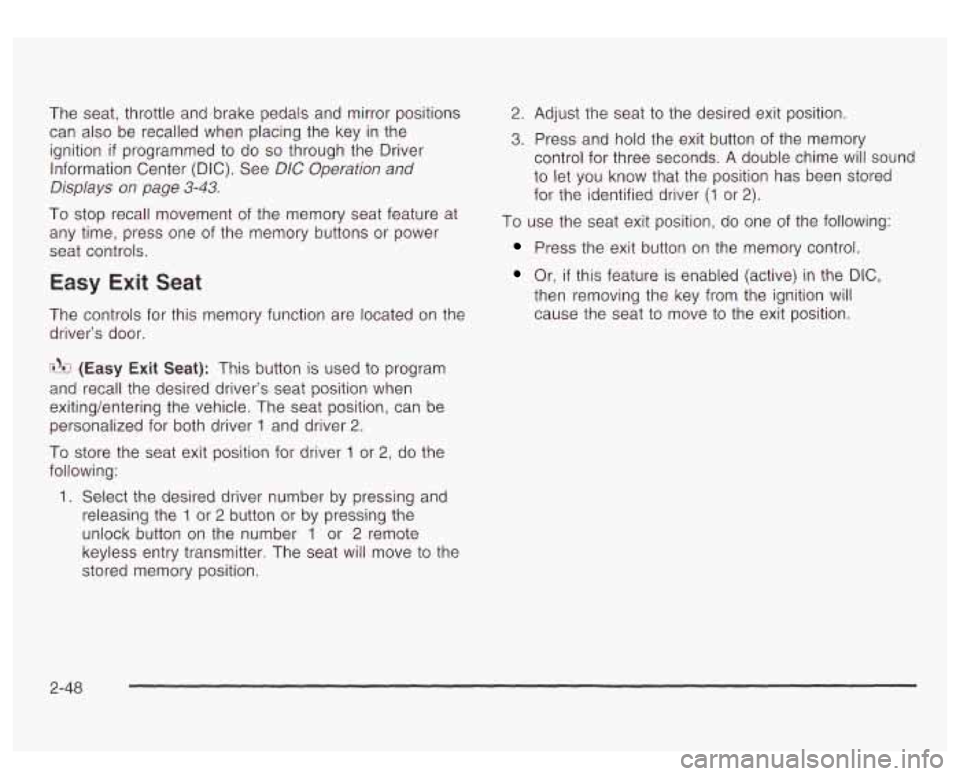
ii! (Easy Exit Seat): This button is used to program
and recall the desired driver's seat position when
exiting/entering the vehicle. The seat position, can be
personalized for both driver
1 and driver 2.
To store the seat exit position for driver 1 or 2, do the
following:
1. Select the desired driver number by pressing and
releasing the
1 or 2 button or by pressing the
unlock button on the number
1 or 2 remote
keyless entry transmitter. The seat will move to the
stored memory position.
2. Adjust the seat to the desired exit position.
3. Press and hold the exit button of the memory
control for three seconds.
A double chime will sound
to let you know that the position has been stored
for the identified driver
(1 or 2).
To use the seat exit position, do one of the following:
Press the exit button on the memory control.
Or, if this feature is enabled (active) in the DIC,
then removing the key from the ignition will
cause the seat to move
to the exit position.
2-48
Page 148 of 447
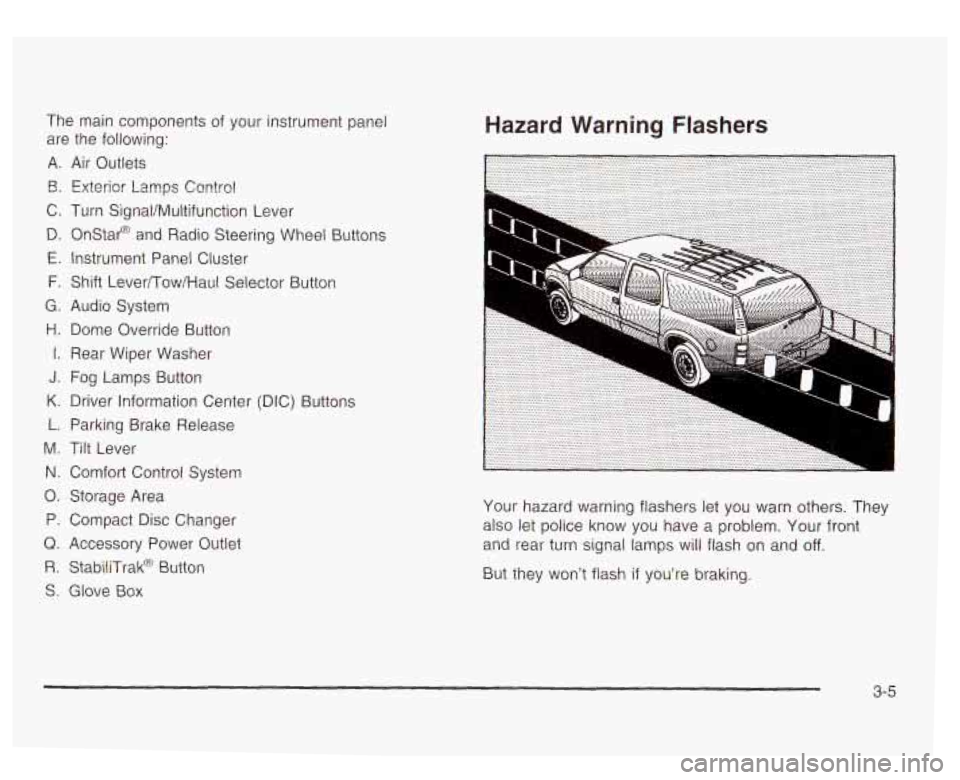
The main components of your instrument panel
are the following:
A. Air Outlets
€3. Exterior Lamps Contro!
C. Turn SignaVMultifunction Lever
D. Onstar@ and Radio Steering Wheel Buttons
E. Instrument Panel Cluster
F. Shift Lever/Tow/Haul Selector Button
G. Audio System
H. Dome Override Button
I. Rear Wiper Washer
J. Fog Lamps Button
K. Driver Information Center (DIC) Buttons
L. Parking Brake Release
M. Tilt Lever
N. Comfort Control System
0. Storage Area
P. Compact Disc Changer
Q. Accessory Power Outlet
R. StabiliTrak@ Button
S. Glove Box
Hazard Warning Flashers
Your hazard warning flashers let you warn others. They
also let police know you have a problem, Your front
and rear turn signal
lamps will flash on and off.
But they won’t flash if you’re braking.
3-5
Page 170 of 447
r5;’ (Mode): Press this button to select the air delivery
mode and AUTO mode. Choose AUTO
if you want
the system
to automatically regulate the airflow.
See
“Auto Mode” later in this section for more
information on using this feature.
(Temperature): Press this button up or down to
increase or decrease the temperature setting.
A @ 7 (Fan): Press this button up or down to adjust
the fan speed. Choose AUTO
if you want the system
to automatically choose the fan speed to maintain
a selected temperature. See “Auto Mode” later in this
section for more information on using this feature.
AUTO Mode
When using the system in auto mode, find your comfort
setting by placing the temperature control
to 74°F
(23°C) and allowing about 20 minutes for the system to
regulate. Then adjust the temperature setting as
necessary. If you choose full cold
60” F (15”C), the
system will remain at the maximum cooling setting.
If you choose full hot 90 F (32”C), the system will remain
at the maximum heat setting.
Climate Controls Personalization
You can store and recall the climate control settings for
temperature, air delivery mode and fan speed for
two different
drivers. The personal ch~i~e settings
recalled are determined by the transmitter used
to enter
the vehicle.
After the button with the unlock symbol on a remote
keyless entry transmitter is pressed, the climate control
will adjust
to the last settings of the identified driver.
The settings can also be changed by pressing one of the
memory buttons
(1 or 2) located on the driver’s door.
When adjustments are made, the new settings are
automatically saved for that driver.
3-27
Page 186 of 447
Driver Information Center (DIC)
The DIC display is located on the instrument panel
cluster above the steering wheel. The DIC can display
information such as the trip odometer, fuel economy and
personalization features.
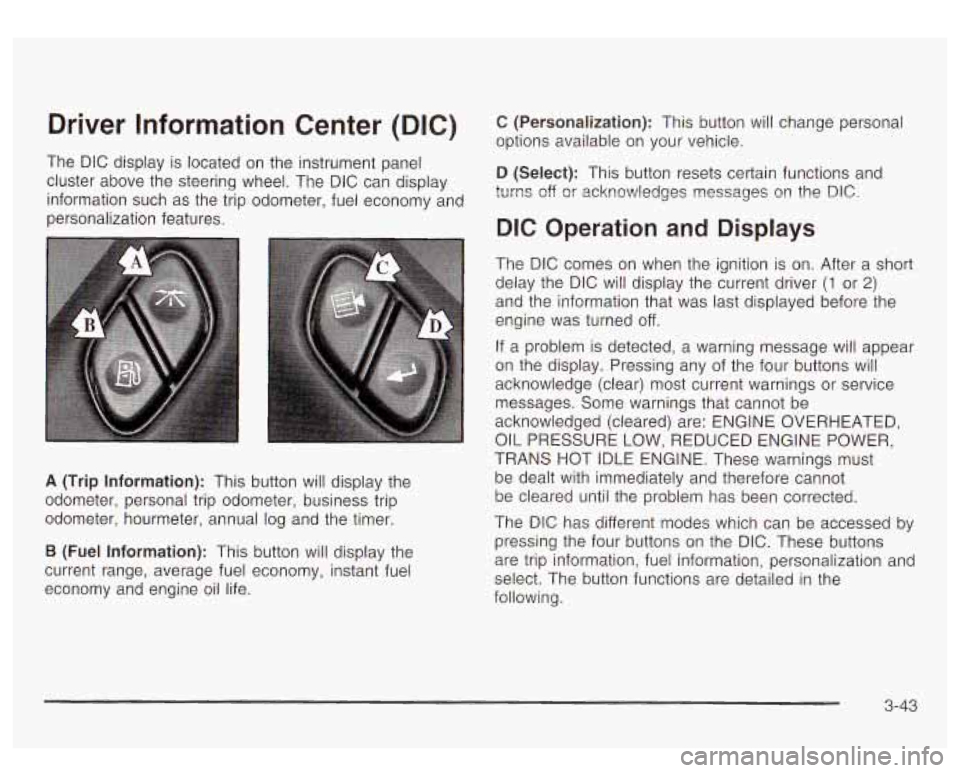
A (Trip Information): This button will display the
odometer, personal trip odometer, business trip
odometer, hourmeter, annual log and the timer.
B (Fuel Information): This button will display the
current range, average fuel economy, instant fuel
economy and engine oil life.
C (Personalization): This button will change personal
options available on your vehicle.
D (Select): This button resets certain functions and
turns off
or acknowledges nessages on the DIC.
DIC Operation and Displays
The DIC comes on when the ignition is on. After a short
delay the DIC will display the current driver
(1 or 2)
and the information that was last displayed before the
engine was turned off.
If a problem is detected, a warning message will appear
on the display. Pressing any of the four buttons will
acknowledge (clear) most current warnings or service
messages. Some warnings that cannot be
acknowledged (cleared) are: ENGINE OVERHEATED,
OIL PRESSURE LOW, REDUCED ENGINE POWER,
TRANS HOT IDLE ENGINE. These warnings must
be dealt with immediately and therefore cannot
be cleared until the problem has been corrected.
The DIC has different modes which can be accessed
by
pressing the four buttons on the DIC. These buttons
are trip information, fuel information, personalization and
select. The button functions are detailed in the
following.
3-43
Page 195 of 447
If you choose English, all information will be displayed
in English units. For example, distance in miles and fuel
economy in miles per gallon.
Choose one of the two options and press the
personalization button while it is displayed on the DIC
to
select it and move on to the next feature.
Display Language
To select your personalization for display language,
press the select button while DISPLAY LANGUAGE is
displayed on the DIC. Pressing the select button
will scroll through the following languages:
English
French
Spanish
Choose one of the three options and press the
personalization button while it is displayed on the DIC
to
select it.
If you accidentally choose a language that you don’t
want or understand, press and hold the personalization
button and the trip information button at the same
time. The DIC will begin scrolling through the languages
in their particular language. English will be in English,
French will be in French and
so on. When you see
the language that you would like, release both buttons.
The
DIC will then display the information in the
language you chose. You can also scroll
through the different languages by
pressing and holding the trip reset stem for four seconds,
as long as you are in the season odometer mode.
DIC Warnings and Messages
Warning messages are displayed on the DIC to notify
the driver that the status of the vehicle has changed and
that some action may be needed by the driver
to
correct the condition. If there is more than one message
that needs to be displayed they will appear one after
another. Some messages may not require immediate
action but you should press the select button to
acknowledge that you received the message and clear it
from the display. Some messages cannot be cleared
from the display because they are more urgent;
these messages require action before they can be
removed from the DIC display. The following are the
possible messages that can be displayed and some
information about them.
CHANGE ENGINE OIL
This message is displayed when the engine oil needs to
be changed. See GM Oil Life System previously in
this section for information on how
to reset the message.
This message will clear itself after
10 seconds until
the next igntion cycle.
3-52
Page 201 of 447
Audio System(s)
Notice: Before you add any sound equipment to
your vehicle
- like a tape player, CB radio, mobile
telephone or two-way radio
- be sure you can
add what you want. If you can, it’s very important to
do
it properly. Added sound equipment may
interfere with the operation of your vehicle’s engine,
Delphi Electronics radio or other systems, and
even damage them. Your vehicle’s systems may interfere with the operation of sound equipment that
has been added improperly.
So, before adding sound equipment, check with
your dealer and be sure to check federal rules
covering mobile radio and telephone units.
Your audio system has been designed to operate easily
and to give years of listening pleasure. You will get
the most enjoyment out of
it if you acquaint yourself with
it first. Find out what your audio system can do and
how to operate all
of its controls to be sure you’re getting
the most out of the advanced engineering that went
into it. Your
vehicle may have a feature called Retained
Accessory Power (RAP). With RAP, you can play your
audio system even after the ignition is turned
off.
See “Retained Accessory Power (RAP)” under Ignition
Positions on page 2- 18.
Setting the Time
Press and hold the HR button until the correct hour
appears
on the display. Press and hold the MN button
until the correct minute appears on the display. The time
may be set with the ignition on or
off.
To synchronize the time with an FM station broadcasting
Radio Data System (RDS) information, press and
hold the hour and minute buttons at the same time until
RDS TIME appears
on the display. To accept this
time, press and hold the hour and minute buttons, at the
same time, for another
2 seconds. If the time is not
available from the station,
NO UPDAT will appear on the
display instead.
RDS time is broadcast once a minute. Once you have
tuned to an RDS broadcast station,
it may take a
few minutes for your time
to update.
3-58
Page 204 of 447
Finding a Station
BAND: Press this button to switch between AM, FM,
FM2, or XMI, XM2 (USA only,
if your radio is equipped
with
XhATrJ Satellite Radio Service) The dispiay wiii
show your selection.
TUNE: Turn this knob to choose radio stations.
4 SEEK b : Press the right or the left arrow to seek
to the next or to the previous station and stay there.
The radio will seek only to stations that are in the
selected band and only to those with a strong signal.
4 SCAN b : Press and hold one of the arrows
for more than two seconds. The radio will produce one
beep. The radio will scan
to a station, play for a few
seconds, then go on to the next station. SCAN will be
displayed. Press one of the arrows again
to stop
scanning.
The radio will scan only
to stations that are in the
selected band and only to those with a strong signal.
To scan preset stations, press and hold one of the
arrows for more than four seconds. The radio will
produce two beeps. The radio will scan to the first preset station,
play for a few seconds, then go on to the next
preset station. PSCN will be displayed. Press one of the
arrows again or one of the pushbuttons
to stop scanning.
The radio will scan only
to preset stations that are in the
selected band and only to those with a strong signal.
Setting Preset Stations
The six numbered pushbuttons let you return to your
favorite stations. You can set up to
30 stations (six AM,
six FM1 and six FM2, or six XMI and six XM2 (USA
only,
if your radio is equipped with the XM Satellite
Radio Service) by performing the following steps:
1. Turn the radio on.
2. Press BAND to select AM, FM1 or FM2,
or XMI
, XM2.
3. Tune in the desired station.
4. Press AUTO
EQ to select the equalization that best
5. Press and hold one of the six numbered
suits
the type of station you are listening to.
pushbuttons. The radio will produce one beep.
Whenever you press that numbered pushbutton, the
station you set will return and the bass and treble
equalization that you selected
will also be
automatically selected for that pushbutton.
6. Repeat the steps for each pushbutton.
3-61
Page 207 of 447
BAND (Alternate Frequency): Alternate frequency
allows the radio
to switch to a stronger station with the
same program type. Press and hold BAND for two
seconds to turn alternate frequency on. AF
ON
will appear on the display. The radio may switch to
stronger stations. Press and hold BAND again for two
seconds
to turn alternate frequency off. AF OFF
will appear on the display. The radio will not switch
to
other stations.
This function does not apply for XMTM
Setting Preset PTYs (RDS Only)
The six numbered pushbuttons let you return to your
favorite PTYs. These buttons have factory PTY presets.
You can set up
to 12 PTYs (six FMI and six FM2) by
performing the following steps:
1. Press BAND
to select FMI or FM2.
2. Turn the P-TYPE LIST knob. TYPE and a PTY will
appear on the display.
3. Turn the P-TYPE LIST knob to select a PTY.
4. Press and hold one of the six numbered
pushbuttons until you hear a beep. Whenever you
press that numbered pushbutton, the PTY you
set will return.
5. Repeat the steps for each pushbutton.
RDS Messages
ALERT!: Alert warns of local or national emergencies.
When an alert announcement comes on the current
radio station, ALERT! will appear on the display. You will
hear the announcement, even
if the volume is muted
or a cassette tape or compact disc is playing. If the
cassette tape or compact disc player is playing, play will
stop during the announcement. You will not be able
to turn off alert announcements.
ALERT! will not be affected by tests of the emergency
broadcast system. This feature is not supported by
all RDS stations.
INFO (Information): If the current station has a
message, the information symbol will appear on the
display. Press this button
to see the message. The
message may display the artist and song title, call in
phone numbers, etc. If the whole message is not displayed, parts of it will
appear every three seconds.
To scroll through the
message at your own speed, press the INFO button
repeatedly. A new group of words will appear on
the display with each press. Once the complete
message has been displayed, the information symbol
will disappear from the display until another new
message is received. The old message can be displayed
by pressing the INFO button until a new message is
received or a different station
is tuned to.
When a message is not available from a station, NO
INFO will be displayed.
3-64
Page 215 of 447
Listening to a DVD Before You Drive
Your vehicle may have an overhead Rear Seat
Entertainment (RSE) System. If your vehicle has this
system and a DVD is playing, the DVD symbol will
appear on the radio display indicating that the DVD is
available and can be listened through your vehicle’s
speakers.
To listen to the DVD, press the TAPE DISC
button until RSE appears on the radio display. The
current radio source will stop and the DVD sound will
come through the speakers. To stop listening to
the DVD, press the TAPE DISC button,
if a cassette
tape or a CD is loaded, or press the BAND button
to select a different source.
When the RSE system is turned
off, the DVD symbol
will go off of the radio display and the radio will display
RSE
OFF. The radio will return to the last radio
source that you were listening
to.
Rear Seat Entertainment System
Your vehicle may have the optional Digital Versatile Disc
(DVD) Rear Seat Entertainment (RSE) system. The
RSE system includes a DVD player, a video display
screen, two sets of wireless headphones, and a remote
control. The
RSE system is for rear seat passengers. The driver
cannot safely view the video screen while driving and
should not try
to do so.
DVD Player
The DVD player is located in the overhead console.
The DVD player can be controlled by the buttons on the
DVD player and by the buttons on the remote control.
See “Remote Control’’ later in this section for more
information.
The DVD player power may be turned on when the
ignition is in RUN, ACCESSORY, or when Retained
Accessory Power (RAP) is active.
The RSE system DVD player is only compatible with
DVDs of the appropriate DVD region code for the
country that the vehicle was sold in. The DVD region
code is printed on the jacket of most DVDs.
The DVD player will also play audio CDs. Home
recorded CDs (CD-R or CD-RW formats) will not play in
this DVD player.
3-72
Page 216 of 447
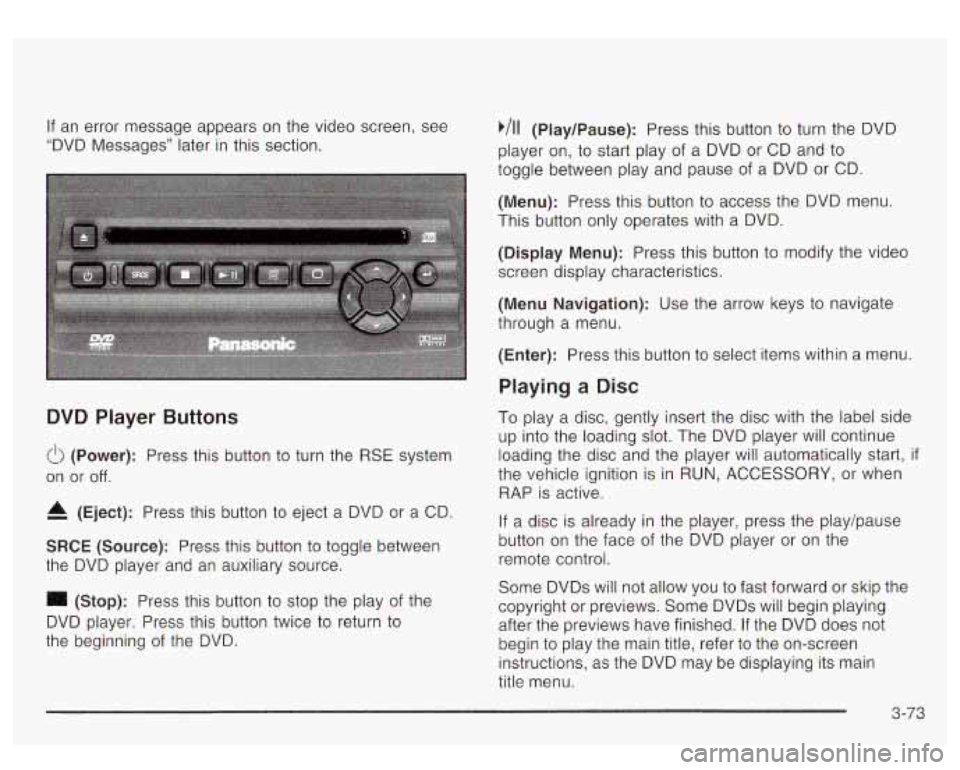
If an error message appears on the video screen, see
“DVD Messages” later in this section.
DVD Player Buttons
(Power): Press this button to turn the RSE system
on or
off.
4 (Eject): Press this button to eject a DVD or a CD.
SRCE (Source): Press this button to toggle between
the DVD player and an auxiliary source.
(Stop): Press this button to stop the play of the
DVD player. Press this button twice
to return to
the beginning
of the DVD.
,111 (Play/Pause): Press this button to turn the DVD
player on, to start play of a DVD or CD and
to
toggle between play and pause of a DVD or CD.
(Menu): Press this button to access the DVD menu.
This button only operates with a DVD.
(Display Menu): Press this button to modify the video
screen display characteristics.
(Menu Navigation): Use the arrow keys to navigate
through a menu.
(Enter): Press this button to select items within a menu
Playing a Disc
To play a disc, gently insert the disc with the label side
up into the loading slot. The DVD player will continue
loading the disc and the player will automatically start,
if
the vehicle ignition is in RUN, ACCESSORY, or when
RAP is active.
If a disc is already in the player, press the play/pause
button on the face of the DVD player or on the
remote control.
Some DVDs will not allow you to fast forward or skip the
copyright or previews. Some DVDs will begin playing
after the previews have finished. If the DVD does not
begin
to play the main title, refer to the on-screen
instructions, as the DVD may be displaying its main
title menu.
3-73