change wheel GMC YUKON DENALI 2003 User Guide
[x] Cancel search | Manufacturer: GMC, Model Year: 2003, Model line: YUKON DENALI, Model: GMC YUKON DENALI 2003Pages: 447, PDF Size: 21.97 MB
Page 346 of 447
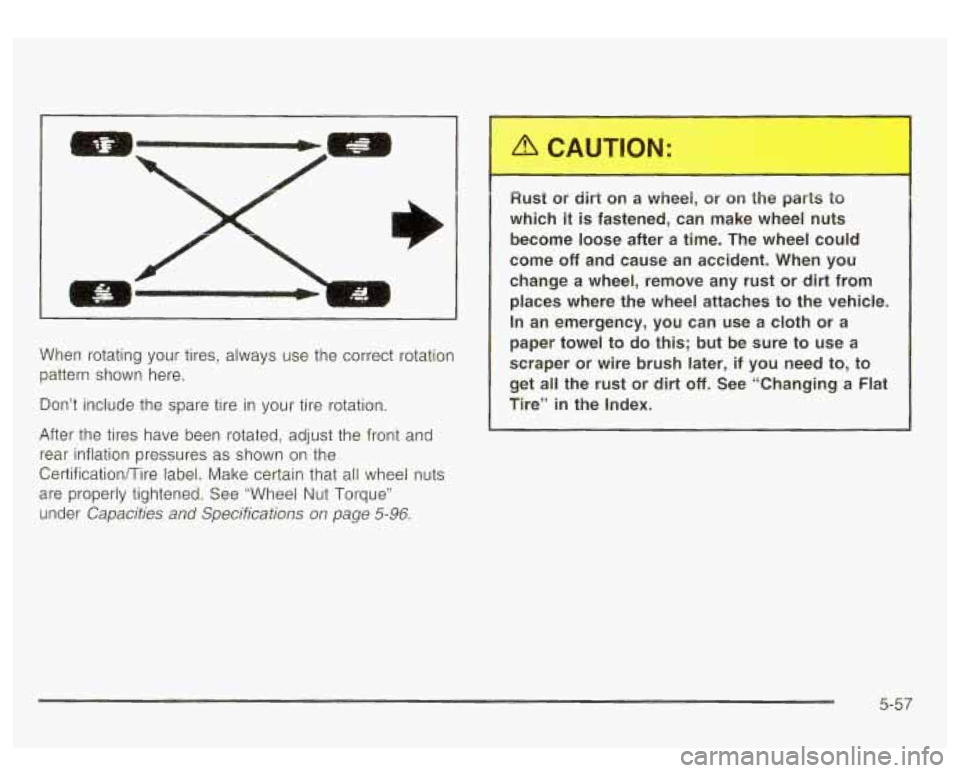
When rotating your tires, always use the correct rotation
pattern shown here.
Don’t include the spare tire in your tire rotation.
After the tires have been rotated, adjust the front and
rear inflation pressures as shown on the
Certificationnire label. Make certain that all wheel nuts
are properly tightened. See “Wheel Nut Torque”
under Capacities and Specifications on page
5-96.
Rust or dirt on a wheel, or on the parts to
which
it is fastened, can make wheel nuts
become loose after a time. The wheel could
come
off and cause an accident. When you
change a wheel, remove any rust or dirt from
places where the wheel attaches to the vehicle.
In an emergency, you can use a cloth or a
paper towel to do this; but be sure to use a
scraper or wire brush later,
if you need to, to
get all the rust or dirt
off. See “Changing a Flat
Tire”
in the Index.
5-57
Page 352 of 447
If a Tire Goes Flat
It’s unusual for a tire to “blowout” while you’re driving,
especially
if you maintain your tires properly. If air goes
out
of a tire, it’s much more likely to ieak out siowiy.
But if you should ever have a “blowout”, here are a few
tips about what
to expect and what to do:
If a front tire fails, the flat tire will create a drag that
pulls the vehicle toward that side. Take your foot
off the
accelerator pedal and grip the steering wheel firmly.
Steer to maintain lane position, and then gently brake
to
a stop well out of the traffic lane.
A rear blowout, particularly on a curve, acts much like a
skid and may require the same correction you’d use
in a skid.
In any rear blowout, remove your foot from the
accelerator pedal. Get the vehicle under control by
steering the way you want the vehicle
to go. It may be
very bumpy and noisy, but you can still steer. Gently
brake to a stop
- well off the road if possible.
If a tire goes flat, the next part shows how to use your
jacking equipment to change a flat tire safely.
Changing a Flat Tire
If a tire goes flat, avoid further tire and wheel damage
by driving slowly to a level place. Turn on your
hazard warning
fi hers.
Changing a tire can cause an injury. The
vehicle can slip
off the jack and roll over you
or other people. You and they could be badly injured. Find a level place to change your tire.
To help prevent the vehicle from moving:
1. Set the parking brake firmly.
2. Put the shift lever in PARK (P).
3. Turn off the engine.
4. Put the wheel blocks at the front and rear
of the tire farthest away from the one
being changed. That would be the tire on
the other side
of the vehicle, at the
opposite end.
5-63
Page 361 of 447
Rust or dirt on the wheel, or on the parts to
which
it is fastened, can make the wheel nuts
become loose after a time. The wheel could
come
off and cause an accident. When you
change
a wheel, remove any rust or dirt from
the places where the wheel attaches to the
vehicle. In an emergency, you can use a cloth or a paper towel to do this; but be sure to use
a scraper or wire brush later, if you need to, to
get all the rust or dirt
off.
1
Never use oil or grease on studs or nuts. If
you do, the nuts might come loose. Your wheel
could fall
off, causing a serious accident.
6. After mounting the spare, put the wheel
nuts back on with
the rounded end of
the nuts toward
the wheel. Tighten
each wheel nut
by hand. Then use
the wheel wrench
to
tighten the nuts
until the wheel is held
against the hub.
7. Turn the wheel wrench counterclockwise to lower
the vehicle. Lower the jack completely.
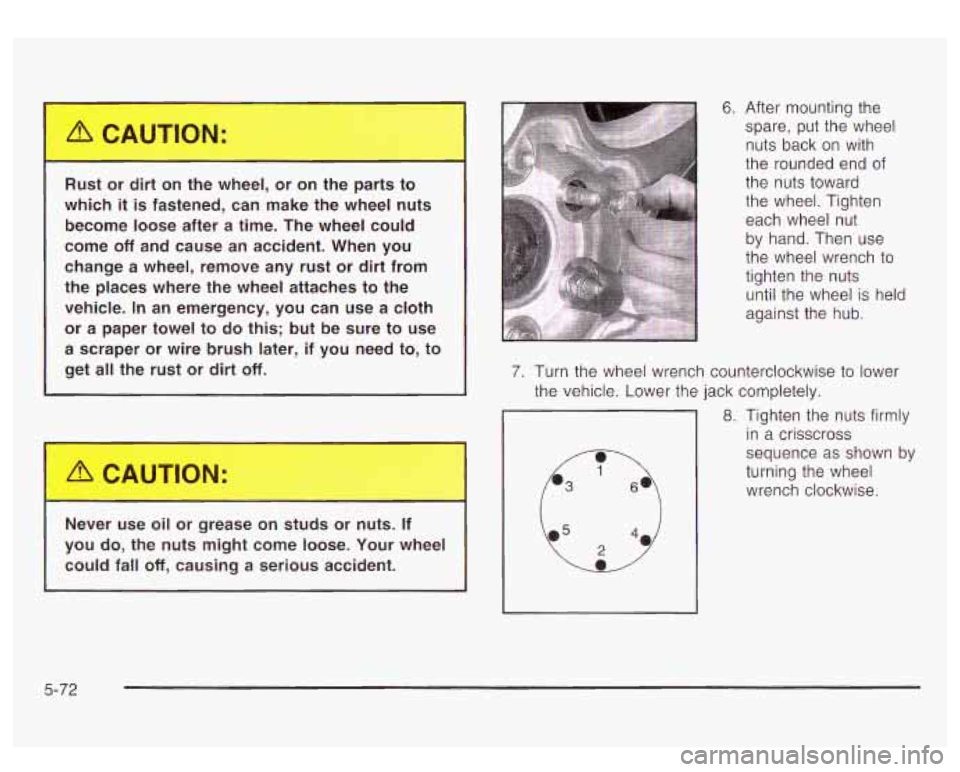
8. Tighten the nuts firmly
in a crisscross
sequence as shown by
turning the wheel
wrench clockwise.
5-72
Page 391 of 447
Part A: Scheduled Maintenance
Services
This part contains engine oil and chassis lubrication
scheduled maintenance which explains the engine oil life
system and how it indicates when
to change the
engine oil and filter. Lubricate chassis components with
each oil change.
Also, listed are scheduled maintenance
services which are to be performed at the mileage
intervals specified.
Using Your Maintenance Schedule
We at General Motors want to help you keep your
vehicle in good working condition. But we don’t know
exactly how you’ll drive it. You may drive very short
distances only a few times a week. Or you may drive
long distances all the time in very hot, dusty weather.
You may use your vehicle in making deliveries. Or
you may drive it to work,
to do errands or in many
other ways.
Because of all the different ways people use their
vehicles, maintenance needs vary. You may need more
frequent checks and replacements.
So please read
the following and note how you drive. If you have any
questions on how to keep your vehicle in good condition,
see your dealer. This part tells you
the maintenance services you should
have done and when you should schedule them.
When you go
to your dealer for your service needs,
you’ll know that GM-trained and supported service
people will perform the work using genuine GM parts.
The proper fluids and lubricants
to use are listed in
Part
D. Make sure whoever services your vehicle uses
these.
All parts should be replaced and all necessary
repairs done before you or anyone else drives the
vehicle.
This schedule is for vehicles that:
carry passengers and cargo within recommended
limits. You will find these limits on your vehicle’s
Certificationflire label. See Loading Your Vehicle
on
page 4-44.
are driven on reasonable road surfaces within legal
driving limits.
are driven off-road in the recommended manner.
See Operating Your All- Wheel-Drive Vehicle
Off
Paved Roads on page 4- 16.
use the recommended fuel. See Gasoline Octane
on page 5-5.
6-4
Page 398 of 447
Also look for any opened or broken air bag coverings,
and have them repaired or replaced. (The air bag
system does not need regular maintenance.)
Inspect wiper blades for wear or cracking. Replace
blade inserts that appear worn or damaged or that
streak or miss areas of the windshield.
Also see
Cleaning the Outside
of Your Vehicle on page 5-81.
Spare Tire Check
At least twice a year, after the monthly inflation check of
the spare tire determines that the spare is inflated
to
the correct tire inflation pressure, make sure that
the spare tire is stored securely. Push, pull, and then
try
to rotate or turn the tire. If it moves, use the wheel
wrenchhatchet
to tighten the cable. See Changing a Flat
Tire
on page 5-63.
Engine Air Cleaner Filter Restriction
Indicator Check
Your vehicle has an engine air cleaner filter restriction
indicator located on the air cleaner in the engine
compartment. The indicator lets you know when the air
cleaner filter is dirty and needs
to be changed. Check
the indicator at least twice a year or when your engine oil is changed,
whichever occurs first. See Engine Air
Cleaner/Filter
on page 5- 17 for more information. Inspect
your air cleaner filter restriction indicator more often
if
the vehicle is used in dusty areas or under off road
conditions.
Weatherstrip Lubrication
Silicone grease on weatherstrips will make them last
longer, seal better, and not stick or squeak. Apply
silicone grease with a clean cloth. During very cold,
damp weather more frequent application may be required. See
Part D: Recommended Fluids and
Lubricants
on page 6- 15.
Automatic Transmission Check
Check the transmission fluid level; add if needed. See
Automatic Transmission Fluid on page
5-20. A fluid loss
may indicate a problem. Check the system and repair
if needed.
At Least Once a Year
Key Lock Cylinders Service
Lubricate the key lock cylinders with the lubricant
specified in Part D.
Page 401 of 447
Part C: Periodic Maintenance
Inspections
Listed in this part are inspections and services which
should be performed at least twice a year (for instance,
each spring and fall).
You should let your dealer’s
service department or other qualified service center do
these jobs. Make sure any necessary repairs are
completed at once.
Proper procedures
to perform these services may be
found in a service manual. See Service Publications
Ordering Information on page
7- IO.
Steering and Suspension Inspection
Inspect the front and rear suspension and steering
system for damaged, loose or missing parts, signs of
wear or lack of lubrication. Inspect the power steering
lines and hoses for proper hook-up, binding, leaks,
cracks, chafing, etc.
Exhaust System Inspection
Inspect the complete exhaust system. Inspect the body
near the exhaust system. Look for broken, damaged,
missing or out-of-position parts as well as open seams,
holes, loose connections or other conditions which
could cause a heat build-up in the floor pan or could let
exhaust fumes into the vehicle. See Engine Exhaust
on page 2-29.
Fuel System Inspection
Engine Cooling System Inspection
Inspect the complete fuel system for damage or leaks.
Inspect the hoses and have them replaced
if they
are cracked, swollen or deteriorated. Inspect all pipes,
fittings and clamps; replace as needed. Clean the
outside of the radiator and air conditioning condenser.
To help ensure proper operation, a pressure test of
the cooling system and pressure cap is recommended
at least once a year.
Transfer Case and Front Axle
(All-Wheel Drive) Inspection
Every 12 months, or at engine oil change intervals,
check front axle and transfer case and add lubricant
when necessary.
A fluid loss could indicate a problem.
Check and have it repaired,
if needed. Check vent
hose at transfer case for kinks and proper installation.
Brake System Inspection
Inspect the complete system. Inspect brake lines and
hoses for proper hook-up, binding, leaks, cracks,
chafing, etc. Inspect disc brake pads for wear and rotors
for surface condition. Inspect other brake parts,
including calipers, parking brake, etc. You may need
to
have your brakes inspected more often if your driving
habits or conditions result in frequent braking.
6-1 4
Page 412 of 447
GM Mobility Program for Persons
with Disabilities
This program, avaiiabie io
qualified applicants, can
reimburse you up
to
$1,000 toward aftermarket
driver or passenger
adaptive equipment you
may require for your
vehicle (hand controls,
wheelchair/scooter lifts, etc.).
I I
This program can also provide you with free resource
information, such as area driver assessment centers and
mobility equipment installers. The program is available
for a limited period of time from the date of vehicle
purchase/lease. See your dealer for more details or call
the GM Mobility Assistance Center at 1-800-323-9935.
Text telephone (TTY) users, call 1-800-833-9935.
GM of Canada also has a Mobility Program. Call
1-800-GM-DRIVE (463-7483) for details.
All TTY users
call 1-800-263-3830.
Roadside Assistance Program
GMC’s Roadside Assistance Provides stranded owners
with over-the-phone roadside repairs, location of the
nearest
GhlC dealer or the following special services:
Flat Tire Change: Installation of spare tire will be
covered at no charge (customer is responsible for repair
or replacement of tire).
Fuel Delivery: Delivery of enough fuel for the customer
to get to the nearest service station (up to $5.00)
will be covered.
Jump Start: No-start situations which require a battery
jump start will be covered at no charge.
Lock Out: Replacement keys or locksmith service will be
covered at no charge
if you are unable to gain entry
into your vehicle. Delivery of the replacement key will be
covered within
10 miles (16 km).
Emergency Towing Service: Towing
to the nearest GMC
dealer for warranty related disablements will be
covered.
Trip Routing: Custom-made, computerized highlighted
maps using the most direct or scenic route are provided
free of charge. Maps include points of interest and a
list of GMC dealers along the route. Also included is a
list of hotels along the route that are discounted
7-5
Page 425 of 447
Accessory Power Outlets ................................. 3-17
Adding Washer Fluid
....................................... 5-35
Additional Program Information
........................... 7-8
Additives, Fuel
................................................. 5-6
Add-on Electrical Equipment
............................ 5-87
Adjusting the Speakers (Balance/Fade)
.......... 3-63
Passenger Status Indicator
........................... 3-32
Readiness Light
.......................................... 3-31
Air Bag Systems
..................................... 1-72, 1-77
Vehicle
................................................... 1-85
How Does an Air Bag Restrain? .................... 1-78
Passenger Sensing System
........................... 1-81
Servicing Your Air Bag-Equipped Vehicle
......... 1-85
What Makes an Air Bag Inflate?
.................... 1-78
What Will You See After an Air Bag Inflates?
...... 1-79
Where Are the Air Bags?
.............................. 1-74
Air Cleaner/Filter, Engine
................................. 5-1 7
Air Conditioning
.............................................. 3-23
All Overseas Locations
...................................... 7-4
All-Wheel Drive
............................................... 5-46
Aluminum Wheels
........................................... 5-83
AM
............................................................... 3-87
Antenna, Fixed Mast
....................................... 3-89
Antenna, XMTM Satellite Radio System
............... 3-89
Adjustable
Throttle and Brake Pedal
.................. 2-20
Air Bag
Adding Equipment
to Your Air Bag-Equipped
When Should an
Air Bag Inflate? ................... 1-77 Anti-lock Brake System
... 4-7
Appearance Care
............................................ 5-78
Care of Safety Belts
.................................... 5-80
.......................
Anti-Lock Brake. System Warning Light .......... 3-35
Chemica! Paint Spcltting ............................... 5-84
Cleaning the Inside of Your Vehicle ................ 5-78
Cleaning the Outside of Your Vehicle
.............. 5-81
Finish Damage
............................................ 5-83
GM Vehicle Care/Appearance Materials
.......... 5-84
Sheet Metal Damage
................................... 5-83
Underbody Maintenance
... ............. 5-84
Weatherstrips
...................... ............. 5-80
Ashtrays
........................................................ 3-18
Audio Output
.................................................. 3-78
Audio System(s)
............................................. 3-58
Audio Systems Audio Steering Wheel Controls
...................... 3-86
Care of Your Cassette Tape Player
................ 3-87
Care of Your CD and DVD Player
.................. 3-89
Care of Your CD Changer
............................ 3-88
Care of Your CDs and DVDs
........................ 3-88
CD Changer
............................................... 3-83
Fixed Mast Antenna
..................................... 3-89
Radio with Cassette and CD
......................... 3-59
Rear Seat Audio (RSA)
................................ 3-81
Setting the Time
.......................................... 3-58
Theft-Deterrent Feature
................................ 3-85
Understanding Radio Reception
..................... 3-87
XMTM Satellite Radio Antenna System
............ 3-89
Automatic Climate Control System
..................... 3-19
1
Page 440 of 447
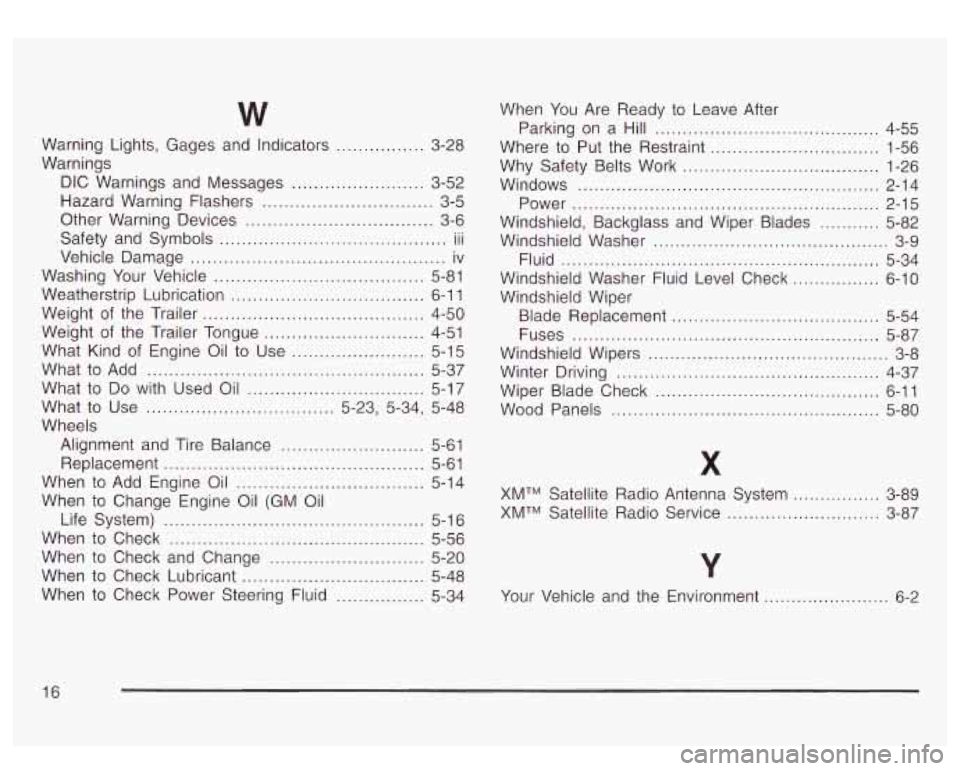
Warning Lights. Gages and Indicators ..... ... 3-28
Warnings DIC Warnings and Messages
..... ... 3-52
Other Warning Devices
.. ..... 3-6
Hazard
Warning Flashers
....... ..... 3-5
Safety and Symbols
... .... Ill
Vehicle Damage ........ .... ....... iv
...
Washing Your Vehicle .................................. 5-81
Weatherstrip Lubrication
................................... 6-1 1
Weight of the Trailer ........................................ 4-50
Weight of the Trailer Tongue
...... ............... 4-51
What Kind of Engine Oil
to Use ..... ... 5-1 5
What to Add ........................... ............... 5-37
What
to Do with Used Oil .. ................... 5-17
What to Use ........................
... 5-23, 5-34, 5-48
Wheels
Alignment and Tire Balance
.......................... 5-61
Replacement
............................................... 5-61
When
to Add Engine Oil .................................. 5-14
When to Change Engine Oil (GM Oil
Life System)
............................ ....... 5-16
When to Check
.................... ............... 5-56
When to Check and Change ............................ 5-20
When to Check Lubricant
................................. 5-48
When
to Check Power Steering Fluid ......... 5-34 When
You Are Ready
to Leave After
Where
to Put the Restraint ..........................
Why Safety Belts Work ...............................
Windows ..................................................
Power ...................................................
Windshield, Backglass and Wiper Blades ...
Windshield Washer .............................
Fluid ..............................................
Windshield Washer Fluid Level Check ....
Windshield Wiper
Parking on
a Hill .........................
Blade Replacement .................................
Fuses ...................................................
Windshield Wipers .................................
Winter
Driving ........ ...........
Wood Panels ......... ...........
Wiper Blade Check ..... ...........
X
XMTM Satellite Radio Antenna System ....
XMTM Satellite Radio Service ............
Y
Your Vehicle and the Environment . .
4-55
. 1-56
. 1-26
. 2-14
. 2-15
. 5-82
.. 3-9
. 5-34
. 6-10
. 5-54
. 5-a7
.. 3-8
. 4-37
. 6-1 1
. 5-80
..... 3-89
..... 3-87
.. 6-2
16