clock GMC YUKON DENALI 2003 User Guide
[x] Cancel search | Manufacturer: GMC, Model Year: 2003, Model line: YUKON DENALI, Model: GMC YUKON DENALI 2003Pages: 447, PDF Size: 21.97 MB
Page 339 of 447
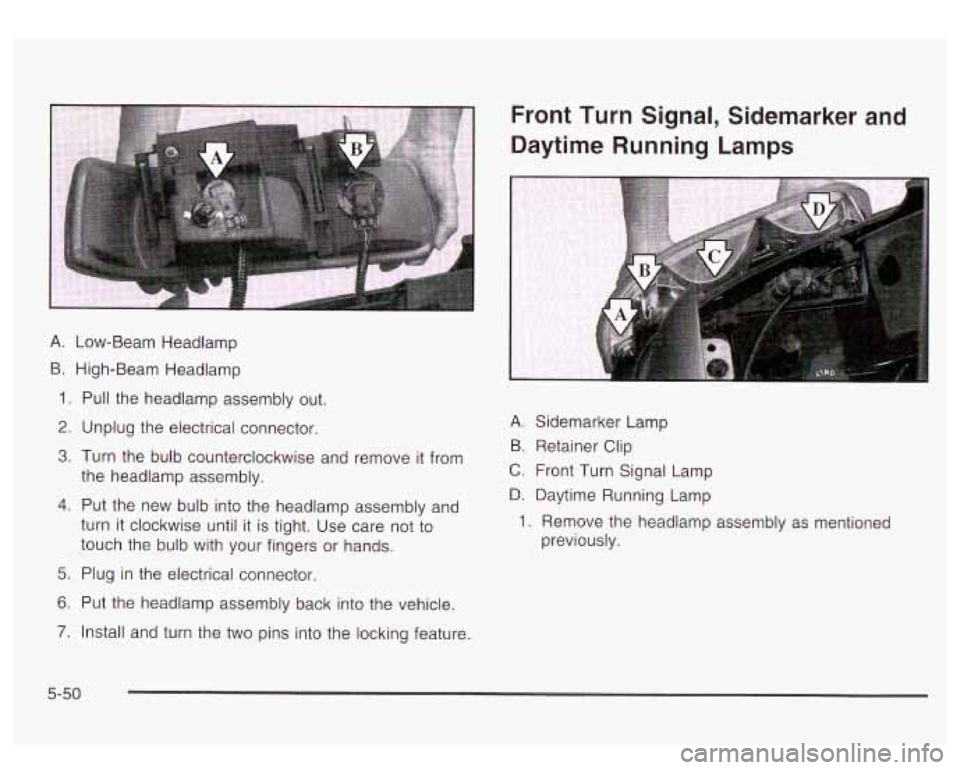
A. Low-Beam Headlamp
B. High-Beam Headlamp
1. Pull the headlamp assembly out.
2. Unplug the electrical connector.
3. Turn the bulb counterclockwise and remove it from
the headlamp assembly.
4. Put the new bulb into the headlamp assembly and
turn it clockwise until it is tight. Use care not to
touch the bulb with your fingers or hands.
5. Plug in the electrical connector.
6. Put the headlamp assembly back into the vehicle.
7. Install and turn the two pins into the locking feature.
A. Sidemarker Lamp
B. Retainer Clip
C. Front Turn Signal Lamp
D. Daytime Running Lamp
1. Remove the headlamp assembly as mentioned
previously.
5-50
Page 340 of 447
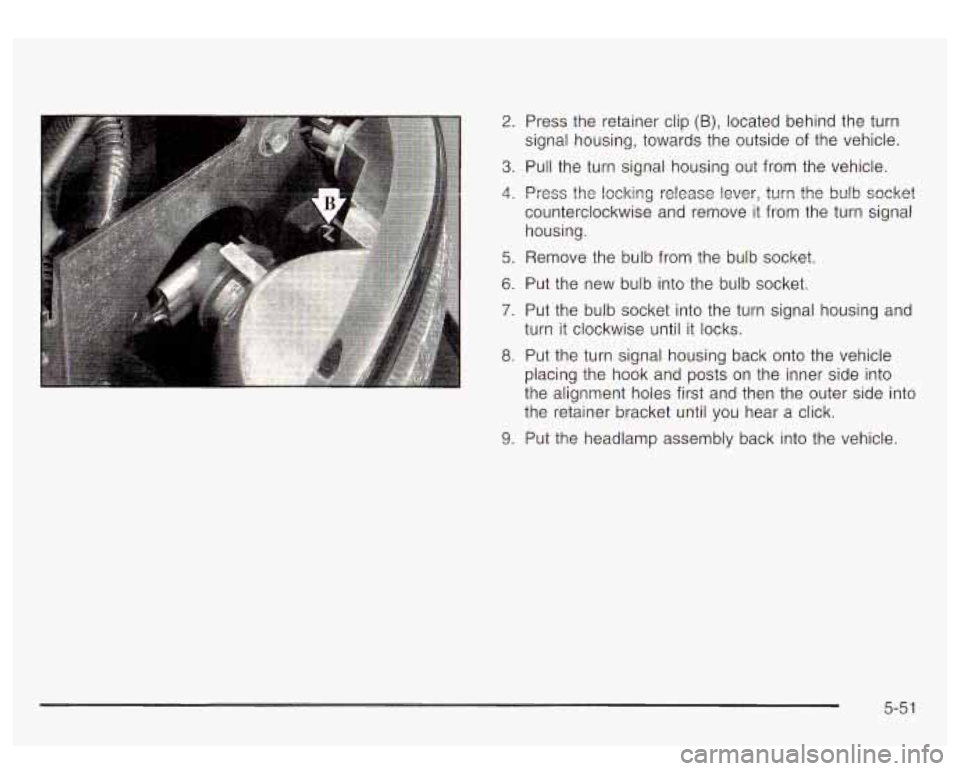
2. Press the retainer clip (B), located behind the turn
signal housing, towards the outside of the vehicle.
3. Pull the turn signal housing out from the vehicle.
4. Press the locking release lever, turn the bulb socket
counterclockwise and remove it from the turn signal
housing.
5. Remove the bulb from the bulb socket.
6. Put the new bulb into the bulb socket.
7. Put the bulb socket into the turn signal housing and
turn it clockwise until it locks.
8. Put the turn signal housing back onto the vehicle
placing the hook and
posts on the inner side into
the alignment holes first and then the outer side into
the retainer bracket until you hear a click.
9. Put the headlamp assembly back into the vehicle.
5-5 1
Page 341 of 447
Center High-Mounted Stoplamp
(CHMSL)
It is recommended that this component be replaced as
a unit by your dealer.
Taillamps
I
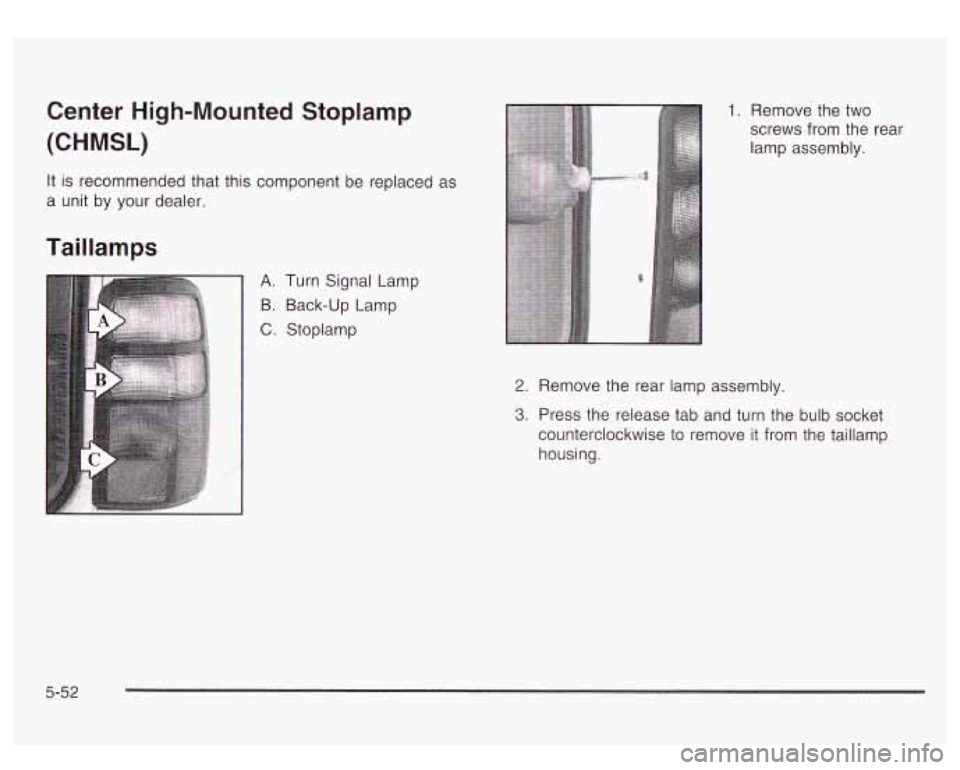
A. Turn Signal Lamp
B. Back-up Lamp
C. Stoplamp
1. Remove the two
screws from the rear
lamp assembly.
2. Remove the rear lamp assembly.
3. Press the release tab and turn the bulb socket
counterclockwise
to remove it from the taillamp
housing.
5-52
Page 342 of 447
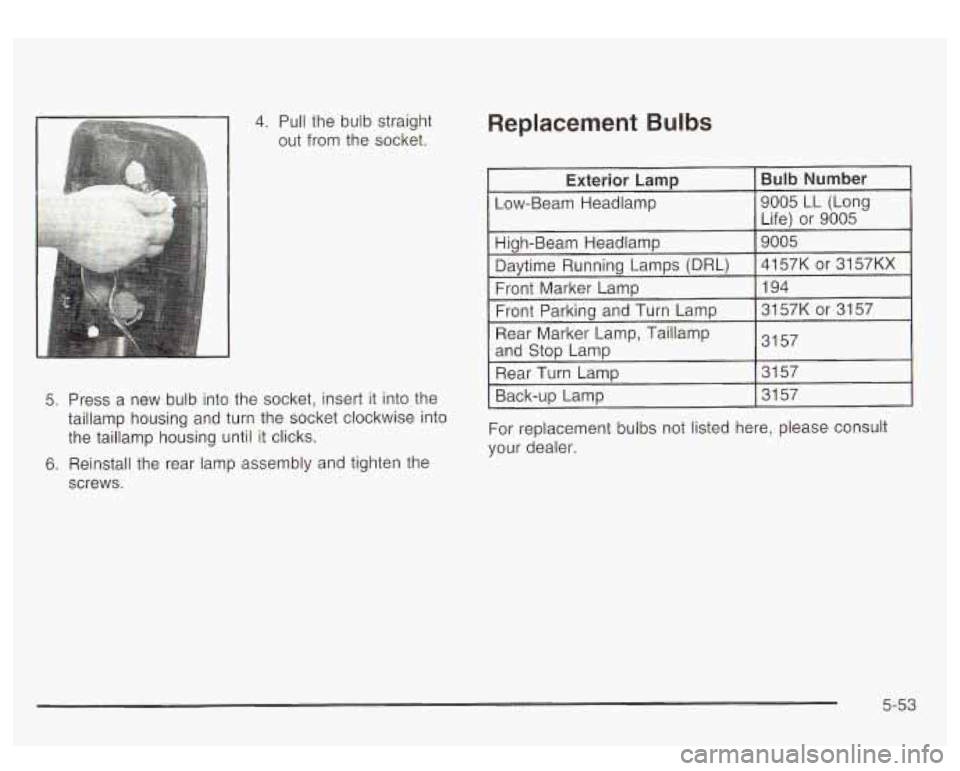
4. Pull the bulb straight
out from the socket.
5. Press a new bulb into the socket, insert it into the
taillamp housing and turn the socket clockwise into
the taillamp housing until it clicks.
6. Reinstall the rear lamp assembly and tighten the
screws.
Replacement Bulbs
~~~~
For replacement bulbs not listed here, please Consult
your dealer.
5-53
Page 354 of 447
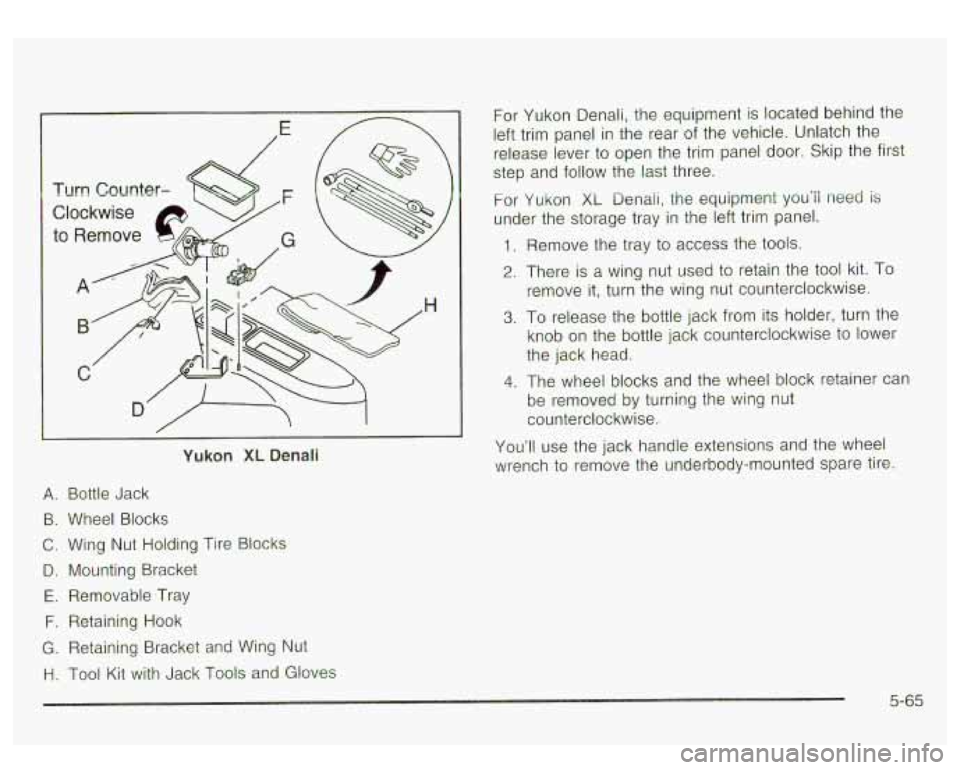
Yukon XL Denali
For Yukon Denali, the equipment is located behind the
left trim panel in the rear of the vehicle. Unlatch the
release lever to open the trim panel door. Skip the first
step and follow the last three.
For Yukon
XL Denaii, the equipment you'ii need is
under the storage tray in the left trim panel.
1. Remove the tray to access the tools.
2. There is a wing nut used to retain the tool kit. To
remove it, turn the wing nut counterclockwise.
3. To release the bottle jack from its holder, turn the
knob on the bottle jack counterclockwise to lower
the jack head.
4. The wheel blocks and the wheel block retainer can
be removed by turning the wing nut
counterclockwise.
You'll use the jack handle extensions and the wheel
wrench to remove the underbody-mounted spare tire.
A. Bottle Jack
B. Wheel Blocks
C. Wing Nut Holding Tire Blocks
D. Mounting Bracket
E. Removable Tray
F. Retaining Hook
G. Retaining Bracket and Wing Nut
H. Tool Kit with Jack Tools and Gloves
5-65
Page 356 of 447
1
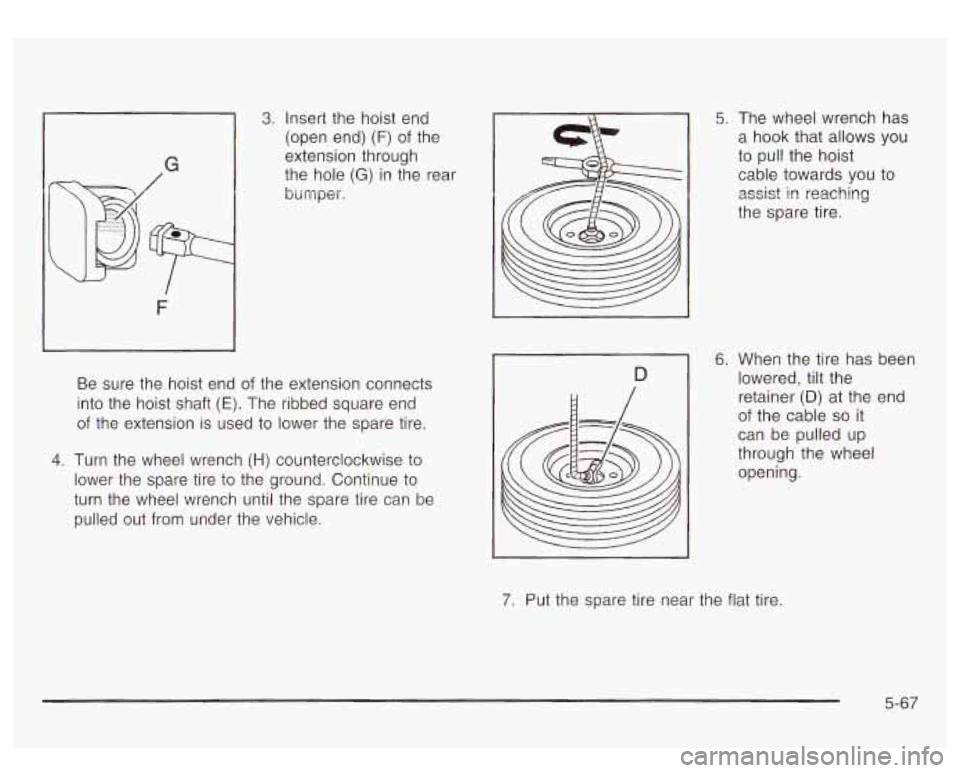
3. Insert the hoist end
(open end)
(F) of the
extension through
the hole
(G) in the rear
bumper.
Be sure the hoist end of the extension connects
into the hoist shaft (E). The ribbed square end
of the extension
is used to lower the spare tire.
4. Turn the wheel wrench (H) counterclockwise to
lower the spare tire to the ground. Continue to
turn the wheel wrench until the spare tire can be
pulled out from under the vehicle.
II
5. The wheel wrench has
a hook that allows you
to pull the hoist
cable towards you
to
assist in reaching
the spare tire.
6. When the tire has been
lowered, tilt the
retainer
(D) at the end
of the cable so it
can be pulled up
through the wheel
opening.
7. Put the spare tire near the flat tire.
5-67
Page 358 of 447
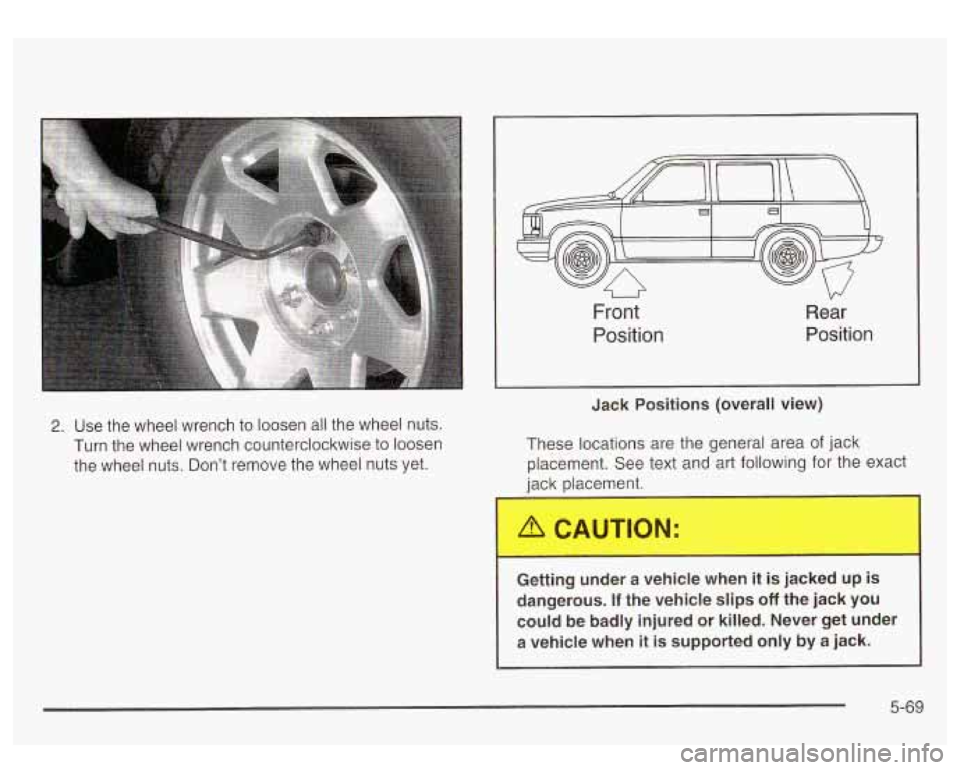
2. Use the wheel wrench to loosen all the wheel nuts.
Turn the wheel wrench counterclockwise to loosen
the wheel nuts. Don’t remove the wheel nuts yet.
U vv
Front
Position Rear
Position
J Jack Positions (overall view)
These locations are the general area of jack
placement. See text and art following for the exact
jack placement.
Getting under a vehicle when it is jacked up is
dangerous.
If the vehicle slips off the jack you
could be badly injured or killed. Never get under
a vehicle when it
is supported only by a jack.
5-69
Page 359 of 447
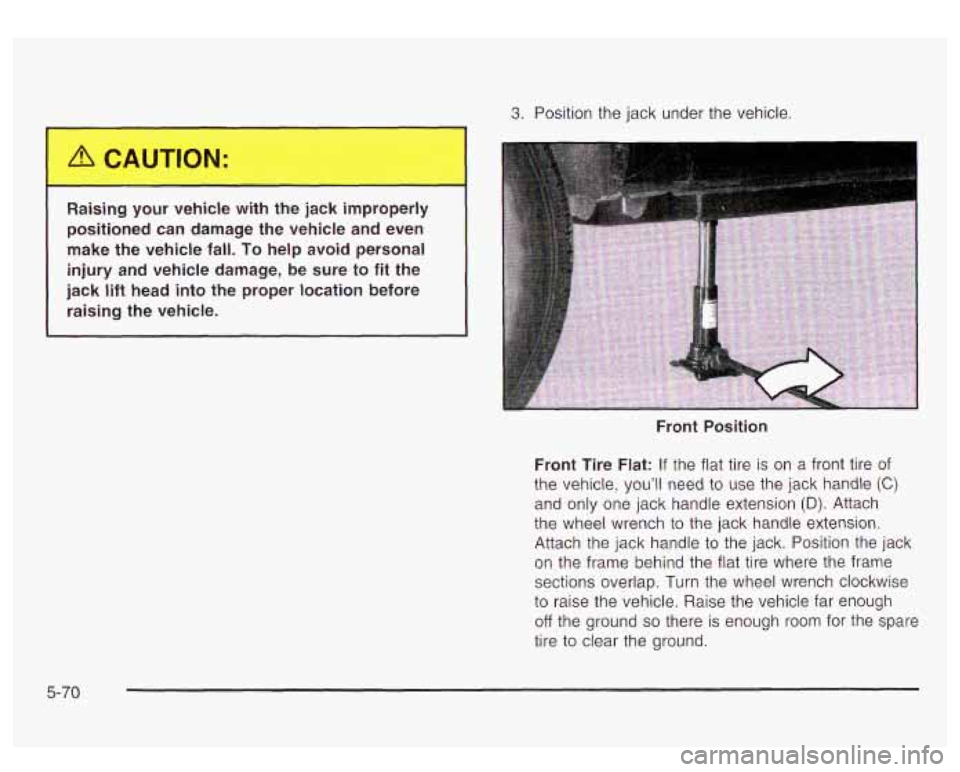
3. Position the jack under the vehicle.
Raising your vehicle with the jack improperly
positioned can damage the vehicle and even
make the vehicle fall.
To help avoid personal
injury and vehicle damage, be sure to fit the
jack lift head into the proper location before
raising the vehicle.
Front Position
Front Tire Flat:
If the flat tire is on a front tire of
the vehicle,
you’ll need to use the jack handle (C)
and only one jack handle extension (D). Attach
the wheel wrench
to the jack handle extension.
Attach the jack handle
to the jack. Position the jack
on the frame behind the flat tire where the frame
sections overlap. Turn the wheel wrench clockwise
to raise the vehicle. Raise the vehicle far enough
off the ground so there is enough room for the spare
tire
to clear the ground.
5-70
Page 360 of 447
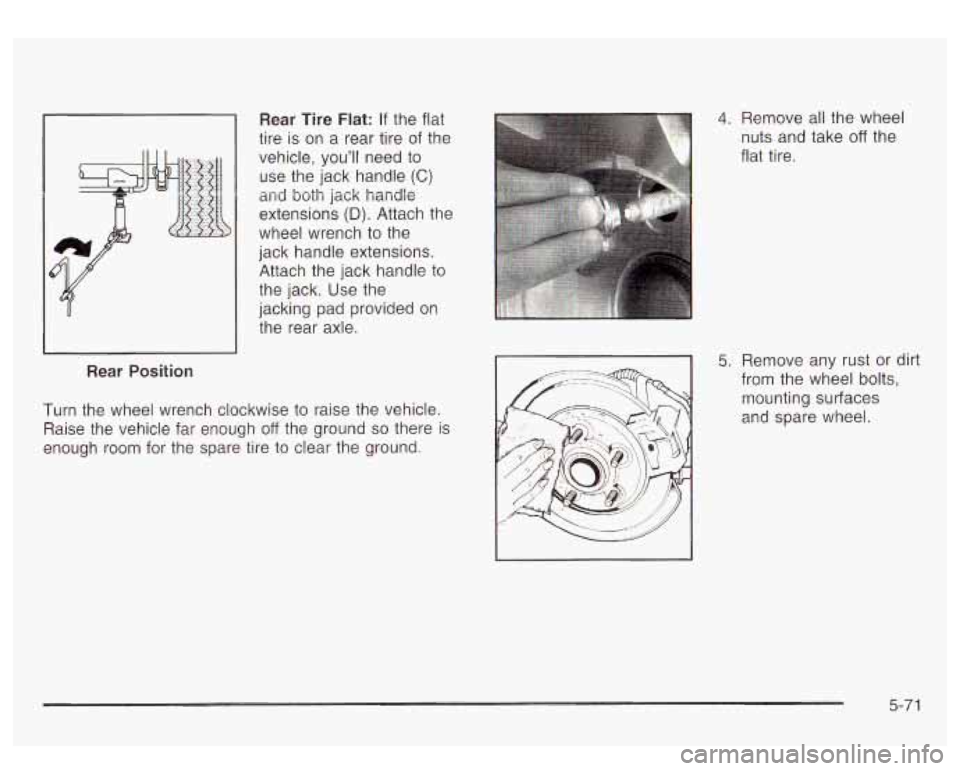
Rear Tire Flat: If the flat
tire is on a rear tire of the
vehicle,
you’ll need to
use the jack handle (C)
and both jack handle
extensions
(D). Attach the
wheel wrench to the
jack handle extensions.
Attach the jack handle
to
the jack. Use the
jacking pad provided on
the rear axle.
Rear Position
Turn the wheel wrench clockwise
to raise the vehicle.
Raise the vehicle far enough
off the ground so there is
enough room for the spare tire to clear the ground.
4. Remove all the wheel
nuts and take
off the
flat tire.
5. Remove any rust or dirt
from the wheel
bolts,
mounting surfaces
and spare wheel.
5-7’
Page 361 of 447
Rust or dirt on the wheel, or on the parts to
which
it is fastened, can make the wheel nuts
become loose after a time. The wheel could
come
off and cause an accident. When you
change
a wheel, remove any rust or dirt from
the places where the wheel attaches to the
vehicle. In an emergency, you can use a cloth or a paper towel to do this; but be sure to use
a scraper or wire brush later, if you need to, to
get all the rust or dirt
off.
1
Never use oil or grease on studs or nuts. If
you do, the nuts might come loose. Your wheel
could fall
off, causing a serious accident.
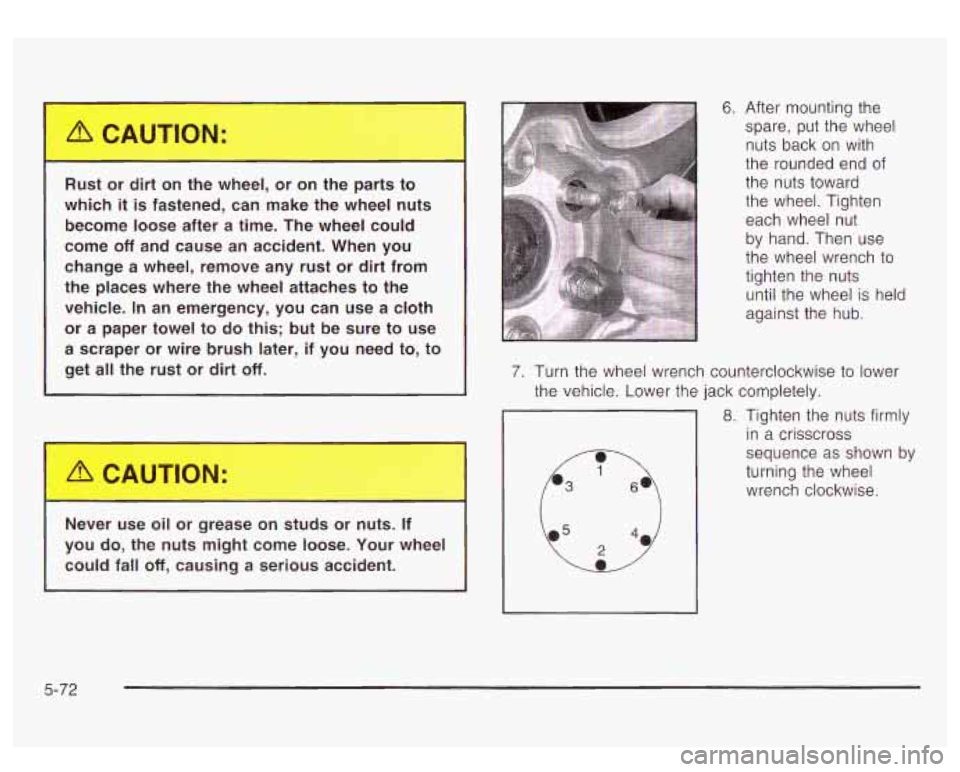
6. After mounting the spare, put the wheel
nuts back on with
the rounded end of
the nuts toward
the wheel. Tighten
each wheel nut
by hand. Then use
the wheel wrench
to
tighten the nuts
until the wheel is held
against the hub.
7. Turn the wheel wrench counterclockwise to lower
the vehicle. Lower the jack completely.
8. Tighten the nuts firmly
in a crisscross
sequence as shown by
turning the wheel
wrench clockwise.
5-72