engine oil GMC YUKON DENALI 2003 Owner's Manual
[x] Cancel search | Manufacturer: GMC, Model Year: 2003, Model line: YUKON DENALI, Model: GMC YUKON DENALI 2003Pages: 447, PDF Size: 21.97 MB
Page 306 of 447
How to Reset the CHANGE ENGINE OIL
Message
The GM Oil Life System calculates when to change
your engine oil and filter based on vehic!e
use. Anytime
your oil is changed, reset the system
so it can
calculate when the next oil change is required.
If a
situation occurs where you change your
oil prior to a
CHANGE ENGINE OIL message being turned on, reset
the system.
To reset the CHANGE ENGINE
OIL message, see “GM
Oil Life System” under DIC Operation and Displays
on page 3-43 for vehicles equipped with the DIC, or do
the following:
1. Turn the ignition key to RUN with the engine off.
2. Fully press and release the accelerator pedal three
If the OIL LIFE RESET message flashes for
10 seconds,
the system is reset.
If the system does not reset, try the procedure once
again. If it still does not reset, see your dealer for
service. times
within five seconds.
What to Do with Used Oil
Used engine oil contains certain elements that may be
unhealthy for your skin and could even cause cancer.
Don’t let used oil stay on your skin for very long. Clean
your skin and nails with soap and water, or a good hand cleaner. Wash
or properly dispose of clothing or
rags containing used engine oil. See the manufacturer’s
warnings about the use and disposal of oil products.
Used oil can be a threat
to the environment. If you
change your own oil, be sure
to drain all the oil from the
filter before disposal. Never dispose of oil by putting it
in the trash, pouring it on the ground, into sewers, or into
streams or bodies of water. Instead, recycle it by
taking it to a place that collects used oil. If you have a
problem properly disposing of your used oil, ask
your dealer, a service station or a local recycling center
for help.
Engine Air Cleaner/Filter
The engine air cleanedfilter assembly has an air filter
restriction indicator that lets you know when the engine
air cleaner/filter is dirty and needs to be serviced.
The air filter restriction indicator is located on the air
filter assembly cover. See Engine Compartment
Overview
on page 5-72 for more information on location.
See Part
B: Owner Checks and Services on page 6-10
to determine when to check the air filter restriction
indicator.
5-1 7
Page 309 of 447

Automatic Transmission Fluid
When to Check and Change
A good time to check your automatic transmission fluid
level is when the engine oil is changed.
Change both the fluid and filter every
50,000 miles
(83
000 km) if the vehicle’s GVWR is over 8,600 or if
the vehicle is mainly driven under one or more of these
conditions:
In heavy city traffic where the outside temperature
regularly reaches 90°F (32°C) or higher.
0 In hilly or mountainous terrain.
When doing frequent trailer towing.
Uses such as found in taxi, police or delivery
service.
If your vehicle’s GVWR is not over 8,600 and you do
not use your vehicle under any of these conditions,
change the fluid and filter every
100,000 miles
(1 66 000 km).
How to Check
Because this operation can be a little difficult, you may
choose to have this done at the dealership service
department.
If you do it yourself, be sure to follow all the instructions
here, or you could get a false reading on the dipstick.
Notice: Too much or too little fluid can damage
your transmission. Too much can mean that some of the fluid could come out and fall
on hot engine
part or exhaust system parts, starting a fire.
Too little fluid could cause the transmission to
overheat. Be sure to get an accurate reading if you
check your transmission fluid.
Wait at least 30 minutes before checking the
transmission fluid level
if you have been driving:
When outside temperatures are above 90°F (32°C).
At high speed for quite a while.
In heavy traffic - especially in hot weather.
While pulling a trailer.
See
Part A: Scheduled Maintenance Services on
page 6-4.
5-20
Page 312 of 447
The following explains your cooling system and how to
add coolant when it is low. If you have a problem
with engine overheating, see Engine Overheating
on
page 5-25.
A 50/50 mixture of clean, drinkable water and
DEX-COOL@ coolant will:
Give freezing protection down to -34°F (-37°C).
Give boiling protection up to 265°F (129°C).
Protect against rust and corrosion.
Help keep the proper engine temperature.
e Let the warning lights and gages work as they
should.
Notice: When adding coolant, it is important that
you use only
DEX-COOL@ (silicate-free) coolant.
If coolant other than DEX-COOL@ is added to the
system, premature engine, heater core or radiator
corrosion may result. In addition, the engine coolant
will require change sooner
-- at 30,000 miles
(50,000 km) or 24 months, whichever occurs first.
Damage caused by the use of coolant other than
DEX-COQL.@ is not covered by your new vehicle
warranty.
What to Use
Use a mixture of one-half clean, drinkable water and
one-half DEX-COOL@ coolant which won’t damage
aluminum parts.
!f YOU uss this coolant mixture,
you don’t need
to add anything else.
Adding c..ly
c water to your cooling
system can be dangerous. Plain water, or
some other liquid such as alcohol, can boil before the proper coolant mixture will. Your
vehicle’s coolant warning system
is set for the
proper coolant mixture. With plain water or the
wrong mixture, your engine could get too hot
but you wouldn’t get the overheat warning.
Your engine could catch fire and you or others
could be burned. Use a
50/50 mixture of clean,
drinkable water and DEX-COQL@ coolant.
Notice: If you use an improper coolant mixture,
your engine could overheat and be badly damaged.
The repair cost wouldn’t be covered by your
warranty. Too much water
in the mixture can freeze
and crack the engine, radiator, heater core and
other parts.
5-23
Page 314 of 447
Adding Coolant
If you need more coolant, add the proper DEX-COOL@
coolant mixture
at the surge tank, but only when the
engine
is cool.
1 “J can be burned if you sb... coolant on hot
engine parts. Coolant contains ethylene glycol, and
it will burn if the engine parts are hot
enough. Don’t spill coolant on a hot engine.
When replacing the pressure cap, make sure it is
hand-tight.
Coolant Surge Tank Pressure Cap
The coolant surge tank pressure cap must be fully
installed on the coolant surge tank. See Engine
Compartment Overview on page
5-12 for more
information on location.
Notice: Your pressure cap is a pressure-type cap
and must be tightly installed to prevent coolant
loss
and possible engine damage from overheating.
See “Capacities and Specifications” for more
information.
Engine Overheating
You will find a coolant temperature gage on your
vehicle’s instrument panel. See Engine Coolant
Temperature Gage
on page 3-36. in addition, yoti ill
find a LOW COOLANT, ENGINE COOLANT HOT,
ENGINE OVERHEATED and a REDUCED ENGINE
POWER message in the DIC on the instrument panel.
See DIC Warnings and Messages on page
3-52.
Overheated Engine Protection
Operating Mode
If an overheated engine condition exists and the
REDUCED ENGINE POWER message is displayed, an
overheat protection mode which alternates firing
groups of cylinders helps prevent engine damage.
In
this mode, you will notice a loss in power and engine
performance. This operating mode allows your vehicle to
be driven
to a safe place in an emergency. Driving
extended miles (km) and/or towing a trailer in the
overheat protection mode should be avoided.
Notice: After driving in the overheated engine
protection operating mode, to avoid engine damage,
allow the engine to cool before attempting any repair.
The engine oil will be severely degraded. Repair the cause of coolant
loss, change the oil and reset the oil
life system. See “Engine Oil” in the Index.
5-25
Page 317 of 447
Cooling System
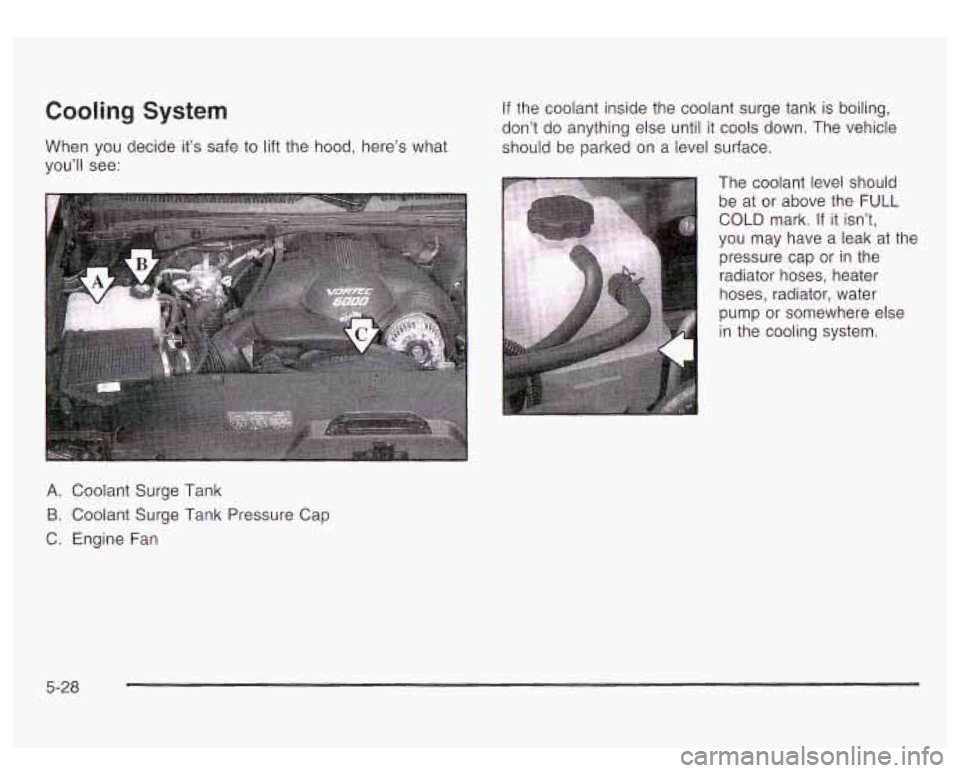
When you decide it’s safe to lift the hood, here’s what
you’ll see: If the
coolant inside the coolant surge tank
is boiling,
don’t do anything else until
it cools down. The vehicle
should be parked on a level surface.
A. Coolant Surge Tank
B. Coolant Surge Tank Pressure Cap
C. Engine Fan
1
The coolant level should
be at or above the FULL
COLD mark. If
it isn’t,
you may have a leak at the
pressure cap or in the
radiator hoses, heater
hoses, radiator, water pump or somewhere else
in the cooling system.
5-28
Page 320 of 447
Adding only plain water to your cooling
system can be dangerous. Plain water, or
some other liquid such as alcohol, can boil
before the proper coolant mixture will. Your
vehicle's coolant warning system
is set for the
proper coolant mixture.
With plain water or the
wrong mixture, your engine could get too hot
but you wouldn't get the overheat warning.
Your engine could catch fire and you or others
could be burned. Use a
50/50 mixture of clean,
drinkable water and DEX
COOL@ coolant.
Notice: In cold weather, water can freeze and crack
the engine, radiator, heater core and other parts.
Use the recommended coolant and the proper
coolant mixture. You can be burned
if you spill coolant on tist
engine parts. Coolant contains ethylene glycol
and
it will burn if the engine parts are hot
enough. Don't
spill coolant on a hot engine.
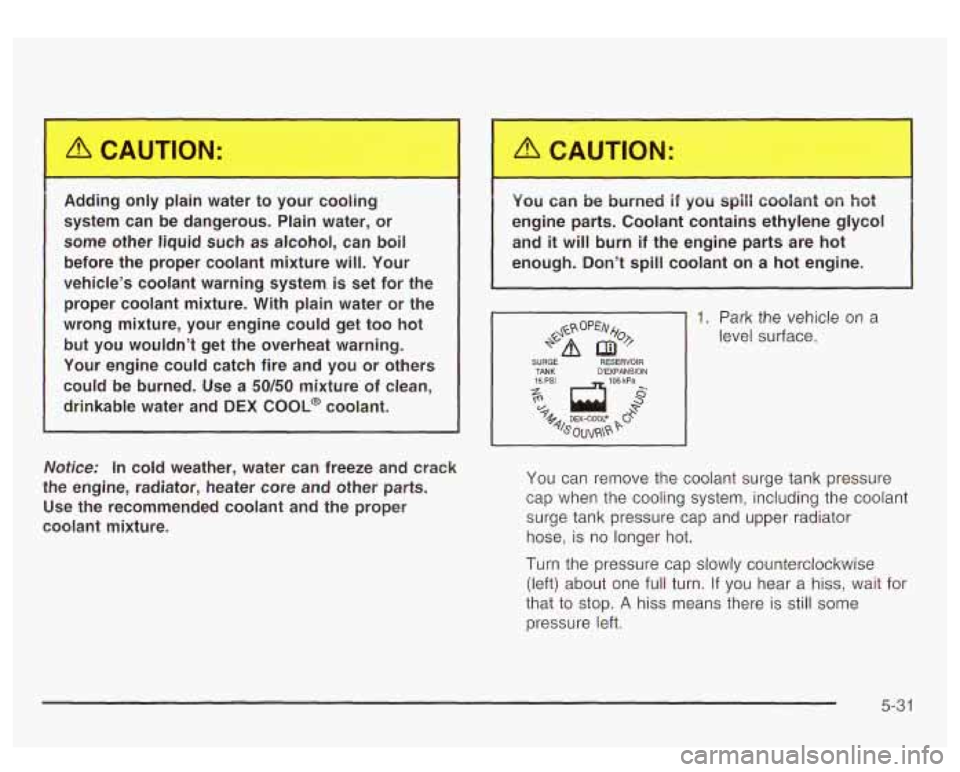
1. Park the vehicle on a
level surface.
SURGE RESERVOIR
15 PSI
TANK - 105 kPa
D'EXPANSION I
You
can remove the coolant surge tank pressure
cap when the cooling system, including the coolant
surge tank pressure cap and upper radiator hose,
is no longer hot.
Turn the pressure cap slowly counterclockwise
(left) about one full turn. If you hear a hiss, wait for
that
to stop. A hiss means there is still some
pressure left.
5-31
Page 327 of 447
Notice;
Using the wrong fluid can badly damage brake
system parts. For example, just a few drops of mineral-based oil, such as engine oil, in your
brake system can damage brake system
parts
so badly that they’ll have to be replaced.
Don’t let someone put
in the wrong kind of fluid.
If you spill brake fluid on your vehicle’s painted
surfaces,
the paint finish can be damaged. Be
careful not to spill brake fluid on your vehicle. If
you do, wash
it off immediately. See
“Appearance Care’’ in the Index.
Brake Wear
Your vehicle has four-wheel disc brakes.
Disc brake pads have built-in wear indicators that make
a high-pitched warning sound when the brake pads
are worn and new pads are needed. The sound
may come and go or be heard all the time your vehicle
is moving (except when you are pushing on the
brake pedal firmly).
~ The brake wea rarl -g sou.-_. ... eans that
soon your brakes won’t work well. That could
lead to an accident. When you hear the brake
wear warning sound, have your vehicle
serviced.
Notice: Continuing to drive with worn-out brake
pads could result in costly brake repair.
Some driving conditions or climates may cause a brake
squeal when the brakes are first applied or lightly
applied. This does not mean something is wrong with
your brakes.
Properly torqued wheel nuts are necessary
to help
prevent brake pulsation. When tires are rotated, inspect
brake pads for wear and evenly tighten wheel nuts in
the proper sequence to
GM torque specifications.
Brake linings should always be replaced as complete
axle sets.
See
Brake System Inspection on page 6-14.
5-38
Page 385 of 447
Capacities and Specifications
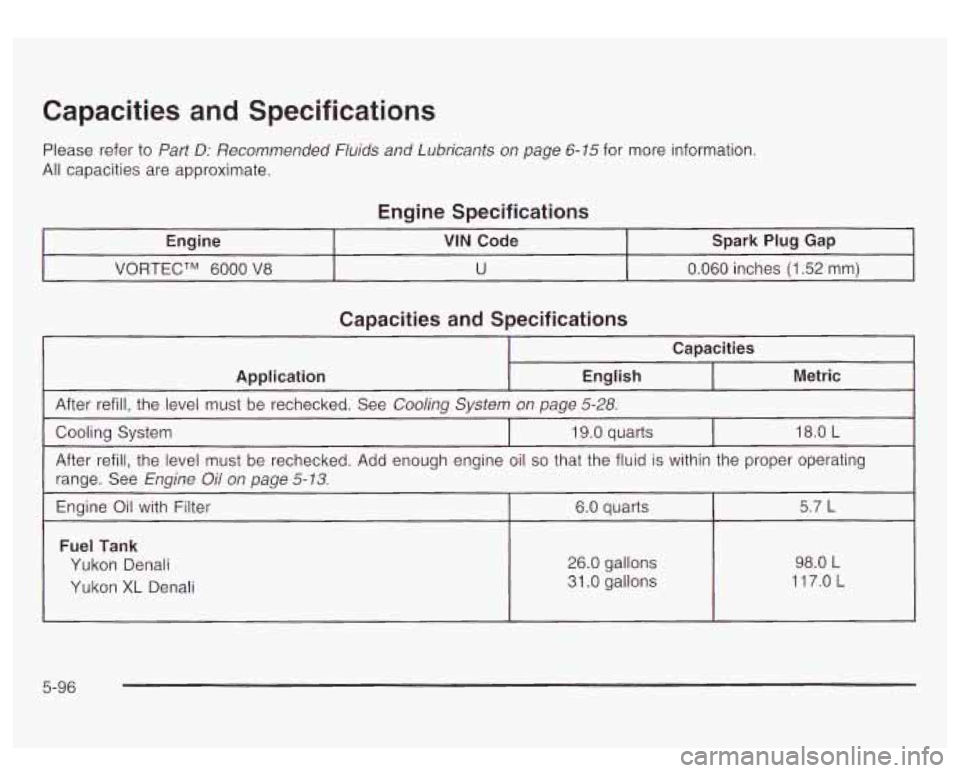
Please refer to Part D: Recommended Fluids and Lubricants on page 6-15 for more information.
All capacities are approximate.
Engine Specifications
Engine VIN Code 1 Spark Pluq GaD - I t -
VORTECTM 6000 V8 U I 0.060 inches (1.52 mm)
Capacities and Specifications
Capacities
Application Metric
English
After refill, the level must be rechecked. See Cooling System on page 5-28.
Cooling System 19.0 quarts 18.0 L
After refill, the level must be rechecked. Add enough engine oil so that the fluid is within the proper operating
range. See Engine Oil on page
5-13.
Engine Oil with Filter
Fuel Tank
5.7 L 6.0 quarts
Yukon Denali
Yukon
XL Denali
26.0 gallons
31 .O gallons
98.0 L
117.0 L
5-96
Page 387 of 447
Normal Maintenance Replacement Parts
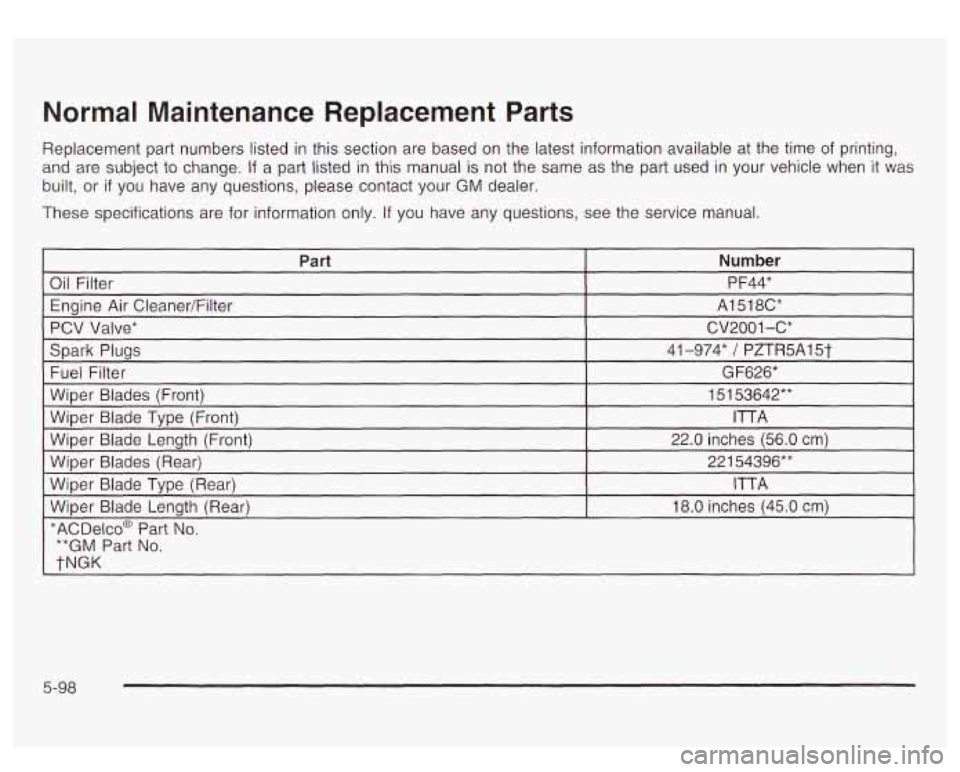
Replacement part numbers listed in this section are based on the latest information available at the time of printing,
and are subject
to change. If a part listed in this manual is not the same as the part used in your vehicle when it was
built, or
if you have any questions, please contact your GM dealer.
These specifications are for information only.
If you have any questions, see the service manual.
I Part 1 Number I
Oil Filter
G F626"
Fuel Filter 41
-974*
/ PZTR5A15t
Spark Plugs cv2001
-c* PCV Valve" AI
51 8C*
Engine Air CleanedFilter P F44*
Wiper Blades (Front)
ITTA
Wiper Blade Tvpe (Front)
151 53642**
Wiper Blade Length (Front)
ITTA WiDer Blade Tvpe (Rear) 221
54396**
Wiper Blades (Rear) 22.0
inches (56.0 cm) a. I
Wiper Blade Length (Rear) 18.0 inches (45.0 cm)
*ACDelco@ Part
No.
**GM Part No.
tNGK
5-98
Page 389 of 447
Maintenance Schedule
Introduction
1
IMPORTANT:
KEEP ENGINE OIL
AT THE PROPER
EVEL
AND CHANGE AS
RECOMMENDED
,. - .~
protectjon
I
Have you purchased the GM Protection Plan? The Plan
supplements your new vehicle warranties. See your
Warranty and Owner Assistance booklet or your dealer
for details.
Your Vehicle and the Environment
Proper vehicle maintenance not only helps to keep your
vehicle in good working condition, but also helps the
environment. All recommended maintenance procedures
are important. Improper vehicle maintenance can
even affect the quality of the air we breathe. Improper
fluid levels or the wrong tire inflation can increase
the level of emissions from your vehicle. To help protect
our environment, and to keep your vehicle in good
condition, please maintain your vehicle properly.
Maintenance Requirements
Maintenance intervals, checks, inspections and
recommended fluids and lubricants as prescribed in this
manual are necessary
to keep your vehicle in good
working condition. Any damage caused by failure
to follow recommended maintenance may not be
covered by warranty.
6-2