ECU GMC YUKON DENALI 2003 Service Manual
[x] Cancel search | Manufacturer: GMC, Model Year: 2003, Model line: YUKON DENALI, Model: GMC YUKON DENALI 2003Pages: 447, PDF Size: 21.97 MB
Page 250 of 447
Environmental Concerns
e
e
e
Cargo on the load floor piled higher than
the seatbacks can be thrown forward during a sudden stop. You or your
passengers could be injured. Keep cargo
below the top of the seatbacks.
Unsecured cargo on the load floor can be
tossed about when driving over rough
terrain. You or your passengers can be struck by flying objects. Secure the cargo properly.
Heavy loads on the roof raise the vehicle’s
center of gravity, making
it more likely to
roll over. You can be seriously or fatally
injured if the vehicle rolls over. Put heavy
loads inside the cargo area, not on the
roof. Keep cargo in the cargo area as far
forward and low as possible.
You’ll find other important information in this manual.
See Loading
Your Vehicle on page 4-44 and Tires
on page 5-55.
Off-road driving can provide wholesome and satisfying
recreation. However, it also raises environmental
concerns. we recognize these concerns and urge every
off-roader to follow these basic rules for protecting
the environment:
e
e
e
e
e
Always use established trails, roads and areas that
have been specially set aside for public off-road
recreational driving; obey all posted regulations.
Avoid any driving practice that could damage the
environment
- shrubs, flowers, trees, grasses - or
disturb wildlife (this includes wheel-spinning, breaking down trees or unnecessary driving through
streams or over soft ground).
Always carry a litter bag
... make sure all refuse is
removed from any campsite before leaving.
Take extreme care with open fires (where permitted), camp stoves and lanterns.
Never park your vehicle over dry grass or other
combustible materials that could catch fire from the heat of the vehicle’s exhaust system.
4-1 7
Page 270 of 447
You may see highway signs on mountains that
warn of special problems. Examples are long
grades, passing or no-passing zones, a falling rocks
area or winding roads. Be alert
to these and take
appropriate action.
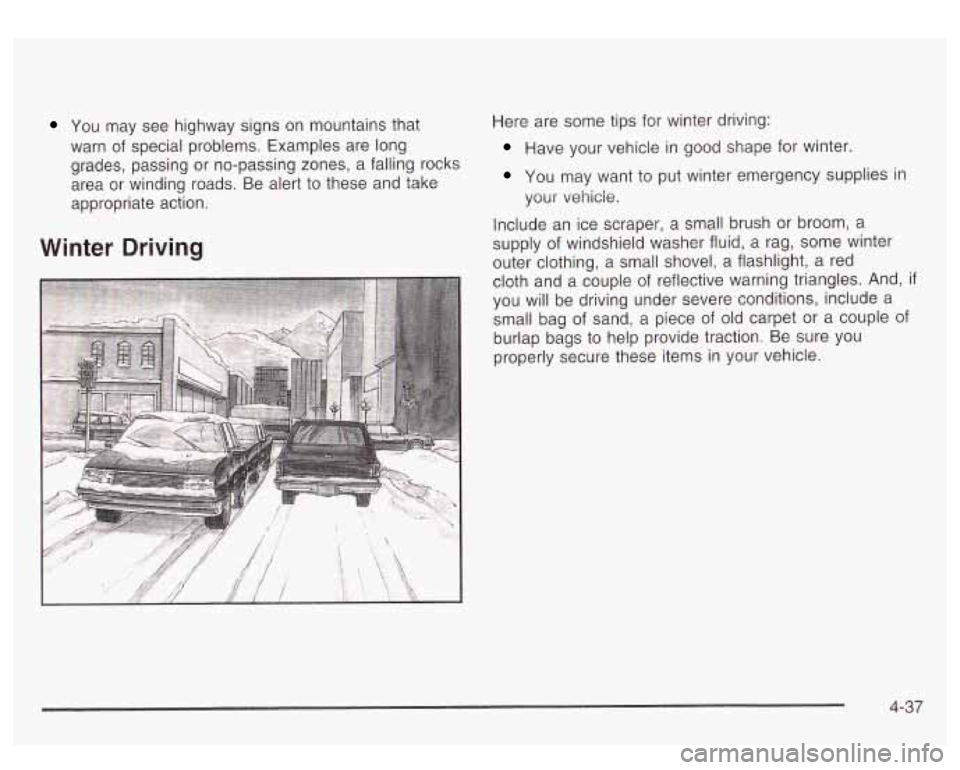
Winter Driving
Here are some tips for winter driving:
Have your vehicle in good shape for winter.
You may want to put winter emergency supplies in
your
vehicle.
Include an ice scraper, a small brush or broom, a
supply of windshield washer fluid, a rag, some winter
outer clothing, a small shovel, a flashlight, a red
cloth and a couple of reflective warning triangles. And,
if
you will be driving under severe conditions, include a
small bag of sand, a piece of old carpet or a couple of
burlap bags
to help provide traction. Be sure you
properly secure these items in your vehicle.
4-37
Page 278 of 447
weigh station and weigh your vehicle. Your dealer can If
you put things inside your vehicle - like suitcases,
help you with this. Be sure to spread out your load
tools, packages, or anything else
- they go as fast as
equally on both sides of the centerline.
the vehicle goes.
If you have to stop or turn quickly,
Never exceed the GVWR for your vehicle, or the GAWR
for either the front or rear axle. or
if there
is a crash, they’ll keep going.
And,
if you do have a heavy load, you should
spread it out.
Do no. .Jad ,3ur vehic., any heavier than the
GVWR, or either the maximum front or rear
GAWR. If you do, parts on your vehicle can
break, and
it can change the way your vehicle
handles. These could cause you to lose
control and crash.
Also, overloading can
shorten the life
of your vehicle.
Your warranty does not cover parts or components that
fail because
of overloading.
The label will help you decide how much cargo and
installed equipment your truck can carry.
Using heavier suspension components to get added
durability might not change your weight ratings. Ask your
dealer to help you load your vehicle the right way. Things you put inside your vehicle can strike
and injure people
in a sudden stop or turn, or
in a crash.
Put things in the cargo area of your
vehicle. Try to spread the weight evenly.
0 Never stack heavier things, like suitcases,
inside the vehicle
so that some of them
are above the tops of the seats.
* Don’t leave an unsecured child restraint in
your vehicle.
When you carry something inside the
vehicle, secure
it whenever you can.
Don’t leave a seat folded down unless you
need to.
There’s also important loading information for off-road
driving
in this manual. See “Loading Your Vehicle
for Off-Road Driving” under Operating Your
All-Wheel-Drive Vehicle
Off Paved Roads on page 4-16.
4-45
Page 286 of 447
Driving with a Trailer
If you have a rear-most window open and you
pull a trailer with your vehicle, carbon
monoxide (CO) could come into your vehicle.
You can’t see or smell CO.
It can cause
unconsciousness or death. See “Engine
Exhaust” in the Index.
To maximize your safety
when towing a trailer:
Have your exhaust system inspected for
leaks, and make necessary repairs before
starting on your trip.
Keep the rear-most windows closed.
If exhaust does come into your vehicle
through a window in the rear or another
opening, drive with your front, main
heating or cooling system on and with the
fan on any speed. This will bring fresh,
outside air into your vehicle.
Do not use
the comfort control setting for maximum
air because
it only recirculates the air
inside your vehicle. See “Comfort
1 Controls” in the Index. Towing a trailer requires a certain amount
of experience.
Before setting out for the open road, you’ll want to get
to know your rig. Acquaint yourself with the feel of
handling and braking with the added weight of the trailer.
And always keep
in mind that the vehicle you are
driving is now a good deal longer and not nearly as
responsive as your vehicle is by itself.
Before you start, check the trailer hitch and platform
(and attachments), safety chains, electrical connector,
lamps, tires and mirror adjustment.
If the trailer has
electric brakes, start your vehicle and trailer moving and
then apply the trailer brake controller by hand to be
sure the brakes are working. This lets you check your
electrical connection at the same time.
During your trip, check occasionally to be sure that the
load is secure, and that the lamps and any trailer
brakes are still working.
Following Distance
Stay at least twice as far behind the vehicle ahead a5
you would when driving your vehicle without a trailer.
This can help you avoid situations that require
heavy braking and sudden turns.
Passing
You’ll need more passing distance up ahead when
you’re towing a trailer. And, because you’re a good deal
longer, you’ll need to go much farther beyond the
passed vehicle before you can return to your lane.
4-53
Page 345 of 447
Notice: Don’t let anyone tell you that underinflation
or overinflation is all right. It’s not. If your tires
don’t have enough air (underinflation), you can get
the following:
Too much flexing
Too much heat
0 Tire overloading
Bad wear
Bad handling
Bad fuel economy
If your tires have too much air (overinflation), you
can get the following:
Unusual wear
Bad handling
Rough ride
Needless damage from road hazards
When to Check
Check your tires once a month or more.
Also, check the tire pressure of the spare tire
How to Check
Use a good quality pocket-type gage to check tire
pressure. You can’t tell
if your tires are properly inflated
simply by looking at them. Radial tires may look
properly inflated even when they’re underinflated.
Be sure to put the valve caps back on the valve stems.
They help prevent leaks by keeping out dirt and
moisture.
Tire Inspection and Rotation
Tires should be rotated every 7,500 miles (12,500 km).
Any time you notice unusual wear, rotate your tires
as soon as possible and check wheel alignment.
Also
check for damaged tires or wheels. See When It Is Time
for New Tires on page
5-58 and Wheel Replacement
on page
5-61 for more information.
Make sure the spare tire is stored securely. Push, pull,
and then try to rotate or turn the tire. If
it moves,
use the wheel wrench and jack handle extensions
to
tighten the cable. See Changing a Flat Tire on
page 5-63.
The purpose of regular rotation is to achieve more
uniform wear for all tires on the vehicle.
The first rotation
is the most important. See “Part
A: Scheduled
Maintenance Services,” in Section
6, for scheduled
rotation intervals.
5-56
Page 364 of 447
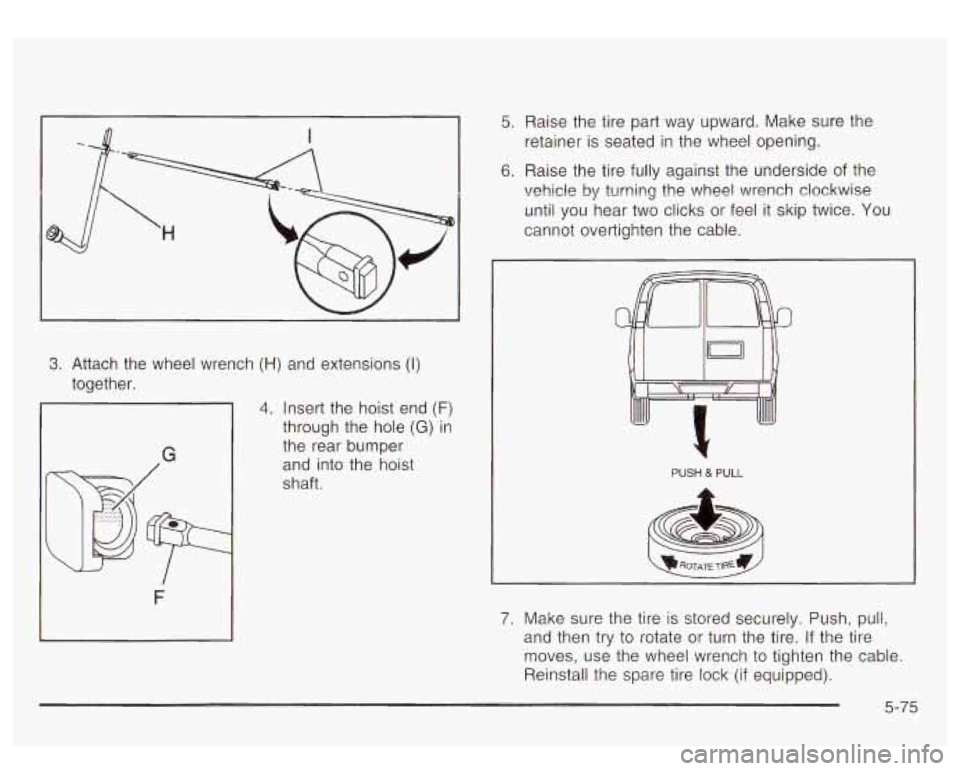
3. Attach the wheel wrench (H) and extensions (I)
together.
G
F
4. Insert the hoist end (F)
through the hole (G) in
the rear bumper
and into the hoist
shaft.
5. Raise the tire part way upward. Make sure the
retainer is seated in the wheel opening.
6. Raise the tire fully against the underside of the
vehicle by turning the wheel wrench clockwise
until you hear two clicks or feel it skip twice. You
cannot overtighten the cable.
PUSH & PULL
7. Make sure the tire is stored securely. Push, pull,
and then try to rotate or turn the tire. If the tire
moves, use the wheel wrench
to tighten the cable.
Reinstall the spare tire lock
(if equipped).
5-75
Page 365 of 447
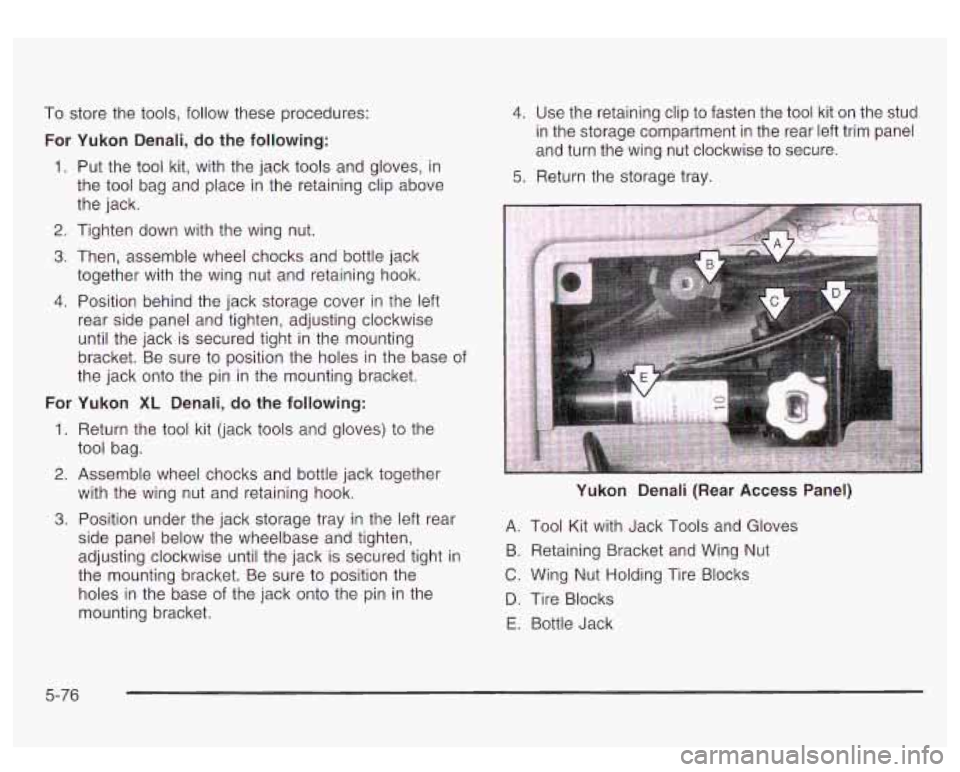
To store the tools, follow these procedures:
For Yukon Denali, do the following:
1. Put the tool kit, with the jack tools and gloves, in
the tool bag and place in the retaining clip above
the jack.
2. Tighten down with the wing nut.
3. Then, assemble wheel chocks and bottle jack
together with the wing nut and retaining hook.
4. Position behind the jack storage cover in the left
rear side panel and tighten, adjusting clockwise
until the jack is secured tight in the mounting
bracket. Be sure
to position the holes in the base of
the jack onto the pin in the mounting bracket.
For Yukon XL Denali, do the following:
1. Return the tool kit (jack tools and gloves) to the
tool bag.
2. Assemble wheel chocks and bottle jack together
with the wing nut and retaining hook.
3. Position under the jack storage tray in the left rear
side panel below the wheelbase and tighten,
adjusting clockwise until the jack
is secured tight in
the mounting bracket. Be sure to position the
holes in the base of the jack onto the pin in the
mounting bracket.
4. Use the retaining clip to fasten the tool kit on the stud
in the storage compartment in the rear left trim panel
and turn the wing nut clockwise
to secure.
5. Return the storage tray.
Yukon Denali (Rear Access Panel)
A. Tool Kit with Jack Tools and Gloves
B. Retaining Bracket and Wing Nut
C. Wing Nut Holding Tire Blocks
D. Tire Blocks
E. Bottle Jack
5-76
Page 398 of 447
Also look for any opened or broken air bag coverings,
and have them repaired or replaced. (The air bag
system does not need regular maintenance.)
Inspect wiper blades for wear or cracking. Replace
blade inserts that appear worn or damaged or that
streak or miss areas of the windshield.
Also see
Cleaning the Outside
of Your Vehicle on page 5-81.
Spare Tire Check
At least twice a year, after the monthly inflation check of
the spare tire determines that the spare is inflated
to
the correct tire inflation pressure, make sure that
the spare tire is stored securely. Push, pull, and then
try
to rotate or turn the tire. If it moves, use the wheel
wrenchhatchet
to tighten the cable. See Changing a Flat
Tire
on page 5-63.
Engine Air Cleaner Filter Restriction
Indicator Check
Your vehicle has an engine air cleaner filter restriction
indicator located on the air cleaner in the engine
compartment. The indicator lets you know when the air
cleaner filter is dirty and needs
to be changed. Check
the indicator at least twice a year or when your engine oil is changed,
whichever occurs first. See Engine Air
Cleaner/Filter
on page 5- 17 for more information. Inspect
your air cleaner filter restriction indicator more often
if
the vehicle is used in dusty areas or under off road
conditions.
Weatherstrip Lubrication
Silicone grease on weatherstrips will make them last
longer, seal better, and not stick or squeak. Apply
silicone grease with a clean cloth. During very cold,
damp weather more frequent application may be required. See
Part D: Recommended Fluids and
Lubricants
on page 6- 15.
Automatic Transmission Check
Check the transmission fluid level; add if needed. See
Automatic Transmission Fluid on page
5-20. A fluid loss
may indicate a problem. Check the system and repair
if needed.
At Least Once a Year
Key Lock Cylinders Service
Lubricate the key lock cylinders with the lubricant
specified in Part D.
Page 427 of 447
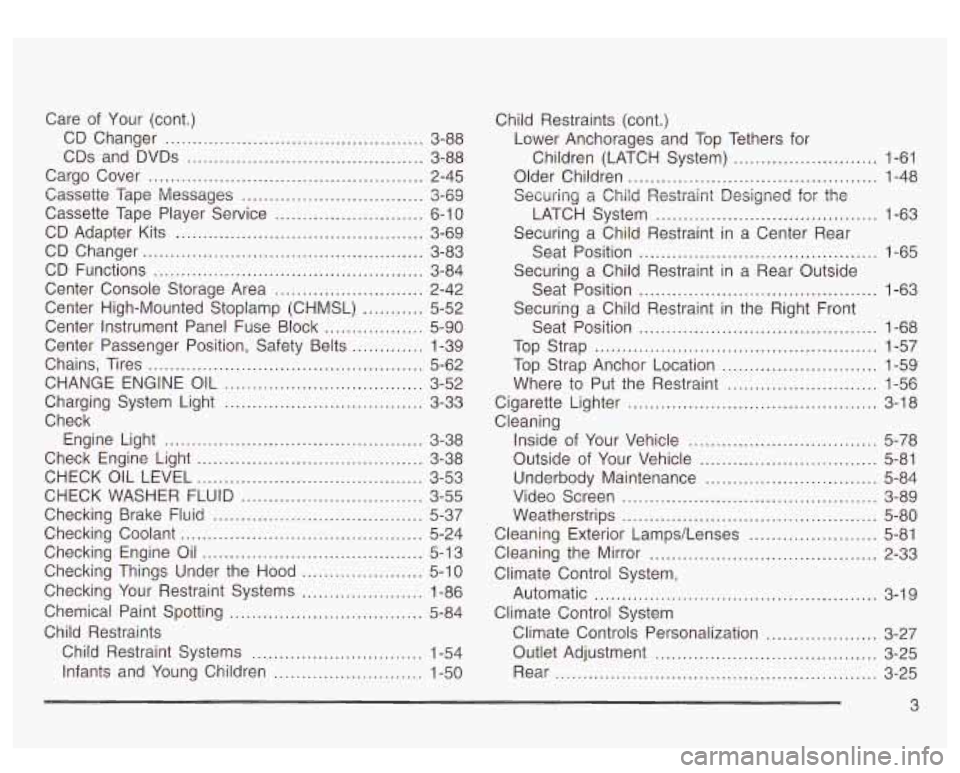
Care of Your (cont.)
CD Changer
............................................... 3-88
CDs and DVDs
........................................... 3-88
Cargo Cover
.................................................. 2-45
Cassette Tape Messages
................................. 3-69
Cassette Tape Player Service
........................... 6-10
CD Adapter Kits
............................................. 3-69
CD Changer
................................................... 3-83
CD Functions
................................................. 3-84
Center Console Storage Area
........................... 2-42
Center High-Mounted Stoplamp (CHMSL)
........... 5-52
Center Instrument Panel Fuse Block
.................. 5-90
Center Passenger Position, Safety Belts
............. 1-39
Chains, Tires
.................................................. 5-62
Charging System Light
................................. 3-33
Check
Check Engine Light
........... ........... 3-38
CHECK OIL LEVEL
.............. ............... 3-53
Checking Brake Fluid
...................................... 5-37
CHANGE ENGINE
OIL .................................... 3-52
Engine Light
......... ................... 3-38
CHECK WASHER FLUID
............................. 3-55
Checking Coolant
................................. .... 5-24
Checking Engine Oil
..................................... 5-1 3
Checking Things Under the Hood
...................... 5-10
Checking Your Restraint Systems
................... 1-86
Chemical Paint Spotting
........ ................... 5-84
Child Restraints Child Restraint Systems
............................... 1-54
Infants and Young Children
........................... 1-50 Child Restraints (cont.)
Lower Anchorages and Top Tethers for
Older Children
............................................. 1-48
Securing
a Child Restrairit Designed for the
Securing a Child Restraint in a Center Rear
Securing
a Child Restraint in a Rear Outside
Securing a Child Restraint in the Right Front
Children
(LATCH System)
.......................... 1-61
LATCH System
........................................ 1-63
Seat Position
........................................... 1-65
Seat Position
........................................... 1-63
Seat Position
........................................... 1-68
Top Strap
................................................... 1-57
Cigarette Lighter
......................................... 3-18
Top
Strap Anchor Location
............................ 1-59
Where to Put the Restraint
........................... 1-56
Cleaning Inside of Your Vehicle
.............. ......... 5-78
Outside
of Your Vehicle ........ ............. 5-81
Underbody Maintenance ............................ 5-84
Video Screen
........................................... 3-89
Weatherstrips
.................................. ..... 5-80
Cleaning Exterior Lamps/Lenses
....................... 5-81
Cleaning the Mirror
......................................... 2-33
Climate Control System, Automatic
............................................... 3-19
Climate Control System Climate Controls Personalization
.................... 3-27
Outlet Adjustment
........................................ 3-25
Rear
.......................................................... 3-25
Page 428 of 447
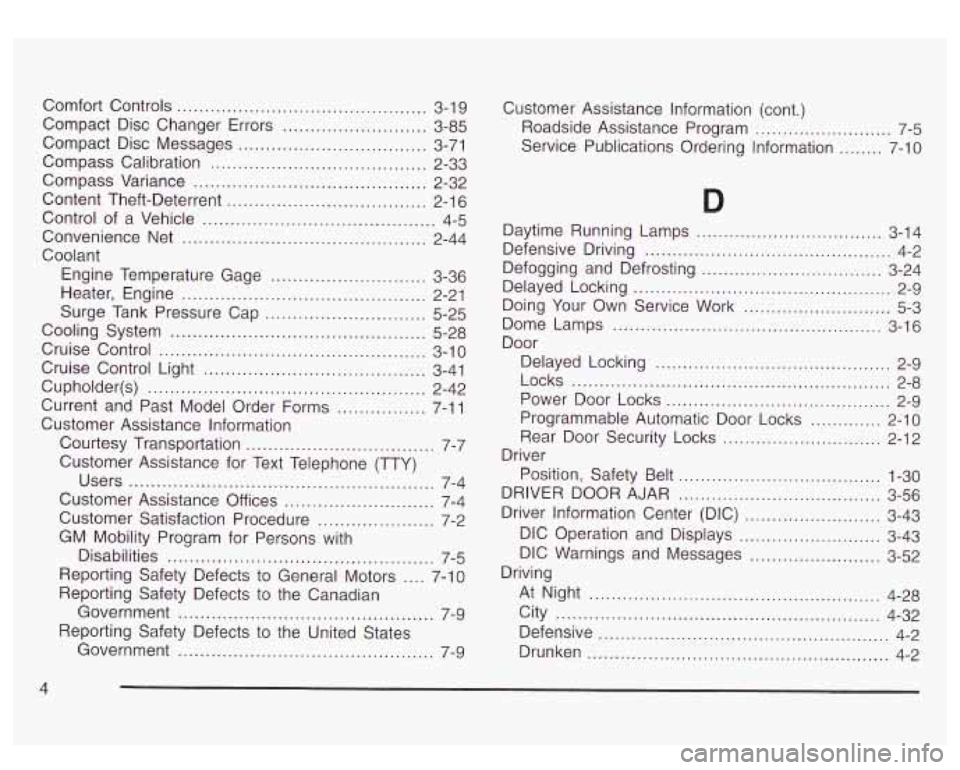
Comfort Controls ............................................. 3-1 9
Compact Disc Messages
.................................. 3-71
Compass Calibration
....................................... 2-33
Compass Variance
.......................................... 2-32
Content Theft-Deterrent
......................... .... 2-16
Control of a Vehicle
......................... ......... 4-5
Convenience Net ............................................ 2-44
Coolant Engine Temperature Gage
............................ 3-36
Heater, Engine
............................................ 2-21
Surge Tank Pressure Cap
............................. 5-25
Cooling System
.............................................. 5-28
Cruise Control
................................................ 3-10
Cruise Control Light
......................... ....... 3-41
Cupholder(s)
....................................... .... 2-42
Current and Past Model Order Forms
......... 7-1 1
Customer Assistance Information Courtesy Transportation
.................................. 7-7
Customer Assistance for Text Telephone (TTY)
Users
....................................................... 7-4
Customer Assistance
Off ices ........................... 7-4
Customer Satisfaction Procedure
..................... 7-2
GM Mobility Program for Persons with
Disabilities
................................................ 7-5
Reporting Safety Defects
to General Motors .... 7-10
Reporting Safety Defects to the Canadian Government
.............................................. 7-9
Reporting Safety Defects
to the United States
Government
.............................................. 7-9
Compact
Disc Changer Errors
.......................... 3-85 Customer Assistance Information
(cont.)
Roadside Assistance Program ......................... 7-5
Service Publications Ordering Information
.... 7-10
Daytime Running Lamps
.................................. 3-14
Defensive Driving
............................................. 4-2
Defogging and Defrosting
................................. 3-24
Delayed Locking
............................................... 2-9
Doing Your Own Service Work
........................... 5-3
Dome Lamps
................................................. 3-16
Door
Delayed Locking
........................................... 2-9
Power Door Locks
......................................... 2-9
Programmable Automatic Door Locks
............. 2-10
Rear Door Security Locks
............................. 2-12
Driver Position, Safety Belt
..................................... 1-30
DRIVER DOOR AJAR
..................................... 3-56
Driver Information Center (DIC)
......................... 3-43
DIC Operation and Displays
.......................... 3-43
DIC Warnings and Messages
........................ 3-52
At Night
..................................................... 4-28
City
........................................................... 4-32
Defensive
..................................................... 4-2
Drunken
....................................................... 4-2
Locks
.......................................................... 2-8
Driving
4