service GMC YUKON DENALI 2003 Repair Manual
[x] Cancel search | Manufacturer: GMC, Model Year: 2003, Model line: YUKON DENALI, Model: GMC YUKON DENALI 2003Pages: 447, PDF Size: 21.97 MB
Page 344 of 447
Tires
Your new vehicle comes with high-quality tires made by
a leading tire manufacturer. If you ever have questions
about your tire warranty and where to obtain service,
see your Warranty booklet for details.
Poorly
m-. ltained anc nproperly used 1 !s
are dangerous.
Overloading your tires can cause
overheating as
a result of too much
friction. You could have an air-out and a
serious accident. See “Loading Your
Vehicle”
in the Index.
0 Underinflated tires pose the same danger
as overloaded tires. The resulting accident could cause serious injury. Check all tires
frequently to maintain the recommended
pressure. Tire pressure should be checked
when your tires are cold.
CAUTION: (Continued)
Overinflated tires are more likely to be
cut, punctured or broken by a sudden
impact
- such as when you hit a pothole.
Keep tires at the recommended pressure.
Worn, old tires can cause accidents. If
your tread is badly worn, or if your tires
have been damaged, replace them.
Inflation -- Tire Pressure
The CertificationKire label, which is on the rear edge of
the driver’s door, shows the correct inflation pressures
for your tires when they’re cold. “Cold” means your
vehicle has been sitting for at least three hours
or driven
no more than
1 mile (1.6 km).
5-55
Page 345 of 447
Notice: Don’t let anyone tell you that underinflation
or overinflation is all right. It’s not. If your tires
don’t have enough air (underinflation), you can get
the following:
Too much flexing
Too much heat
0 Tire overloading
Bad wear
Bad handling
Bad fuel economy
If your tires have too much air (overinflation), you
can get the following:
Unusual wear
Bad handling
Rough ride
Needless damage from road hazards
When to Check
Check your tires once a month or more.
Also, check the tire pressure of the spare tire
How to Check
Use a good quality pocket-type gage to check tire
pressure. You can’t tell
if your tires are properly inflated
simply by looking at them. Radial tires may look
properly inflated even when they’re underinflated.
Be sure to put the valve caps back on the valve stems.
They help prevent leaks by keeping out dirt and
moisture.
Tire Inspection and Rotation
Tires should be rotated every 7,500 miles (12,500 km).
Any time you notice unusual wear, rotate your tires
as soon as possible and check wheel alignment.
Also
check for damaged tires or wheels. See When It Is Time
for New Tires on page
5-58 and Wheel Replacement
on page
5-61 for more information.
Make sure the spare tire is stored securely. Push, pull,
and then try to rotate or turn the tire. If
it moves,
use the wheel wrench and jack handle extensions
to
tighten the cable. See Changing a Flat Tire on
page 5-63.
The purpose of regular rotation is to achieve more
uniform wear for all tires on the vehicle.
The first rotation
is the most important. See “Part
A: Scheduled
Maintenance Services,” in Section
6, for scheduled
rotation intervals.
5-56
Page 347 of 447
When It Is Time for New Tires
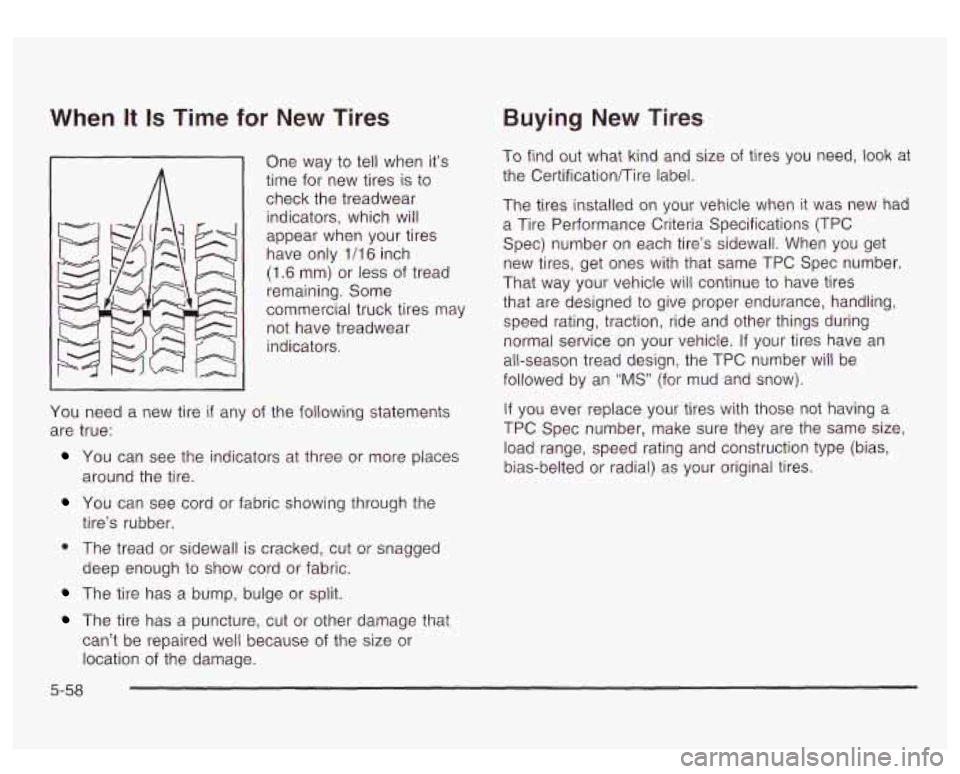
One way to tell when it’s
time for new tires is
to
check the treadwear
indicators, which will
appear when your tires have only
1/16 inch
(1.6 mm) or less of tread
remaining. Some
commercial truck tires may
not have treadwear indicators.
You need a new tire
if any of the following statements
are true:
You can see the indicators at three or more places
around the tire.
You can see cord or fabric showing through the
. The tread or sidewall is cracked, cut or snagged
The tire has a bump, bulge or split.
The tire has a puncture, cut or other damage that
tire’s rubber.
deep
enough
to show cord or fabric.
can’t be repaired well because of the size or
location
of the damage.
Buying New Tires
To find out what kind and size of tires you need, look at
the CertificationlTire label.
The tires installed on your vehicle when it was new had
a Tire Performance Criteria Specifications (TPC
Spec) number on each tire’s sidewall. When you get
new tires, get ones with that same TPC Spec number.
That way your vehicle will continue
to have tires
that are designed to give proper endurance, handling,
speed rating, traction, ride and other things during
normal service on your vehicle. If your tires have an
all-season tread design, the TPC number will be
followed by an
“MS” (for mud and snow).
If you ever replace your tires with those not having a
TPC Spec number, make sure they are the same size,
load range, speed rating and construction type (bias,
bias-belted or radial) as your original tires.
5-58
Page 349 of 447
While the tires available on General Motors passenger
cars and light trucks may vary with respect
to these
grades, they must also conform
to federal safety
requirements and additional General Motors Tire
Performance Criteria (TPC) standards.
Treadwear
The treadwear grade is a comparative rating based on
the wear rate of the tire when tested under controlled
conditions on a specified government test course.
For example, a tire graded
150 would wear one and
a half
(1.5) times as well on the government course as
a tire graded
100. The relative performance of tires
depends upon the actual conditions of their use,
however, and may depart significantly from the norm
due
to variations in driving habits, service practices and
differences
in road characteristics and climate.
Traction - AA, A, 6, C
The traction grades, from highest to lowest, are AA, A,
B, and C. Those grades represent the tire’s ability
to stop on wet pavement as measured under controlled
conditions on specified government test surfaces of
asphalt and concrete.
A tire marked C may have poor
traction performance. Warning: The traction grade assigned
to this tire is based
on straight-ahead braking
traction tests, and does not include acceleration,
cornering, hydroplaning, or peak traction characteristics.
Temperature - A, B, C
The temperature grades are A (the highest), B, and C,
representing the tire’s resistance
to the generation
of heat and its ability
to dissipate heat when tested
under controlled conditions on a specified indoor
laboratory test wheel. Sustained high temperature can
cause the material
of the tire to degenerate and
reduce tire life, and excessive temperature can lead
to
sudden tire failure. The grade C corresponds to a
level of performance which all passenger car tires must
meet under the Federal Motor Vehicle Safety Standard
No. 109. Grades B and A represent higher levels of
performance on the laboratory test wheel than the
minimum required
by law.
Warning: The temperature grade for this tire is
established for a tire that is properly inflated and not
overloaded. Excessive speed, underinflation, or
excessive loading, either separately or in combination,
can cause heat buildup and possible tire failure.
5-60
Page 372 of 447
Aluminum Wheels
Keep your wheels clean using a soft clean cloth with
mild soap and water. Rinse with clean water. After
rinsing thoroughly, dry with a soft clean towel. A wax
may then be applied.
The surface of these wheels is similar
to the painted
surface of your vehicle. Don’t use strong soaps,
chemicals, abrasive polishes, abrasive cleaners,
cleaners with acid, or abrasive cleaning brushes on
them because you could damage the surface. Do not
use chrome polish on aluminum wheels.
Don’t take your vehicle through an automatic car wash
that has silicone carbide tire cleaning brushes. These
brushes can also damage the surface of these wheels.
Tires
To clean your tires, use a stiff brush with tire cleaner.
Nofice: When applying a tire dressing, always take
care to wipe
off any overspray or splash from all
painted surfaces on the body
or wheels of the
vehicle. Petroleum-based products may damage the
paint finish and tires.
Sheet Metal Damage
If your vehicle is damaged and requires sheet metal
repair or replacement, make sure the body repair shop
appiies anti-corrosion materiai to parts repaired or
replaced
to restore corrosion protection.
Original manufacturer replacement parts will provide the
corrosion protection while maintaining the warranty.
Finish Damage
Any stone chips, fractures or deep scratches in the
finish should be repaired right away. Bare metal
will corrode quickly and may develop into major repair
expense.
Minor chips and scratches can be repaired with touch-up
materials avaliable from your dealer or other service
outlets. Larger areas of finish damage can be corrected
in your dealer’s body and paint shop.
5-83
Page 375 of 447
Vehicle Identification
Vehicle Identification Number (VIN)
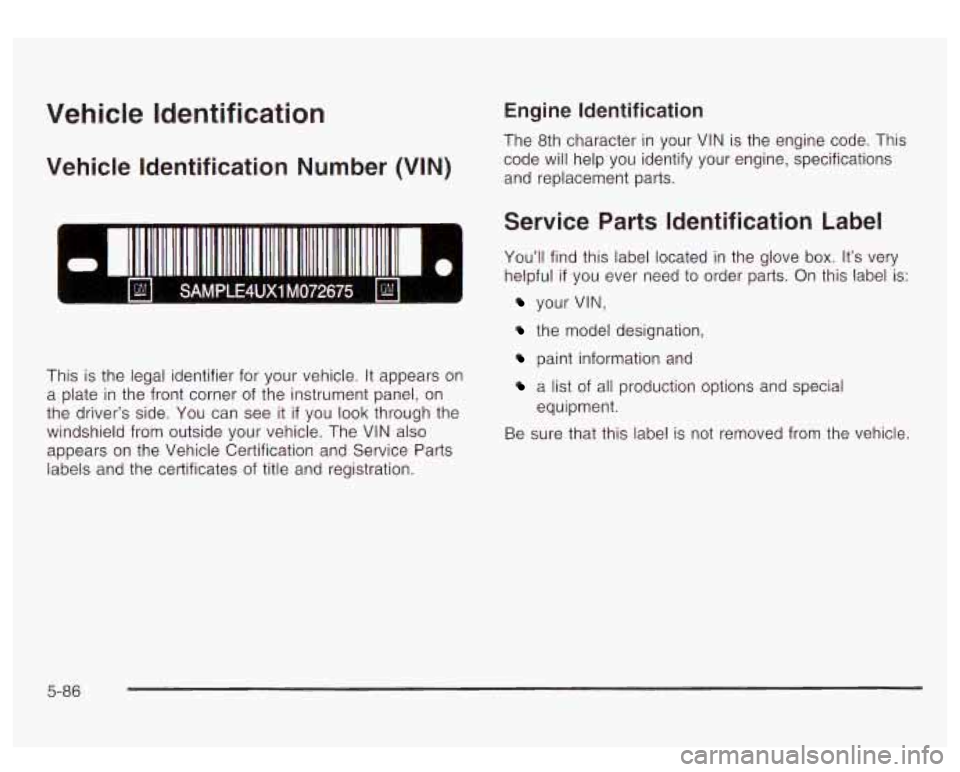
SAMPLE4UXl M072675
This is the legal identifier for your vehicle. It appears on
a plate in the front corner of the instrument panel, on
the driver’s side. You can see it
if you look through the
windshield from outside your vehicle. The VIN also
appears on the Vehicle Certification and Service Parts
labels and the certificates of title and registration.
Engine Identification
The 8th character in your VIN is the engine code. This
code will help you identify your engine, specifications
and replacement parts.
Service Parts Identification Label
You’ll find this label located in the glove box. It’s very
helpful
if you ever need to order parts. On this label is:
your VIN,
the model designation’
paint information and
a list of all production options and special
equipment.
Be sure that this label is not removed from the vehicle.
5-86
Page 387 of 447
Normal Maintenance Replacement Parts
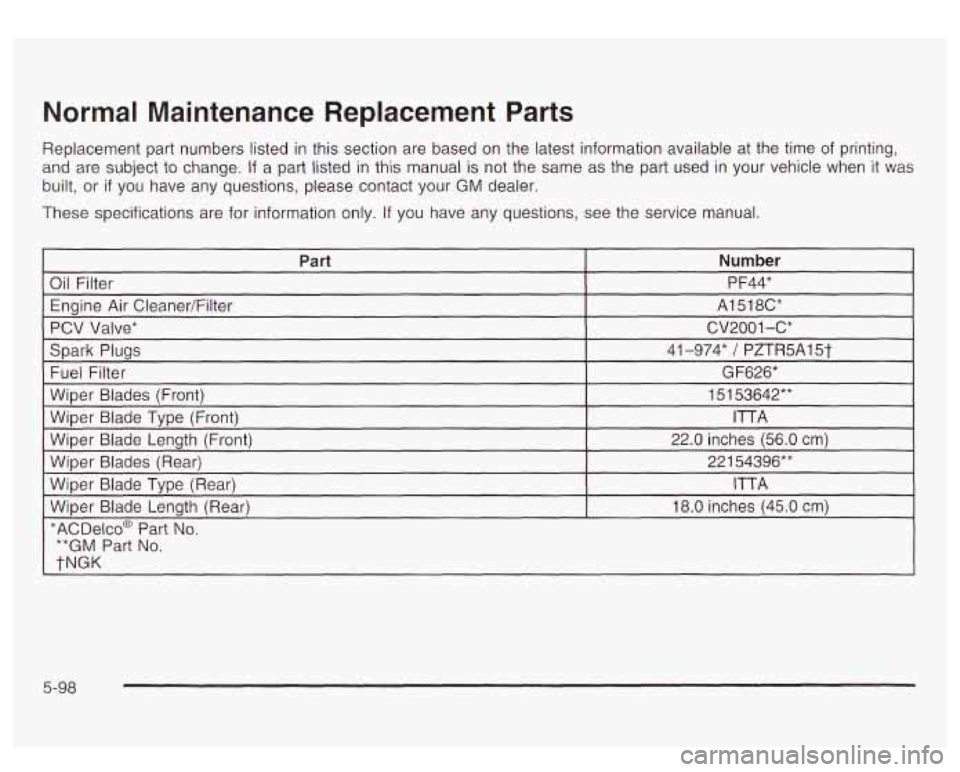
Replacement part numbers listed in this section are based on the latest information available at the time of printing,
and are subject
to change. If a part listed in this manual is not the same as the part used in your vehicle when it was
built, or
if you have any questions, please contact your GM dealer.
These specifications are for information only.
If you have any questions, see the service manual.
I Part 1 Number I
Oil Filter
G F626"
Fuel Filter 41
-974*
/ PZTR5A15t
Spark Plugs cv2001
-c* PCV Valve" AI
51 8C*
Engine Air CleanedFilter P F44*
Wiper Blades (Front)
ITTA
Wiper Blade Tvpe (Front)
151 53642**
Wiper Blade Length (Front)
ITTA WiDer Blade Tvpe (Rear) 221
54396**
Wiper Blades (Rear) 22.0
inches (56.0 cm) a. I
Wiper Blade Length (Rear) 18.0 inches (45.0 cm)
*ACDelco@ Part
No.
**GM Part No.
tNGK
5-98
Page 388 of 447
Section 6 Maintenance Schedule
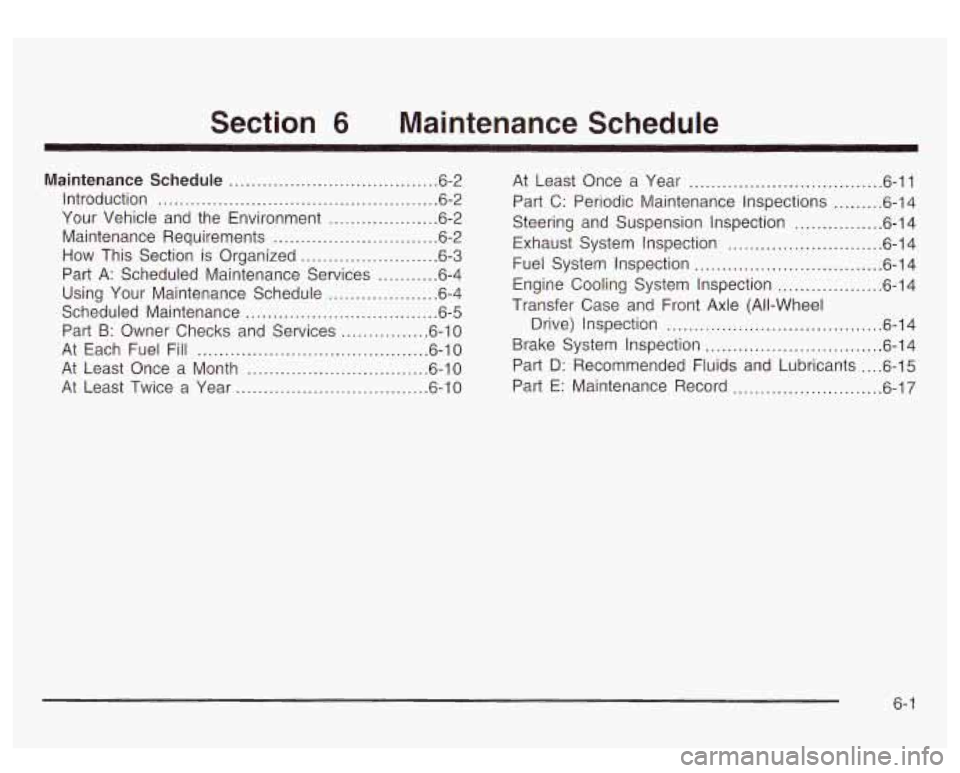
Maintenance Schedule ...................................... 6.2
Introduction
................................................... 6.2
Your Vehicle and the Environment
.................... 6-2
Maintenance Requirements
.............................. 6.2
How This Section is Organized
......................... 6-3
Part A: Scheduled Maintenance Services
........... 6-4
Using Your Maintenance Schedule
.................... 6-4
Scheduled Maintenance
................................... 6-5
Part
B: Owner Checks and Sewices ................ 6-10
At Each Fuel Fill
.......................................... 6-10
At Least Once a Month
................................. 6-10
At Least Twice a Year
................................... 6-10
~~
At Least Once a Year ................................... 6.11
Part C: Periodic Maintenance Inspections
......... 6.14
Steering and Suspension Inspection
................ 6.14
Exhaust System Inspection
............................ 6.14
Fuel System Inspection
.................................. 6.14
Engine Cooling System Inspection
................... 6.14
Drive) Inspection
....................................... 6.14
Brake System Inspection
................................ 6.14
Part D: Recommended Fluids and Lubricants
.... 6.15
Part E: Maintenance Record
........................... 6.17
Transfer Case and Front
Axle (All-Wheel
6- 1
Page 390 of 447
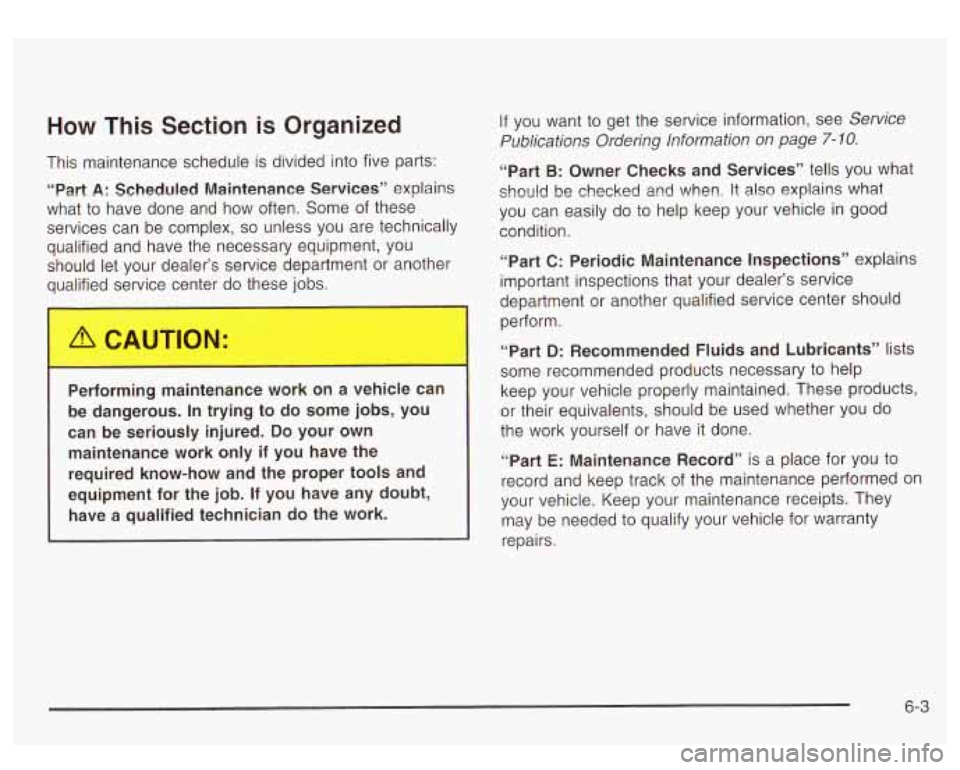
How This Section is Organized
This maintenance schedule is divided into five parts:
“Part
A: Scheduled Maintenance Services” explains
what
to have done and how often. Some of these
services can be complex,
so unless you are technically
qualified and have the necessary equipment, you
should let your dealer’s service department or another
qualif
i service center do these jobs.
Performing maintenance work on a venicle can
be dangerous. In trying to do some jobs, you
can be seriously injured.
Do --- your own 1
If you want to get the service information, see Service
Publications Ordering Information on page
7- IO.
“Part B: Owner Checks and Services” tells you what
should
be checked and when. It also explains what
you can easily do
to help keep your vehicle in good
condition.
“Part
C: Periodic Maintenance Inspections” explains
important inspections that your dealer’s service
department or another qualified service center should
perform.
“Part
D: Recommended Fluids and Lubricants” lists
some recommended products necessary
to help
keep your vehicle properly maintained. These products,
or their equivalents, should be used whether you do
the work yourself or have it done.
maintenance work only
if you have the
required know-how and the proper tools and “Part E: Maintenance Record”
is a place for you to
equipment for the job. If you have any doubt, record
and keep track of the maintenance performed on
your vehicle. Keep your maintenance receipts. They
have a qualified technician do the work. may be needed
to qualify your vehicle for warranty 1 repairs.
6-3
Page 391 of 447
Part A: Scheduled Maintenance
Services
This part contains engine oil and chassis lubrication
scheduled maintenance which explains the engine oil life
system and how it indicates when
to change the
engine oil and filter. Lubricate chassis components with
each oil change.
Also, listed are scheduled maintenance
services which are to be performed at the mileage
intervals specified.
Using Your Maintenance Schedule
We at General Motors want to help you keep your
vehicle in good working condition. But we don’t know
exactly how you’ll drive it. You may drive very short
distances only a few times a week. Or you may drive
long distances all the time in very hot, dusty weather.
You may use your vehicle in making deliveries. Or
you may drive it to work,
to do errands or in many
other ways.
Because of all the different ways people use their
vehicles, maintenance needs vary. You may need more
frequent checks and replacements.
So please read
the following and note how you drive. If you have any
questions on how to keep your vehicle in good condition,
see your dealer. This part tells you
the maintenance services you should
have done and when you should schedule them.
When you go
to your dealer for your service needs,
you’ll know that GM-trained and supported service
people will perform the work using genuine GM parts.
The proper fluids and lubricants
to use are listed in
Part
D. Make sure whoever services your vehicle uses
these.
All parts should be replaced and all necessary
repairs done before you or anyone else drives the
vehicle.
This schedule is for vehicles that:
carry passengers and cargo within recommended
limits. You will find these limits on your vehicle’s
Certificationflire label. See Loading Your Vehicle
on
page 4-44.
are driven on reasonable road surfaces within legal
driving limits.
are driven off-road in the recommended manner.
See Operating Your All- Wheel-Drive Vehicle
Off
Paved Roads on page 4- 16.
use the recommended fuel. See Gasoline Octane
on page 5-5.
6-4