wheel GMC YUKON DENALI 2003 Manual PDF
[x] Cancel search | Manufacturer: GMC, Model Year: 2003, Model line: YUKON DENALI, Model: GMC YUKON DENALI 2003Pages: 447, PDF Size: 21.97 MB
Page 361 of 447
Rust or dirt on the wheel, or on the parts to
which
it is fastened, can make the wheel nuts
become loose after a time. The wheel could
come
off and cause an accident. When you
change
a wheel, remove any rust or dirt from
the places where the wheel attaches to the
vehicle. In an emergency, you can use a cloth or a paper towel to do this; but be sure to use
a scraper or wire brush later, if you need to, to
get all the rust or dirt
off.
1
Never use oil or grease on studs or nuts. If
you do, the nuts might come loose. Your wheel
could fall
off, causing a serious accident.
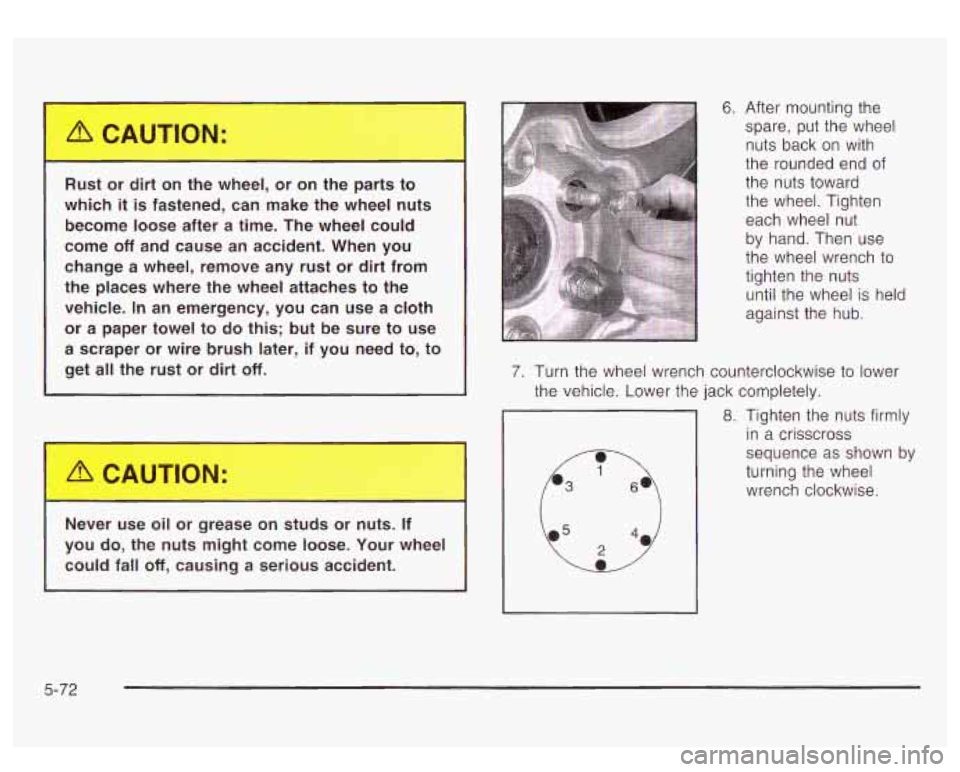
6. After mounting the spare, put the wheel
nuts back on with
the rounded end of
the nuts toward
the wheel. Tighten
each wheel nut
by hand. Then use
the wheel wrench
to
tighten the nuts
until the wheel is held
against the hub.
7. Turn the wheel wrench counterclockwise to lower
the vehicle. Lower the jack completely.
8. Tighten the nuts firmly
in a crisscross
sequence as shown by
turning the wheel
wrench clockwise.
5-72
Page 362 of 447
incorrect wheel nuts or improperly tightened
wheel nuts can cause the wheel to come loose
and even come
off. This could lead to an
accident. Be sure to use the correct wheel
nuts.
If you have to replace them, be sure to
get new
GM original equipment wheel nuts.
Stop somewhere as soon as you can and have
the nuts tightened with a torque wrench to the
proper torque specification. See “Capacities
and Specifications”
in the Index for wheel nut
torque specification.
Notice: Improperly tightened wheel nuts can lead
to brake pulsation and rotor damage.
To avoid
expensive brake repairs, evenly tighten the wheel nuts in the proper sequence and to the proper
torque specification. See “Capacities and
Specifications” in the index for the wheel nut
torque specification. When
you reinstall the regular wheel and tire, you must
also reinstall the center cap. Place the cap on the
wheel and tap it into place until
it seats flush with the
wheel. The cap only goes
on one way. Be sure to line up
the tab
on the center cap with the indentation on the
wheel.
Storing a Flat or Spare Tire, Jack
and Tools
Storing a jack, a tire, or other equipment in the
passenger compartment of the vehicle could
cause injury. In a sudden stop or collision, loose equipment could strike someone. Store
all these in the proper place.
Notice: An aluminum wheel with a flat tire should
always be stored under the vehicle with the
hoist. However, storing
it that way for an extended
period of time could damage the wheel.
To avoid
this, always stow the wheel properly with the valve stem pointing up and have the wheel repaired as
soon as possible.
5-73
Page 363 of 447
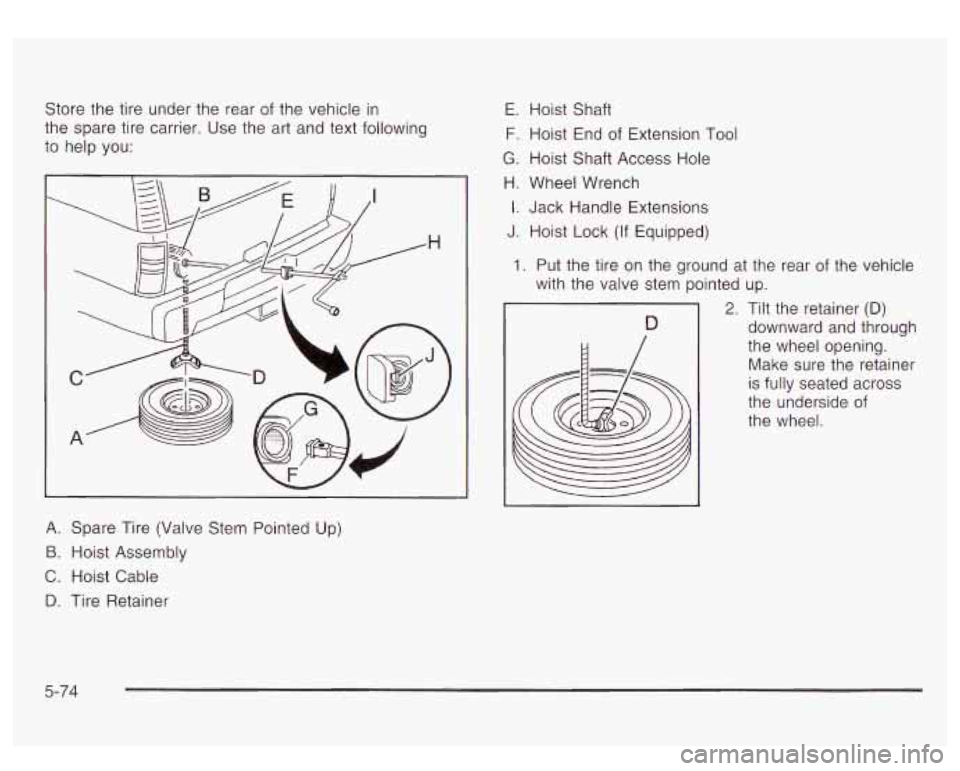
Store the tire under the rear of the vehicle in
the spare tire carrier. Use the art and text following
to help you:
A. Spare Tire (Valve Stem Pointed Up)
B. Hoist Assembly
C. Hoist Cable
D. Tire Retainer
E. Hoist Shaft
F. Hoist End of Extension Tool
G. Hoist Shaft Access Hole
H. Wheel Wrench
I. Jack Handle Extensions
I. Hoist Lock (If Equipped)
1. Put the tire on the ground at the rear of the vehicle
with the valve stem pointed up.
D
/
2. Tilt the retainer (D)
downward and through
the wheel opening.
Make sure the retainer
is fully seated across
the underside of
the wheel.
5-74
Page 364 of 447
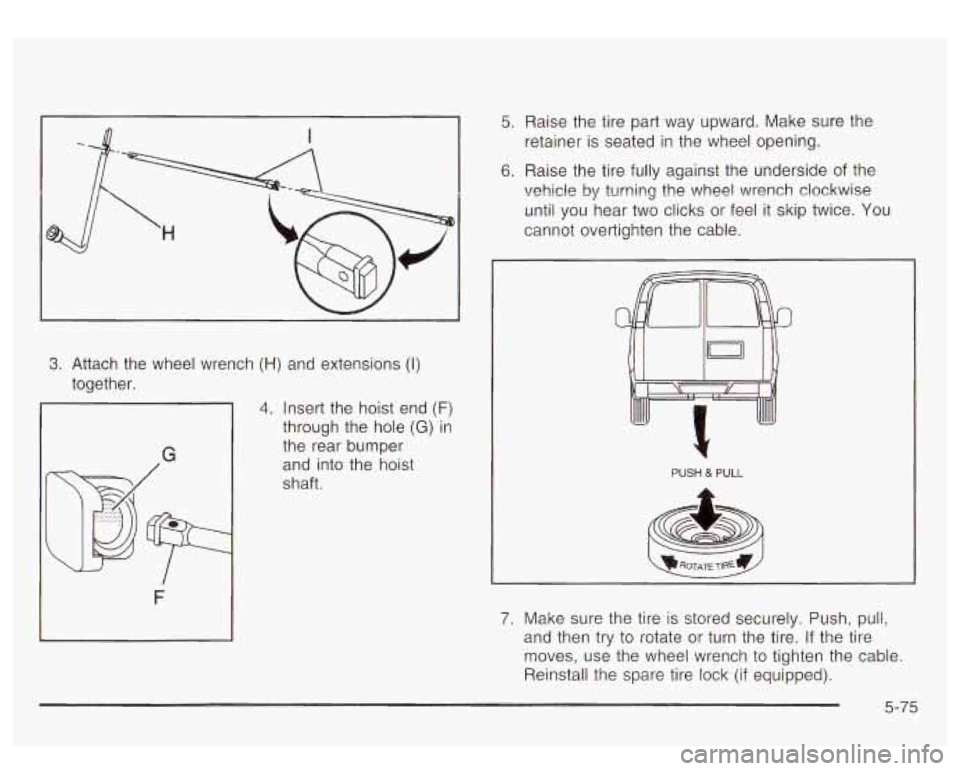
3. Attach the wheel wrench (H) and extensions (I)
together.
G
F
4. Insert the hoist end (F)
through the hole (G) in
the rear bumper
and into the hoist
shaft.
5. Raise the tire part way upward. Make sure the
retainer is seated in the wheel opening.
6. Raise the tire fully against the underside of the
vehicle by turning the wheel wrench clockwise
until you hear two clicks or feel it skip twice. You
cannot overtighten the cable.
PUSH & PULL
7. Make sure the tire is stored securely. Push, pull,
and then try to rotate or turn the tire. If the tire
moves, use the wheel wrench
to tighten the cable.
Reinstall the spare tire lock
(if equipped).
5-75
Page 365 of 447
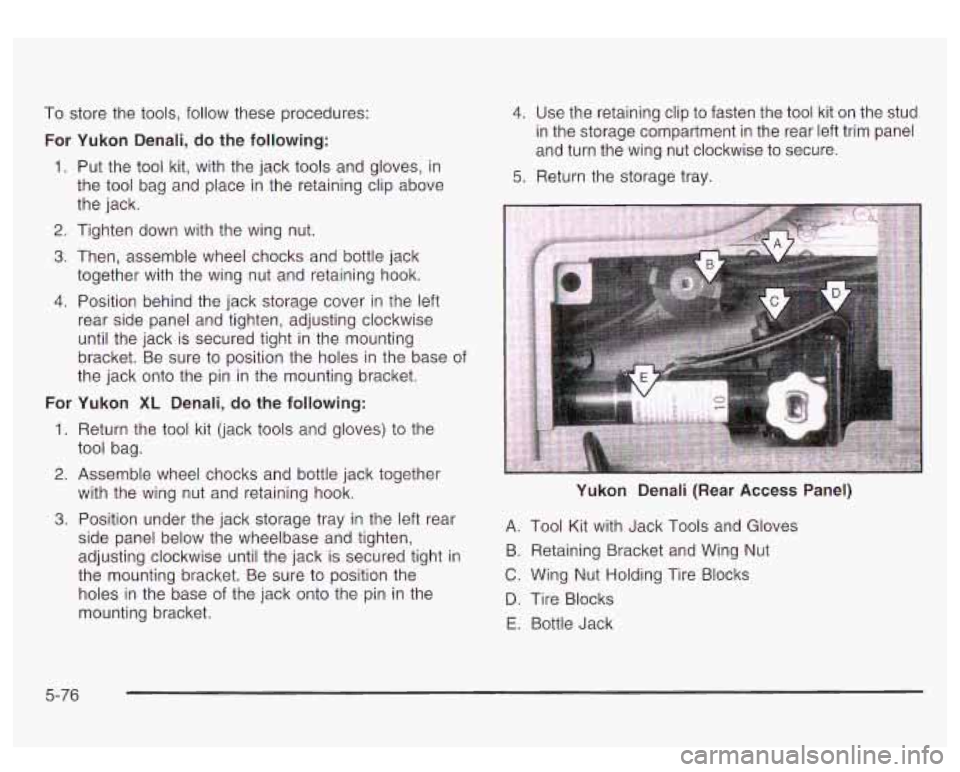
To store the tools, follow these procedures:
For Yukon Denali, do the following:
1. Put the tool kit, with the jack tools and gloves, in
the tool bag and place in the retaining clip above
the jack.
2. Tighten down with the wing nut.
3. Then, assemble wheel chocks and bottle jack
together with the wing nut and retaining hook.
4. Position behind the jack storage cover in the left
rear side panel and tighten, adjusting clockwise
until the jack is secured tight in the mounting
bracket. Be sure
to position the holes in the base of
the jack onto the pin in the mounting bracket.
For Yukon XL Denali, do the following:
1. Return the tool kit (jack tools and gloves) to the
tool bag.
2. Assemble wheel chocks and bottle jack together
with the wing nut and retaining hook.
3. Position under the jack storage tray in the left rear
side panel below the wheelbase and tighten,
adjusting clockwise until the jack
is secured tight in
the mounting bracket. Be sure to position the
holes in the base of the jack onto the pin in the
mounting bracket.
4. Use the retaining clip to fasten the tool kit on the stud
in the storage compartment in the rear left trim panel
and turn the wing nut clockwise
to secure.
5. Return the storage tray.
Yukon Denali (Rear Access Panel)
A. Tool Kit with Jack Tools and Gloves
B. Retaining Bracket and Wing Nut
C. Wing Nut Holding Tire Blocks
D. Tire Blocks
E. Bottle Jack
5-76
Page 366 of 447
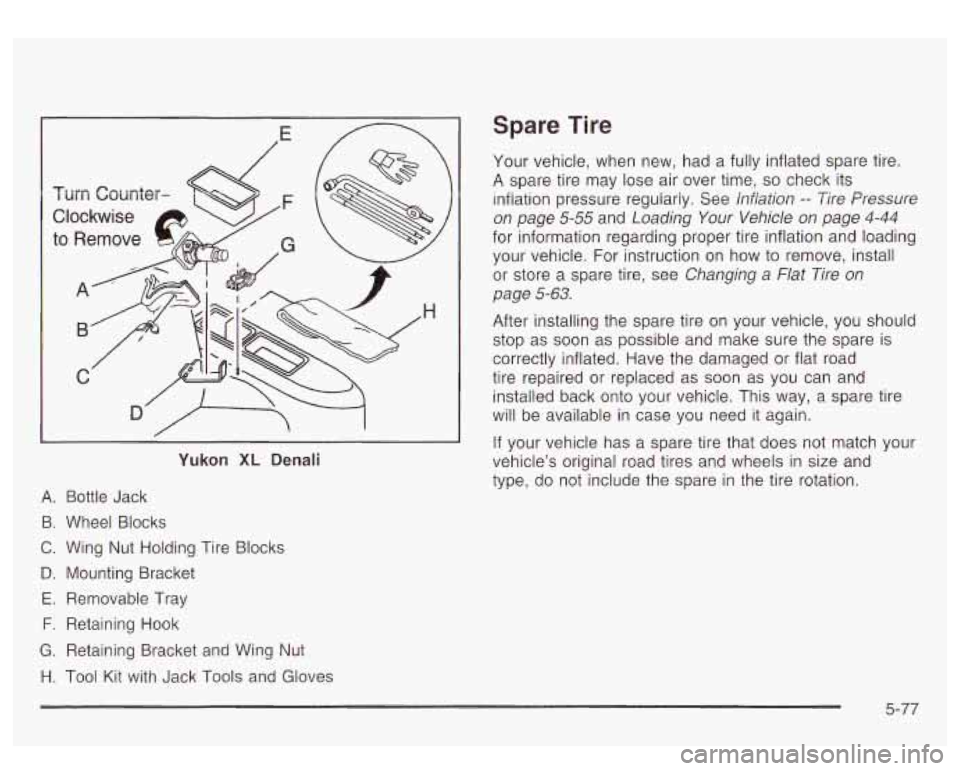
Yukon XL Denali
A. Bottle Jack
B. Wheel Blocks
C. Wing Nut Holding Tire Blocks
D. Mounting Bracket
E. Removable Tray
F. Retaining Hook
G. Retaining Bracket and Wing Nut
H. Tool Kit with Jack Tools and Gloves
Spare Tire
Your vehicle, when new, had a fully inflated spare tire.
A spare tire may lose air over time, so check its
inflation pressure reguiariy. See infiation
-- Tire Pressure
on page
5-55 and Loading Your Vehicle on page 4-44
for information regarding proper tire inflation and loading
your vehicle. For instruction on how to remove, install
or store a spare tire, see Changing a Flat Tire
on
page 5-63.
After installing the spare tire on your vehicle, you should
stop as soon as possible and make sure the spare is
correctly inflated. Have the damaged or flat road
tire repaired or replaced as soon as you can and
installed back onto your vehicle. This way, a spare tire
will be available in case you need it again.
If your vehicle has a spare tire that does not match your
vehicle’s original road tires and wheels in size and
type,
do not include the spare in the tire rotation.
5-77
Page 372 of 447
Aluminum Wheels
Keep your wheels clean using a soft clean cloth with
mild soap and water. Rinse with clean water. After
rinsing thoroughly, dry with a soft clean towel. A wax
may then be applied.
The surface of these wheels is similar
to the painted
surface of your vehicle. Don’t use strong soaps,
chemicals, abrasive polishes, abrasive cleaners,
cleaners with acid, or abrasive cleaning brushes on
them because you could damage the surface. Do not
use chrome polish on aluminum wheels.
Don’t take your vehicle through an automatic car wash
that has silicone carbide tire cleaning brushes. These
brushes can also damage the surface of these wheels.
Tires
To clean your tires, use a stiff brush with tire cleaner.
Nofice: When applying a tire dressing, always take
care to wipe
off any overspray or splash from all
painted surfaces on the body
or wheels of the
vehicle. Petroleum-based products may damage the
paint finish and tires.
Sheet Metal Damage
If your vehicle is damaged and requires sheet metal
repair or replacement, make sure the body repair shop
appiies anti-corrosion materiai to parts repaired or
replaced
to restore corrosion protection.
Original manufacturer replacement parts will provide the
corrosion protection while maintaining the warranty.
Finish Damage
Any stone chips, fractures or deep scratches in the
finish should be repaired right away. Bare metal
will corrode quickly and may develop into major repair
expense.
Minor chips and scratches can be repaired with touch-up
materials avaliable from your dealer or other service
outlets. Larger areas of finish damage can be corrected
in your dealer’s body and paint shop.
5-83
Page 373 of 447
Underbody Maintenance
Chemicals used for ice and snow removal and dust
control can collect on the underbody. If these are not
removed, accelerated corrosion (rust) can occur on
the underbody parts such as fuel lines, frame, floor pan
and exhaust system even though they have corrosion protection.
At least every spring, flush these materials from the
underbody with plain water. Clean any areas where mud
and debris can collect. Dirt packed in close areas of
the frame should be loosened before being flushed. Your dealer or an underbody car washing system can
do this for you.
Chemical Paint Spotting
Some weather and atmospheric conditions can create a
chemical fallout. Airborne pollutants can fall upon and
attack painted surfaces
on your vehicle. This damage
can take two forms; blotchy, ringlet-shaped
discolorations, and small irregular dark spots etched into
the paint surface.
Although no defect in the paint job causes this,
GM will
repair, at no charge
to the owner, the surfaces of
new vehicles damaged by this fallout condition within
12 months or 12,000 miles (20 000 km) of purchase,
whichever occurs first.
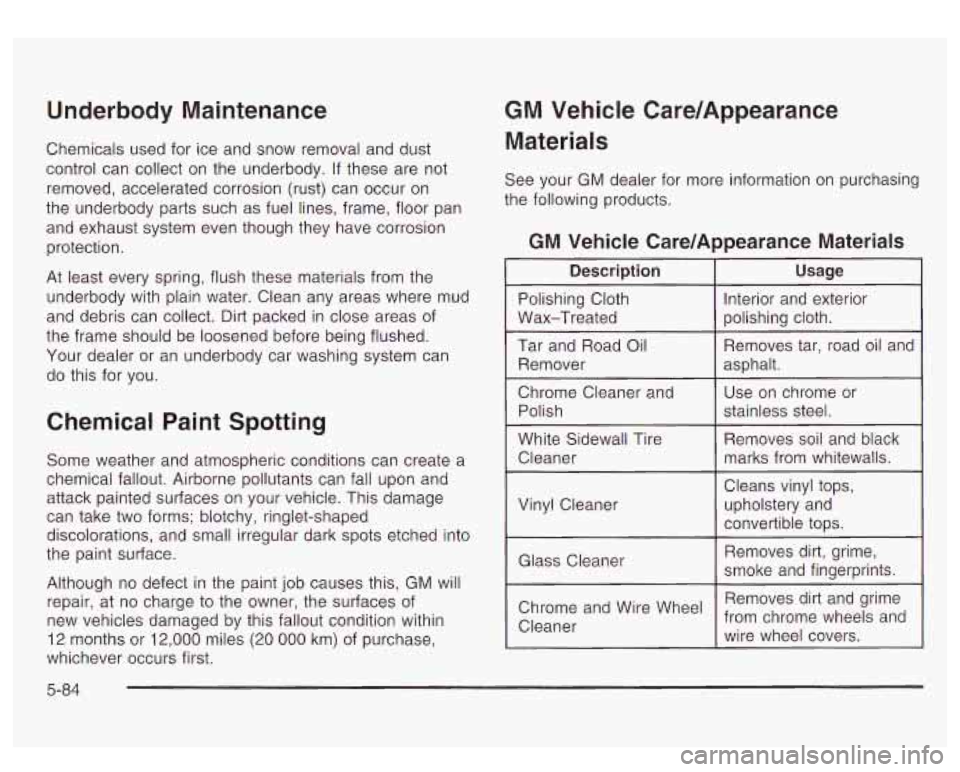
GM Vehicle Care/Appearance
Materials
See your GM dealer for more information on purchasing
the following products.
GM Vehicle Care/Appearance Materials -
Description I Usage
Polishing Cloth Interior and exterior
Wax-Treated
Tar and Road Oil Removes tar, road oil and
Remover asphalt.
-
Chrome Cleaner and Use on chrome or
Polish stainless steel.
White Sidewall Tire Removes soil and black
Cleaner marks
from whitewalls.
-
I Cleans vinyl tops,
Vinvl Cleaner I upholstery-and
I convertible tops. I
Glass Cleaner Removes dirt, grime,
smoke and fingerprints.
Removes dirt and grime
from chrome wheels and
wire wheel covers.
Cleaner
Chrome and Wire
5-84
Page 386 of 447
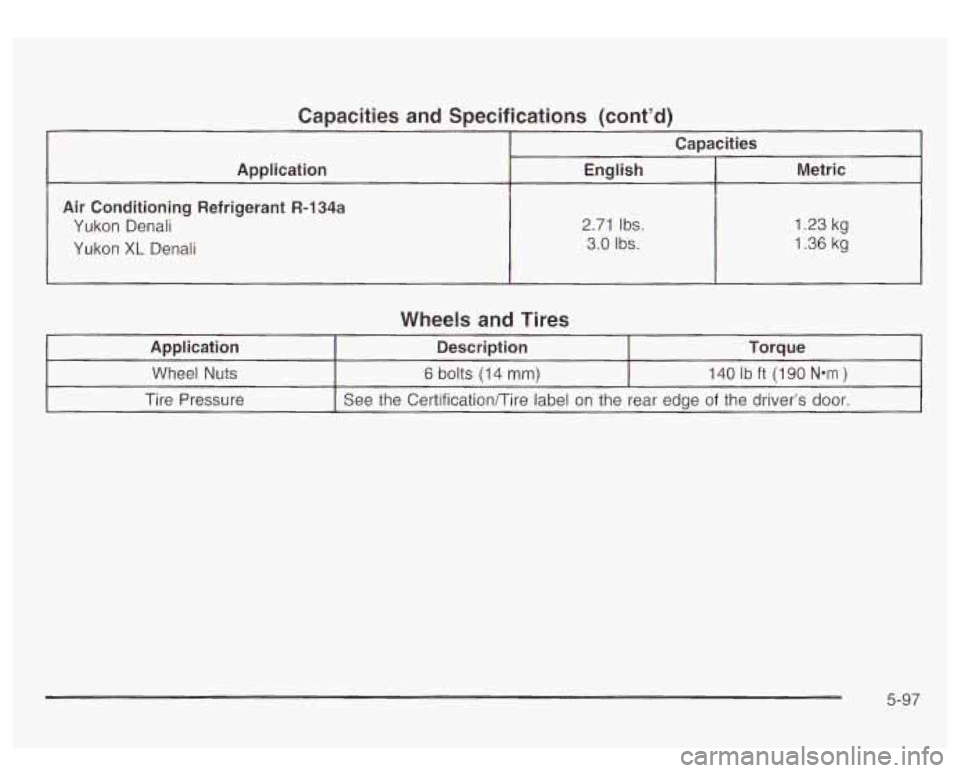
Capacities and Specifications (cont’d)
I r
Application
Air Conditioning Refrigerant R-l34a
Yukon Denali
Yukon
XL Denaii
I
Capacities ~
English
2.71 Ibs.
3.0 Ibs.
t
Metric
1.23 kg
1.36 kg
1
Wheels and Tires
5-97
Page 388 of 447
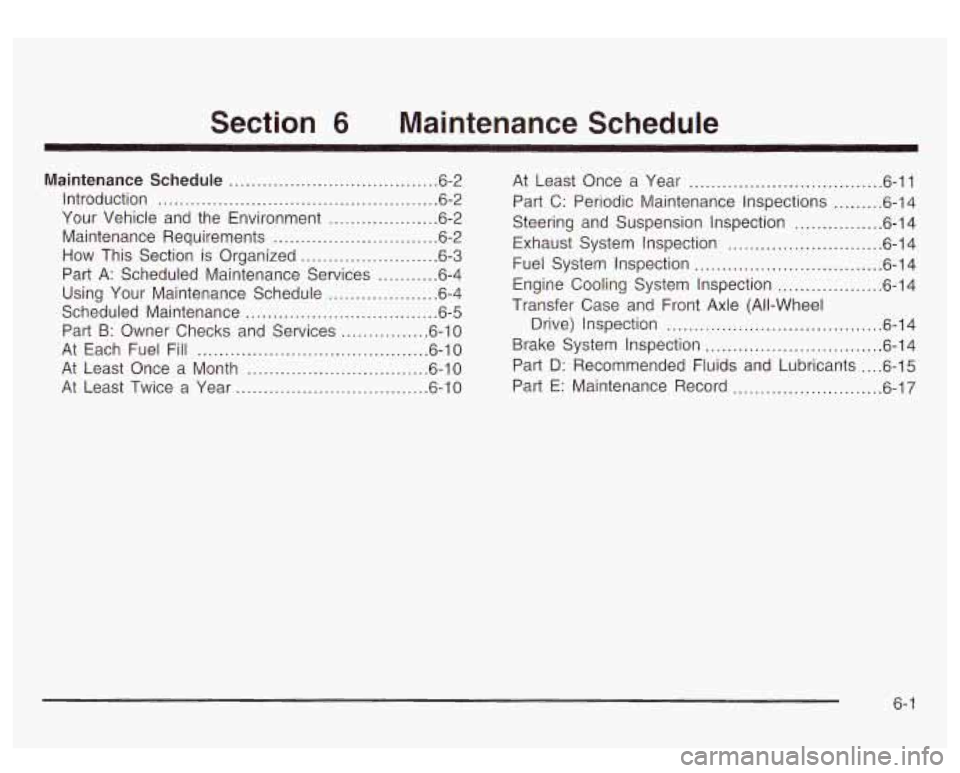
Section 6 Maintenance Schedule
Maintenance Schedule ...................................... 6.2
Introduction
................................................... 6.2
Your Vehicle and the Environment
.................... 6-2
Maintenance Requirements
.............................. 6.2
How This Section is Organized
......................... 6-3
Part A: Scheduled Maintenance Services
........... 6-4
Using Your Maintenance Schedule
.................... 6-4
Scheduled Maintenance
................................... 6-5
Part
B: Owner Checks and Sewices ................ 6-10
At Each Fuel Fill
.......................................... 6-10
At Least Once a Month
................................. 6-10
At Least Twice a Year
................................... 6-10
~~
At Least Once a Year ................................... 6.11
Part C: Periodic Maintenance Inspections
......... 6.14
Steering and Suspension Inspection
................ 6.14
Exhaust System Inspection
............................ 6.14
Fuel System Inspection
.................................. 6.14
Engine Cooling System Inspection
................... 6.14
Drive) Inspection
....................................... 6.14
Brake System Inspection
................................ 6.14
Part D: Recommended Fluids and Lubricants
.... 6.15
Part E: Maintenance Record
........................... 6.17
Transfer Case and Front
Axle (All-Wheel
6- 1