ABS GMC YUKON DENALI 2003 Owners Manual
[x] Cancel search | Manufacturer: GMC, Model Year: 2003, Model line: YUKON DENALI, Model: GMC YUKON DENALI 2003Pages: 447, PDF Size: 21.97 MB
Page 240 of 447
Anti-lock Brake System
Your vehicle has anti-lock brakes. ABS is an advanced
electronic braking system that will help prevent a
braking skid.
When you start your engine and begin to drive away,
your anti-lock brake system will check itself. You
may hear a momentary motor or clicking noise while
this test is going on. This is normal.
If there’s a problem with
the anti-lock brake system, this warning light
will
stay on. See Anti-Lock
Brake System Warning
Light
on page 3-35.
Along with ABS, your vehicle has a Dynamic Rear
Proportioning (DRP) system.
If there’s a DRP problem,
both the brake and ABS warning lights will come
on
accompanied by a IO-second chime. The lights
and chime will come
on each time the ignition is turned
on until the problem is repaired. See your dealer for
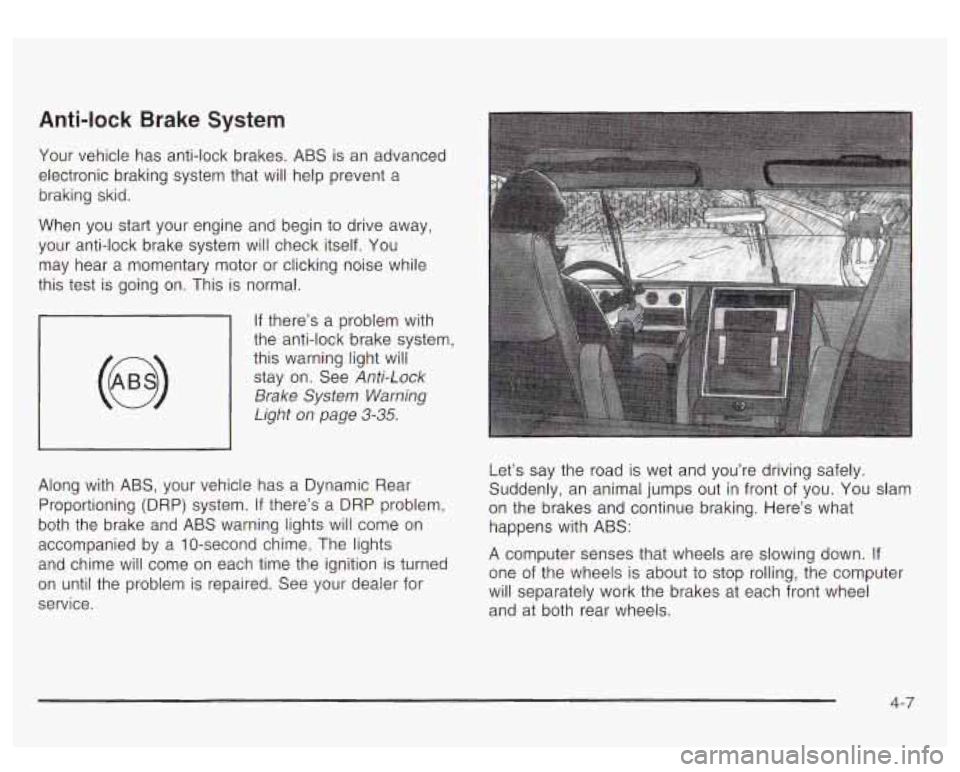
service. Let’s say
the road is wet and you’re driving safely.
Suddenly, an animal jumps out in front of you. You slam
on the brakes and continue braking. Here’s what
happens with ABS:
A computer senses that wheels are slowing down. If
one of the wheels is about to stop rolling, the computer
will separately work the brakes at each front wheel
and at both rear wheels.
4-7
Page 243 of 447
When the Stabilitrak@system has been turned off you
may still hear system noises as a result of the
brake-traction control coming on.
It is recommended to leave the system on for normal
driving conditions, but it may be necessary
to turn
the system
off if your vehicle is stuck in sand, mud, ice
or snow, and you want
to “rock” your vehicle to
attempt to free it. It may also be necessary to turn off
the system when driving in extreme off-road conditions
where high wheel spin is required. See If
You Are
Stuck: In Sand, Mud, Ice or Snow on page
4-4 1.
Traction Control Operation
The traction control system is part of the
Stabilitrak@system. Traction control limits wheel spin by
reducing engine power
to the wheels (engine speed
management) and by applying brakes
to each individual
wheel (brake-traction control) as necessary.
The traction control system is enabled automatically
when you start your vehicle, and it will activate
and display the TRACTION ACTIVE message in the
Driver Information Center (DIC)
if it senses that any of
the wheels are spinning or beginning to lose traction
while driving. If you turn
off Stabilitrak@, only the
brake-traction control portion
of traction control will
work. The engine speed management will be disabled.
In this state, engine power is not reduced automatically
and the driven wheels can spin more freely. This
can cause the brake-traction control
to activate
constantly. For more information on the traction active
message, see Driver Information Center (DIC) on
page
3-43.
Notice: If the traction off light comes on due to
heavy braking and/or because the traction control
system has been continuously active, do not allow
the wheel@) of one axle to spin excessively.
If you
do, you may be causing damage to your transfer
case. This could lead to costly repairs not covered by
your warranty.
If the brake-traction control system activates constantly
or
if the brakes have heated up due to high speed
braking, the brake-traction control will be automatically
disabled. The system will come back on after the
brakes have cooled. This can take up
to two minutes ot
longer depending on brake usage.
Notice: Don’t allow the wheel(s) of one axle to spin
excessively when the traction
off, ABS and brake
lights are on and the
SERVICE STABILITY MESSAGE
is displayed. In this situation, damage to the transfer
case
is possible. This could lead to costly repairs not
covered by your warranty. You should immediately
reduce engine power until the lights and messages
are no longer displayed.
4-1 0
Page 248 of 447
Loss of Control
Let’s review what driving experts say about what happens
when the three control systems (brakes, steering and
acceleration) don’t have enough friction where the tires
meet the road
to do what the driver has asked.
In any emergency, don’t give up. Keep trying
to steer
and constantly seek an escape route or area of
less danger.
In a skid, a driver can lose control of the vehicle.
Defensive drivers avoid most skids by taking reasonable
care suited to existing conditions, and by not
“overdriving” those conditions. But skids are always
possible.
The three types of skids correspond
to your vehicle’s
three control systems. In the braking skid, your wheels
aren’t rolling. In the steering or cornering skid,
too much
speed or steering in a curve causes tires to slip and lose
cornering force. And in the acceleration skid,
too much
throttle causes the driving wheels
to spin.
A cornering skid is best handled by easing your foot off
the accelerator pedal.
If your vehicle starts to slide, ease your foot off the
accelerator pedal and quickly steer the way you want
the vehicle
to go. If you start steering quickly enough,
your vehicle may straighten out. Always be ready
for
a second skid if it occurs.
Of course, traction is reduced when water, snow, ice,
gravel or other material is on the road. For safety, you’ll
want
to slow down and adjust your driving to these
conditions.
It is important to slow down on slippery
surfaces because stopping distance will be longer and
vehicle control more limited.
While driving on a surface with reduced traction, try
your best
to avoid sudden steering, acceleration
or braking (including engine braking by shifting
to a
lower gear). Any sudden changes could cause the tires
to slide. You may not realize the surface is slippery
until your vehicle is skidding. Learn
to recognize warning
clues
- such as enough water, ice or packed snow
on the road
to make a “mirrored surface” - and slow
down when you have any doubt.
Remember: Any anti-lock brake system (ABS) helps
avoid only the braking skid.
4-1 5
Page 279 of 447
Automatic Level Control
The automatic level control rear suspension comes as a
part of the AutorideTMsuspension. See AutorideTM on
page
4-46.
This type of level control is fully automatic and will
provide a better leveled riding position as well as better
handling under a variety of passenger and loading
conditions. An air compressor connected
to the rear
shocks will raise or lower the rear of the vehicle
to maintain proper vehicle height. The system is
activated when the ignition key
is turned to RUN and
will automatically adjust vehicle height thereafter.
The system may exhaust (lower vehicle height) for up
to
10 minutes after the ignition key has been turned to
OFF. You may hear the air compressor operating when
the height is being adjusted.
If a weight-distributing hitch is being used, it is
recommended
to allow the shocks to inflate, thereby
leveling the vehicle prior to adjusting the height.
AutorideTM
The AutorideTM feature provides superior vehicle ride
and handling under a variety
of passenger and loading
conditions.
The system is fully automatic and
uses a computer
controller
to continuously monitor vehicle speed, wheel
to body position, IifVdive and steering position of the
vehicle. The controller then sends signals to each shock
absorber
to independently adjust the damping level to
provide the optimum vehicle ride.
AutorideTM also interacts with the towlhaul mode that,
when activated, will provide additional control of
the shock absorbers. This additional control results in
better ride and handling characteristics when the vehicle
is loaded or towing a trailer. See "Tow/Haul Mode"
under Towing a Trailer on page
4-47 for more
information.
4-46
Page 288 of 447
Parking on Hills
You really should not park your vehicle, with a
trailer attached, on a hill.
If something goes
wrong, your rig could start to move. People
can be injured, and both your vehicle and the
trailer can be damaged.
But if you ever have to park your rig on a hill, here’s
how to do it:
1. Apply your regular brakes, but don’t shift into
2. Have someone place chocks under the trailer
3. When the wheel chocks are in place, release the
PARK
(P) yet.
wheels.
regular brakes until the chocks absorb the load.
4. Reapply the regular brakes. Then apply your
5. Release the regular brakes.
parking brake
and shift into PARK
(P).
When You Are Ready to Leave After
Parking on a Hill
1. Apply your regular brakes and hold the pedal down
while you:
start your engine,
shift into a gear, and
release the parking brake.
2. Let up on the brake pedal.
3. Drive slowly until the trailer is clear of the chocks.
4. Stop and have someone pick up and store the
chocks.
Maintenance When Trailer Towing
Your vehicle will need service more often when you’re
pulling a trailer. See the Maintenance Schedule for more
on this. Things that are especially important in trailer
operation are automatic transmission fluid (don’t overfill),
engine
oil, axle lubricant, belts, cooling system and
brake system. Each
of these is covered in this manual,
and the Index will help you find them quickly. If
you’re trailering, it’s a good idea to review these sections
before you start your trip.
Check periodically to see that all hitch nuts and bolts
are tight.
4-55