coolant reservoir GMC YUKON DENALI 2003 Owners Manual
[x] Cancel search | Manufacturer: GMC, Model Year: 2003, Model line: YUKON DENALI, Model: GMC YUKON DENALI 2003Pages: 447, PDF Size: 21.97 MB
Page 116 of 447
Engine Coolant Heater
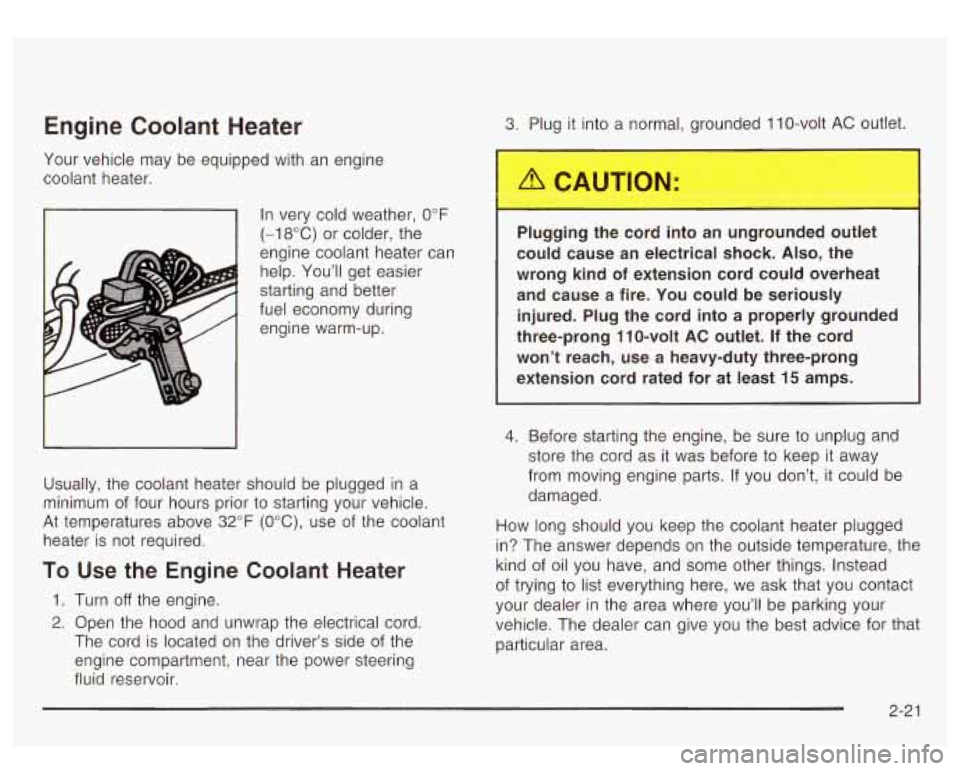
Your vehicle may be equipped with an engine
coolant heater.
I
Usually, the coolant heater sho In very cold weather,
0°F
(-18°C) or
colder, the
engine coolant heater can
help. You’ll get easier
starting and better
fuel economy during
engine warm-up.
luld be ph Jgged in a
minimum of four hours prior to starting your vehicle.
At temperatures above 32°F (OOC), use of the coolant
heater is not required.
To Use the Engine Coolant Heater
1. Turn off the engine.
2. Open the hood and unwrap the electrical cord.
The cord is located on the driver’s side of the
engine compartment, near the power steering
fluid reservoir. 3.
Plug it into a normal, grounded 1 IO-volt AC outlet.
PIL,ging the cord inl, an ,..grc,.lded out.,_
could cause an electrical shock. Also, the
wrong kind
of extension cord could overheat
and cause a fire. You could be seriously
injured. Plug the cord into a properly grounded
three-prong
11 0-volt AC outlet. If the cord
won’t reach, use a heavy-duty three-prong
extension cord rated for at least
15 amps.
4. Before starting the engine, be sure to unplug and
store the cord as it was before to keep it away
from moving engine parts.
If you don’t, it could be
damaged.
How long should you keep the coolant heater plugged
in? The answer depends on the outside temperature, the
kind of oil you have, and some other things. Instead
of trying to list everything here, we ask that you contact
your dealer in the area where you’ll be parking your
vehicle. The dealer can give you the best advice for that
particular area.
2-21
Page 302 of 447
A. Engine Air CleanedFilter
B. Coolant Surge Tank
C. Air Filter Restriction Indicator
D. Engine Qii Dipstick
E. Engine Oil Fill
F. Automatic Transmission Dipstick
G. Fan
H. Remote Negative (-) Terminal (GND)
I. Remote Positive (+) Terminal
J. Power Steering Fluid Reservoir (Out of View)
K. Brake Master Cylinder Reservoir
L. Underhood Fuse Block
M. Battery
N. Windshield Washer Fluid Reservoir
Before closing the hood, be sure all filler caps are on
properly. Pull down the hood and close
it firmly.
Engine Oil
If the CHECK OIL LEVEL message appears on the
instrument cluster, it means you need to check
your engine oil level right away.
For more information, see “CHECK OIL LEVEL” under
DIC Warnings and Messages on page 3-52.
You should check your engine oil level regularly; this is
an added reminder.
Checking Engine Oil
It’s a good idea to check your engine oil every time you
get fuel. In order to get an accurate reading, the oil
must be warm and the vehicle must be on level ground.
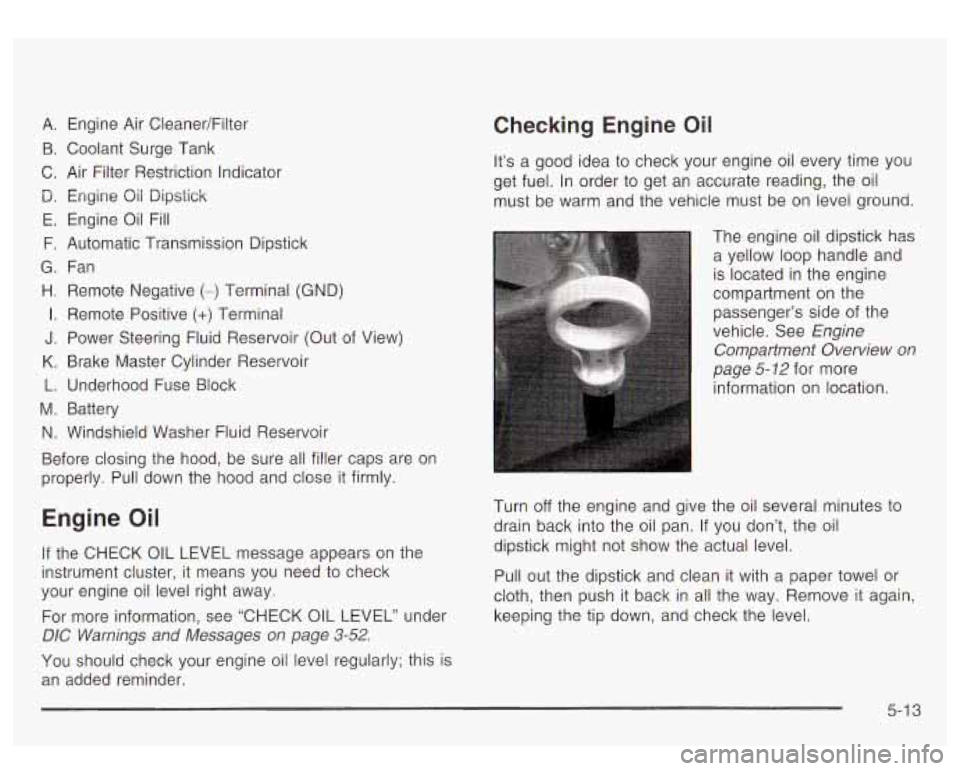
The engine oil dipstick has a yellow loop handle and
is located in the engine
compartment on the
passenger’s side of the
vehicle. See Engine
Compartment Overview on
page
5- 12 for more
information on location.
Turn
off the engine and give the oil several minutes to
drain back into the oil pan. If you don’t, the oil
dipstick might not show the actual level.
Pull out the dipstick and clean it with a paper towel or
cloth, then push it back in all the way. Remove it again,
keeping the tip down, and check the level.
5-1 3
Page 320 of 447
Adding only plain water to your cooling
system can be dangerous. Plain water, or
some other liquid such as alcohol, can boil
before the proper coolant mixture will. Your
vehicle's coolant warning system
is set for the
proper coolant mixture.
With plain water or the
wrong mixture, your engine could get too hot
but you wouldn't get the overheat warning.
Your engine could catch fire and you or others
could be burned. Use a
50/50 mixture of clean,
drinkable water and DEX
COOL@ coolant.
Notice: In cold weather, water can freeze and crack
the engine, radiator, heater core and other parts.
Use the recommended coolant and the proper
coolant mixture. You can be burned
if you spill coolant on tist
engine parts. Coolant contains ethylene glycol
and
it will burn if the engine parts are hot
enough. Don't
spill coolant on a hot engine.
1. Park the vehicle on a
level surface.
SURGE RESERVOIR
15 PSI
TANK - 105 kPa
D'EXPANSION I
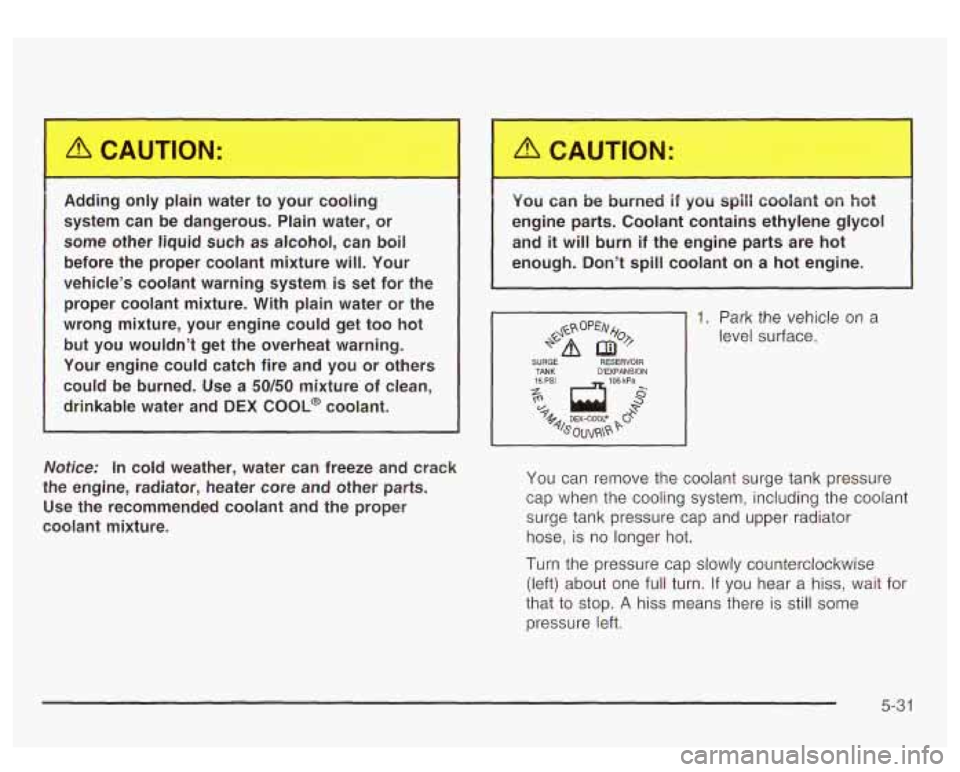
You
can remove the coolant surge tank pressure
cap when the cooling system, including the coolant
surge tank pressure cap and upper radiator hose,
is no longer hot.
Turn the pressure cap slowly counterclockwise
(left) about one full turn. If you hear a hiss, wait for
that
to stop. A hiss means there is still some
pressure left.
5-31
Page 324 of 447
Adding Washer Fluid
Your vehicle has a low washer fluid message that
comes on when the washer fluid
is low. The message is
displayed for
15 seconds at the star? of each ignition
cycle. When the LOW
WASHER FLUID message
is displayed, you will need to add washer fluid to the
windshield washer fluid reservoir.
The windshield washer
the engine compartment
toward the front of the
vehicle on the driver’s side.
4-4- fluid reservoir is located in 111
W
Open the cap with the washer symbol on it. Add washer
fluid until the tank is full.
Notice:
When using concentrated washer fluid, follow
the manufacturer’s instructions for adding water.
Don’t mix water with ready-to-use washer fluid.
Water can cause the solution to freeze and
damage your washer
fluid tank and other parts
of the washer system.
Also, water doesn’t
clean as well as washer fluid.
Fill your washer fluid tank only three-quarters
full when it’s very cold. This allows for expansion if freezing occurs, which could damage the tank if
it is completely full.
Don’t use engine coolant (antifreeze)
in your
windshield washer.
It can damage your
washer system and paint.
5-35