lock GMC YUKON DENALI 2008 Owners Manual
[x] Cancel search | Manufacturer: GMC, Model Year: 2008, Model line: YUKON DENALI, Model: GMC YUKON DENALI 2008Pages: 502, PDF Size: 6.18 MB
Page 351 of 502
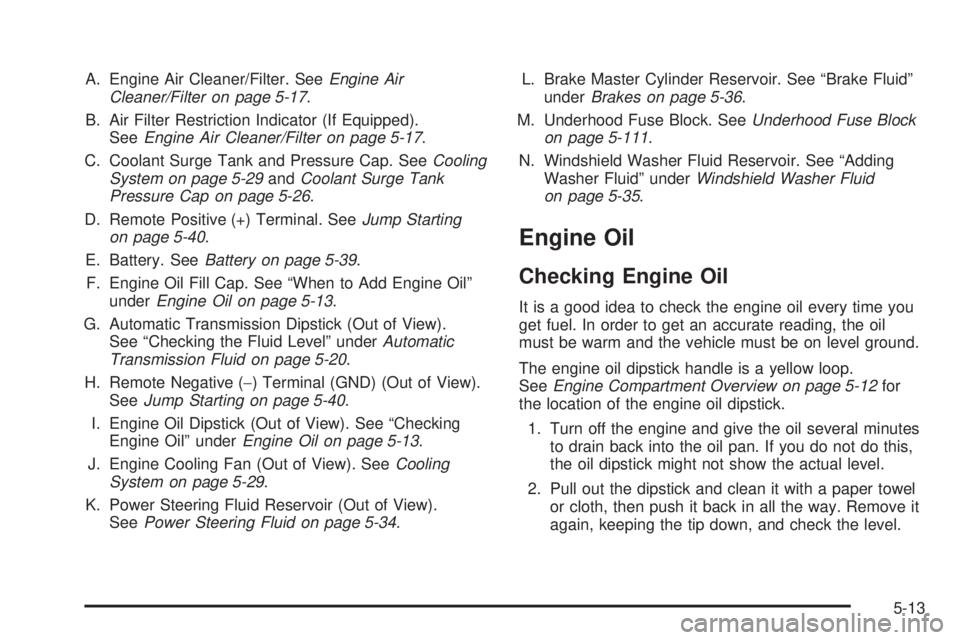
A. Engine Air Cleaner/Filter. SeeEngine Air
Cleaner/Filter on page 5-17.
B. Air Filter Restriction Indicator (If Equipped).
SeeEngine Air Cleaner/Filter on page 5-17.
C. Coolant Surge Tank and Pressure Cap. SeeCooling
System on page 5-29andCoolant Surge Tank
Pressure Cap on page 5-26.
D. Remote Positive (+) Terminal. SeeJump Starting
on page 5-40.
E. Battery. SeeBattery on page 5-39.
F. Engine Oil Fill Cap. See “When to Add Engine Oil”
underEngine Oil on page 5-13.
G. Automatic Transmission Dipstick (Out of View).
See “Checking the Fluid Level” underAutomatic
Transmission Fluid on page 5-20.
H. Remote Negative (−) Terminal (GND) (Out of View).
SeeJump Starting on page 5-40.
I. Engine Oil Dipstick (Out of View). See “Checking
Engine Oil” underEngine Oil on page 5-13.
J. Engine Cooling Fan (Out of View). SeeCooling
System on page 5-29.
K. Power Steering Fluid Reservoir (Out of View).
SeePower Steering Fluid on page 5-34.L. Brake Master Cylinder Reservoir. See “Brake Fluid”
underBrakes on page 5-36.
M. Underhood Fuse Block. SeeUnderhood Fuse Block
on page 5-111.
N. Windshield Washer Fluid Reservoir. See “Adding
Washer Fluid” underWindshield Washer Fluid
on page 5-35.
Engine Oil
Checking Engine Oil
It is a good idea to check the engine oil every time you
get fuel. In order to get an accurate reading, the oil
must be warm and the vehicle must be on level ground.
The engine oil dipstick handle is a yellow loop.
SeeEngine Compartment Overview on page 5-12for
the location of the engine oil dipstick.
1. Turn off the engine and give the oil several minutes
to drain back into the oil pan. If you do not do this,
the oil dipstick might not show the actual level.
2. Pull out the dipstick and clean it with a paper towel
or cloth, then push it back in all the way. Remove it
again, keeping the tip down, and check the level.
5-13
Page 359 of 502
6. Using the TRANS TEMP reading, determine and
perform the appropriate check procedure. If the
TRANS TEMP reading is not within the required
temperature ranges, allow the vehicle to cool,
or operate the vehicle until the appropriate
transmission uid temperature is reached.
Cold Check Procedure
Use this procedure only as a reference to determine if
the transmission has enough uid to be operated safely
until a hot check procedure can be made. The hot check
procedure is the most accurate method to check the uid
level. Perform the hot check procedure at the rst
opportunity. Use this cold check procedure to check uid
level when the transmission temperature is between
80°F and 90°F (27°C and 32°C).
1. Locate the transmission dipstick at the rear of the
engine compartment, on the passenger side of the
vehicle.
The dipstick handle has
this graphic. SeeEngine
Compartment Overview on
page 5-12for more
information.
2. Flip the handle up, and then pull out the dipstick
and wipe it with a clean rag or paper towel.3. Install the dipstick by pushing it back in all the way,
wait three seconds, and then pull it back out again.
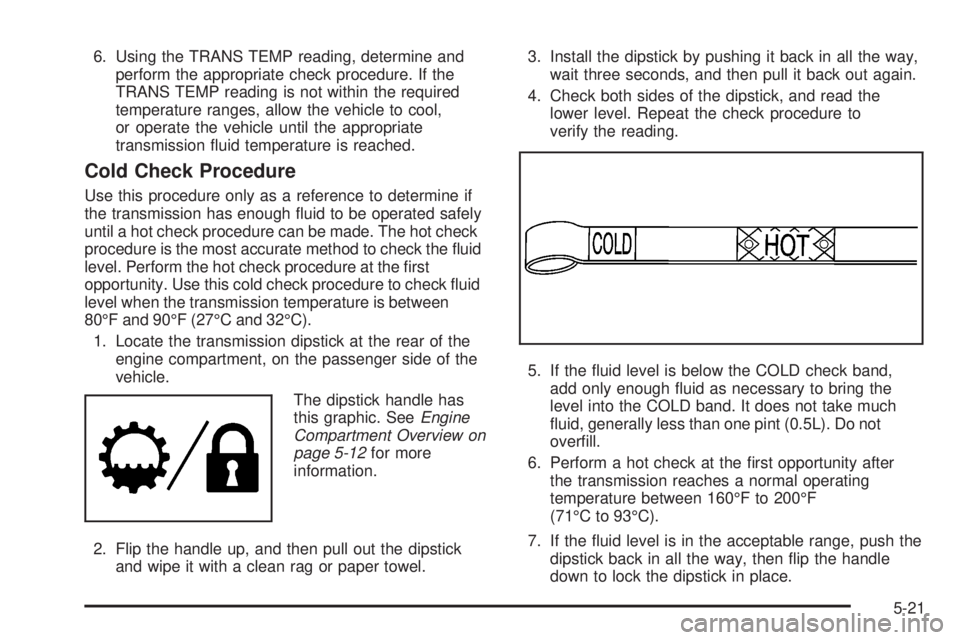
4. Check both sides of the dipstick, and read the
lower level. Repeat the check procedure to
verify the reading.
5. If the uid level is below the COLD check band,
add only enough uid as necessary to bring the
level into the COLD band. It does not take much
uid, generally less than one pint (0.5L). Do not
overll.
6. Perform a hot check at the rst opportunity after
the transmission reaches a normal operating
temperature between 160°F to 200°F
(71°C to 93°C).
7. If the uid level is in the acceptable range, push the
dipstick back in all the way, then ip the handle
down to lock the dipstick in place.
5-21
Page 360 of 502
Hot Check Procedure
Use this procedure to check the transmission uid level
when the transmission uid temperature is between
160°F and 200°F (71°C and 93°C).
The hot check is the most accurate method to check the
uid level. The hot check should be performed at the
rst opportunity in order to verify the cold check.
The uid level rises as uid temperature increases, so
it is important to ensure the transmission temperature is
within range.
1. Locate the transmission dipstick at the rear of the
engine compartment, on the passenger side of the
vehicle.
The dipstick handle has
this graphic. SeeEngine
Compartment Overview on
page 5-12for more
information.
2. Flip the handle up, and then pull out the dipstick
and wipe it with a clean rag or paper towel.
3. Install the dipstick by pushing it back in all the way,
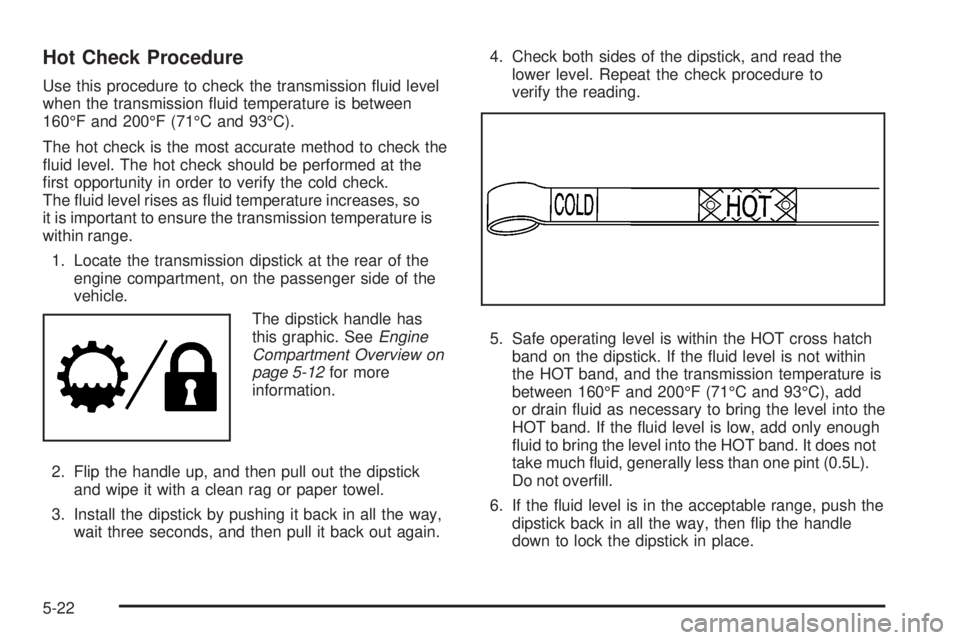
wait three seconds, and then pull it back out again.4. Check both sides of the dipstick, and read the
lower level. Repeat the check procedure to
verify the reading.
5. Safe operating level is within the HOT cross hatch
band on the dipstick. If the uid level is not within
the HOT band, and the transmission temperature is
between 160°F and 200°F (71°C and 93°C), add
or drain uid as necessary to bring the level into the
HOT band. If the uid level is low, add only enough
uid to bring the level into the HOT band. It does not
take much uid, generally less than one pint (0.5L).
Do not overll.
6. If the uid level is in the acceptable range, push the
dipstick back in all the way, then ip the handle
down to lock the dipstick in place.
5-22
Page 370 of 502
Notice:In cold weather, water can freeze and crack
the engine, radiator, heater core and other parts.
Use the recommended coolant and the proper
coolant mixture.
{CAUTION:
You can be burned if you spill coolant on hot
engine parts. Coolant contains ethylene glycol
and it will burn if the engine parts are hot
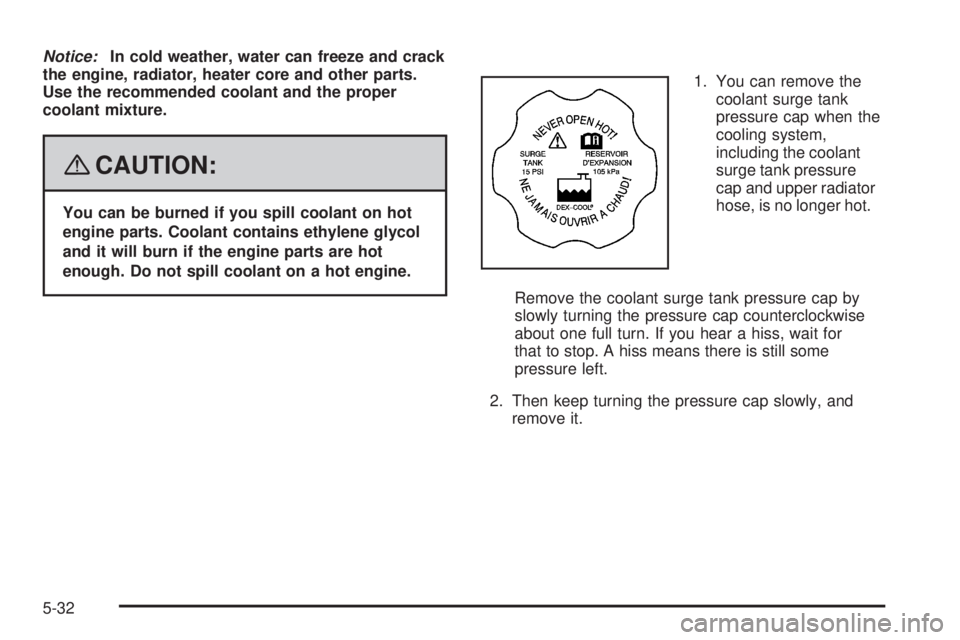
enough. Do not spill coolant on a hot engine.1. You can remove the
coolant surge tank
pressure cap when the
cooling system,
including the coolant
surge tank pressure
cap and upper radiator
hose, is no longer hot.
Remove the coolant surge tank pressure cap by
slowly turning the pressure cap counterclockwise
about one full turn. If you hear a hiss, wait for
that to stop. A hiss means there is still some
pressure left.
2. Then keep turning the pressure cap slowly, and
remove it.
5-32
Page 387 of 502
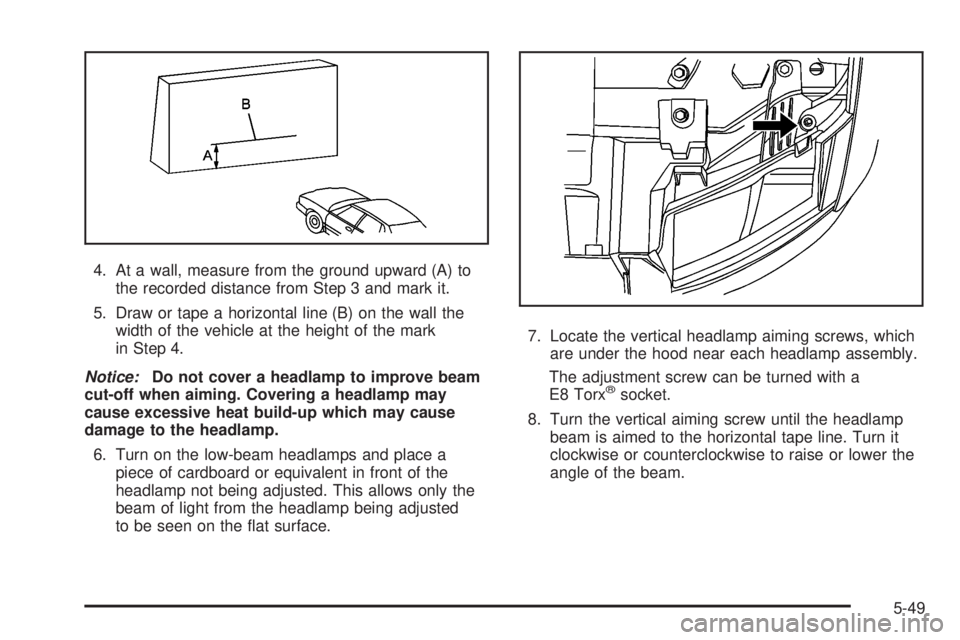
4. At a wall, measure from the ground upward (A) to
the recorded distance from Step 3 and mark it.
5. Draw or tape a horizontal line (B) on the wall the
width of the vehicle at the height of the mark
in Step 4.
Notice:Do not cover a headlamp to improve beam
cut-off when aiming. Covering a headlamp may
cause excessive heat build-up which may cause
damage to the headlamp.
6. Turn on the low-beam headlamps and place a
piece of cardboard or equivalent in front of the
headlamp not being adjusted. This allows only the
beam of light from the headlamp being adjusted
to be seen on the at surface.7. Locate the vertical headlamp aiming screws, which
are under the hood near each headlamp assembly.
The adjustment screw can be turned with a
E8 Torx
®socket.
8. Turn the vertical aiming screw until the headlamp
beam is aimed to the horizontal tape line. Turn it
clockwise or counterclockwise to raise or lower the
angle of the beam.
5-49
Page 389 of 502
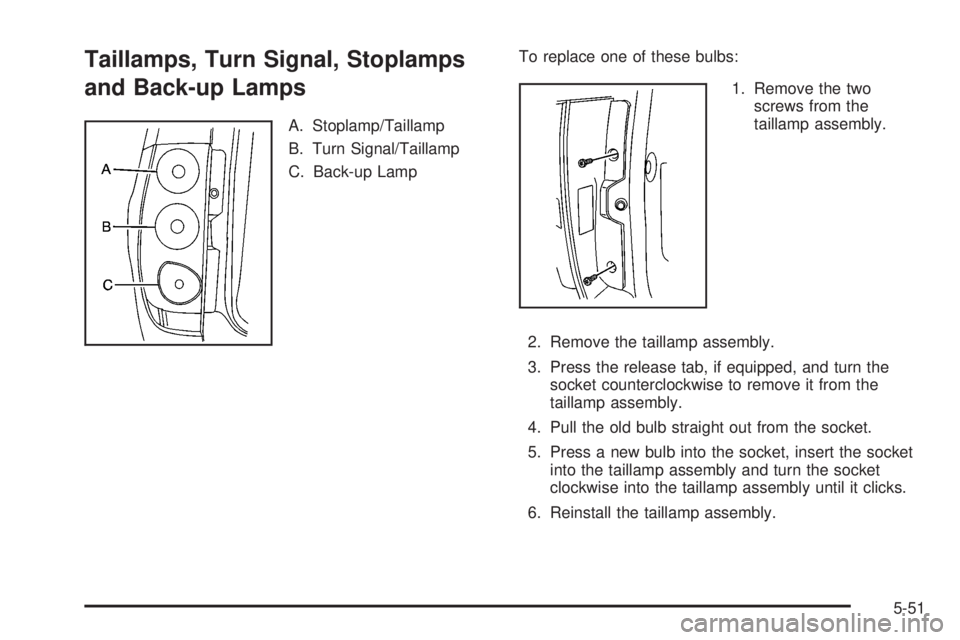
Taillamps, Turn Signal, Stoplamps
and Back-up Lamps
A. Stoplamp/Taillamp
B. Turn Signal/Taillamp
C. Back-up LampTo replace one of these bulbs:
1. Remove the two
screws from the
taillamp assembly.
2. Remove the taillamp assembly.
3. Press the release tab, if equipped, and turn the
socket counterclockwise to remove it from the
taillamp assembly.
4. Pull the old bulb straight out from the socket.
5. Press a new bulb into the socket, insert the socket
into the taillamp assembly and turn the socket
clockwise into the taillamp assembly until it clicks.
6. Reinstall the taillamp assembly.
5-51
Page 390 of 502
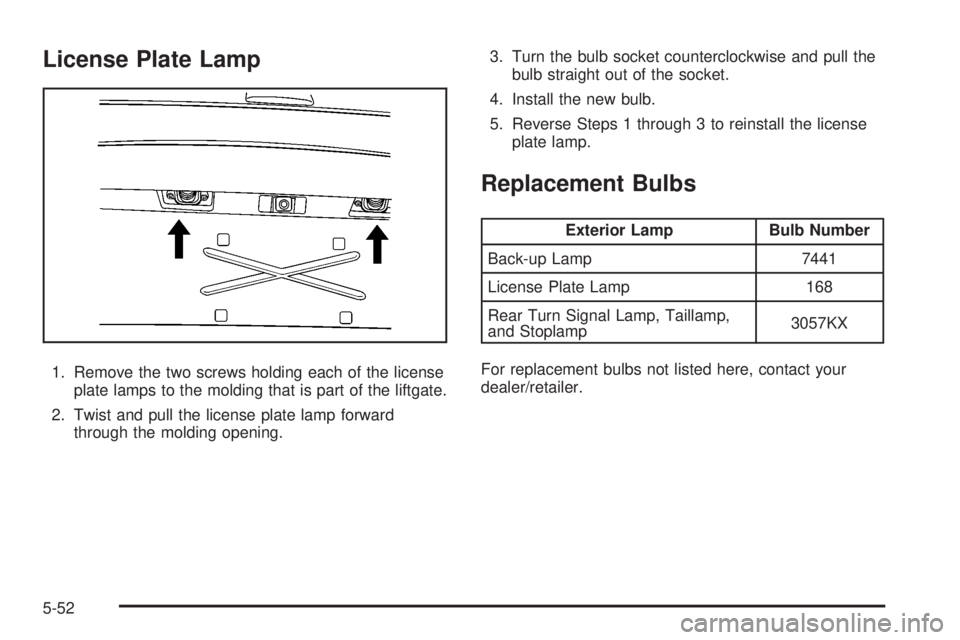
License Plate Lamp
1. Remove the two screws holding each of the license
plate lamps to the molding that is part of the liftgate.
2. Twist and pull the license plate lamp forward
through the molding opening.3. Turn the bulb socket counterclockwise and pull the
bulb straight out of the socket.
4. Install the new bulb.
5. Reverse Steps 1 through 3 to reinstall the license
plate lamp.
Replacement Bulbs
Exterior Lamp Bulb Number
Back-up Lamp 7441
License Plate Lamp 168
Rear Turn Signal Lamp, Taillamp,
and Stoplamp3057KX
For replacement bulbs not listed here, contact your
dealer/retailer.
5-52
Page 391 of 502
Windshield Wiper Blade
Replacement
Windshield wiper blades should be inspected for wear
or cracking. SeeScheduled Maintenance on page 6-4.
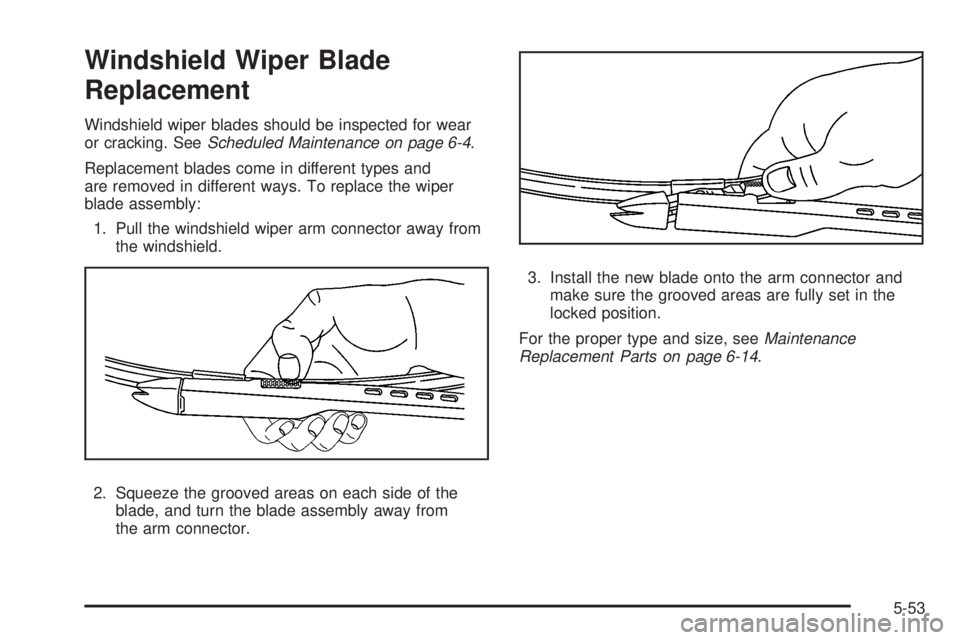
Replacement blades come in different types and
are removed in different ways. To replace the wiper
blade assembly:
1. Pull the windshield wiper arm connector away from
the windshield.
2. Squeeze the grooved areas on each side of the
blade, and turn the blade assembly away from
the arm connector.3. Install the new blade onto the arm connector and
make sure the grooved areas are fully set in the
locked position.
For the proper type and size, seeMaintenance
Replacement Parts on page 6-14.
5-53
Page 392 of 502
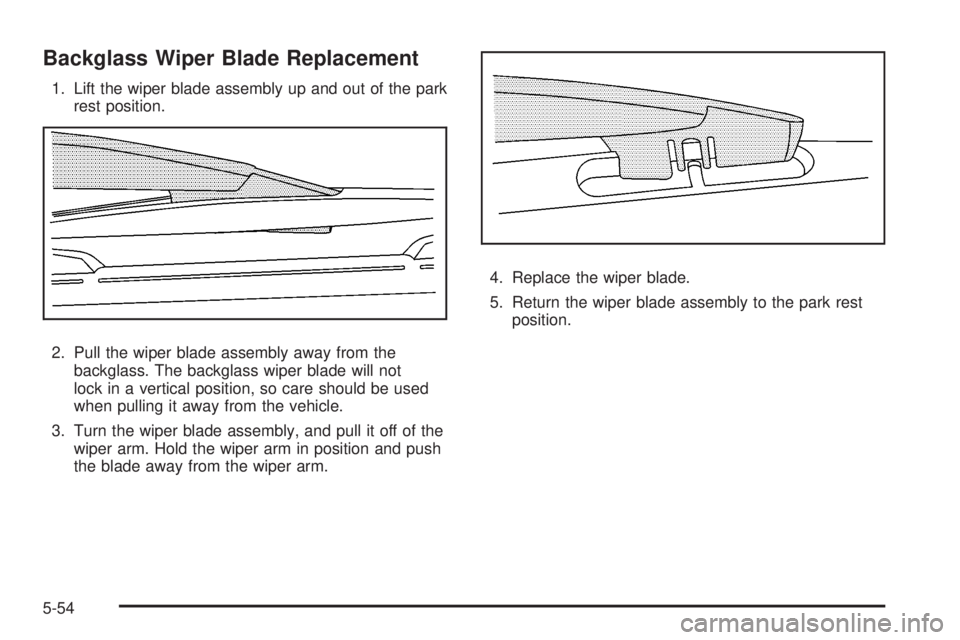
Backglass Wiper Blade Replacement
1. Lift the wiper blade assembly up and out of the park
rest position.
2. Pull the wiper blade assembly away from the
backglass. The backglass wiper blade will not
lock in a vertical position, so care should be used
when pulling it away from the vehicle.
3. Turn the wiper blade assembly, and pull it off of the
wiper arm. Hold the wiper arm in position and push
the blade away from the wiper arm.4. Replace the wiper blade.
5. Return the wiper blade assembly to the park rest
position.
5-54
Page 404 of 502
TPMS Sensor Matching Process
Each TPMS sensor has a unique identication code.
Any time you rotate your vehicle’s tires or replace one or
more of the TPMS sensors, the identication codes
will need to be matched to the new tire/wheel position.
The sensors are matched to the tire/wheel positions
in the following order: driver side front tire, passenger
side front tire, passenger side rear tire, and driver
side rear tire using a TPMS diagnostic tool. See your
dealer/retailer for service.
The TPMS sensors can also be matched to each
tire/wheel position by increasing or decreasing the tire’s
air pressure. If increasing the tire’s air pressure, do
not exceed the maximum ination pressure indicated on
the tire’s sidewall.
To decrease air-pressure out of a tire you can use the
pointed end of the valve cap, a pencil-style air pressure
gage, or a key.
You have two minutes to match the rst tire/wheel
position, and ve minutes overall to match all four
tire/wheel positions. If it takes longer than two minutes,
to match the rst tire and wheel, or more than
ve minutes to match all four tire and wheel positions
the matching process stops and you need to start over.The TPMS sensor matching process is outlined below:
1. Set the parking brake.
2. Turn the ignition switch to ON/RUN with the
engine off.
3. Press the Remote Keyless Entry (RKE) transmitter’s
LOCK and UNLOCK buttons at the same time for
approximately ve seconds. The horn sounds twice
to signal the receiver is in relearn mode and
TIRE LEARNING ACTIVE message displays on the
DIC screen.
4. Start with the driver side front tire.
5. Remove the valve cap from the valve cap stem.
Activate the TPMS sensor by increasing or
decreasing the tire’s air pressure for ve seconds,
or until a horn chirp sounds. The horn chirp, which
may take up to 30 seconds to sound, conrms that
the sensor identication code has been matched to
this tire and wheel position.
6. Proceed to the passenger side front tire, and repeat
the procedure in Step 5.
5-66