lock GMC YUKON DENALI 2008 Owners Manual
[x] Cancel search | Manufacturer: GMC, Model Year: 2008, Model line: YUKON DENALI, Model: GMC YUKON DENALI 2008Pages: 502, PDF Size: 6.18 MB
Page 405 of 502
7. Proceed to the passenger side rear tire, and repeat
the procedure in Step 5.
8. Proceed to the driver side rear tire, and repeat the
procedure in Step 5. The horn sounds two times to
indicate the sensor identication code has been
matched to the driver side rear tire, and the TPMS
sensor matching process is no longer active.
The TIRE LEARNING ACTIVE message on the
DIC display screen goes off.
9. Turn the ignition switch to LOCK/OFF.
10. Set all four tires to the recommended air pressure
level as indicated on the Tire and Loading
Information label.
11. Put the valve caps back on the valve stems.Tire Inspection and Rotation
We recommend that you regularly inspect your
vehicle’s tires, including the spare tire, for signs of
wear or damage. SeeWhen It Is Time for New
Tires on page 5-69for more information.
Tires should be rotated every 5,000 to 8,000 miles
(8 000 to 13 000 km). SeeScheduled Maintenance
on page 6-4.
The purpose of a regular tire rotation is to achieve
a uniform wear for all tires on the vehicle. This will
ensure that your vehicle continues to perform most
like it did when the tires were new.
Any time you notice unusual wear, rotate your
tires as soon as possible and check wheel
alignment. Also check for damaged tires or wheels.
SeeWhen It Is Time for New Tires on page 5-69
andWheel Replacement on page 5-74.
5-67
Page 410 of 502
Different Size Tires and Wheels
If you add wheels or tires that are a different size than
your original equipment wheels and tires, this could
affect the way your vehicle performs, including its
braking, ride and handling characteristics, stability, and
resistance to rollover. Additionally, if your vehicle has
electronic systems such as anti-lock brakes, rollover
airbags, traction control, and electronic stability control,
the performance of these systems can be affected.
{CAUTION:
If you add different sized wheels, your vehicle
may not provide an acceptable level of
performance and safety if tires not
recommended for those wheels are selected.
You may increase the chance that you will crash
and suffer serious injury. Only use GM specic
wheel and tire systems developed for your
vehicle, and have them properly installed by a
GM certied technician.
SeeBuying New Tires on page 5-70andAccessories
and Modifications on page 5-3for additional information.
Uniform Tire Quality Grading
Quality grades can be found where applicable on
the tire sidewall between tread shoulder and
maximum section width. For example:
Treadwear 200 Traction AA Temperature A
The following information relates to the system
developed by the United States National Highway
Traffic Safety Administration (NHTSA), which
grades tires by treadwear, traction, and
temperature performance. This applies only to
vehicles sold in the United States. The grades are
molded on the sidewalls of most passenger car
tires. The Uniform Tire Quality Grading (UTQG)
system does not apply to deep tread, winter-type
snow tires, space-saver, or temporary use spare
tires, tires with nominal rim diameters of
10 to 12 inches (25 to 30 cm), or to some
limited-production tires.
While the tires available on General Motors
passenger cars and light trucks may vary with
respect to these grades, they must also conform
to federal safety requirements and additional
General Motors Tire Performance Criteria (TPC)
standards.
5-72
Page 416 of 502
Changing a Flat Tire
If a tire goes at, avoid further tire and wheel damage
by driving slowly to a level place. Turn on your vehicle’s
hazard warning ashers. SeeHazard Warning Flashers
on page 3-6for more information.
{CAUTION:
Changing a tire can be dangerous. The vehicle
can slip off the jack and roll over or fall on you
or other people. You and they could be badly
injured or even killed. Find a level place to
change your tire. To help prevent the vehicle
from moving:
1. Set the parking brake rmly.
2. Put the shift lever in PARK (P).
CAUTION: (Continued)
CAUTION: (Continued)
3. Turn off the engine and do not restart
while the vehicle is raised.
4. Do not allow passengers to remain in the
vehicle.
To be even more certain the vehicle will not
move, you should put blocks at the front and
rear of the tire farthest away from the one
being changed. That would be the tire, on the
other side, at the opposite end of the vehicle.
When your vehicle has a at tire, use the following
example as a guide to assist you in the placement of
wheel blocks.
5-78
Page 418 of 502
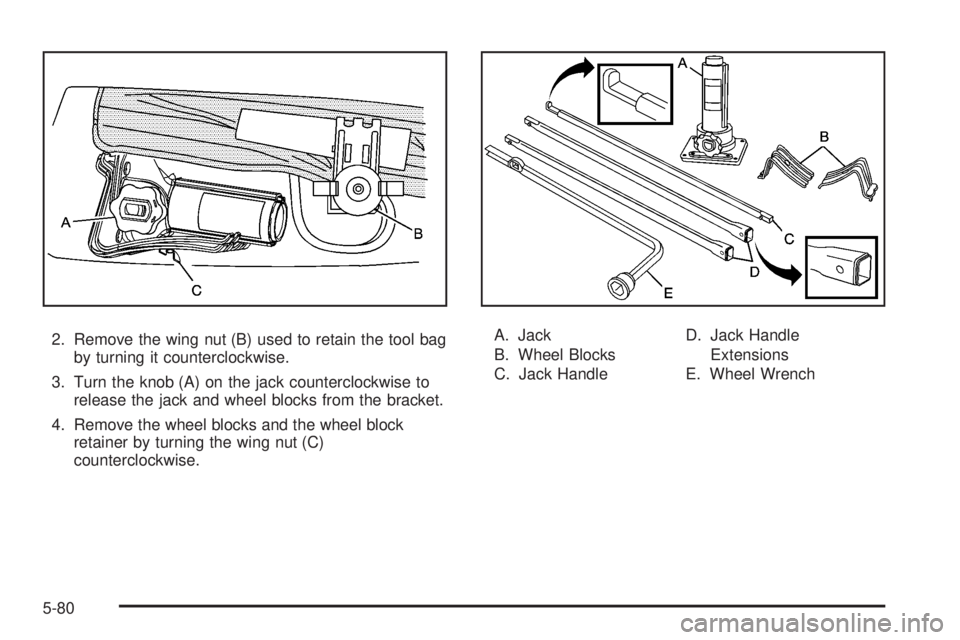
2. Remove the wing nut (B) used to retain the tool bag
by turning it counterclockwise.
3. Turn the knob (A) on the jack counterclockwise to
release the jack and wheel blocks from the bracket.
4. Remove the wheel blocks and the wheel block
retainer by turning the wing nut (C)
counterclockwise.A. Jack
B. Wheel Blocks
C. Jack HandleD. Jack Handle
Extensions
E. Wheel Wrench
5-80
Page 419 of 502
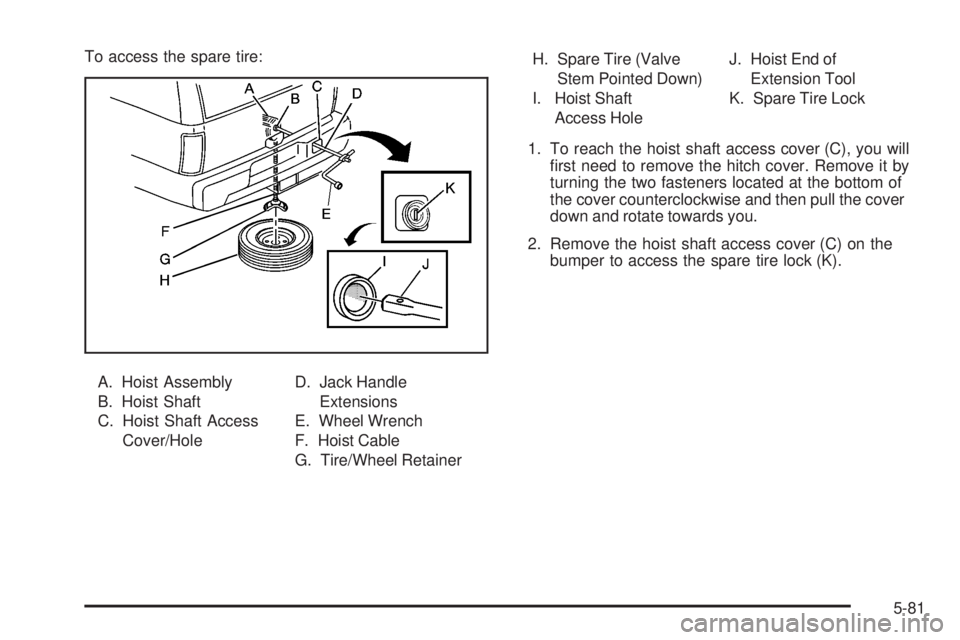
To access the spare tire:
A. Hoist Assembly
B. Hoist Shaft
C. Hoist Shaft Access
Cover/HoleD. Jack Handle
Extensions
E. Wheel Wrench
F. Hoist Cable
G. Tire/Wheel RetainerH. Spare Tire (Valve
Stem Pointed Down)
I. Hoist Shaft
Access HoleJ. Hoist End of
Extension Tool
K. Spare Tire Lock
1. To reach the hoist shaft access cover (C), you will
rst need to remove the hitch cover. Remove it by
turning the two fasteners located at the bottom of
the cover counterclockwise and then pull the cover
down and rotate towards you.
2. Remove the hoist shaft access cover (C) on the
bumper to access the spare tire lock (K).
5-81
Page 420 of 502
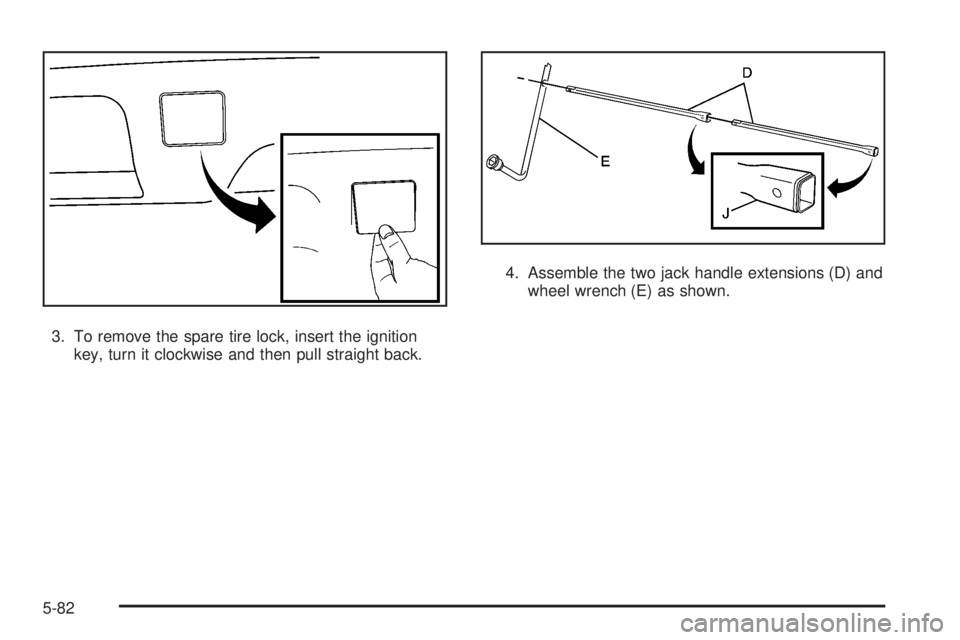
3. To remove the spare tire lock, insert the ignition
key, turn it clockwise and then pull straight back.4. Assemble the two jack handle extensions (D) and
wheel wrench (E) as shown.
5-82
Page 421 of 502
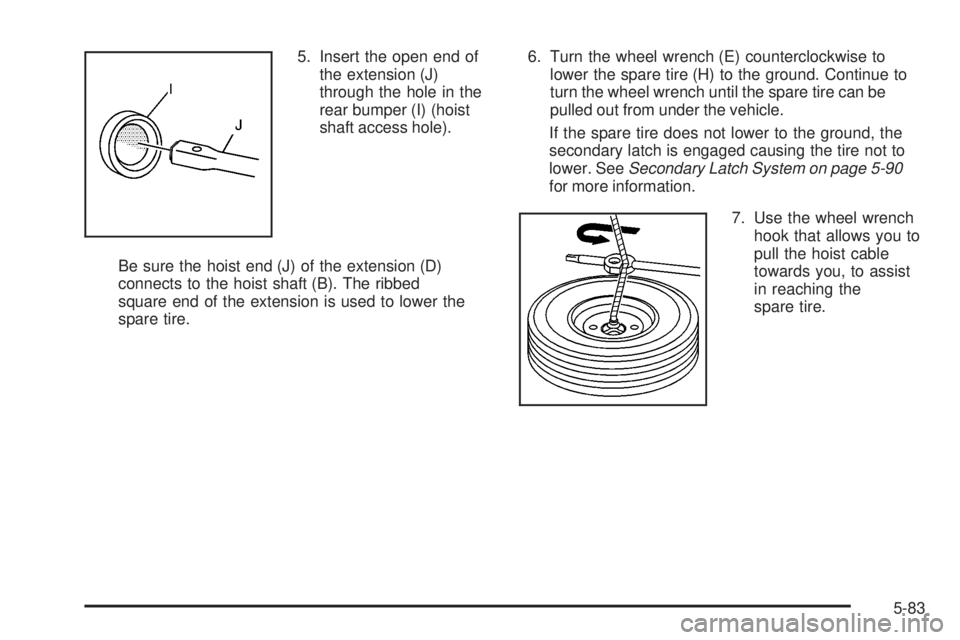
5. Insert the open end of
the extension (J)
through the hole in the
rear bumper (I) (hoist
shaft access hole).
Be sure the hoist end (J) of the extension (D)
connects to the hoist shaft (B). The ribbed
square end of the extension is used to lower the
spare tire.6. Turn the wheel wrench (E) counterclockwise to
lower the spare tire (H) to the ground. Continue to
turn the wheel wrench until the spare tire can be
pulled out from under the vehicle.
If the spare tire does not lower to the ground, the
secondary latch is engaged causing the tire not to
lower. SeeSecondary Latch System on page 5-90
for more information.
7. Use the wheel wrench
hook that allows you to
pull the hoist cable
towards you, to assist
in reaching the
spare tire.
5-83
Page 423 of 502
Removing the Flat Tire and
Installing the Spare Tire
1. Do a safety check before proceeding. SeeChanging
a Flat Tire on page 5-78for more information.
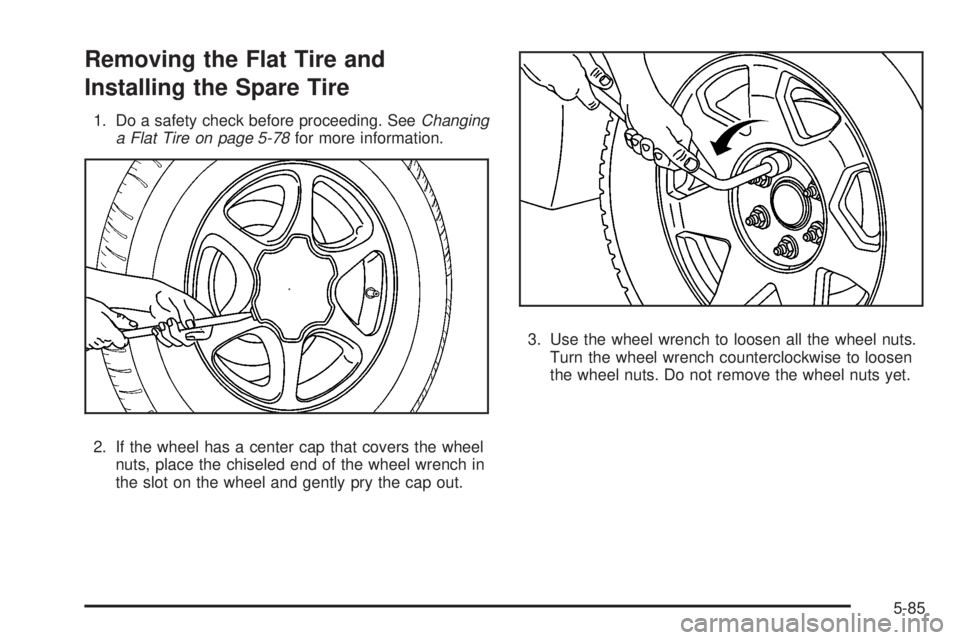
2. If the wheel has a center cap that covers the wheel
nuts, place the chiseled end of the wheel wrench in
the slot on the wheel and gently pry the cap out.3. Use the wheel wrench to loosen all the wheel nuts.
Turn the wheel wrench counterclockwise to loosen
the wheel nuts. Do not remove the wheel nuts yet.
5-85
Page 425 of 502
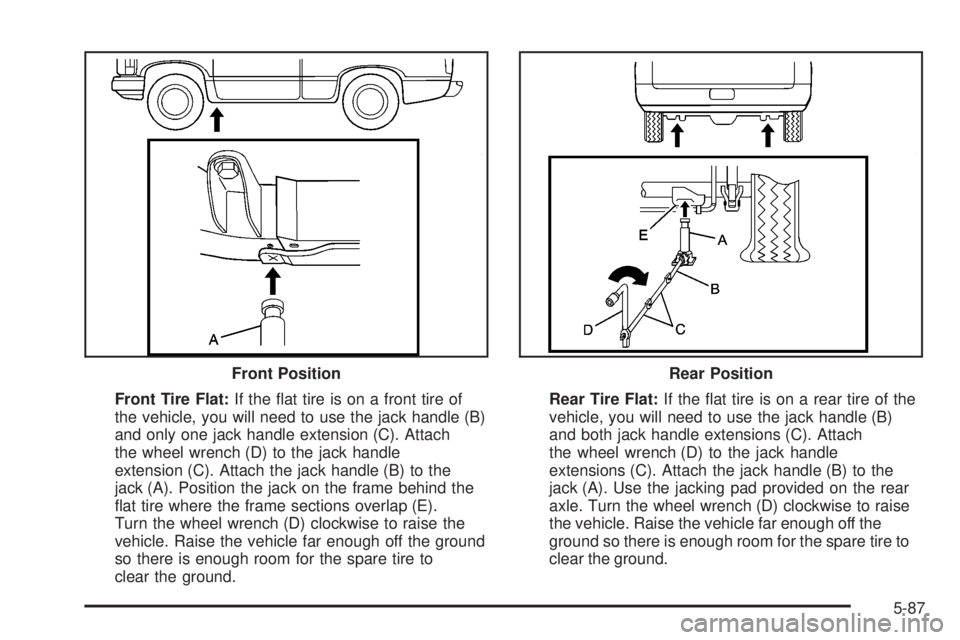
Front Tire Flat:If the at tire is on a front tire of
the vehicle, you will need to use the jack handle (B)
and only one jack handle extension (C). Attach
the wheel wrench (D) to the jack handle
extension (C). Attach the jack handle (B) to the
jack (A). Position the jack on the frame behind the
at tire where the frame sections overlap (E).
Turn the wheel wrench (D) clockwise to raise the
vehicle. Raise the vehicle far enough off the ground
so there is enough room for the spare tire to
clear the ground.Rear Tire Flat:If the at tire is on a rear tire of the
vehicle, you will need to use the jack handle (B)
and both jack handle extensions (C). Attach
the wheel wrench (D) to the jack handle
extensions (C). Attach the jack handle (B) to the
jack (A). Use the jacking pad provided on the rear
axle. Turn the wheel wrench (D) clockwise to raise
the vehicle. Raise the vehicle far enough off the
ground so there is enough room for the spare tire to
clear the ground. Front Position
Rear Position
5-87
Page 427 of 502
8. Put the wheel nuts back on with the rounded end
of the nuts toward the wheel after mounting the
spare tire.
9. Tighten each wheel nut by hand. Then use the
wheel wrench to tighten the nuts until the wheel
is held against the hub.
10. Turn the wheel wrench counterclockwise to lower
the vehicle. Lower the jack completely.
{CAUTION:
Incorrect or improperly tightened wheel nuts
can cause the wheel to come loose and even
come off. This could lead to a crash. If you
have to replace them, be sure to get new
original equipment wheel nuts. Stop
somewhere as soon as you can and have the
nuts tightened with a torque wrench to the
proper torque specication. SeeCapacities and
Specifications on page 5-114for wheel nut
torque specication.Notice:Improperly tightened wheel nuts can lead
to brake pulsation and rotor damage. To avoid
expensive brake repairs, evenly tighten the wheel
nuts in the proper sequence and to the proper
torque specication. SeeCapacities and
Specifications on page 5-114for the wheel nut
torque specication.
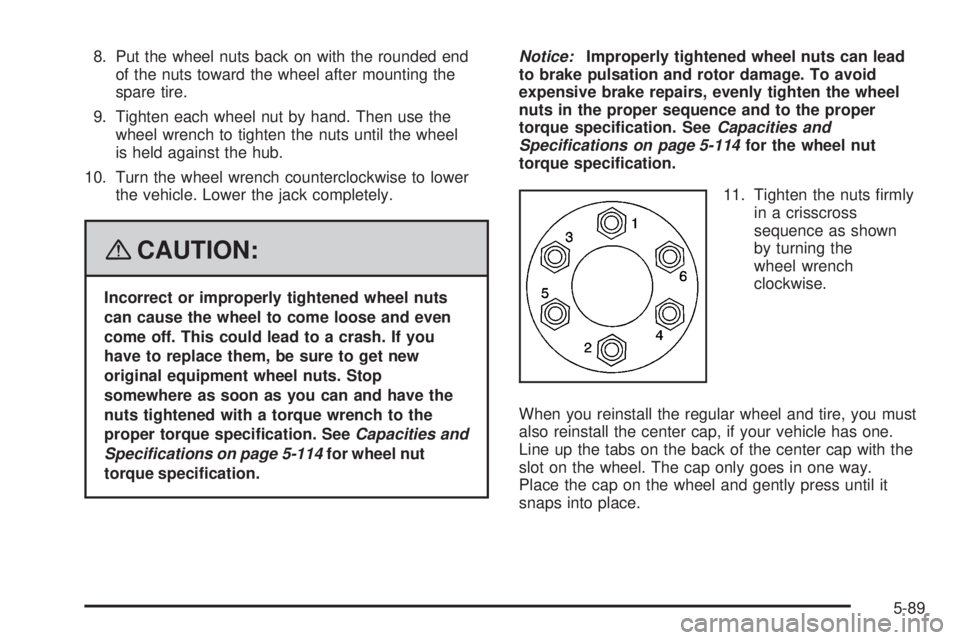
11. Tighten the nuts rmly
in a crisscross
sequence as shown
by turning the
wheel wrench
clockwise.
When you reinstall the regular wheel and tire, you must
also reinstall the center cap, if your vehicle has one.
Line up the tabs on the back of the center cap with the
slot on the wheel. The cap only goes in one way.
Place the cap on the wheel and gently press until it
snaps into place.
5-89