instrument panel GMC YUKON DENALI 2008 User Guide
[x] Cancel search | Manufacturer: GMC, Model Year: 2008, Model line: YUKON DENALI, Model: GMC YUKON DENALI 2008Pages: 502, PDF Size: 6.18 MB
Page 113 of 502
Power Liftgate
Power Liftgate Operation
{CAUTION:
It can be dangerous to drive with the liftgate
open because carbon monoxide (CO) gas can
come into your vehicle. You cannot see or
smell CO. It can cause unconsciousness and
even death.
If you must drive with the liftgate open, or if
electrical wiring or other cable connections
must pass through the seal between the body
and the liftgate:
Make sure all other windows are shut.
Turn the fan on your heating or cooling
system to its highest speed with the
recirculation mode off. That will force
outside air into your vehicle. See Climate
Control System in the index.
CAUTION: (Continued)
CAUTION: (Continued)
If you have air outlets on or under the
instrument panel, open them all the way.
If your vehicle has a power liftgate, disable
the power liftgate function.
SeePower Liftgate on page 2-15.
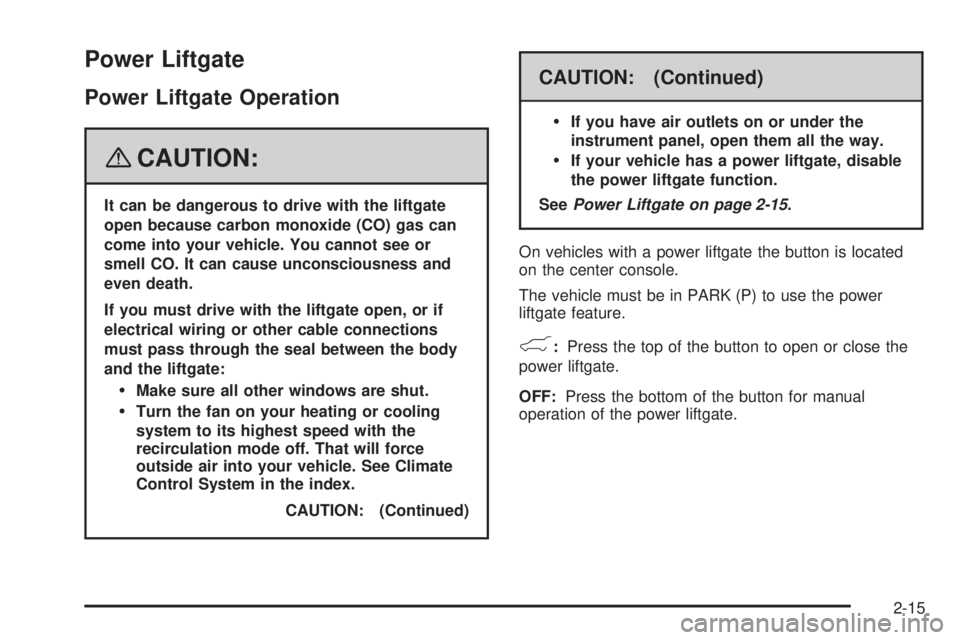
On vehicles with a power liftgate the button is located
on the center console.
The vehicle must be in PARK (P) to use the power
liftgate feature.
&:Press the top of the button to open or close the
power liftgate.
OFF:Press the bottom of the button for manual
operation of the power liftgate.
2-15
Page 122 of 502
PASS-Key®III+ Operation
Your vehicle has PASS-Key®III+ (Personalized
Automotive Security System) theft-deterrent system.
PASS-Key
®III+ is a passive theft-deterrent system.
The system is automatically armed when the key
is removed from the ignition.
The system is automatically disarmed when the key is
turned to ON/RUN, ACC/ACCESSORY or START
from the LOCK/OFF position.
You do not have to manually arm or disarm the system.
The security light will come on if there is a problem
with arming or disarming the theft-deterrent system.
When the PASS-Key
®III+ system senses that someone
is using the wrong key, it prevents the vehicle from
starting. Anyone using a trial-and-error method to start
the vehicle will be discouraged because of the high
number of electrical key codes.
If the engine does not start and the security light on the
instrument panel cluster comes on when trying to
start the vehicle, there may be a problem with your
theft-deterrent system. Turn the ignition off and try again.If the engine still does not start, and the key appears to
be undamaged, try another ignition key. At this time,
you may also want to check the fuse, seeFuses
and Circuit Breakers on page 5-108. If the engine still
does not start with the other key, your vehicle needs
service. If your vehicle does start, the rst key may be
faulty. See your dealer/retailer who can service the
PASS-Key
®III+ to have a new key made. In an
emergency, contact Roadside Assistance.
It is possible for the PASS-Key
®III+ decoder to learn
the transponder value of a new or replacement key. Up
to 10 keys may be programmed for the vehicle. The
following procedure is for programming additional keys
only. If all the currently programmed keys are lost or
do not operate, you must see your dealer/retailer
or a locksmith who can service PASS-Key
®III+ to have
keys made and programmed to the system.
See your dealer/retailer or a locksmith who can service
PASS-Key
®III+ to get a new key blank that is cut
exactly as the ignition key that operates the system.
2-24
Page 127 of 502
Adjustable Throttle and Brake Pedal
On vehicles with this feature, you can change the
position of the throttle and brake pedals.
This feature is designed for shorter drivers, since the
pedals cannot move farther away from the standard
position, but can move toward the driver for better pedal
reach.
No adjustment to the pedals can be made when the
vehicle is in REVERSE (R) or while using the cruise
control.
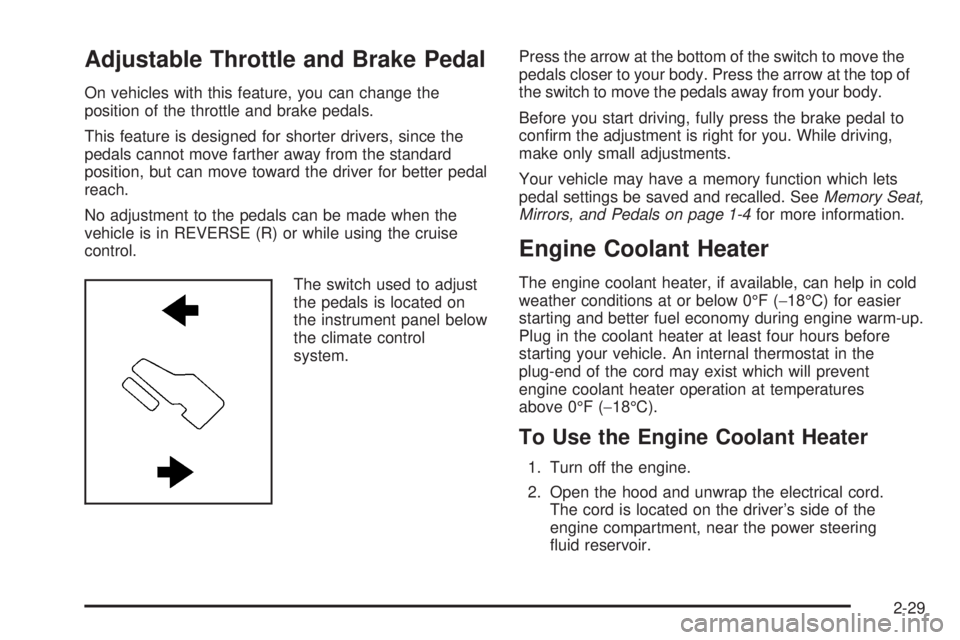
The switch used to adjust
the pedals is located on
the instrument panel below
the climate control
system.Press the arrow at the bottom of the switch to move the
pedals closer to your body. Press the arrow at the top of
the switch to move the pedals away from your body.
Before you start driving, fully press the brake pedal to
conrm the adjustment is right for you. While driving,
make only small adjustments.
Your vehicle may have a memory function which lets
pedal settings be saved and recalled. SeeMemory Seat,
Mirrors, and Pedals on page 1-4for more information.
Engine Coolant Heater
The engine coolant heater, if available, can help in cold
weather conditions at or below 0°F (−18°C) for easier
starting and better fuel economy during engine warm-up.
Plug in the coolant heater at least four hours before
starting your vehicle. An internal thermostat in the
plug-end of the cord may exist which will prevent
engine coolant heater operation at temperatures
above 0°F (−18°C).
To Use the Engine Coolant Heater
1. Turn off the engine.
2. Open the hood and unwrap the electrical cord.
The cord is located on the driver’s side of the
engine compartment, near the power steering
uid reservoir.
2-29
Page 128 of 502
3. Plug the cord into a normal, grounded 110-volt
AC outlet.
{CAUTION:
Plugging the cord into an ungrounded outlet
could cause an electrical shock. Also, the
wrong kind of extension cord could overheat
and cause a re. You could be seriously
injured. Plug the cord into a properly grounded
three-prong 110-volt AC outlet. If the cord will
not reach, use a heavy-duty three-prong
extension cord rated for at least 15 amps.
4. Before starting the engine, be sure to unplug and
store the cord as it was before to keep it away
from moving engine parts. If you do not, it could be
damaged.
How long should you keep the coolant heater plugged
in? The answer depends on the outside temperature, the
kind of oil you have, and some other things. Instead
of trying to list everything here, we ask that you contact
your dealer/retailer in the area where you will be
parking your vehicle. The dealer/retailer can give you
the best advice for that particular area.
Automatic Transmission Operation
Your vehicle has a Hydra-Matic®6L80 automatic
transmission, and has an electronic shift position
indicator within the instrument panel cluster. The
electronic shift position indicator displays when the shift
lever is moved out of PARK (P).
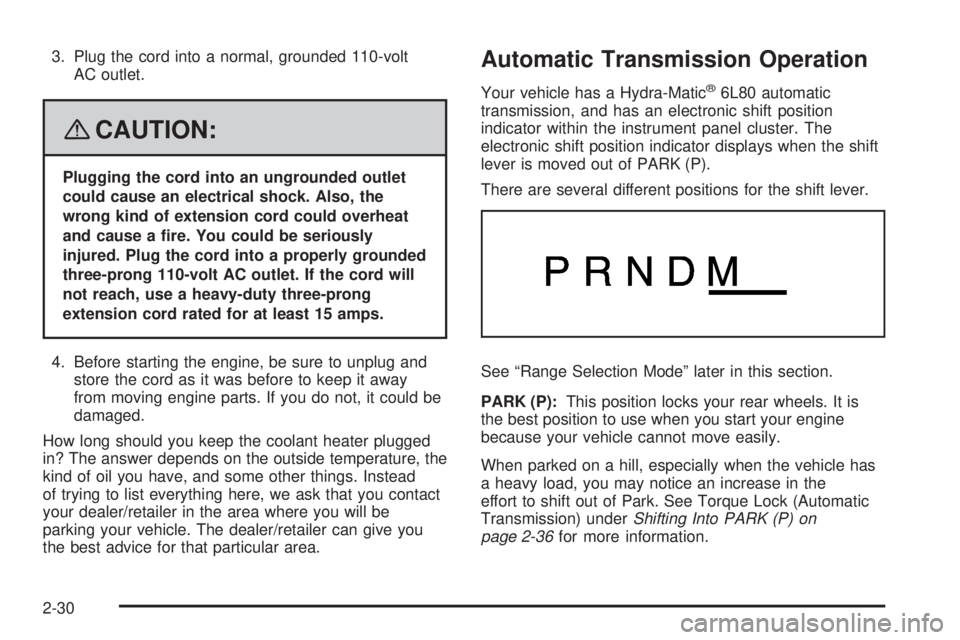
There are several different positions for the shift lever.
See “Range Selection Mode” later in this section.
PARK (P):This position locks your rear wheels. It is
the best position to use when you start your engine
because your vehicle cannot move easily.
When parked on a hill, especially when the vehicle has
a heavy load, you may notice an increase in the
effort to shift out of Park. See Torque Lock (Automatic
Transmission) underShifting Into PARK (P) on
page 2-36for more information.
2-30
Page 132 of 502
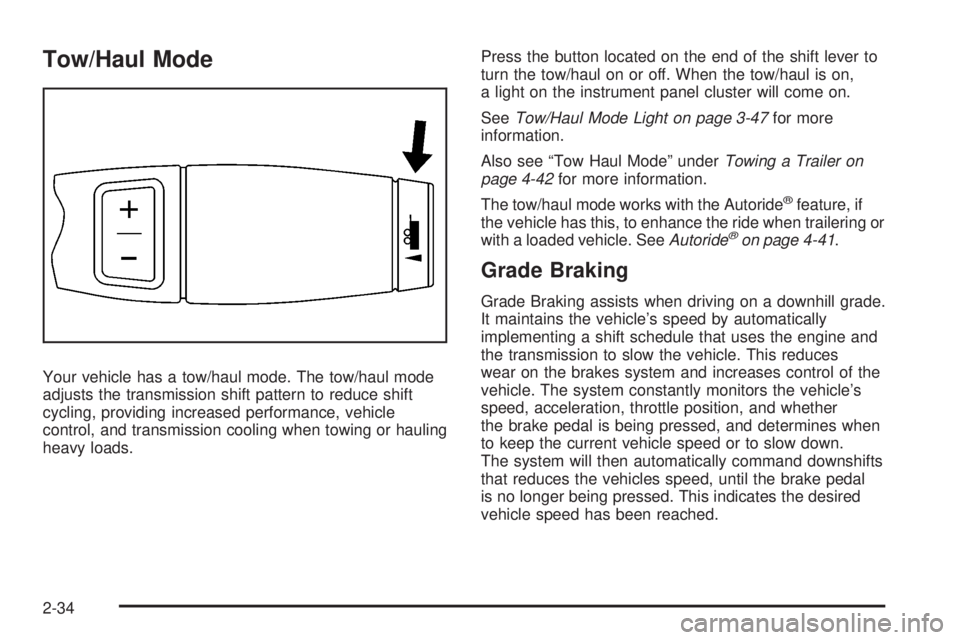
Tow/Haul Mode
Your vehicle has a tow/haul mode. The tow/haul mode
adjusts the transmission shift pattern to reduce shift
cycling, providing increased performance, vehicle
control, and transmission cooling when towing or hauling
heavy loads.Press the button located on the end of the shift lever to
turn the tow/haul on or off. When the tow/haul is on,
a light on the instrument panel cluster will come on.
SeeTow/Haul Mode Light on page 3-47for more
information.
Also see “Tow Haul Mode” underTowing a Trailer on
page 4-42for more information.
The tow/haul mode works with the Autoride
®feature, if
the vehicle has this, to enhance the ride when trailering or
with a loaded vehicle. SeeAutoride
®on page 4-41.
Grade Braking
Grade Braking assists when driving on a downhill grade.
It maintains the vehicle’s speed by automatically
implementing a shift schedule that uses the engine and
the transmission to slow the vehicle. This reduces
wear on the brakes system and increases control of the
vehicle. The system constantly monitors the vehicle’s
speed, acceleration, throttle position, and whether
the brake pedal is being pressed, and determines when
to keep the current vehicle speed or to slow down.
The system will then automatically command downshifts
that reduces the vehicles speed, until the brake pedal
is no longer being pressed. This indicates the desired
vehicle speed has been reached.
2-34
Page 157 of 502
Instrument Panel Storage
Your vehicle may have a closed storage area on the
instrument panel above the compact disc changer. You
can open the storage area by pressing in the bottom
of the lid and the lid will automatically raise up.
Press down on the lid to close the storage area.
Center Console Storage
Your vehicle has a console compartment between the
bucket seats.
To open it, press the button on the front of the console
and swing the console cover open.
The console may be equipped with an accessory power
outlet inside. SeeAccessory Power Outlet(s) on
page 3-21.
The rear of the console also has a cupholder that
swings down for the rear seat passengers to use.
Luggage Carrier
You can load things on top of your vehicle with this
feature.
The luggage carrier has slats and siderails attached to
the roof and crossrails which can be moved back
and forth to help secure cargo. Tie the load to the
siderails or siderail supports.
Notice:Loading cargo on the luggage carrier that
weighs more than 200 lbs (91 kg) or hangs over
the rear or sides of the vehicle may damage your
vehicle. Load cargo so that it rests on the slats
as far forward as possible and against the side rails,
making sure to fasten it securely.
Don’t exceed the maximum vehicle capacity when
loading your vehicle. For more information on vehicle
capacity and loading, seeLoading Your Vehicle on
page 4-34.
To prevent damage or loss of cargo as you’re leaving,
check now and then to make sure the luggage and
cargo are still securely fastened.
2-59
Page 163 of 502
Instrument Panel Overview...............................3-4
Hazard Warning Flashers................................3-6
Other Warning Devices...................................3-6
Horn.............................................................3-6
Tilt Wheel.....................................................3-7
Heated Steering Wheel...................................3-7
Turn Signal/Multifunction Lever.........................3-8
Turn and Lane-Change Signals........................3-8
Headlamp High/Low-Beam Changer..................3-9
Flash-to-Pass.................................................3-9
Windshield Wipers........................................3-10
Rainsense™ II Wipers...................................3-10
Windshield Washer.......................................3-11
Rear Window Wiper/Washer...........................3-12
Cruise Control..............................................3-13
Exterior Lamps.............................................3-16
Headlamps on Reminder................................3-17
Daytime Running Lamps (DRL).......................3-17
Automatic Headlamp System..........................3-18
Fog Lamps..................................................3-19
Instrument Panel Brightness...........................3-19
Dome Lamps...............................................3-19
Dome Lamp Override....................................3-20
Entry Lighting...............................................3-20
Exit Lighting.................................................3-20Front Reading Lamps....................................3-20
Electric Power Management...........................3-20
Battery Run-Down Protection..........................3-21
Accessory Power Outlet(s).............................3-21
Ashtray(s) and Cigarette Lighter......................3-22
Climate Controls............................................3-23
Dual Automatic Climate Control System...........3-23
Outlet Adjustment.........................................3-29
Rear Air Conditioning and Heating System
and Electronic Climate Controls
...................3-29
Warning Lights, Gages, and Indicators............3-31
Instrument Panel Cluster................................3-32
Speedometer and Odometer...........................3-33
Trip Odometer..............................................3-33
Tachometer.................................................3-33
Safety Belt Reminders...................................3-33
Airbag Readiness Light..................................3-34
Passenger Airbag Status Indicator...................3-35
Charging System Light..................................3-37
Voltmeter Gage............................................3-38
Brake System Warning Light..........................3-39
Antilock Brake System Warning Light...............3-40
StabiliTrak
®Indicator Light..............................3-40
Section 3 Instrument Panel
3-1
Page 164 of 502
Engine Coolant Temperature Gage..................3-41
Tire Pressure Light.......................................3-41
Malfunction Indicator Lamp.............................3-42
Oil Pressure Gage........................................3-45
Oil Pressure Light.........................................3-46
Security Light...............................................3-46
Fog Lamp Light............................................3-47
Cruise Control Light......................................3-47
Highbeam On Light.......................................3-47
Tow/Haul Mode Light....................................3-47
Fuel Gage...................................................3-48
Low Fuel Warning Light.................................3-48
Driver Information Center (DIC).......................3-49
DIC Operation and Displays
(Using DIC Buttons)...................................3-49
DIC Operation and Displays
(Using Trip Odometer Reset Stem)..............3-54DIC Warnings and Messages.........................3-56
DIC Vehicle Customization (With DIC Buttons). . . .3-64
Audio System(s).............................................3-73
Setting the Clock..........................................3-74
Radio(s) (MP3).............................................3-76
Using an MP3 (Radio with Six-Disc Player)......3-94
Using an MP3 (Radio with CD and DVD
Player).....................................................3-99
XM Radio Messages...................................3-104
Navigation/Radio System..............................3-105
Rear Seat Entertainment (RSE) System.........3-105
Rear Seat Audio (RSA)................................3-115
Theft-Deterrent Feature................................3-116
Audio Steering Wheel Controls......................3-117
Radio Reception.........................................3-118
Rear Side Window Antenna..........................3-119
XM™ Satellite Radio Antenna System............3-119
Section 3 Instrument Panel
3-2
Page 166 of 502
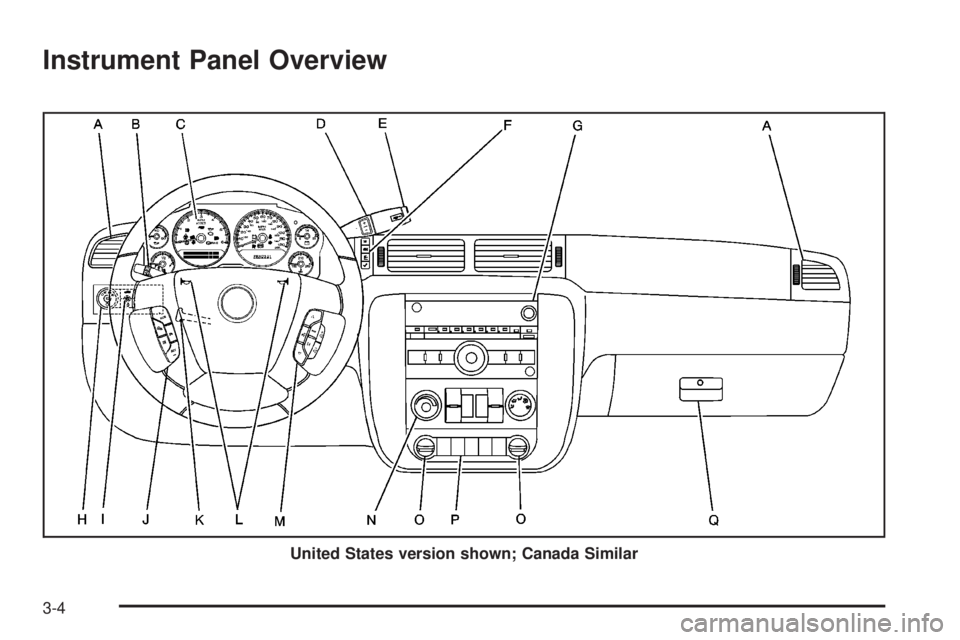
Instrument Panel Overview
United States version shown; Canada Similar
3-4
Page 167 of 502
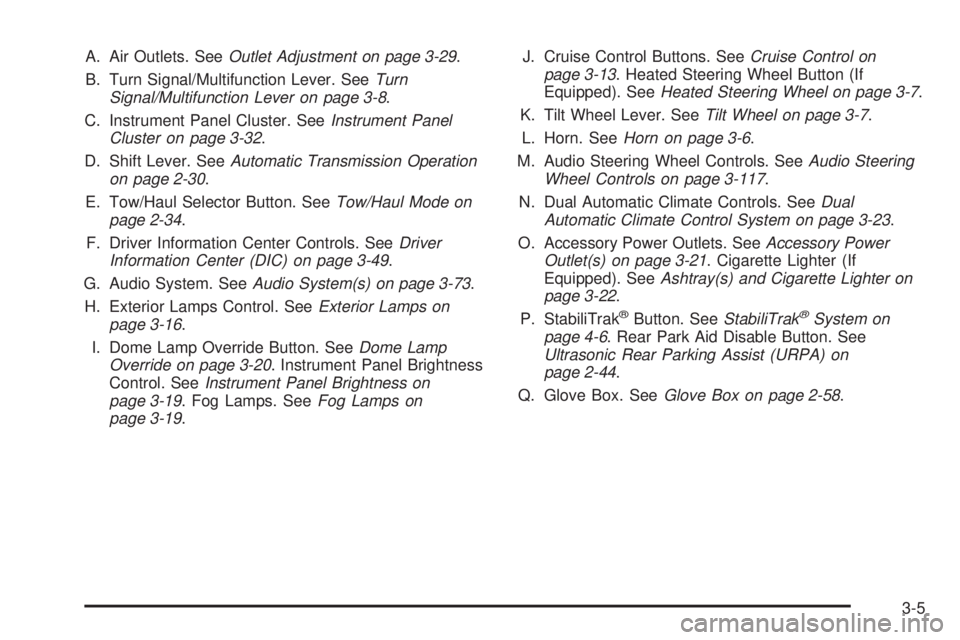
A. Air Outlets. SeeOutlet Adjustment on page 3-29.
B. Turn Signal/Multifunction Lever. SeeTurn
Signal/Multifunction Lever on page 3-8.
C. Instrument Panel Cluster. SeeInstrument Panel
Cluster on page 3-32.
D. Shift Lever. SeeAutomatic Transmission Operation
on page 2-30.
E. Tow/Haul Selector Button. SeeTow/Haul Mode on
page 2-34.
F. Driver Information Center Controls. SeeDriver
Information Center (DIC) on page 3-49.
G. Audio System. SeeAudio System(s) on page 3-73.
H. Exterior Lamps Control. SeeExterior Lamps on
page 3-16.
I. Dome Lamp Override Button. SeeDome Lamp
Override on page 3-20. Instrument Panel Brightness
Control. SeeInstrument Panel Brightness on
page 3-19. Fog Lamps. SeeFog Lamps on
page 3-19.J. Cruise Control Buttons. SeeCruise Control on
page 3-13. Heated Steering Wheel Button (If
Equipped). SeeHeated Steering Wheel on page 3-7.
K. Tilt Wheel Lever. SeeTilt Wheel on page 3-7.
L. Horn. SeeHorn on page 3-6.
M. Audio Steering Wheel Controls. SeeAudio Steering
Wheel Controls on page 3-117.
N. Dual Automatic Climate Controls. SeeDual
Automatic Climate Control System on page 3-23.
O. Accessory Power Outlets. SeeAccessory Power
Outlet(s) on page 3-21. Cigarette Lighter (If
Equipped). SeeAshtray(s) and Cigarette Lighter on
page 3-22.
P. StabiliTrak
®Button. SeeStabiliTrak®System on
page 4-6. Rear Park Aid Disable Button. See
Ultrasonic Rear Parking Assist (URPA) on
page 2-44.
Q. Glove Box. SeeGlove Box on page 2-58.
3-5