instrument panel GMC YUKON DENALI 2008 Workshop Manual
[x] Cancel search | Manufacturer: GMC, Model Year: 2008, Model line: YUKON DENALI, Model: GMC YUKON DENALI 2008Pages: 502, PDF Size: 6.18 MB
Page 402 of 502
Tire Pressure Monitor Operation
The Tire Pressure Monitor System (TPMS) is designed
to warn the driver when a low tire pressure condition
exists. TPMS sensors are mounted onto each tire and
wheel assembly, excluding the spare tire and wheel
assembly. The TPMS sensors monitor the air pressure in
the vehicle’s tires and transmits the tire pressure readings
to a receiver located in the vehicle.
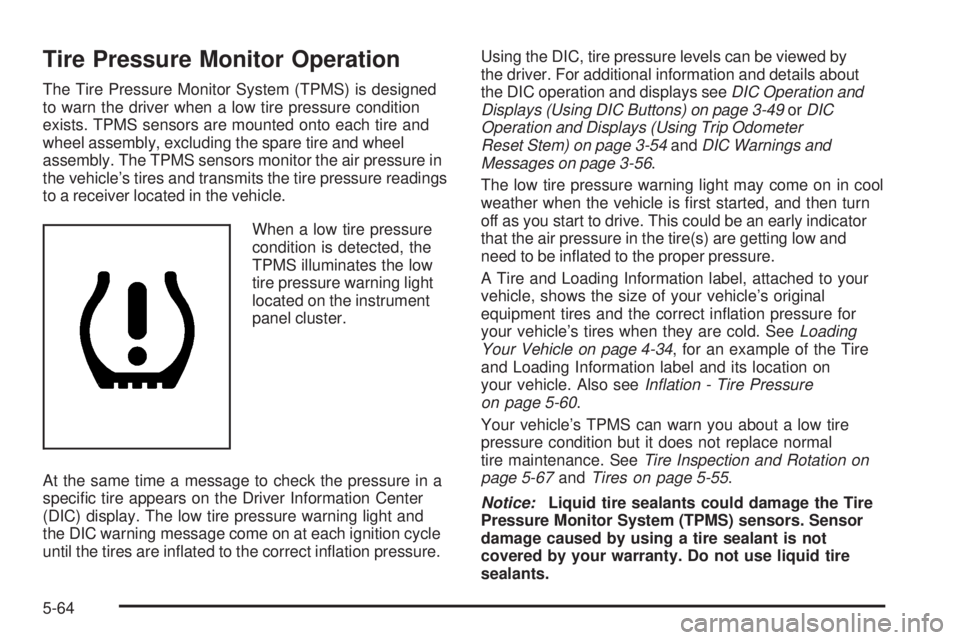
When a low tire pressure
condition is detected, the
TPMS illuminates the low
tire pressure warning light
located on the instrument
panel cluster.
At the same time a message to check the pressure in a
specic tire appears on the Driver Information Center
(DIC) display. The low tire pressure warning light and
the DIC warning message come on at each ignition cycle
until the tires are inated to the correct ination pressure.Using the DIC, tire pressure levels can be viewed by
the driver. For additional information and details about
the DIC operation and displays seeDIC Operation and
Displays (Using DIC Buttons) on page 3-49orDIC
Operation and Displays (Using Trip Odometer
Reset Stem) on page 3-54andDIC Warnings and
Messages on page 3-56.
The low tire pressure warning light may come on in cool
weather when the vehicle is rst started, and then turn
off as you start to drive. This could be an early indicator
that the air pressure in the tire(s) are getting low and
need to be inated to the proper pressure.
A Tire and Loading Information label, attached to your
vehicle, shows the size of your vehicle’s original
equipment tires and the correct ination pressure for
your vehicle’s tires when they are cold. SeeLoading
Your Vehicle on page 4-34, for an example of the Tire
and Loading Information label and its location on
your vehicle. Also seeInflation - Tire Pressure
on page 5-60.
Your vehicle’s TPMS can warn you about a low tire
pressure condition but it does not replace normal
tire maintenance. SeeTire Inspection and Rotation on
page 5-67andTires on page 5-55.
Notice:Liquid tire sealants could damage the Tire
Pressure Monitor System (TPMS) sensors. Sensor
damage caused by using a tire sealant is not
covered by your warranty. Do not use liquid tire
sealants.
5-64
Page 439 of 502
Instrument Panel, Vinyl, and Other
Plastic Surfaces
A soft cloth dampened with water may be used to
remove dust. If a more thorough cleaning is necessary,
a clean soft cloth dampened with a mild soap solution
can be used to gently remove dust and dirt. Never use
spot lifters or removers on plastic surfaces. Many
commercial cleaners and coatings that are sold to
preserve and protect soft plastic surfaces may
permanently change the appearance and feel of your
interior and are not recommended. Do not use silicone
or wax-based products, or those containing organic
solvents to clean your vehicle’s interior because they
can alter the appearance by increasing the gloss in a
non-uniform manner.
Some commercial products may increase gloss on your
instrument panel. The increase in gloss may cause
annoying reections in the windshield and even make it
difficult to see through the windshield under certain
conditions.
Wood Panels
Use a clean cloth moistened in warm, soapy water
(use mild dish washing soap). Dry the wood immediately
with a clean cloth.
Speaker Covers
Vacuum around a speaker cover gently, so that the
speaker will not be damaged. Clean spots with just
water and mild soap.
Care of Safety Belts
Keep belts clean and dry.
{CAUTION:
Do not bleach or dye safety belts. If you do, it
may severely weaken them. In a crash, they
might not be able to provide adequate
protection. Clean safety belts only with mild
soap and lukewarm water.
Weatherstrips
Silicone grease on weatherstrips will make them last
longer, seal better, and not stick or squeak. Apply
silicone grease with a clean cloth. During very cold,
damp weather frequent application may be required. See
Recommended Fluids and Lubricants on page 6-12.
5-101
Page 445 of 502
Vehicle Identication
Vehicle Identication Number (VIN)
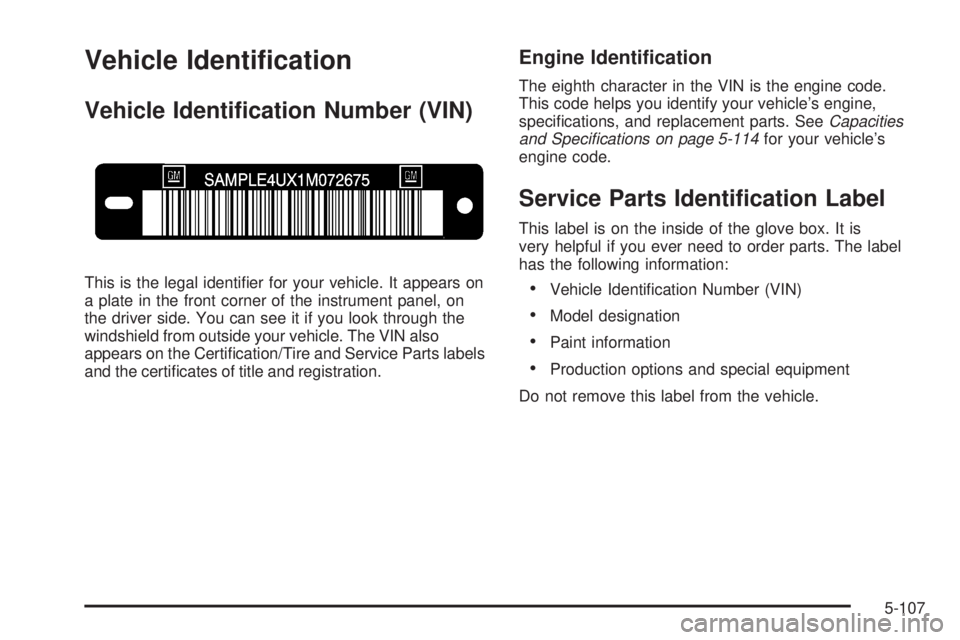
This is the legal identier for your vehicle. It appears on
a plate in the front corner of the instrument panel, on
the driver side. You can see it if you look through the
windshield from outside your vehicle. The VIN also
appears on the Certication/Tire and Service Parts labels
and the certicates of title and registration.
Engine Identication
The eighth character in the VIN is the engine code.
This code helps you identify your vehicle’s engine,
specications, and replacement parts. SeeCapacities
and Specifications on page 5-114for your vehicle’s
engine code.
Service Parts Identication Label
This label is on the inside of the glove box. It is
very helpful if you ever need to order parts. The label
has the following information:
Vehicle Identication Number (VIN)
Model designation
Paint information
Production options and special equipment
Do not remove this label from the vehicle.
5-107
Page 447 of 502
Instrument Panel Fuse Block
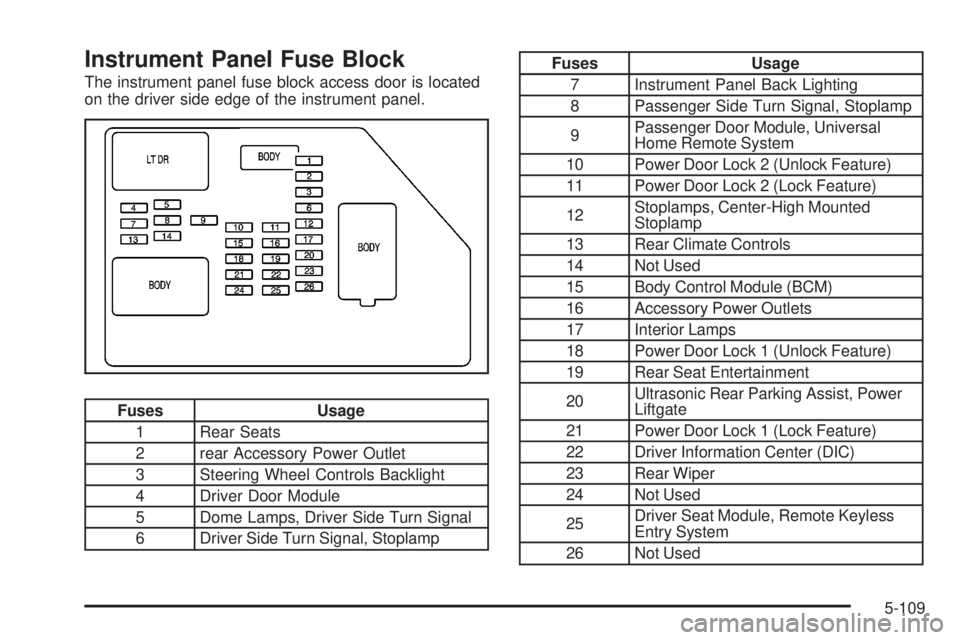
The instrument panel fuse block access door is located
on the driver side edge of the instrument panel.
Fuses Usage
1 Rear Seats
2 rear Accessory Power Outlet
3 Steering Wheel Controls Backlight
4 Driver Door Module
5 Dome Lamps, Driver Side Turn Signal
6 Driver Side Turn Signal, Stoplamp
Fuses Usage
7 Instrument Panel Back Lighting
8 Passenger Side Turn Signal, Stoplamp
9Passenger Door Module, Universal
Home Remote System
10 Power Door Lock 2 (Unlock Feature)
11 Power Door Lock 2 (Lock Feature)
12Stoplamps, Center-High Mounted
Stoplamp
13 Rear Climate Controls
14 Not Used
15 Body Control Module (BCM)
16 Accessory Power Outlets
17 Interior Lamps
18 Power Door Lock 1 (Unlock Feature)
19 Rear Seat Entertainment
20Ultrasonic Rear Parking Assist, Power
Liftgate
21 Power Door Lock 1 (Lock Feature)
22 Driver Information Center (DIC)
23 Rear Wiper
24 Not Used
25Driver Seat Module, Remote Keyless
Entry System
26 Not Used
5-109
Page 448 of 502
Harness
ConnectorUsage
LT DR Driver Door Harness Connection
BODY Harness Connector
BODY Harness Connector
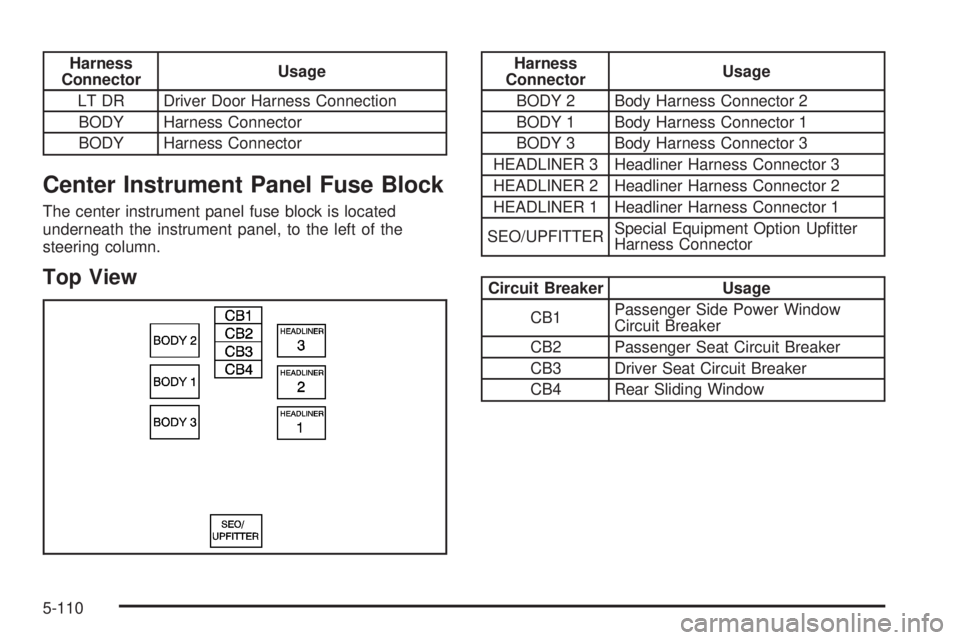
Center Instrument Panel Fuse Block
The center instrument panel fuse block is located
underneath the instrument panel, to the left of the
steering column.
Top View
Harness
ConnectorUsage
BODY 2 Body Harness Connector 2
BODY 1 Body Harness Connector 1
BODY 3 Body Harness Connector 3
HEADLINER 3 Headliner Harness Connector 3
HEADLINER 2 Headliner Harness Connector 2
HEADLINER 1 Headliner Harness Connector 1
SEO/UPFITTERSpecial Equipment Option Uptter
Harness Connector
Circuit Breaker Usage
CB1Passenger Side Power Window
Circuit Breaker
CB2 Passenger Seat Circuit Breaker
CB3 Driver Seat Circuit Breaker
CB4 Rear Sliding Window
5-110
Page 450 of 502
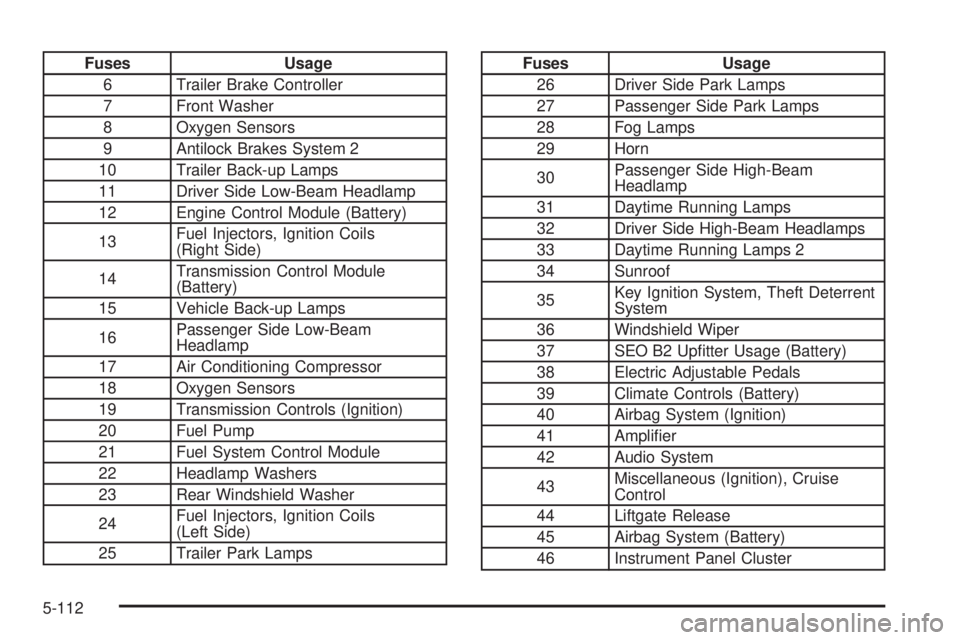
Fuses Usage
6 Trailer Brake Controller
7 Front Washer
8 Oxygen Sensors
9 Antilock Brakes System 2
10 Trailer Back-up Lamps
11 Driver Side Low-Beam Headlamp
12 Engine Control Module (Battery)
13Fuel Injectors, Ignition Coils
(Right Side)
14Transmission Control Module
(Battery)
15 Vehicle Back-up Lamps
16Passenger Side Low-Beam
Headlamp
17 Air Conditioning Compressor
18 Oxygen Sensors
19 Transmission Controls (Ignition)
20 Fuel Pump
21 Fuel System Control Module
22 Headlamp Washers
23 Rear Windshield Washer
24Fuel Injectors, Ignition Coils
(Left Side)
25 Trailer Park LampsFuses Usage
26 Driver Side Park Lamps
27 Passenger Side Park Lamps
28 Fog Lamps
29 Horn
30Passenger Side High-Beam
Headlamp
31 Daytime Running Lamps
32 Driver Side High-Beam Headlamps
33 Daytime Running Lamps 2
34 Sunroof
35Key Ignition System, Theft Deterrent
System
36 Windshield Wiper
37 SEO B2 Uptter Usage (Battery)
38 Electric Adjustable Pedals
39 Climate Controls (Battery)
40 Airbag System (Ignition)
41 Amplier
42 Audio System
43Miscellaneous (Ignition), Cruise
Control
44 Liftgate Release
45 Airbag System (Battery)
46 Instrument Panel Cluster
5-112
Page 472 of 502
Customer Assistance and
Information
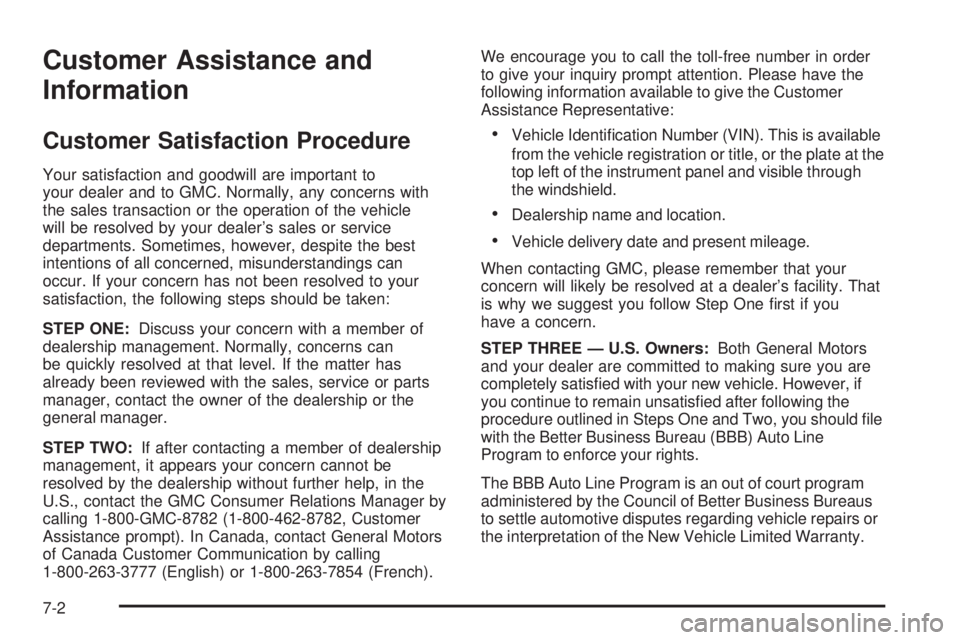
Customer Satisfaction Procedure
Your satisfaction and goodwill are important to
your dealer and to GMC. Normally, any concerns with
the sales transaction or the operation of the vehicle
will be resolved by your dealer’s sales or service
departments. Sometimes, however, despite the best
intentions of all concerned, misunderstandings can
occur. If your concern has not been resolved to your
satisfaction, the following steps should be taken:
STEP ONE:Discuss your concern with a member of
dealership management. Normally, concerns can
be quickly resolved at that level. If the matter has
already been reviewed with the sales, service or parts
manager, contact the owner of the dealership or the
general manager.
STEP TWO:If after contacting a member of dealership
management, it appears your concern cannot be
resolved by the dealership without further help, in the
U.S., contact the GMC Consumer Relations Manager by
calling 1-800-GMC-8782 (1-800-462-8782, Customer
Assistance prompt). In Canada, contact General Motors
of Canada Customer Communication by calling
1-800-263-3777 (English) or 1-800-263-7854 (French).We encourage you to call the toll-free number in order
to give your inquiry prompt attention. Please have the
following information available to give the Customer
Assistance Representative:
Vehicle Identication Number (VIN). This is available
from the vehicle registration or title, or the plate at the
top left of the instrument panel and visible through
the windshield.
Dealership name and location.
Vehicle delivery date and present mileage.
When contacting GMC, please remember that your
concern will likely be resolved at a dealer’s facility. That
is why we suggest you follow Step One rst if you
have a concern.
STEP THREE — U.S. Owners:Both General Motors
and your dealer are committed to making sure you are
completely satised with your new vehicle. However, if
you continue to remain unsatised after following the
procedure outlined in Steps One and Two, you should le
with the Better Business Bureau (BBB) Auto Line
Program to enforce your rights.
The BBB Auto Line Program is an out of court program
administered by the Council of Better Business Bureaus
to settle automotive disputes regarding vehicle repairs or
the interpretation of the New Vehicle Limited Warranty.
7-2
Page 489 of 502
A
Accessories and Modications............................ 5-3
Adding Equipment to Your Airbag-Equipped
Vehicle.......................................................1-90
Additives, Fuel................................................. 5-6
Add-On Electrical Equipment...........................5-108
Adjustable Throttle and Brake Pedal..................2-29
Air Cleaner/Filter, Engine.................................5-17
Air Conditioning..............................................3-23
Airbag
Passenger Status Indicator...........................3-35
Readiness Light..........................................3-34
Airbag System................................................1-75
What Will You See After an Airbag Inates?....1-84
When Should an Airbag Inate?....................1-81
Where Are the Airbags?...............................1-78
Airbag Systems
Adding Equipment to Your Airbag-Equipped
Vehicle...................................................1-90
How Does an Airbag Restrain?......................1-83
Passenger Sensing System...........................1-85
Servicing Your Airbag-Equipped Vehicle..........1-90
What Makes an Airbag Inate?......................1-83
All-Wheel Drive...............................................5-45
All-Wheel-Drive (AWD) System........................... 4-8
Antenna, Rear Side Window...........................3-119
Antenna, XM™ Satellite Radio Antenna System . . . 3-119
Antilock Brake System (ABS)............................. 4-4
Antilock Brake, System Warning Light................3-40Appearance Care
Aluminum Wheels......................................5-104
Care of Safety Belts...................................5-101
Chemical Paint Spotting..............................5-105
Cleaning Exterior Lamps/Lenses..................5-102
Fabric/Carpet............................................5-100
Finish Care...............................................5-102
Finish Damage..........................................5-105
Instrument Panel, Vinyl, and Other Plastic
Surfaces...............................................5-101
Interior Cleaning..........................................5-98
Leather....................................................5-100
Sheet Metal Damage..................................5-105
Speaker Covers.........................................5-101
Tires........................................................5-104
Underbody Maintenance.............................5-105
Vehicle Care/Appearance Materials...............5-106
Washing Your Vehicle.................................5-102
Weatherstrips............................................5-101
Windshield, Backglass, and Wiper Blades......5-103
Wood Panels............................................5-101
Appointments, Scheduling Service....................... 7-8
Ashtray.........................................................3-22
Audio System.................................................3-73
Audio Steering Wheel Controls....................3-117
Navigation/Radio System, see Navigation
Manual.................................................3-105
Radio Reception........................................3-118
Rear Seat Audio (RSA)...............................3-115
Setting the Clock.........................................3-74
1
Page 491 of 502
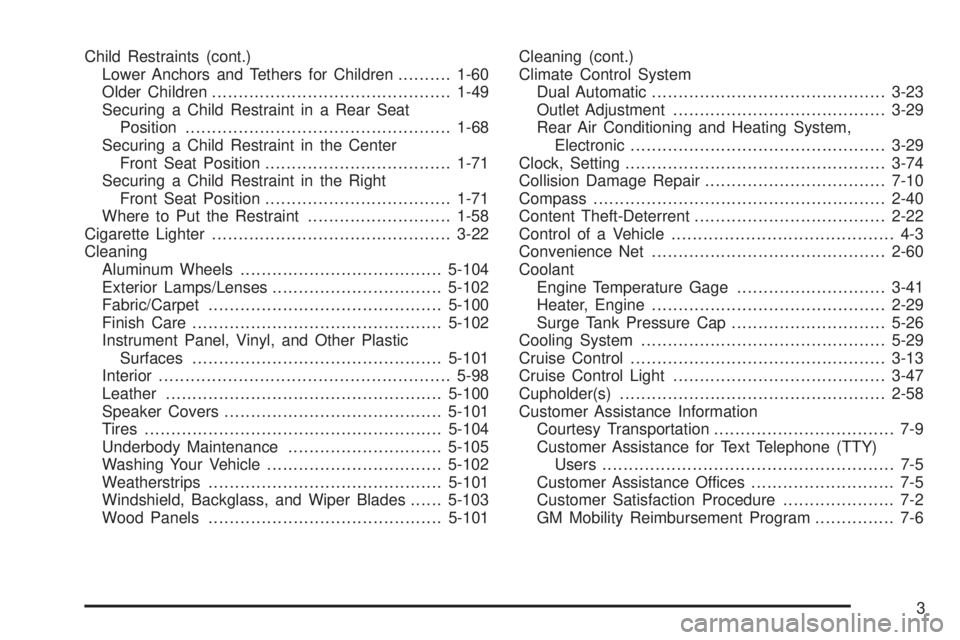
Child Restraints (cont.)
Lower Anchors and Tethers for Children..........1-60
Older Children.............................................1-49
Securing a Child Restraint in a Rear Seat
Position..................................................1-68
Securing a Child Restraint in the Center
Front Seat Position...................................1-71
Securing a Child Restraint in the Right
Front Seat Position...................................1-71
Where to Put the Restraint...........................1-58
Cigarette Lighter.............................................3-22
Cleaning
Aluminum Wheels......................................5-104
Exterior Lamps/Lenses................................5-102
Fabric/Carpet............................................5-100
Finish Care...............................................5-102
Instrument Panel, Vinyl, and Other Plastic
Surfaces...............................................5-101
Interior.......................................................5-98
Leather....................................................5-100
Speaker Covers.........................................5-101
Tires........................................................5-104
Underbody Maintenance.............................5-105
Washing Your Vehicle.................................5-102
Weatherstrips............................................5-101
Windshield, Backglass, and Wiper Blades......5-103
Wood Panels............................................5-101Cleaning (cont.)
Climate Control System
Dual Automatic............................................3-23
Outlet Adjustment........................................3-29
Rear Air Conditioning and Heating System,
Electronic................................................3-29
Clock, Setting.................................................3-74
Collision Damage Repair..................................7-10
Compass.......................................................2-40
Content Theft-Deterrent....................................2-22
Control of a Vehicle.......................................... 4-3
Convenience Net............................................2-60
Coolant
Engine Temperature Gage............................
3-41
Heater, Engine............................................2-29
Surge Tank Pressure Cap.............................5-26
Cooling System..............................................5-29
Cruise Control................................................3-13
Cruise Control Light........................................3-47
Cupholder(s)..................................................2-58
Customer Assistance Information
Courtesy Transportation.................................. 7-9
Customer Assistance for Text Telephone (TTY)
Users....................................................... 7-5
Customer Assistance Offices........................... 7-5
Customer Satisfaction Procedure..................... 7-2
GM Mobility Reimbursement Program............... 7-6
3
Page 492 of 502
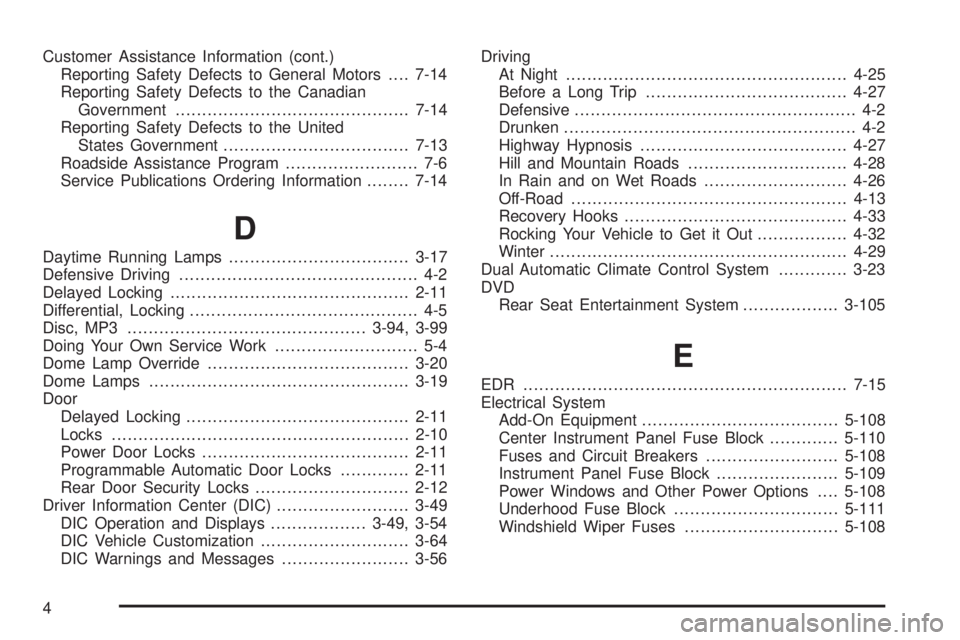
Customer Assistance Information (cont.)
Reporting Safety Defects to General Motors....7-14
Reporting Safety Defects to the Canadian
Government............................................7-14
Reporting Safety Defects to the United
States Government...................................7-13
Roadside Assistance Program......................... 7-6
Service Publications Ordering Information........7-14
D
Daytime Running Lamps..................................3-17
Defensive Driving............................................. 4-2
Delayed Locking.............................................2-11
Differential, Locking........................................... 4-5
Disc, MP3.............................................3-94, 3-99
Doing Your Own Service Work........................... 5-4
Dome Lamp Override......................................3-20
Dome Lamps.................................................3-19
Door
Delayed Locking..........................................2-11
Locks........................................................2-10
Power Door Locks.......................................2-11
Programmable Automatic Door Locks.............2-11
Rear Door Security Locks.............................2-12
Driver Information Center (DIC).........................3-49
DIC Operation and Displays..................3-49, 3-54
DIC Vehicle Customization............................3-64
DIC Warnings and Messages........................3-56Driving
At Night.....................................................4-25
Before a Long Trip......................................4-27
Defensive..................................................... 4-2
Drunken....................................................... 4-2
Highway Hypnosis.......................................4-27
Hill and Mountain Roads..............................4-28
In Rain and on Wet Roads...........................4-26
Off-Road....................................................4-13
Recovery Hooks..........................................4-33
Rocking Your Vehicle to Get it Out.................4-32
Winter........................................................4-29
Dual Automatic Climate Control System.............3-23
DVD
Rear Seat Entertainment System..................3-105
E
EDR .............................................................7-15
Electrical System
Add-On Equipment.....................................5-108
Center Instrument Panel Fuse Block.............5-110
Fuses and Circuit Breakers.........................5-108
Instrument Panel Fuse Block.......................5-109
Power Windows and Other Power Options....5-108
Underhood Fuse Block...............................5-111
Windshield Wiper Fuses.............................5-108
4