check oil GMC YUKON DENALI 2010 User Guide
[x] Cancel search | Manufacturer: GMC, Model Year: 2010, Model line: YUKON DENALI, Model: GMC YUKON DENALI 2010Pages: 560, PDF Size: 4.32 MB
Page 398 of 560
At a minimum, E85 should meet ASTM Specification
D 5798. By definition, this means that fuel labeled E85
will have an ethanol content between 70% and 85%.
Filling the fuel tank with fuel mixtures that do not meet
ASTM specifications can affect driveability and could
cause the malfunction indicator lamp to come on.
To ensure quick starts in the wintertime, the E85 fuel
must be formulated properly for your climate according
to ASTM specification D 5798. If you have trouble
starting on E85, it could be because the E85 fuel is not
properly formulated for your climate. If this happens,
switching to gasoline or adding gasoline to the fuel tank
can improve starting. For good starting and heater
efficiency below 0°C (32°F), the fuel mix in the fuel tank
should contain no more than 70% ethanol. It is best
not to alternate repeatedly between gasoline and E85.
If you do switch fuels, it is recommended that you
add as much fuel as possible—do not add less than
11 L (three gallons) when refueling. You should drive
the vehicle immediately after refueling for at least
11 km (seven miles) to allow the vehicle to adapt to
the change in ethanol concentration.
E85 has less energy per gallon than gasoline, so you
will need to refill the fuel tank more often when using
E85 than when you are using gasoline. See Filling the
Tank on page 6‑9. Notice:
Some additives are not compatible with E85
fuel and can harm the vehicle's fuel system. Do not
add anything to E85. Damage caused by additives
would not be covered by the vehicle warranty.
Notice: This vehicle was not designed for fuel that
contains methanol. Do not use fuel containing
methanol. It can corrode metal parts in the fuel
system and also damage plastic and rubber parts.
That damage would not be covered under the
vehicle warranty.
Fuels in Foreign Countries
If you plan on driving in another country outside the
United States or Canada, the proper fuel might be hard
to find. Never use leaded gasoline or any other fuel not
recommended in the previous text on fuel. Costly
repairs caused by use of improper fuel would not be
covered by the vehicle warranty.
To check the fuel availability, ask an auto club,
or contact a major oil company that does business in
the country where you will be driving.
6-8
Page 402 of 560
Checking Things Under
the Hood
{WARNING:
An electric fan under the hood can start up and
injure you even when the engine is not running.
Keep hands, clothing, and tools away from any
underhood electric fan.
{WARNING:
Things that burn can get on hot engine parts and
start a fire. These include liquids like fuel, oil,
coolant, brake fluid, windshield washer and other
fluids, and plastic or rubber. You or others could
be burned. Be careful not to drop or spill things
that will burn onto a hot engine.
Hood Release
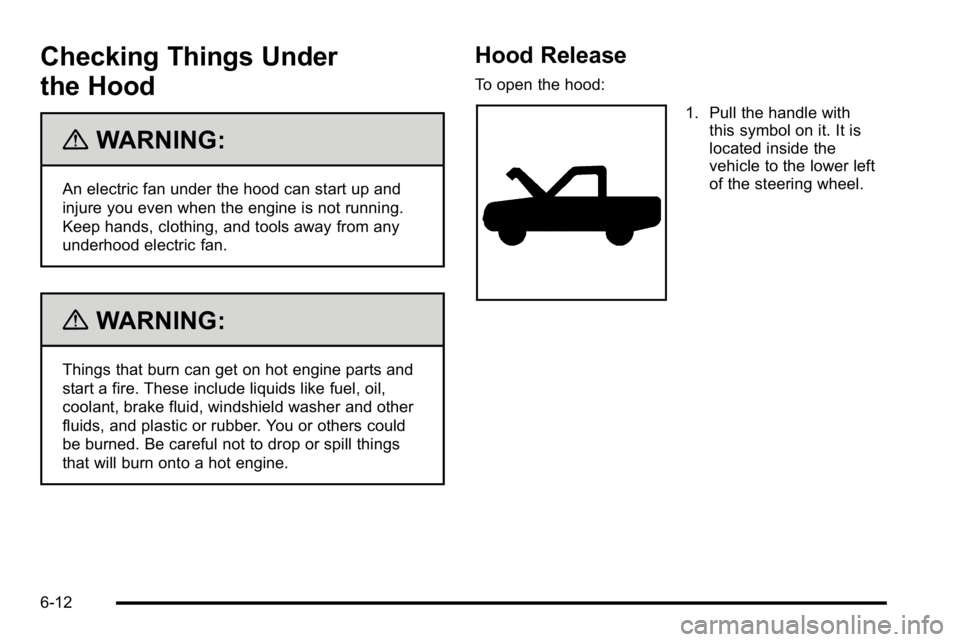
To open the hood:
1. Pull the handle withthis symbol on it. It is
located inside the
vehicle to the lower left
of the steering wheel.
6-12
Page 405 of 560
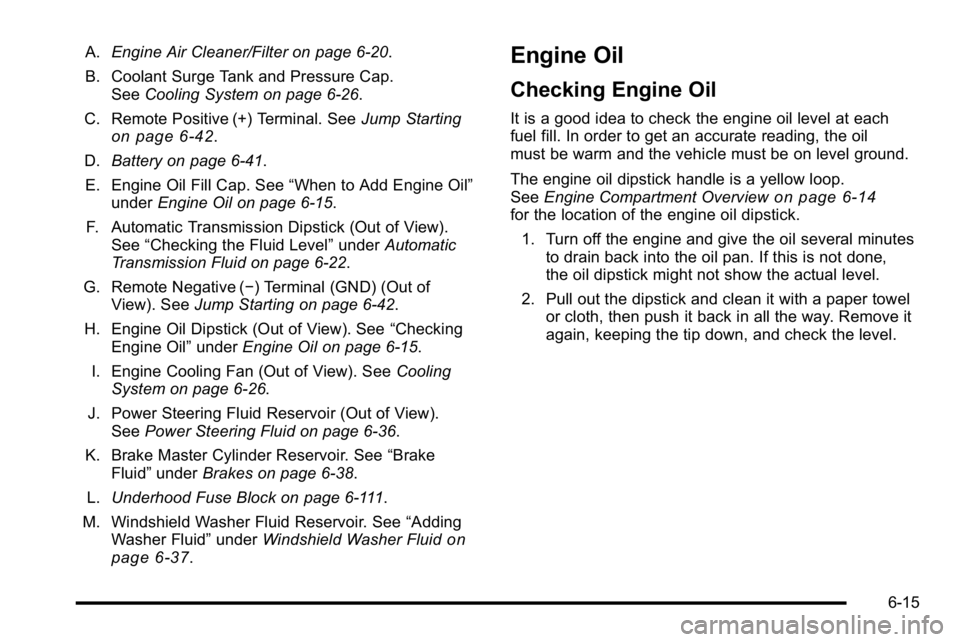
A.Engine Air Cleaner/Filter on page 6‑20.
B. Coolant Surge Tank and Pressure Cap. See Cooling System on page 6‑26.
C. Remote Positive (+) Terminal. See Jump Starting
on page 6‑42.
D. Battery on page 6‑41.
E. Engine Oil Fill Cap. See “When to Add Engine Oil”
under Engine Oil on page 6‑15.
F. Automatic Transmission Dipstick (Out of View). See “Checking the Fluid Level” underAutomatic
Transmission Fluid on page 6‑22.
G. Remote Negative (−) Terminal (GND) (Out of View). See Jump Starting on page 6‑42.
H. Engine Oil Dipstick (Out of View). See “Checking
Engine Oil” underEngine Oil on page 6‑15.
I. Engine Cooling Fan (Out of View). See Cooling
System on page 6‑26.
J. Power Steering Fluid Reservoir (Out of View). See Power Steering Fluid on page 6‑36.
K. Brake Master Cylinder Reservoir. See “Brake
Fluid” under Brakes on page 6‑38.
L. Underhood Fuse Block on page 6‑111.
M. Windshield Washer Fluid Reservoir. See “Adding
Washer Fluid” underWindshield Washer Fluid
on
page 6‑37.
Engine Oil
Checking Engine Oil
It is a good idea to check the engine oil level at each
fuel fill. In order to get an accurate reading, the oil
must be warm and the vehicle must be on level ground.
The engine oil dipstick handle is a yellow loop.
See Engine Compartment Overview
on page 6‑14for the location of the engine oil dipstick.
1. Turn off the engine and give the oil several minutes to drain back into the oil pan. If this is not done,
the oil dipstick might not show the actual level.
2. Pull out the dipstick and clean it with a paper towel or cloth, then push it back in all the way. Remove it
again, keeping the tip down, and check the level.
6-15
Page 408 of 560
Engine Oil Life System
When to Change Engine Oil
This vehicle has a computer system that indicates when
to change the engine oil and filter. This is based on
engine revolutions and engine temperature, and not on
mileage. Based on driving conditions, the mileage at
which an oil change is indicated can vary considerably.
For the oil life system to work properly, the system must
be reset every time the oil is changed.
On some vehicles, when the system has calculated that
oil life has been diminished, a CHANGE ENGINE OIL
SOON message comes on to indicate that an oil
change is necessary. SeeDIC Warnings and Messages
on page 4‑56. Change the oil as soon as possible
within the next 1 000 km (600 miles). It is possible that,
if driving under the best conditions, the oil life system
might not indicate that an oil change is necessary
for over a year. However, the engine oil and filter
must be changed at least once a year and at this
time the system must be reset. For vehicles without
the CHANGE ENGINE OIL SOON message. An oil change is needed when the OIL LIFE
REMAINING percentage is near 0%. Your dealer/
retailer has trained service people who will perform
this work using genuine parts and reset the system.
It is also important to check the oil regularly and keep it
at the proper level.
If the system is ever reset accidentally, the oil must be
changed at 5 000 km (3,000 miles) since the last oil
change. Remember to reset the oil life system
whenever the oil is changed.
How to Reset the Engine Oil Life
System
The Engine Oil Life System calculates when to
change the engine oil and filter based on vehicle use.
Whenever the oil is changed, reset the system so it can
calculate when the next oil change is required. If a
situation occurs where the oil is changed prior to a
CHANGE ENGINE OIL SOON message coming on,
reset the system.
6-18
Page 419 of 560
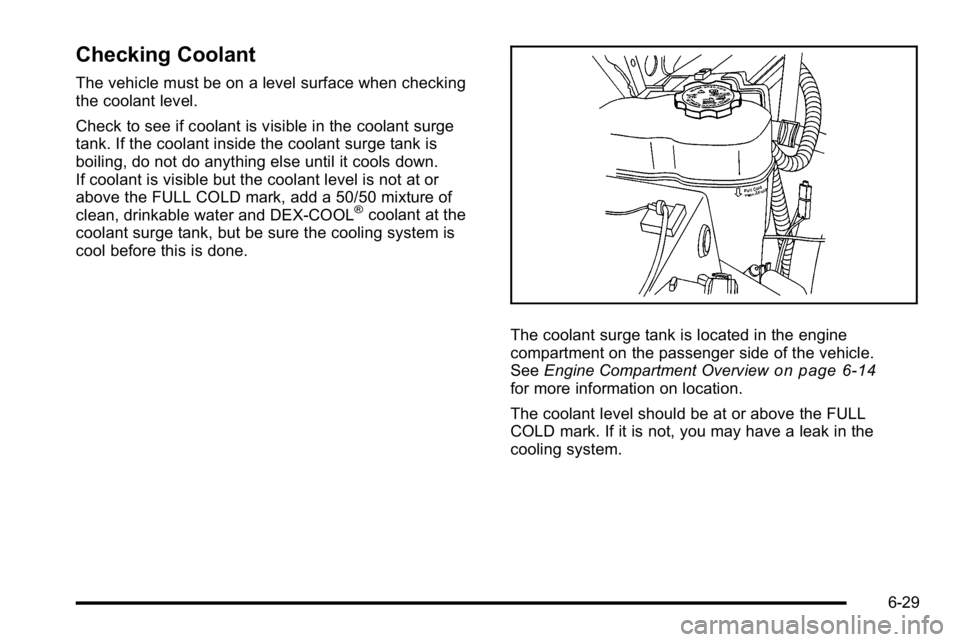
Checking Coolant
The vehicle must be on a level surface when checking
the coolant level.
Check to see if coolant is visible in the coolant surge
tank. If the coolant inside the coolant surge tank is
boiling, do not do anything else until it cools down.
If coolant is visible but the coolant level is not at or
above the FULL COLD mark, add a 50/50 mixture of
clean, drinkable water and DEX-COOL
®coolant at the
coolant surge tank, but be sure the cooling system is
cool before this is done.
The coolant surge tank is located in the engine
compartment on the passenger side of the vehicle.
See Engine Compartment Overview
on page 6‑14for more information on location.
The coolant level should be at or above the FULL
COLD mark. If it is not, you may have a leak in the
cooling system.
6-29
Page 429 of 560
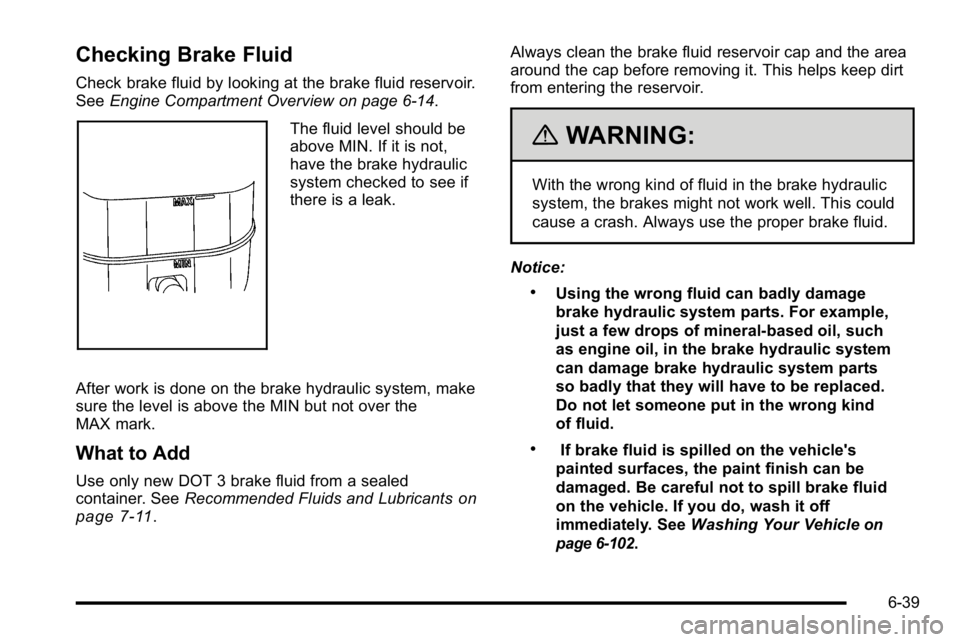
Checking Brake Fluid
Check brake fluid by looking at the brake fluid reservoir.
SeeEngine Compartment Overview on page 6‑14.
The fluid level should be
above MIN. If it is not,
have the brake hydraulic
system checked to see if
there is a leak.
After work is done on the brake hydraulic system, make
sure the level is above the MIN but not over the
MAX mark.
What to Add
Use only new DOT 3 brake fluid from a sealed
container. See Recommended Fluids and Lubricantson
page 7‑11. Always clean the brake fluid reservoir cap and the area
around the cap before removing it. This helps keep dirt
from entering the reservoir.
{WARNING:
With the wrong kind of fluid in the brake hydraulic
system, the brakes might not work well. This could
cause a crash. Always use the proper brake fluid.
Notice:
.Using the wrong fluid can badly damage
brake hydraulic system parts. For example,
just a few drops of mineral-based oil, such
as engine oil, in the brake hydraulic system
can damage brake hydraulic system parts
so badly that they will have to be replaced.
Do not let someone put in the wrong kind
of fluid.
.If brake fluid is spilled on the vehicle's
painted surfaces, the paint finish can be
damaged. Be careful not to spill brake fluid
on the vehicle. If you do, wash it off
immediately. See Washing Your Vehicle
on
page 6‑102
.
6-39
Page 488 of 560
Spare Tire
Your vehicle, when new, had a fully-inflated spare tire.
A spare tire may lose air over time, so check its inflation
pressure regularly. SeeInflation - Tire Pressure
on
page 6‑64and Loading the Vehicleon page 5‑31for
information regarding proper tire inflation and loading
your vehicle. For instruction on how to remove, install or
store a spare tire, see Removing the Flat Tire and
Installing the Spare Tire
on page 6‑86and Storing a
Flat or Spare Tire and Tools on page 6‑94.
After installing the spare tire on your vehicle, you should
stop as soon as possible and make sure the spare is
correctly inflated. The spare tire is made to perform well
at speeds up to 70 mph (112 km/h) at the recommended
inflation pressure, so you can finish your trip.
Have the damaged or flat road tire repaired or replaced
as soon as you can and installed back onto your
vehicle. This way, a spare tire will be available in case
you need it again. Do not mix tires and wheels of
different sizes, because they will not fit. Keep your
spare tire and its wheel together.
Appearance Care
Interior Cleaning
The vehicle's interior will continue to look its best if it is
cleaned often. Although not always visible, dust and
dirt can accumulate on the upholstery. Dirt can damage
carpet, fabric, leather, and plastic surfaces. Regular
vacuuming is recommended to remove particles from
the upholstery. It is important to keep the upholstery
from becoming and remaining heavily soiled.
Soils should be removed as quickly as possible.
The vehicle's interior may experience extremes of
heat that could cause stains to set rapidly.
Lighter colored interiors may require more frequent
cleaning. Use care because newspapers and garments
that transfer color to home furnishings may also transfer
color to the vehicle's interior.
6-98
Page 505 of 560
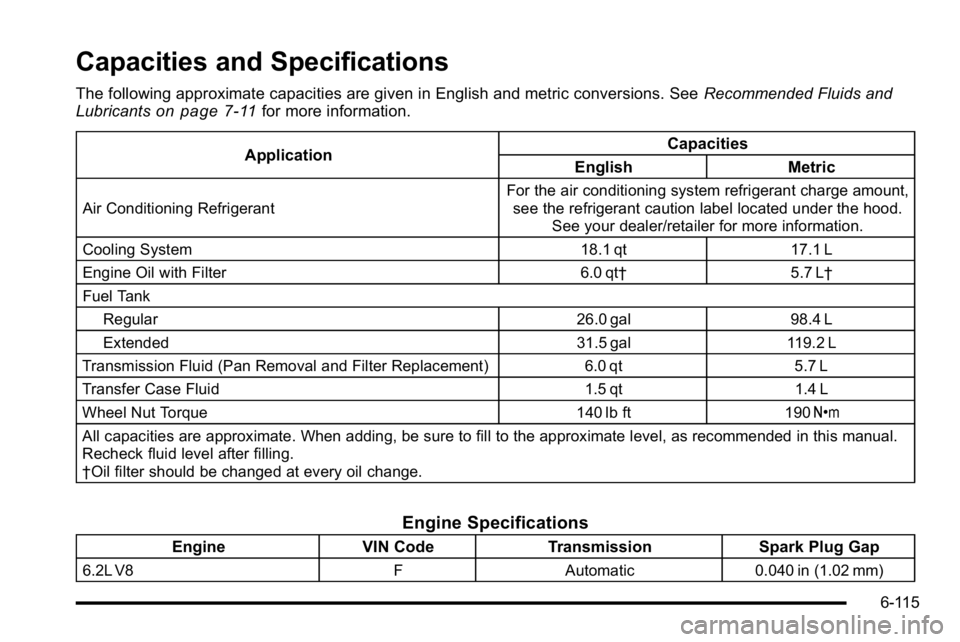
Capacities and Specifications
The following approximate capacities are given in English and metric conversions. SeeRecommended Fluids and
Lubricantson page 7‑11for more information.
Application Capacities
English Metric
Air Conditioning Refrigerant For the air conditioning system refrigerant charge amount,
see the refrigerant caution label located under the hood. See your dealer/retailer for more information.
Cooling System 18.1 qt17.1 L
Engine Oil with Filter 6.0 qt†5.7 L†
Fuel Tank Regular 26.0 gal98.4 L
Extended 31.5 gal119.2 L
Transmission Fluid (Pan Removal and Filter Replacement) 6.0 qt5.7 L
Transfer Case Fluid 1.5 qt1.4 L
Wheel Nut Torque 140 lb ft190Y
All capacities are approximate. When adding, be sure to fill to the approximate level, as recommended in this manual.
Recheck fluid level after filling.
†Oil filter should be changed at every oil change.
Engine Specifications
Engine VIN CodeTransmission Spark Plug Gap
6.2L V8 FAutomatic 0.040 in (1.02 mm)
6-115
Page 510 of 560
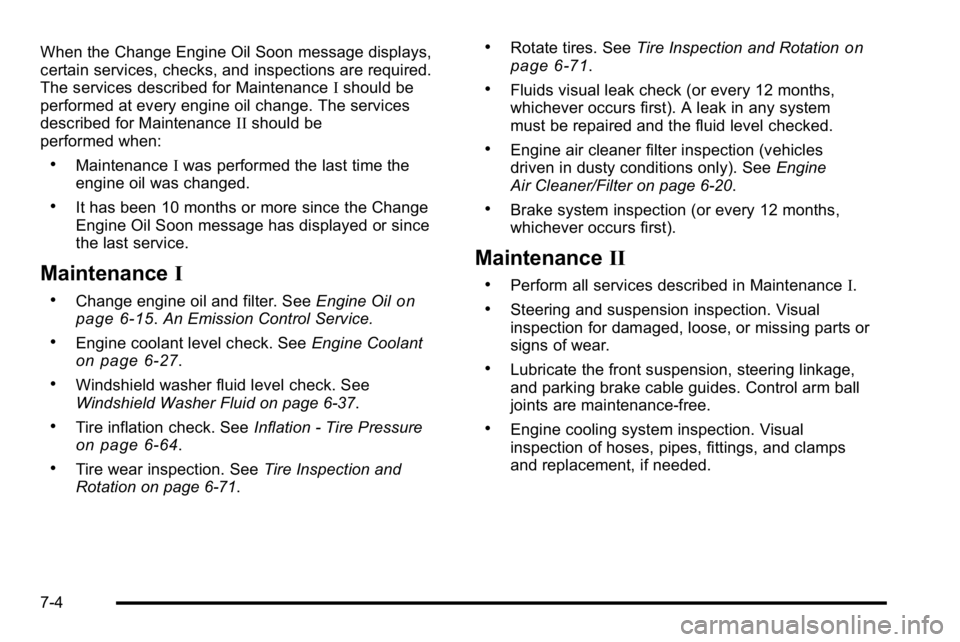
When the Change Engine Oil Soon message displays,
certain services, checks, and inspections are required.
The services described for MaintenanceIshould be
performed at every engine oil change. The services
described for Maintenance IIshould be
performed when:
.Maintenance Iwas performed the last time the
engine oil was changed.
.It has been 10 months or more since the Change
Engine Oil Soon message has displayed or since
the last service.
Maintenance I
.Change engine oil and filter. See Engine Oilon
page 6‑15. An Emission Control Service.
.Engine coolant level check. See Engine Coolanton page 6‑27.
.Windshield washer fluid level check. See
Windshield Washer Fluid on page 6‑37.
.Tire inflation check. SeeInflation - Tire Pressureon page 6‑64.
.Tire wear inspection. See Tire Inspection and
Rotation on page 6‑71.
.Rotate tires. See Tire Inspection and Rotationon
page 6‑71.
.Fluids visual leak check (or every 12 months,
whichever occurs first). A leak in any system
must be repaired and the fluid level checked.
.Engine air cleaner filter inspection (vehicles
driven in dusty conditions only). See Engine
Air Cleaner/Filter on page 6‑20.
.Brake system inspection (or every 12 months,
whichever occurs first).
Maintenance II
.Perform all services described in Maintenance I.
.Steering and suspension inspection. Visual
inspection for damaged, loose, or missing parts or
signs of wear.
.Lubricate the front suspension, steering linkage,
and parking brake cable guides. Control arm ball
joints are maintenance‐free.
.Engine cooling system inspection. Visual
inspection of hoses, pipes, fittings, and clamps
and replacement, if needed.
7-4
Page 511 of 560
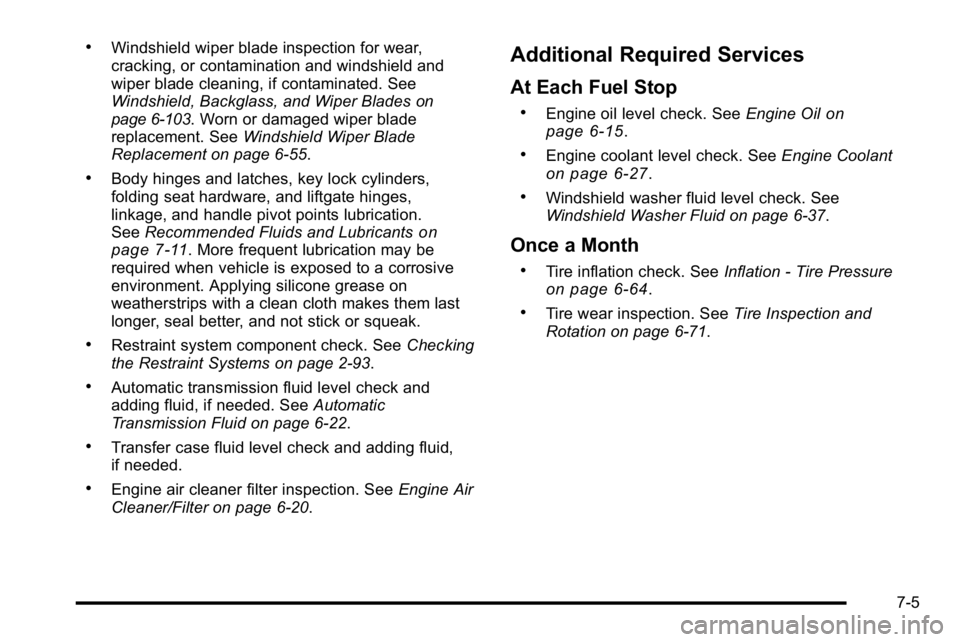
.Windshield wiper blade inspection for wear,
cracking, or contamination and windshield and
wiper blade cleaning, if contaminated. See
Windshield, Backglass, and Wiper Blades
on
page 6‑103. Worn or damaged wiper blade
replacement. See Windshield Wiper Blade
Replacement on page 6‑55.
.Body hinges and latches, key lock cylinders,
folding seat hardware, and liftgate hinges,
linkage, and handle pivot points lubrication.
See Recommended Fluids and Lubricants
on
page 7‑11. More frequent lubrication may be
required when vehicle is exposed to a corrosive
environment. Applying silicone grease on
weatherstrips with a clean cloth makes them last
longer, seal better, and not stick or squeak.
.Restraint system component check. See Checking
the Restraint Systems on page 2‑93.
.Automatic transmission fluid level check and
adding fluid, if needed. See Automatic
Transmission Fluid on page 6‑22.
.Transfer case fluid level check and adding fluid,
if needed.
.Engine air cleaner filter inspection. See Engine Air
Cleaner/Filter on page 6‑20.
Additional Required Services
At Each Fuel Stop
.Engine oil level check. See Engine Oilon
page 6‑15.
.Engine coolant level check. See Engine Coolanton page 6‑27.
.Windshield washer fluid level check. See
Windshield Washer Fluid on page 6‑37.
Once a Month
.Tire inflation check. SeeInflation - Tire Pressureon page 6‑64.
.Tire wear inspection. See Tire Inspection and
Rotation on page 6‑71.
7-5