cooling GMC YUKON HYBRID 2010 Owners Manual
[x] Cancel search | Manufacturer: GMC, Model Year: 2010, Model line: YUKON HYBRID, Model: GMC YUKON HYBRID 2010Pages: 120, PDF Size: 1.03 MB
Page 40 of 120
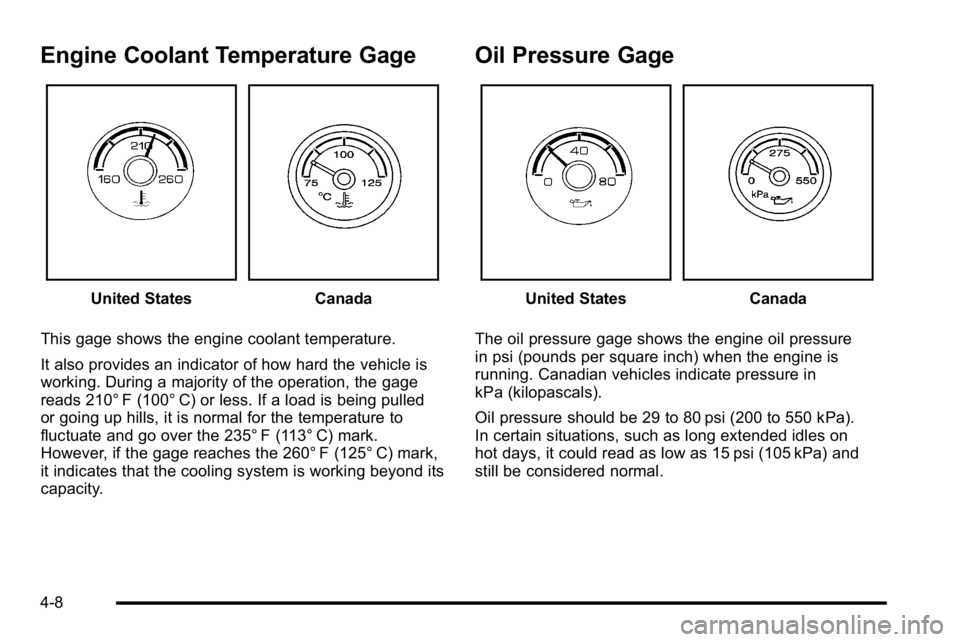
Engine Coolant Temperature Gage
United StatesCanada
This gage shows the engine coolant temperature.
It also provides an indicator of how hard the vehicle is
working. During a majority of the operation, the gage
reads 210° F (100° C) or less. If a load is being pulled
or going up hills, it is normal for the temperature to
fluctuate and go over the 235° F (113° C) mark.
However, if the gage reaches the 260° F (125° C) mark,
it indicates that the cooling system is working beyond its
capacity.
Oil Pressure Gage
United StatesCanada
The oil pressure gage shows the engine oil pressure
in psi (pounds per square inch) when the engine is
running. Canadian vehicles indicate pressure in
kPa (kilopascals).
Oil pressure should be 29 to 80 psi (200 to 550 kPa).
In certain situations, such as long extended idles on
hot days, it could read as low as 15 psi (105 kPa) and
still be considered normal.
4-8
Page 57 of 120
Section 6 Service and Appearance Care
Service. . . . . . . . . . . . . . . . . . . . . . . . . . . . . . . . . . . . . . . . . . . . . 6-2
Doing Your Own Service Work . . . . . . . . . . . . . . . . . . 6-2
Checking Things Under the Hood . . . . . . . . . . . . . . . . .6-3
High Voltage Devices and Wiring . . . . . . . . . . . . . . . 6-3
Engine Compartment Overview . . . . . . . . . . . . . . . . . 6-4
Automatic Transmission Fluid . . . . . . . . . . . . . . . . . . . 6-5
Drive Motor/Generator Control Module (DMCM) Coolant Surge Tank Pressure Cap . . . . . . . . . . . . 6-8
Drive Motor/Generator Control Module (DMCM) Cooling System . . . . . . . . . . . . . . . . . . . . . . . . . . . . . . . 6-9
Power Steering Fluid . . . . . . . . . . . . . . . . . . . . . . . . . . 6-13
Brakes . . . . . . . . . . . . . . . . . . . . . . . . . . . . . . . . . . . . . . . . . 6-13
Battery . . . . . . . . . . . . . . . . . . . . . . . . . . . . . . . . . . . . . . . . . 6-16
Jump Starting . . . . . . . . . . . . . . . . . . . . . . . . . . . . . . . . . . 6-18
Bulb Replacement . . . . . . . . . . . . . . . . . . . . . . . . . . . . . . . . 6-24
Taillamps, Turn Signal, Stoplamps and Back-up Lamps . . . . . . . . . . . . . . . . . . . . . . . . . . . . . . 6-24
Replacement Bulbs . . . . . . . . . . . . . . . . . . . . . . . . . . . . 6-25 Electrical System
. . . . . . . . . . . . . . . . . . . . . . . . . . . . . . . . . 6-25
High Voltage Devices and Wiring . . . . . . . . . . . . . . 6-25
Fuses and Circuit Breakers . . . . . . . . . . . . . . . . . . . . 6-26
Underhood Fuse Block . . . . . . . . . . . . . . . . . . . . . . . . 6-26
Tires . . . . . . . . . . . . . . . . . . . . . . . . . . . . . . . . . . . . . . . . . . . . . . . 6-28
Inflation - Tire Pressure . . . . . . . . . . . . . . . . . . . . . . . . 6-28
Tire Pressure Monitor Operation . . . . . . . . . . . . . . . 6-29
Tire Inspection and Rotation . . . . . . . . . . . . . . . . . . . 6-33
Tire Chains . . . . . . . . . . . . . . . . . . . . . . . . . . . . . . . . . . . . 6-34
If a Tire Goes Flat . . . . . . . . . . . . . . . . . . . . . . . . . . . . . 6-34
Tire Sealant and Compressor Kit (Without Selector Switch) . . . . . . . . . . . . . . . . . . . . 6-35
Tire Sealant and Compressor Kit (With Selector Switch) . . . . . . . . . . . . . . . . . . . . . . . 6-45
Tire Sealant and Compressor Kit Storage . . . . . . 6-55
Appearance Care . . . . . . . . . . . . . . . . . . . . . . . . . . . . . . . . . 6-56
Vehicle Care/Appearance Materials . . . . . . . . . . . . 6-56
Capacities and Specifications . . . . . . . . . . . . . . . . . . .6-57
6-1
Page 61 of 120
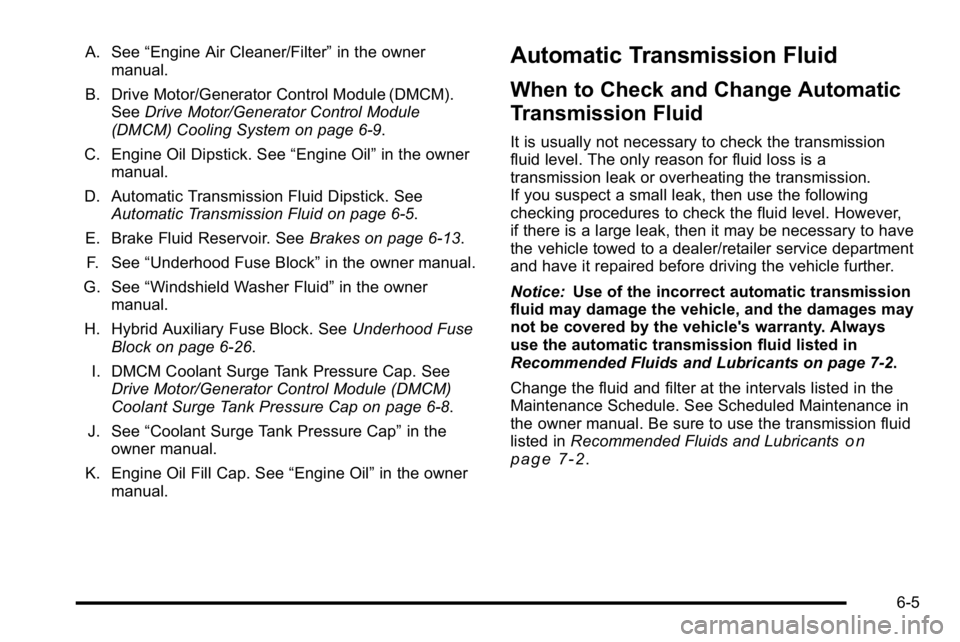
A. See“Engine Air Cleaner/Filter” in the owner
manual.
B. Drive Motor/Generator Control Module (DMCM). See Drive Motor/Generator Control Module
(DMCM) Cooling System on page 6‑9.
C. Engine Oil Dipstick. See “Engine Oil”in the owner
manual.
D. Automatic Transmission Fluid Dipstick. See Automatic Transmission Fluid on page 6‑5.
E. Brake Fluid Reservoir. See Brakes on page 6‑13.
F. See “Underhood Fuse Block” in the owner manual.
G. See “Windshield Washer Fluid” in the owner
manual.
H. Hybrid Auxiliary Fuse Block. See Underhood Fuse
Block on page 6‑26.
I. DMCM Coolant Surge Tank Pressure Cap. See Drive Motor/Generator Control Module (DMCM)
Coolant Surge Tank Pressure Cap on page 6‑8.
J. See “Coolant Surge Tank Pressure Cap” in the
owner manual.
K. Engine Oil Fill Cap. See “Engine Oil”in the owner
manual.Automatic Transmission Fluid
When to Check and Change Automatic
Transmission Fluid
It is usually not necessary to check the transmission
fluid level. The only reason for fluid loss is a
transmission leak or overheating the transmission.
If you suspect a small leak, then use the following
checking procedures to check the fluid level. However,
if there is a large leak, then it may be necessary to have
the vehicle towed to a dealer/retailer service department
and have it repaired before driving the vehicle further.
Notice: Use of the incorrect automatic transmission
fluid may damage the vehicle, and the damages may
not be covered by the vehicle's warranty. Always
use the automatic transmission fluid listed in
Recommended Fluids and Lubricants on page 7‑2.
Change the fluid and filter at the intervals listed in the
Maintenance Schedule. See Scheduled Maintenance in
the owner manual. Be sure to use the transmission fluid
listed in Recommended Fluids and Lubricants
on
page 7‑2.
6-5
Page 65 of 120
The Drive Motor/Generator Control Module (DMCM)
coolant surge tank pressure cap must be fully installed
on the hybrid coolant surge tank.
Notice:If the pressure cap is not tightly installed,
coolant loss and possible damage to the Drive
Motor/Generator Control Module (DMCM) may occur.
Be sure the cap is properly and tightly secured.
Drive Motor/Generator Control
Module (DMCM) Cooling System
In addition to the regular cooling system, the vehicle
also has a cooling system for the DMCM system.
This system is serviced differently than the vehicle's
main cooling system. The DMCM cooling system
includes the DMCM coolant surge tank, DMCM surge
tank pressure cap, DMCM cooling pumps, hybrid
cooling radiator and the Drive Motor/Generator Control
Module (DMCM). The DMCM cooling system uses a
50/50 pre-mixed DEX-COOL™ coolant and deionized
water available at your dealer/retailer. See “Engine
Coolant” and“Cooling System” in the owner manual for
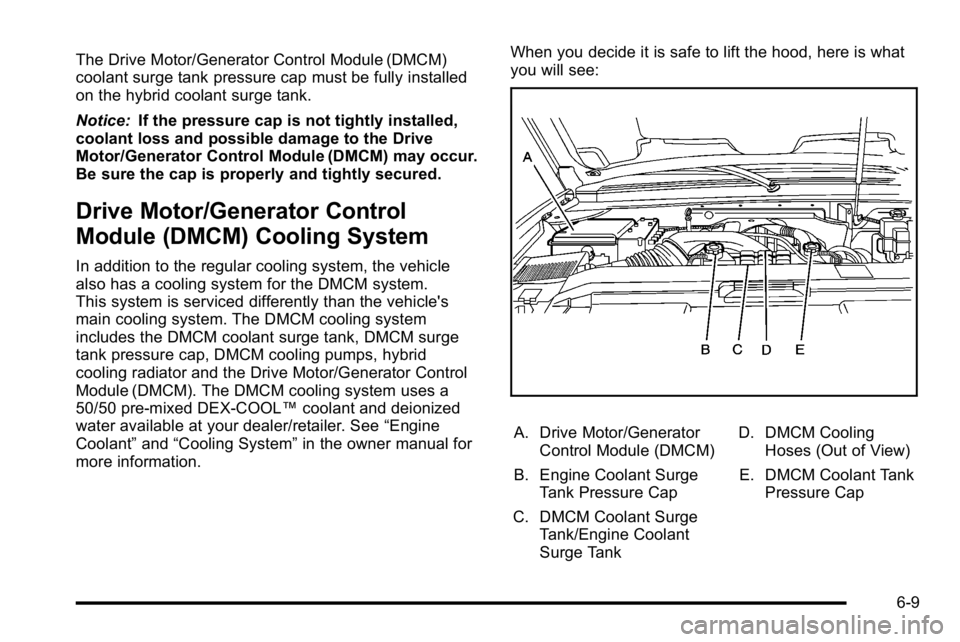
more information. When you decide it is safe to lift the hood, here is what
you will see:
A. Drive Motor/Generator
Control Module (DMCM)
B. Engine Coolant Surge Tank Pressure Cap
C. DMCM Coolant Surge Tank/Engine Coolant
Surge Tank D. DMCM Cooling
Hoses (Out of View)
E. DMCM Coolant Tank Pressure Cap
6-9
Page 66 of 120
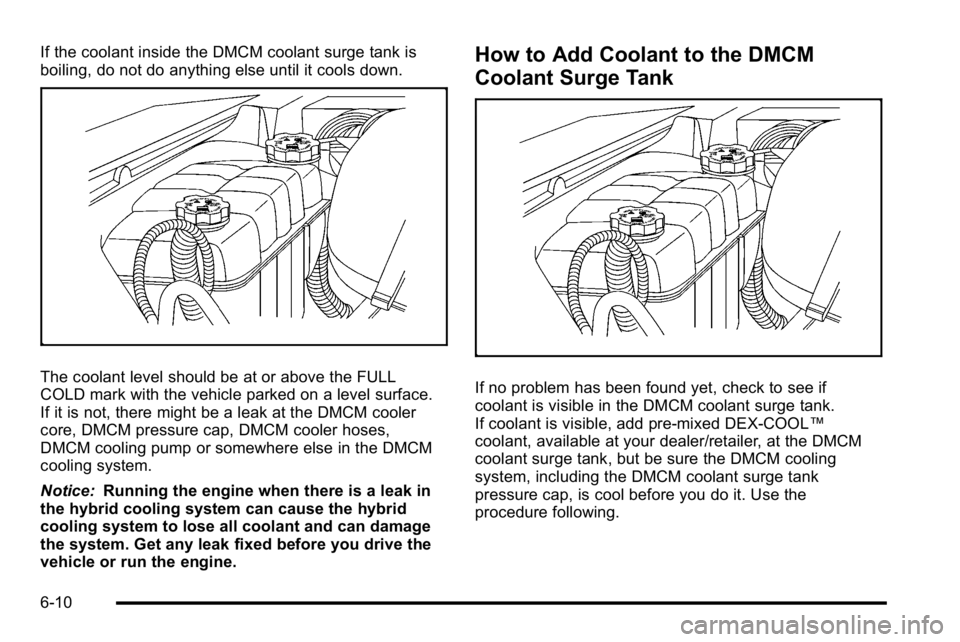
If the coolant inside the DMCM coolant surge tank is
boiling, do not do anything else until it cools down.
The coolant level should be at or above the FULL
COLD mark with the vehicle parked on a level surface.
If it is not, there might be a leak at the DMCM cooler
core, DMCM pressure cap, DMCM cooler hoses,
DMCM cooling pump or somewhere else in the DMCM
cooling system.
Notice:Running the engine when there is a leak in
the hybrid cooling system can cause the hybrid
cooling system to lose all coolant and can damage
the system. Get any leak fixed before you drive the
vehicle or run the engine.
How to Add Coolant to the DMCM
Coolant Surge Tank
If no problem has been found yet, check to see if
coolant is visible in the DMCM coolant surge tank.
If coolant is visible, add pre‐mixed DEX-COOL™
coolant, available at your dealer/retailer, at the DMCM
coolant surge tank, but be sure the DMCM cooling
system, including the DMCM coolant surge tank
pressure cap, is cool before you do it. Use the
procedure following.
6-10
Page 67 of 120
{WARNING:
Steam and scalding liquids from a hot cooling
system can blow out and burn you badly. They are
under pressure, and if you turn the coolant surge
tank pressure cap—even a little —they can come
out at high speed. Never turn the cap when the
cooling system, including the coolant surge tank
pressure cap, is hot. Wait for the cooling system
and coolant surge tank pressure cap to cool if you
ever have to turn the pressure cap.
Notice: Using coolant other than a pre‐mixed
DEX-COOL, available at your dealer/retailer, may
damage your vehicle. Any repairs would not be
covered by your warranty. Always use a pre‐mixed
DEX-COOL (silicate-free) coolant in your vehicle.
{WARNING:
You can be burned if you spill coolant on hot
engine parts. Coolant contains ethylene glycol
and it will burn if the engine parts are hot enough.
Do not spill coolant on a hot engine. If the DMCM coolant is empty , the vehicle must be
serviced by your dealer and a special fill procedure
must be followed.
Notice:
Attempting to fill the DMCM cooling surge
tank yourself when the fluid level is empty can
damage your vehicle. Your vehicle must be
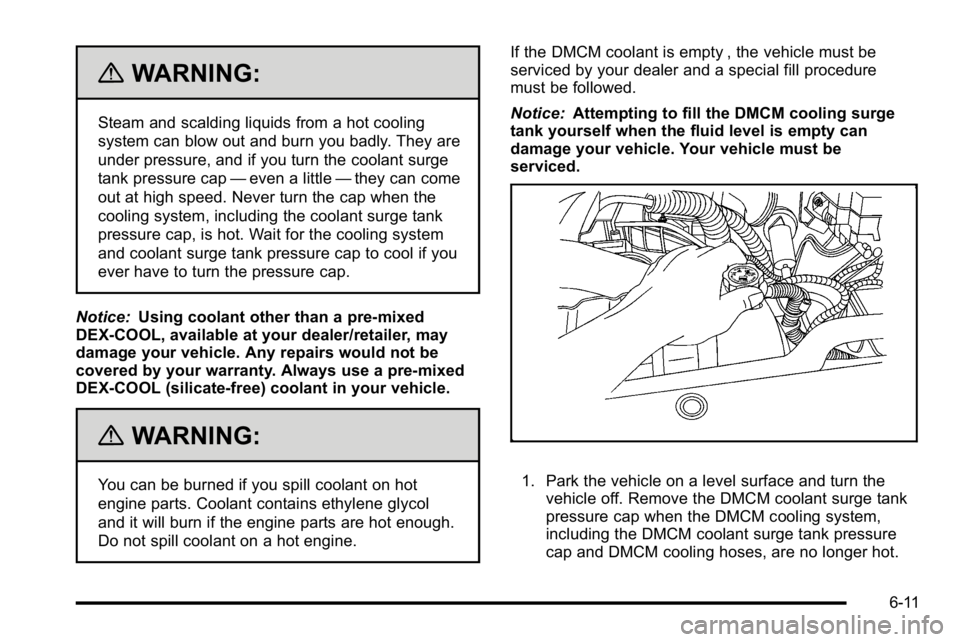
serviced.1. Park the vehicle on a level surface and turn the vehicle off. Remove the DMCM coolant surge tank
pressure cap when the DMCM cooling system,
including the DMCM coolant surge tank pressure
cap and DMCM cooling hoses, are no longer hot.
6-11
Page 68 of 120
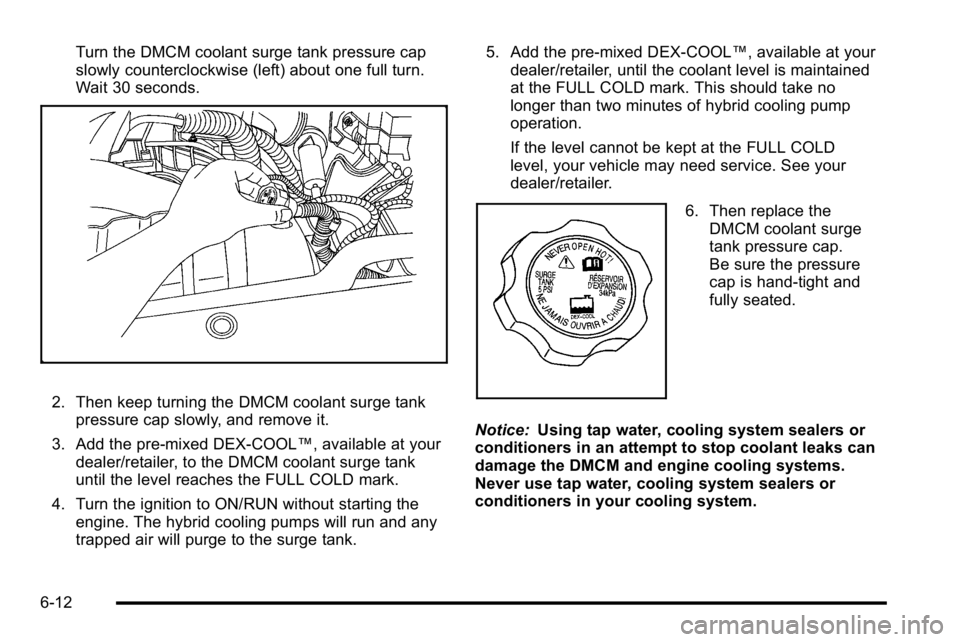
Turn the DMCM coolant surge tank pressure cap
slowly counterclockwise (left) about one full turn.
Wait 30 seconds.
2. Then keep turning the DMCM coolant surge tankpressure cap slowly, and remove it.
3. Add the pre‐mixed DEX‐COOL™, available at your dealer/retailer, to the DMCM coolant surge tank
until the level reaches the FULL COLD mark.
4. Turn the ignition to ON/RUN without starting the engine. The hybrid cooling pumps will run and any
trapped air will purge to the surge tank. 5. Add the pre‐mixed DEX‐COOL™, available at your
dealer/retailer, until the coolant level is maintained
at the FULL COLD mark. This should take no
longer than two minutes of hybrid cooling pump
operation.
If the level cannot be kept at the FULL COLD
level, your vehicle may need service. See your
dealer/retailer.
6. Then replace the
DMCM coolant surge
tank pressure cap.
Be sure the pressure
cap is hand-tight and
fully seated.
Notice: Using tap water, cooling system sealers or
conditioners in an attempt to stop coolant leaks can
damage the DMCM and engine cooling systems.
Never use tap water, cooling system sealers or
conditioners in your cooling system.
6-12
Page 83 of 120
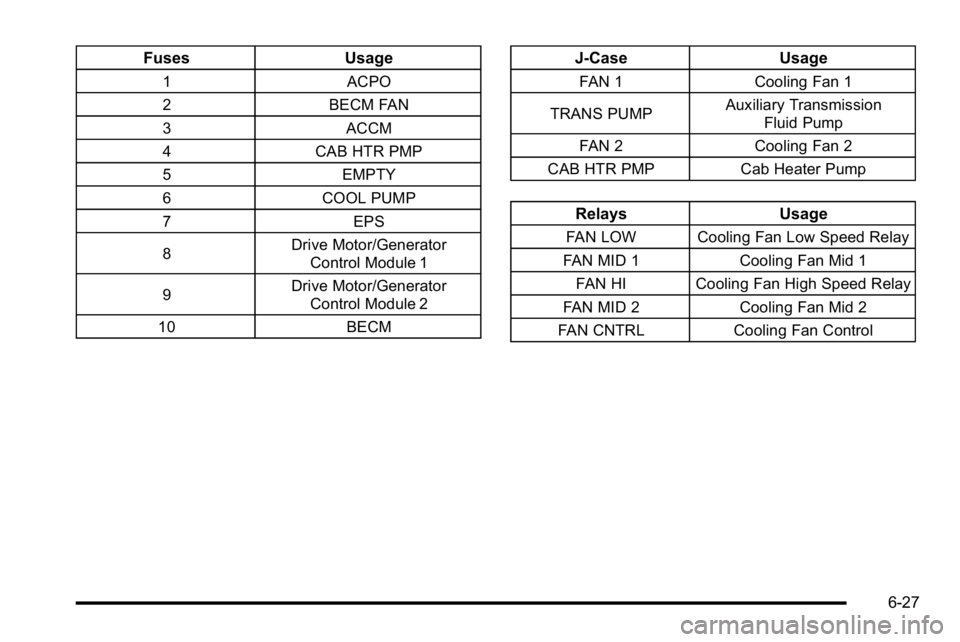
FusesUsage
1ACPO
2 BECM FAN
3 ACCM
4 CAB HTR PMP
5 EMPTY
6 COOL PUMP
7 EPS
8 Drive Motor/Generator
Control Module 1
9 Drive Motor/Generator
Control Module 2
10 BECM
J‐Case Usage
FAN 1Cooling Fan 1
TRANS PUMP Auxiliary Transmission
Fluid Pump
FAN 2 Cooling Fan 2
CAB HTR PMP Cab Heater Pump
Relays Usage
FAN LOW Cooling Fan Low Speed Relay
FAN MID 1 Cooling Fan Mid 1 FAN HI Cooling Fan High Speed Relay
FAN MID 2 Cooling Fan Mid 2
FAN CNTRL Cooling Fan Control
6-27
Page 113 of 120
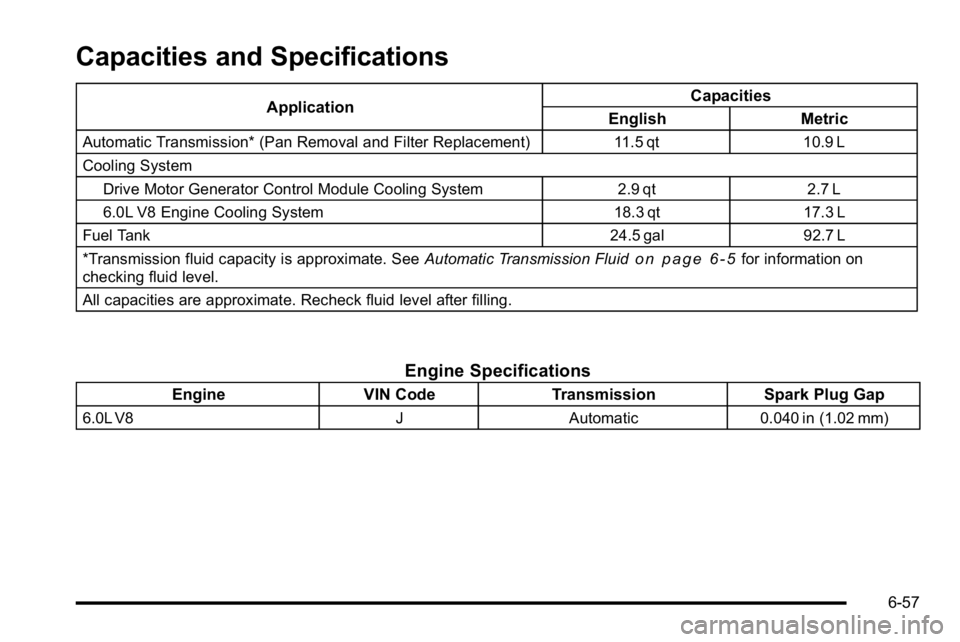
Capacities and Specifications
ApplicationCapacities
English Metric
Automatic Transmission* (Pan Removal and Filter Replacement) 11.5 qt10.9 L
Cooling System Drive Motor Generator Control Module Cooling System 2.9 qt2.7 L
6.0L V8 Engine Cooling System 18.3 qt17.3 L
Fuel Tank 24.5 gal92.7 L
*Transmission fluid capacity is approximate. See Automatic Transmission Fluid
on page 6‑5for information on
checking fluid level.
All capacities are approximate. Recheck fluid level after filling.
Engine Specifications
Engine VIN CodeTransmission Spark Plug Gap
6.0L V8 JAutomatic 0.040 in (1.02 mm)
6-57
Page 116 of 120
Maintenance Schedule
At Least Once a Year
Tire Sealant and Compressor Kit
Check the sealant expiration date printed on the
instruction label of the Tire Sealant and Compressor Kit
at least once a year. See your dealer/retailer for a
replacement canister.
Recommended Fluids and
Lubricants
Fluids identified below are specific to the hybrid vehicle
and can be obtained from your dealer/retailer. See the
owner manual for the other fluids and lubricants
recommended for the vehicle.Usage Fluid/Lubricant
Drive Motor/Generator
Control Module
(DMCM) Cooling
System Always use the pre-mixed
50/50 mixture of de‐ionized water
and DEX-COOL®(silicate-free)
coolant available at your dealer/
retailer. See Drive Motor/Generator
Control Module (DMCM) Cooling
System on page 6‑9.
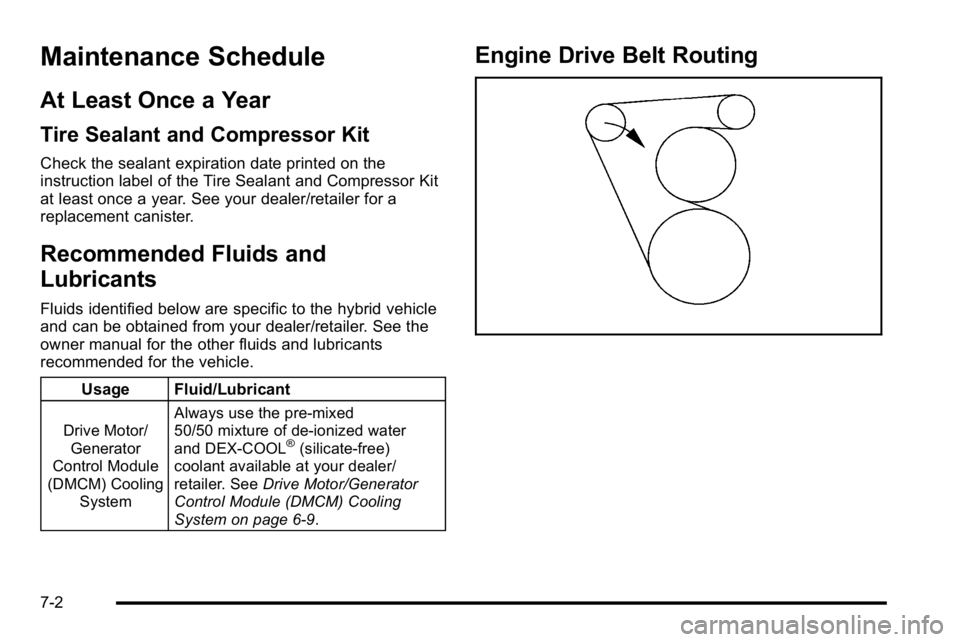
Engine Drive Belt Routing
7-2