engine oil GMC YUKON XL 2007 Owner's Guide
[x] Cancel search | Manufacturer: GMC, Model Year: 2007, Model line: YUKON XL, Model: GMC YUKON XL 2007Pages: 608, PDF Size: 3.01 MB
Page 455 of 608
Cooling System
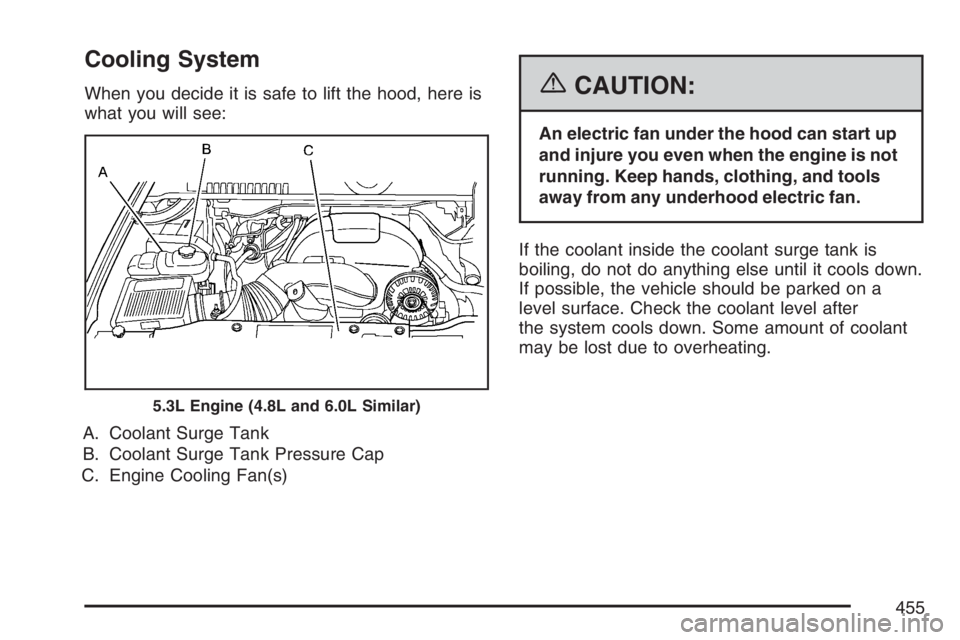
When you decide it is safe to lift the hood, here is
what you will see:
A. Coolant Surge Tank
B. Coolant Surge Tank Pressure Cap
C. Engine Cooling Fan(s){CAUTION:
An electric fan under the hood can start up
and injure you even when the engine is not
running. Keep hands, clothing, and tools
away from any underhood electric fan.
If the coolant inside the coolant surge tank is
boiling, do not do anything else until it cools down.
If possible, the vehicle should be parked on a
level surface. Check the coolant level after
the system cools down. Some amount of coolant
may be lost due to overheating.
5.3L Engine (4.8L and 6.0L Similar)
455
Page 458 of 608
{CAUTION:
Adding only plain water to your cooling
system can be dangerous. Plain water, or
some other liquid such as alcohol, can
boil before the proper coolant mixture will.
Your vehicle’s coolant warning system is
set for the proper coolant mixture. With
plain water or the wrong mixture, your
engine could get too hot but you would
not get the overheat warning. Your engine
could catch re and you or others could
be burned. Use a 50/50 mixture of clean,
drinkable water and DEX-COOL
®coolant.
Notice:In cold weather, water can freeze and
crack the engine, radiator, heater core and
other parts. Use the recommended coolant and
the proper coolant mixture.
{CAUTION:
You can be burned if you spill coolant on
hot engine parts. Coolant contains
ethylene glycol and it will burn if the
engine parts are hot enough. Do not spill
coolant on a hot engine.
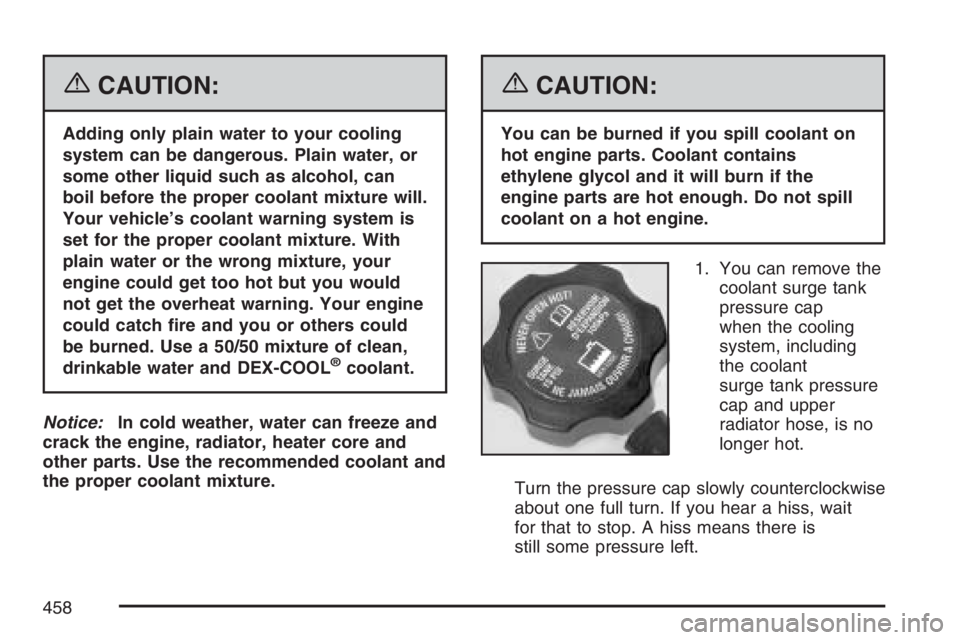
1. You can remove the
coolant surge tank
pressure cap
when the cooling
system, including
the coolant
surge tank pressure
cap and upper
radiator hose, is no
longer hot.
Turn the pressure cap slowly counterclockwise
about one full turn. If you hear a hiss, wait
for that to stop. A hiss means there is
still some pressure left.
458
Page 464 of 608
Checking Brake Fluid
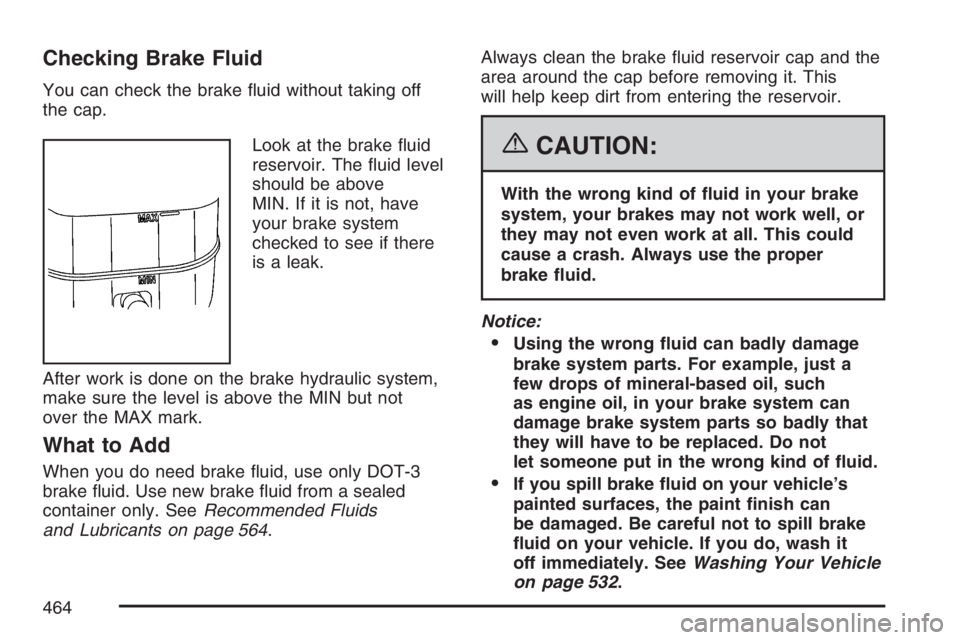
You can check the brake uid without taking off
the cap.
Look at the brake uid
reservoir. The uid level
should be above
MIN. If it is not, have
your brake system
checked to see if there
is a leak.
After work is done on the brake hydraulic system,
make sure the level is above the MIN but not
over the MAX mark.
What to Add
When you do need brake uid, use only DOT-3
brake uid. Use new brake uid from a sealed
container only. SeeRecommended Fluids
and Lubricants on page 564.Always clean the brake uid reservoir cap and the
area around the cap before removing it. This
will help keep dirt from entering the reservoir.
{CAUTION:
With the wrong kind of uid in your brake
system, your brakes may not work well, or
they may not even work at all. This could
cause a crash. Always use the proper
brake uid.
Notice:
Using the wrong uid can badly damage
brake system parts. For example, just a
few drops of mineral-based oil, such
as engine oil, in your brake system can
damage brake system parts so badly that
they will have to be replaced. Do not
let someone put in the wrong kind of uid.
If you spill brake uid on your vehicle’s
painted surfaces, the paint nish can
be damaged. Be careful not to spill brake
uid on your vehicle. If you do, wash it
off immediately. SeeWashing Your Vehicle
on page 532.
464
Page 545 of 608
Fuses Usage
1 Not Used
2Electronic Stability Suspension
Control, Automatic Level Control
Exhaust
3 Left Trailer Stop/Turn Lamp
4 Engine Controls
5Engine Control Module, Throttle
Control
6 Right Trailer Stop/Turn Lamp
7 Front Washer
8 Oxygen Sensors
9 Anti-lock Brakes System 2
10 Trailer Back-up Lamps
11 Driver’s Side Low-Beam Headlamp
12 Engine Control Module (Battery)
13Fuel Injectors, Ignition Coils
(Right Side)
14Transmission Control Module
(Battery)
15 Vehicle Back-up Lamps
16Passenger’s Side Low-Beam
Headlamp
17 Air Conditioning Compressor
18 Oxygen Sensors
19 Transmission Controls (Ignition)Fuses Usage
20 Fuel Pump
21 Not Used
22 Rear Washer
23Fuel Injectors, Ignition Coils
(Left Side)
24 Trailer Park Lamps
25 Driver’s Side Park Lamps
26 Passenger’s Side Park Lamps
27 Fog Lamps
28 Horn
29Passenger’s Side High-Beam
Headlamp
30 Daytime Running Lamps
31 Driver’s Side High-Beam Headlamp
32 Daylight Running Lamps 2
33 Sunroof
34Key Ignition System, Theft Deterrent
System
35 Windshield Wiper
36 SEO B2 Uptter Usage (Battery)
37 Electric Adjustable Pedals
38 Climate Controls (Battery)
39 Airbag System (Ignition)
40 Amplier
545
Page 548 of 608
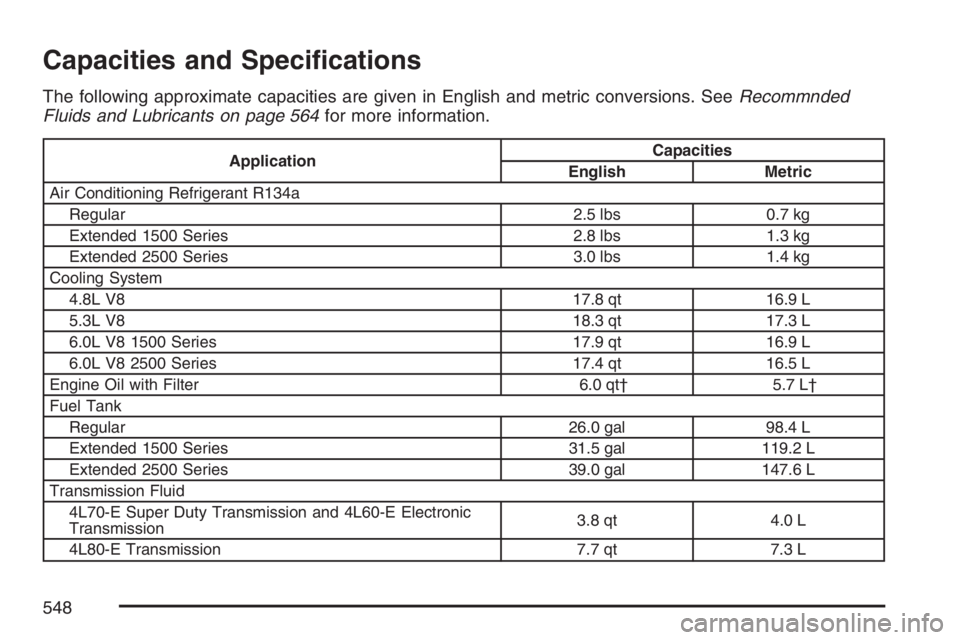
Capacities and Specications
The following approximate capacities are given in English and metric conversions. SeeRecommnded
Fluids and Lubricants on page 564for more information.
ApplicationCapacities
English Metric
Air Conditioning Refrigerant R134a
Regular 2.5 lbs 0.7 kg
Extended 1500 Series 2.8 lbs 1.3 kg
Extended 2500 Series 3.0 lbs 1.4 kg
Cooling System
4.8L V8 17.8 qt 16.9 L
5.3L V8 18.3 qt 17.3 L
6.0L V8 1500 Series 17.9 qt 16.9 L
6.0L V8 2500 Series 17.4 qt 16.5 L
Engine Oil with Filter 6.0 qt† 5.7 L†
Fuel Tank
Regular 26.0 gal 98.4 L
Extended 1500 Series 31.5 gal 119.2 L
Extended 2500 Series 39.0 gal 147.6 L
Transmission Fluid
4L70-E Super Duty Transmission and 4L60-E Electronic
Transmission3.8 qt 4.0 L
4L80-E Transmission 7.7 qt 7.3 L
548
Page 549 of 608
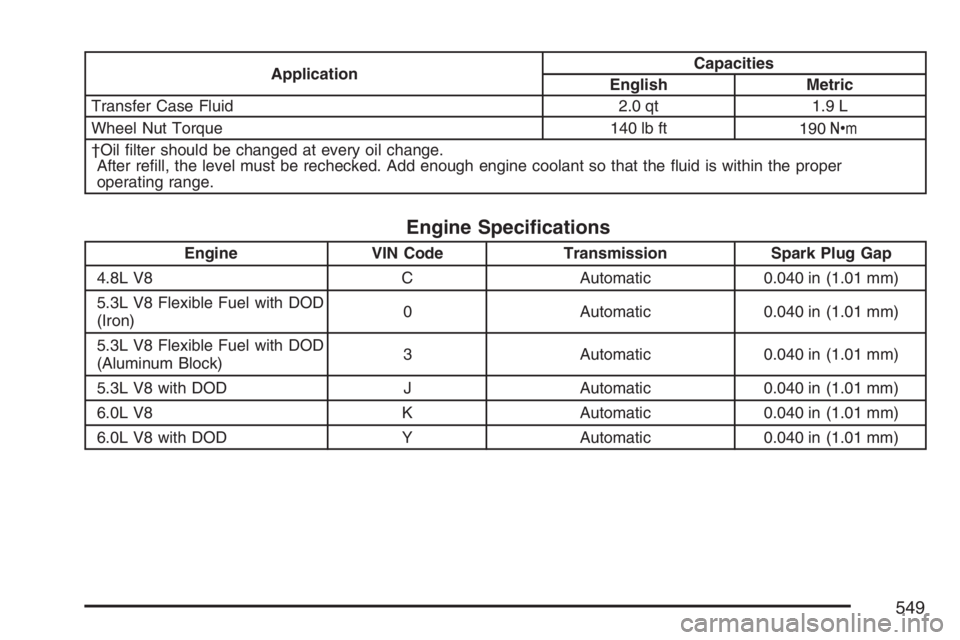
ApplicationCapacities
English Metric
Transfer Case Fluid 2.0 qt 1.9 L
Wheel Nut Torque 140 lb ft
190Y
†Oil lter should be changed at every oil change.
After rell, the level must be rechecked. Add enough engine coolant so that the uid is within the proper
operating range.
Engine Specications
Engine VIN Code Transmission Spark Plug Gap
4.8L V8 C Automatic 0.040 in (1.01 mm)
5.3L V8 Flexible Fuel with DOD
(Iron)0 Automatic 0.040 in (1.01 mm)
5.3L V8 Flexible Fuel with DOD
(Aluminum Block)3 Automatic 0.040 in (1.01 mm)
5.3L V8 with DOD J Automatic 0.040 in (1.01 mm)
6.0L V8 K Automatic 0.040 in (1.01 mm)
6.0L V8 with DOD Y Automatic 0.040 in (1.01 mm)
549
Page 552 of 608
Maintenance Schedule
Introduction
Important: Keep engine oil at the proper level
and change as recommended.
Have you purchased the GM Protection Plan?
The Plan supplements your new vehicle
warranties. See your Warranty and Owner
Assistance booklet or your dealer for details.
Maintenance Requirements
Notice:Maintenance intervals, checks,
inspections, replacement parts, and
recommended uids and lubricants as
prescribed in this manual are necessary to
keep your vehicle in good working condition.
Any damage caused by failure to follow
scheduled maintenance may not be covered by
warranty.
Your Vehicle and the Environment
Proper vehicle maintenance not only helps to keep
your vehicle in good working condition, but also
helps the environment. All recommended
maintenance is important. Improper vehicle
maintenance can even affect the quality of the air
we breathe. Improper uid levels or the wrong
tire ination can increase the level of emissions
from your vehicle. To help protect our environment,
and to keep your vehicle in good condition, be
sure to maintain your vehicle properly.
552
Page 555 of 608
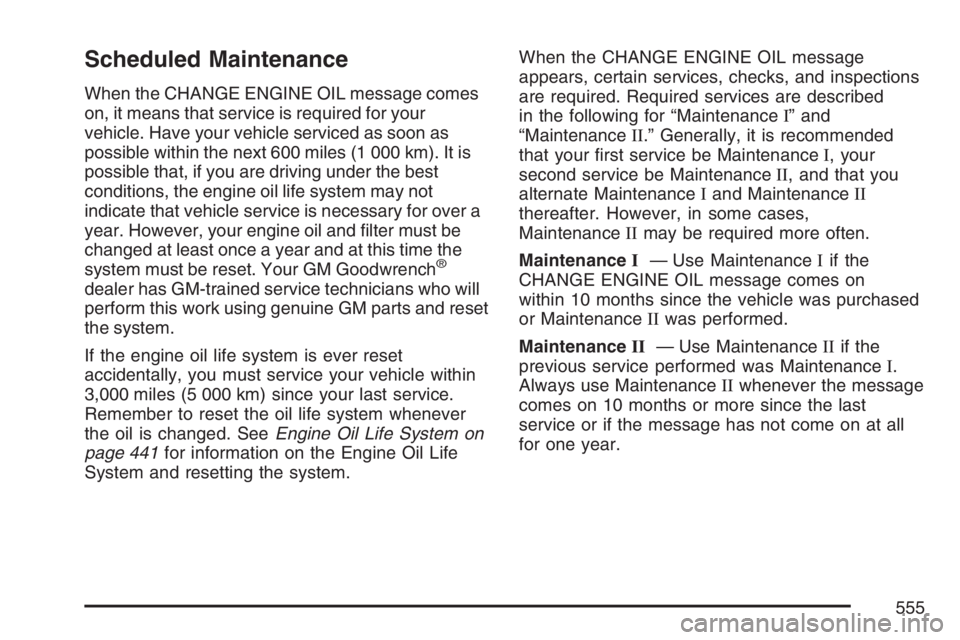
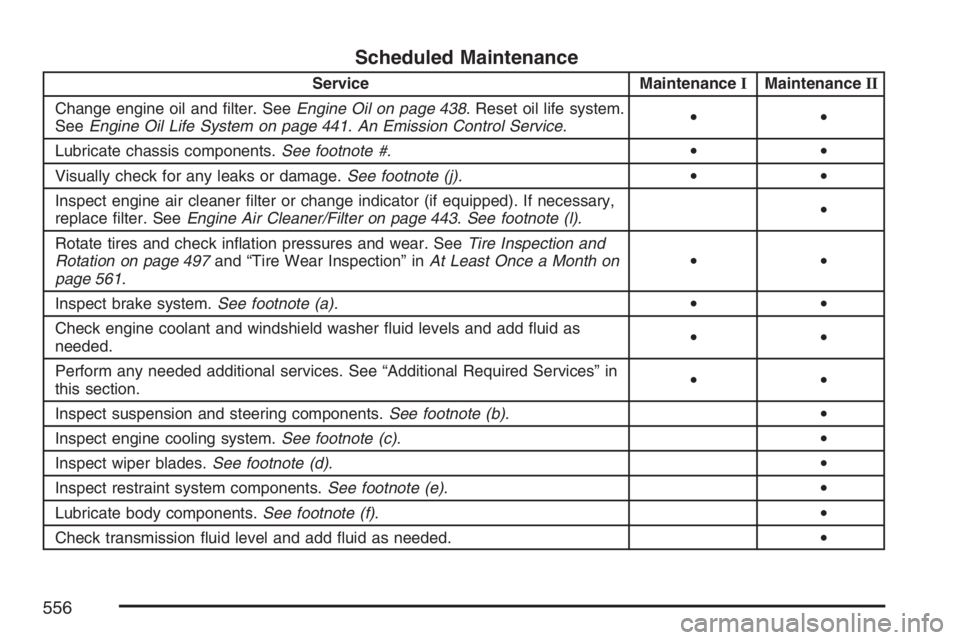
Scheduled Maintenance
When the CHANGE ENGINE OIL message comes
on, it means that service is required for your
vehicle. Have your vehicle serviced as soon as
possible within the next 600 miles (1 000 km). It is
possible that, if you are driving under the best
conditions, the engine oil life system may not
indicate that vehicle service is necessary for over a
year. However, your engine oil and lter must be
changed at least once a year and at this time the
system must be reset. Your GM Goodwrench
®
dealer has GM-trained service technicians who will
perform this work using genuine GM parts and reset
the system.
If the engine oil life system is ever reset
accidentally, you must service your vehicle within
3,000 miles (5 000 km) since your last service.
Remember to reset the oil life system whenever
the oil is changed. SeeEngine Oil Life System on
page 441for information on the Engine Oil Life
System and resetting the system.When the CHANGE ENGINE OIL message
appears, certain services, checks, and inspections
are required. Required services are described
in the following for “MaintenanceI” and
“MaintenanceII.” Generally, it is recommended
that your rst service be MaintenanceI, your
second service be MaintenanceII, and that you
alternate MaintenanceIand MaintenanceII
thereafter. However, in some cases,
MaintenanceIImay be required more often.
MaintenanceI— Use MaintenanceIif the
CHANGE ENGINE OIL message comes on
within 10 months since the vehicle was purchased
or MaintenanceIIwas performed.
MaintenanceII— Use MaintenanceIIif the
previous service performed was MaintenanceI.
Always use MaintenanceIIwhenever the message
comes on 10 months or more since the last
service or if the message has not come on at all
for one year.
555
Page 556 of 608
Scheduled Maintenance
Service MaintenanceIMaintenanceII
Change engine oil and lter. SeeEngine Oil on page 438. Reset oil life system.
SeeEngine Oil Life System on page 441.An Emission Control Service.••
Lubricate chassis components.See footnote #.••
Visually check for any leaks or damage.See footnote (j).••
Inspect engine air cleaner lter or change indicator (if equipped). If necessary,
replace lter. SeeEngine Air Cleaner/Filter on page 443.See footnote (l).•
Rotate tires and check ination pressures and wear. SeeTire Inspection and
Rotation on page 497and “Tire Wear Inspection” inAt Least Once a Month on
page 561.••
Inspect brake system.See footnote (a).••
Check engine coolant and windshield washer uid levels and add uid as
needed.••
Perform any needed additional services. See “Additional Required Services” in
this section.••
Inspect suspension and steering components.See footnote (b).•
Inspect engine cooling system.See footnote (c).•
Inspect wiper blades.See footnote (d).•
Inspect restraint system components.See footnote (e).•
Lubricate body components.See footnote (f).•
Check transmission uid level and add uid as needed.•
556
Page 560 of 608
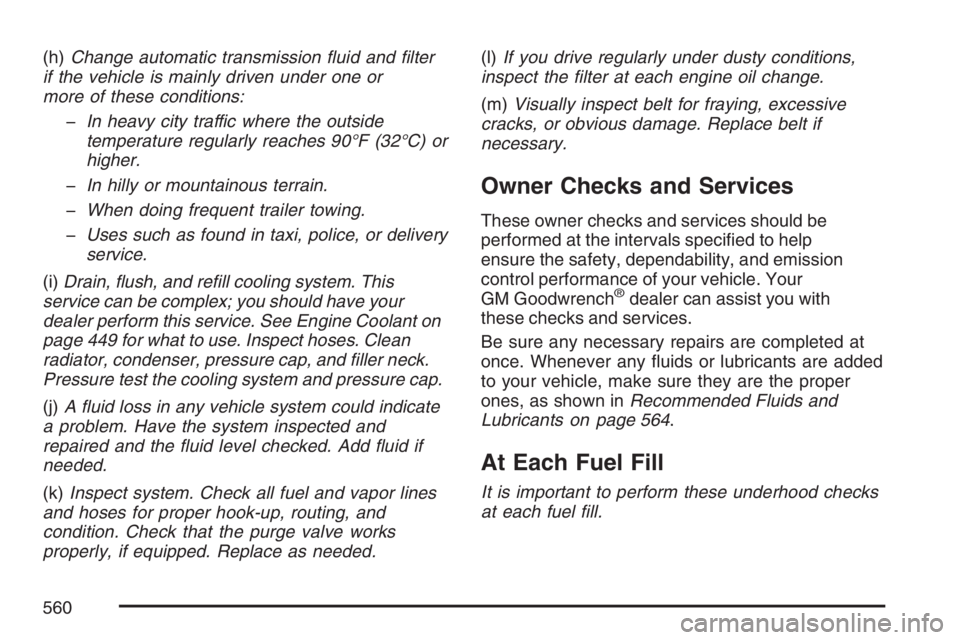
(h)Change automatic transmission uid and lter
if the vehicle is mainly driven under one or
more of these conditions:
In heavy city traffic where the outside
temperature regularly reaches 90°F (32°C) or
higher.
In hilly or mountainous terrain.
When doing frequent trailer towing.
Uses such as found in taxi, police, or delivery
service.
(i)Drain, ush, and rell cooling system. This
service can be complex; you should have your
dealer perform this service. See Engine Coolant on
page 449 for what to use. Inspect hoses. Clean
radiator, condenser, pressure cap, and ller neck.
Pressure test the cooling system and pressure cap.
(j)A uid loss in any vehicle system could indicate
a problem. Have the system inspected and
repaired and the uid level checked. Add uid if
needed.
(k)Inspect system. Check all fuel and vapor lines
and hoses for proper hook-up, routing, and
condition. Check that the purge valve works
properly, if equipped. Replace as needed.(l)If you drive regularly under dusty conditions,
inspect the lter at each engine oil change.
(m)Visually inspect belt for fraying, excessive
cracks, or obvious damage. Replace belt if
necessary.
Owner Checks and Services
These owner checks and services should be
performed at the intervals specied to help
ensure the safety, dependability, and emission
control performance of your vehicle. Your
GM Goodwrench
®dealer can assist you with
these checks and services.
Be sure any necessary repairs are completed at
once. Whenever any uids or lubricants are added
to your vehicle, make sure they are the proper
ones, as shown inRecommended Fluids and
Lubricants on page 564.
At Each Fuel Fill
It is important to perform these underhood checks
at each fuel ll.
560