tow GMC YUKON XL 2007 Repair Manual
[x] Cancel search | Manufacturer: GMC, Model Year: 2007, Model line: YUKON XL, Model: GMC YUKON XL 2007Pages: 608, PDF Size: 3.01 MB
Page 417 of 608
Following Distance
Stay at least twice as far behind the vehicle ahead
as you would when driving your vehicle without
a trailer. This can help you avoid situations
that require heavy braking and sudden turns.
Passing
You’ll need more passing distance up ahead when
you’re towing a trailer. And, because you’re a
good deal longer, you’ll need to go much farther
beyond the passed vehicle before you can
return to your lane.
Backing Up
Hold the bottom of the steering wheel with
one hand. Then, to move the trailer to the left, just
move that hand to the left. To move the trailer
to the right, move your hand to the right. Always
back up slowly and, if possible, have someone
guide you.
Making Turns
Notice:Making very sharp turns while
trailering could cause the trailer to come in
contact with the vehicle. Your vehicle could be
damaged. Avoid making very sharp turns
while trailering.
When you’re turning with a trailer, make wider
turns than normal. Do this so your trailer
won’t strike soft shoulders, curbs, road signs,
trees or other objects. Avoid jerky or sudden
maneuvers. Signal well in advance.
Turn Signals When Towing a Trailer
The arrows on your instrument panel will
ash whenever you signal a turn or lane change.
Properly hooked up, the trailer lamps will also
ash, telling other drivers you’re about to
turn, change lanes or stop.
When towing a trailer, the arrows on your
instrument panel will ash for turns even if the bulbs
on the trailer are burned out. Thus, you may think
drivers behind you are seeing your signal when
they are not. It’s important to check occasionally to
be sure the trailer bulbs are still working.
417
Page 418 of 608
Driving On Grades
Reduce speed and shift to a lower gearbefore
you start down a long or steep downgrade. If you
don’t shift down, you might have to use your
brakes so much that they would get hot and no
longer work well.
You can tow in DRIVE (D). You may want to shift
the transmission to THIRD (3) or, if necessary,
a lower gear selection if the transmission shifts too
often (e.g., under heavy loads and/or hilly
conditions).
You may also want to activate the tow/haul mode
if the transmission shifts too often. See “Tow/Haul
Mode” earlier in this section for more information.
When towing at high altitude on steep uphill
grades, consider the following: Engine coolant at
or near sea level will boil at a lower temperature
than at higher altitudes. If you turn your engine off
immediately after towing at high altitude on
steep uphill grades, your vehicle may show signs
similar to engine overheating.To avoid this, let the engine run while parked
(preferably on level ground) with the automatic
transmission in PARK (P) for a few minutes before
turning the engine off. If you do get the overheat
warning, seeEngine Overheating on page 452.
Parking on Hills
{CAUTION:
You really should not park your vehicle,
with a trailer attached, on a hill. If
something goes wrong, your rig could
start to move. People can be injured, and
both your vehicle and the trailer can be
damaged.
But if you ever have to park your rig on a hill,
here’s how to do it:
1. Apply your regular brake, but don’t shift into
PARK (P) yet.
2. Have someone place chocks under the trailer
wheels.
418
Page 420 of 608
Maintenance When Trailer Towing
Your vehicle will need service more often when
you’re pulling a trailer. See the Maintenance
Schedule for more on this. Things that are
especially important in trailer operation are
automatic transmission uid (don’t overll), engine
oil, axle lubricant, belts, cooling system and
brake system. Each of these is covered in this
manual, and the Index will help you nd them
quickly. If you’re trailering, it’s a good idea
to review these sections before you start your trip.
Check periodically to see that all hitch nuts and
bolts are tight.
Trailer Wiring Harness
Your vehicle is equipped with the following wiring
harnesses for towing a trailer.
Basic Trailer Wiring
The trailer wiring harness, with a seven-pin
connector, is located at the rear of the vehicle and
is tied to the vehicle’s frame. The harness
connector can be plugged into a seven-pin
universal heavy-duty trailer connector available
through your dealer.
The seven-wire harness contains the following
trailer circuits:
Yellow: Left Stop/Turn Signal
Dark Green: Right Stop/Turn Signal
Brown: Taillamps
White: Ground
Light Green: Back-up Lamps
Red: Battery Feed*
Dark Blue: Trailer Brake*
*The fuses for these two circuits are installed in
the underhood electrical center, but the wires
are not connected. They should be connected by
your dealer or a qualied service center.
420
Page 421 of 608
Heavy-Duty Trailer Wiring Harness
Package
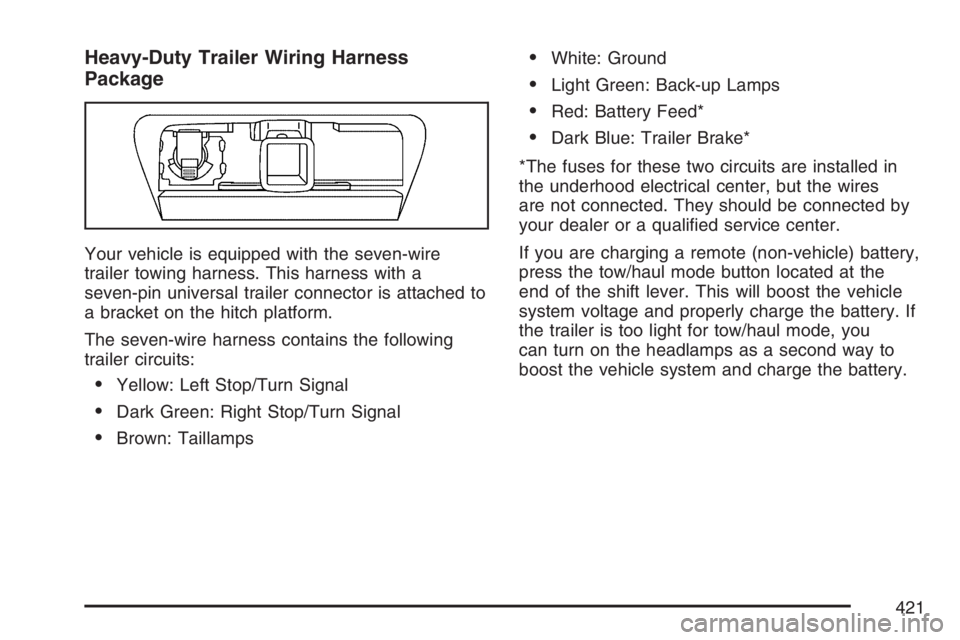
Your vehicle is equipped with the seven-wire
trailer towing harness. This harness with a
seven-pin universal trailer connector is attached to
a bracket on the hitch platform.
The seven-wire harness contains the following
trailer circuits:
Yellow: Left Stop/Turn Signal
Dark Green: Right Stop/Turn Signal
Brown: Taillamps
White: Ground
Light Green: Back-up Lamps
Red: Battery Feed*
Dark Blue: Trailer Brake*
*The fuses for these two circuits are installed in
the underhood electrical center, but the wires
are not connected. They should be connected by
your dealer or a qualied service center.
If you are charging a remote (non-vehicle) battery,
press the tow/haul mode button located at the
end of the shift lever. This will boost the vehicle
system voltage and properly charge the battery. If
the trailer is too light for tow/haul mode, you
can turn on the headlamps as a second way to
boost the vehicle system and charge the battery.
421
Page 422 of 608
Electric Brake Control Wiring
Provisions
These wiring provisions are included with your
vehicle as part of the trailer wiring package. These
provisions are for an electric brake controller. The
instrument panel contains blunt cut wires near the
data link connector for the trailer brake controller.
The harness contains the following wires:
Dark Blue: Brake Signal to Trailer Connector
Red/Black: Battery
Light Blue/White: Brake Switch
White: Ground
It should be installed by your dealer or a qualied
service center.
Power Winches
If you wish to use a power winch on your vehicle,
only use it when your vehicle is stationary or
anchored.
Trailer Recommendations
You must subtract your hitch loads from the Cargo
Weight Rating (CWR) for your vehicle. CWR is
the maximum weight of the load your vehicle can
carry. It doesn’t include the weight of the people
inside. But you can gure about 150 lbs. (68 kg) for
each seat. The total cargo load must not be
more than your vehicle’s CWR.
Weigh your vehicle with the trailer attached, so
that you won’t go over the GVWR or GAWR. If you
are using a weight-distributing hitch, weigh the
vehicle without the spring bars in place.
You’ll get the best performance if you spread out
the weight of your load the right way, and if
you choose the correct hitch and trailer brakes.
For more information, seeTowing a Trailer
on page 405.
422
Page 438 of 608
Engine Oil
If the CHECK OIL LEVEL message appears on
the instrument cluster, it means you need to check
your engine oil level right away.
For more information, see CHECK OIL LEVEL
underDIC Warnings and Messages on page 254.
You should check your engine oil level regularly;
this is an added reminder.
Checking Engine Oil
It is a good idea to check your engine oil every
time you get fuel. In order to get an accurate
reading, the oil must be warm and the vehicle must
be on level ground.The engine oil dipstick handle is a yellow loop.
SeeEngine Compartment Overview on page 436
for the location of the engine oil dipstick.
1. Turn off the engine and give the oil several
minutes to drain back into the oil pan. If you
do not do this, the oil dipstick might not
show the actual level.
2. Pull out the dipstick and clean it with a paper
towel or cloth, then push it back in all the
way. Remove it again, keeping the tip down,
and check the level.
438
Page 447 of 608
Then, without shutting off the engine, follow
these steps:
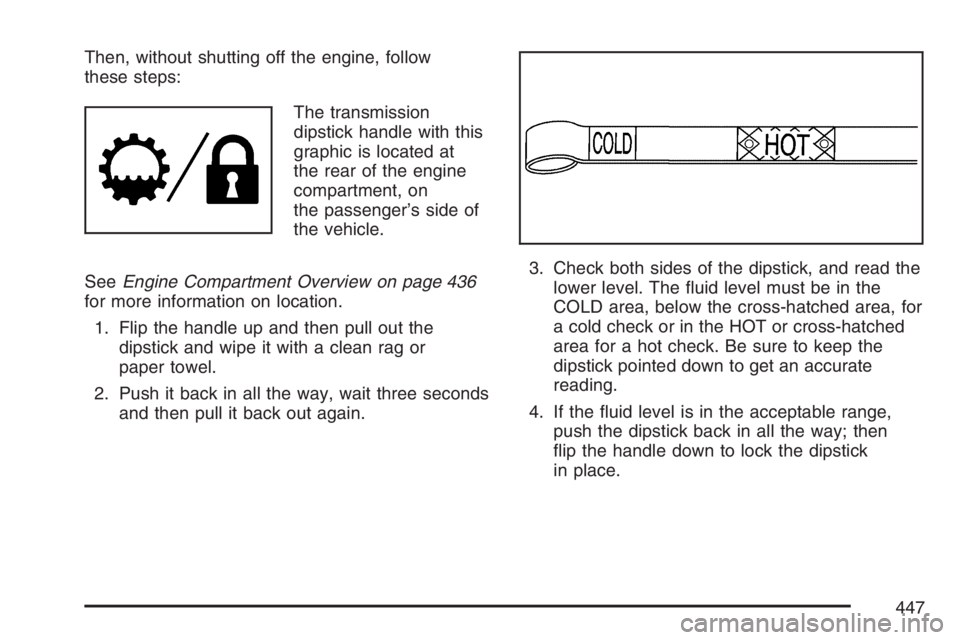
The transmission
dipstick handle with this
graphic is located at
the rear of the engine
compartment, on
the passenger’s side of
the vehicle.
SeeEngine Compartment Overview on page 436
for more information on location.
1. Flip the handle up and then pull out the
dipstick and wipe it with a clean rag or
paper towel.
2. Push it back in all the way, wait three seconds
and then pull it back out again.3. Check both sides of the dipstick, and read the
lower level. The uid level must be in the
COLD area, below the cross-hatched area, for
a cold check or in the HOT or cross-hatched
area for a hot check. Be sure to keep the
dipstick pointed down to get an accurate
reading.
4. If the uid level is in the acceptable range,
push the dipstick back in all the way; then
ip the handle down to lock the dipstick
in place.
447
Page 453 of 608
If No Steam Is Coming From Your
Engine
The ENGINE OVERHEATED STOP ENGINE or
the ENGINE OVERHEATED IDLE ENGINE
message, along with a low coolant condition, can
indicate a serious problem.
If you get an engine overheat warning, but see or
hear no steam, the problem may not be too
serious. Sometimes the engine can get a little too
hot when you:
Climb a long hill on a hot day.
Stop after high-speed driving.
Idle for long periods in traffic.
Tow a trailer. SeeTowing a Trailer on
page 405.If you get the ENGINE OVERHEATED STOP
ENGINE or the ENGINE OVERHEATED IDLE
ENGINE message with no sign of steam, try this
for a minute or so:
1. If you have an air conditioner and it is on,
turn it off.
2. Turn on your heater to full hot at the highest
fan speed and open the windows as
necessary.
3. In heavy traffic, let the engine idle in
NEUTRAL (N) while stopped. If it is safe to
do so, pull off the road, shift to PARK (P)
or NEUTRAL (N) and let the engine idle.
If you no longer have the overheat warning, you
can drive. Just to be safe, drive slower for
about 10 minutes. If the warning does not come
back on, you can drive normally.
If the warning continues, pull over, stop, and park
your vehicle immediately.
453
Page 454 of 608
If there is still no sign of steam and your vehicle is
equipped with an engine-driven cooling fan,
push down the accelerator until the engine speed
is about twice as fast as normal idle speed for
at least ve minutes while you are parked.
If there is still no sign of steam and your vehicle is
equipped with an electric cooling fan, idle the
engine for ve minutes while you are parked.
If you still have the warning, turn off the engine
and get everyone out of the vehicle until it
cools down. Also, see “Overheated Engine
Protection Operating Mode” later in this section.
You may decide not to lift the hood but to get
service help right away.Overheated Engine Protection
Operating Mode
If an overheated engine condition exists and the
REDUCED ENGINE POWER message is
displayed, an overheat protection mode which
alternates ring groups of cylinders helps prevent
engine damage. In this mode, you will notice a
loss in power and engine performance. This
operating mode allows your vehicle to be driven to
a safe place in an emergency. Driving extended
miles (km) and/or towing a trailer in the overheat
protection mode should be avoided.
Notice:After driving in the overheated engine
protection operating mode, to avoid engine
damage, allow the engine to cool before
attempting any repair. The engine oil will be
severely degraded. Repair the cause of coolant
loss, change the oil and reset the oil life
system. SeeEngine Oil on page 438.
454
Page 460 of 608
5. Then replace the pressure cap. Be sure the
pressure cap is hand-tight and fully seated.
6. Verify coolant level after engine is shutoff and
the coolant is cold. If necessary, repeat
coolant ll procedure steps 1 through 6.
Engine Fan Noise
If your vehicle has a clutched engine cooling fan,
when the clutch is engaged, the fan spins
faster to provide more air to cool the engine. In
most everyday driving conditions, the fan is
spinning slower and the clutch is not fully engaged.
This improves fuel economy and reduces fan
noise. Under heavy vehicle loading, trailer towing,
and/or high outside temperatures, the fan speed
increases as the clutch more fully engages, so you
may hear an increase in fan noise. This is
normal and should not be mistaken as the
transmission slipping or making extra shifts. It is
merely the cooling system functioning properly.
The fan will slow down when additional cooling is
not required and the clutch disengages.You may also hear this fan noise when you start
the engine. It will go away as the fan clutch
partially disengages.
If your vehicle has electric cooling fans, you may
hear the fans spinning at low speed during
most everyday driving. The fans may turn off if no
cooling is required. Under heavy vehicle loading,
trailer towing, and/or high outside temperatures, or
if you are operating your air conditioning system,
the fans may change to high speed and you
may hear an increase in fan noise. This is normal
and indicates that the cooling system is
functioning properly. The fans will change to low
speed when additional cooling is no longer
required.
460