lock GMC YUKON XL DENALI 2001 User Guide
[x] Cancel search | Manufacturer: GMC, Model Year: 2001, Model line: YUKON XL DENALI, Model: GMC YUKON XL DENALI 2001Pages: 394, PDF Size: 2.77 MB
Page 31 of 394
1-18
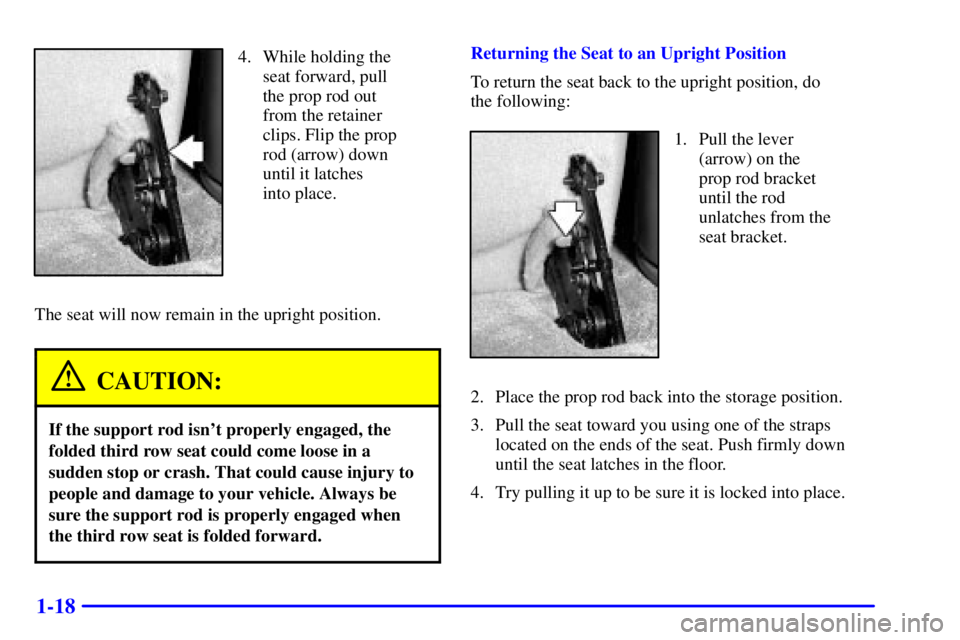
4. While holding the
seat forward, pull
the prop rod out
from the retainer
clips. Flip the prop
rod (arrow) down
until it latches
into place.
The seat will now remain in the upright position.
CAUTION:
If the support rod isn't properly engaged, the
folded third row seat could come loose in a
sudden stop or crash. That could cause injury to
people and damage to your vehicle. Always be
sure the support rod is properly engaged when
the third row seat is folded forward.
Returning the Seat to an Upright Position
To return the seat back to the upright position, do
the following:
1. Pull the lever
(arrow) on the
prop rod bracket
until the rod
unlatches from the
seat bracket.
2. Place the prop rod back into the storage position.
3. Pull the seat toward you using one of the straps
located on the ends of the seat. Push firmly down
until the seat latches in the floor.
4. Try pulling it up to be sure it is locked into place.
Page 32 of 394
1-19
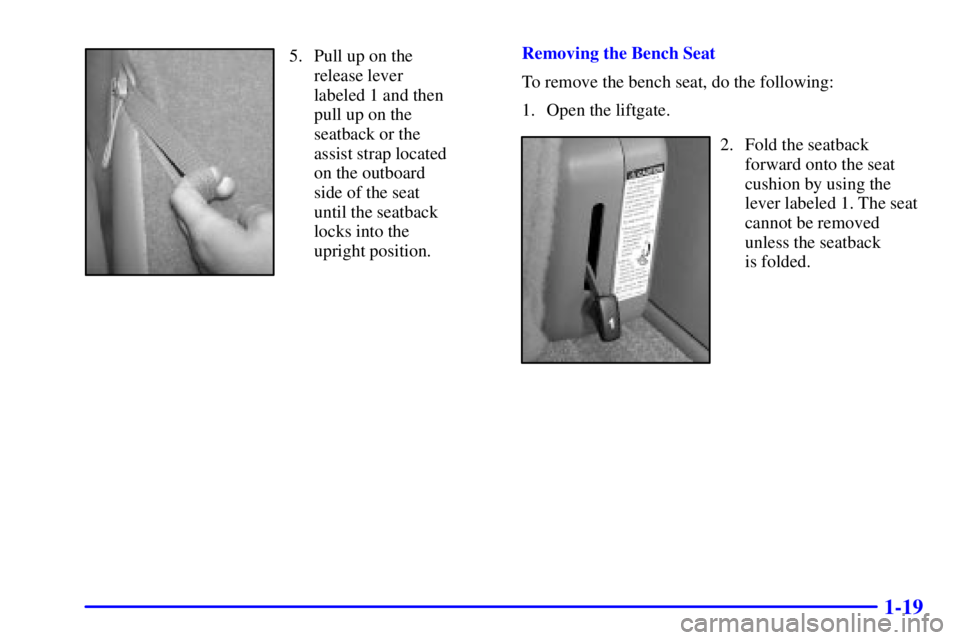
5. Pull up on the
release lever
labeled 1 and then
pull up on the
seatback or the
assist strap located
on the outboard
side of the seat
until the seatback
locks into the
upright position.Removing the Bench Seat
To remove the bench seat, do the following:
1. Open the liftgate.
2. Fold the seatback
forward onto the seat
cushion by using the
lever labeled 1. The seat
cannot be removed
unless the seatback
is folded.
Page 34 of 394
1-21
Reinstalling the Bench Seat
To reinstall the bench seat, do the following:
1. While holding the rear of the seat up, slide the front
wheels into the slots on the floor. The front latches
should lock into place. If latches do not lock, try
tilting the rear of the seat upwards.
2. Once the latches are engaged, let the seat drop into
place. Release the lever labeled 1 to return the
seatback to its upright position.
3. Push and pull on the seat to make sure it is locked
into place. The seatback cannot be raised to the
upright position unless the seat is secured to
the floor.
CAUTION:
A seat that isn't locked into place properly can
move around in a collision or sudden stop. People
in the vehicle could be injured. Be sure to lock
the seat into place properly when installing it.
Entering or Exiting the Third Row Seats
Denali: To enter or exit the third row seat you must
fold the seat down following the instructions given
previously. If you are exiting the third row seat with
no assistance do the following:
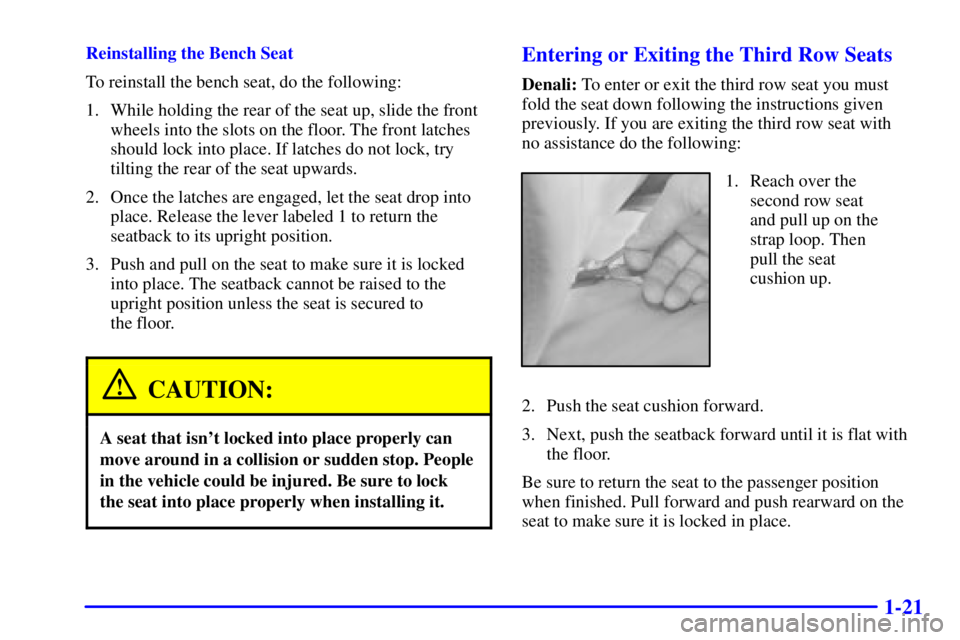
1. Reach over the
second row seat
and pull up on the
strap loop. Then
pull the seat
cushion up.
2. Push the seat cushion forward.
3. Next, push the seatback forward until it is flat with
the floor.
Be sure to return the seat to the passenger position
when finished. Pull forward and push rearward on the
seat to make sure it is locked in place.
Page 35 of 394
1-22
Denali XL: The passenger's side of the second row
60/40 or rear bucket seat has an easy entry/exit feature.
This makes it easy to get in and out of the third row seat.
To operate the easy entry seat, do the following:
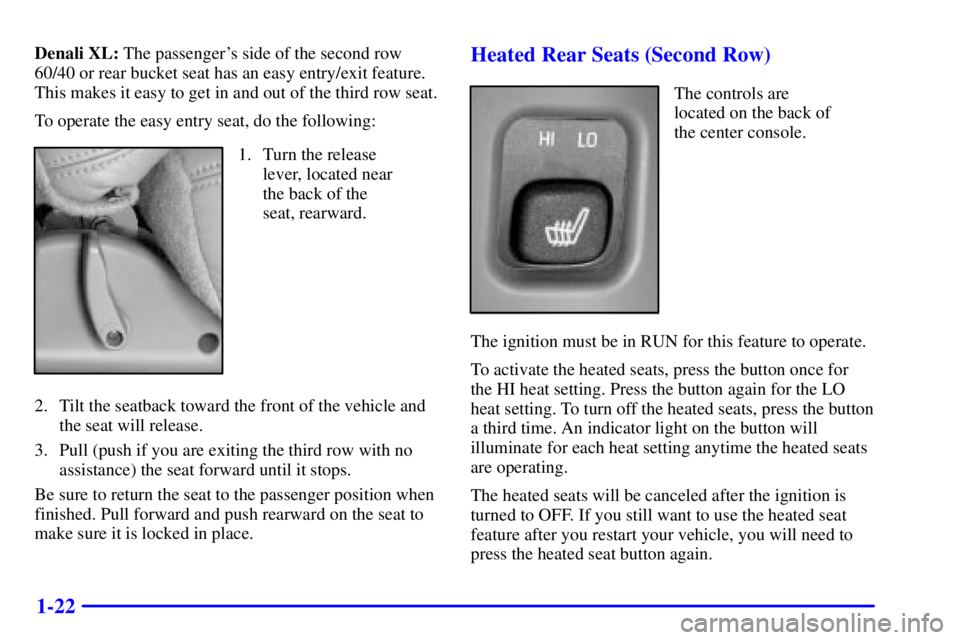
1. Turn the release
lever, located near
the back of the
seat, rearward.
2. Tilt the seatback toward the front of the vehicle and
the seat will release.
3. Pull (push if you are exiting the third row with no
assistance) the seat forward until it stops.
Be sure to return the seat to the passenger position when
finished. Pull forward and push rearward on the seat to
make sure it is locked in place.
Heated Rear Seats (Second Row)
The controls are
located on the back of
the center console.
The ignition must be in RUN for this feature to operate.
To activate the heated seats, press the button once for
the HI heat setting. Press the button again for the LO
heat setting. To turn off the heated seats, press the button
a third time. An indicator light on the button will
illuminate for each heat setting anytime the heated seats
are operating.
The heated seats will be canceled after the ignition is
turned to OFF. If you still want to use the heated seat
feature after you restart your vehicle, you will need to
press the heated seat button again.
Page 42 of 394
1-29
Driver Position
This part describes the driver's restraint system.
Lap-Shoulder Belt
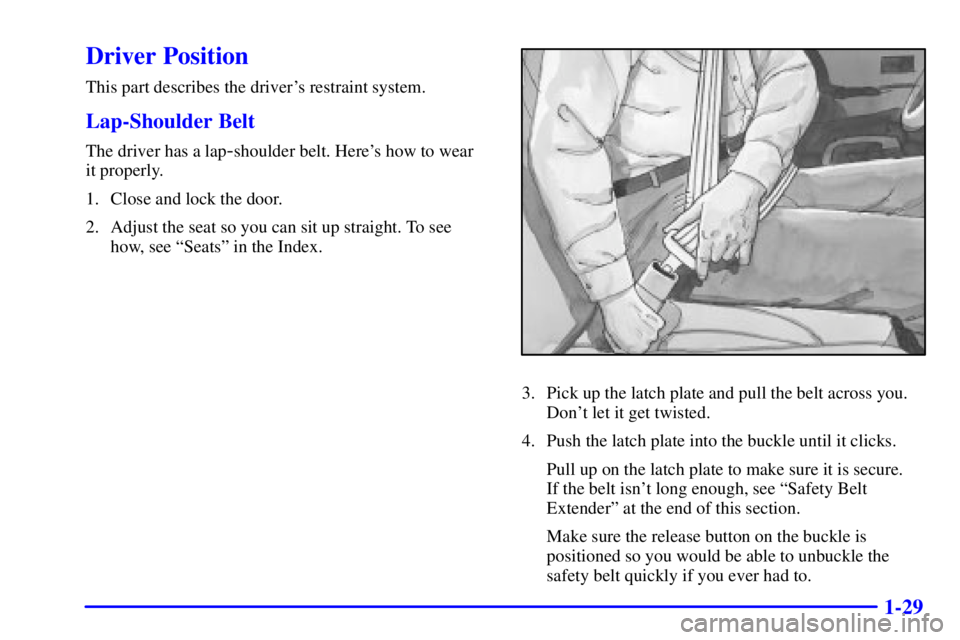
The driver has a lap-shoulder belt. Here's how to wear
it properly.
1. Close and lock the door.
2. Adjust the seat so you can sit up straight. To see
how, see ªSeatsº in the Index.
3. Pick up the latch plate and pull the belt across you.
Don't let it get twisted.
4. Push the latch plate into the buckle until it clicks.
Pull up on the latch plate to make sure it is secure.
If the belt isn't long enough, see ªSafety Belt
Extenderº at the end of this section.
Make sure the release button on the buckle is
positioned so you would be able to unbuckle the
safety belt quickly if you ever had to.
Page 43 of 394
1-30
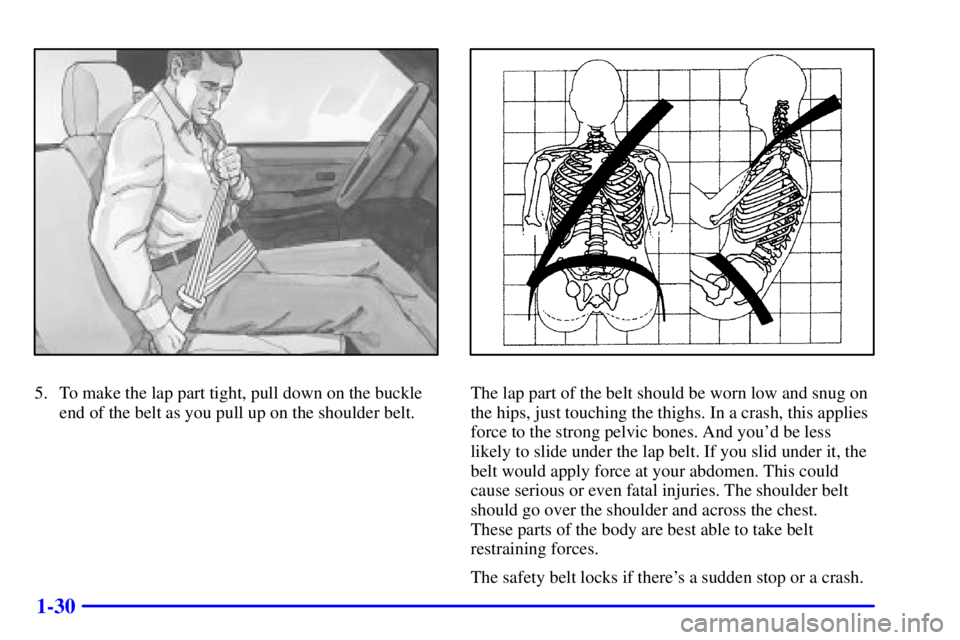
5. To make the lap part tight, pull down on the buckle
end of the belt as you pull up on the shoulder belt.The lap part of the belt should be worn low and snug on
the hips, just touching the thighs. In a crash, this applies
force to the strong pelvic bones. And you'd be less
likely to slide under the lap belt. If you slid under it, the
belt would apply force at your abdomen. This could
cause serious or even fatal injuries. The shoulder belt
should go over the shoulder and across the chest.
These parts of the body are best able to take belt
restraining forces.
The safety belt locks if there's a sudden stop or a crash.
Page 49 of 394
1-36
The best way to protect the fetus is to protect the
mother. When a safety belt is worn properly, it's more
likely that the fetus won't be hurt in a crash. For
pregnant women, as for anyone, the key to making
safety belts effective is wearing them properly.
Right Front Passenger Position
To learn how to wear the right front passenger's
safety belt properly, see ªDriver Positionº earlier
in this section.
The right front passenger's safety belt works the same
way as the driver's safety belt
-- except for one thing.
If you ever pull the shoulder portion of the belt out all
the way, you will engage the child restraint locking
feature. If this happens, just let the belt go back all the
way and start again.
Air Bag Systems
This part explains the frontal and side impact air
bag systems.
Your vehicle has four air bags
-- a frontal air bag for
the driver, another frontal air bag for the right front
passenger, a side impact air bag for the driver, and
another side impact air bag for the right front passenger.Frontal air bags are designed to help reduce the risk of
injury from the force of an inflating frontal air bag. But
these air bags must inflate very quickly to do their job
and comply with federal regulations.
Here are the most important things to know about the
air bag systems:
CAUTION:
You can be severely injured or killed in a crash if
you aren't wearing your safety belt
-- even if you
have air bags. Wearing your safety belt during a
crash helps reduce your chance of hitting things
inside the vehicle or being ejected from it. Air
bags are designed to work with safety belts but
don't replace them.
CAUTION: (Continued)
Page 53 of 394
1-40
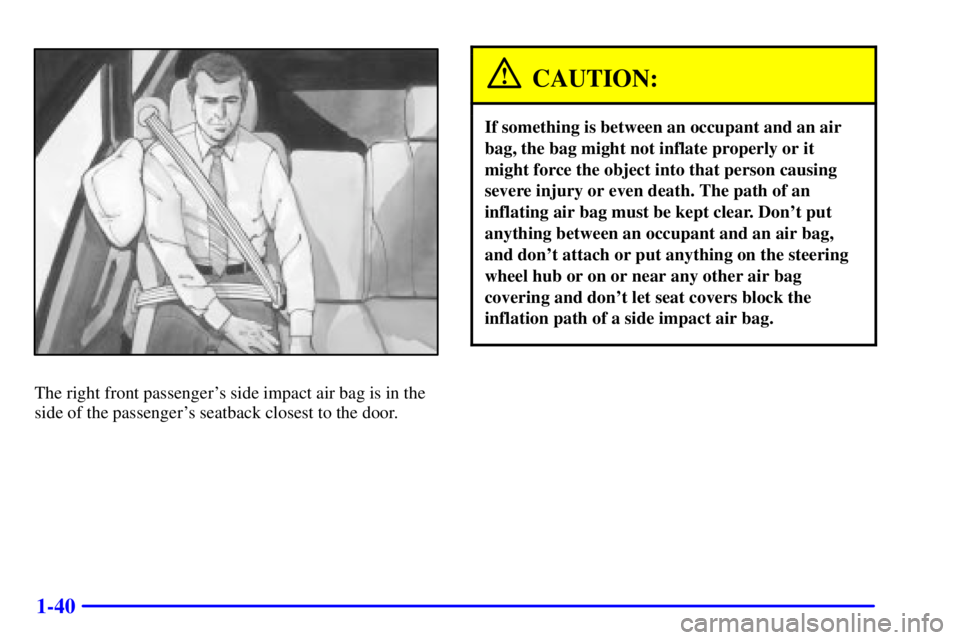
The right front passenger's side impact air bag is in the
side of the passenger's seatback closest to the door.
CAUTION:
If something is between an occupant and an air
bag, the bag might not inflate properly or it
might force the object into that person causing
severe injury or even death. The path of an
inflating air bag must be kept clear. Don't put
anything between an occupant and an air bag,
and don't attach or put anything on the steering
wheel hub or on or near any other air bag
covering and don't let seat covers block the
inflation path of a side impact air bag.
Page 59 of 394
1-46
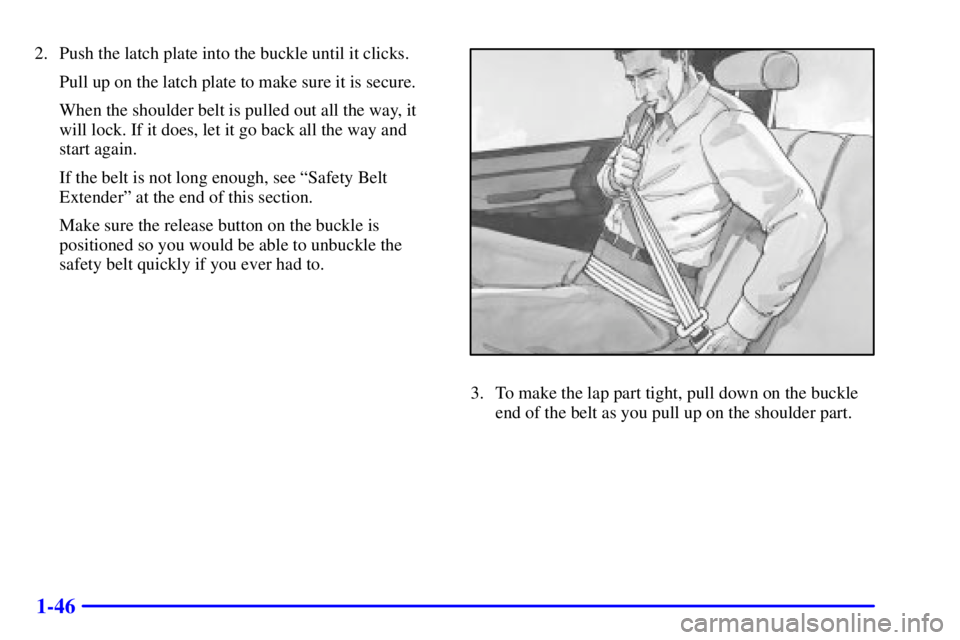
2. Push the latch plate into the buckle until it clicks.
Pull up on the latch plate to make sure it is secure.
When the shoulder belt is pulled out all the way, it
will lock. If it does, let it go back all the way and
start again.
If the belt is not long enough, see ªSafety Belt
Extenderº at the end of this section.
Make sure the release button on the buckle is
positioned so you would be able to unbuckle the
safety belt quickly if you ever had to.
3. To make the lap part tight, pull down on the buckle
end of the belt as you pull up on the shoulder part.
Page 60 of 394
1-47
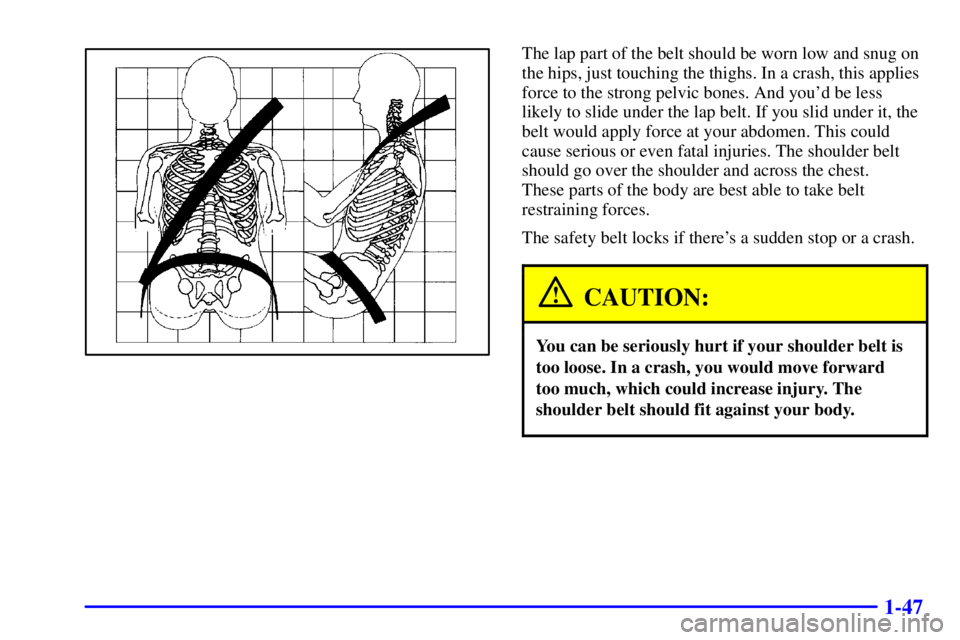
The lap part of the belt should be worn low and snug on
the hips, just touching the thighs. In a crash, this applies
force to the strong pelvic bones. And you'd be less
likely to slide under the lap belt. If you slid under it, the
belt would apply force at your abdomen. This could
cause serious or even fatal injuries. The shoulder belt
should go over the shoulder and across the chest.
These parts of the body are best able to take belt
restraining forces.
The safety belt locks if there's a sudden stop or a crash.
CAUTION:
You can be seriously hurt if your shoulder belt is
too loose. In a crash, you would move forward
too much, which could increase injury. The
shoulder belt should fit against your body.