ESP GREAT WALL FLORID 2008 User Guide
[x] Cancel search | Manufacturer: GREAT WALL, Model Year: 2008, Model line: FLORID, Model: GREAT WALL FLORID 2008Pages: 281, PDF Size: 43.97 MB
Page 115 of 281
Downloaded from www.Manualslib.com manuals search engine GWFLORID Maintenance Manual108
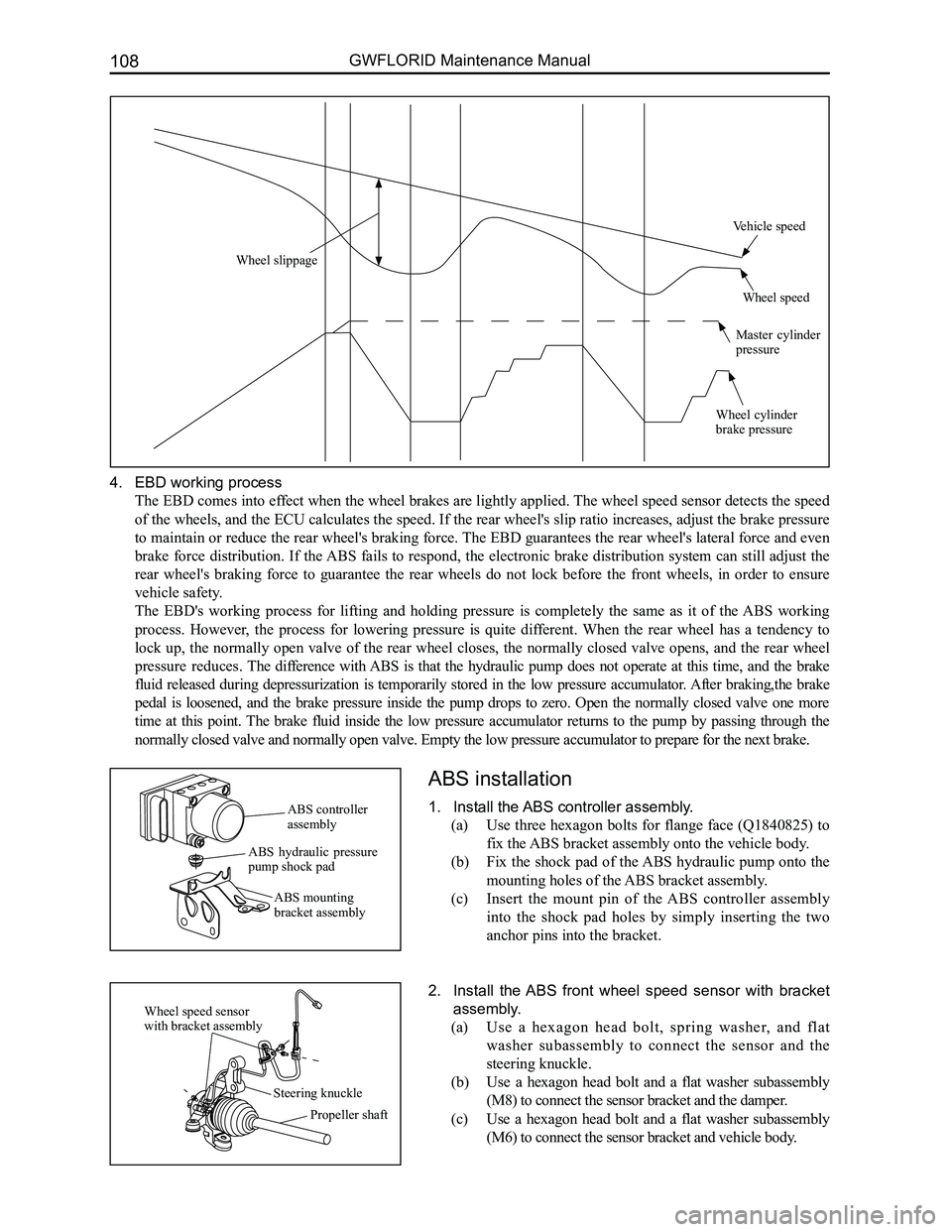
4. EBD working process
The EBD comes into effect when the wheel brakes are lightly applied. The wheel speed sensor detects the speed
of the wheels, and the ECU calculates the speed. If the rear wheel's slip ratio increases, adjust the brake pressure
to maintain or reduce the rear wheel's braking force. The EBD guarantees the rear wheel's lateral force and even
brake force distribution. If the ABS fails to respond, the electronic brake distribution system can still adjust the
rear wheel's braking force to guarantee the rear wheels do not lock before the front wheels, in order to ensure
vehicle safety.
The EBD's working process for lifting and holding pressure is completely the same as it of the ABS working
process. However, the process for lowering pressure is quite different. When the rear wheel has a tendency to
lock up, the normally open valve of the rear wheel closes, the normally closed valve opens, and the rear wheel
pressure reduces. The difference with ABS is that the hydraulic pump does not operate at this time, and the brake
fluid released during depressurization is temporarily stored in the low pressure accumulator. After braking,the brake
pedal is loosened, and the brake pressure inside the pump drops to zero. Open the normally closed valve one more
time at this point. The brake fluid inside the low pressure accumulator returns to the pump by passing through the
normally closed valve and normally open valve. Empty the low pressure ac\
cumulator to prepare for the next brake.
ABS installation
1. Install the ABS controller assembly.
(a) Use three hexagon bolts for flange face (Q1840825) to
fix the ABS bracket assembly onto the vehicle body.
(b) Fix the shock pad of the ABS hydraulic pump onto the
mounting holes of the ABS bracket assembly.
(c) Insert the mount pin of the ABS controller assembly
into the shock pad holes by simply inserting the two
anchor pins into the bracket.
2. Install the ABS front wheel speed sensor with bracket
assembly.
(a) Use a hexagon head bolt, spring washer, and flat
washer subassembly to connect the sensor and the
steering knuckle.
(b) Use a hexagon head bolt and a flat washer subassembly
(M8) to connect the sensor bracket and the damper.
(c) Use a hexagon head bolt and a flat washer subassembly
(M6) to connect the sensor bracket and vehicle body.
ABS controller assembly
ABS hydraulic pressure pump shock pad
ABS mounting bracket assembly
Wheel speed sensor with bracket assembly
Steering knuckle
Propeller shaft
Wheel slippage
Vehicle speed
Wheel speed
Master cylinder pressure
Wheel cylinder brake pressure
Page 117 of 281
Downloaded from www.Manualslib.com manuals search engine GWFLORID Maintenance Manual110
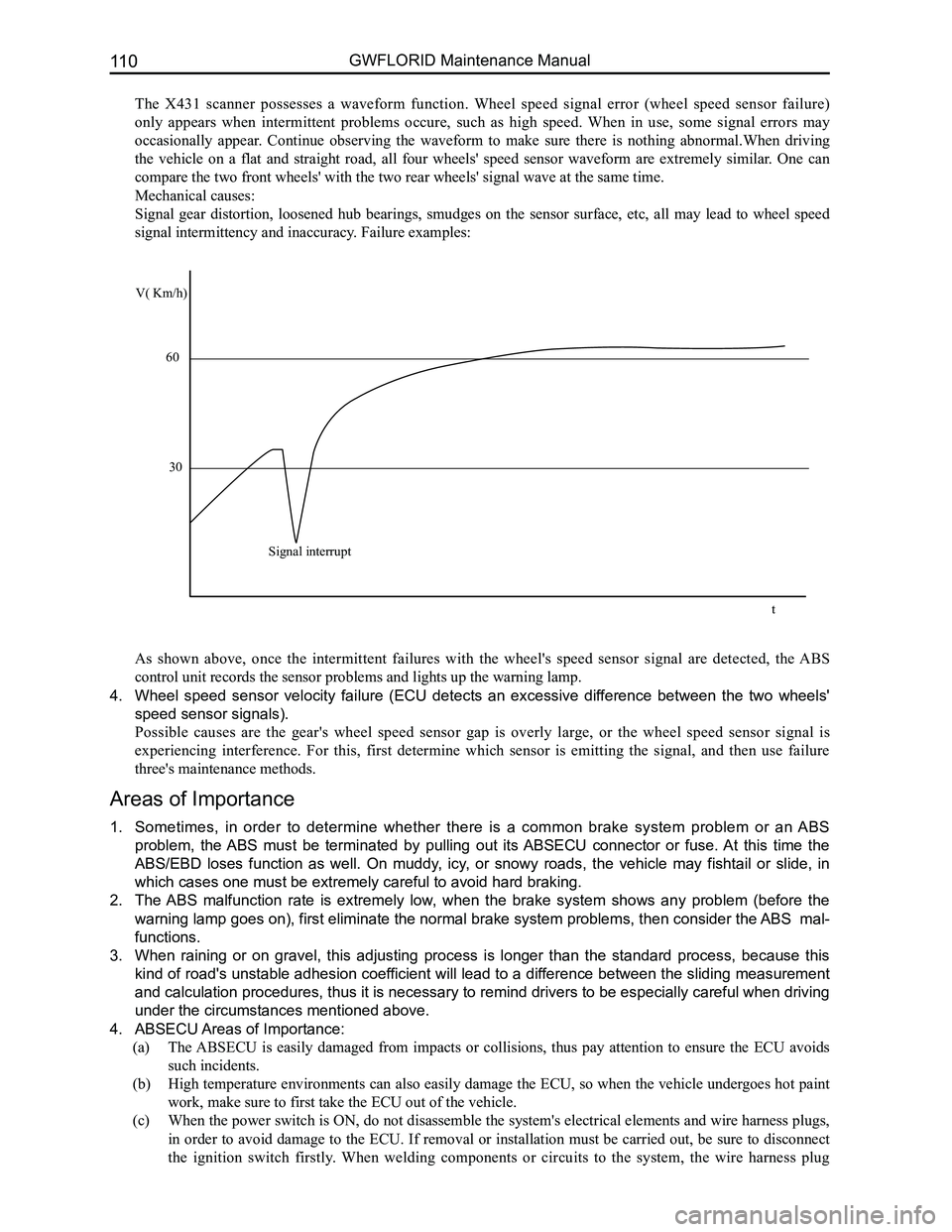
The X431 scanner possesses a waveform function. Wheel speed signal error (wheel speed sensor failure)
only appears when intermittent problems occure, such as high speed. When in use, some signal errors may
occasionally appear. Continue observing the waveform to make sure there is nothing abnormal.When driving
the vehicle on a flat and straight road, all four wheels' speed sensor waveform are extremely similar. One can
compare the two front wheels' with the two rear wheels' signal wave at t\
he same time.
Mechanical causes:
Signal gear distortion, loosened hub bearings, smudges on the sensor surface, etc, all may lead to wheel speed
signal intermittency and inaccuracy. Failure examples:
As shown above, once the intermittent failures with the wheel's speed sensor signal are detected, the ABS
control unit records the sensor problems and lights up the warning lamp.\
4. Wheel speed sensor velocity failure (ECU detects an excessive difference between the two wheels'
speed sensor signals).
Possible causes are the gear's wheel speed sensor gap is overly large, or the wheel speed sensor signal is
experiencing interference. For this, first determine which sensor is emitting the signal, and then use failure
three's maintenance methods.
Areas of Importance
1. Sometimes, in order to determine whether there is a common brake system problem or an ABS
problem, the ABS must be terminated by pulling out its ABSECU connector or fuse. At this time the
ABS/EBD loses function as well. On muddy, icy, or snowy roads, the vehicle may fishtail or slide, in
which cases one must be extremely careful to avoid hard braking.
2. The ABS malfunction rate is extremely low, when the brake system shows any problem (before the
warning lamp goes on), first eliminate the normal brake system problems, then consider the ABS mal-
functions.
3. When raining or on gravel, this adjusting process is longer than the standard process, because this
kind of road's unstable adhesion coefficient will lead to a difference between the sliding measurement
and calculation procedures, thus it is necessary to remind drivers to be especially careful when driving
under the circumstances mentioned above.
4. ABSECU Areas of Importance:
(a) The ABSECU is easily damaged from impacts or collisions, thus pay attention to ensure the ECU avoids
such incidents.
(b) High temperature environments can also easily damage the ECU, so when the vehicle undergoes hot paint
work, make sure to first take the ECU out of the vehicle.
(c) When the power switch is ON, do not disassemble the system's electrical elements and wire harness plugs,
in order to avoid damage to the ECU. If removal or installation must be carried out, be sure to disconnect
the ignition switch firstly. When welding components or circuits to the system, the wire harness plug
V( Km/h)
60
30
Signal interrupt
t
Page 118 of 281
Downloaded from www.Manualslib.com manuals search engine 111Brake System
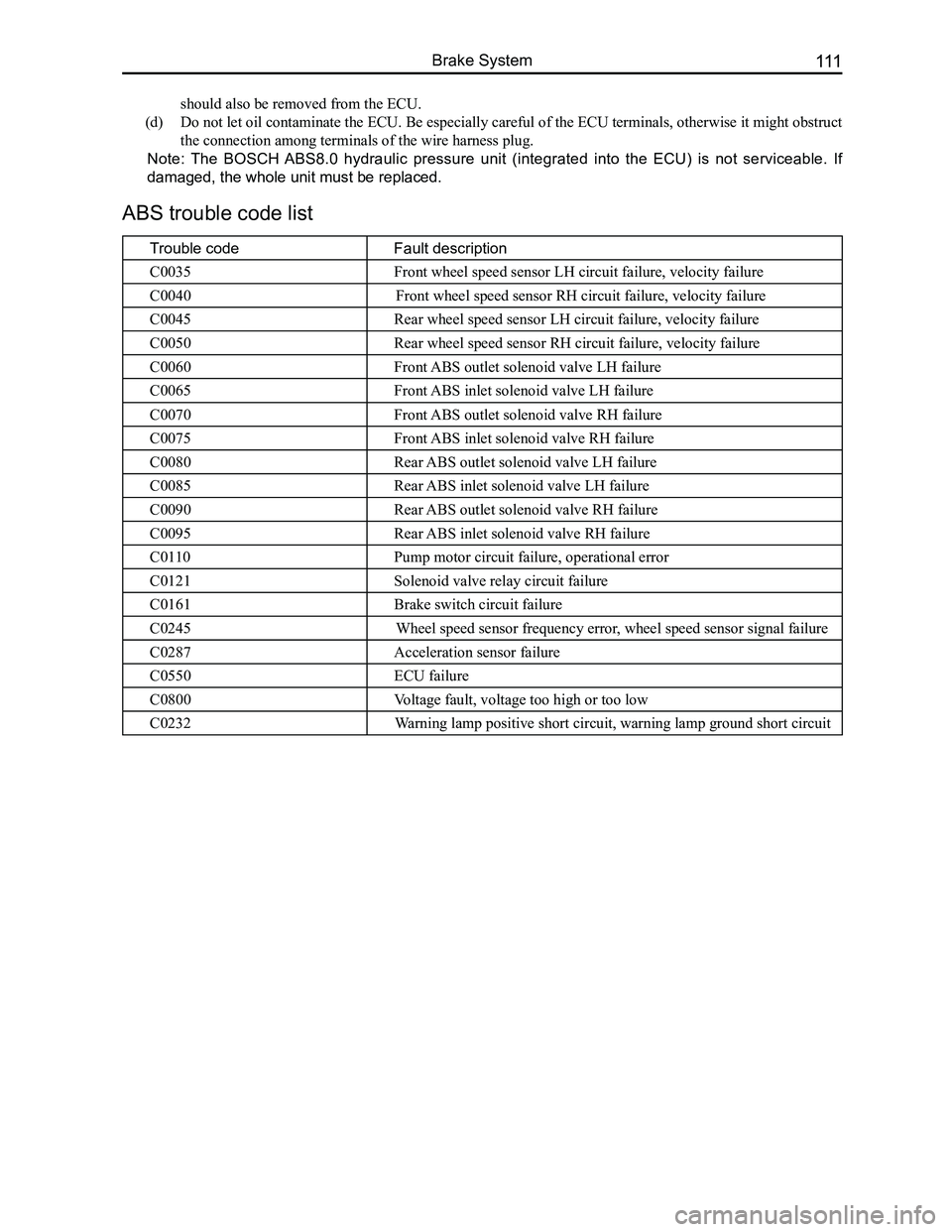
ABS trouble code list
Trouble codeFault description
C0035Front wheel speed sensor LH circuit failure, velocity failure
C0040Front wheel speed sensor RH circuit failure, velocity failure
C0045Rear wheel speed sensor LH circuit failure, velocity failure
C0050Rear wheel speed sensor RH circuit failure, velocity failure
C0060Front ABS outlet solenoid valve LH failure
C0065Front ABS inlet solenoid valve LH failure
C0070Front ABS outlet solenoid valve RH failure
C0075Front ABS inlet solenoid valve RH failure
C0080Rear ABS outlet solenoid valve LH failure
C0085Rear ABS inlet solenoid valve LH failure
C0090Rear ABS outlet solenoid valve RH failure
C0095Rear ABS inlet solenoid valve RH failure
C0110Pump motor circuit failure, operational error
C0121Solenoid valve relay circuit failure
C0161Brake switch circuit failure
C0245Wheel speed sensor frequency error, wheel speed sensor signal failure
C0287Acceleration sensor failure
C0550ECU failure
C0800Voltage fault, voltage too high or too low
C0232Warning lamp positive short circuit, warning lamp ground short circuit
should also be removed from the ECU.
(d) Do not let oil contaminate the ECU. Be especially careful of the ECU terminals, otherwise it might obstruct
the connection among terminals of the wire harness plug.
Note: The BOSCH ABS8.0 hydraulic pressure unit (integrated into the ECU) is not serviceable. If
damaged, the whole unit must be replaced.
Page 191 of 281
Downloaded from www.Manualslib.com manuals search engine GWFLORID Maintenance Manual184
Power Windows
The GWFLORID electric power window actuator consist of a motor and module. Its functions include: jam
protection, centralized control rise, soft-stop, characterized by easy control, long life, etc.
The functions of electric power window actuator
1. Jam protection
Power windows have an jam protection function when manually or automatically rising after it has been
initialized. There is no limit on the amount of jam protections. When room temperature is 25±5oC, wire
resistance 150 mΩ and 14.5 V working voltage, the jam protection force risen glass is less than 100 N. When the
window is manually or electrically rising, once it encounters a force greater than the jam protection force, the glass
will immediately stop rising and make the motor rotate in reverse. Rever\
se rotation distance is about 125 mm.
2. Centralized control rise
The central door lock controller provides four lifters with a low level signal. The power windows will close until
they are completely closed. This enables the two power window actuators to start separately, which can avoid
hitting peak currents if they start up at the same time. As long as the centralized controller's rising pin receives
the low level signal, the motor will close the window until it is comple\
tely closed.
3. Soft-stop
If the motor suffers from an impacting block when the window is rolled all the way up or all the way down, it
would shorten the power window actuator's use life. In order to avoid this, the soft-stop function must be used,
in which both manual and automatic rolling up and down should have this \
function.
(a) Soft close function:
When the window is about to get to the top, that is to say, when it's rising to the soft-stop point, the engine's
power will cut off to make the motor stop working, meanwhile the rising inertia will continue to roll the
window up to the top. The soft-stop point is about 2 mm under the top limiting position.
(b) When the window is about to lower to the bottom, that is to say, when it's lowering to the soft-stop point,
the engine's power will cut off to make it stop working, meanwhile the lowering inertia will continue to roll
the window down to the bottom. The soft-stop point is about 12 mm above the bottom limiting position.
(c) Zero position calibration: This position takes the top limiting position as the zero position. In order to
guarantee reliable and safer system operation while in use, the zero pos\
ition will need constant calibration.
Manual calibration: When the window stops at the rising soft-stop position after rising for a period,
press the rise button so it will rise to the limiting position. Zero cal\
ibration is then complete.
Automatic calibration: After the motor runs forward and reverse more than 20 times, it will undergo
zero position calibration one time. That is to say, when it completely starts or stops operating, the motor will
be blocked one time. Currently, there is no soft close or start-up function. Zero position calibration is com-
pleted when the window is completely closed to the limiting position.
4. Motor locked protection
The control module will cut off the power supply to stop the motor from working within 250 ms of the l\
ocking.
5. Motor temperature protection
When the control module is powered on, the initial temperature of the motor is set at 40oC. There are two
temperature limits for the motor's thermal protection function. If the temperature of the coil exceeds the first
temperature limit (170oC), the motor will not respond to any new operation input, but it will still complete the present
operation. If the motor's temperature exceeds the first temperature limit during its operation, it will keep working until
the temperature of the motor coil reaches the second temperature limit (190oC), then the motor will not be limited by
the second temperature's threshold while reversing, so as to guarantee the safety of the users. Once the temperature of
the motor has lowered below the temperature limit, the motor will work normally.
6. Self-diagnostic protection function
So as to guarantee the system's reliability while improving the system's average non-failure time, self-diagnostic
protection measures are used: If the power supply voltage exceeds 16 V, the control module will close the auto-
rising function.
(a) Switch contact point adhesion:
If it is detected that the switch contact point adhesion has reached up to 10 m input instructions will no
longer be received. If later the switch contact is detected to be disconnected again, it's function will return
to normal.
(b) Relay contact point adhesion:
The power window actuator is controlled by two contact point relays.
After a shutoff command is sent to one of the relays, if the system detects that this relay is still on, then
the system will choose this relay contact point for adhesion. Thereupon, the system will send out another
command to make the other electric relay switch on as well, so as to guarantee the motor's power supply is
Page 196 of 281
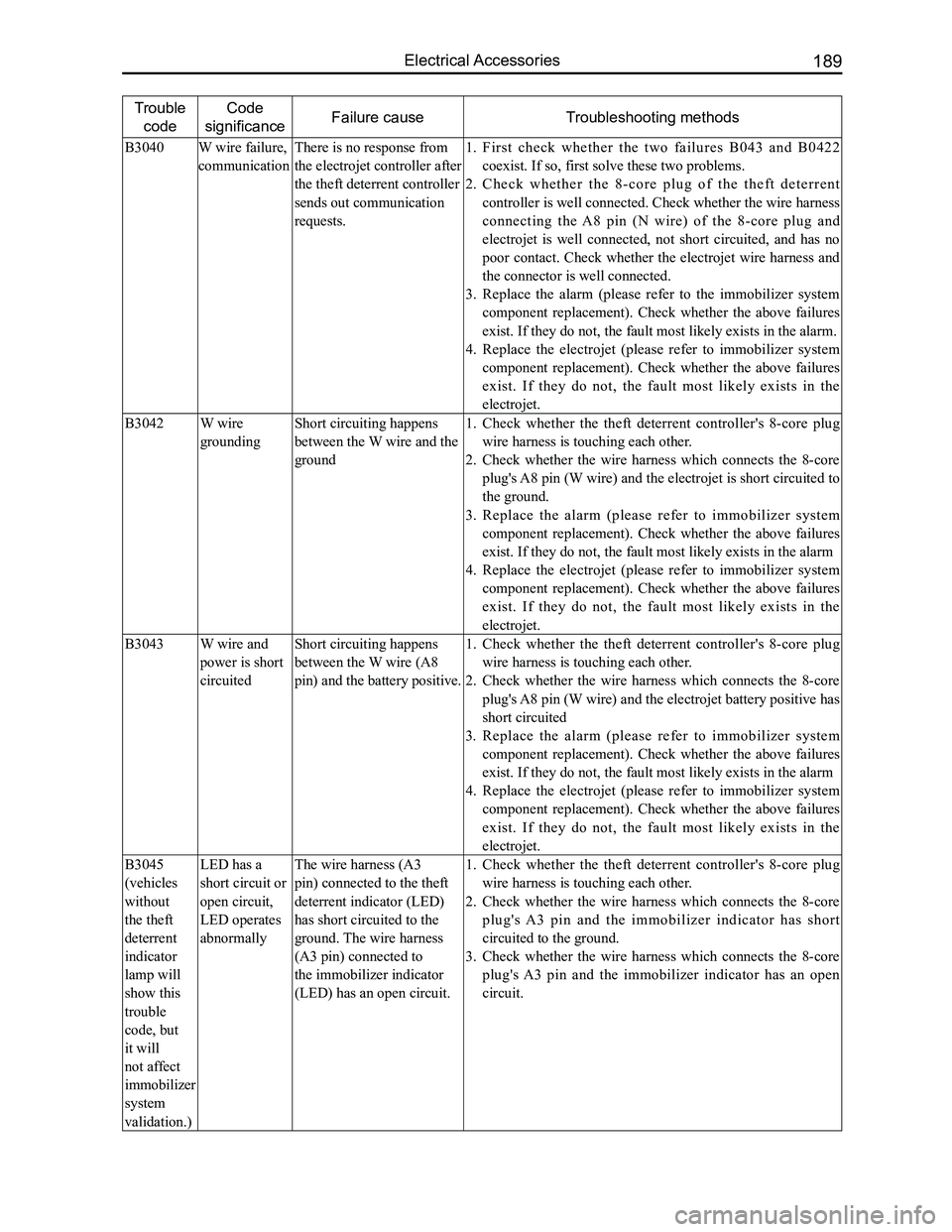
Downloaded from www.Manualslib.com manuals search engine 189Electrical Accessories
Trouble
code
Code
significanceFailure causeTroubleshooting methods
B3040W wire failure,
communication
There is no response from
the electrojet controller after
the theft deterrent controller
sends out communication
requests.
First check whether the two failures B043 and B0422 1.
coexist. If so, first solve these two problems.
C h e c k w h e t h e r t h e 8 - c o r e p l u g o f t h e t h e f t d e t e r r e n t 2.
controller is well connected. Check whether the wire harness
connecting the A8 pin (N wire) of the 8-core plug and
electrojet is well connected, not short circuited, and has no
poor contact. Check whether the electrojet wire harness and
the connector is well connected.
Replace the alarm (please refer to the immobilizer system 3.
component replacement). Check whether the above failures
exist. If they do not, the fault most likely exists in the alarm.
Replace the electrojet (please refer to immobilizer system 4.
component replacement). Check whether the above failures
exist. If they do not, the fault most likely exists in the
electrojet.
B3042W wire
grounding
Short circuiting happens
between the W wire and the
ground
Check whether the theft deterrent controller's 8-core plug 1.
wire harness is touching each other.
Check whether the wire harness which connects the 8-core 2.
plug's A8 pin (W wire) and the electrojet is short circuited to
the ground.
Replace the alarm (please refer to immobilizer system 3.
component replacement). Check whether the above failures
exist. If they do not, the fault most likely exists in the alarm
Replace the electrojet (please refer to immobilizer system 4.
component replacement). Check whether the above failures
exist. If they do not, the fault most likely exists in the
electrojet.
B3043W wire and
power is short
circuited
Short circuiting happens
between the W wire (A8
pin) and the battery positive.
Check whether the theft deterrent controller's 8-core plug 1.
wire harness is touching each other.
Check whether the wire harness which connects the 8-core 2.
plug's A8 pin (W wire) and the electrojet battery positive has
short circuited
Replace the alarm (please refer to immobilizer system 3.
component replacement). Check whether the above failures
exist. If they do not, the fault most likely exists in the alarm
Replace the electrojet (please refer to immobilizer system 4.
component replacement). Check whether the above failures
exist. If they do not, the fault most likely exists in the
electrojet.
B3045
(vehicles
without
the theft
deterrent
indicator
lamp will
show this
trouble
code, but
it will
not affect
immobilizer
system
validation.)
LED has a
short circuit or
open circuit,
LED operates
abnormally
The wire harness (A3
pin) connected to the theft
deterrent indicator (LED)
has short circuited to the
ground. The wire harness
(A3 pin) connected to
the immobilizer indicator
(LED) has an open circuit.
Check whether the theft deterrent controller's 8-core plug 1.
wire harness is touching each other.
Check whether the wire harness which connects the 8-core 2.
plug's A3 pin and the immobilizer indicator has short
circuited to the ground.
Check whether the wire harness which connects the 8-core 3.
plug's A3 pin and the immobilizer indicator has an open
circuit.
Page 197 of 281
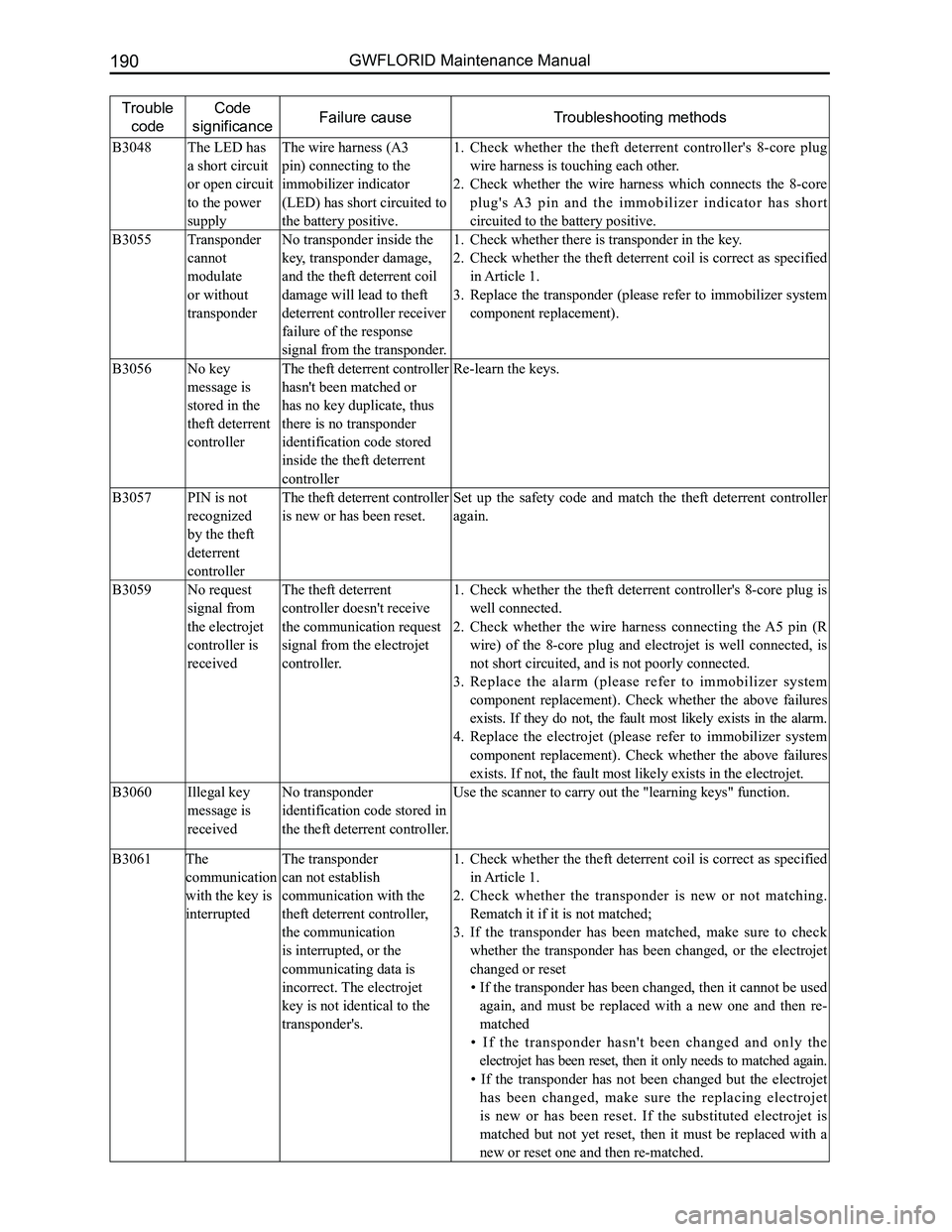
Downloaded from www.Manualslib.com manuals search engine GWFLORID Maintenance Manual190
Trouble
code
Code
significanceFailure causeTroubleshooting methods
B3048The LED has
a short circuit
or open circuit
to the power
supply
The wire harness (A3
pin) connecting to the
immobilizer indicator
(LED) has short circuited to
the battery positive.
Check whether the theft deterrent controller's 8-core plug 1.
wire harness is touching each other.
Check whether the wire harness which connects the 8-core 2.
plug's A3 pin and the immobilizer indicator has short
circuited to the battery positive.
B3055Transponder
cannot
modulate
or without
transponder
No transponder inside the
key, transponder damage,
and the theft deterrent coil
damage will lead to theft
deterrent controller receiver
failure of the response
signal from the transponder.
Check whether there is transponder in the key.1.
Check whether the theft deterrent coil is correct as specified 2.
in Article 1.
Replace the transponder (please refer to immobilizer system 3.
component replacement).
B3056No key
message is
stored in the
theft deterrent
controller
The theft deterrent controller
hasn't been matched or
has no key duplicate, thus
there is no transponder
identification code stored
inside the theft deterrent
controller
Re-learn the keys.
B3057PIN is not
recognized
by the theft
deterrent
controller
The theft deterrent controller
is new or has been reset.
Set up the safety code and match the theft deterrent controller
again.
B3059No request
signal from
the electrojet
controller is
received
The theft deterrent
controller doesn't receive
the communication request
signal from the electrojet
controller.
Check whether the theft deterrent controller's 8-core plug is 1.
well connected.
Check whether the wire harness connecting the A5 pin (R 2.
wire) of the 8-core plug and electrojet is well connected, is
not short circuited, and is not poorly connected.
Replace the alarm (please refer to immobilizer system 3.
component replacement). Check whether the above failures
exists. If they do not, the fault most likely exists in the alarm.
Replace the electrojet (please refer to immobilizer system 4.
component replacement). Check whether the above failures
exists. If not, the fault most likely exists in the electrojet.
B3060Illegal key
message is
received
No transponder
identification code stored in
the theft deterrent controller.
Use the scanner to carry out the "learning keys" function.
B3061The
communication
with the key is
interrupted
The transponder
can not establish
communication with the
theft deterrent controller,
the communication
is interrupted, or the
communicating data is
incorrect. The electrojet
key is not identical to the
transponder's.
Check whether the theft deterrent coil is correct as specified 1.
in Article 1.
Check whether the transponder is new or not matching. 2.
Rematch it if it is not matched;
If the transponder has been matched, make sure to check 3.
whether the transponder has been changed, or the electrojet
changed or reset
• If the transponder has been changed, then it cannot be used
again, and must be replaced with a new one and then re-
matched
• If the transponder hasn't been changed and only the
electrojet has been reset, then it only needs to matched again.
• If the transponder has not been changed but the electrojet
has been changed, make sure the replacing electrojet
is new or has been reset. If the substituted electrojet is
matched but not yet reset, then it must be replaced with a
new or reset one and then re-matched.
Page 225 of 281
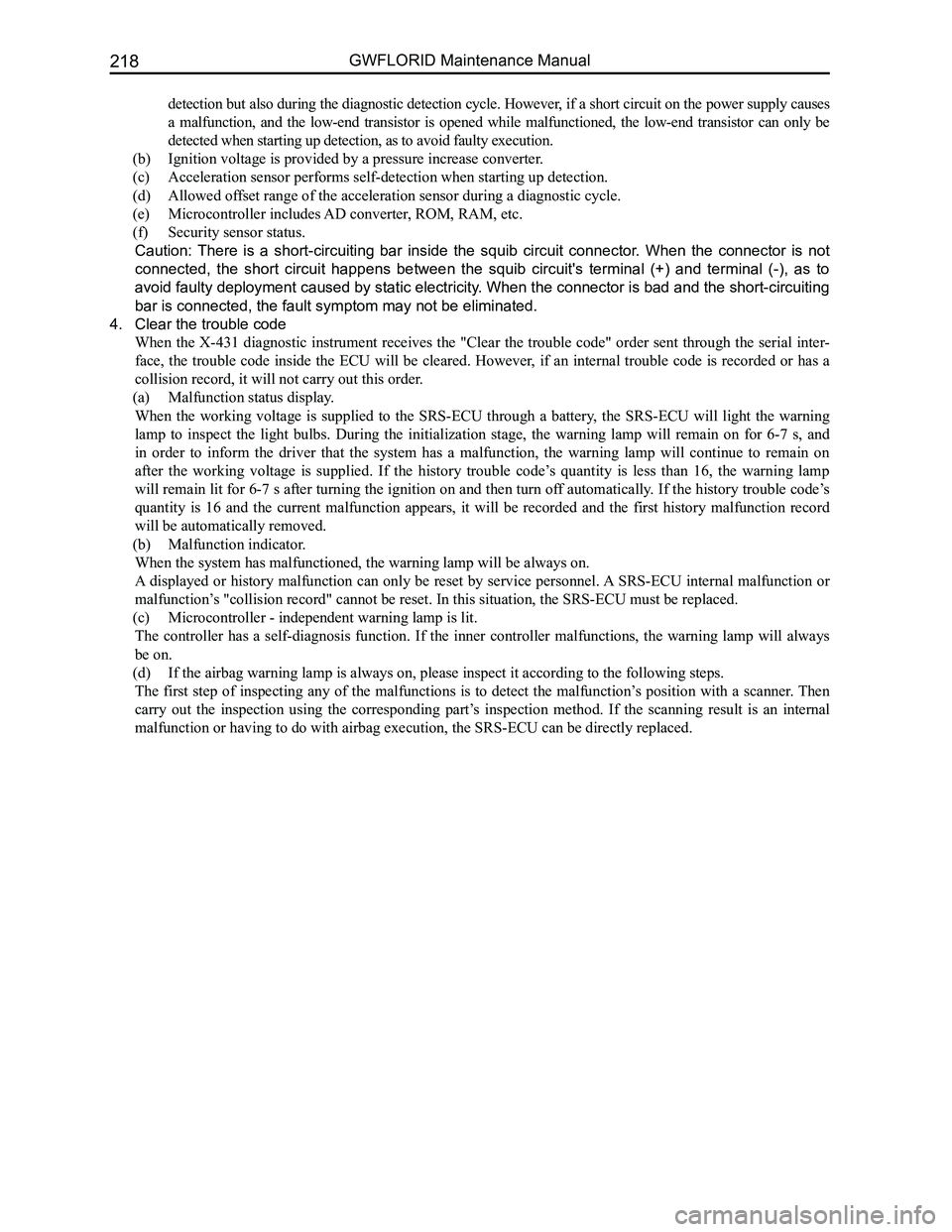
Downloaded from www.Manualslib.com manuals search engine GWFLORID Maintenance Manual218
detection but also during the diagnostic detection cycle. However, if a short circuit on the power supply causes
a malfunction, and the low-end transistor is opened while malfunctioned, the low-end transistor can only be
detected when starting up detection, as to avoid faulty execution.
(b) Ignition voltage is provided by a pressure increase converter.
(c) Acceleration sensor performs self-detection when starting up detection.
(d) Allowed offset range of the acceleration sensor during a diagnostic cycle.
(e) Microcontroller includes AD converter, ROM, RAM, etc.
(f) Security sensor status.
Caution: There is a short-circuiting bar inside the squib circuit connector. When the connector is not
connected, the short circuit happens between the squib circuit's terminal (+) and terminal (-), as to
avoid faulty deployment caused by static electricity. When the connector is bad and the short-circuiting
bar is connected, the fault symptom may not be eliminated.
4. Clear the trouble code
When the X-431 diagnostic instrument receives the "Clear the trouble code" order sent through the serial inter-
face, the trouble code inside the ECU will be cleared. However, if an internal trouble code is recorded or has a
collision record, it will not carry out this order.
(a) Malfunction status display.
When the working voltage is supplied to the SRS-ECU through a battery, the SRS-ECU will light the warning
lamp to inspect the light bulbs. During the initialization stage, the warning lamp will remain on for 6-7 s, and
in order to inform the driver that the system has a malfunction, the warning lamp will continue to remain on
after the working voltage is supplied. If the history trouble code’s quantity is less than 16, the warning lamp
will remain lit for 6-7 s after turning the ignition on and then turn off automatically. If the history trouble code’s
quantity is 16 and the current malfunction appears, it will be recorded and the first history malfunction record
will be automatically removed.
(b) Malfunction indicator.
When the system has malfunctioned, the warning lamp will be always on.
A displayed or history malfunction can only be reset by service personnel. A SRS-ECU internal malfunction or
malfunction’s "collision record" cannot be reset. In this situation, the SRS-ECU mus\
t be replaced.
(c) Microcontroller - independent warning lamp is lit.
The controller has a self-diagnosis function. If the inner controller malfunctions, the warning lamp will always
be on.
(d) If the airbag warning lamp is always on, please inspect it according to the following steps.
The first step of inspecting any of the malfunctions is to detect the malfunction’s position with a scanner. Then
carry out the inspection using the corresponding part’s inspection method. If the scanning result is an internal
malfunction or having to do with airbag execution, the SRS-ECU can be di\
rectly replaced.
Page 226 of 281
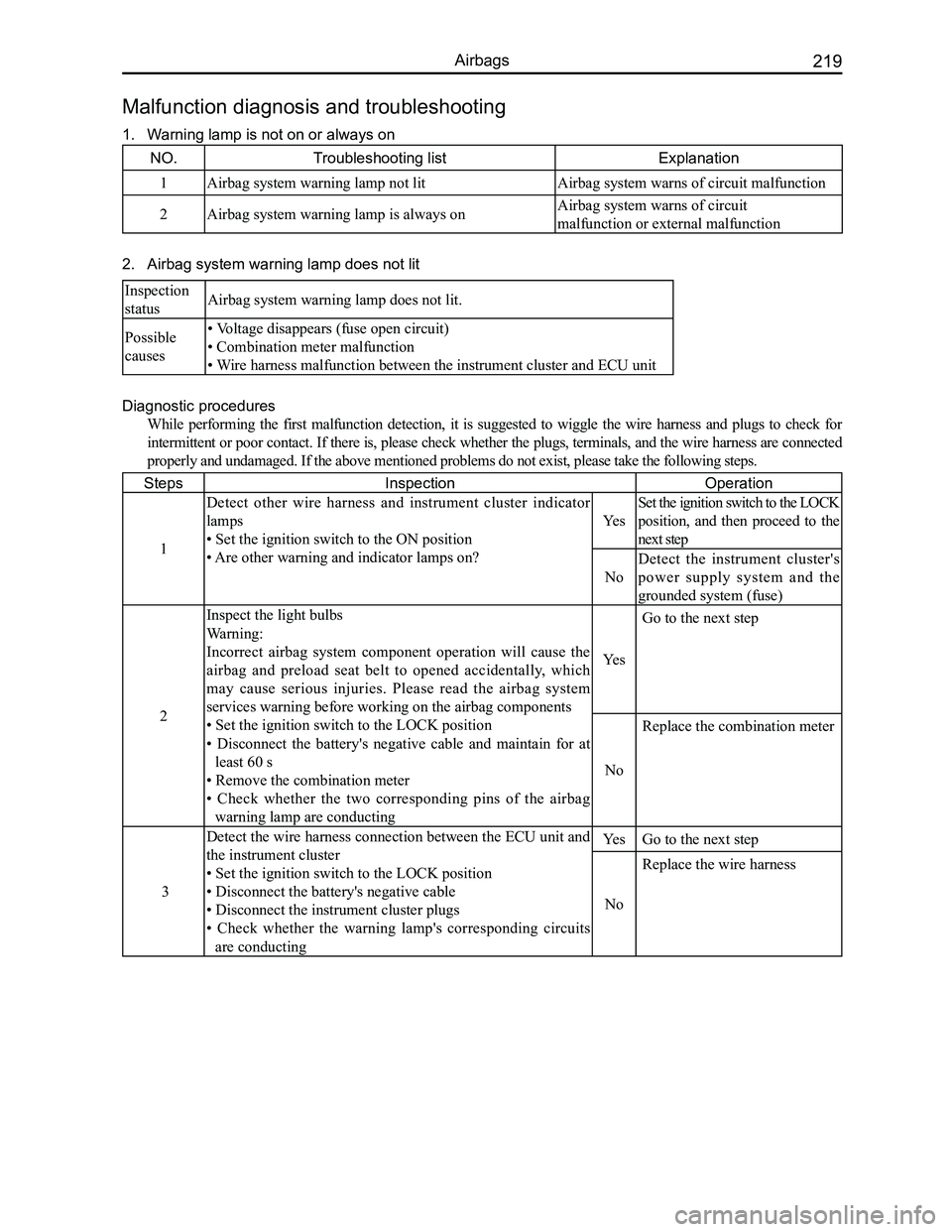
Downloaded from www.Manualslib.com manuals search engine 219Airbags
NO.Troubleshooting listExplanation
1Airbag system warning lamp not litAirbag system warns of circuit malfunction
2Airbag system warning lamp is always onAirbag system warns of circuit
malfunction or external malfunction
2. Airbag system warning lamp does not lit
Inspection
statusAirbag system warning lamp does not lit.
Possible
causes
• Voltage disappears (fuse open circuit)
• Combination meter malfunction
• Wire harness malfunction between the instrument cluster and ECU unit
Diagnostic procedures
While performing the first malfunction detection, it is suggested to wiggle the wire harness and plugs to check for
intermittent or poor contact. If there is, please check whether the plugs, terminals, and the wire harness are connected
properly and undamaged. If the above mentioned problems do not exist, pl\
ease take the following steps.
StepsInspectionOperation
1
Detect other wire harness and instrument cluster indicator
lamps
• Set the ignition switch to the ON position
• Are other warning and indicator lamps on?
Yes
Set the ignition switch to the LOCK
position, and then proceed to the
next step
No
Detect the instrument cluster's
power supply system and the
grounded system (fuse)
2
Inspect the light bulbs
Warning:
Incorrect airbag system component operation will cause the
airbag and preload seat belt to opened accidentally, which
may cause serious injuries. Please read the airbag system
services warning before working on the airbag components
• Set the ignition switch to the LOCK position
• Disconnect the battery's negative cable and maintain for at
least 60 s
• Remove the combination meter
• Check whether the two corresponding pins of the airbag
warning lamp are conducting
Yes
Go to the next step
No
Replace the combination meter
3
Detect the wire harness connection between the ECU unit and
the instrument cluster
• Set the ignition switch to the LOCK position
• Disconnect the battery's negative cable
• Disconnect the instrument cluster plugs
• Check whether the warning lamp's corresponding circuits
are conducting
YesGo to the next step
No
Replace the wire harness
Malfunction diagnosis and troubleshooting
1. Warning lamp is not on or always on
Page 227 of 281
Downloaded from www.Manualslib.com manuals search engine GWFLORID Maintenance Manual220
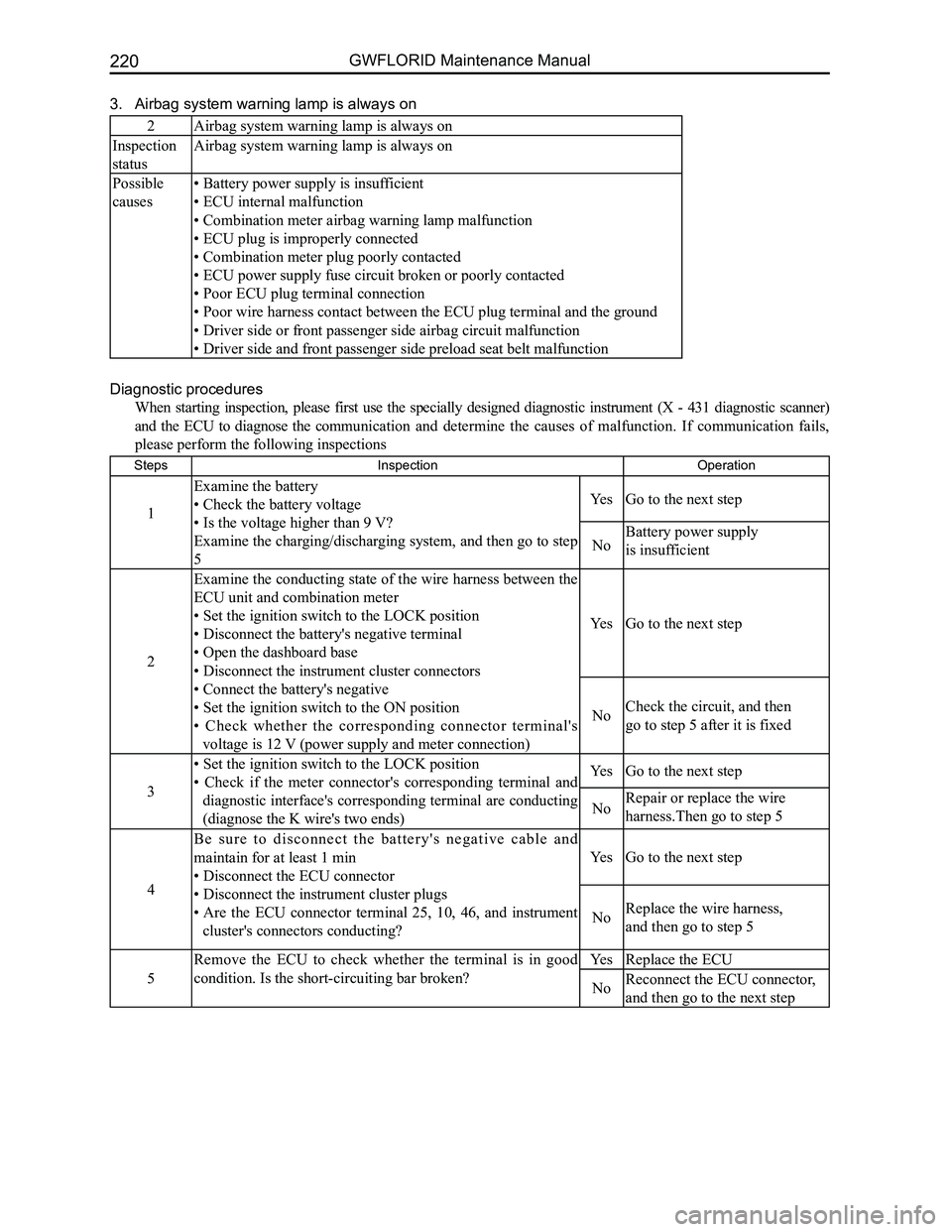
3. Airbag system warning lamp is always on
2Airbag system warning lamp is always on
Inspection
status
Airbag system warning lamp is always on
Possible
causes
• Battery power supply is insufficient
• ECU internal malfunction
• Combination meter airbag warning lamp malfunction
• ECU plug is improperly connected
• Combination meter plug poorly contacted
• ECU power supply fuse circuit broken or poorly contacted
• Poor ECU plug terminal connection
• Poor wire harness contact between the ECU plug terminal and the ground
• Driver side or front passenger side airbag circuit malfunction
• Driver side and front passenger side preload seat belt malfunction
Diagnostic procedures
When starting inspection, please first use the specially designed diagnostic instrument (X - 431 diagnostic scanner)
and the ECU to diagnose the communication and determine the causes of malfunction. If communication fails,
please perform the following inspections
StepsInspection Operation
1
Examine the battery
• Check the battery voltage
• Is the voltage higher than 9 V?
Examine the charging/discharging system, and then go to step
5
YesGo to the next step
NoBattery power supply
is insufficient
2
Examine the conducting state of the wire harness between the
ECU unit and combination meter
• Set the ignition switch to the LOCK position
• Disconnect the battery's negative terminal
• Open the dashboard base
• Disconnect the instrument cluster connectors
• Connect the battery's negative
• Set the ignition switch to the ON position
• Check whether the corresponding connector terminal's
voltage is 12 V (power supply and meter connection)
YesGo to the next step
NoCheck the circuit, and then
go to step 5 after it is fixed
3
• Set the ignition switch to the LOCK position
• Check if the meter connector's corresponding terminal and
diagnostic interface's corresponding terminal are conducting
(diagnose the K wire's two ends)
YesGo to the next step
NoRepair or replace the wire
harness.Then go to step 5
4
B e s u r e t o d i s c o n n e c t t h e b a t t e r y ' s n e g a t i v e c a b l e a n d
maintain for at least 1 min
• Disconnect the ECU connector
• Disconnect the instrument cluster plugs
• Are the ECU connector terminal 25, 10, 46, and instrument
cluster's connectors conducting?
YesGo to the next step
NoReplace the wire harness,
and then go to step 5
5
Remove the ECU to check whether the terminal is in good
condition. Is the short-circuiting bar broken?
YesReplace the ECU
NoReconnect the ECU connector,
and then go to the next step
Page 228 of 281
Downloaded from www.Manualslib.com manuals search engine 221Airbags
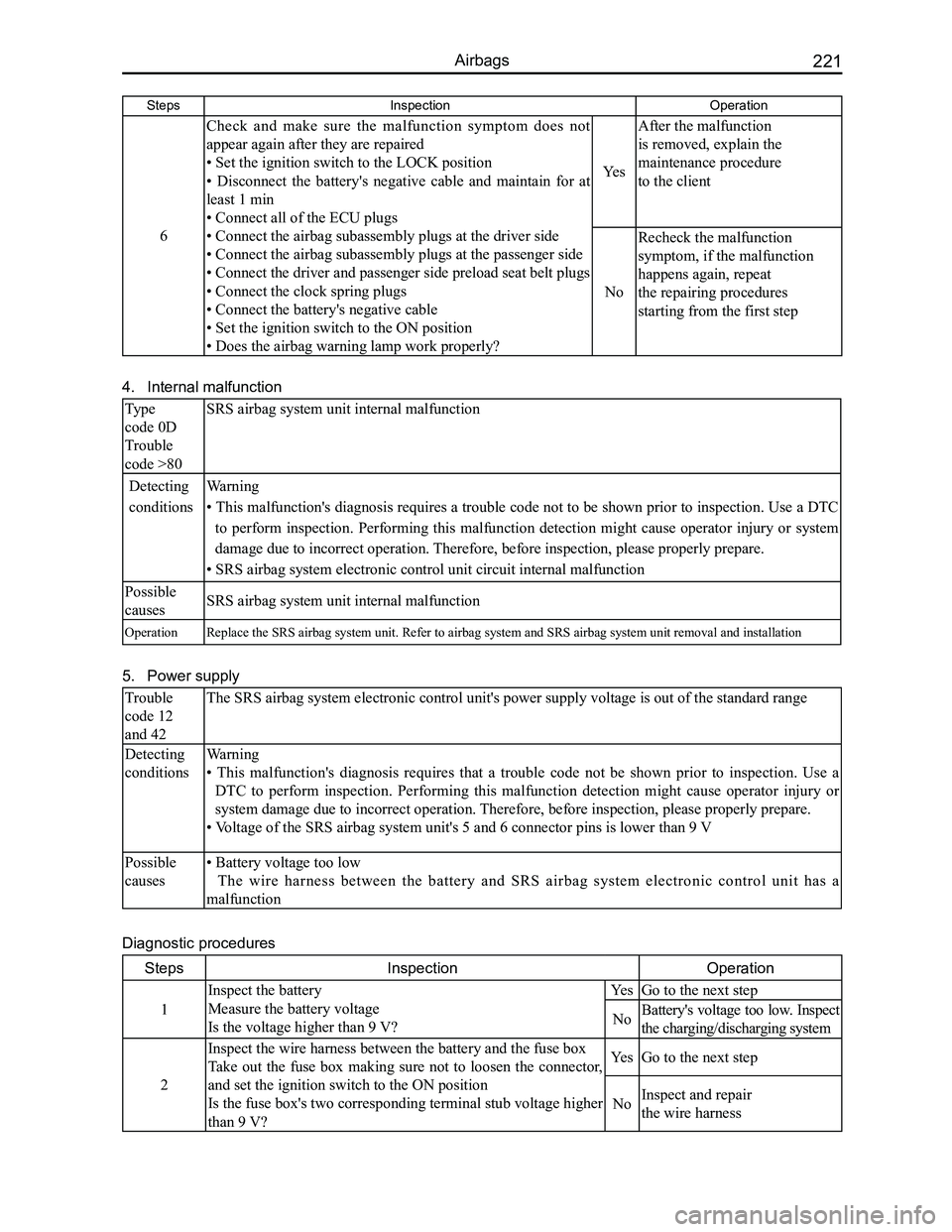
StepsInspection Operation
6
Check and make sure the malfunction symptom does not
appear again after they are repaired
• Set the ignition switch to the LOCK position
• Disconnect the battery's negative cable and maintain for at
least 1 min
• Connect all of the ECU plugs
• Connect the airbag subassembly plugs at the driver side
• Connect the airbag subassembly plugs at the passenger side
• Connect the driver and passenger side preload seat belt plugs
• Connect the clock spring plugs
• Connect the battery's negative cable
• Set the ignition switch to the ON position
• Does the airbag warning lamp work properly?
Yes
After the malfunction
is removed, explain the
maintenance procedure
to the client
No
Recheck the malfunction
symptom, if the malfunction
happens again, repeat
the repairing procedures
starting from the first step
4. Internal malfunction
Type
code 0D
Trouble
code >80
SRS airbag system unit internal malfunction
Detecting
conditions
Warning
• This malfunction's diagnosis requires a trouble code not to be shown prior to inspection. Use a DTC
to perform inspection. Performing this malfunction detection might cause operator injury or system
damage due to incorrect operation. Therefore, before inspection, please properly prepare.
• SRS airbag system electronic control unit circuit internal malfunction
Possible
causesSRS airbag system unit internal malfunction
OperationReplace the SRS airbag system unit. Refer to airbag system and SRS airba\
g system unit removal and installation
5. Power supply
Trouble
code 12
and 42
The SRS airbag system electronic control unit's power supply voltage is \
out of the standard range
Detecting
conditions
Warning
• This malfunction's diagnosis requires that a trouble code not be shown prior to inspection. Use a
DTC to perform inspection. Performing this malfunction detection might cause operator injury or
system damage due to incorrect operation. Therefore, before inspection, please properly prepare.
• Voltage of the SRS airbag system unit's 5 and 6 connector pins is lower than 9 V
Possible
causes
• Battery voltage too low
The wire harness between the battery and SRS airbag system electronic control unit has a
malfunction
Diagnostic procedures
StepsInspectionOperation
1
Inspect the battery
Measure the battery voltage
Is the voltage higher than 9 V?
YesGo to the next step
NoBattery's voltage too low. Inspect
the charging/discharging system
2
Inspect the wire harness between the battery and the fuse box
Take out the fuse box making sure not to loosen the connector,
and set the ignition switch to the ON position
Is the fuse box's two corresponding terminal stub voltage higher
than 9 V?
YesGo to the next step
NoInspect and repair
the wire harness