wheel torque GREAT WALL FLORID 2008 User Guide
[x] Cancel search | Manufacturer: GREAT WALL, Model Year: 2008, Model line: FLORID, Model: GREAT WALL FLORID 2008Pages: 281, PDF Size: 43.97 MB
Page 92 of 281
Downloaded from www.Manualslib.com manuals search engine 85Suspension System
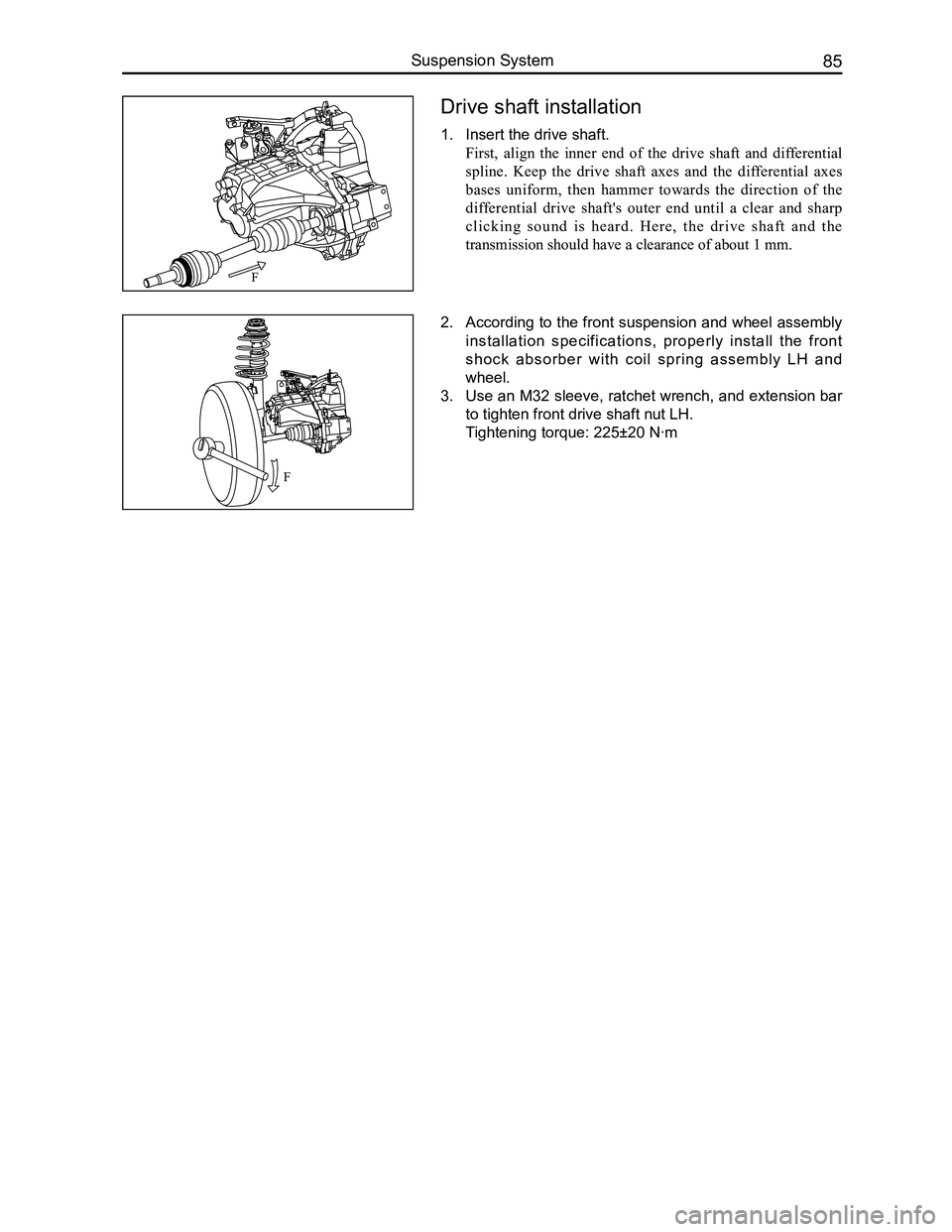
Drive shaft installation
1. Insert the drive shaft.
First, align the inner end of the drive shaft and differential
spline. Keep the drive shaft axes and the differential axes
bases uniform, then hammer towards the direction of the
differential drive shaft's outer end until a clear and sharp
clicking sound is heard. Here, the drive shaft and the
transmission should have a clearance of about 1 mm.
2. According to the front suspension and wheel assembly
installation specifications, properly install the front
shock absorber with coil spring assembly LH and
wheel.
3. Use an M32 sleeve, ratchet wrench, and extension bar
to tighten front drive shaft nut LH.
Tightening torque: 225±20 N·m
F
F
Page 100 of 281
Downloaded from www.Manualslib.com manuals search engine 93Suspension System
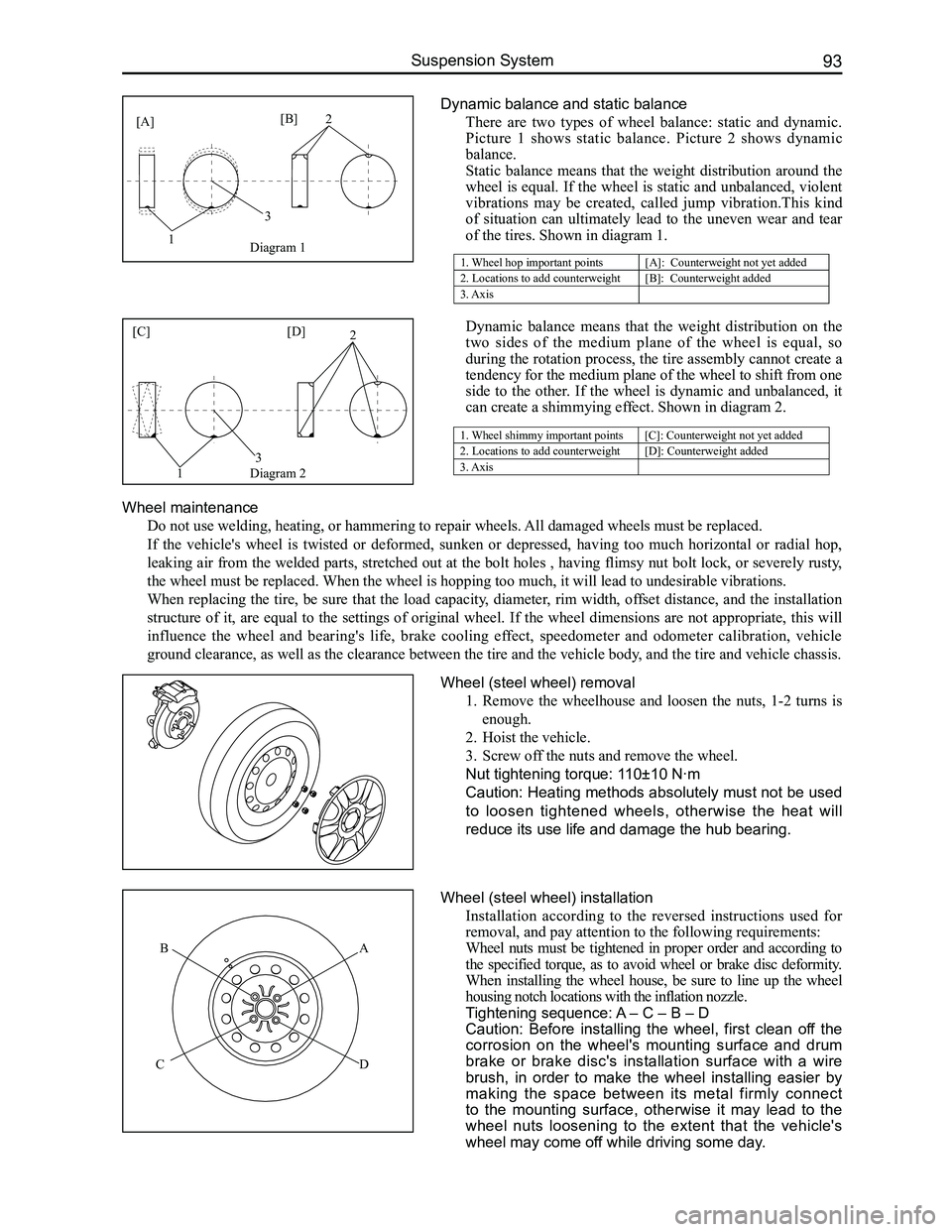
Dynamic balance and static balance
There are two types of wheel balance: static and dynamic.
Picture 1 shows static balance. Picture 2 shows dynamic
balance.
Static balance means that the weight distribution around the
wheel is equal. If the wheel is static and unbalanced, violent
vibrations may be created, called jump vibration.This kind
of situation can ultimately lead to the uneven wear and tear
of the tires. Shown in diagram 1.
Dynamic balance means that the weight distribution on the
two sides of the medium plane of the wheel is equal, so
during the rotation process, the tire assembly cannot create a
tendency for the medium plane of the wheel to shift from one
side to the other. If the wheel is dynamic and unbalanced, it
can create a shimmying effect. Shown in diagram 2.
1. Wheel shimmy important points[C]: Counterweight not yet added
2. Locations to add counterweight[D]: Counterweight added
3. Axis
Wheel maintenance
Do not use welding, heating, or hammering to repair wheels. All damaged wheels must be replaced.
If the vehicle's wheel is twisted or deformed, sunken or depressed, having too much horizontal or radial hop,
leaking air from the welded parts, stretched out at the bolt holes , having flimsy nut bolt lock, or severely rusty,
the wheel must be replaced. When the wheel is hopping too much, it will lead to undesirable vibratio\
ns.
When replacing the tire, be sure that the load capacity, diameter, rim width, offset distance, and the installation
structure of it, are equal to the settings of original wheel. If the wheel dimensions are not appropriate, this will
influence the wheel and bearing's life, brake cooling effect, speedometer and odometer calibration, vehicle
ground clearance, as well as the clearance between the tire and the vehi\
cle body, and the tire and vehicle chassis.
Wheel (steel wheel) removal
1. Remove the wheelhouse and loosen the nuts, 1-2 turns is
enough.
2. Hoist the vehicle.
3. Screw off the nuts and remove the wheel.
Nut tightening torque: 110±10 N·m
Caution: Heating methods absolutely must not be used
to loosen tightened wheels, otherwise the heat will
reduce its use life and damage the hub bearing.
Wheel (steel wheel) installation
Installation according to the reversed instructions used for
removal, and pay attention to the following requirements:
Wheel nuts must be tightened in proper order and according to
the specified torque, as to avoid wheel or brake disc deformity.
When installing the wheel house, be sure to line up the wheel
housing notch locations with the inflation nozzle.
Tightening sequence: A – C – B – D
Caution: Before installing the wheel, first clean off the
corrosion on the wheel's mounting surface and drum
brake or brake disc's installation surface with a wire
brush, in order to make the wheel installing easier by
making the space between its metal firmly connect
to the mounting surface, otherwise it may lead to the
wheel nuts loosening to the extent that the vehicle's
wheel may come off while driving some day.
1
3
2[A][B]
1. Wheel hop important points[A]: Counterweight not yet added
2. Locations to add counterweight[B]: Counterweight added
3. Axis
Diagram 1
Diagram 2
[C][D]
1
3
2
AB
CD
Page 119 of 281
Downloaded from www.Manualslib.com manuals search engine GWFLORID Maintenance Manual112
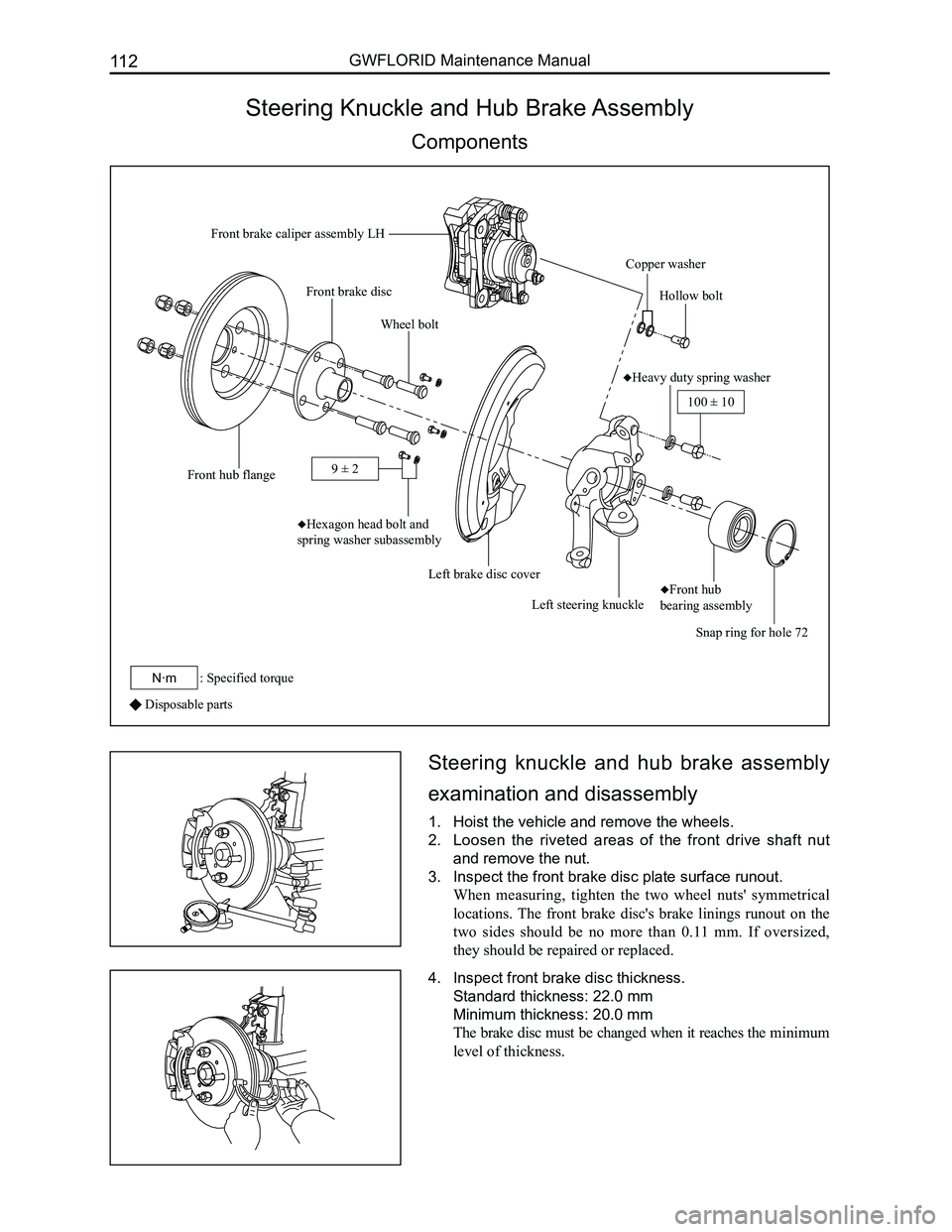
Steering Knuckle and Hub Brake Assembly
Components
Disposable parts
Steering knuckle and hub brake assembly
examination and disassembly
1. Hoist the vehicle and remove the wheels.
2. Loosen the riveted areas of the front drive shaft nut
and remove the nut.
3. Inspect the front brake disc plate surface runout.
When measuring, tighten the two wheel nuts' symmetrical
locations. The front brake disc's brake linings runout on the
two sides should be no more than 0.11 mm. If oversized,
they should be repaired or replaced.
4. Inspect front brake disc thickness.
Standard thickness: 22.0 mm
Minimum thickness: 20.0 mm
The brake disc must be changed when it reaches the minimum
level of thickness.
Front brake caliper assembly LH
Copper washer
Hollow bolt
♦Heavy duty spring washer
Snap ring for hole 72
♦Front hub
bearing assemblyLeft steering knuckle
Left brake disc cover
♦Hexagon head bolt and
spring washer subassembly
Wheel bolt
Front hub flange
Front brake disc
100 ± 10
: Specified torqueN·m
9 ± 2
Page 121 of 281
Downloaded from www.Manualslib.com manuals search engine GWFLORID Maintenance Manual114
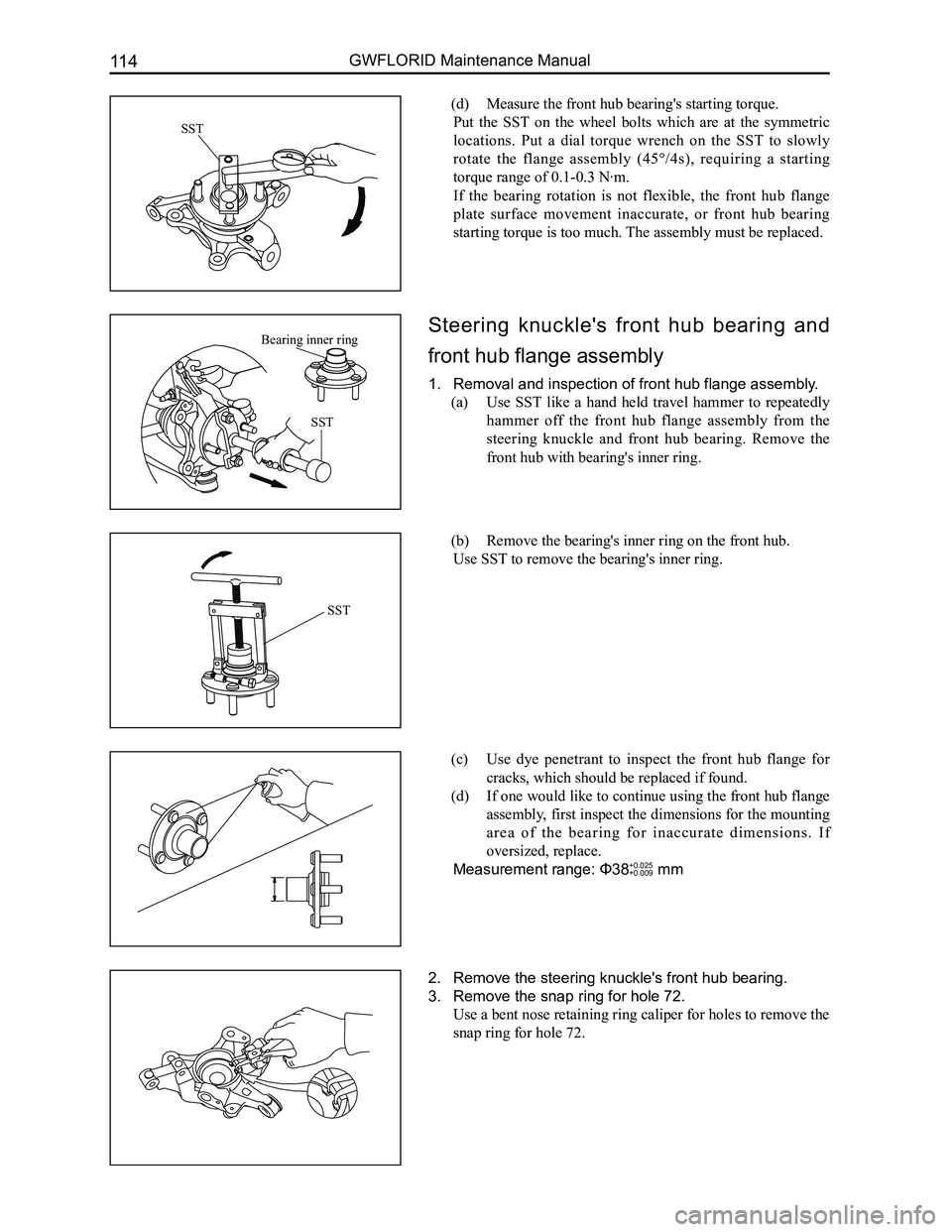
(d) Measure the front hub bearing's starting torque.
Put the SST on the wheel bolts which are at the symmetric
locations. Put a dial torque wrench on the SST to slowly
rotate the flange assembly (45°/4s), requiring a starting
torque range of 0.1-0.3 N·m.
If the bearing rotation is not flexible, the front hub flange
plate surface movement inaccurate, or front hub bearing
starting torque is too much. The assembly must be replaced.
Steering knuckle's front hub bearing and
front hub flange assembly
1. Removal and inspection of front hub flange assembly.
(a) Use SST like a hand held travel hammer to repeatedly
hammer off the front hub flange assembly from the
steering knuckle and front hub bearing. Remove the
front hub with bearing's inner ring.
(b) Remove the bearing's inner ring on the front hub.
Use SST to remove the bearing's inner ring.
SST
SST
Bearing inner ring
SST
(c) Use dye penetrant to inspect the front hub flange for
cracks, which should be replaced if found.
(d) If one would like to continue using the front hub flange
assembly, first inspect the dimensions for the mounting
area of the bearing for inaccurate dimensions. If
oversized, replace.
Measurement range: Φ38+0.025 +0.009 mm
2. Remove the steering knuckle's front hub bearing.
3. Remove the snap ring for hole 72.
Use a bent nose retaining ring caliper for holes to remove the
snap ring for hole 72.
Page 123 of 281
Downloaded from www.Manualslib.com manuals search engine GWFLORID Maintenance Manual116
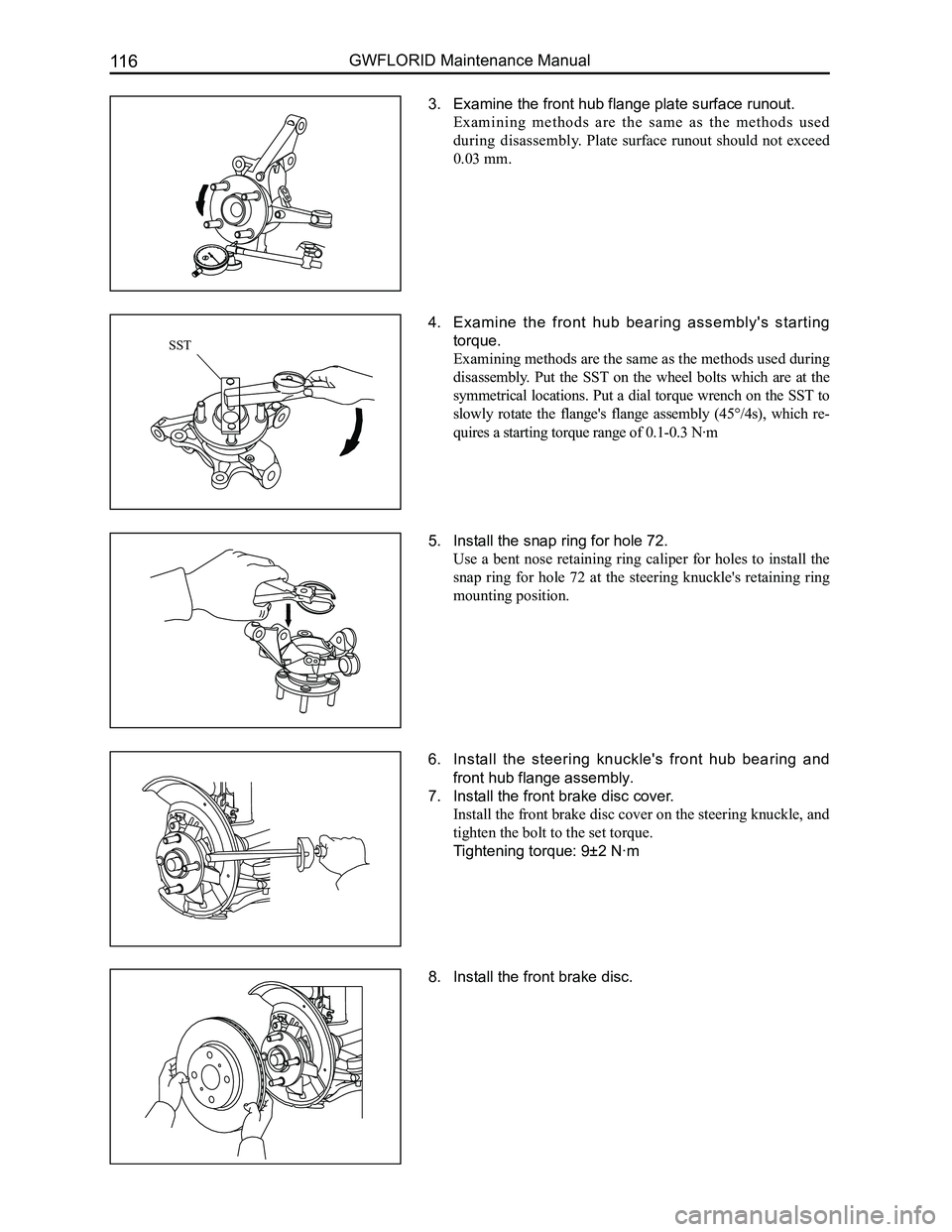
3. Examine the front hub flange plate surface runout.
Examining methods are the same as the methods used
during disassembly. Plate surface runout should not exceed
0.03 mm.
4. Examine the front hub bearing assembly's starting
torque.
Examining methods are the same as the methods used during
disassembly. Put the SST on the wheel bolts which are at the
symmetrical locations. Put a dial torque wrench on the SST to
slowly rotate the flange's flange assembly (45°/4s), which re-
quires a starting torque range of 0.1-0.3 N·m
5. Install the snap ring for hole 72.
Use a bent nose retaining ring caliper for holes to install the
snap ring for hole 72 at the steering knuckle's retaining ring
mounting position.
6. Install the steering knuckle's front hub bearing and
front hub flange assembly.
7. Install the front brake disc cover.
Install the front brake disc cover on the steering knuckle, and
tighten the bolt to the set torque.
Tightening torque: 9±2 N·m
SST
8. Install the front brake disc.
Page 124 of 281
Downloaded from www.Manualslib.com manuals search engine 117Brake System
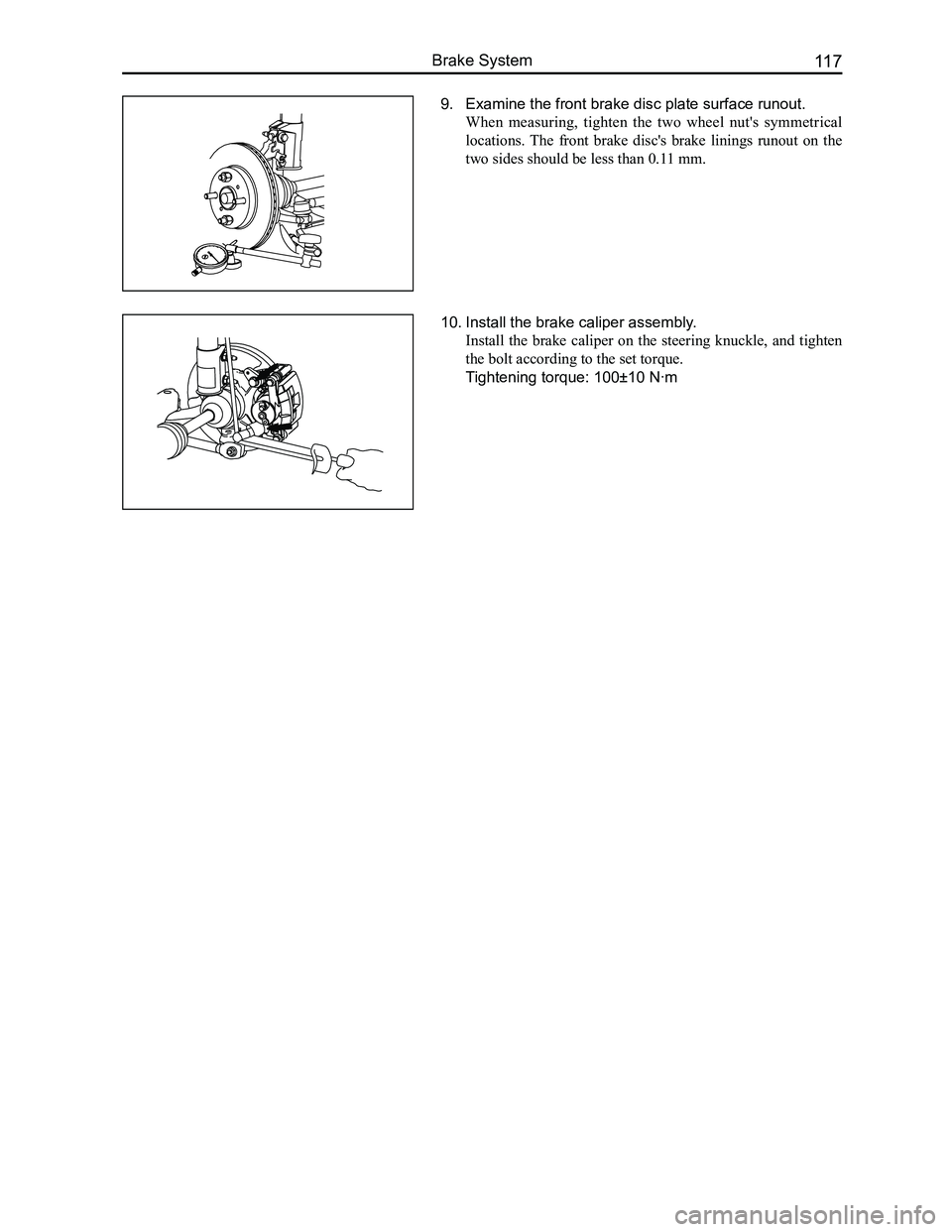
9. Examine the front brake disc plate surface runout.
When measuring, tighten the two wheel nut's symmetrical
locations. The front brake disc's brake linings runout on the
two sides should be less than 0.11 mm.
10. Install the brake caliper assembly.
Install the brake caliper on the steering knuckle, and tighten
the bolt according to the set torque.
Tightening torque: 100±10 N·m
Page 125 of 281
Downloaded from www.Manualslib.com manuals search engine GWFLORID Maintenance Manual118
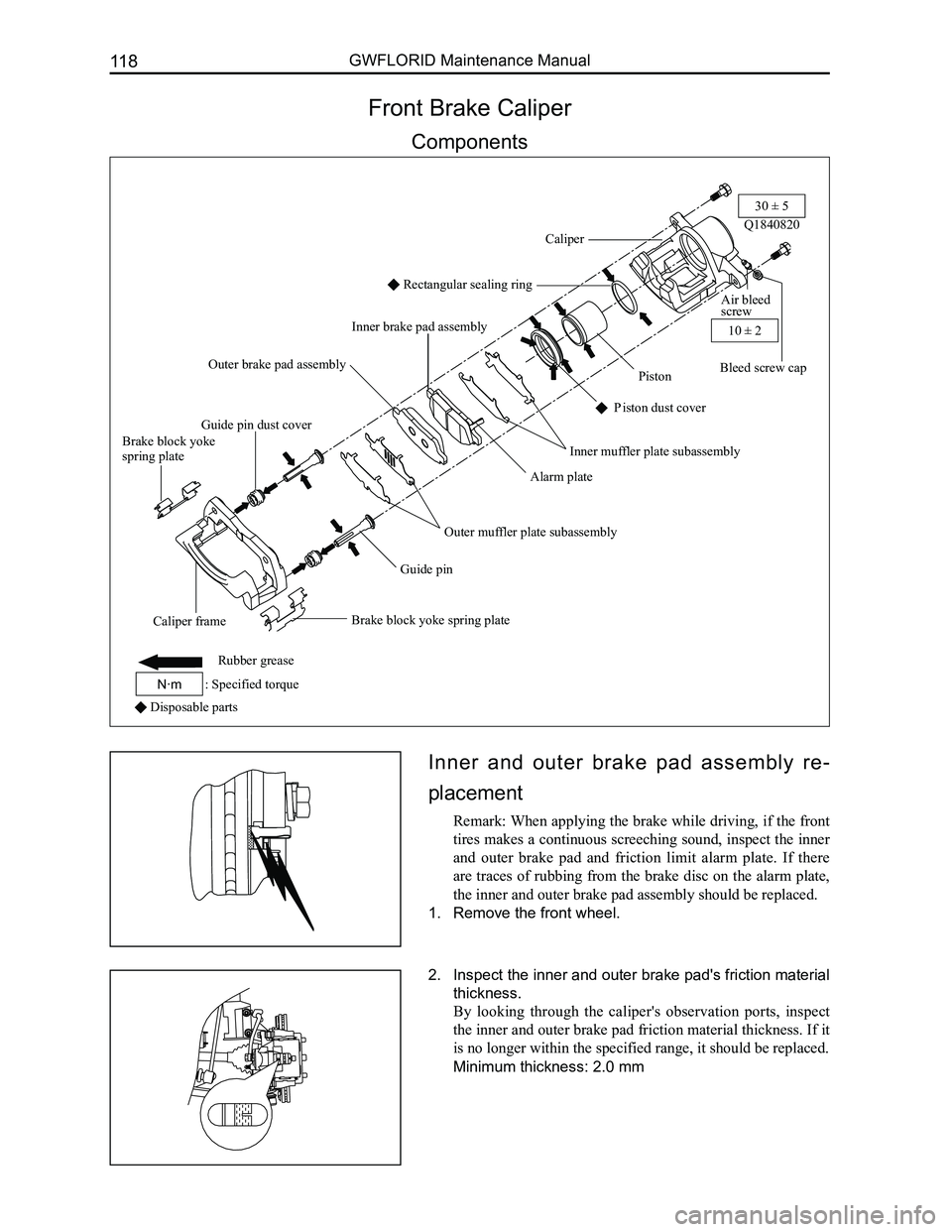
Front Brake Caliper
Components
Disposable parts
Inner and outer brake pad assembly re-
placement
Remark: When applying the brake while driving, if the front
tires makes a continuous screeching sound, inspect the inner
and outer brake pad and friction limit alarm plate. If there
are traces of rubbing from the brake disc on the alarm plate,
the inner and outer brake pad assembly should be replaced.
1. Remove the front wheel.
2. Inspect the inner and outer brake pad's friction material
thickness.
By looking through the caliper's observation ports, inspect
the inner and outer brake pad friction material thickness. If it
is no longer within the specified range, it should be replaced.
Minimum thickness: 2.0 mm
Bleed screw cap
Air bleed screw
Caliper
Rectangular sealing ring
Piston
P iston dust cover
Inner muffler plate subassembly
Alarm plate
Inner brake pad assembly
Outer brake pad assembly
Outer muffler plate subassembly
Guide pin
Guide pin dust cover
Caliper frame
Brake block yoke spring plate
Brake block yoke spring plate
30 ± 5
: Specified torqueN·m
10 ± 2
Q1840820
Rubber grease
Page 127 of 281
Downloaded from www.Manualslib.com manuals search engine GWFLORID Maintenance Manual120
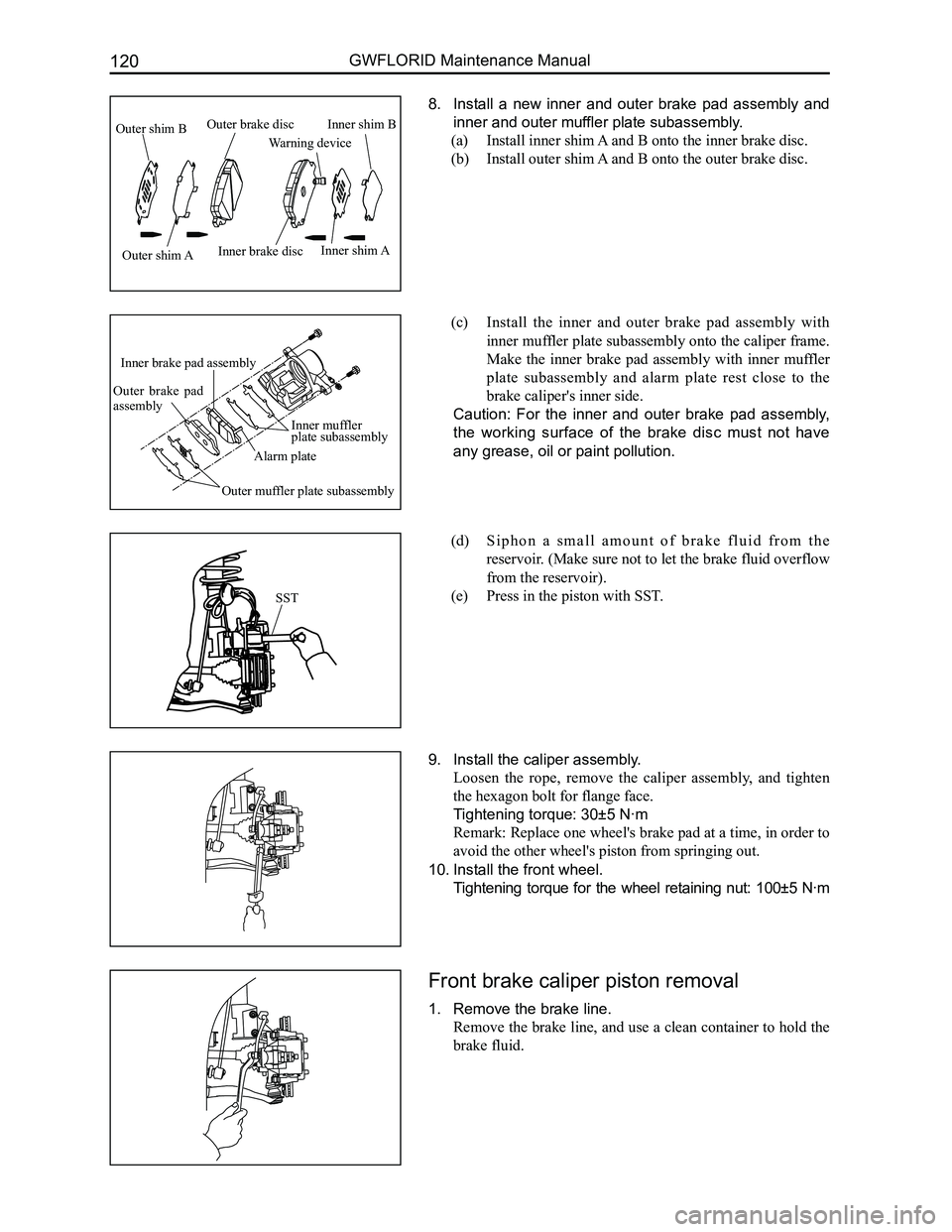
8. Install a new inner and outer brake pad assembly and
inner and outer muffler plate subassembly.
(a) Install inner shim A and B onto the inner brake disc.
(b) Install outer shim A and B onto the outer brake disc.
(c) Install the inner and outer brake pad assembly with
inner muffler plate subassembly onto the caliper frame.
Make the inner brake pad assembly with inner muffler
plate subassembly and alarm plate rest close to the
brake caliper's inner side.
Caution: For the inner and outer brake pad assembly,
the working surface of the brake disc must not have
any grease, oil or paint pollution.
(d) S i p h o n a s m a l l a m o u n t o f b r a k e f l u i d f r o m t h e
reservoir. (Make sure not to let the brake fluid overflow
from the reservoir).
(e) Press in the piston with SST.
9. Install the caliper assembly.
Loosen the rope, remove the caliper assembly, and tighten
the hexagon bolt for flange face.
Tightening torque: 30±5 N·m
Remark: Replace one wheel's brake pad at a time, in order to
avoid the other wheel's piston from springing out.
10. Install the front wheel.
Tightening torque for the wheel retaining nut: 100±5 N·m
Front brake caliper piston removal
1. Remove the brake line.
Remove the brake line, and use a clean container to hold the
brake fluid.
SST
Outer shim B
Outer shim AInner brake disc
Warning device
Inner shim B
Inner shim A
Outer brake disc
Inner muffler plate subassembly
Alarm plate
Inner brake pad assembly
Outer brake pad assembly
Outer muffler plate subassembly
Page 131 of 281
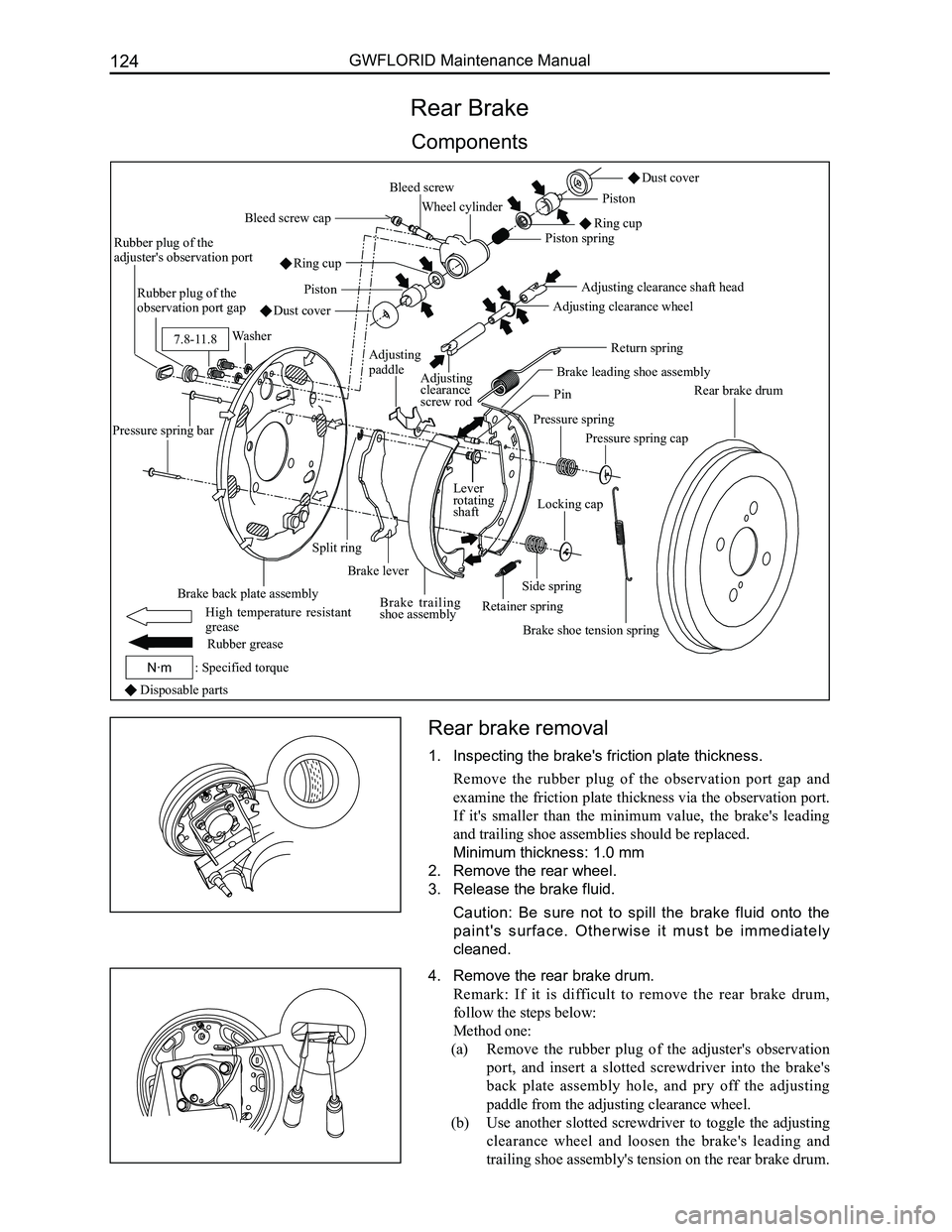
Downloaded from www.Manualslib.com manuals search engine GWFLORID Maintenance Manual124
Rear Brake
Components
4. Remove the rear brake drum.
Remark: If it is difficult to remove the rear brake drum,
follow the steps below:
Method one:
(a) Remove the rubber plug of the adjuster's observation
port, and insert a slotted screwdriver into the brake's
back plate assembly hole, and pry off the adjusting
paddle from the adjusting clearance wheel.
(b) Use another slotted screwdriver to toggle the adjusting
clearance wheel and loosen the brake's leading and
trailing shoe assembly's tension on the rear brake drum.
Disposable parts
Dust cover
Brake leading shoe assembly
Pressure spring
Pressure spring cap
Brake shoe tension spring
Rear brake drum
Lever rotating shaft
Retainer spring
Locking cap
Split ring
Brake lever
Brake trailing shoe assembly
Brake back plate assembly
Pressure spring bar
Rubber plug of the adjuster's observation port
Rubber plug of the observation port gap
Washer
Bleed screw cap
Bleed screwPiston
Ring cup
Piston spring
Wheel cylinder
Adjusting clearance shaft head
Adjusting clearance wheel
Adjusting clearance screw rod
Return springAdjusting paddle
Pin
Side spring
Dust cover
Piston
Ring cup
Rubber grease
: Specified torqueN·m
7.8-11.8
High temperature resistant grease
Rear brake removal
1. Inspecting the brake's friction plate thickness.
Remove the rubber plug of the observation port gap and
examine the friction plate thickness via the observation port.
If it's smaller than the minimum value, the brake's leading
and trailing shoe assemblies should be replaced.
Minimum thickness: 1.0 mm
2. Remove the rear wheel.
3. Release the brake fluid.
Caution: Be sure not to spill the brake fluid onto the
paint's surface. Otherwise it must be immediately
cleaned.
Page 135 of 281
Downloaded from www.Manualslib.com manuals search engine GWFLORID Maintenance Manual128
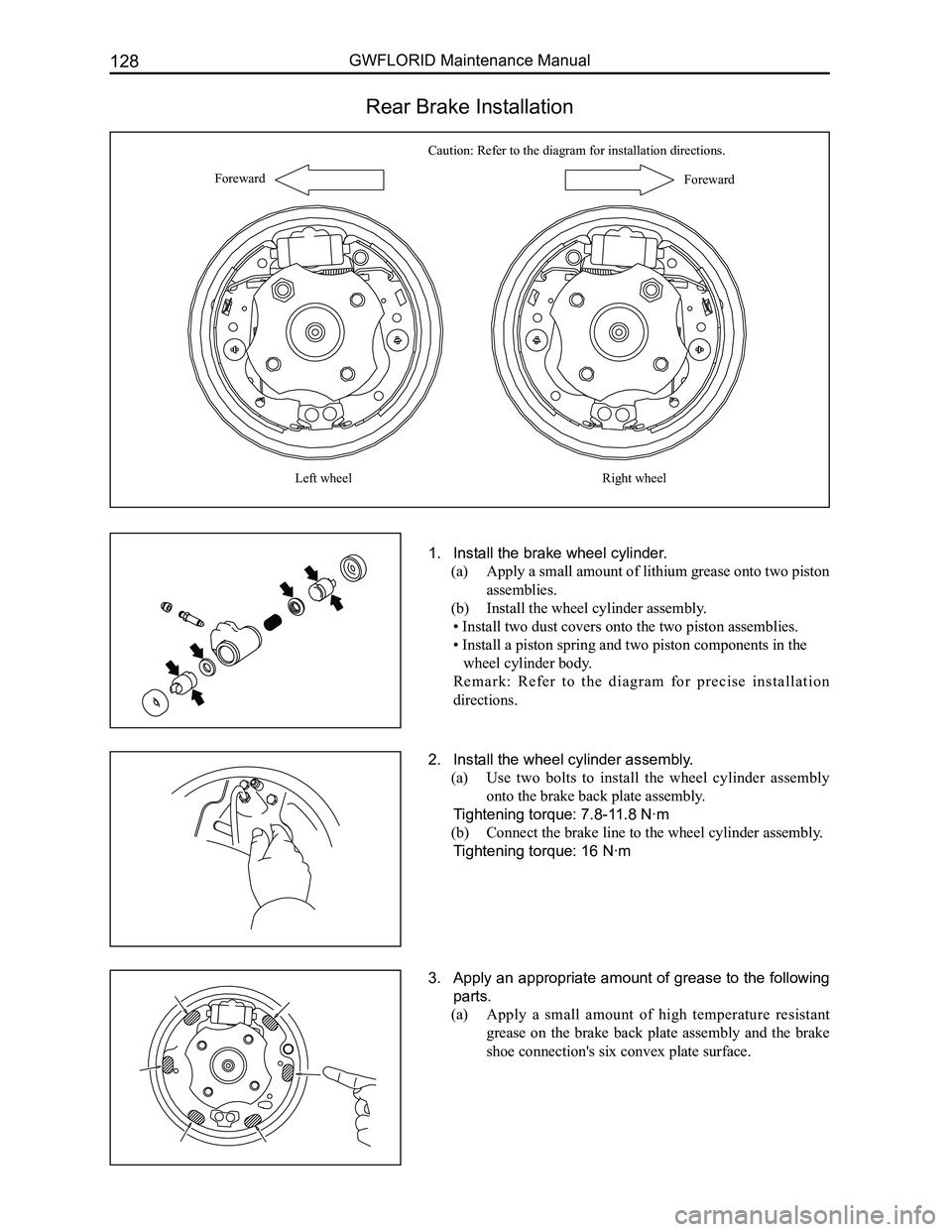
Rear Brake Installation
1. Install the brake wheel cylinder.
(a) Apply a small amount of lithium grease onto two piston
assemblies.
(b) Install the wheel cylinder assembly.
• Install two dust covers onto the two piston assemblies.
• Install a piston spring and two piston components in the
wheel cylinder body.
R e m a r k : R e f e r t o t h e d i a g r a m f o r p r e c i s e i n s t a l l a t i o n
directions.
2. Install the wheel cylinder assembly.
(a) Use two bolts to install the wheel cylinder assembly
onto the brake back plate assembly.
Tightening torque: 7.8-11.8 N·m
(b) Connect the brake line to the wheel cylinder assembly.
Tightening torque: 16 N·m
3. Apply an appropriate amount of grease to the following
parts.
(a) Apply a small amount of high temperature resistant
grease on the brake back plate assembly and the brake
shoe connection's six convex plate surface.
Caution: Refer to the diagram for installation directions.
ForewardForeward
Left wheelRight wheel