cylinder GREAT WALL FLORID 2008 Service Manual
[x] Cancel search | Manufacturer: GREAT WALL, Model Year: 2008, Model line: FLORID, Model: GREAT WALL FLORID 2008Pages: 281, PDF Size: 43.97 MB
Page 4 of 281

Downloaded from www.Manualslib.com manuals search engine Chapter One: Overview ........................................................................\
........................................1
How to Use This Manual ...................................................................................\
...........2
Identifying Number Location ..................................................................................\
......3
Comprehensive Repair Instructions .............................................................................4
General Repair Methods and Operations ....................................................................9
Chapter Two: Overall Parameters ........................................................................\
......................10
Basic Parameters of the Overall Vehicle ...................................................................11
Engine Technical Parameters ..................................................................................\
..12
Chassis’ Main Assembly Technical Parameters .........................................................13
Vehicle Structure Type and Parameters ....................................................................15
Air Conditioning System Structure and Parameters ..................................................16
Electrical System Structure and Parameters .............................................................16
Grade Specification and Filled Quantity of Each
Individual Functioning Component’s Working Agent ..................................................18
Torque Specifications for Key Operational Bolts ........................................................18
Vehicle Body’s Basic Calibration Measurements ......................................................22
Chapter Three: Fuel Supply and Exhaust System .....................................................................29
Fuel Supply System ...................................................................................\
................30
Components ..................................................................................\
..........................30
Fuel Tank Removal ..................................................................................\
................31
Fuel Pump and Charcoal Canister Removal ...........................................................31
Fuel Filter Removal ...................................................................................\
...............31
Fuel Filler Pipe Assembly Removal .........................................................................32
Exhaust System ...................................................................................\
......................33
Components ..................................................................................\
..........................33
Exhaust System Removal ...................................................................................\
.....34
Exhaust System Installation ...................................................................................\
..35
Chapter Four: Clutch Operational System........................................................................\
..........36
Areas of Importance ..................................................................................\
................37
Troubleshooting ..................................................................................\
.......................37
Clutch Operational System ..................................................................................\
......38
Components ..................................................................................\
..........................38
Clutch Master Cylinder Removal .............................................................................38
Clutch Master Cylinder Installation ..........................................................................40
Clutch Pedal Removal ..................................................................................\
...........40
Clutch Pedal Installation ..................................................................................\
........40
Clutch Pedal Examination and Adjustment ..............................................................41
CONTENTS
Page 5 of 281

Downloaded from www.Manualslib.com manuals search engine Chapter Five: Transmission ........................................................................\
................................42
037A Transmission’s Overall External Schematics ....................................................43
Main Technical Parameters ..................................................................................\
....43
Transmission’s Proper Use and Care ........................................................................44
Technical Specifications for Transmission Installation and Adjustment .....................44
Areas of Importance ..................................................................................\
................45
Troubleshooting ..................................................................................\
.......................46
037A Transmission Structural Schematics ................................................................47
Clutch ...................................................................................\
......................................48
Gear Shift Fork and Fork Shaft ..................................................................................49
Transmission Case ..................................................................................\
..................50
Disassembling the Input Shaft Subassembly ............................................................56
Disassembling the Output Shaft Subassembly ..........................................................60
Disassembling the Shift Cover Subassembly ............................................................64
Disassembling the Differential Subassembly .............................................................68
Chapter Six: Suspension System ........................................................................\
.......................71
Suspension System Technical Parameters ...............................................................72
Front Suspension ...................................................................................\
....................73
Subframe and Front Stabilizer Bar ............................................................................77
Lower Swing Arm ...................................................................................\
....................80
Drive Shaft ..................................................................................\
...............................84
Rear Suspension ..................................................................................\
.....................86
Wheel and Tire ...................................................................................\
........................89
Chapter Seven: Brake System ........................................................................\
...........................94
Brake System Components Arrangement Schematics ..............................................95
Brake System Maintenance ...................................................................................\
....96
Brake Pedal ..................................................................................\
.............................98
Parking Brake Control Mechanism Assembly ..........................................................102
Vacuum Booster with Brake Cylinder Assembly ......................................................103
Anti-lock Brake System ...................................................................................\
.........107
ABS General Problem Maintenance and Areas of Importance ................................109
Steering Knuckle and Hub Brake Assembly ............................................................112
Front Brake Caliper ...................................................................................\
...............118
Rear Brake ...................................................................................\
............................124
Rear Support Axle ...................................................................................\
.................131
Chapter Eight: Steering System ........................................................................\
.......................134
Troubleshooting ..................................................................................\
.....................135
Steering System Maintenance .................................................................................137
Power Steering Fluid Instructions ............................................................................141
Page 10 of 281
Downloaded from www.Manualslib.com manuals search engine 3Overview
Correct vehicle maintenance and repair is very important
to the safety of the maintenance person and the vehicle. If
any vehicle part change is necessary, please use a part with
the same part number or part number specified by the Great
Wall Motor Co., Ltd. Never use a part that has not been au-
thorized by the Great Wall Motor Co., Ltd.
4. Inspect the front brake disc thickness.
Standard thickness: 22.0 mm
Minimum thickness: 20.0 mm
The brake disc must be changed when its thickness falls be-
low the minimum level.
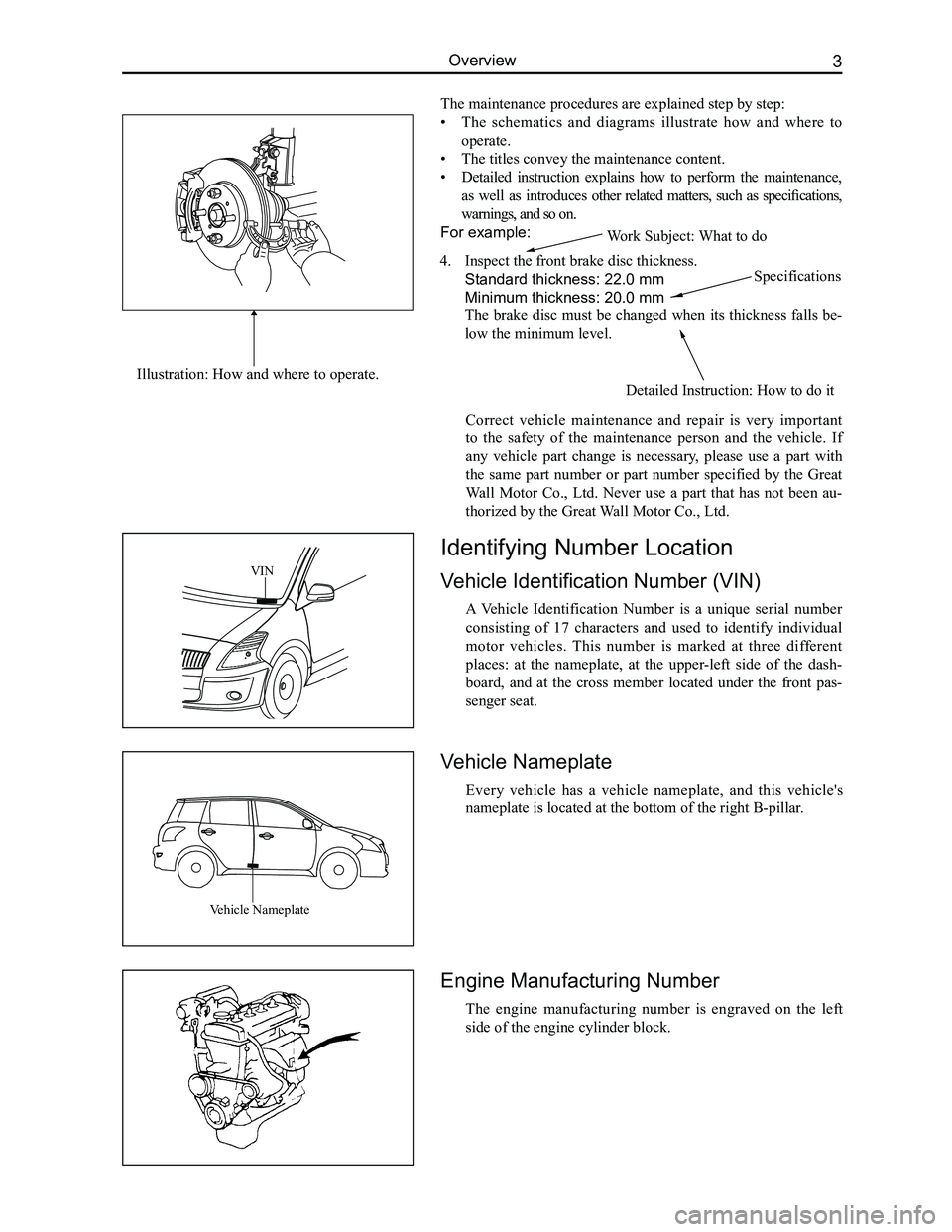
The maintenance procedures are explained step by step:
• The schematics and diagrams illustrate how and where to
operate.
• The titles convey the maintenance content.
• Detailed instruction explains how to perform the maintenance,
as well as introduces other related matters, such as specifications,
warnings, and so on.
For example:
Illustration: How and where to operate.
Work Subject: What to do
Detailed Instruction: How to do it
Specifications
Engine Manufacturing Number
The engine manufacturing number is engraved on the left
side of the engine cylinder block.
Vehicle Nameplate
Every vehicle has a vehicle nameplate, and this vehicle's
nameplate is located at the bottom of the right B-pillar.
Identifying Number Location
Vehicle Identification Number (VIN)
A Vehicle Identification Number is a unique serial number
consisting of 17 characters and used to identify individual
motor vehicles. This number is marked at three different
places: at the nameplate, at the upper-left side of the dash-
board, and at the cross member located under the front pas-
senger seat.
VIN
Vehicle Nameplate
Page 19 of 281
Downloaded from www.Manualslib.com manuals search engine GWFLORID Maintenance Manual12
Ride
Performance
Outter acceleration noise dB (A)≤74≤75
60 km/h constant velocity interior noise dB (A)≤65≤65
Driver operating noise dB (A)≤90≤90
Emission
CO emission (g/km)≤2.30≤1.00≤0.64
HC emission (g/km)≤0.20≤0.10/
NOx emission (g/km)≤0.15≤0.08≤0.5
Particle emission (g/km)//≤0.05
Smoke density//≤4.0
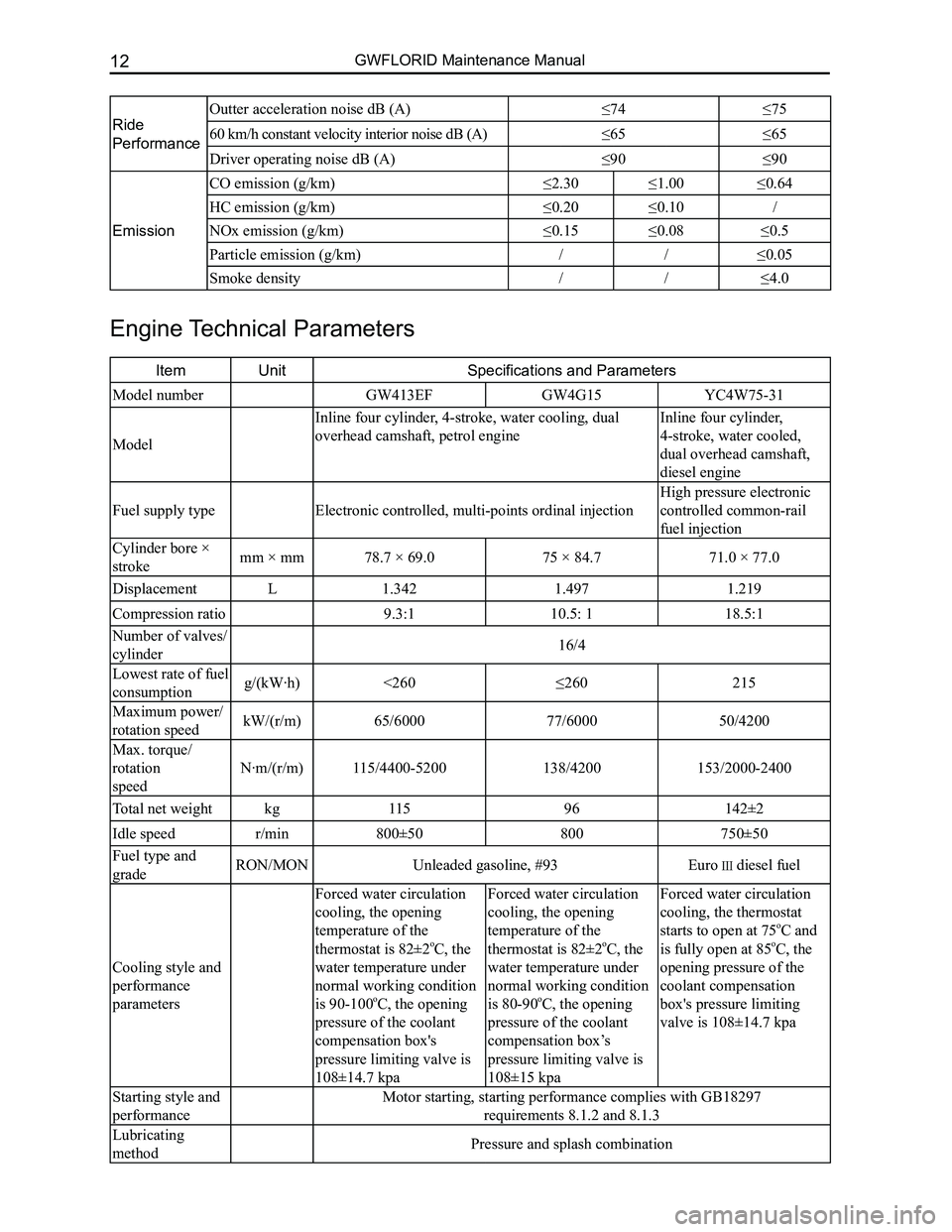
Engine Technical Parameters
ItemUnitSpecifications and Parameters
Model numberGW413EFGW4G15YC4W75-31
Model
Inline four cylinder, 4-stroke, water cooling, dual
overhead camshaft, petrol engine
Inline four cylinder,
4-stroke, water cooled,
dual overhead camshaft,
diesel engine
Fuel supply typeElectronic controlled, multi-points ordinal injection
High pressure electronic
controlled common-rail
fuel injection
Cylinder bore ×
strokemm × mm78.7 × 69.075 × 84.771.0 × 77.0
DisplacementL1.3421.4971.219
Compression ratio9.3:110.5: 118.5:1
Number of valves/
cylinder16/4
Lowest rate of fuel
consumption g/(kW·h)<260≤260215
Maximum power/
rotation speed kW/(r/m)65/600077/600050/4200
Max. torque/
rotation
speed
N·m/(r/m)115/4400-5200138/4200153/2000-2400
Total net weightkg11596142±2
Idle speedr/min800±50800750±50
Fuel type and
gradeRON/MONUnleaded gasoline, #93Euro diesel fuel
Cooling style and
performance
parameters
Forced water circulation
cooling, the opening
temperature of the
thermostat is 82±2oC, the
water temperature under
normal working condition
is 90-100oC, the opening
pressure of the coolant
compensation box's
pressure limiting valve is
108±14.7 kpa
Forced water circulation
cooling, the opening
temperature of the
thermostat is 82±2oC, the
water temperature under
normal working condition
is 80-90oC, the opening
pressure of the coolant
compensation box’s
pressure limiting valve is
108±15 kpa
Forced water circulation
cooling, the thermostat
starts to open at 75oC and
is fully open at 85oC, the
opening pressure of the
coolant compensation
box's pressure limiting
valve is 108±14.7 kpa
Starting style and
performance
Motor starting, starting performance complies with GB18297
requirements 8.1.2 and 8.1.3
Lubricating
methodPressure and splash combination
Page 21 of 281
Downloaded from www.Manualslib.com manuals search engine GWFLORID Maintenance Manual14
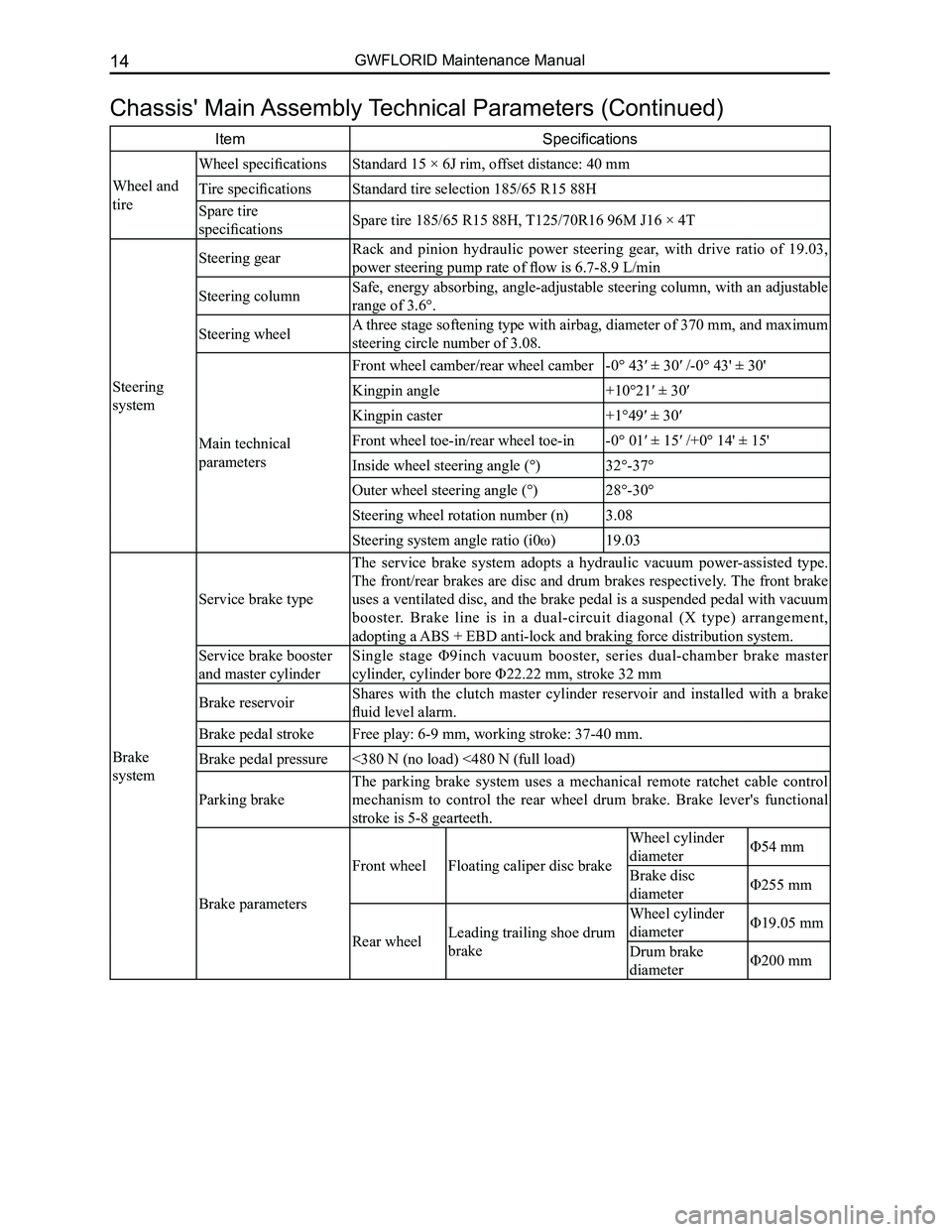
Chassis' Main Assembly Technical Parameters (Continued)
ItemSpecifications
Wheel and
tire
Wheel specificationsStandard 15 × 6J rim, offset distance: 40 mm
Tire specificationsStandard tire selection 185/65 R15 88H
Spare tire
specificationsSpare tire 185/65 R15 88H, T125/70R16 96M J16 × 4T
Steering
system
Steering gearRack and pinion hydraulic power steering gear, with drive ratio of 19.03,
power steering pump rate of flow is 6.7-8.9 L/min
Steering columnSafe, energy absorbing, angle-adjustable steering column, with an adjustable
range of 3.6°.
Steering wheelA three stage softening type with airbag, diameter of 370 mm, and maximum
steering circle number of 3.08.
Main technical
parameters
Front wheel camber/rear wheel camber-0° 43′ ± 30′ /-0° 43' ± 30'
Kingpin angle+10°21′ ± 30′
Kingpin caster+1°49′ ± 30′
Front wheel toe-in/rear wheel toe-in-0° 01′ ± 15′ /+0° 14' ± 15'
Inside wheel steering angle (°)32°-37°
Outer wheel steering angle (°)28°-30°
Steering wheel rotation number (n)3.08
Steering system angle ratio (i0ω)19.03
Brake
system
Service brake type
The service brake system adopts a hydraulic vacuum power-assisted type.
The front/rear brakes are disc and drum brakes respectively. The front brake
uses a ventilated disc, and the brake pedal is a suspended pedal with vacuum
booster. Brake line is in a dual-circuit diagonal (X type) arrangement,
adopting a ABS + EBD anti-lock and braking force distribution system.
Service brake booster
and master cylinder
Single stage Φ9inch vacuum booster, series dual-chamber brake master
cylinder, cylinder bore Φ22.22 mm, stroke 32 mm
Brake reservoirShares with the clutch master cylinder reservoir and installed with a brake
fluid level alarm.
Brake pedal strokeFree play: 6-9 mm, working stroke: 37-40 mm.
Brake pedal pressure<380 N (no load) <480 N (full load)
Parking brake
The parking brake system uses a mechanical remote ratchet cable control
mechanism to control the rear wheel drum brake. Brake lever's functional
stroke is 5-8 gearteeth.
Brake parameters
Front wheelFloating caliper disc brake
Wheel cylinder
diameterΦ54 mm
Brake disc
diameterΦ255 mm
Rear wheelLeading trailing shoe drum
brake
Wheel cylinder
diameterΦ19.05 mm
Drum brake
diameterΦ200 mm
Page 26 of 281
Downloaded from www.Manualslib.com manuals search engine 19Overall Parameters
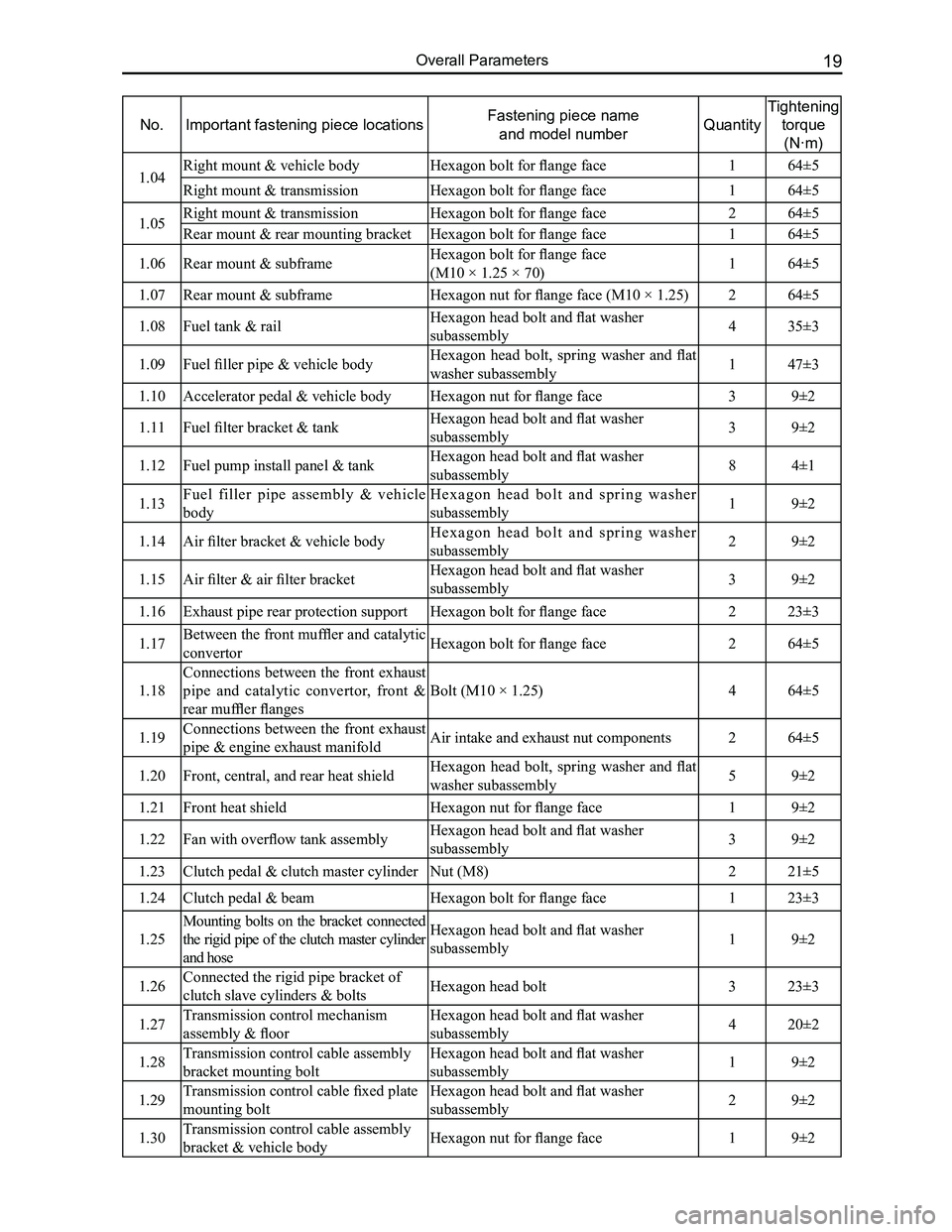
No.Important fastening piece locationsFastening piece name
and model numberQuantity
Tightening
torque
(N·m)
1.04Right mount & vehicle bodyHexagon bolt for flange face164±5
Right mount & transmissionHexagon bolt for flange face 164±5
1.05Right mount & transmissionHexagon bolt for flange face 264±5
Rear mount & rear mounting bracketHexagon bolt for flange face 164±5
1.06Rear mount & subframeHexagon bolt for flange face
(M10 × 1.25 × 70)164±5
1.07Rear mount & subframeHexagon nut for flange face (M10 × 1.25)264±5
1.08Fuel tank & railHexagon head bolt and flat washer
subassembly435±3
1.09Fuel filler pipe & vehicle bodyHexagon head bolt, spring washer and flat
washer subassembly147±3
1.10Accelerator pedal & vehicle bodyHexagon nut for flange face39±2
1.11Fuel filter bracket & tankHexagon head bolt and flat washer
subassembly39±2
1.12Fuel pump install panel & tankHexagon head bolt and flat washer
subassembly84±1
1.13Fuel filler pipe assembly & vehicle
body
H e x a g o n h e a d b o l t a n d s p r i n g w a s h e r
subassembly19±2
1.14Air filter bracket & vehicle bodyH e x a g o n h e a d b o l t a n d s p r i n g w a s h e r
subassembly29±2
1.15Air filter & air filter bracketHexagon head bolt and flat washer
subassembly39±2
1.16Exhaust pipe rear protection supportHexagon bolt for flange face223±3
1.17Between the front muffler and catalytic
convertorHexagon bolt for flange face264±5
1.18
Connections between the front exhaust
pipe and catalytic convertor, front &
rear muffler flanges
Bolt (M10 × 1.25)464±5
1.19Connections between the front exhaust
pipe & engine exhaust manifoldAir intake and exhaust nut components264±5
1.20Front, central, and rear heat shieldHexagon head bolt, spring washer and flat
washer subassembly59±2
1.21Front heat shieldHexagon nut for flange face19±2
1.22Fan with overflow tank assemblyHexagon head bolt and flat washer
subassembly39±2
1.23Clutch pedal & clutch master cylinderNut (M8)221±5
1.24Clutch pedal & beamHexagon bolt for flange face123±3
1.25
Mounting bolts on the bracket connected
the rigid pipe of the clutch master cylinder
and hose
Hexagon head bolt and flat washer
subassembly19±2
1.26Connected the rigid pipe bracket of
clutch slave cylinders & boltsHexagon head bolt323±3
1.27Transmission control mechanism
assembly & floor
Hexagon head bolt and flat washer
subassembly420±2
1.28Transmission control cable assembly
bracket mounting bolt
Hexagon head bolt and flat washer
subassembly19±2
1.29Transmission control cable fixed plate
mounting bolt
Hexagon head bolt and flat washer
subassembly29±2
1.30Transmission control cable assembly
bracket & vehicle bodyHexagon nut for flange face19±2
Page 43 of 281
Downloaded from www.Manualslib.com manuals search engine GWFLORID Maintenance Manual36
Clutch Operational System
Areas of Importance ...........................................................37
Troubleshooting ..................................................................37
Clutch Operational System .................................................38
Components .....................................................................38
Clutch Master Cylinder Removal ......................................38
Clutch Master Cylinder Installation ...................................40
Clutch Pedal Removal ......................................................40
Clutch Pedal Installation ...................................................40
Clutch Pedal Examination and Adjustment.......................41
Page 44 of 281
Downloaded from www.Manualslib.com manuals search engine 37Clutch Operational System
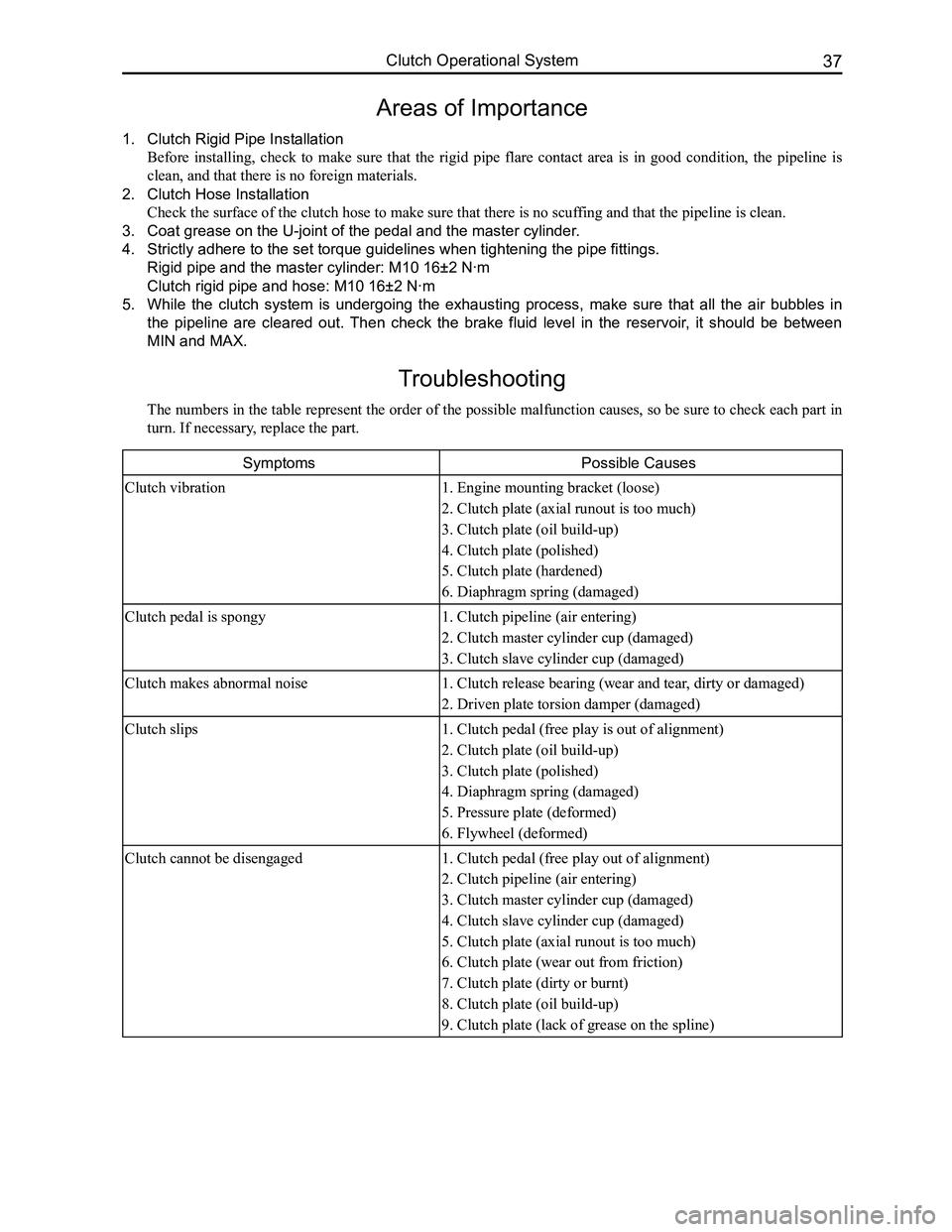
Areas of Importance
1. Clutch Rigid Pipe Installation
Before installing, check to make sure that the rigid pipe flare contact area is in good condition, the pipeline is
clean, and that there is no foreign materials.
2. Clutch Hose Installation
Check the surface of the clutch hose to make sure that there is no scuffing and that the pipeline is clean.
3. Coat grease on the U-joint of the pedal and the master cylinder.
4. Strictly adhere to the set torque guidelines when tightening the pipe fittings.
Rigid pipe and the master cylinder: M10 16±2 N·m
Clutch rigid pipe and hose: M10 16±2 N·m
5. While the clutch system is undergoing the exhausting process, make sure that all the air bubbles in
the pipeline are cleared out. Then check the brake fluid level in the reservoir, it should be between
MIN and MAX.
Troubleshooting
The numbers in the table represent the order of the possible malfunction causes, so be sure to check each part in
turn. If necessary, replace the part.
SymptomsPossible Causes
Clutch vibration1. Engine mounting bracket (loose)
2. Clutch plate (axial runout is too much)
3. Clutch plate (oil build-up)
4. Clutch plate (polished)
5. Clutch plate (hardened)
6. Diaphragm spring (damaged)
Clutch pedal is spongy1. Clutch pipeline (air entering)
2. Clutch master cylinder cup (damaged)
3. Clutch slave cylinder cup (damaged)
Clutch makes abnormal noise1. Clutch release bearing (wear and tear, dirty or damaged)
2. Driven plate torsion damper (damaged)
Clutch slips1. Clutch pedal (free play is out of alignment)
2. Clutch plate (oil build-up)
3. Clutch plate (polished)
4. Diaphragm spring (damaged)
5. Pressure plate (deformed)
6. Flywheel (deformed)
Clutch cannot be disengaged1. Clutch pedal (free play out of alignment)
2. Clutch pipeline (air entering)
3. Clutch master cylinder cup (damaged)
4. Clutch slave cylinder cup (damaged)
5. Clutch plate (axial runout is too much)
6. Clutch plate (wear out from friction)
7. Clutch plate (dirty or burnt)
8. Clutch plate (oil build-up)
9. Clutch plate (lack of grease on the spline)
Page 45 of 281
Downloaded from www.Manualslib.com manuals search engine GWFLORID Maintenance Manual38
Clutch Operational System
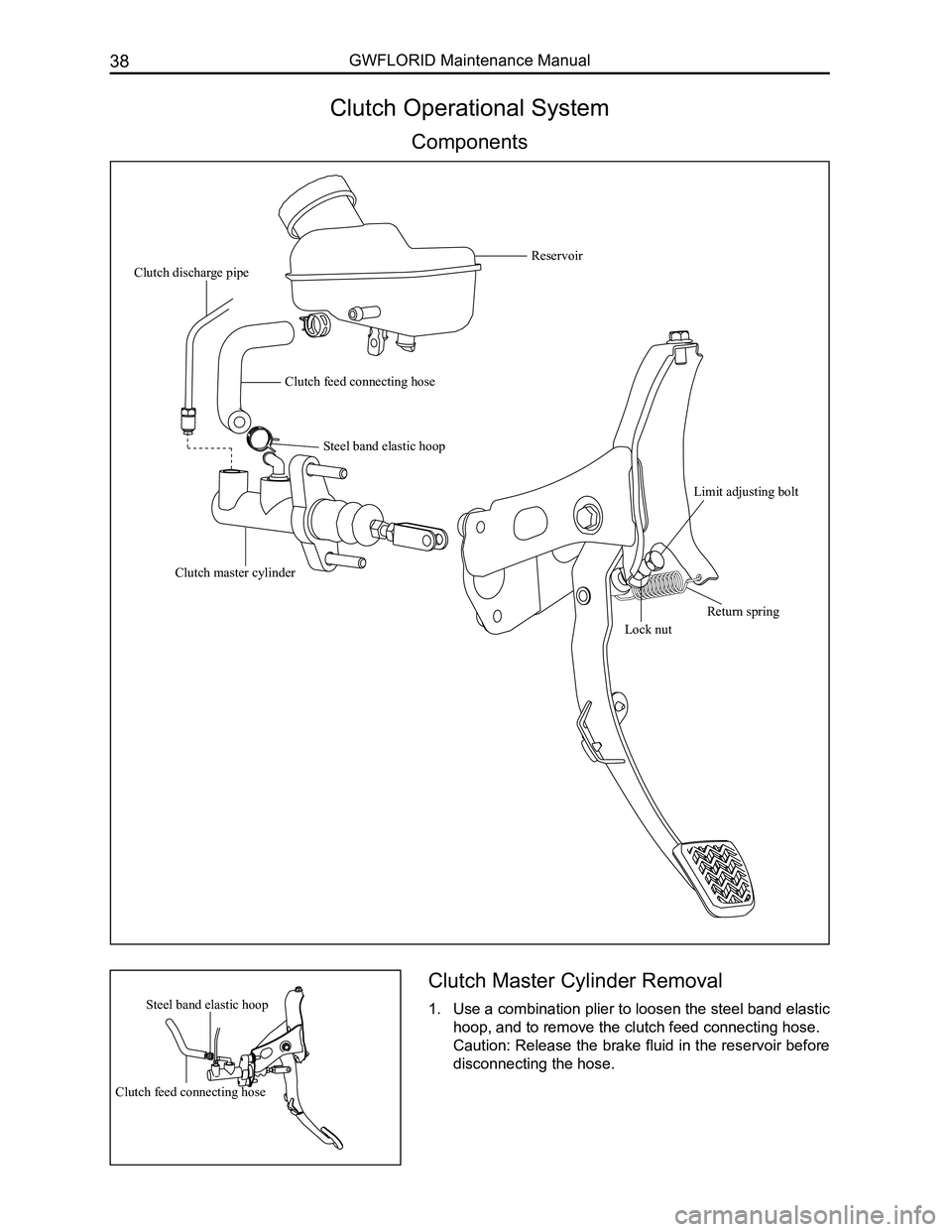
Components
Clutch Master Cylinder Removal
1. Use a combination plier to loosen the steel band elastic
hoop, and to remove the clutch feed connecting hose.
Caution: Release the brake fluid in the reservoir before
disconnecting the hose.
Steel band elastic hoop
Clutch feed connecting hose
Reservoir
Steel band elastic hoop
Clutch feed connecting hose
Clutch discharge pipe
Clutch master cylinder
Limit adjusting bolt
Return spring
Lock nut
Page 46 of 281
Downloaded from www.Manualslib.com manuals search engine 39Clutch Operational System
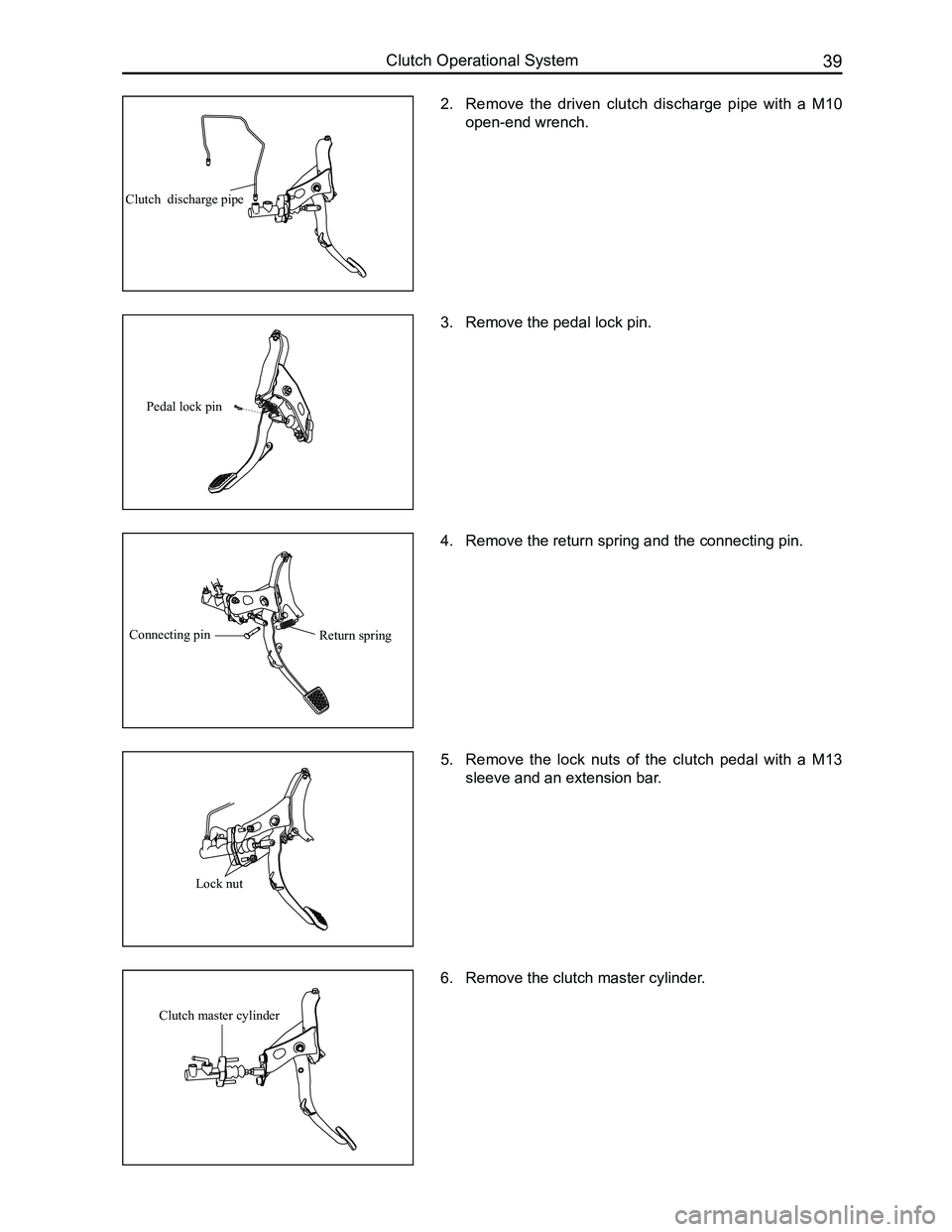
2. Remove the driven clutch discharge pipe with a M10
open-end wrench.
3. Remove the pedal lock pin.
4. Remove the return spring and the connecting pin.
5. Remove the lock nuts of the clutch pedal with a M13
sleeve and an extension bar.
6. Remove the clutch master cylinder.
Clutch discharge pipe
Pedal lock pin
Return springConnecting pin
Lock nut
Clutch master cylinder