wheel GREAT WALL HOVER 2006 Service Workshop Manual
[x] Cancel search | Manufacturer: GREAT WALL, Model Year: 2006, Model line: HOVER, Model: GREAT WALL HOVER 2006Pages: 425, PDF Size: 26.05 MB
Page 302 of 425
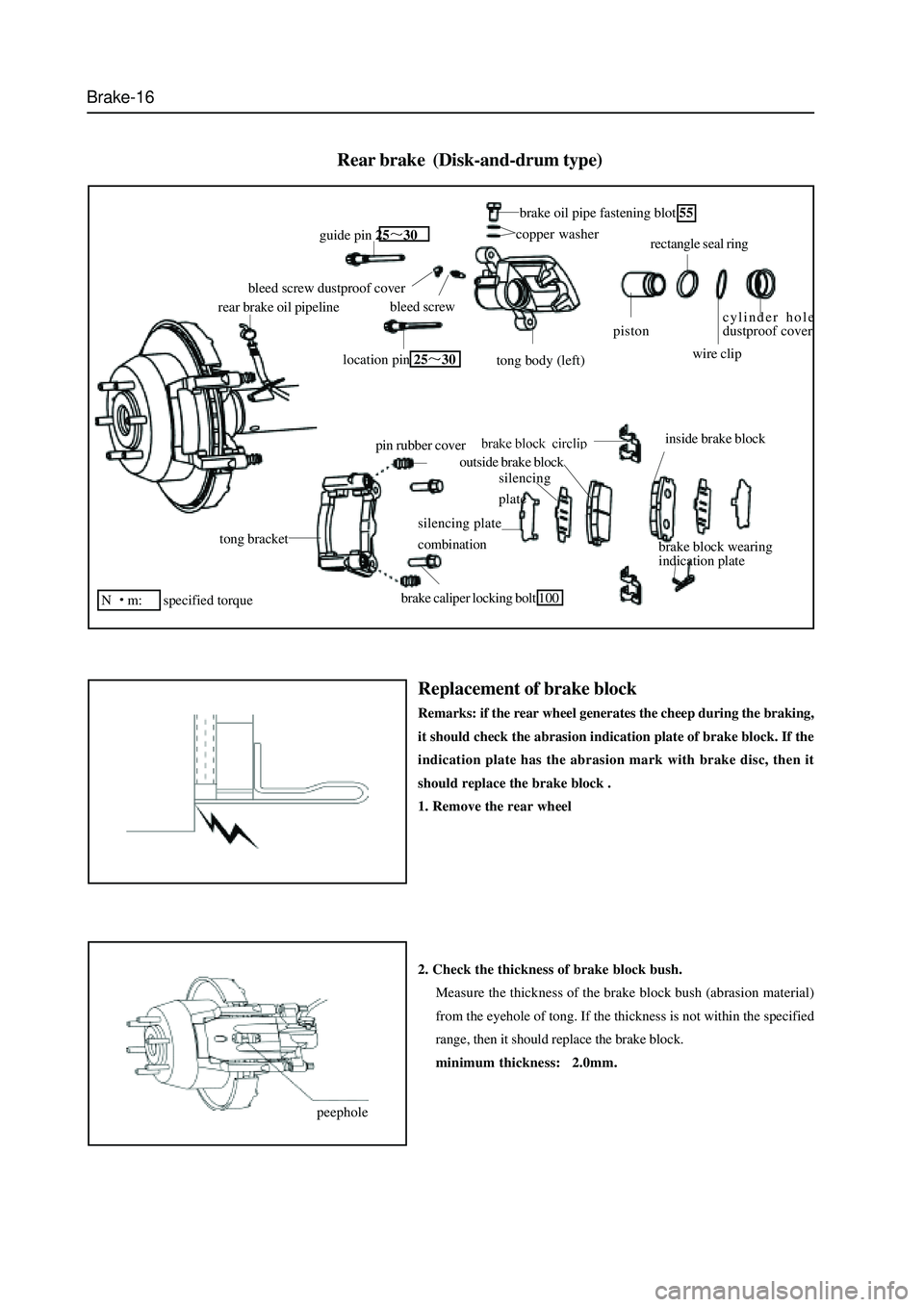
Brake-16
Rear brake (Disk-and-drum type)
tong bracket
pin rubber cover
brake caliper locking bolt 100
silencing plate
combination
outside brake block
inside brake block
brake block wearing
indication plate
cylinder hole
dustproof cover
wire clip
rectangle seal ring
piston
tong body (left)
copper washer
brake oil pipe fastening blot 55
location pin 2530
bleed screw
bleed screw dustproof cover
guide pin 2530
rear brake oil pipeline
N
m: specified torque
peepholesilencing
plate
Replacement of brake block
Remarks: if the rear wheel generates the cheep during the braking,
it should check the abrasion indication plate of brake block. If the
indication plate has the abrasion mark with brake disc, then it
should replace the brake block .
1. Remove the rear wheel
2. Check the thickness of brake block bush.
Measure the thickness of the brake block bush (abrasion material)
from the eyehole of tong. If the thickness is not within the specified
range, then it should replace the brake block.
minimum thickness: 2.0mm.
Page 304 of 425
Brake-18
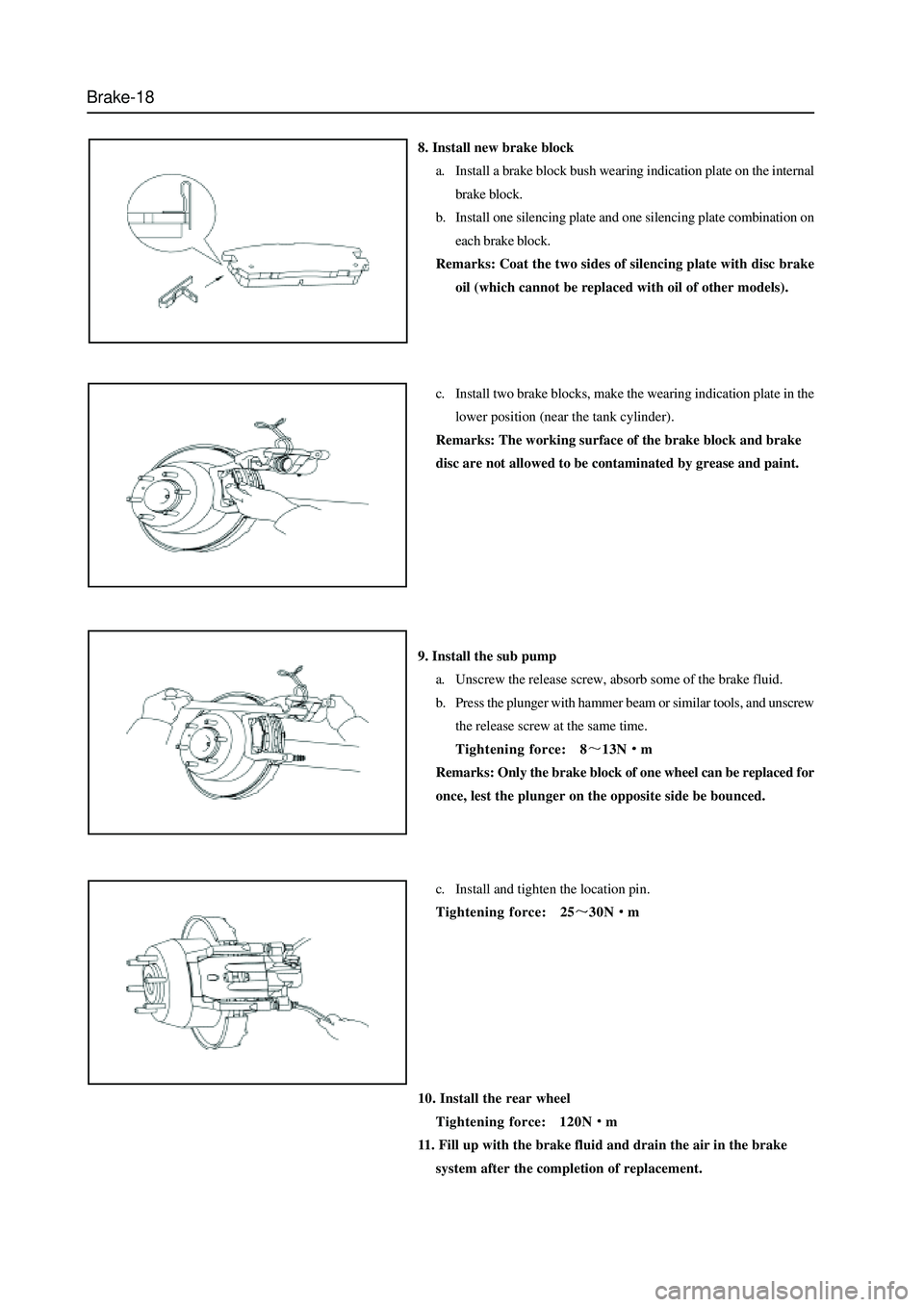
8. Install new brake block
a. Install a brake block bush wearing indication plate on the internal
brake block.
b. Install one silencing plate and one silencing plate combination on
each brake block.
Remarks: Coat the two sides of silencing plate with disc brake
oil (which cannot be replaced with oil of other models).
c. Install two brake blocks, make the wearing indication plate in the
lower position (near the tank cylinder).
Remarks: The working surface of the brake block and brake
disc are not allowed to be contaminated by grease and paint.
9. Install the sub pump
a. Unscrew the release screw, absorb some of the brake fluid.
b. Press the plunger with hammer beam or similar tools, and unscrew
the release screw at the same time.
Tightening force: 8
13Nm
Remarks: Only the brake block of one wheel can be replaced for
once, lest the plunger on the opposite side be bounced.
c. Install and tighten the location pin.
Tightening force: 25
30Nm
10. Install the rear wheel
Tightening force: 120N
m
11. Fill up with the brake fluid and drain the air in the brake
system after the completion of replacement.
Page 309 of 425
Brake-23
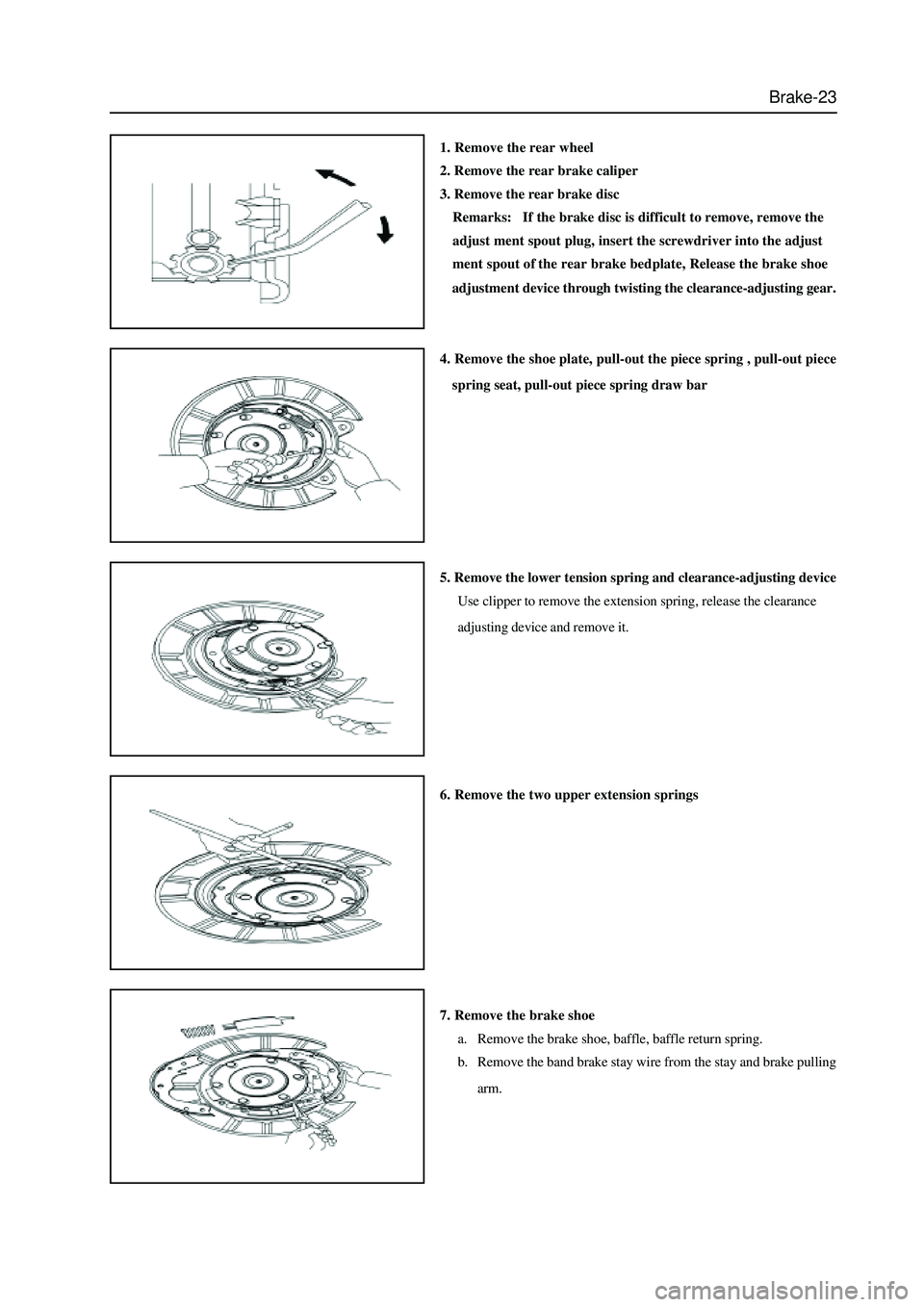
1. Remove the rear wheel
2. Remove the rear brake caliper
3. Remove the rear brake disc
Remarks: If the brake disc is difficult to remove, remove the
adjust ment spout plug, insert the screwdriver into the adjust
ment spout of the rear brake bedplate, Release the brake shoe
adjustment device through twisting the clearance-adjusting gear.
4. Remove the shoe plate, pull-out the piece spring , pull-out piece
spring seat, pull-out piece spring draw bar
5. Remove the lower tension spring and clearance-adjusting device
Use clipper to remove the extension spring, release the clearance
adjusting device and remove it.
6. Remove the two upper extension springs
7. Remove the brake shoe
a. Remove the brake shoe, baffle, baffle return spring.
b. Remove the band brake stay wire from the stay and brake pulling
arm.
Page 311 of 425
Brake-25
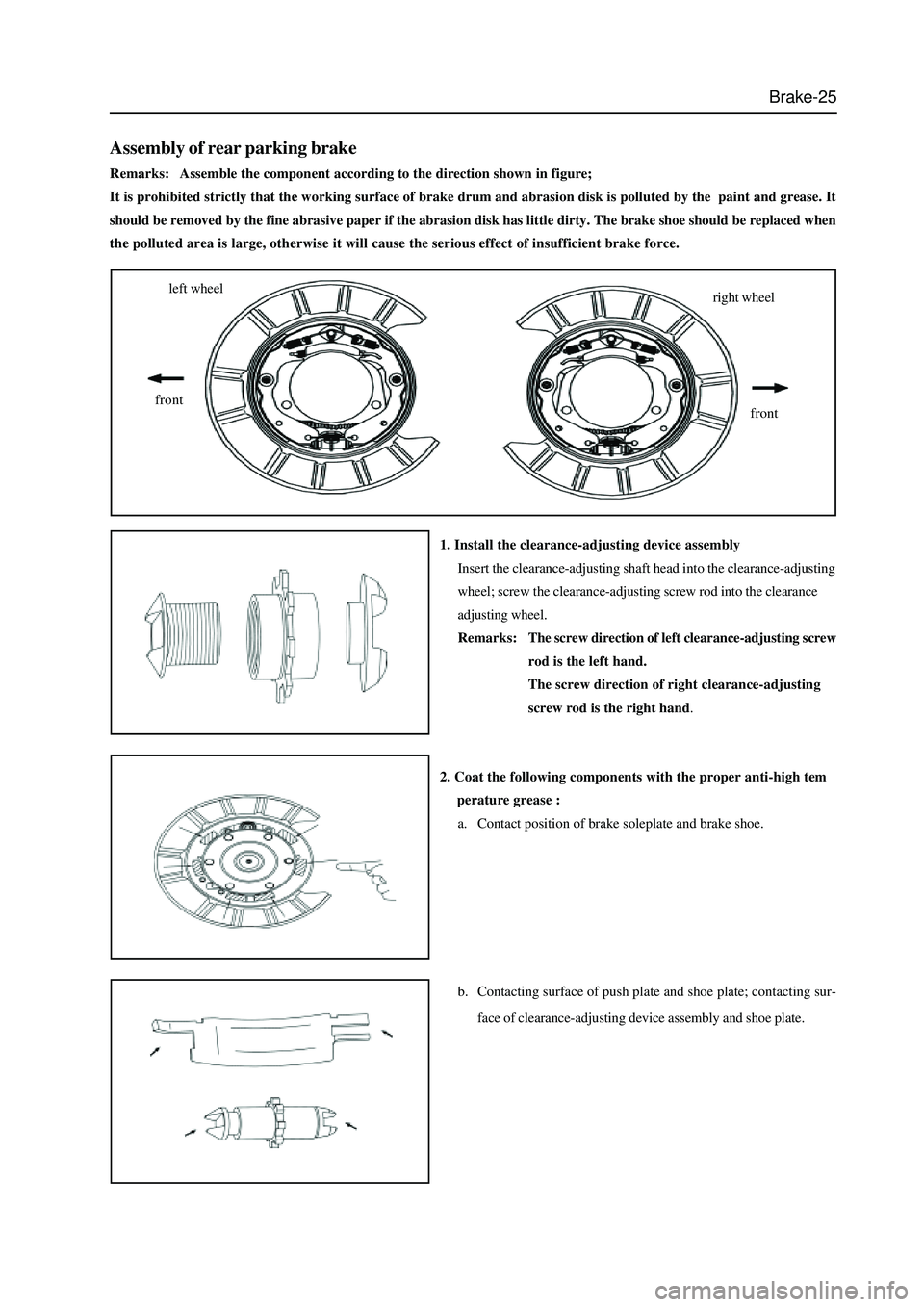
1. Install the clearance-adjusting device assembly
Insert the clearance-adjusting shaft head into the clearance-adjusting
wheel; screw the clearance-adjusting screw rod into the clearance
adjusting wheel.
Remarks:The screw direction of left clearance-adjusting screw
rod is the left hand.
The screw direction of right clearance-adjusting
screw rod is the right hand.
2. Coat the following components with the proper anti-high tem
perature grease :
a. Contact position of brake soleplate and brake shoe.
b. Contacting surface of push plate and shoe plate; contacting sur-
face of clearance-adjusting device assembly and shoe plate.
Assembly of rear parking brake
Remarks: Assemble the component according to the direction shown in figure;
It is prohibited strictly that the working surface of brake drum and abrasion disk is polluted by the paint and grease. It
should be removed by the fine abrasive paper if the abrasion disk has little dirty. The brake shoe should be replaced when
the polluted area is large, otherwise it will cause the serious effect of insufficient brake force.
left wheel
frontright wheel
front
Page 314 of 425
Brake-28
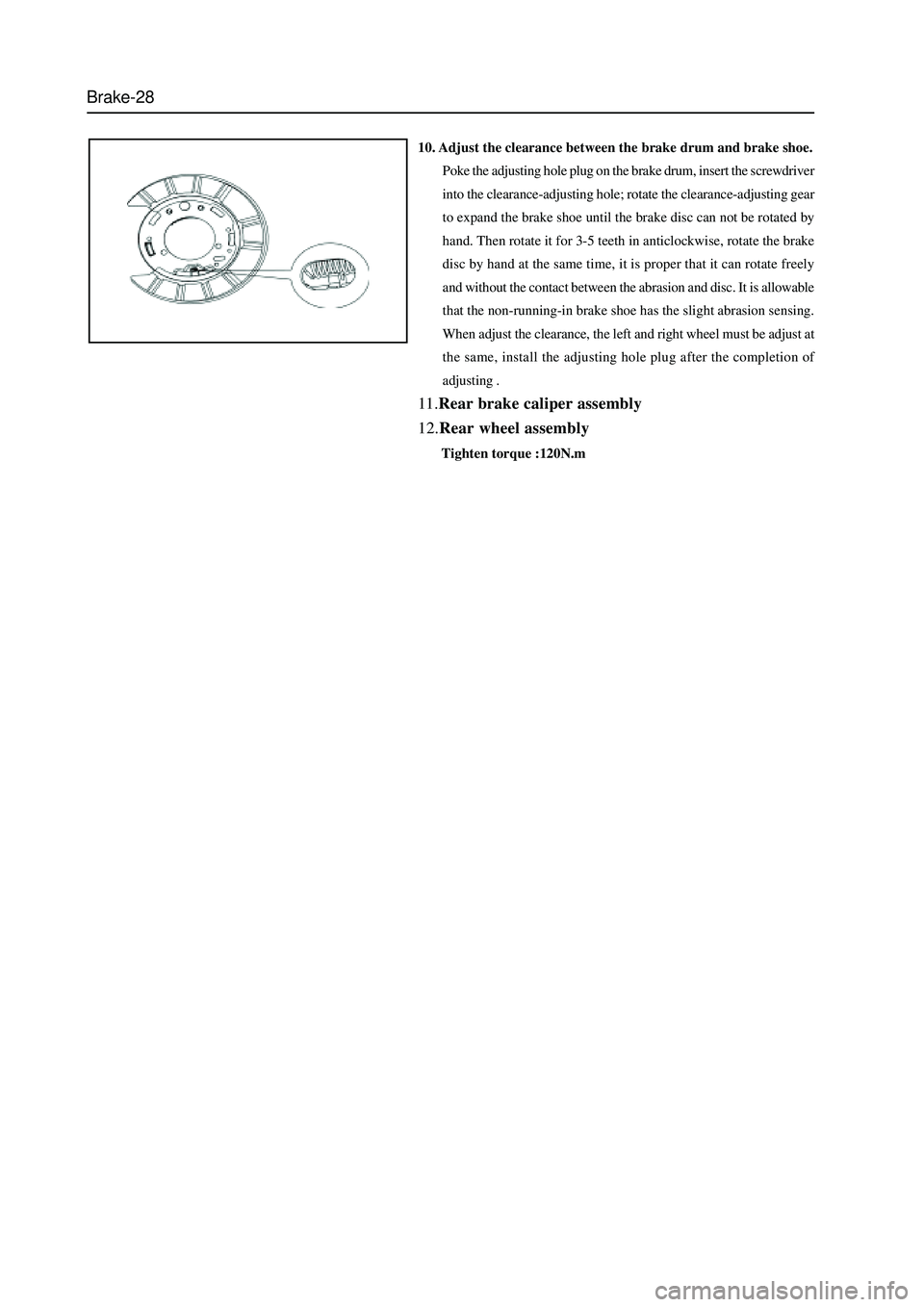
10. Adjust the clearance between the brake drum and brake shoe.
Poke the adjusting hole plug on the brake drum, insert the screwdriver
into the clearance-adjusting hole; rotate the clearance-adjusting gear
to expand the brake shoe until the brake disc can not be rotated by
hand. Then rotate it for 3-5 teeth in anticlockwise, rotate the brake
disc by hand at the same time, it is proper that it can rotate freely
and without the contact between the abrasion and disc. It is allowable
that the non-running-in brake shoe has the slight abrasion sensing.
When adjust the clearance, the left and right wheel must be adjust at
the same, install the adjusting hole plug after the completion of
adjusting .
11.Rear brake caliper assembly
12.Rear wheel assembly
Tighten torque :120N.m
Page 315 of 425
Brake-29
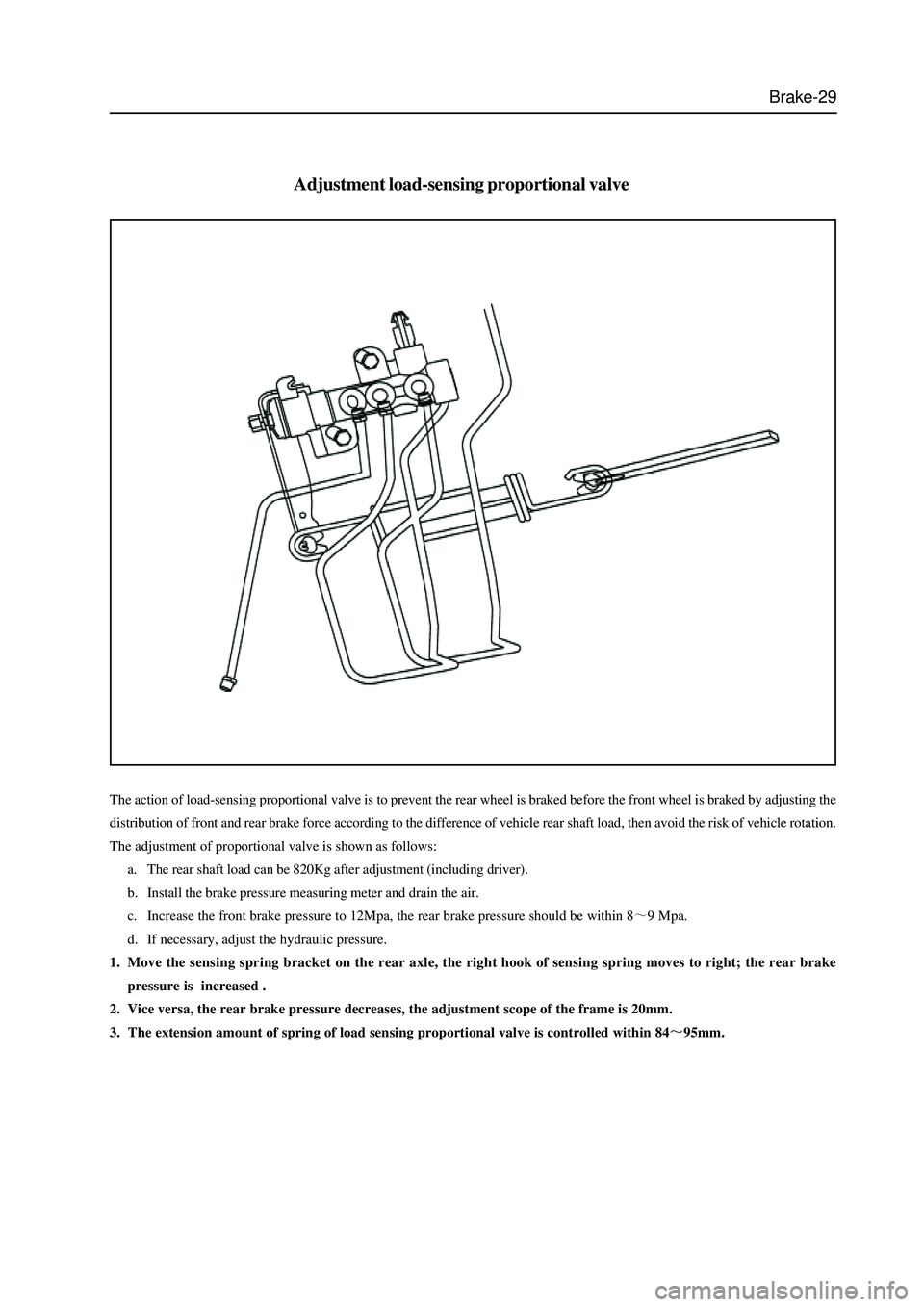
The action of load-sensing proportional valve is to prevent the rear wheel is braked before the front wheel is braked by adjusting the
distribution of front and rear brake force according to the difference of vehicle rear shaft load, then avoid the risk of vehicle rotation.
The adjustment of proportional valve is shown as follows:
a. The rear shaft load can be 820Kg after adjustment (including driver).
b. Install the brake pressure measuring meter and drain the air.
c. Increase the front brake pressure to 12Mpa, the rear brake pressure should be within 8
9 Mpa.
d. If necessary, adjust the hydraulic pressure.
1. Move the sensing spring bracket on the rear axle, the right hook of sensing spring moves to right; the rear brake
pressure is increased .
2. Vice versa, the rear brake pressure decreases, the adjustment scope of the frame is 20mm.
3. The extension amount of spring of load sensing proportional valve is controlled within 84
95mm.
Adjustment load-sensing proportional valve
Page 317 of 425
Brake-31
Antilock Braking System (ABS)
Cautions
1. It must not remove or install the electric elements and wire bunch plug when the ignition switch is in ON to avoid
the damage of ECU. It should turn off the ignition switch if needs disassembly.
2. Pay attention to do not knock or impact the ABS ECU during the maintenance and repair, for it will damage the
ABS ECU easily.
3. The wheel speed sensor and hydraulic unit (integrated with ECU) of BOSCH ABS8.0 can not be repaired, it should
be replaced in integral if damaged.
4. After the brake system is maintained, the brake pedal maybe soft. Discharge the air according to the normal brake
system.
5. It must use the brake fluid from original manufacturer; the brake fluid of different number cannot be used in mixed,
otherwise it will cause the failure of brake system. Select the tyre of original type as most as possible
Repair of Antilock Braking System (ABS)
1. It should process the failure diagnosis for the brake system before process the ABS failure diagnosis. It can
diagnose out the failure rapidly by using Table 1. In Table 1, the small number means the failure which occurs most
possibly. Check each element according to the sequence and maintain or replace it if necessary.
2. Check the following elements for normal operation before the diagnosis:
Brake fluid level and brake fluid quality
Pressure of tyre, size of tyre, shape and depth of tyre figure
Other brake component
These components will affect the brake effect of the ABS. Check the system sensor, connecting wire and connector for correct
installation, arrangement and connection. Ensure the completeness of fuse, repair or replace it if necessary.
3. Process the analysis and diagnosis according to the ABS advanced by owner. Use the diagnosis instrument (Annex
1) for final check and confirmation. It must process the run inspection after the competition of all ABS maintenance.
The test condition is shown as follows:
a. Confirm the tyre complies with the requirement, the tyre pressure is normal.
b. The brake system (including brake light ) is normal
c. The brake system is without leakage.
d. The position and installation of wheel speed sensor is correct.
e. All fuses are normal.
4. test method:
Run for 1 min at least when the vehicle speed is beyond 40Km/h, process a proper brake. Then read out the failure code to
ensure the ABS is without failure code.
Page 324 of 425
Steering-5
Technical requirements
1.The fastening torque of the mounting bolts of the integral power
steering gear assembly is
2.The fastening torque of the connecting bolts of the steering drive sub-
assembly and the integral power steering gear assembly is
3. The fastening torque of the connecting bolts of the steering drive
assembly and the left horizontal beam of the frame is
4. The fastening torque of the mounting bolts of the power steering
pump is 40N.m.
5. The tension force of multi-wedge belt 4PK1100 is 4PK1100.
6. Centering fastening of the handwheel: steer the front wheel to the
right front and remove the handwheel without changing the position
of the steering stem, install the handwheel aligning the center, the
radials of the handwheel should be at the left & right centering state;
the symbol of “the Great Wall” on the steering wheel shall be in
driver’s straight view position, secure the nut firmly with the
fastening torque of
7. Inspection of free clearance of the handwheel
Steer the car in a straight direction and stop the engine, apply a 5N force to
the handwheel along the circumference, left turn the handwheel and stop
the turning when the resistance is increasingly felt with each turn; then right
turn the handwheel and stop the turning when the resistance is increasingly
felt with each turn; the angle rotated along the circumference is the free
clearance of the handwheel, whose standard value shall be below 20
, and
the angle from the center to the right shall not be more than 10
Page 388 of 425
Safety airbag-18
Impact-vehicle diagnosis
Test SRS-ECU diagnostic signals
1. Connect the (X-431 diagnostic test’s) diagnostic joint
2. Read the diagnostic results with X-431 diagnostic tester
Repairing procedure
1.When safety airbag is released.
The following parts should be replaced with new ones
a. Passengers’ side safety airbag module
b. SRS-ECU
c. Driver’s side safety airbag module
2 Check the following parts; replace them with new ones providing something wrong with them.
a. Clock spring
b. Steering-wheel, steering column, bottom steering shaft module
3.Driver’s side safety airbag module’s installation status towards the steering wheel.
a. Check whether abnormal knocking is with the steering wheel, its activity is in good condition and its clearance is normal.
b. Check whether the wiring harness joint is broken and its terminal is deformed.
Caution: Due to the impact, the diagnostic instrument cannot communicate with SRS-ECU when accumulator is lack of
power, in this case, check and maintain the instrument panel wiring harness or utilize the extension power supply.
Page 389 of 425
Safety airbag-19
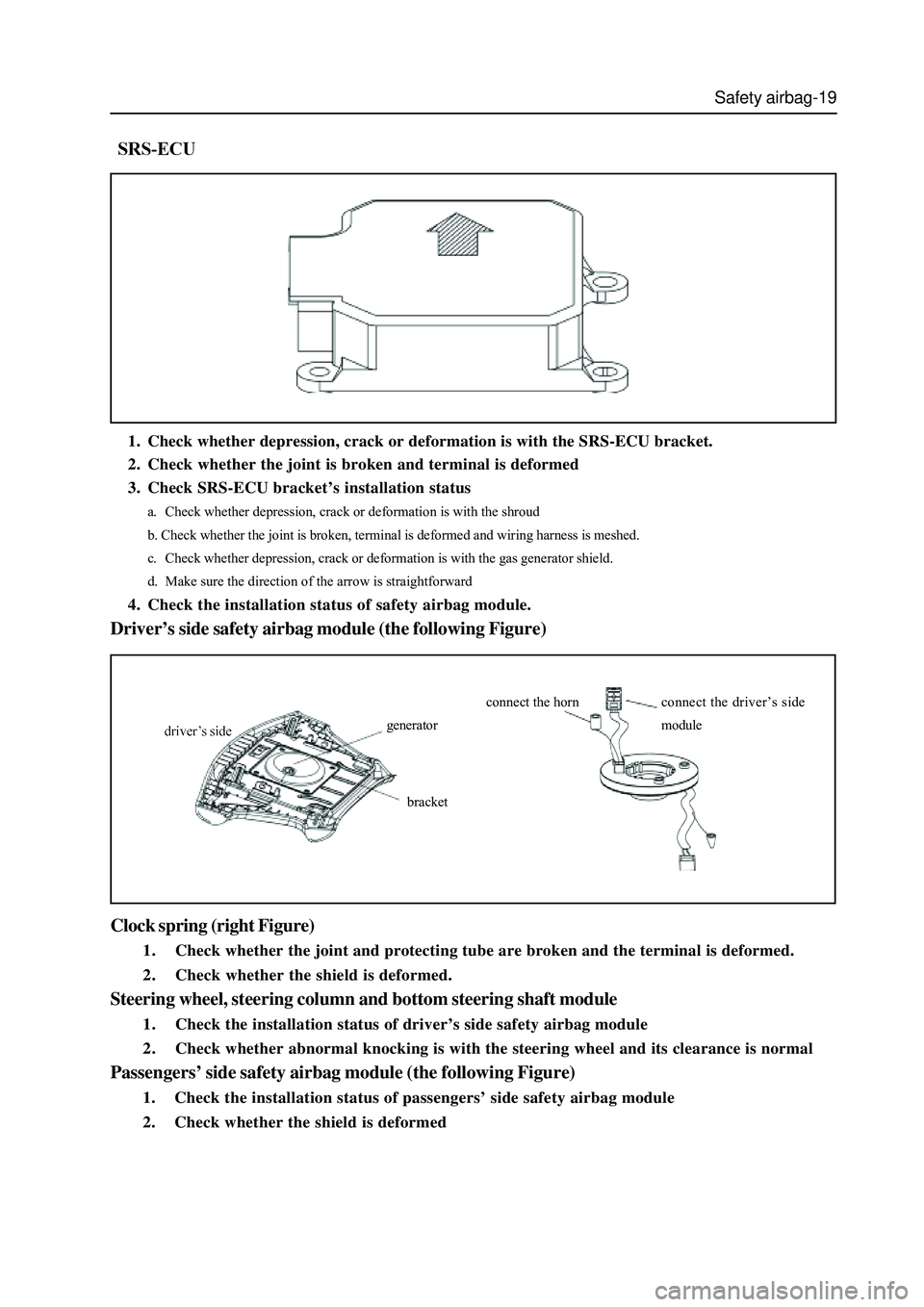
1. Check whether depression, crack or deformation is with the SRS-ECU bracket.
2. Check whether the joint is broken and terminal is deformed
3. Check SRS-ECU bracket’s installation status
a. Check whether depression, crack or deformation is with the shroud
b. Check whether the joint is broken, terminal is deformed and wiring harness is meshed.
c. Check whether depression, crack or deformation is with the gas generator shield.
d. Make sure the direction of the arrow is straightforward
4. Check the installation status of safety airbag module.
Driver’s side safety airbag module (the following Figure)
generator
bracketconnect the hornconnect the driver’s side
module
Clock spring (right Figure)
1. Check whether the joint and protecting tube are broken and the terminal is deformed.
2. Check whether the shield is deformed.
Steering wheel, steering column and bottom steering shaft module
1. Check the installation status of driver’s side safety airbag module
2. Check whether abnormal knocking is with the steering wheel and its clearance is normal
Passengers’ side safety airbag module (the following Figure)
1. Check the installation status of passengers’ side safety airbag module
2. Check whether the shield is deformed