clutch GREAT WALL HOVER 2006 Service Manual Online
[x] Cancel search | Manufacturer: GREAT WALL, Model Year: 2006, Model line: HOVER, Model: GREAT WALL HOVER 2006Pages: 425, PDF Size: 26.05 MB
Page 248 of 425
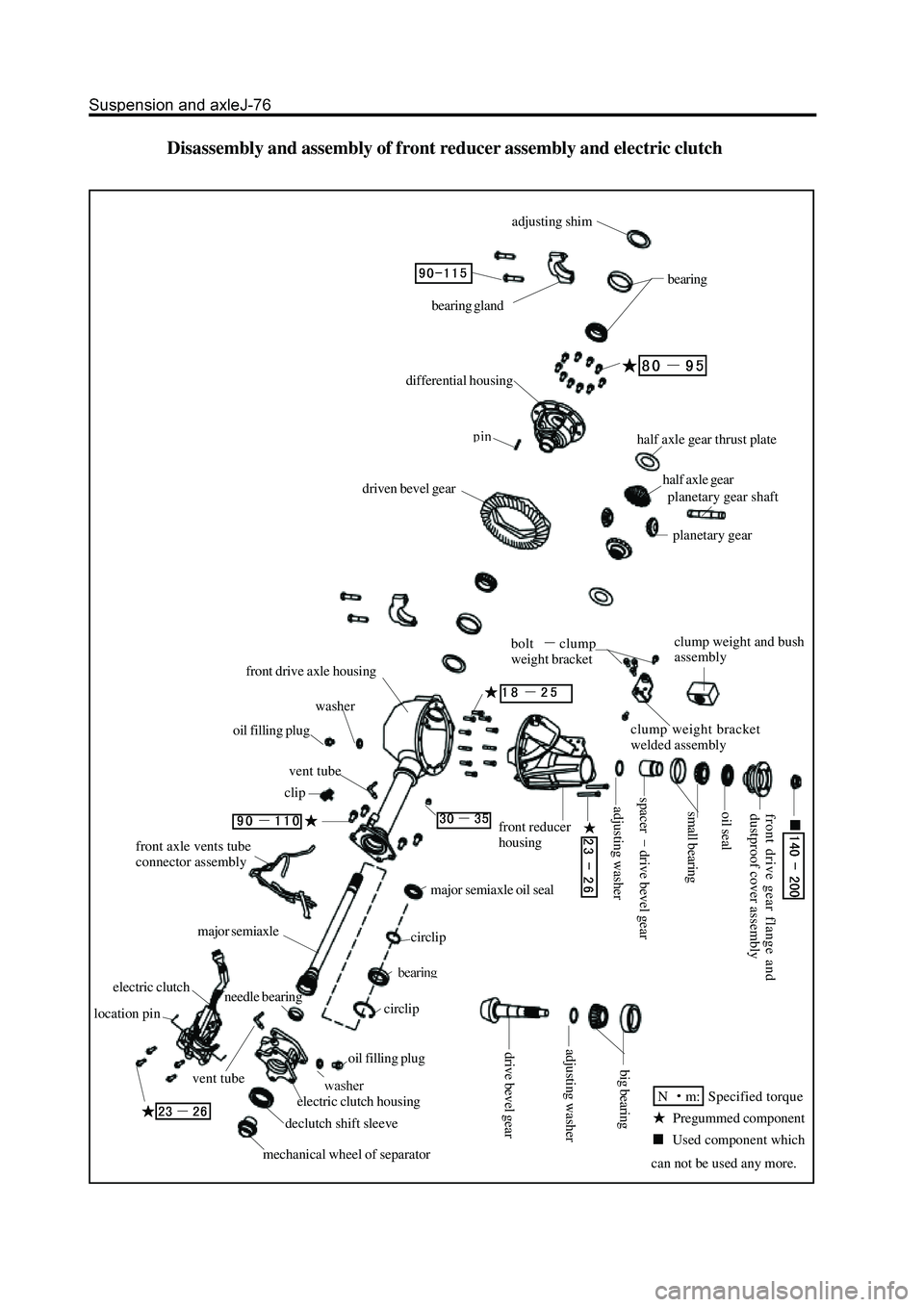
Disassembly and assembly of front reducer assembly and electric clutch
adjusting shim
bearing gland
differential housing
driven bevel gear
front drive axle housing
washer
oil filling plug
vent tube
clip
front axle vents tube
connector assembly
major semiaxle
needle bearingelectric clutch
location pin
vent tube
mechanical wheel of separator
declutch shift sleeve
electric clutch housing
oil filling plug
circlip
major semiaxle oil seal
half axle gear thrust plate
half axle gear
planetary gear shaft
planetary gear
bolt clump
weight bracketclump weight and bush
assembly
clump weight bracket
welded assembly
front reducer
housing
adjusting washerspacer
drive bevel gear
small bearingoil sealfront drive gear flange and
dustproof cover assembly
drive bevel gearadjusting washer
Pregummed component
N m: Specified torque
Used component which
can not be used any more.bearing
circlip
big bearing
Page 249 of 425
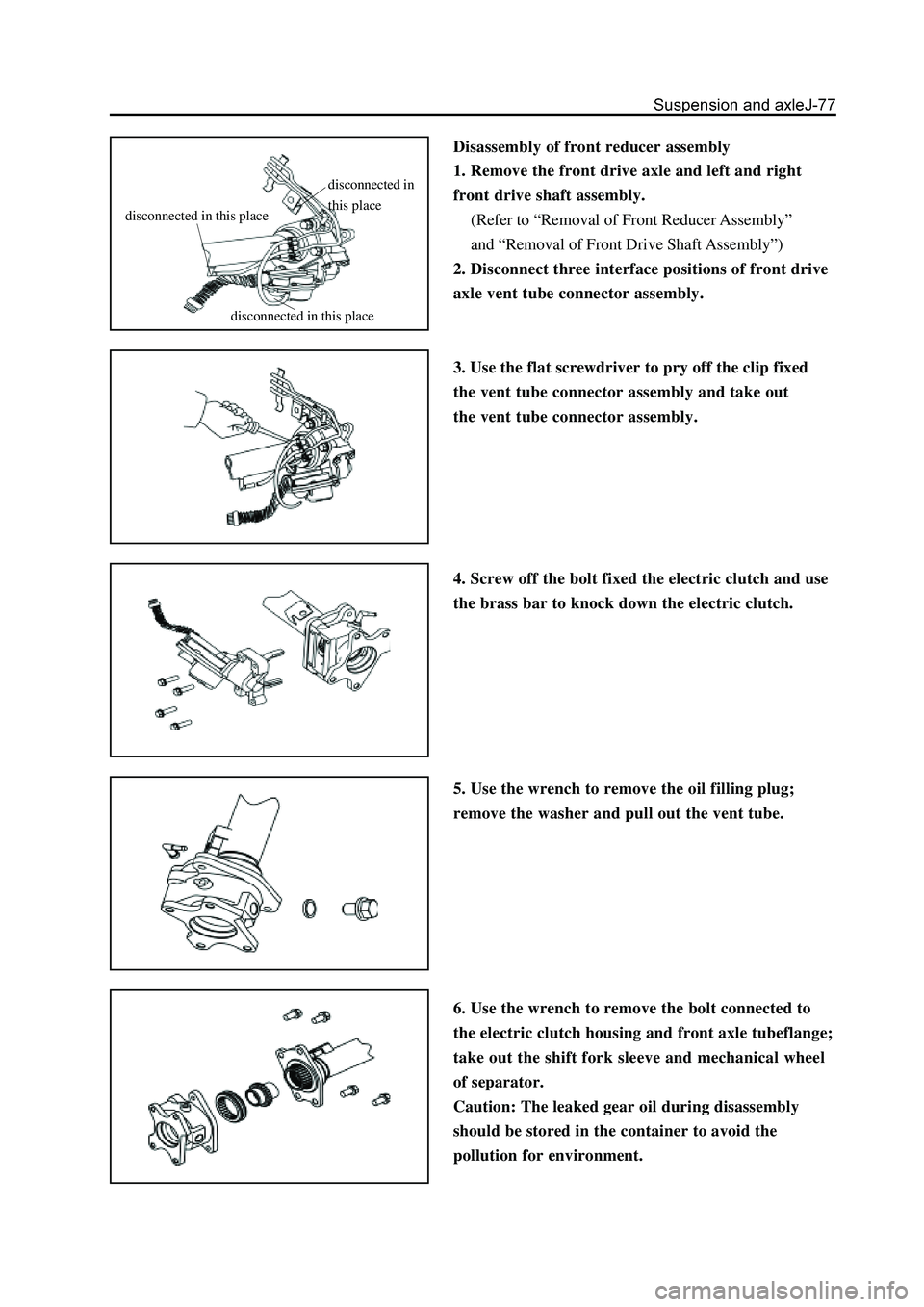
Disassembly of front reducer assembly
1. Remove the front drive axle and left and right
front drive shaft assembly.
(Refer to “Removal of Front Reducer Assembly”
and “Removal of Front Drive Shaft Assembly”)
2. Disconnect three interface positions of front drive
axle vent tube connector assembly.
3. Use the flat screwdriver to pry off the clip fixed
the vent tube connector assembly and take out
the vent tube connector assembly.
4. Screw off the bolt fixed the electric clutch and use
the brass bar to knock down the electric clutch.
5. Use the wrench to remove the oil filling plug;
remove the washer and pull out the vent tube.
6. Use the wrench to remove the bolt connected to
the electric clutch housing and front axle tubeflange;
take out the shift fork sleeve and mechanical wheel
of separator.
Caution: The leaked gear oil during disassembly
should be stored in the container to avoid the
pollution for environment.
disconnected in
this place
disconnected in this place
disconnected in this place
Page 265 of 425
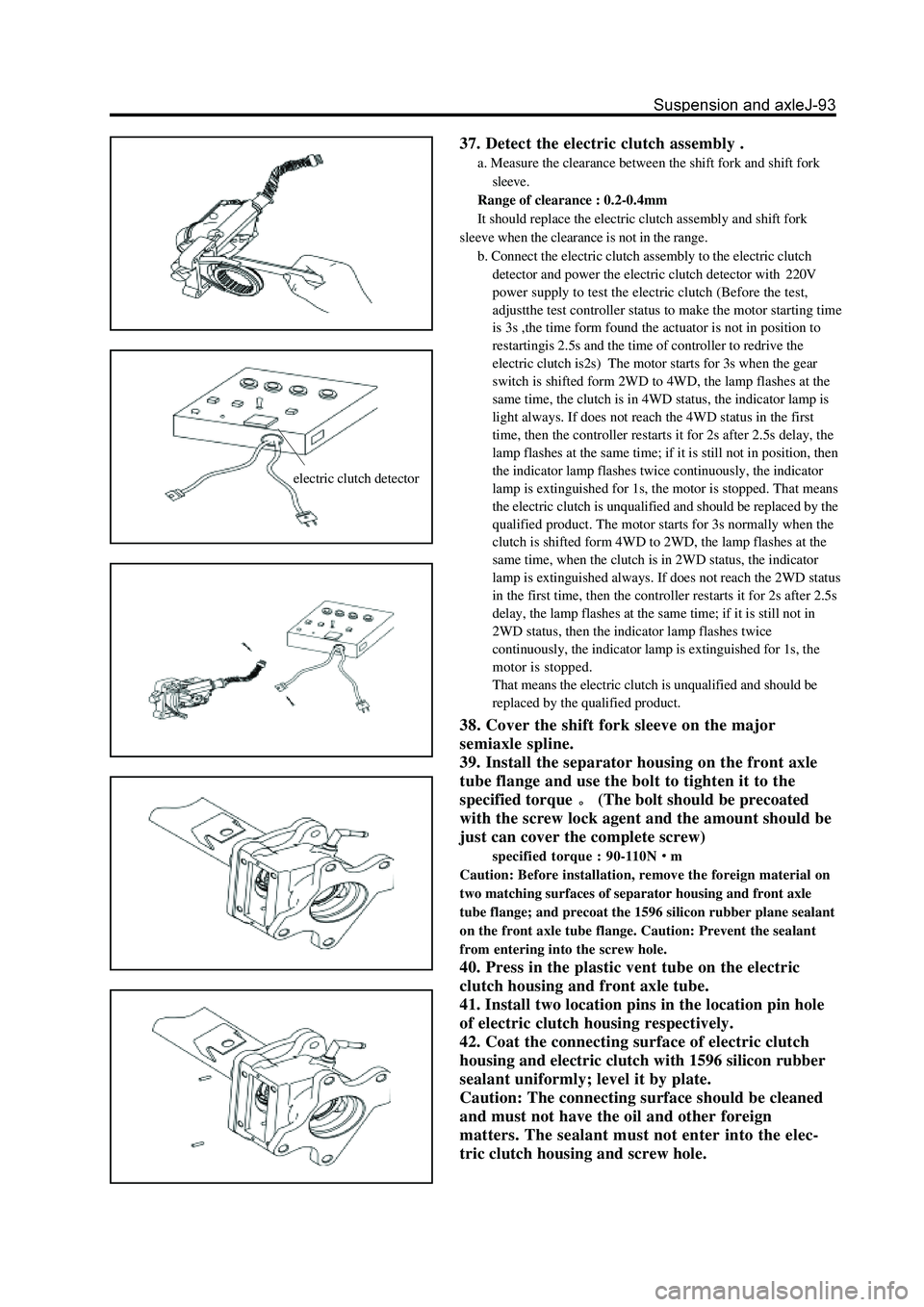
electric clutch detector
37. Detect the electric clutch assembly .
a. Measure the clearance between the shift fork and shift fork
sleeve.
Range of clearance : 0.2-0.4mm
It should replace the electric clutch assembly and shift fork
sleeve when the clearance is not in the range.
b. Connect the electric clutch assembly to the electric clutch
detector and power the electric clutch detector with220V
power supply to test the electric clutch (Before the test,
adjustthe test controller status to make the motor starting time
is 3s ,the time form found the actuator is not in position to
restartingis 2.5s and the time of controller to redrive the
electric clutch is2s) The motor starts for 3s when the gear
switch is shifted form 2WD to 4WD, the lamp flashes at the
same time, the clutch is in 4WD status, the indicator lamp is
light always. If does not reach the 4WD status in the first
time, then the controller restarts it for 2s after 2.5s delay, the
lamp flashes at the same time; if it is still not in position, then
the indicator lamp flashes twice continuously, the indicator
lamp is extinguished for 1s, the motor is stopped. That means
the electric clutch is unqualified and should be replaced by the
qualified product. The motor starts for 3s normally when the
clutch is shifted form 4WD to 2WD, the lamp flashes at the
same time, when the clutch is in 2WD status, the indicator
lamp is extinguished always. If does not reach the 2WD status
in the first time, then the controller restarts it for 2s after 2.5s
delay, the lamp flashes at the same time; if it is still not in
2WD status, then the indicator lamp flashes twice
continuously, the indicator lamp is extinguished for 1s, the
motor is stopped.
That means the electric clutch is unqualified and should be
replaced by the qualified product.
38. Cover the shift fork sleeve on the major
semiaxle spline.
39. Install the separator housing on the front axle
tube flange and use the bolt to tighten it to the
specified torque
(The bolt should be precoated
with the screw lock agent and the amount should be
just can cover the complete screw)
specified torque : 90-110Nm
Caution: Before installation, remove the foreign material on
two matching surfaces of separator housing and front axle
tube flange; and precoat the 1596 silicon rubber plane sealant
on the front axle tube flange. Caution: Prevent the sealant
from entering into the screw hole.
40. Press in the plastic vent tube on the electric
clutch housing and front axle tube.
41. Install two location pins in the location pin hole
of electric clutch housing respectively.
42. Coat the connecting surface of electric clutch
housing and electric clutch with 1596 silicon rubber
sealant uniformly; level it by plate.
Caution: The connecting surface should be cleaned
and must not have the oil and other foreign
matters. The sealant must not enter into the elec-
tric clutch housing and screw hole.
Page 266 of 425
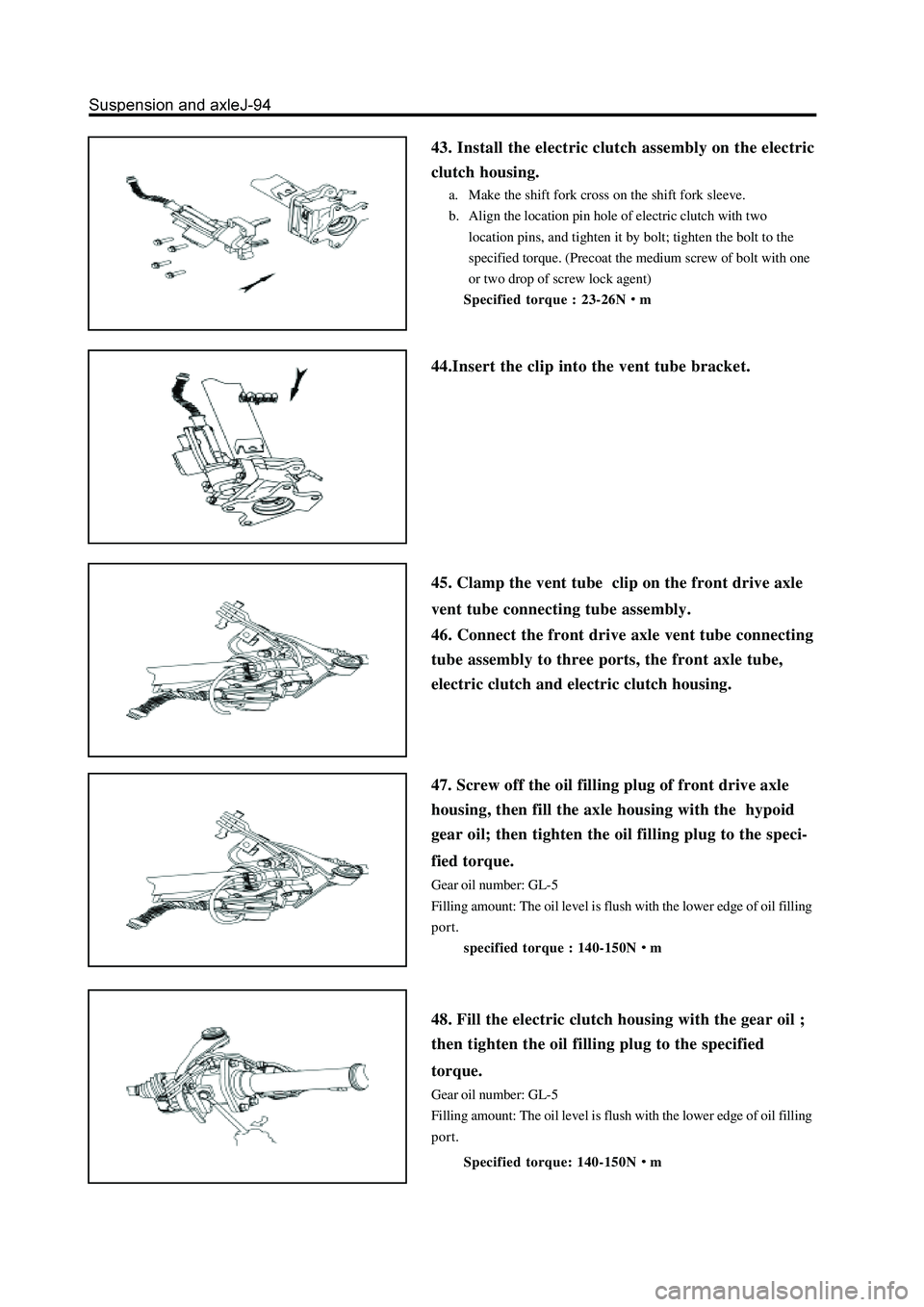
44.Insert the clip into the vent tube bracket.
45. Clamp the vent tube clip on the front drive axle
vent tube connecting tube assembly.
46. Connect the front drive axle vent tube connecting
tube assembly to three ports, the front axle tube,
electric clutch and electric clutch housing. 43. Install the electric clutch assembly on the electric
clutch housing.
a. Make the shift fork cross on the shift fork sleeve.
b. Align the location pin hole of electric clutch with two
location pins, and tighten it by bolt; tighten the bolt to the
specified torque. (Precoat the medium screw of bolt with one
or two drop of screw lock agent)
Specified torque : 23-26N
m
47. Screw off the oil filling plug of front drive axle
housing, then fill the axle housing with the hypoid
gear oil; then tighten the oil filling plug to the speci-
fied torque.
Gear oil number: GL-5
Filling amount: The oil level is flush with the lower edge of oil filling
port.
specified torque : 140-150N
m
48. Fill the electric clutch housing with the gear oil ;
then tighten the oil filling plug to the specified
torque.
Gear oil number: GL-5
Filling amount: The oil level is flush with the lower edge of oil filling
port.
Specified torque: 140-150N
m
Page 267 of 425
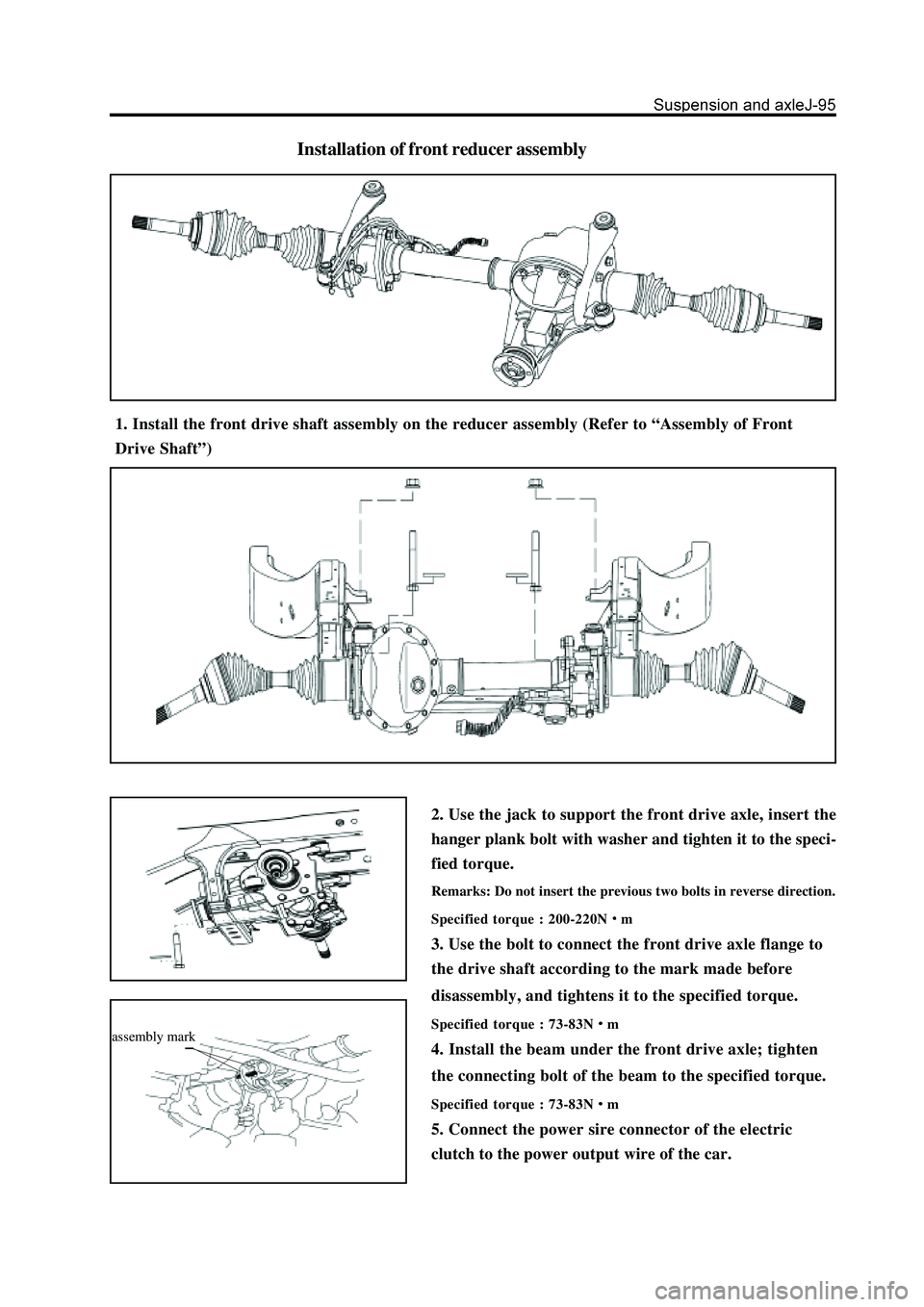
Installation of front reducer assembly
1. Install the front drive shaft assembly on the reducer assembly (Refer to “Assembly of Front
Drive Shaft”)
assembly mark
2. Use the jack to support the front drive axle, insert the
hanger plank bolt with washer and tighten it to the speci-
fied torque.
Remarks: Do not insert the previous two bolts in reverse direction.
Specified torque : 200-220N
m
3. Use the bolt to connect the front drive axle flange to
the drive shaft according to the mark made before
disassembly, and tightens it to the specified torque.
Specified torque : 73-83Nm
4. Install the beam under the front drive axle; tighten
the connecting bolt of the beam to the specified torque.
Specified torque : 73-83Nm
5. Connect the power sire connector of the electric
clutch to the power output wire of the car.
Page 292 of 425
Brake-6
4. Adjust the stroke of pedal if necessary
a. Rotate the pedal push bar to adjust the free stroke if the stroke
length is improper.
b. Start the engine to confirm the free stroke of pedal.
c. Check the height of pedal after adjusts the free stroke of pedal.
d. The height difference of brake pedal and clutch pedal to front
apron is 0
8mm.
e. The height difference of brake pedal and accelerator pedal to the
front apron is 45
5mm.
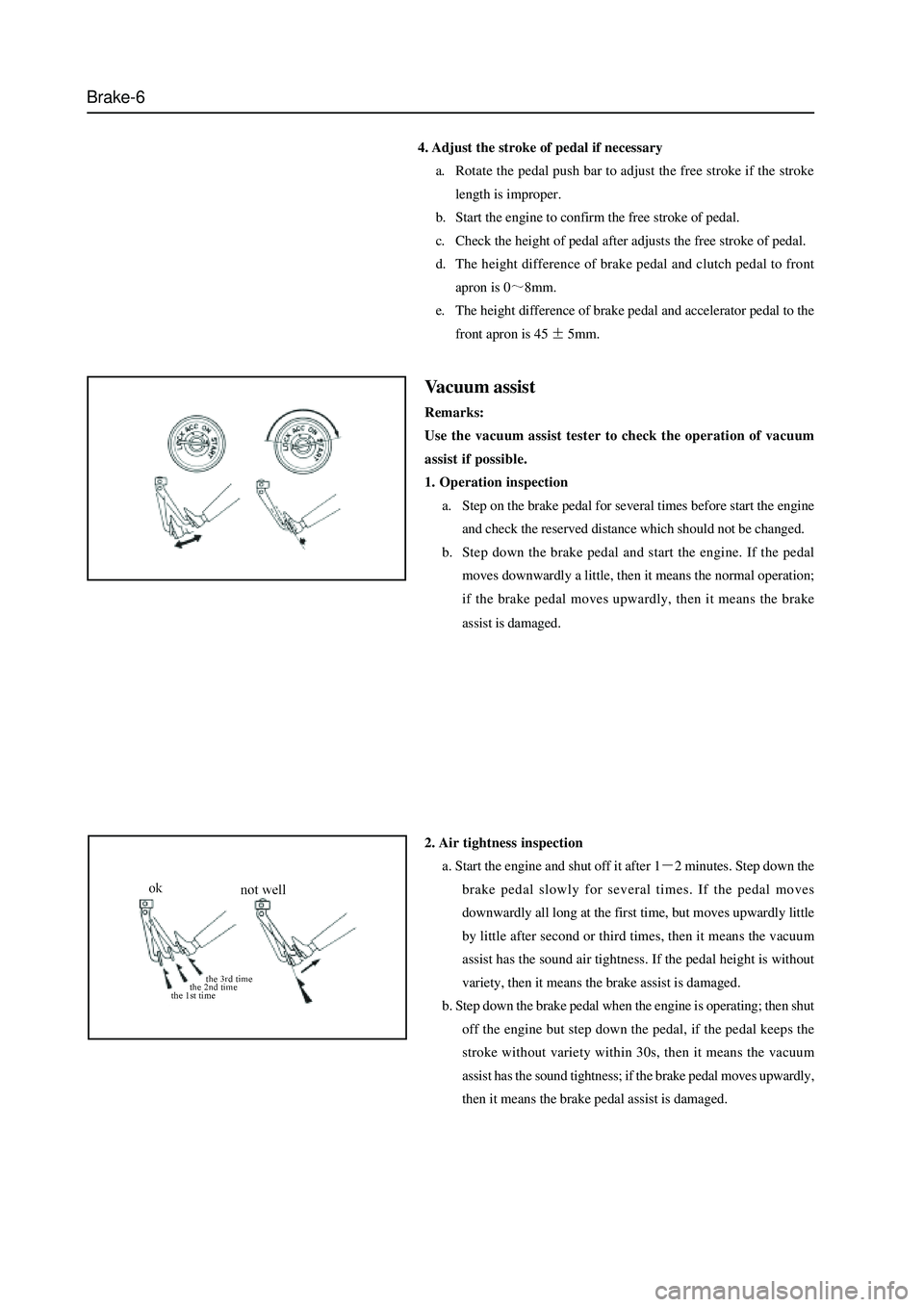
Vacuum assist
Remarks:
Use the vacuum assist tester to check the operation of vacuum
assist if possible.
1. Operation inspection
a. Step on the brake pedal for several times before start the engine
and check the reserved distance which should not be changed.
b. Step down the brake pedal and start the engine. If the pedal
moves downwardly a little, then it means the normal operation;
if the brake pedal moves upwardly, then it means the brake
assist is damaged.
2. Air tightness inspection
a. Start the engine and shut off it after 1
2 minutes. Step down the
brake pedal slowly for several times. If the pedal moves
downwardly all long at the first time, but moves upwardly little
by little after second or third times, then it means the vacuum
assist has the sound air tightness. If the pedal height is without
variety, then it means the brake assist is damaged.
b. Step down the brake pedal when the engine is operating; then shut
off the engine but step down the pedal, if the pedal keeps the
stroke without variety within 30s, then it means the vacuum
assist has the sound tightness; if the brake pedal moves upwardly,
then it means the brake pedal assist is damaged.
Page 363 of 425
CD Player and Air Conditioning System-10
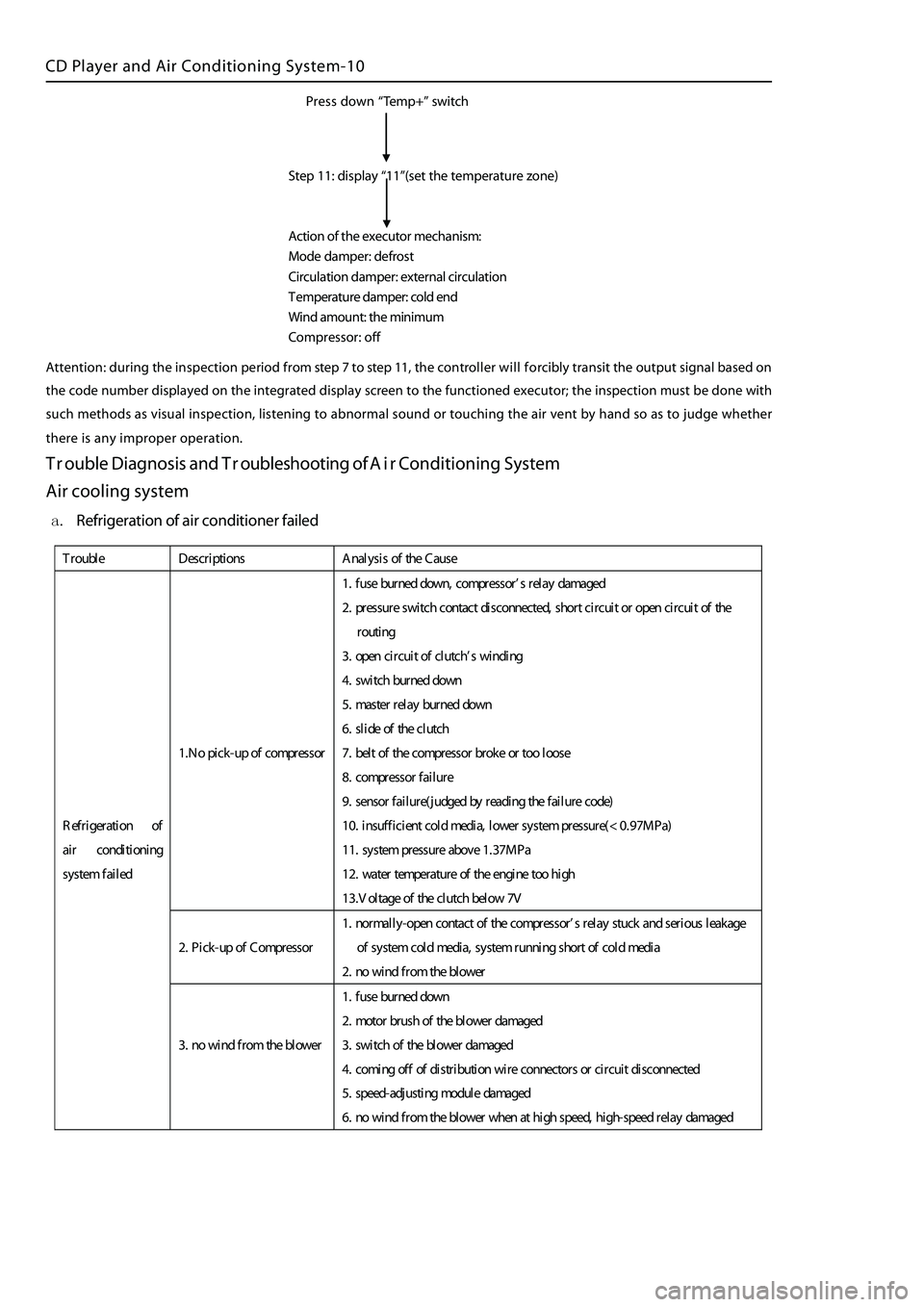
Refrigeration of air conditioner failed
T rou ble Des crip tion s Ana l ysis o f the Cause
1.No pick -up o f com pressor 1.
fuse burned down , com presso r’s r elay dama ge
d
2. pressu re sw itch contac t d isco nn ected, short c ircu itor open circ uit o f the
ro utin
g
3. open circ ui t o f clutch’ s w indi ng
4. sw itch burned down
5. ma ster relay b urne d d ow
n
6.
s lid e o f the clut ch
7. beltof the c om presso r b roke ortoo l oose
8. comp ressor failur
e
9. sens or failur e(ju dg ed by read ing t he failu recode
)
10. insu ffic ient cold me dia, lowe r system p ress ur e(< 0 .97M Pa
)
11. system pressu re abov e 1 .37M Pa
12. water t em peratu re of the e ngine t oo high
13. V oltag e o f the clut ch below 7
V
2. Pick -up o f Com pressor 1.
norm
ally -ope n c ontact of the c om presso r’s r elay stuc k a nd seriou s leaka ge
of system cold me dia, system runn ing s hortof cold me di
a
2. no wind from the b lowe
r
R e frig eratio n of
ai r c ondition in
g
syst emfaile
d
3.no wind from the b lowe
r 1.
fuse burned down
2. mo tor b rush ofthe b lowe r dam aged
3. sw itch ofthe b lowe r dam aged
4. comi ng off o f d istrib utio n w ire c onnector s o r circu itdisc
onne cted
5. speed-ad justin g m odule d amaged
6. no wind from the b lowe r w hen a t high s peed, h igh- sp ee d r elay dama ge
d
Press down “Temp+” switch
Step 11: display “11”(set the temperature zone)
Action of the executor mechanism
:
M ode damper: defrost
Circulation damper: external circulation
Te mperature damper: cold end
Wind amount: the minimum
Compressor: off
Attention: during the inspection period fr om step 7 to step 11, the controlle r
will for cibly transit the output signal based on
the code number displayed on the integrated display screen to the functioned executor; the inspection must be done with
such
m ethods as visual inspection, listening to abnormal sound or touching the air vent by hand so as to judge whether
there is any improper operation.
T rouble Diagnosis and T roubleshooting of A i r Conditioning System
Air cooling system
Page 366 of 425
CD Player and Air Conditioning System-13
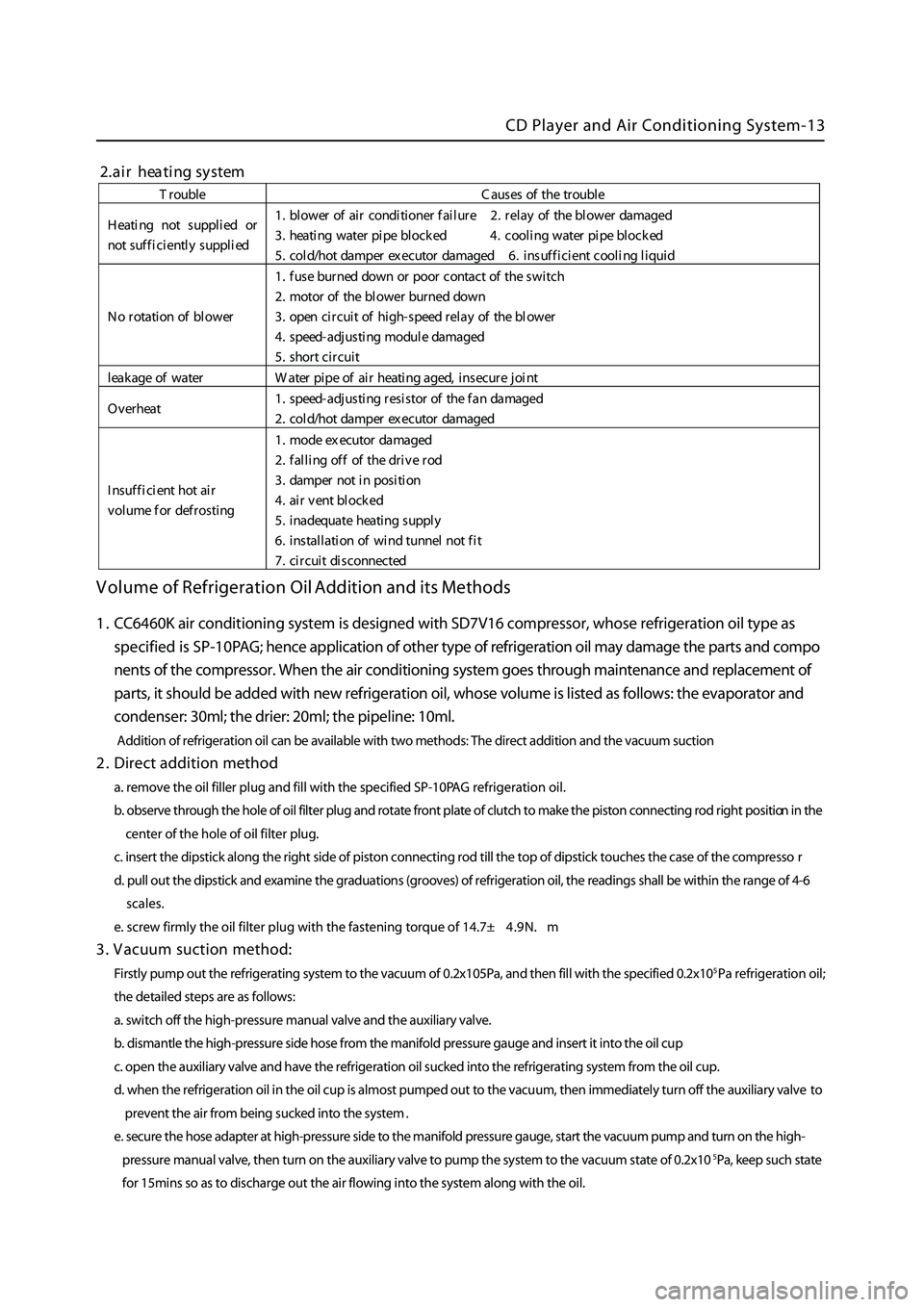
1 .CC6460K air conditioning system is designed with SD7V16 compressor, whose refrigeration oil type as
specified is SP-10P AG; hence application of other type of refrigeration oil may damage the parts and compo
nents of the compressor. When the
air conditioning system goes through maintenance and replacement of
parts, it should be added with new refrigeration oil, whose volume is listed as follows: the evaporator and
condenser: 30ml; the drier: 20ml; the pipeline: 10ml.
Addition of refrigeration oil can be available with two methods: The direct addition and the vacuum suction
2 .D irect addition method
a. remove the oil filler plug and fill with the specified SP-10P AG refrigeration oil.
b. observe through the hole of oil filter plug and rotate front plate of clutch to make the piston connecting rod right positio n in the
center of the hole of oil filter plug.
c. insert the dipstick along the right side of piston connecting rod till the top of dipstick touches the case of the compresso
r
d. pull out the dipstick and examine the graduations (grooves) of refrigeration oil, the readings shall be within the range of 4-6
scales
.
e. screw firmly the oil filter plug with the fastening torque of 14.7± 4.9N
.m
3. Vacuum suction method:
Firstly pump out the refrigerating system to the vacuum of 0.2x10⁵Pa, and then fill with the specified 0.2x10 5 Pa refrigeration oil;
the detailed steps are as follows:
a. switch off the high-pressure manual valve and the auxiliary valve.
b. dismantle the high-pressure side hose from the manifold pressure gauge and insert it into the oil cu
p
c. open the auxiliary valve and have the refrigeration oil sucked into the refrigerating system from the oil cup.
d. when the refrigeration oil in the oil cup is almost pumped out to the vacuum, then immediately turn off the auxiliary valve
to
prevent the air from being sucked into the system
.
e. secure the hose adapter at high-pressure side to the manifold pressure gauge, start the vacuum pump and turn on the high-
pressure manual valve, then turn on the auxiliary valve to pump the system to the vacuum state of 0.2x10
5Pa, keep such state
for 15mins so as to discharge out the air flowing into the system along with the oil.
V ol ume of Refrigeration Oil Addition and its Methods
2.ai r h eating system
T r oubl e Cau ses o f the trouble
H e ati n g n otsuppl i ed or
no t s
uf f i cientl y suppl i ed 1.
blow erof air c ondition erf ai l u re 2.relay o f the blow erdamage
d
3. heati n g w ater pipe bloc k e d 4 . coo ling water p i pe b lock ed
5. col d/h ot damp erexecutor damage d 6. ins
uf f i cien t c oo ling l iqu id
N o rotation ofblow er 1.
f use burned
down orpoor contac t o f the switch
2. mo tor o f the blowe r burne d d ow
n
3. op en circ uit o f h igh- sp eed relay o f the blow er
4. speed-ad j usti n g m odule d am aged
5. short c ircu it
leak age o f w ater W ater p ipe o f ai rhe ati n g a ged, inse cu re j oi nt
O v erhe at 1.
speed-ad j usti n g r esi sto r o f the f an d am aged
2. col d/h ot damp erexecutor damaged
I nsu f f i cien t h otair
vo lume f or d efro stin
g 1.
mode executor dama ge
d
2. f al li n g o f fof the d riv e ro
d
3. damp ernot in p osi ti o
n
4. air v ent b l ock ed
5. inad equa te heatin g s
upply
6. inst
alla tion ofwind tunn elno t fi t
7. circ uit d i sco nn ecte
d
Page 418 of 425
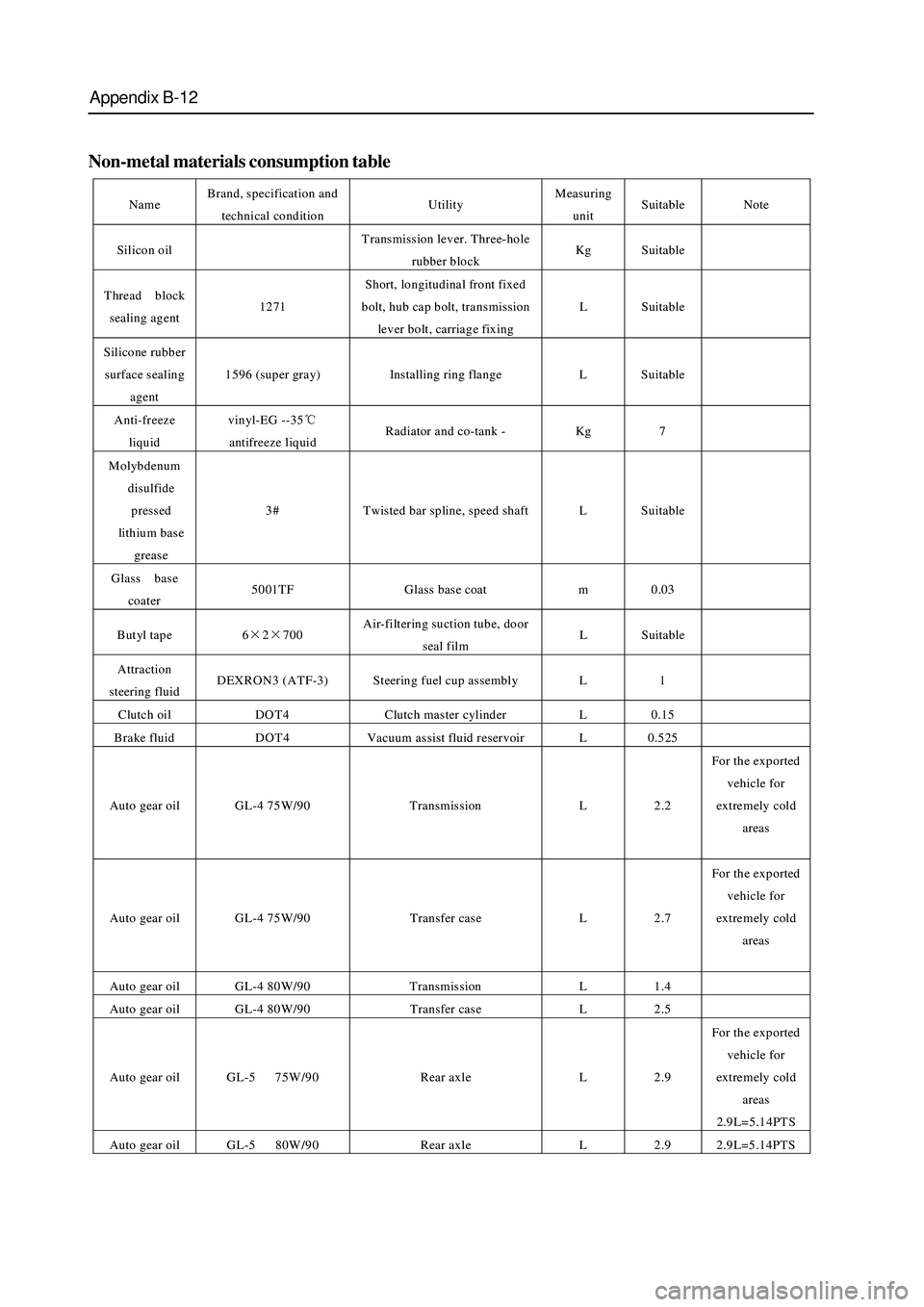
Appendix B-12
Non-metal materials consumption table
Name Brand, specification and
technical condition Utility Measuring
unit Suitable Note
Silicon oil Transmission lever. Three-hole
rubber block Kg Suitable
Thread block
sealing agent 1271 Short, longitudinal front fixed
bolt, hub cap bolt, transmission
lever bolt, carriage fixing L Suitable
Silicone rubber
surface sealing
agent 1596 (super gray) Installing ring flange L Suitable
Anti-freeze
liquid vinyl-EG --35℃
antifreeze liquid Radiator and co-tank - Kg 7
Molybdenum
disulfide
pressed
lithium base
grease 3# Twisted bar spline, speed shaft L Suitable
Glass base
coat er 5001TF Glass base coat m 0.03
Butyl tape 6×2×700 Air-filtering suction tube, door
seal film L Suitable
Attraction
steering fluid DEXRON3 (ATF-3) Steering fuel cup assembly L 1
Clutch oil DOT4 Clutch master cylinder L 0.15
Brake fluid DOT4 Vacuum assist fluid reservoir L 0.525
Auto gear oil GL-4 75W/90 Transmission L 2.2 For the exported
vehicle for
extremely cold
areas
Auto gear oil GL-4 75W/90 Transfer case L 2.7 For the exported
vehicle for
extremely cold
areas
Auto gear oil GL-4 80W/90 Transmission L 1.4
Auto gear oil GL-4 80W/90 Transfer case L 2.5
Auto gear oil GL-5 75W/90 Rear axle L 2.9 For the exported
vehicle for
extremely cold
areas
2.9L=5.14PTS
Auto gear oil GL-5 80W/90 Rear axle L 2.9 2.9L=5.14PTS