clutch GREAT WALL HOVER 2006 Service Service Manual
[x] Cancel search | Manufacturer: GREAT WALL, Model Year: 2006, Model line: HOVER, Model: GREAT WALL HOVER 2006Pages: 425, PDF Size: 26.05 MB
Page 111 of 425
Automatic transmission-35
Power transmission automatic 2nd-Gear and manual 2
In automatic 1st and manual 2nd-Gear, the drive of transmission reaches the front clutch cylinder through the input shaft. In this
condition, the operating principle of each functional unit of transmission is shown as follows:
The engagement of clutch C2 drives the forward central gear.
The forward central gear drives the short planetary gear to rotate in anticlockwise.
The short planetary gear drives the long planetary gear to rotate clockwise.
The engagement of brake belt B1 makes the stop of reverse central gear to make the long planetary gear rotates around the
reverse central gear, then make the internal gear and output shaft rotates in clockwise to make the vehicle moves forwardly.
The clutch C4 is engaged through the 3-4 one-way clutch (OWC) and provides the brake force of engine during overspeed.
Control:
In stable status, the status action of solenoid valve and valve is shown as follows:
The solenoid valve S1 is powered off ; The solenoid valve S2 is powered on.
The drive oil (line pressure) from the manual-operated valve makes the engagement of clutch C2.
When the solenoid valve S1 is powered off, the S1 oil pressure form line pressure 500 pushes the 3-4 Gear shifting valve
moves to left. At the same time, the S1 oil flows into the 1-2 Gear shifting valve to push the 1-2 Gear shifting valve to the
2
nd –Gear.
The line pressure oil from the 1-2 Gear shifting valve flows into the brake belt combination regulating valve, and 2-3 Gar
shifting valve.
The brake belt engagement regulator valve provides the 2nd-Gear oil (controlled by product of line pressure and valve rate)
to brake belt feed loop (BAF).
The brake belt engagement feed loop directly provides the oil to:
External engagement part of front servo piston.
1-2 Gear shifting valve can provide a oil drainage port when the transmission is shifted to 1st-Gear.
Use the 3-4 Gear shifting valve when the transmission is in 4
th-Gear position.
The drive force (line pressure) is sent to the clutch C4 through the 3-4 Gear shifting valve to realize the engagement of
clutch C4.
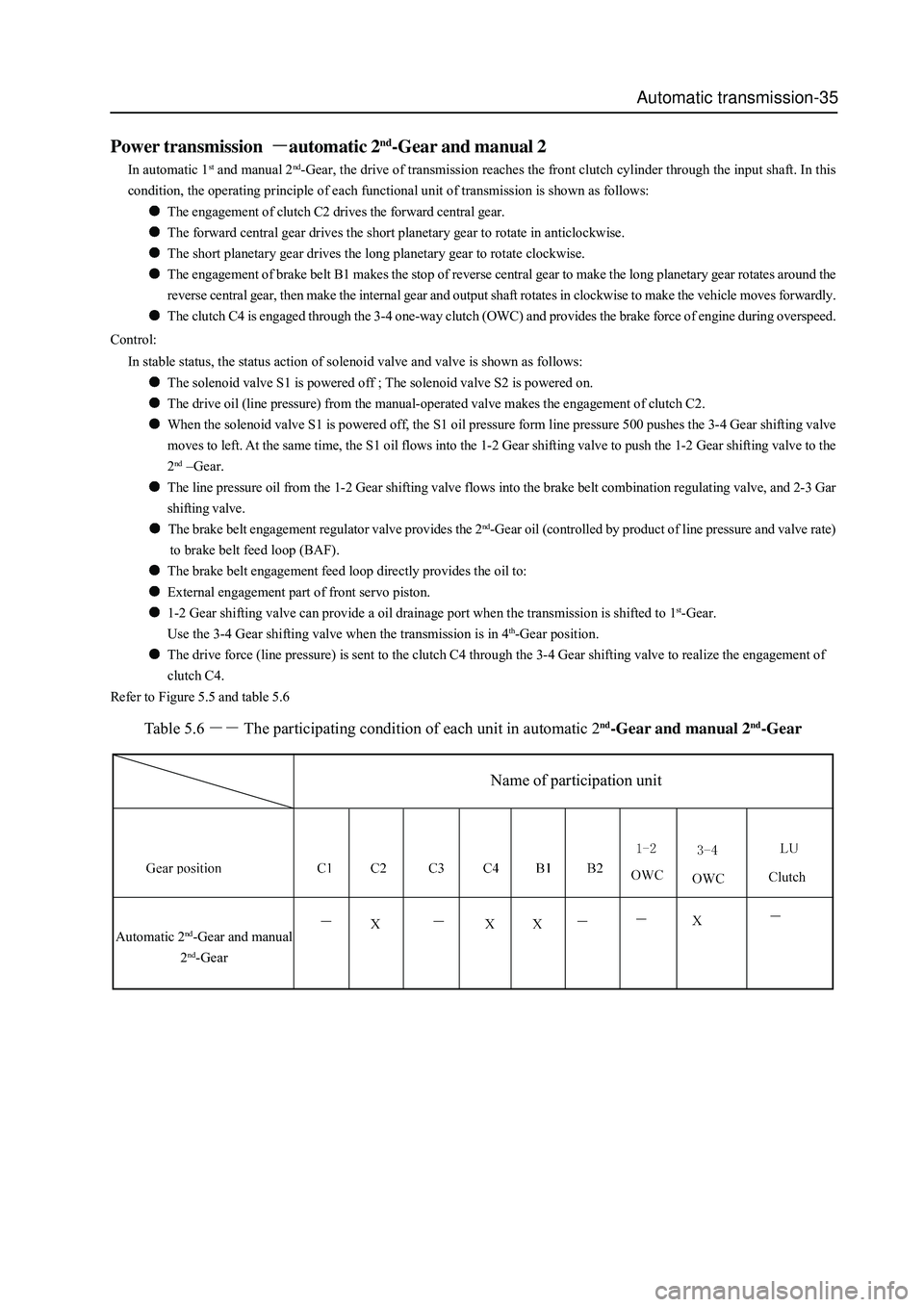
Refer to Figure 5.5 and table 5.6
Table 5.6The participating condition of each unit in automatic 2nd-Gear and manual 2nd-Gear
Automatic 2nd-Gear and manual
2
nd-Gear
Name of participation unit
Page 113 of 425
Automatic transmission-37
power transmission Automatic 3rd-Gear and manual 3rd-Gear
In automatic and manual 3rd-Gear, the drive of transmission reaches the front cylinder through the input shaft. In this condition,
the operating principle of the transmission is shown as follows:
The engagement of clutch C2 drives the front sun gear
The engagement of clutch C1 drives the planetary gear carrier
The forward central gear and planetary gear carrier rotate in the same speed clockwise. So, there is not relative motion
between the forward central gear and planetary gear.
The gear ring and output shaft rotate in the speed of output shaft, and makes the moves forwardly.
The engagement of clutch C4 is through the 3-4 one-way clutch (OWC) and make the engine to provide the brake force
in overspeed.
Control:
In stable status, the status of solenoid valve and valve is shown as follows:
The solenoid valve S1 is powered off; Solenoid valve S2 is powered off
When the solenoid valve S1 and S2 is powered off, 2-3 and 3-4 shift valve are kept in 3rd-Gear position through the line
pressure 500.
1-2 Gear shifting valve is kept in 3rd-Gear position by the oil pressure of S1 and S2.
The (line pressure)oil form the 1-2 Gear shifting valve flows into the brake belt combination regulating valve directly and
flows into the 2-3 Gear shifting valve.
The brake belt combination regulating valve provides the 2nd-Gear oil (controlled by the product of line pressure and valve)
to the brake belt feed loop(BAF).
The brake belt feed loop directly provides the oil to:
External combination part of front servo
When the transmission is shifted to 1st-Gear, the 1-2 Gear shifting valve provides the oil drainage port.
When the transmission is in 4th –Gear position, it will use the 3-4 Gear shifting valve.
The 2nd-Gear oil of 2-3 Gear shifting valve flows into the 3rd-gear loop directly .
The 3rd-Gear oil from the 2-3 Gear shifting valve flows into the clutch combination regulating valve and sequence valve of
4-3 Gear directly.
The clutch combination regulating valve provides the oil of clutch attachment feed loop (controlled by the product of line
pressure of 500 and valve ratio) (CAF).
CAF directly provides the oil to :
clutch C1
Sequence valve of 4-3 Gear
In 4-3 Gear shifting valve, the CAF oil is changed to the release fluid of B1 (B1R-F), it cause the closing of brake belt 1
through the 3-4 Gear shifting valve to spring bottom of 4-3 gear sequence valve and release side of front servo.
The drive force (line pressure ) is sent to the clutch C4 through the 3-4 Gear shifting valve to engage the clutch C4 .
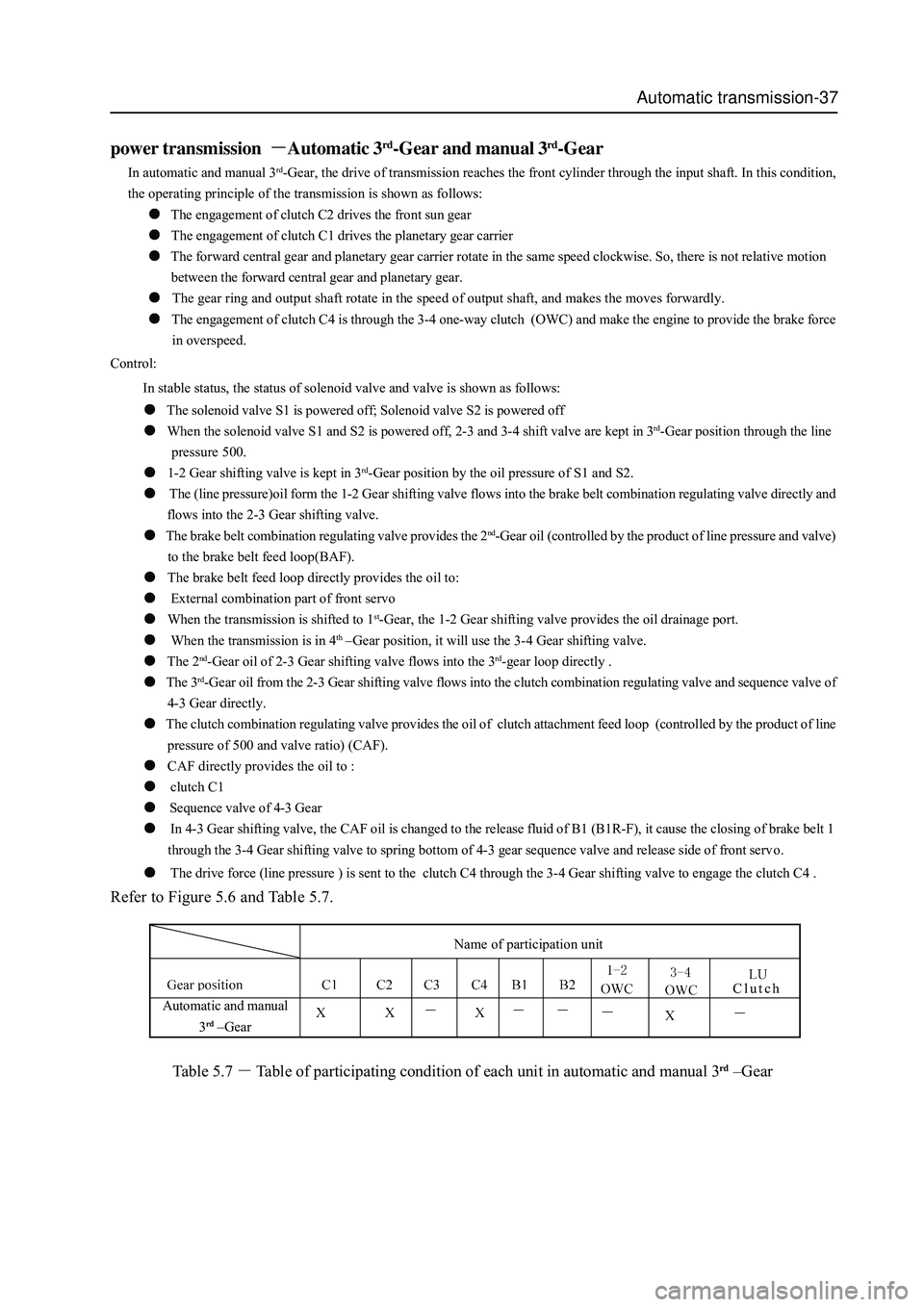
Refer to Figure 5.6 and Table 5.7.
Table 5.7
Table of participating condition of each unit in automatic and manual 3rd –Gear
Clutch
Name of participation unit
Automatic and manual
3
rd –Gear
Page 115 of 425
Automatic transmission-39
Power transmission locking of automatic and manual 3rd-Gear
When the automatic 3rd-Gear and manual 3rd-Gear is locked, the drive of transmission is basically same as that in automatic 3rd-
Gear. But it provide the variable torque drive without slide for the application of torque converter locking clutch.
Control:
The control for the automatic 3
rd-Gear locking and manual 3rd-Gear locking is basically same as that for automatic 3rd –Gear. But
it should be described additionally that the automatic 3
rd-Gear and manual 3rd-gear locking needs the action for variable torque
clutch loop by solenoid valve S7.
When the solenoid valve S7 is opened, the variable torque clutch control valve is closed and allow the oil feed of S7 loop pass
through the solenoid valve S7 to drainage port. It makes the control valve moves to the clutch combination position.
The loop oil from the line 500 flows into the combination part of variable torque clutch through the converter clutch control
valve through the action of variable torque clutch control valve.
The variable torque clutch release oil is drained from the variable torque clutch control valve.
The torque converter loop oil flows into the oil cooler and lubrication loop through the variable clutch control valve.
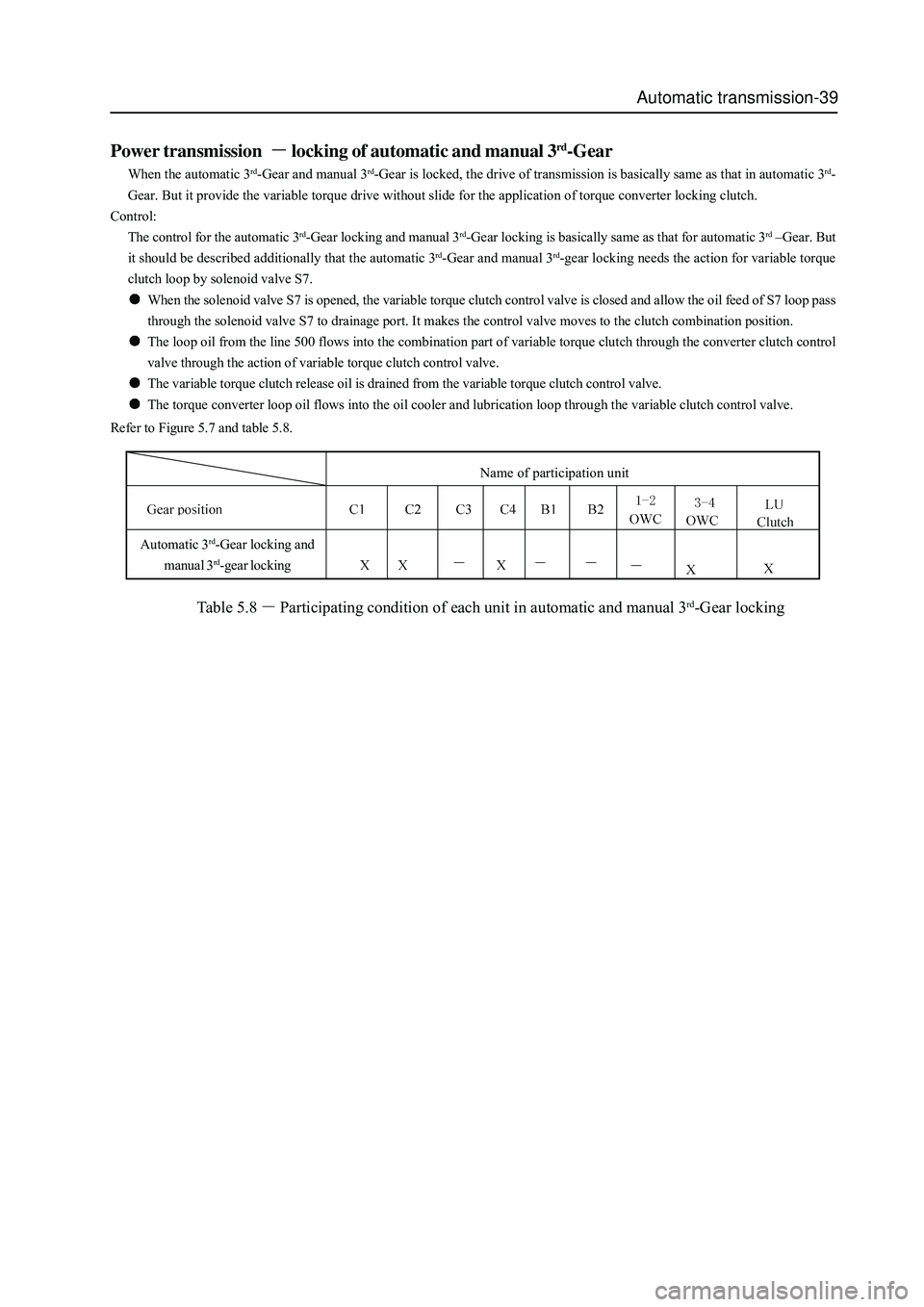
Refer to Figure 5.7 and table 5.8.
Table 5.8Participating condition of each unit in automatic and manual 3rd-Gear locking
Automatic 3rd-Gear locking and
manual 3
rd-gear locking
Name of participation unit
Page 117 of 425
Automatic transmission-41
In automatic 4th-Gear (overspeed gear), the drive of transmission is sent to the front clutch cylinder through the input shaft. The
operation principle of each function assembly of transmission is shown as follows:
The engagement of clutch C1 drives the planetary gear carrier rotates in clockwise rotation.
The engagement of B1 brake belt makes the reverse sun gear to stop.
When the planetary gear carrier rotates, the long planetary gear rotates around the static reverse sun gear, at the same time, it
rotates around its axial line to drive the gear ring and output shaft to generate the forward movement in the speed higher than
that of input shaft (i.e. overspeed) clockwise.
The forward central gear rotates in the speed higher than input shaft and is more than the speed when 3-4 one-way clutch
(OWC) is engaged.
The engagement of clutch C2 is used to reduce the speed difference generated by 3-4 one-way clutch (OWC).
Control:
In the stable status, the status of solenoid valve and valve is shown as follows:
The solenoid valve S1 is powered on ; S2 is powered off.
When the solenoid valve S1 is powered on, the small end of 3-4 shift valve is in 4th-Gear position for the pressure of line 500.
When the solenoid valve S2 is powered off, the large opening of 2-3 shifting valve is in 4th- Gear position for the pressure of
line 500.
The 1-2 Gear shifting valve is kept in 4th-Gear position for the pressure of S2 oil loop.
The 2nd-Gear loop oil (line pressure) from the 1-2 shift valve flows into the brake belt combination regulating valve and 2-3
shift valve directly.
The brake belt combination regulating valve provides the 2nd-Gear loop oil for the brake belt attachment loop (BAF) (adjusted
by product of line pressure and valve ratio)
The brake belt combination lip oil is directly supplied to:
External combination part of front servo
Enter into the internal combination part of front servo piston through 3-4 shift valve
The 1st-Gear-2 switch valve provides a oil-drain port when the transmission is switched to 1st-Gear.
The 2nd-Gear loop oil in 2-3shift valve flows into the 3rd-Gear loop directly.
The 3rd-Gear loop oil from the 2-3 shift valve flows into the clutch combination regulating valve and 4th-Gear-3 sequence
valve directly
The clutch combination regulator valve supplies the oil for the clutch combination loop (CAF) (Regulated by the product of
line pressure and valve rate)
CAF oil is directly supplied to:
clutch C1
4th-Gear-3 sequence valve
The drive oil(line pressure) form the manual-operated valve forces the engagement of clutch C2
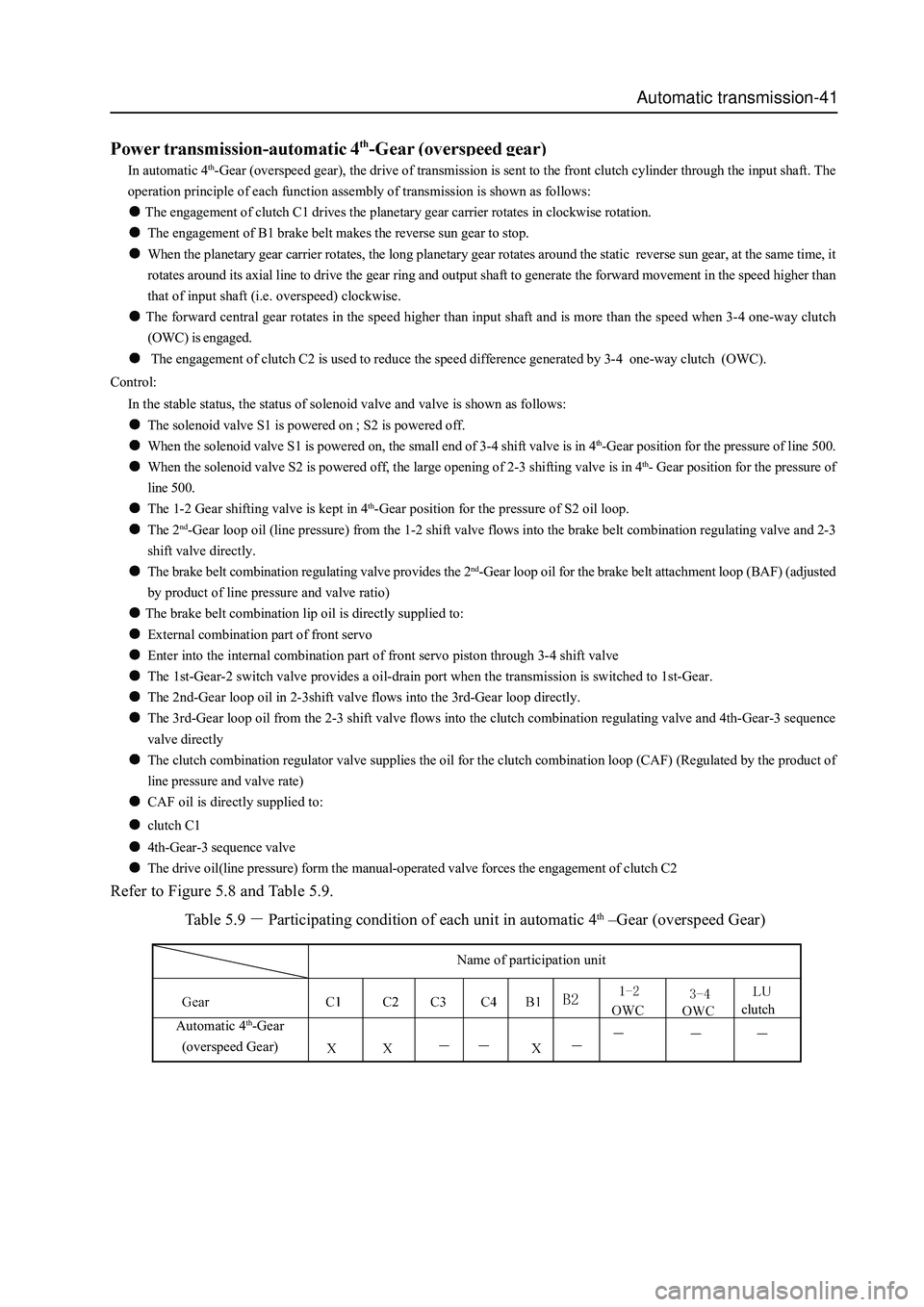
Refer to Figure 5.8 and Table 5.9.
Table 5.9
Participating condition of each unit in automatic 4th –Gear (overspeed Gear)
clutch
Name of participation unit
Automatic 4
th-Gear
(overspeed Gear)
Page 119 of 425
Automatic transmission-43
Power transmissionAutomatic 4th-Gear locking
In automatic 4th –gear locking, the drive of transmission is same as that in automatic 4th –gear basically. But for the application of
variable torque locking clutch, it provides the variable torque drive without slide.
Control:
The automatic 4th –Gear locking is same as that in automatic 4th-Gear basically. But it should be described that when the automatic
4
th-Gear is locked, it has the action for variable torque loop by solenoid valve S7.
When the solenoid valve S7 is opened, the variable torque clutch control valve is closed and allow the S7 loop oil flows to the
drainage port through the solenoid valve S7, then control the valve to move to the clutch engagement position.
The line pressure loop regulating oil from the torque converter clutch regulating valve flows into the combination side of torque
converter clutch directly.
The release oil of torque converter clutch is drained from the control valve of torque converter clutch..
The torque converter loop oil flows into the oil cooler and lubrication loop directly through the control valve of torque
converter clutch..
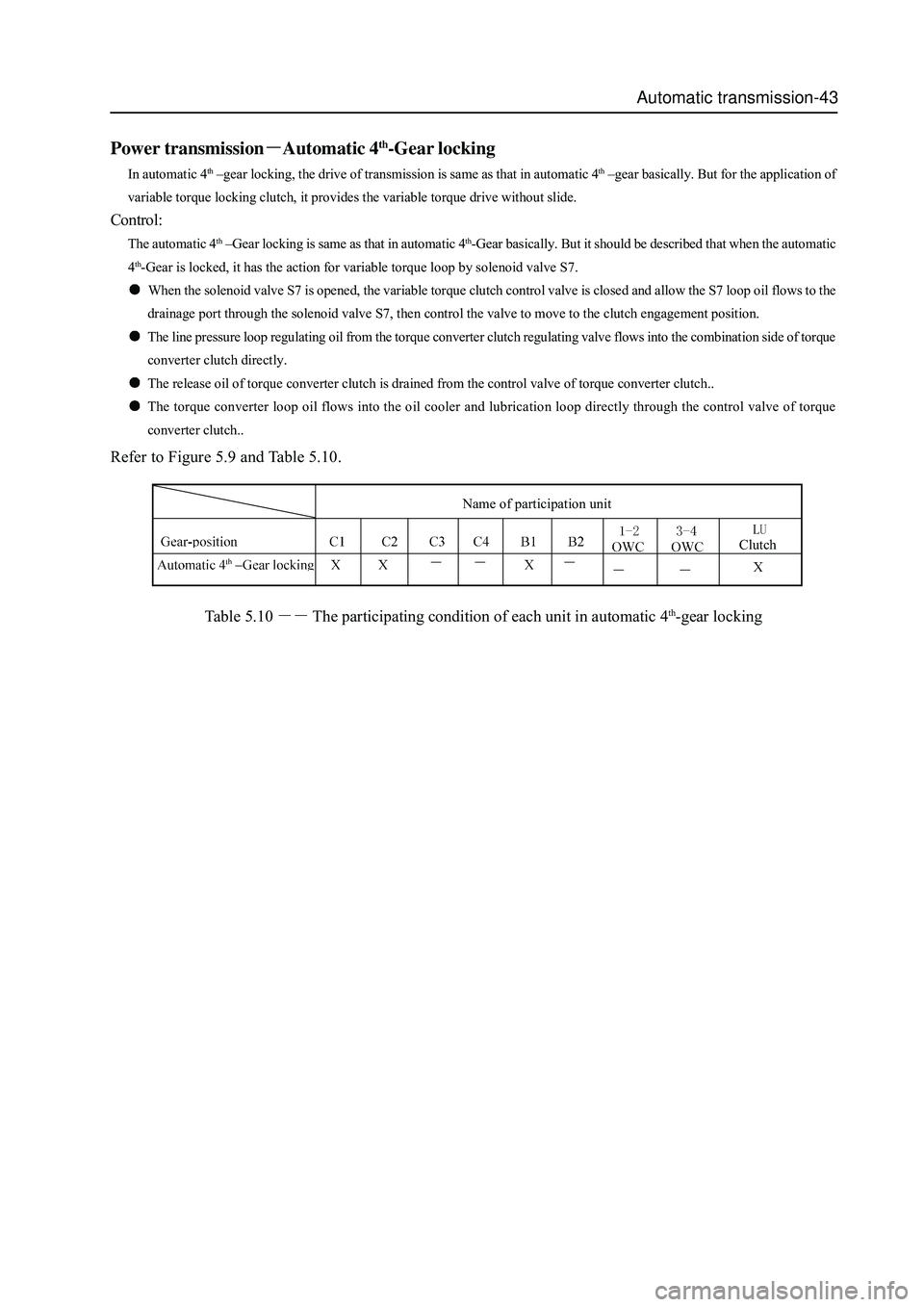
Refer to Figure 5.9 and Table 5.10.
Table 5.10
The participating condition of each unit in automatic 4th-gear locking
Clutch
Name of participation unit
Page 123 of 425
Automatic transmission-47
4. Operating mode of transmission
TCU realizes the effective control for the transmission according to the accurate information acquired form the input data and
complete control for the output data. To ensure the input and output of TCU is actual and effective, TCU executes the data sense
command for hardware and software. For the failure information found in the following operating mode described in detail, TCU
will give the corresponding response.
Similarly, it exists the possibility that could not find out the failure cause. If encounter the condition, the operation for transmis
sion is determined difficultly.
Following condition will effect the operation of transmission, but will not appear the detection failure information.
a. Power supply failure
The transmission adopts the 3-Gear lame Home Mode (LHM) irrelevant to car speed.
If occur the intermittent power supply, then TCU will start form 4-Gear and is switched to the proper gear to meet the
requirement of current work. At this time, it will not monitor the power supply status.
b. The transmission fluid temperature is higher than 135
If found the transmission temperature is high:
The torque converter lock clutch will start in low speed and the car will have the vibration.
Some cars will have the condition that the mode indicator lamp is flash.
The reason for the condition may be the transmission fluid temperature is high or acquire the inaccurate single form the
temperature sensor. If occurs the temperature failure, it may find the high temperature operating condition.
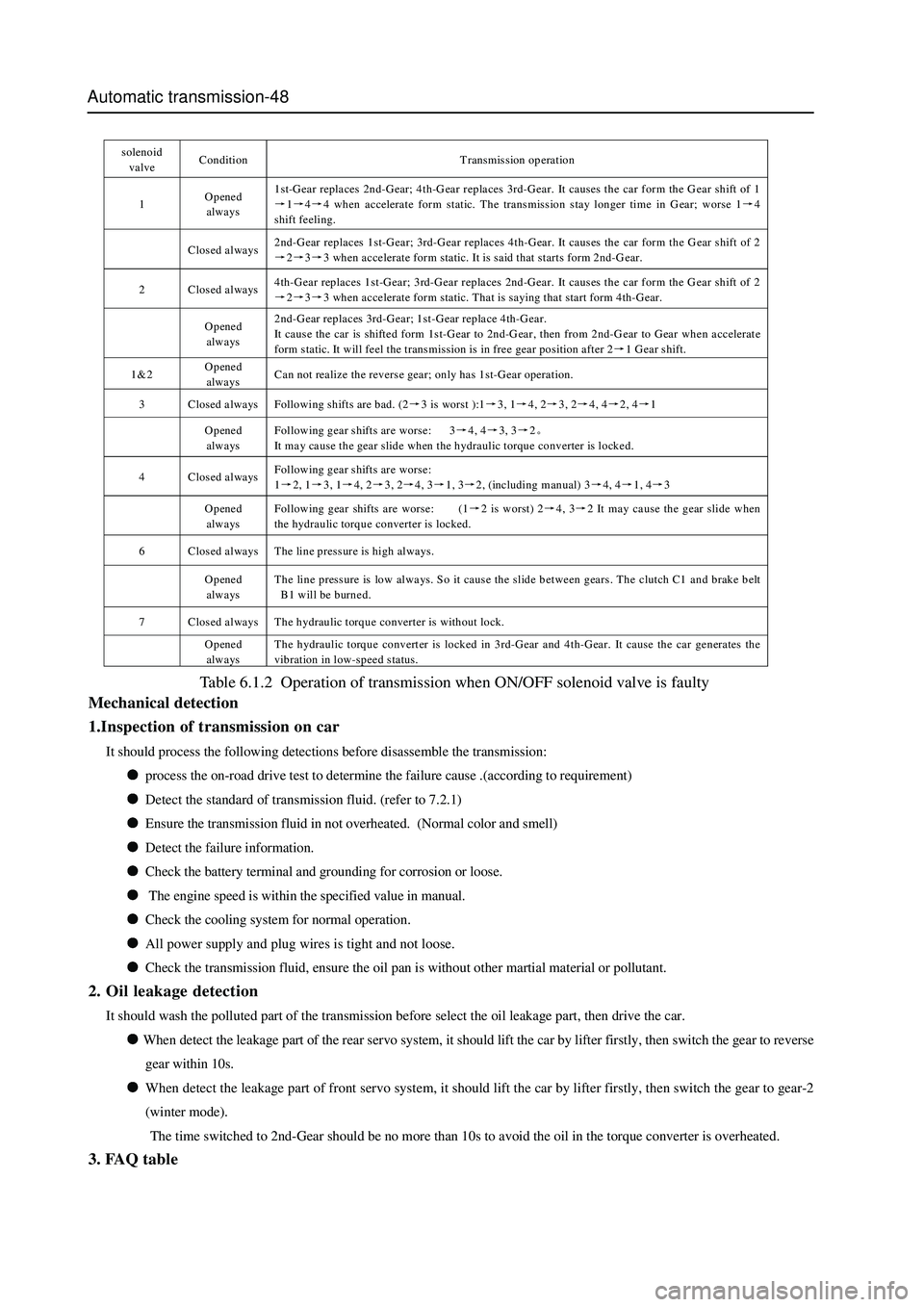
c. Failure of ON/OFF solenoid valve
If one of the solenoid valves has the mechanical failure, TCU will not find the failure. At this time, the failure operation of
transmission will be determined according to the solenoid valve with failure. The characteristic of different solenoid valve failure
is listed in Table 6.1.2.
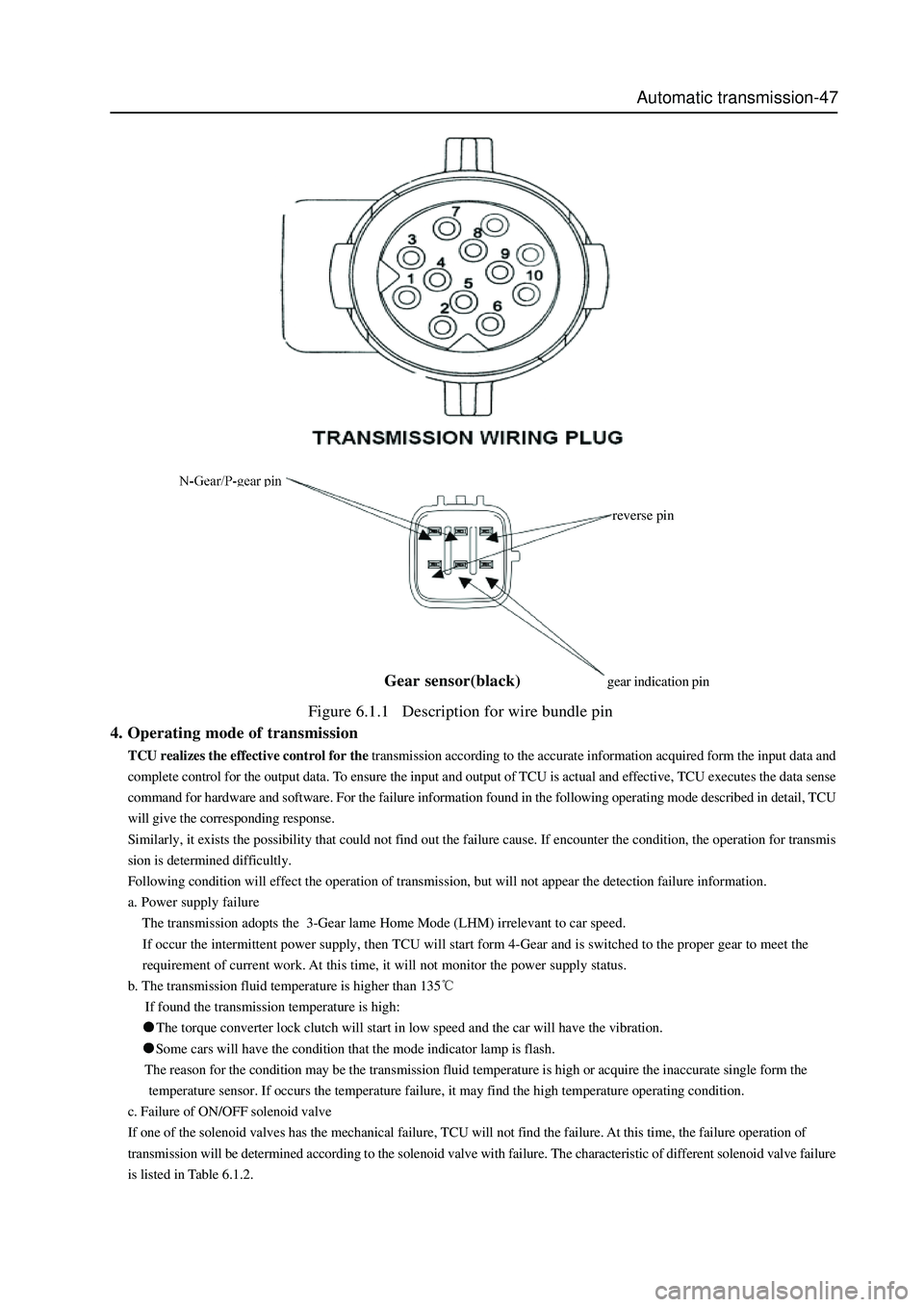
reverse pin
gear indication pin
Gear sensor(black)
Figure 6.1.1 Description for wire bundle pin
Page 124 of 425
Automatic transmission-48
s oleno id
valve Condition Transmission operation
1 Opened
always 1st-Gear replaces 2nd-Gear; 4th-Gear replaces 3rd-Gear. It causes the car form the G ear shift of 1
→1→4→4 when accelerate form static. The transmission stay longer time in Gear; worse 1→4
shift feeling.
Closed always 2nd-Gear replaces 1st-Gear; 3rd-Gear replaces 4th-Gear. It causes the car form the G ear shift of 2
→2→3→3 when accelerate form static. It is said that starts form 2nd-Gear.
2 Closed always 4th-Gear replaces 1st-Gear; 3rd-Gear replaces 2nd-Gear. It causes the car form the G ear shift of 2
→2→3→3 when accelerate form static. That is saying that start form 4th-Gear.
Opened
always 2nd-Gear replaces 3rd-Gear; 1st-Gear replace 4th-Gear.
It cause the car is shifted form 1st-Gear to 2nd-Gear, then from 2nd-G ear to Gear when accelerate
form static. It will feel the transmission is in free gear position after 2→1 Gear shift.
1&2 Opened
always Can not realize the reverse gear; only has 1st-Gear operation.
3 Closed always Following shifts are bad. (2→3 is worst ):1→3, 1→4, 2→3, 2→4, 4→2, 4→1
Opened
always Following gear shifts are worse: 3→4, 4→3, 3→2。
It may cause the gear slide when the hydraulic torque converter is locked.
4 Closed always Following gear shifts are worse:
1→2, 1→3, 1→4, 2→3, 2→4, 3→1, 3→2, (including manual) 3→4, 4→1, 4→3
Opened
always Following gear shifts are worse: (1→2 is worst) 2→4, 3→2 It may cause the gear slide when
the hydraulic torque converter is locked.
6 Closed always The line pressure is high always.
Opened
always The line pressure is low always. So it cause the slide between gears. The clutch C1 and brake belt
B1 will be burned.
7 Closed always The hydraulic torque converter is without lock.
Opened
always The hydraulic torque converter is locked in 3rd-Gear and 4th-Gear. It cause the car generates the
vibration in low-speed status.
Table 6.1.2 Operation of transmission when ON/OFF solenoid valve is faulty
Mechanical detection
1.Inspection of transmission on car
It should process the following detections before disassemble the transmission:
process the on-road drive test to determine the failure cause .(according to requirement)
Detect the standard of transmission fluid. (refer to 7.2.1)
Ensure the transmission fluid in not overheated. (Normal color and smell)
Detect the failure information.
Check the battery terminal and grounding for corrosion or loose.
The engine speed is within the specified value in manual.
Check the cooling system for normal operation.
All power supply and plug wires is tight and not loose.
Check the transmission fluid, ensure the oil pan is without other martial material or pollutant.
2. Oil leakage detection
It should wash the polluted part of the transmission before select the oil leakage part, then drive the car.
When detect the leakage part of the rear servo system, it should lift the car by lifter firstly, then switch the gear to reverse
gear within 10s.
When detect the leakage part of front servo system, it should lift the car by lifter firstly, then switch the gear to gear-2
(winter mode).
The time switched to 2nd-Gear should be no more than 10s to avoid the oil in the torque converter is overheated.
3. FAQ table
Page 125 of 425
Automatic transmission-49
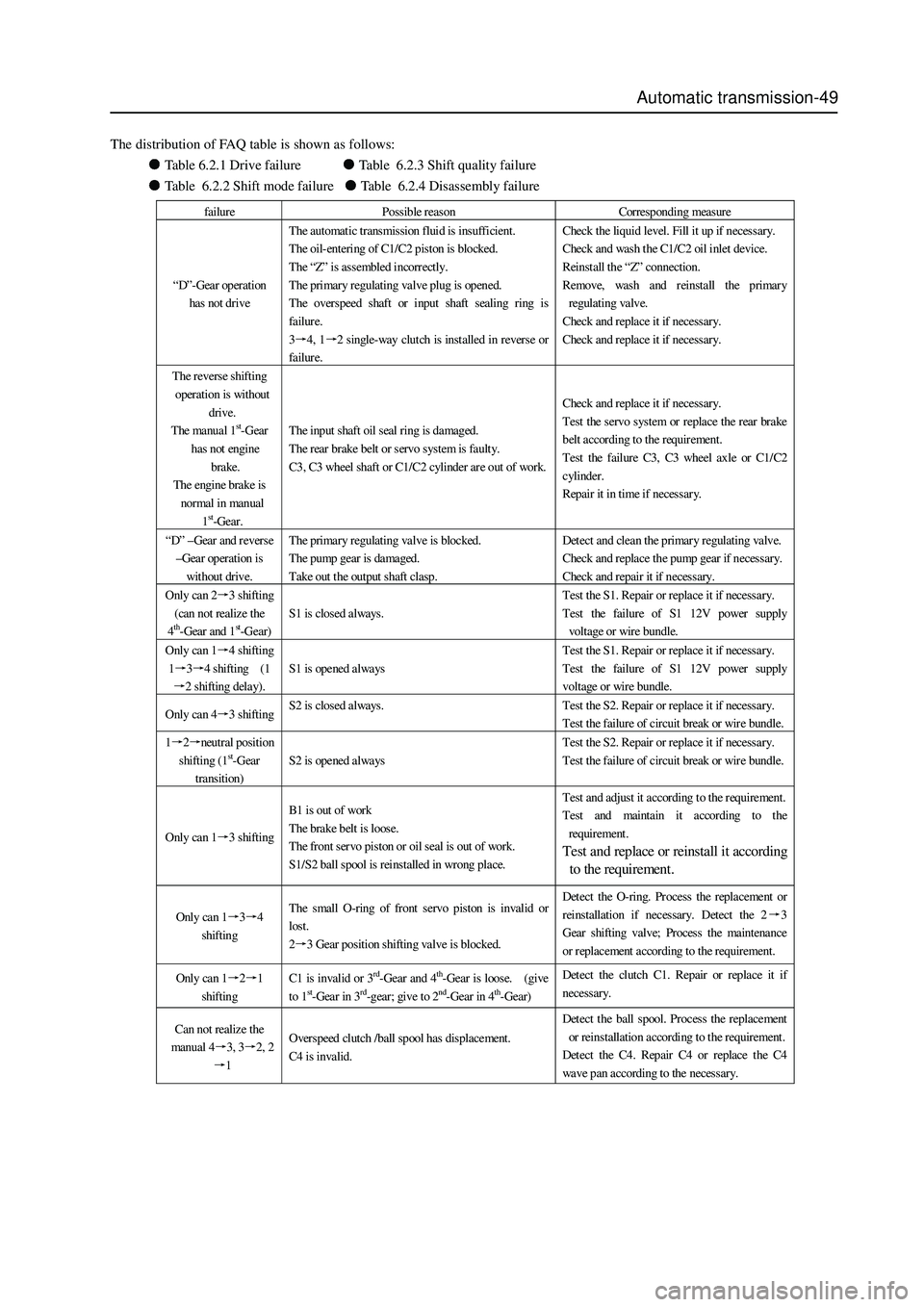
The distribution of FAQ table is shown as follows:
Table 6.2.1 Drive failure Table 6.2.3 Shift quality failure
Table 6.2.2 Shift mode failure Table 6.2.4 Disassembly failure
failure Possible reason Corresponding measure
“D”-Gear operation
has not drive The automatic transmission fluid is insufficient.
The oil-entering of C1/C2 piston is blocked.
The “Z” is assembled incorrectly.
The primary regulating valve plug is opened.
The overspeed shaft or input shaft sealing ring is
failure.
3→4, 1→2 single-way clut ch is installed in revers e or
failure. Check the liquid level. Fill it up if necessary.
Check and wash the C1/C2 oil inlet device.
Reinstall the “Z” connection.
Remove, wash and reinstall the primary
regulating valve.
Check and replace it if necessary.
Check and replace it if necessary.
The reverse shifting
operation is without
drive.
The manual 1
st-Gear
has not engine
brake.
The engine brake is
normal in manual
1
st-Gear. The input shaft oil seal ring is damaged.
The rear brake belt or servo system is faulty.
C3, C3 wheel shaft or C1/C2 cylinder are out of work. Check and replace it if necessary.
Test the servo system or replace the rear brake
belt according to the requirement.
Test the failure C3, C3 wheel axle or C1/C2
cylinder.
Repair it in time if necessary.
“D” –Gear and reverse
–Gear operation is
without drive. The primary regulating valve is blocked.
The pump gear is damaged.
Take out the output shaft clasp. Det ect and clean the primary regulating valve.
Check and replace the pump gear if necessary.
Check and repair it if necessary.
Only can 2→3 shifting
(can not realize the
4
th-Gear and 1st-Gear) S1 is closed always. Test the S1. Repair or replace it if necessary.
Test the failure of S1 12V power supply
voltage or wire bundle.
Only can 1→4 shifting
1→3→4 shifting (1
→2 shifting delay). S1 is opened always Test the S1. Repair or replace it if necessary.
Test the failure of S1 12V power supply
voltage or wire bundle.
Only can 4→3 shifting S2 is closed always.
Test the S2. Repair or replace it if necessary.
Test the failure of circuit break or wire bundle.
1→2→neutral position
shifting (1st-Gear
transition) S2 is opened always Test the S2. Repair or replace it if necessary.
Test the failure of circuit break or wire bundle.
Only can 1→3 shifting B1 is out of work
The brake belt is loose.
The front servo piston or oil s eal is out of work.
S1/S2 ball spool is reinstalled in wrong place. Test and adjust it according to the requirement.
Test and maintain it according to the
requirement. Test and replace or reinstall it according
to the requirement.
Only can 1→3→4
shifting The small O-ring of front s ervo piston is invalid or
lost.
2→3 Gear position shifting valve is blocked. Det ect the O-ring. Process the replacement or
reinstallation if necessary. Detect the 2→3
Gear shifting valve; Process the maintenance
or replacement according to the requirement.
Only can 1→2→1
shifting C1 is invalid or 3rd-Gear and 4th-Gear is loose. (give
to 1st-Gear in 3rd-gear; give to 2nd-Gear in 4th-Gear) Det ect the clutch C1. Repair or replace it if
necessary.
Can not realize the
man ual 4→3, 3→2, 2
→1 Overspeed clutch /ball spool has displacement.
C4 is invalid. Detect the ball spool. Process the replacement
or reinstallation according to the requirement.
Det ect the C4. Repair C4 or r eplace the C4
wave pan according to the necessary.
Page 126 of 425
Automatic transmission-50
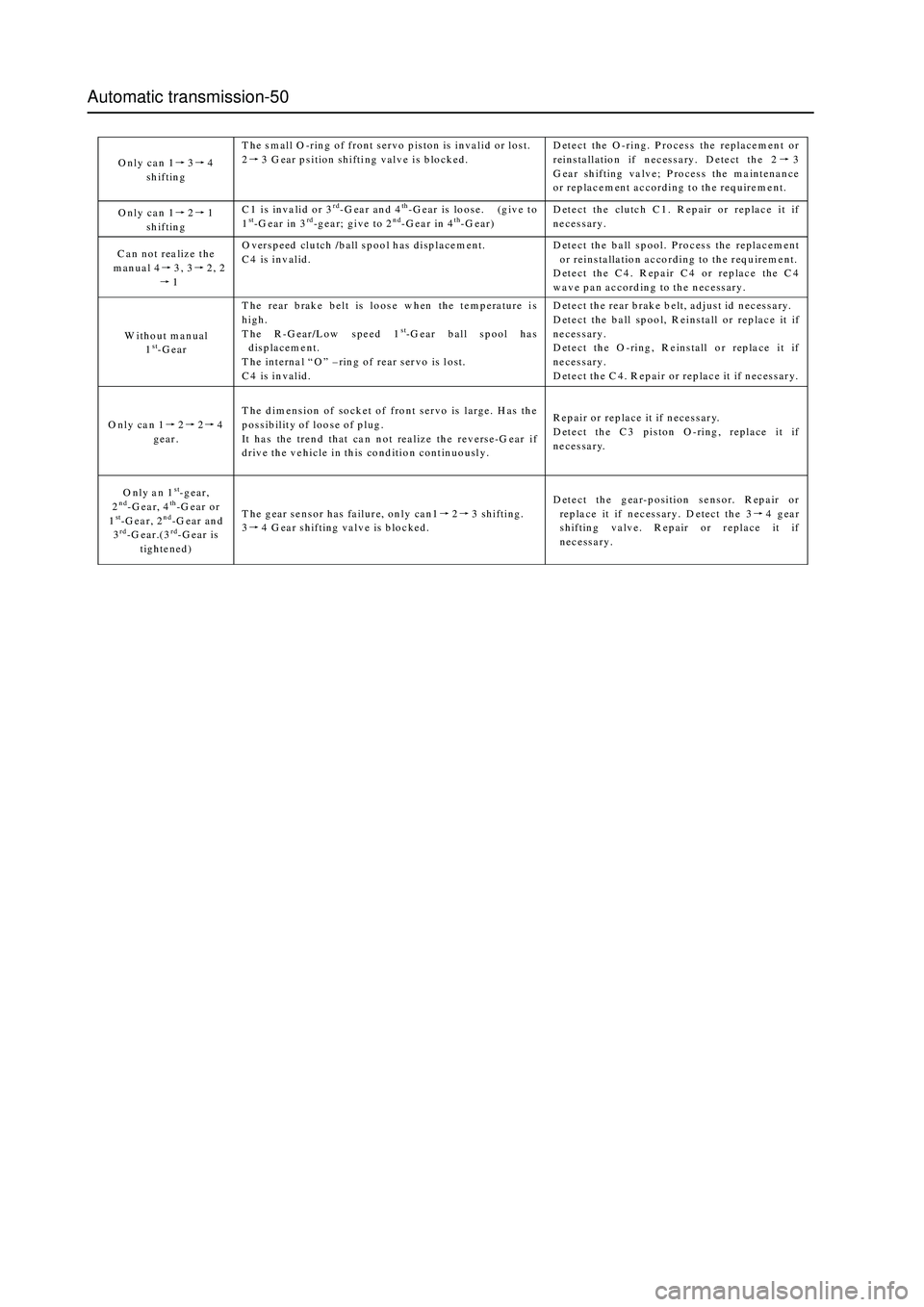
Only can 1→3→4
shifting The sm all O -ring of front servo piston is invalid or lost.
2→3 G ear psition shifting valve is blocked. D etect the O -ring. P rocess the replacem ent or
reinstallatio n if n ecessary. D etect th e 2→3
G ear shifting valve; Process the maintenance
or replacem ent according to the requirem ent.
Only can 1→2→1
shifting C1 is invalid or 3rd-G ear and 4th- G ea r is lo o s e . (g iv e t o
1st-G ear in 3rd-gear; give to 2nd-G ear in 4th-G ear) D etect th e clutch C 1 . R ep air or rep la ce it if
necessary.
Can not realize the
manual 4→3, 3→2, 2
→1 O verspeed clutch /ball spool has displacem ent.
C4 is invalid. D etect the ball spool. Process the replacem ent
or reinstallation according to the req uirem ent.
D etect the C4. R epair C4 or replace the C 4
wave pan according to the necessary.
W itho ut m an ual
1st-G ear The rear brake belt is loose when the tem perature is
high.
The R -G ear/Low speed 1
st-G ear ball spool has
displacem ent.
The internal “O ” –ring of rear servo is lost.
C4 is invalid. D etect the rear brake b elt, adjust id necessary.
D et e ct t h e b a ll sp o o l, R ein s ta ll o r r ep la c e it if
necessary.
D etect the O -ring, R einstall or replace it if
necessary.
D et e ct th e C 4 . R ep a ir o r r ep la c e it if n e c ess a r y.
Only can 1→2→2→4
gear. The dim ension of socket of front servo is large. H as the
possibility of loose of plug.
It has the trend that ca n n ot realize th e reverse-G ear if
drive the vehicle in this condition continuously. Repair or replace it if necessary.
Detect the C3 piston O -ring, replace it if
necessary.
Only an 1st-gear,
2nd-G ear, 4th-G ear or
1st-G ear, 2nd-G ear an d
3rd-G ear.(3rd-G ear is
tightened) The gear sensor has failure, only can1→2→3 shifting.
3→4 Gear shifting valve is blocked. D etect the gear-position sensor. R epair or
replace it if necessary. D etect the 3→4 gear
shiftin g va lv e. R ep air or r ep la ce it if
necessary.
Page 127 of 425

Automatic transmission-51
Table 6.2.3Shifting quality failure
Bad 1→2 Gear
shifting quality The throttle position sensor has failure.
T he brake b elt is adjusted incorrectly.
The front servo piston O-ring is damaged.
The variable pressure solenoid valve (S5) is damaged or
has failure.
S1, S4 has the failure.
The brake belt combination regulating valve (BAR) has
the failur e.
The front servo release spring is installed incorrectly. Detect the resistance, replace the sensor if
necessary.
Detect and replace the rake belt if necessary.
Detect and r epla ce the O -ring if necessary.
Detect, repair or repla ce the S5 if necessary.
Detect, repair or repla ce the S1, S4 if
necessary.
Detect, repair or repla ce the B AR if
necessary.
Detect and repair it if necessary.
Bad 2→3 Gear
shifting quality B1brake belt release valve is blocked.
S3, S2 has the failure.
The clutch combination regulating valve has failure.
The clutch combination oil feed ball spool is lost or
damaged.
The input shaft oil seal is damaged.
C1 piston O-ring is damaged.
C1 piston oil feed ball spool is damaged. Detect the blow-off valve. Replace or
maintain it if necessary.
Detect the S3, S2.Replace or maintain it if
necessary.
Detect the r egulating valve. R eplace or
maintain it if necessary.
Detect the ball spool .Reinstall or replace it if
necessary.
Detect the sealing ring. Reinstall or replace it
if necessary.
Detect the O -ring .R einstall or replace it if
necessary.
Detect the ball spool .Reinstall or replace it if
necessary.
Bad 3→4 Gear
shifting quality S1, S4 has failure.
B1brake belt release valve is blocked.
T he brake b elt is adjusted incorrectly.
The front servo piston O-ring is damaged.
The variable pressure solenoid valve (S5) is damaged or
has failure.
The brake belt combination regulating valve has failure. Detect the S1, S4.R einstall or replace it if
necessary.
Detect the blow-off valve. Replace or repair
it if necessary.
Detect the brake belt. Adjust it if necessary.
Detect the O -ring .R eplace or maintain it if
necessary.
Detect the S5.R epla ce or maintain it if
necessary.
Detect the r egulating valve. R eplace or
maintain it if necessary.
The engine has
the
extinguishing
co nd itio n
when select
the automatic
gear or R-gear. The torque converter clutch control valve is blocked or
solenoid valve 7 has failure. Detect and clean the torque converter clutch
valve (CCCV)
Has unstable
vibration
co nd itio n. S7 has the failure. Process the necessary detection, maintenance
and replacement according to the
requirem ent.