ECO mode HONDA ACCORD 2001 CF / 6.G Owners Manual
[x] Cancel search | Manufacturer: HONDA, Model Year: 2001, Model line: ACCORD, Model: HONDA ACCORD 2001 CF / 6.GPages: 355, PDF Size: 6 MB
Page 5 of 355

Excessive speed is a major f actor in
crash injuries and deaths. Generally,
the higher the speed the greater the
risk, but serious accidents can also
occur at lower speeds. Never drive
f aster than is saf e f or current
conditions, regardless of the
maximum speed posted.
While airbags can save lives, they
can cause serious or fatal injuries to
occupants who sit too close to them,
or are not properly restrained.
Inf ants, young children, and short
adults are at the greatest risk. Be
sure to f ollow all instructions and
warnings in this manual. (See page
.)
Children are saf est when they are
properly restrained in the back seat,
notthefrontseat.Achildwhoistoo
smallforaseatbeltmustbeproperly
restrained in a child saf ety seat. (See
page .) Having a tire blowout or a
mechanical f ailure can be extremely
hazardous. To reduce the possibility
of such problems, check your tire
pressures and condition f requently,
and perform all regularly scheduled
maintenance. (See page .)
You’ll f ind many saf ety
recommendations throughout this
section, and throughout this manual.
Therecommendationsonthispage
are the ones we consider to be the
most important.
A seat belt is your best protection in
all types of collisions. Airbags
supplement seat belts, but airbags
are designed to inf late only in a
moderate to severe f rontal collision.
So even though your car is equipped
with airbags, make sure you and
your passengers always wear your
seat belts, and wear them properly.
(See page .)
Alcohol and driving don’t mix. Even
one drink can reduce your ability to
respond to changing conditions, and
your reaction time gets worse with
every additional drink. So don’t drink
and drive, and don’t let your f riends
drink and drive, either.
14
19 7
224
Driver and Passenger Saf ety
Important Saf ety Precautions
Always Wear Your Seat Belt Be Aware of Airbag Hazards Control Your Speed
Restrain All Children K eep Your Car in Saf e Condition
Don’t Drink and Drive
6
Page 19 of 355

If you are not wearing a
seat belt in a crash, you could be
thrown f orward into the
dashboard and crush the child.
If youarewearingaseatbelt,the
child can be torn f rom your arms
during a crash. For example, if
your car crashes into a parked
vehicleat30mph(48km/h),a
20-lb (9 kg) inf ant will become a
600-lb (275 kg) f orce, and you will
not be able to hold on.
During a
crash, the belt could press deep
into the child and cause very
serious injuries. According to accident statistics,
children of all ages and sizes are
saf er when they are restrained in the
back seat, not the f ront seat. The
National Highway Traf f ic Saf ety
Administration and Transport
Canada recommend that all children
ages 12 and under be properly
restrained in the back seat.
In the back seat, children are less
likely to be injured by striking hard
interior parts during a collision or
hard braking. Also, children cannot
be injured by an inf lating airbag
when they ride in the back.
Front airbags have been designed to
help protect adults in a moderate to
severe f rontal collision. To do this,
the passenger’s f ront airbag is quite
large, and it inf lates with tremendous
speed.
If
the airbag inf lates, it can hit the back
of the child seat with enough force
to kill or very seriously injure an
inf ant.
Driver and Passenger Saf ety
Protecting Children
A ddit ional Precaut ions t o Parent s Neverholdaninfantorchildonyour lap.
Never put a seat belt over yourselfand an inf ant or child. Inf ant s
Never put a rear-f acing child seat int he f ront seat of a vehicle equippedwit h a passenger’s f ront airbag.Children Should Sit in the Back
Seat The Passenger’s Front Airbag
Poses Serious Risks to Children
20
Page 24 of 355
Bef ore purchasing a child seat, we
recommend that parents test the
child seat in the specif ic vehicle
seating position (or positions) where
they intend to use the seat. If a
previously purchased child seat does
not f it, you may need to buy a
different one that will fit.
Due to variations in the design of
child seats, vehicle seats, and seat
belts, all child seats will not f it all
vehicle seating positions.
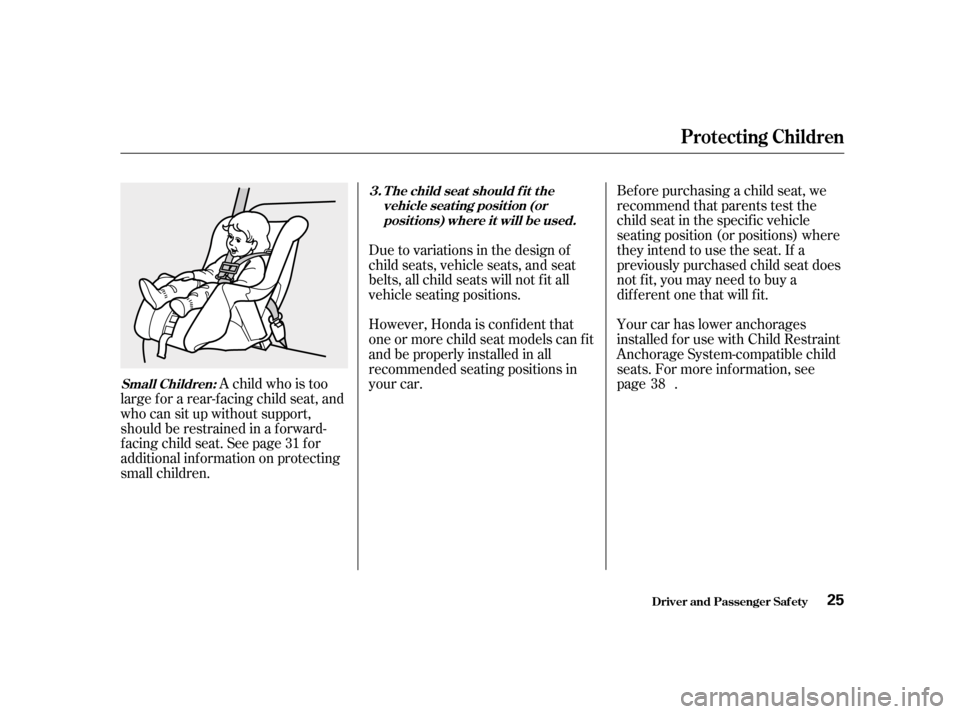
A child who is too
large f or a rear-f acing child seat, and
who can sit up without support,
should be restrained in a f orward-
f acing child seat. See page f or
additional inf ormation on protecting
small children. However, Honda is conf ident that
one or more child seat models can f it
andbeproperlyinstalledinall
recommended seating positions in
your car.
Your car has lower anchorages
installed f or use with Child Restraint
Anchorage System-compatible child
seats. For more inf ormation, see
page .
31 38T he child seat should f it the
vehicle seat ing posit ion (orposit ions) where it will be used.
Small Children: 3.
Protecting Children
Driver and Passenger Saf ety
25
Page 27 of 355
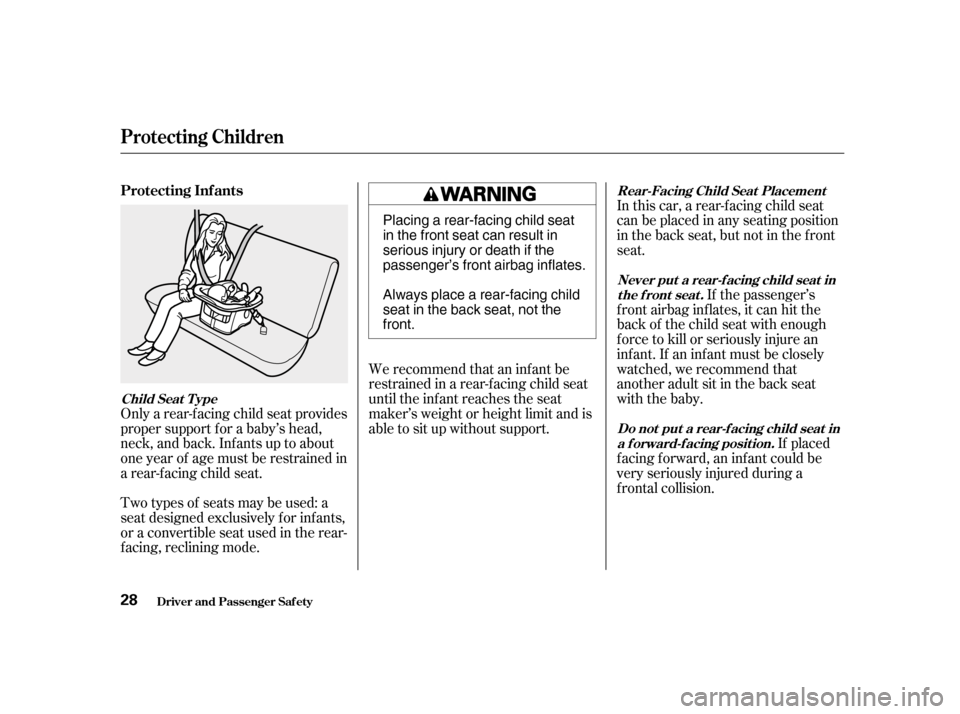
Only a rear-f acing child seat provides
proper support f or a baby’s head,
neck, and back. Inf ants up to about
one year of age must be restrained in
a rear-f acing child seat.In this car, a rear-f acing child seat
canbeplacedinanyseatingposition
in the back seat, but not in the f ront
seat.
Two types of seats may be used: a
seat designed exclusively f or inf ants,
or a convertible seat used in the rear-
f acing, reclining mode. We recommend that an inf ant be
restrained in a rear-f acing child seat
until the inf ant reaches the seat
maker’s weight or height limit and is
able to sit up without support.
If the passenger’s
f ront airbag inf lates, it can hit the
back of the child seat with enough
forcetokillorseriouslyinjurean
inf ant. If an inf ant must be closely
watched, we recommend that
another adult sit in the back seat
with the baby.
If placed
f acing f orward, an inf ant could be
very seriously injured during a
f rontal collision.
Protecting Inf ants
Child Seat T ype
Rear-Facing Child Seat Placement
Never put a rear-f acing child seat inthe front seat.
Do not put a rear-f acing child seat ina f orward-f acing position.
Protecting Children
Driver and Passenger Saf ety
28 Placing a rear-facing child seat
in the front seat can result in
serious injury or death if the
passenger’s front airbag inflates.
Always place a rear-facing child
seat in the back seat, not thefront.
Page 42 of 355
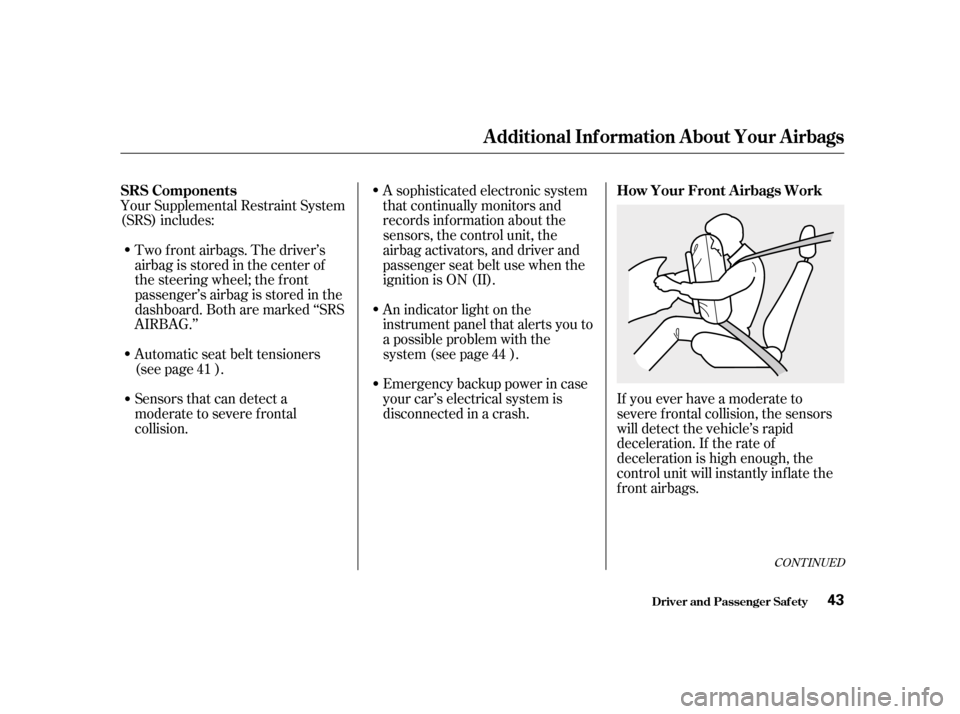
Your Supplemental Restraint System
(SRS) includes:Two f ront airbags. The driver’s
airbag is stored in the center of
the steering wheel; the f ront
passenger’sairbagisstoredinthe
dashboard. Both are marked ‘‘SRS
AIRBAG.’’
If you ever have a moderate to
severe f rontal collision, the sensors
will detect the vehicle’s rapid
deceleration. If the rate of
deceleration is high enough, the
control unit will instantly inf late the
f ront airbags.
Emergency backup power in case
your car’s electrical system is
disconnected in a crash.
An indicator light on the
instrument panel that alerts you to
a possible problem with the
system (see page ).
A sophisticated electronic system
that continually monitors and
records inf ormation about the
sensors, the control unit, the
airbag activators, and driver and
passenger seat belt use when the
ignition is ON (II).
Sensors that can detect a
moderate to severe frontal
collision.
Automatic seat belt tensioners
(see page ).
44
41
CONT INUED
SRS Components How Your Front A irbags Work
Driver and Passenger Saf ety
Additional Inf ormation About Your Airbags
43
Page 49 of 355
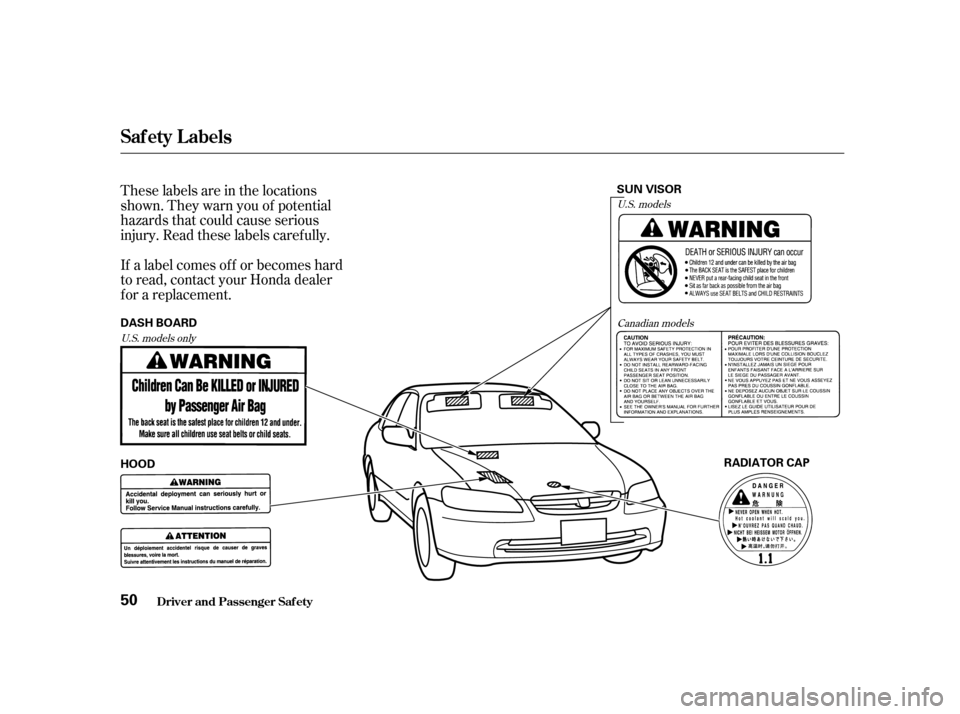
These labels are in the locations
shown. They warn you of potential
hazards that could cause serious
injury. Read these labels caref ully.
If a label comes of f or becomes hard
to read, contact your Honda dealer
f or a replacement.
U.S. models onlyU.S. models
Canadian models
Saf ety L abels
Driver and Passenger Saf ety
50
HOOD
RADIATOR CAP
DASH BOARD
SUN VISOR
Page 54 of 355

Only on models equipped with ABS (seepage )
Only on models equipped with side airbags 204
This light normally comes on f or a
f ew seconds when you turn the
ignition switch ON (II), and when
the ignition switch is turned to
START (III). If this light comes on at
any other time, there is a problem in
theABS.If thishappens,takethe
cartoyourdealertohaveitchecked.
With the light on, your car still has
normal braking ability but no anti-
lock. For complete inf ormation, see
page .
This indicator lights when you turn
the ignition switch ON (II). If it
comes on at any other time, it
indicates a potential problem with
your f ront airbags. This light will
also alert you to a potential problem
with your side airbags. For complete
inf ormation, see page .
This indicator lights when you turn
the ignition switch ON (II). If it
comes on at any other time, it
indicates that the passenger’s side
airbag has automatically shut off.
For complete inf ormation, see page
.
See page .
This indicator comes on when you
turn the ignition switch ON (II). It
is a reminder to check the parking
brake. Driving with the parking
brake not f ully released can
damage the brakes and tires.
If the indicator remains lit after
you have f ully released the
parking brake while the engine is
running, or if it comes on while
driving, it can indicate a problem
in the brake system. For complete
inf ormation, see page .
205
47
47
1. 2.
313
311
Indicator L ights
Inst rument s and Cont rolsAnti-lock Brake System
(A BS) Indicator
Supplemental Restraint
System Indicator
Side A irbag Indicator
Malf unction Indicator
Lamp
Parking Brake and
Brake System Indicator
55
U.S.
Canada
U.S.
Canada
Page 55 of 355
The lef t or right turn signal light
blinks when you signal a lane change
or turn. If the light does not blink or
blinks rapidly, it usually means one
of the turn signal bulbs is burned out
(see page ). Replace the bulb as
soon as possible, since other drivers
cannot see that you are signalling.
WhenyouturnontheHazard
Warning switch, both turn signal
lights blink. All turn signals on the
outside of the car should f lash.
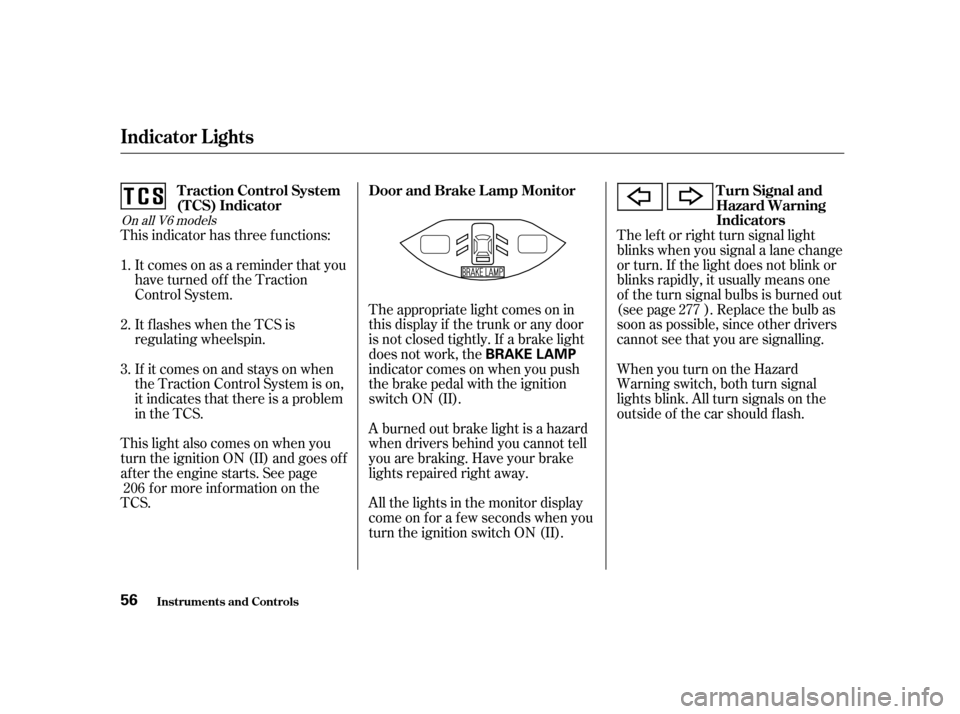
The appropriate light comes on in
this display if the trunk or any door
is not closed tightly. If a brake light
does not work, the
indicator comes on when you push
the brake pedal with the ignition
switch ON (II).
A burned out brake light is a hazard
when drivers behind you cannot tell
you are braking. Have your brake
lights repaired right away.
All the lights in the monitor display
come on f or a f ew seconds when you
turn the ignition switch ON (II).
This indicator has three f unctions:
Itcomesonasareminderthatyou
have turned off the Traction
Control System.
It f lashes when the TCS is
regulating wheelspin.
If itcomesonandstaysonwhen
the Traction Control System is on,
it indicates that there is a problem
in the TCS.
This light also comes on when you
turn the ignition ON (II) and goes off
af ter the engine starts. See page f or more inf ormation on the
TCS.
1. 2. 3.
206 277
On all V6 models
Indicator L ights
Inst rument s and Cont rols Turn Signal and
Hazard Warning
Indicators
Door and Brake L amp Monitor
Traction Control System
(T CS) Indicator
56 BRAKE LAMP
Page 56 of 355

This indicator comes on f or a f ew
seconds when you turn the ignition
switch ON (II). It will then go of f if
you have inserted a properly-coded
ignition key. If it is not a properly-
coded key, the indicator will blink
and the engine will not start (see
page ).
This indicator also blinks several
times when you turn the ignition
switch f rom ON (II) to ACCESSORY
(I) or LOCK (0).
This light comes on when the
washer f luid level is low. Add washer
f luid when you see this light come on
(see page ).
This indicator lights when you turn
the ignition switch to ON (II) with
the headlight switch of f and the
parking brake set. It should go of f if
youturnontheheadlightsorrelease
the parking brake. If it comes on at
any other time, it means there is a
problem with the DRL. There may
also be a problem with the high
beam headlights.
This light comes on with the high
beam headlights. See page for
inf ormation on the headlight
controls.
On Canadian models, this indicator
comes on with reduced brightness
when the Daytime Running Lights
(DRL) are on (see page ). This lights when you set the cruise
control. See page f or inf ormation
on operating the cruise control.
This light comes on as a reminder
that you must ref uel soon.
72
60
63 68
246
Canadian models only
Only on models equipped with Cruise
Control System
Canadian models only
Indicator L ights
Inst rument s and Cont rols Immobilizer System
Indicator
Washer Level Indicator
‘‘Daytime Running
Lights’’ Indicator
High Beam Indicator
Cruise Control Indicator
Low Fuel Indicator
57
Page 62 of 355
The Automatic Lighting Of f f eature
turns of f the headlights, parking
lights, taillights, side marker lights,
license plate lights and instrument
panel lights within 15 seconds of
removing the key from the ignition
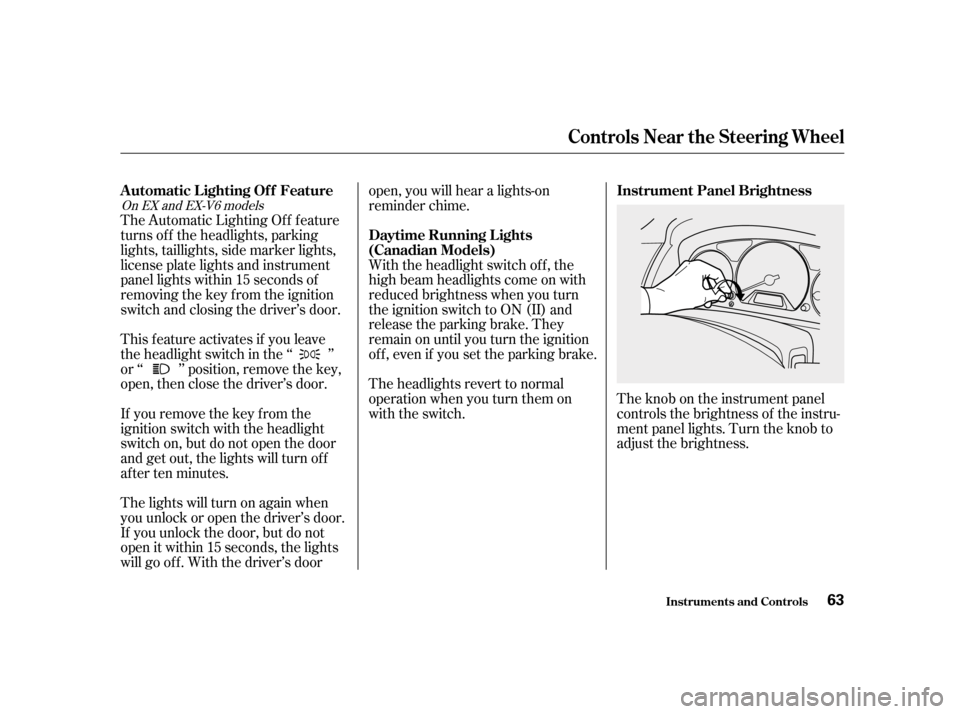
switch and closing the driver’s door.Theknobontheinstrumentpanel
controls the brightness of the instru-
ment panel lights. Turn the knob to
adjust the brightness.
The lights will turn on again when
you unlock or open the driver’s door.
If you unlock the door, but do not
open it within 15 seconds, the lights
will go off. With the driver’s door open, you will hear a lights-on
reminder chime.
With the headlight switch off, the
high beam headlights come on with
reduced brightness when you turn
the ignition switch to ON (II) and
release the parking brake. They
remain on until you turn the ignition
of f , even if you set the parking brake.
The headlights revert to normal
operation when you turn them on
with the switch.
This feature activates if you leave
the headlight switch in the ‘‘ ’’
or ‘‘ ’’ position, remove the key,
open, then close the driver’s door.
If you remove the key f rom the
ignition switch with the headlight
switch on, but do not open the door
and get out, the lights will turn of f
af ter ten minutes.
On EX and EX-V6 models
Controls Near the Steering Wheel
Inst rument s and Cont rols
Automatic Lighting Of f Feature
Instrument Panel Brightness
Daytime Running L ights
(Canadian Models)
63