Battery HONDA ACCORD 2013 9.G Service Manual
[x] Cancel search | Manufacturer: HONDA, Model Year: 2013, Model line: ACCORD, Model: HONDA ACCORD 2013 9.GPages: 595, PDF Size: 20.67 MB
Page 555 of 595
554Handling the Unexpected
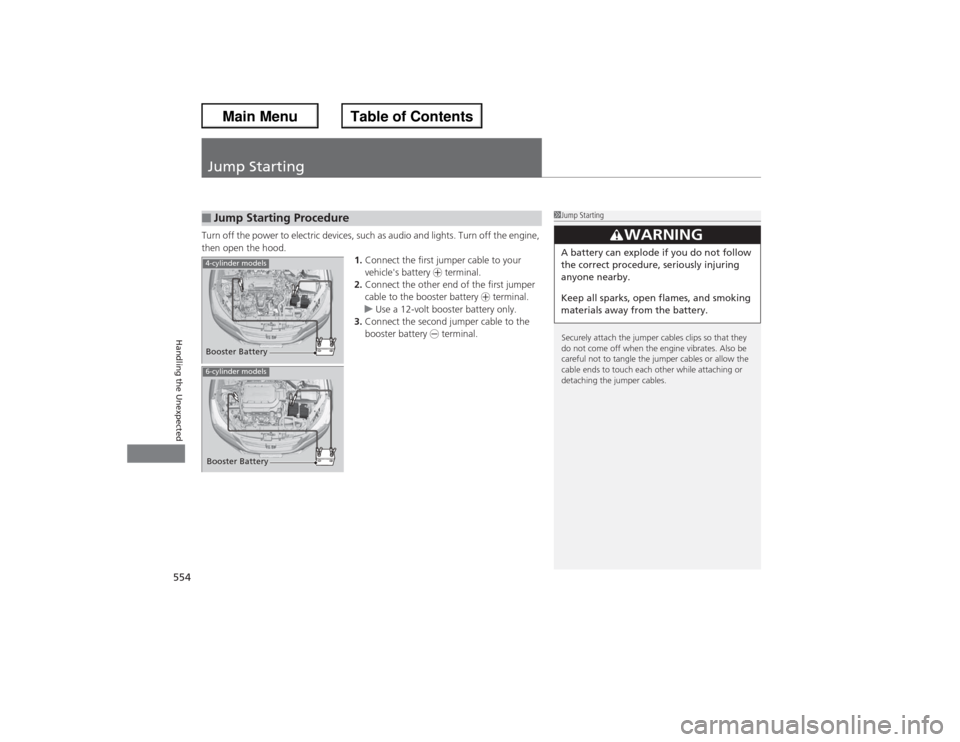
Jump StartingTurn off the power to electric devices, such as audio and lights. Turn off the engine,
then open the hood.1.Connect the first jumper cable to your
vehicle's battery + terminal.
2. Connect the other end of the first jumper
cable to the booster battery + terminal.
u Use a 12-volt booster battery only.
3. Connect the second jumper cable to the
booster battery - terminal.■Jump Starting Procedure
1Jump Starting
Securely attach the jumper cables clips so that they
do not come off when the engine vibrates. Also be
careful not to tangle the jumper cables or allow the
cable ends to touch each other while attaching or
detaching the jumper cables.
3
WARNING
A battery can explode if you do not follow
the correct procedure, seriously injuring
anyone nearby.
Keep all sparks, open flames, and smoking
materials away from the battery.
Booster Battery4-cylinder models6-cylinder modelsBooster Battery
Page 556 of 595
Continued
555
uuJump Starting u
Handling the Unexpected
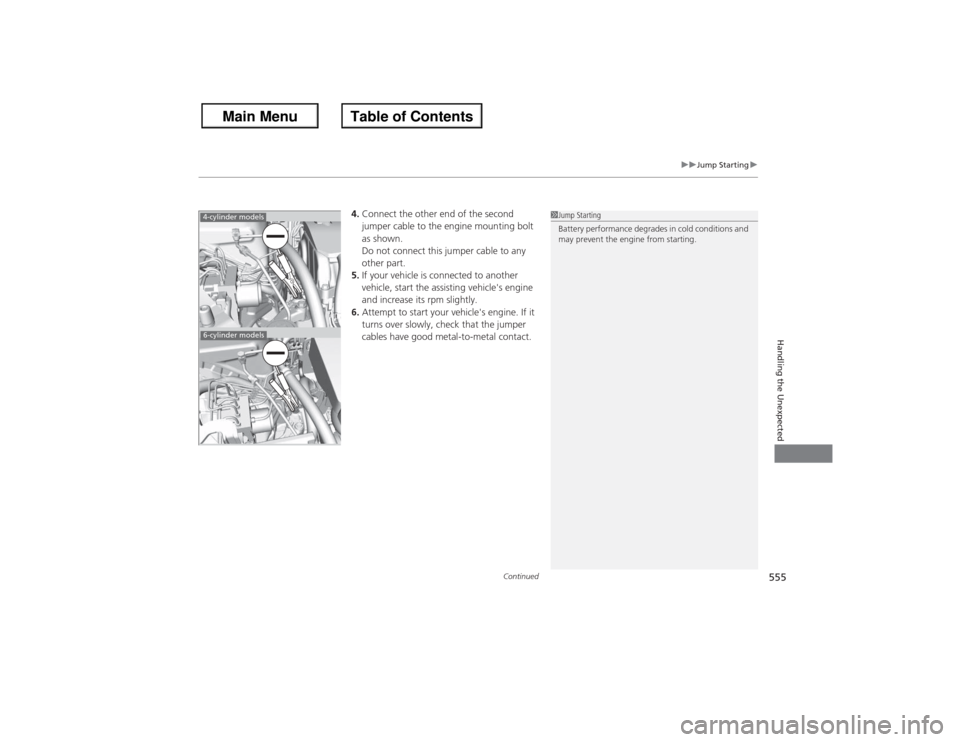
4.Connect the other end of the second
jumper cable to the engine mounting bolt
as shown.
Do not connect this jumper cable to any
other part.
5. If your vehicle is connected to another
vehicle, start the assisting vehicle's engine
and increase its rpm slightly.
6. Attempt to start your vehicle's engine. If it
turns over slowly, check that the jumper
cables have good metal-to-metal contact.
1Jump Starting
Battery performance degrades in cold conditions and
may prevent the engine from starting.
4-cylinder models6-cylinder models
Page 557 of 595
556
uuJump Starting u
Handling the Unexpected
Once your vehicle's engine has started, remove the jumper cables in the following
order.
1. Disconnect the jumper cable from your vehicle's ground.
2. Disconnect the other end of the jumper cable from the booster battery -
terminal.
3. Disconnect the jumper cable from your vehicle's battery + terminal.
4. Disconnect the other end of the jumper cable from the booster battery +
terminal.
Have your vehicle inspected by a nearby service station or a dealer.■What to Do After the Engine Starts
Page 561 of 595
560Handling the Unexpected
Indicator, Coming On/BlinkingIf the Low Oil Pressure Indicator Comes On
■Reasons for the indicator to come on
Comes on when the engine oil pressure is low.■What to do as soon as the indicator comes on
1. Immediately park the vehicle in a safe place.
2. If necessary, turn the hazard warning lights on.■What to do after parking the vehicle
1. Stop the engine and let it sit for about one minute.
2. Open the hood and check the oil level.
u Add oil as necessary.
3. Start the engine and check the low oil pressure indicator.
u The light goes out: Start driving again.
u The light does not go out within 10 seconds: Stop the engine and
contact a dealer for repairs immediately.
If the Charging System Indicator Comes On
■Reasons for the indicator to come on
Comes on when the battery is not being charged.■What to do when th e indicator comes on
Turn off the heating and cooling system
* /climate control system
*, rear
defogger, and other electrical systems, and immediately contact a dealer
for repairs.
1 If the Low Oil Pressure Indicator Comes OnNOTICERunning the engine with low oil pressure can cause
serious mechanical damage almost immediately.1If the Charging System Indicator Comes On
If you need to stop temporarily, do not turn off the
engine. Restarting the engine may rapidly discharge
the battery.
* Not available on all models
Page 565 of 595
564Handling the Unexpected
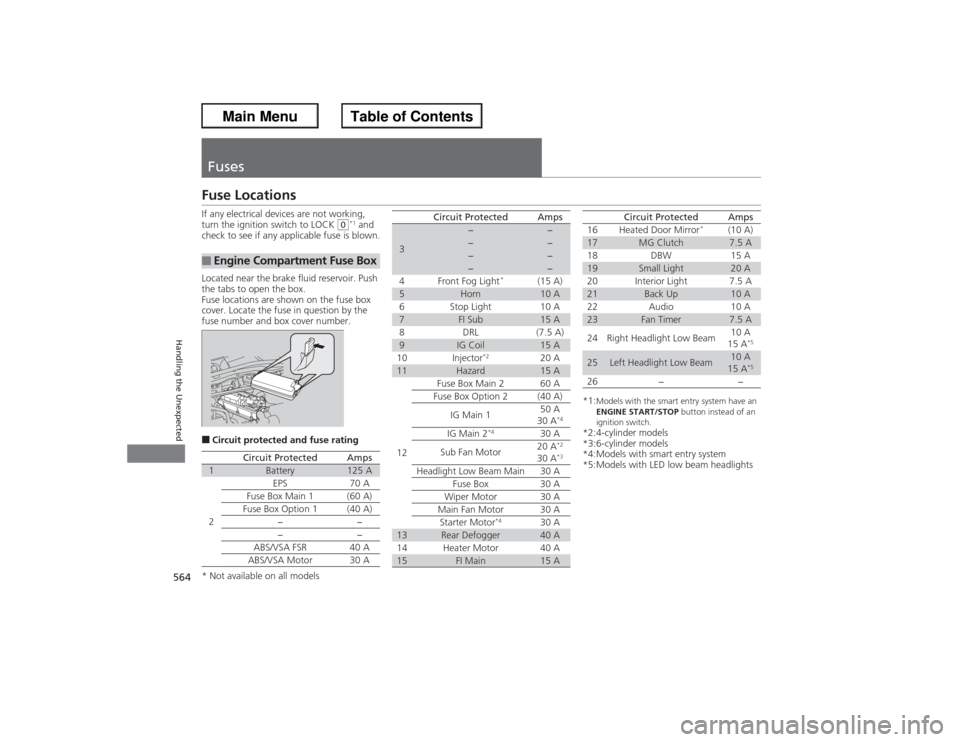
FusesFuse LocationsIf any electrical devices are not working,
turn the ignition switch to LOCK
(0*1 and
check to see if any applicable fuse is blown.
Located near the brake fluid reservoir. Push
the tabs to open the box.
Fuse locations are shown on the fuse box
cover. Locate the fuse in question by the
fuse number and box cover number.
■Circuit protected and fuse rating■Engine Compartment Fuse Box
Circuit Protected
Amps
1
Battery
125 A
2
EPS
70 A
Fuse Box Main 1 (60 A)
Fuse Box Option 1
(40 A)
−−
−
−
ABS/VSA FSR 40 A
ABS/VSA Motor 30 A
3
−
−
−
−
−
−
−
−
4 Front Fog Light
*
(15 A)
5
Horn
10 A
6 Stop Light 10 A
7
FI Sub
15 A
8 DRL (7.5 A)
9
IG Coil
15 A
10 Injector
*2
20 A
11
Hazard
15 A
12 Fuse Box Main 2 60 A
Fuse Box Option 2 (40 A)
IG Main 1 50 A
30 A
*4
IG Main 2
*4
30 A
Sub Fan Motor 20 A
*2
30 A
*3
Headlight Low Beam Main 30 A
Fuse Box 30 A
Wiper Motor 30 A
Main Fan Motor 30 A Starter Motor
*4
30 A
13
Rear Defogger
40 A
14 Heater Motor 40 A
15
FI Main
15 A
Circuit Protected
Amps
*1:
Models with the smart entry system have an
ENGINE START/STOP button instead of an
ignition switch.
*2:4-cylinder models
*3:6-cylinder models
*4:Models with smart entry system
*5:Models with LED low beam headlights 16 Heated Door Mirror
*
(10 A)
17
MG Clutch
7.5 A
18 DBW 15 A
19
Small Light
20 A
20 Interior Light 7.5 A
21
Back Up
10 A
22 Audio 10 A
23
Fan Timer
7.5 A
24 Right Headlight Low Beam 10 A
15 A
*5
25
Left Headlight Low Beam
10 A
15 A
*5
26 − −
Circuit Protected
Amps
* Not available on all models
Page 571 of 595
570Information
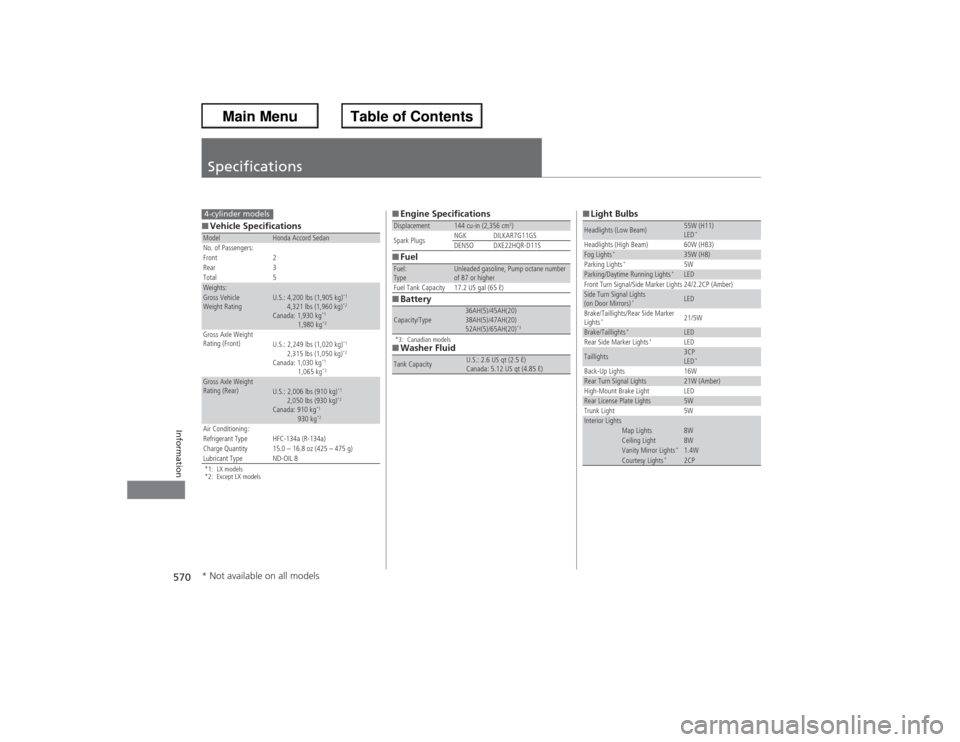
Specifications■Vehicle Specifications*1: LX models
*2: Except LX modelsModel
Honda Accord Sedan
No. of Passengers:
Front 2
Rear 3
Total 5
Weights:Gross Vehicle
Weight Rating
U.S.: 4,200 lbs (1,905 kg)
*1
4,321 lbs (1,960 kg)
*2
Canada: 1,930 kg
*1
1,980 kg
*2
Gross Axle Weight
Rating (Front)
U.S.: 2,249 lbs (1,020 kg)
*1
2,315 lbs (1,050 kg)
*2
Canada: 1,030 kg
*1
1,065 kg
*2
Gross Axle Weight
Rating (Rear)
U.S.: 2,006 lbs (910 kg)
*1
2,050 lbs (930 kg)
*2
Canada: 910 kg
*1
930 kg
*2
Air Conditioning:
Refrigerant Type HFC-134a (R-134a)
Charge Quantity 15.0 – 16.8 oz (425 – 475 g)
Lubricant Type ND-OIL 84-cylinder models
■ Engine Specifications
■ Fuel
■ Battery*3: Canadian models■Washer FluidDisplacement
144 cu-in (2,356 cm
3)
Spark Plugs NGK DILKAR7G11GS
DENSO DXE22HQR-D11S
Fuel:
Type
Unleaded gasoline, Pump octane number
of 87 or higher
Fuel Tank Capacity 17.2 US gal (65 ℓ)
Capacity/Type
36AH(5)/45AH(20)
38AH(5)/47AH(20)
52AH(5)/65AH(20)
*3
Tank Capacity
U.S.: 2.6 US qt (2.5 ℓ)
Canada: 5.12 US qt (4.85 ℓ)
■ Light BulbsHeadlights (Low Beam)
55W (H11)
LED*
Headlights (High Beam) 60W (HB3)Fog Lights
*
35W (H8)
Parking Lights
*
5W
Parking/Daytime Running Lights
*
LED
Front Turn Signal/Side Marker Lights 24/2.2CP (Amber)
Side Turn Signal Lights
(on Door Mirrors)
*
LED
Brake/Taillights/Rear Side Marker
Lights
*
21/5W
Brake/Taillights
*
LED
Rear Side Marker Lights
*
LED
Taillights
3CP
LED*
Back-Up Lights 16WRear Turn Signal Lights
21W (Amber)
High-Mount Brake Light LED
Rear License Plate Lights
5W
Trunk Light 5W
Interior Lights
Map Lights
8W
Ceiling Light
8W
Vanity Mirror Lights
*1.4W
Courtesy Lights
*
2CP
* Not available on all models
Page 573 of 595
572
uu Specifications u
Information
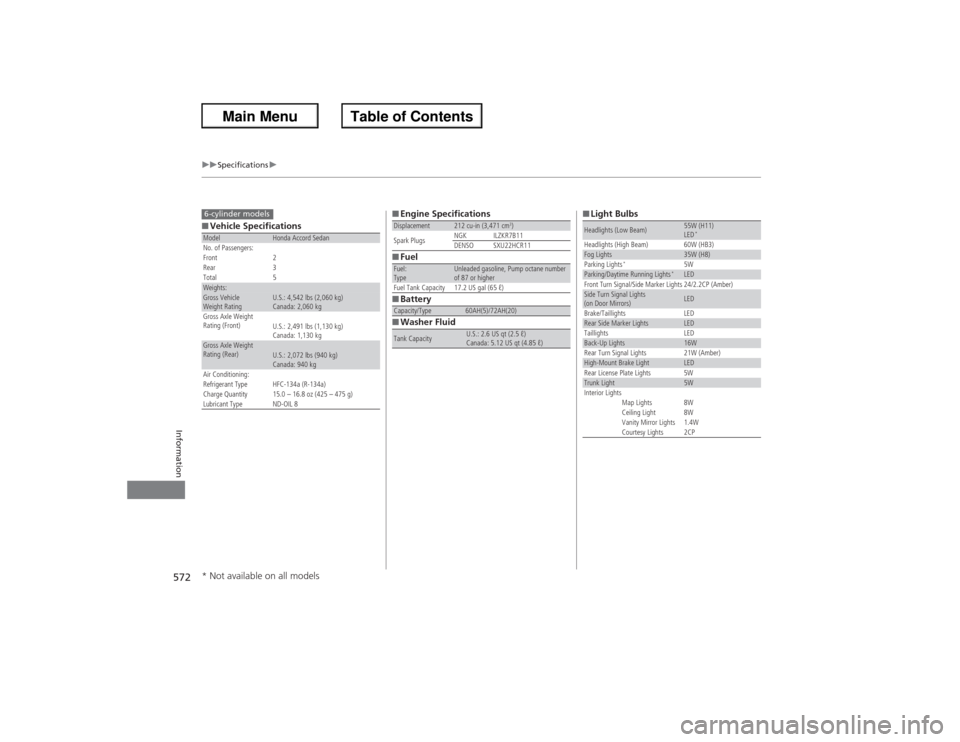
■Vehicle SpecificationsModel
Honda Accord Sedan
No. of Passengers:
Front 2
Rear 3
Total 5
Weights:Gross Vehicle
Weight Rating
U.S.: 4,542 lbs (2,060 kg)
Canada: 2,060 kg
Gross Axle Weight
Rating (Front)
U.S.: 2,491 lbs (1,130 kg)
Canada: 1,130 kg
Gross Axle Weight
Rating (Rear)
U.S.: 2,072 lbs (940 kg)
Canada: 940 kg
Air Conditioning:
Refrigerant Type HFC-134a (R-134a)
Charge Quantity 15.0 – 16.8 oz (425 – 475 g)
Lubricant Type ND-OIL 8
6-cylinder models
■ Engine Specifications
■ Fuel
■ Battery
■ Washer FluidDisplacement
212 cu-in (3,471 cm
3)
Spark Plugs NGK ILZKR7B11
DENSO SXU22HCR11
Fuel:
Type
Unleaded gasoline, Pump octane number
of 87 or higher
Fuel Tank Capacity 17.2 US gal (65 ℓ)
Capacity/Type
60AH(5)/72AH(20)
Tank Capacity
U.S.: 2.6 US qt (2.5 ℓ)
Canada: 5.12 US qt (4.85 ℓ)
■ Light BulbsHeadlights (Low Beam)
55W (H11)
LED*
Headlights (High Beam) 60W (HB3)Fog Lights
35W (H8)
Parking Lights
*
5W
Parking/Daytime Running Lights
*
LED
Front Turn Signal/Side Marker Lights 24/2.2CP (Amber)
Side Turn Signal Lights
(on Door Mirrors)
LED
Brake/Taillights LED
Rear Side Marker Lights
LED
Taillights LED
Back-Up Lights
16W
Rear Turn Signal Lights 21W (Amber)
High-Mount Brake Light
LED
Rear License Plate Lights 5W
Trunk Light
5W
Interior Lights
Map Lights
8W
Ceiling Light
8W
Vanity Mirror Lights
1.4W
Courtesy Lights
2CP
* Not available on all models
Page 578 of 595
577
Continued
Information
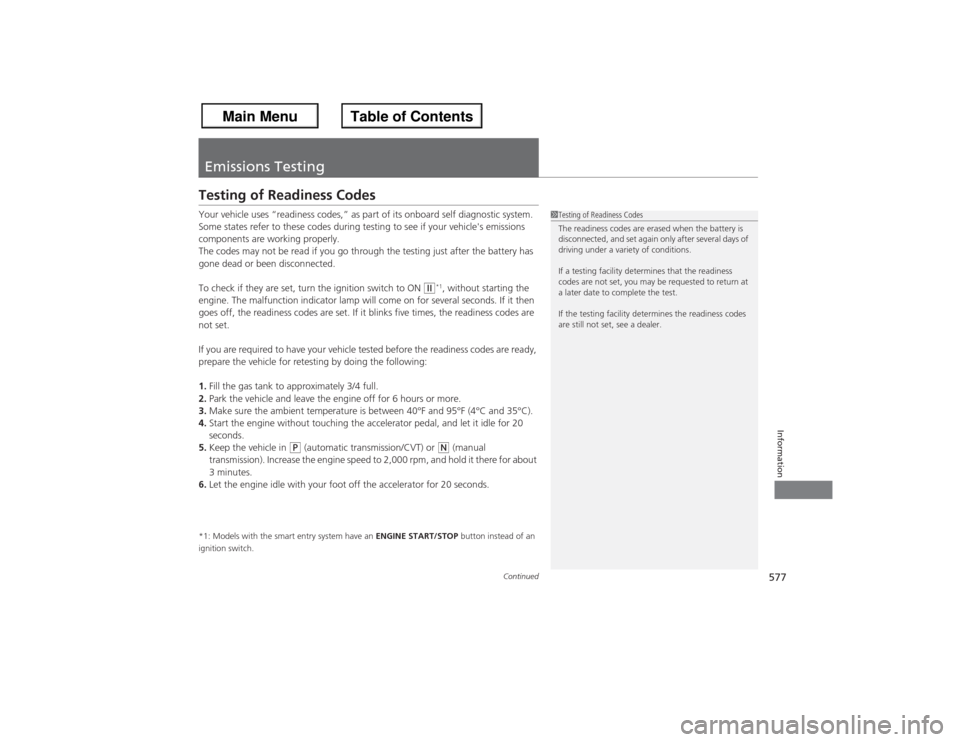
Emissions TestingTesting of Readiness CodesYour vehicle uses “readiness codes,” as part of its onboard self diagnostic system.
Some states refer to these codes during testing to see if your vehicle's emissions
components are working properly.
The codes may not be read if you go through the testing just after the battery has
gone dead or been disconnected.
To check if they are set, turn the ignition switch to ON
(w*1, without starting the
engine. The malfunction indicator lamp will come on for several seconds. If it then
goes off, the readiness codes are set. If it blinks five times, the readiness codes are
not set.
If you are required to have your vehicle tested before the readiness codes are ready,
prepare the vehicle for retesting by doing the following:
1. Fill the gas tank to approximately 3/4 full.
2. Park the vehicle and leave the engine off for 6 hours or more.
3. Make sure the ambient temperature is between 40°F and 95°F (4°C and 35°C).
4. Start the engine without touching the accelerator pedal, and let it idle for 20
seconds.
5. Keep the vehicle in
(P (automatic transmission/CVT) or
(N (manual
transmission). Increase the engine speed to 2,000 rpm, and hold it there for about 3 minutes.
6. Let the engine idle with your foot off the accelerator for 20 seconds.
*1: Models with the smart entry system have an ENGINE START/STOP button instead of an
ignition switch.
1 Testing of Readiness Codes
The readiness codes are erased when the battery is
disconnected, and set again only after several days of
driving under a variety of conditions.
If a testing facility determines that the readiness
codes are not set, you may be requested to return at
a later date to complete the test.
If the testing facility determines the readiness codes
are still not set, see a dealer.
Page 581 of 595
580
uuWarranty Coverages u
Information
Replacement Battery Limited Warranty – provides prorated coverage for a
replacement battery purchased from a dealer.
Replacement Muffler Lifetime Limited Warranty – provides coverage for as
long as the purchaser of the muffler owns the vehicle.
Restrictions and exclusions apply to all these warranties. Please read the 2013 Honda
warranty information booklet that came with your vehicle for precise information on
warranty coverages. Your vehicle’s original tires are covered by their manufacturer.
Tire warranty information is in a separate booklet.■Canadian Owners
Please refer to the 2013 warranty manual that came with your vehicle.
Page 588 of 595
587Index
Shifting ........................................... 435, 437
Auxiliary Input Jack ................................. 176
Average Fuel Economy ........................ 91, 95
Average Speed ........................................... 96BBattery...................................................... 534
Charging System Indicator ................ 69, 560
Jump Starting ......................................... 554
Maintenance (Checking the Battery) ....... 534
Maintenance (Replacing) ......................... 535
Belts (Seat) .................................................. 32
Beverage Holders ..................................... 160
Bluetooth® Audio..................... 201, 234, 287
Bluetooth® HandsFreeLink ®............ 339, 376
Booster Seats (For Children) ...................... 63
Brake System ............................................ 473
Anti-lock Brake System (ABS) .................. 475
Brake Assist System................................. 476
Fluid ....................................................... 511
Foot Brake .............................................. 474
Indicator ........................................... 68, 562
Parking Brake.......................................... 473
Brake System Indicator (Amber) ............... 68
Brake System Indicator (Red) .................... 68
Brightness Control (Instrument Panel) ... 141
Bulb Replacement .................................... 513
Brake/Taillights and Rear Turn Signal Lights/ Rear Side Marker Lights......................... 520
Fog Lights ............................................... 515 Front Turn Signal/Side Marker Lights........ 518
Headlights ............................................... 513
High-Mount Brake Light .......................... 522
Parking Lights .......................................... 519
Parking/Daytime Running Lights .............. 519
Rear License Plate Lights .......................... 522
Side Turn Signal/Emergency
Indicator Lights ...................................... 518
Taillights and Back-Up Lights ................... 521
Bulb Specifications ........................... 570, 572
CCarbon Monoxide Gas ................................ 64
Cargo Hooks ............................................. 162
Carrying Cargo .................................. 419, 421
CD Player ................................... 190, 221, 260
Center Pocket ........................................... 159
Certification Label .................................... 574
Changing Bulbs ......................................... 513
Charging System Indicator ................. 69, 560
Child Safety ................................................. 52
Childproof Door Locks ............................. 118
Emergency Trunk Opener ........................ 123
Child Seat .................................................... 52
Booster Seats............................................. 63
Child Seat for Infants ................................. 54
Child Seat for Small Children ..................... 55
Installing a Child Seat with a Lap/Shoulder Seat Belt .................................................. 59
Larger Children.......................................... 62 Rear-facing Child Seat ............................... 54
Selecting a Child Seat ................................ 56
Using a Tether ........................................... 61
Childproof Door Locks ............................. 118
Cleaning the Exterior ............................... 540
Cleaning the Interior ................................ 538
Climate Control System ............................ 169
Changing the Mode ................................ 169
Defrosting the Windshield and Windows ........................................ 170
Dust and Pollen Filter............................... 537
Recirculation and Fresh Air Mode ............ 169
Sensors ................................................... 172
Synchronized Mode................................. 171
Using Automatic Climate Control ............ 169
Clock .......................................................... 106
Clutch Fluid ............................................... 511
Coat Hook ................................................. 162
Compact Spare Tire .................. 545, 571, 573
Compass .................................................... 414
Console Compartment ............................. 158
Controls..................................................... 105
Coolant (Engine) ...................................... 507
Adding to the Radiator ............................ 508
Adding to the Reserve Tank..................... 507
Overheating ............................................ 558
Creeping (Automatic Transmission/CVT) ............... 434
Cruise Control ........................................... 447
Indicator.................................................... 80
Cup Holders .............................................. 160