CVT HONDA ACCORD 2014 9.G Owner's Manual
[x] Cancel search | Manufacturer: HONDA, Model Year: 2014, Model line: ACCORD, Model: HONDA ACCORD 2014 9.GPages: 595
Page 492 of 595
491
uuMaintenance Minder
TMuTo Use Maintenance Minder
TM
Continued
Maintenance
■
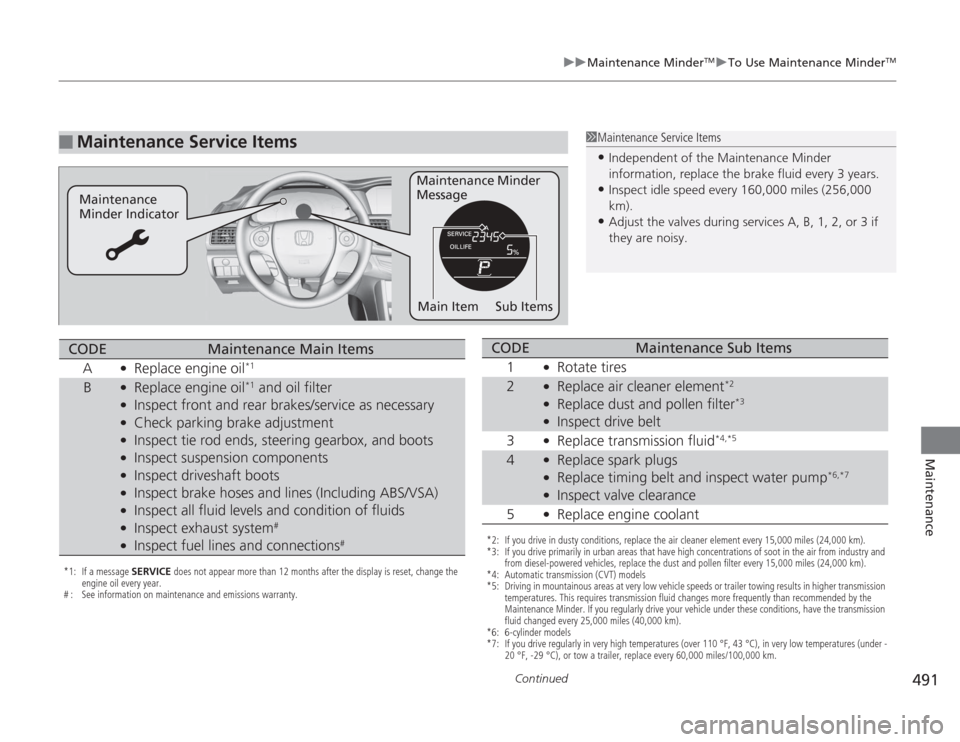
Maintenance Service Items
1Maintenance Service Items•Independent of the Maintenance Minder
information, replace the brake fluid every 3 years.•Inspect idle speed every 160,000 miles (256,000
km).•Adjust the valves during services A, B, 1, 2, or 3 if
they are noisy.
Maintenance Minder
Message
Maintenance
Minder Indicator
Sub Items
Main Item
*1: If a message SERVICE does not appear more than 12 months after the display is reset, change the
engine oil every year.
# : See information on maintenance and emissions warranty.CODE
Maintenance Main Items
A
●
Replace engine oil
*1
B
●
Replace engine oil
*1 and oil filter
●
Inspect front and rear brakes/service as necessary
●
Check parking brake adjustment
●
Inspect tie rod ends, steering gearbox, and boots
●
Inspect suspension components
●
Inspect driveshaft boots
●
Inspect brake hoses and lines (Including ABS/VSA)
●
Inspect all fluid levels and condition of fluids
●
Inspect exhaust system
#
●
Inspect fuel lines and connections
#
*2: If you drive in dusty conditions, replace the air cleaner element every 15,000 miles (24,000 km).
*3: If you drive primarily in urban areas that have high concentrations of soot in the air from industry and from diesel-powered vehicles, replace the dust and pollen filter every 15,000 miles (24,000 km).
*4: Automatic transmission (CVT) models
*5: Driving in mountainous areas at very low vehicle speeds or trailer towing results in higher transmission temperatures. This requires transmission fluid changes more frequently than recommended by the
Maintenance Minder. If you regularly drive your vehicle under these conditions, have the transmission
fluid changed every 25,000 miles (40,000 km).
*6: 6-cylinder models
*7: If you drive regularly in very high temperatures (over 110 °F, 43 °C), in very low temperatures (under - 20 °F, -29 °C), or tow a trailer, replace every 60,000 miles/100,000 km.CODE
Maintenance Sub Items
1
●
Rotate tires
2
●
Replace air cleaner element
*2
●
Replace dust and pollen filter
*3
●
Inspect drive belt
3
●
Replace transmission fluid
*4,*5
4
●
Replace spark plugs
●
Replace timing belt and inspect water pump
*6,*7
●
Inspect valve clearance
5
●
Replace engine coolant
Page 510 of 595
509
uuMaintenance Under the Hood uTransmission Fluid
Continued
Maintenance
Transmission FluidHave a dealer check the fluid level and replace if necessary.
Have a dealer check the fluid level and replace if necessary.■
Continuously Variable Transmission (CVT) Fluid
Specified fluid: HCF-2■
Manual Transmission Fluid
Specified fluid: Honda Manual Transmission Fluid (MTF)4-cylinder models with automatic transmission (CVT)
1Continuously Variable Transmission (CVT) Fluid
NOTICEDo not mix HCF-2 with other transmission fluids.
Using a transmission fluid other than HCF-2 may
adversely affect the operation and durability of your
vehicle's transmission, and damage the transmission.
Any damage caused by using a transmission fluid that
is not equivalent to HCF-2 is not covered by Honda's
new vehicle warranty.
4-cylinder models with manual transmission
1 Manual Transmission Fluid
If Honda MTF is not available, you may use the API
certificated SAE 0 W-20 or 5 W-20 viscosity motor oil
as a temporary measure.
Replace with MTF as soon as possible. Motor oil does
not contain the proper additives for the transmission
and continued use can cause decreased shifting
performance and lead to transmission damage.
Page 546 of 595
545
Continued
Handling the Unexpected
If a Tire Goes FlatChanging a Flat TireIf a tire goes flat while driving, grasp the steering wheel firmly, and brake gradually
to reduce speed. Then, stop in a safe place. Replace the flat tire with a compact
spare tire. Go to a dealer as soon as possible to have the full-size tire repaired or
replaced.
1.Park the vehicle on firm, level, and non-slippery surface and apply the parking
brake.
2. Move the shift lever to
(P
.
2. Move the shift lever to
(R
.
3. Turn on the hazard warning lights and turn the ignition switch to LOCK
(0
*1.
*1: Models with the smart entry system have an ENGINE START/STOP button instead of an
ignition switch.
1 Changing a Flat Tire
Periodically check the tire pressure of the compact
spare. It should be set to the specified pressure.
Specified Pressure: 60 psi (420 kPa, 4.2 kgf/cm
2)
When driving with the compact spare tire, keep the
vehicle speed under 50 mph (80 km/h). Replace with
a full-size tire as soon as possible.
The compact spare tire and wheel in your vehicle are
specifically for this model. Do not use them with
another vehicle. Do not use another type of compact
spare tire or wheel with your vehicle.
Do not mount tire chains on a compact spare tire.
If a chain-mounted front tire goes flat, remove one of
the full-size rear tires and replace it with the compact
spare tire. Remove the flat front tire and replace it
with the full-size tire that was removed from the rear.
Mount the tire chains on the front tire.
Automatic transmission/CVT modelsManual transmission modelsAll models
Page 554 of 595
553
uuEngine Does Not Start uEmergency Engine Stop
Handling the Unexpected
Emergency Engine StopThe ENGINE START/STOP button may be used to stop the engine due to an
emergency situation even while driving. If you must stop the engine, do either of the
following operations:
• Press and hold the ENGINE START/STOP button for two seconds.
• Firmly press the ENGINE START/STOP button twice.
• The steering wheel will not lock.
The power mode changes to VEHICLE OFF with the shift lever in
(P
, and to
ACCESSORY with the shift lever in any position other than
(P
.
The power mode changes to VEHICLE OFF.
• Because turning off the engine also disables the power assist the engine provides
to the steering and braking systems, it will require significantly more physical
effort and time to steer and slow the vehicle. Downshift gears and use both feet
on the brake pedal, if necessary, to slow the vehicle and stop immediately in a
safe place.
Models with smart entry system
1Emergency Engine Stop
NOTICEDo not press the button while driving unless it is
absolutely necessary for the engine to be switched
off.
Automatic transmission/CVT modelsManual transmission models
Page 558 of 595
557
Handling the Unexpected
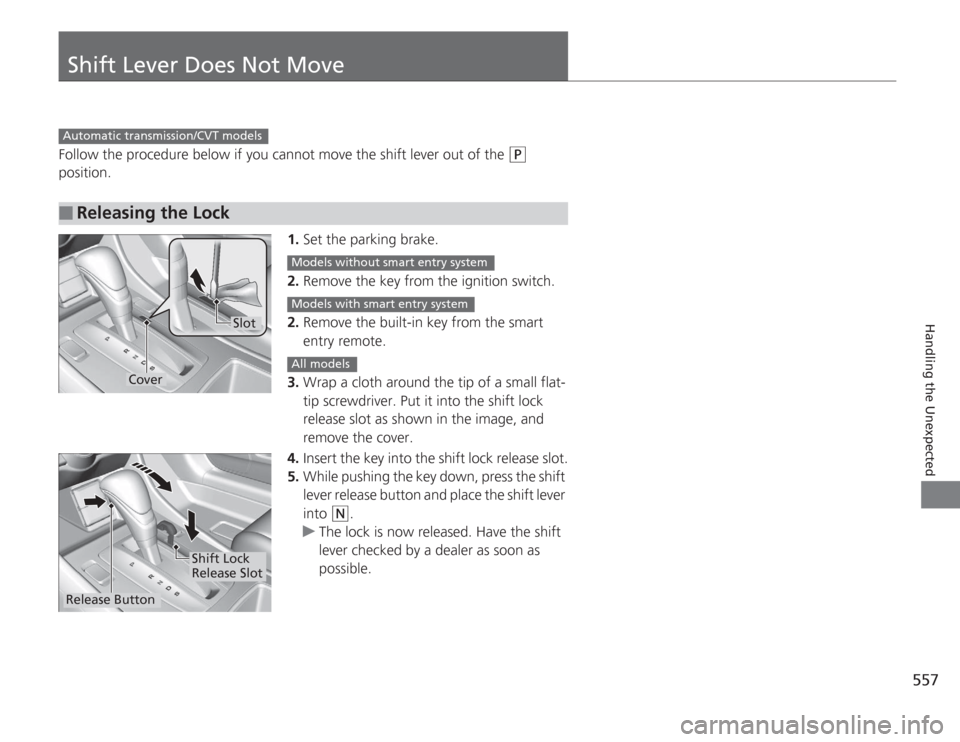
Shift Lever Does Not MoveFollow the procedure below if you cannot move the shift lever out of the
(P
position.
1.Set the parking brake.
2. Remove the key from the ignition switch.
2. Remove the built-in key from the smart
entry remote.
3. Wrap a cloth around the tip of a small flat-
tip screwdriver. Put it into the shift lock
release slot as shown in the image, and
remove the cover.
4. Insert the key into the shift lock release slot.
5. While pushing the key down, press the shift
lever release button and place the shift lever
into
(N
.
u The lock is now released. Have the shift
lever checked by a dealer as soon as
possible.
■
Releasing the Lock
Automatic transmission/CVT models
Slot
Cover
Models without smart entry systemModels with smart entry systemAll models
Release Button
Shift Lock
Release Slot
Page 572 of 595
571
uuSpecifications u
Continued
Information
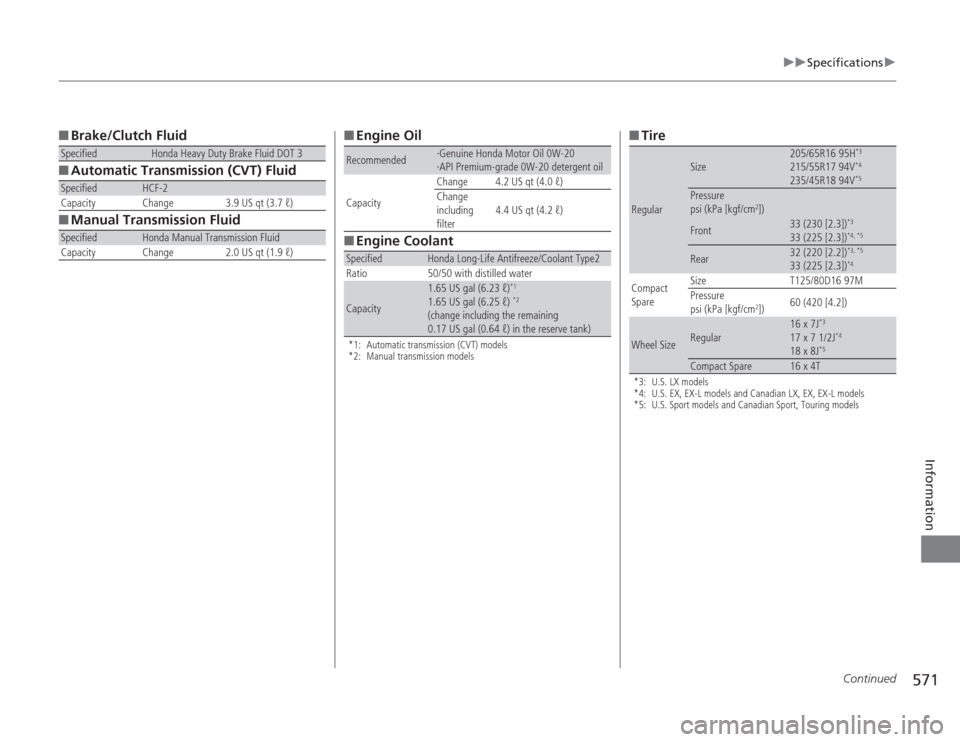
■Brake/Clutch Fluid
■ Automatic Transmission (CVT) Fluid
■ Manual Transmission FluidSpecified
Honda Heavy Duty Brake Fluid DOT 3
Specified
HCF-2
Capacity Change 3.9 US qt (3.7 ℓ)
Specified
Honda Manual Transmission Fluid
Capacity Change 2.0 US qt (1.9 ℓ)
■ Engine Oil
■ Engine Coolant*1: Automatic transmission (CVT) models
*2: Manual transmission modelsRecommended
·Genuine Honda Motor Oil 0W-20
·API Premium-grade 0W-20 detergent oil
Capacity Change 4.2 US qt (4.0 ℓ)
Change
including
filter
4.4 US qt (4.2 ℓ)
Specified
Honda Long-Life Antifreeze/Coolant Type2
Ratio 50/50 with distilled water
Capacity
1.65 US gal (6.23 ℓ)
*1
1.65 US gal (6.25 ℓ)
*2
(change including the remaining
0.17 US gal (0.64 ℓ) in the reserve tank)
■ Tire*3: U.S. LX models
*4: U.S. EX, EX-L models and Canadian LX, EX, EX-L models
*5: U.S. Sport models and Canadian Sport, Touring modelsRegular
Size
205/65R16 95H
*3
215/55R17 94V
*4
235/45R18 94V
*5
Pressure
psi (kPa [kgf/cm
2])
Front
33 (230 [2.3])
*3
33 (225 [2.3])
*4, *5
Rear
32 (220 [2.2])
*3, *5
33 (225 [2.3])
*4
Compact
Spare Size
T125/80D16 97M
Pressure
psi (kPa [kgf/cm
2]) 60 (420 [4.2])
Wheel Size
Regular
16 x 7J
*3
17 x 7 1/2J
*4
18 x 8J
*5
Compact Spare
16 x 4T
Page 575 of 595
574Information
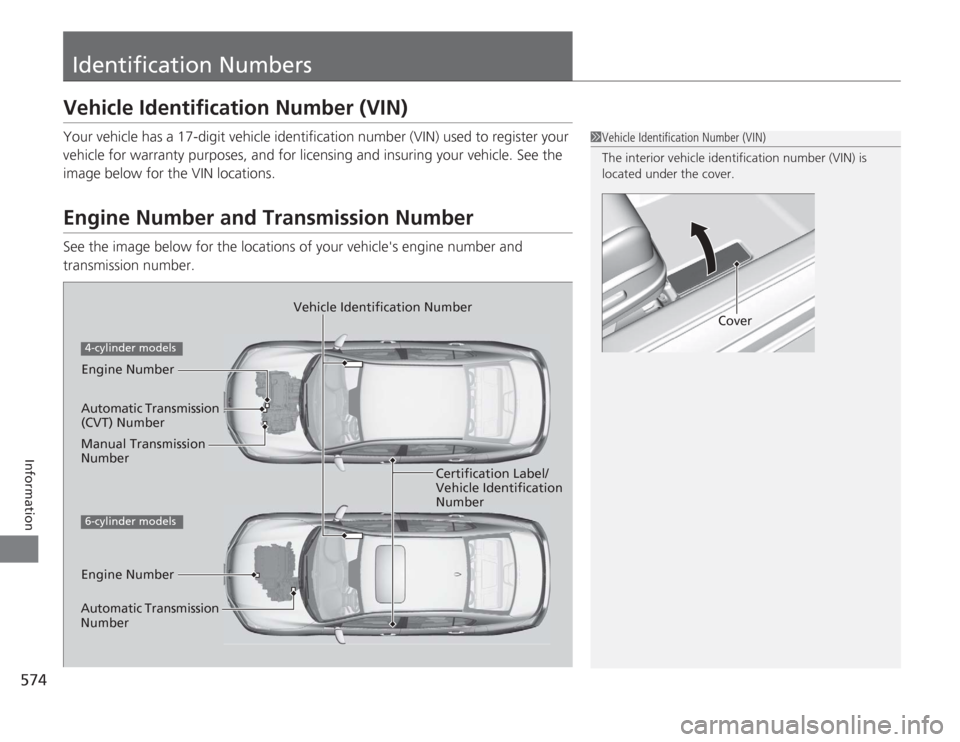
Identification NumbersVehicle Identification Number (VIN)Your vehicle has a 17-digit vehicle identification number (VIN) used to register your
vehicle for warranty purposes, and for licensing and insuring your vehicle. See the
image below for the VIN locations.Engine Number and Transmission NumberSee the image below for the locations of your vehicle's engine number and
transmission number.
1 Vehicle Identification Number (VIN)
The interior vehicle iden tification number (VIN) is
located under the cover.
Cover
Vehicle Identification Number
Engine Number
Certification Label/
Vehicle Identification
Number
Manual Transmission
Number
Automatic Transmission
(CVT) Number
6-cylinder models4-cylinder modelsEngine Number
Automatic Transmission
Number
Page 578 of 595
577
Continued
Information
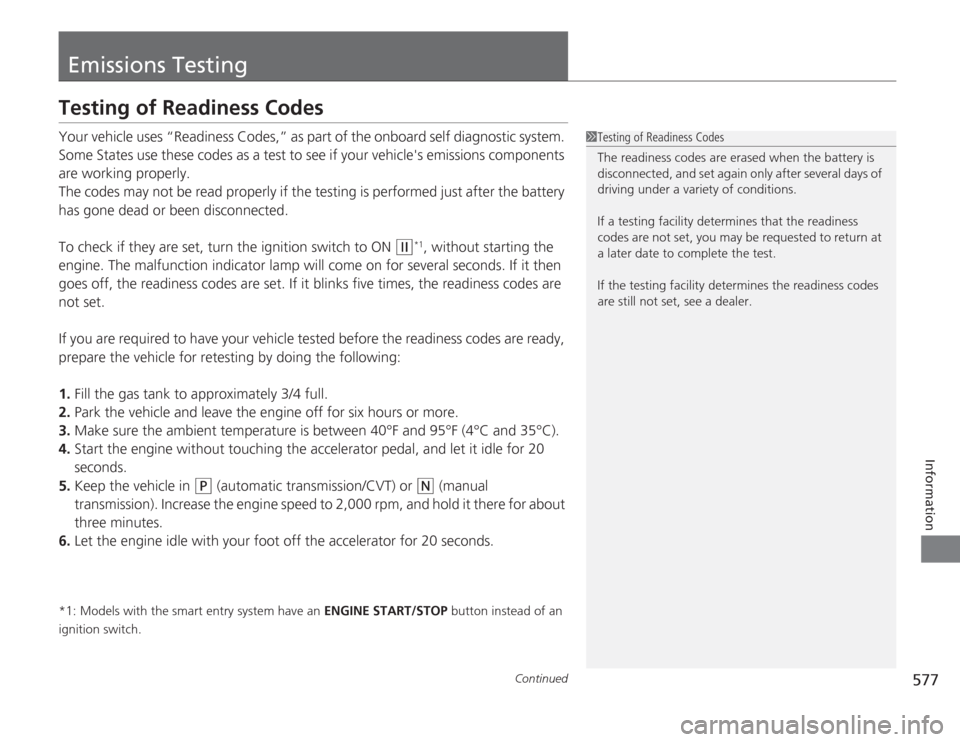
Emissions TestingTesting of Readiness CodesYour vehicle uses “Readiness Codes,” as part of the onboard self diagnostic system.
Some States use these codes as a test to see if your vehicle's emissions components
are working properly.
The codes may not be read properly if the testing is performed just after the battery
has gone dead or been disconnected.
To check if they are set, turn the ignition switch to ON
(w
*1, without starting the
engine. The malfunction indicator lamp will come on for several seconds. If it then
goes off, the readiness codes are set. If it blinks five times, the readiness codes are
not set.
If you are required to have your vehicle tested before the readiness codes are ready,
prepare the vehicle for retesting by doing the following:
1. Fill the gas tank to approximately 3/4 full.
2. Park the vehicle and leave the engine off for six hours or more.
3. Make sure the ambient temperature is between 40°F and 95°F (4°C and 35°C).
4. Start the engine without touching the accelerator pedal, and let it idle for 20
seconds.
5. Keep the vehicle in
(P
(automatic transmission/CVT) or
(N
(manual
transmission). Increase the engine speed to 2,000 rpm, and hold it there for about
three minutes.
6. Let the engine idle with your foot off the accelerator for 20 seconds.
*1: Models with the smart entry system have an ENGINE START/STOP button instead of an
ignition switch.
1 Testing of Readiness Codes
The readiness codes are erased when the battery is
disconnected, and set again only after several days of
driving under a variety of conditions.
If a testing facility determines that the readiness
codes are not set, you may be requested to return at
a later date to complete the test.
If the testing faci lity determines the readiness codes
are still not set, see a dealer.
Page 579 of 595
578
uuEmissions Testing uTesting of Readiness Codes
Information
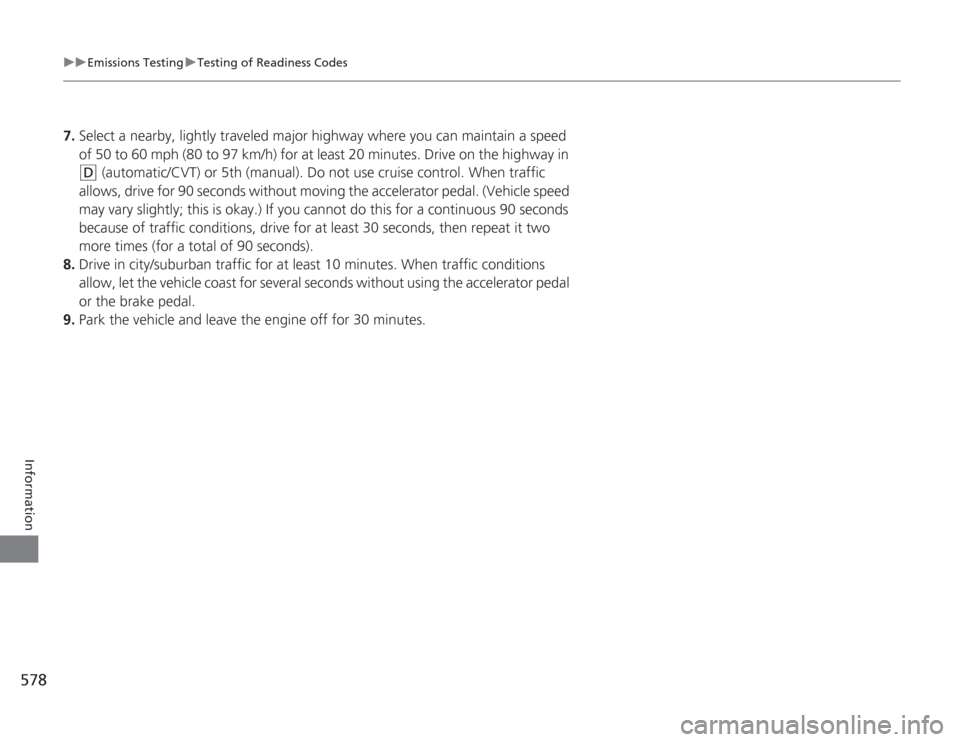
7. Select a nearby, lightly traveled major highway where you can maintain a speed
of 50 to 60 mph (80 to 97 km/h) for at least 20 minutes. Drive on the highway in
(D
(automatic/CVT) or 5th (manual). Do not use cruise control. When traffic
allows, drive for 90 seconds without moving the accelerator pedal. (Vehicle speed
may vary slightly; this is okay.) If you cannot do this for a continuous 90 seconds
because of traffic conditions, drive for at least 30 seconds, then repeat it two
more times (for a total of 90 seconds).
8. Drive in city/suburban traffic for at least 10 minutes. When traffic conditions
allow, let the vehicle coast for several seconds without using the accelerator pedal
or the brake pedal.
9. Park the vehicle and leave the engine off for 30 minutes.
Page 587 of 595
Index
586Index
Index
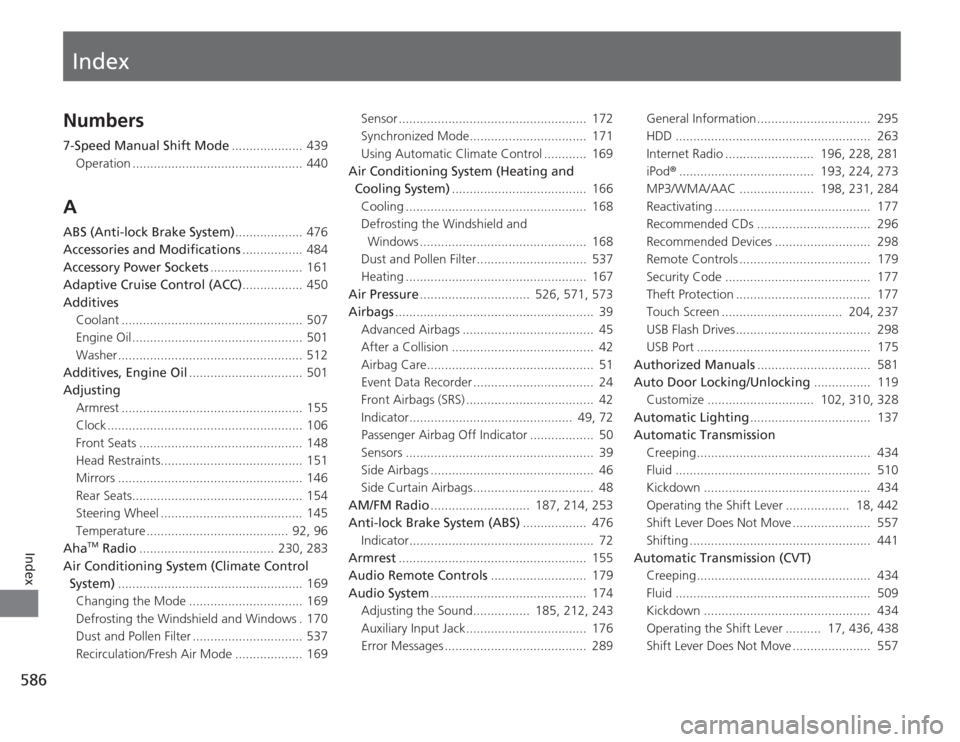
Numbers7-Speed Manual Shift Mode.................... 439
Operation ................................................ 440AABS (Anti-lock Brake System) ................... 476
Accessories and Modifications ................. 484
Accessory Power Sockets .......................... 161
Adaptive Cruise Control (ACC) ................. 450
Additives Coolant ................................................... 507
Engine Oil ................................................ 501
Washer .................................................... 512
Additives, Engine Oil ................................ 501
Adjusting
Armrest ................................................... 155
Clock ....................................................... 106
Front Seats .............................................. 148
Head Restraints........................................ 151
Mirrors .................................................... 146
Rear Seats................................................ 154
Steering Wheel ........................................ 145
Temperature ........................................ 92, 96
Aha
TM Radio ...................................... 230, 283
Air Conditioning System (Climate Control System) .................................................... 169
Changing the Mode ................................ 169
Defrosting the Windshield and Windows . 170
Dust and Pollen Filter ............................... 537
Recirculation/Fresh Air Mode ................... 169 Sensor ..................................................... 172
Synchronized Mode................................. 171
Using Automatic Climate Control ............ 169
Air Conditioning System (Heating and Cooling System) ...................................... 166
Cooling ................................................... 168
Defrosting the Windshield and Windows ............................................... 168
Dust and Pollen Filter............................... 537
Heating ................................................... 167
Air Pressure ............................... 526, 571, 573
Airbags ........................................................ 39
Advanced Airbags ..................................... 45
After a Collision ........................................ 42
Airbag Care............................................... 51
Event Data Recorder .................................. 24
Front Airbags (SRS) .................................... 42
Indicator.............................................. 49, 72
Passenger Airbag Off Indicator .................. 50
Sensors ..................................................... 39
Side Airbags .............................................. 46
Side Curtain Airbags.................................. 48
AM/FM Radio ............................ 187, 214, 253
Anti-lock Brake System (ABS) .................. 476
Indicator.................................................... 72
Armrest ..................................................... 155
Audio Remote Controls ........................... 179
Audio System ............................................ 174
Adjusting the Sound................ 185, 212, 243
Auxiliary Input Jack.................................. 176
Error Messages ........................................ 289 General Information................................ 295
HDD ....................................................... 263
Internet Radio ......................... 196, 228, 281
iPod
®...................................... 193, 224, 273
MP3/WMA/AAC ..................... 198, 231, 284
Reactivating ............................................ 177
Recommended CDs ................................ 296
Recommended Devices ........................... 298
Remote Controls ..................................... 179
Security Code ......................................... 177
Theft Protection ...................................... 177
Touch Screen .................................. 204, 237
USB Flash Drives...................................... 298
USB Port ................................................. 175
Authorized Manuals ................................ 581
Auto Door Locking/Unlocking ................ 119
Customize .............................. 102, 310, 328
Automatic Lighting .................................. 137
Automatic Transmission
Creeping................................................. 434
Fluid ....................................................... 510
Kickdown ............................................... 434
Operating the Shift Lever .................. 18, 442
Shift Lever Does Not Move ...................... 557
Shifting ................................................... 441
Automatic Transmission (CVT) Creeping................................................. 434
Fluid ....................................................... 509
Kickdown ............................................... 434
Operating the Shift Lever .......... 17, 436, 438
Shift Lever Does Not Move ...................... 557