Gasoline HONDA ACCORD HYBRID 2015 9.G Owners Manual
[x] Cancel search | Manufacturer: HONDA, Model Year: 2015, Model line: ACCORD HYBRID, Model: HONDA ACCORD HYBRID 2015 9.GPages: 569
Page 11 of 569
10Quick Reference Guide
SPORT HYBRID i-MMD (intelligent Multi Mode
Drive)Your SPORT HYBRID i-MMD vehicle uses both an electric motor and a gasoline engine as propulsion sources, with the electric moto r
receiving electricity from an internal High Voltage battery or internal generator. The High Voltage battery can be charged from the
generator driven by the engine or regenerative braking.
When driving, your vehicle is propelled exclusively by the electric motor, exclusively by the gasoline engine, or by a combinat ion of two. The
system selects which propulsion source is most appropriate and automatically switches to it. Under certain circumstances, press ing the EV
button can manually enable EV (driven only on electricity) mode.
● Energy efficiency
As with a gasoline-powered vehicle, hybrid vehicle fuel efficiency and driving range is most impacted by your driving style. Ag gressive
acceleration and high -speed driving can easily trigger the system to switch the propulsion source to the gasoline-powered engin e.
In addition, heavy climate control system use negatively affects vehicle range and efficiency. Either of these use patterns wil l more quickly
reduce the High Voltage battery's state of charge.
● Battery types
There are two types of batteries used in this vehicle; a st andard 12-volt battery that powers the airbags, the interior and ext erior lights, and
other standard 12-volt systems; and a high voltage battery that is used to power the propulsion motor and recharge the 12-volt battery.
Page 12 of 569
11Quick Reference Guide
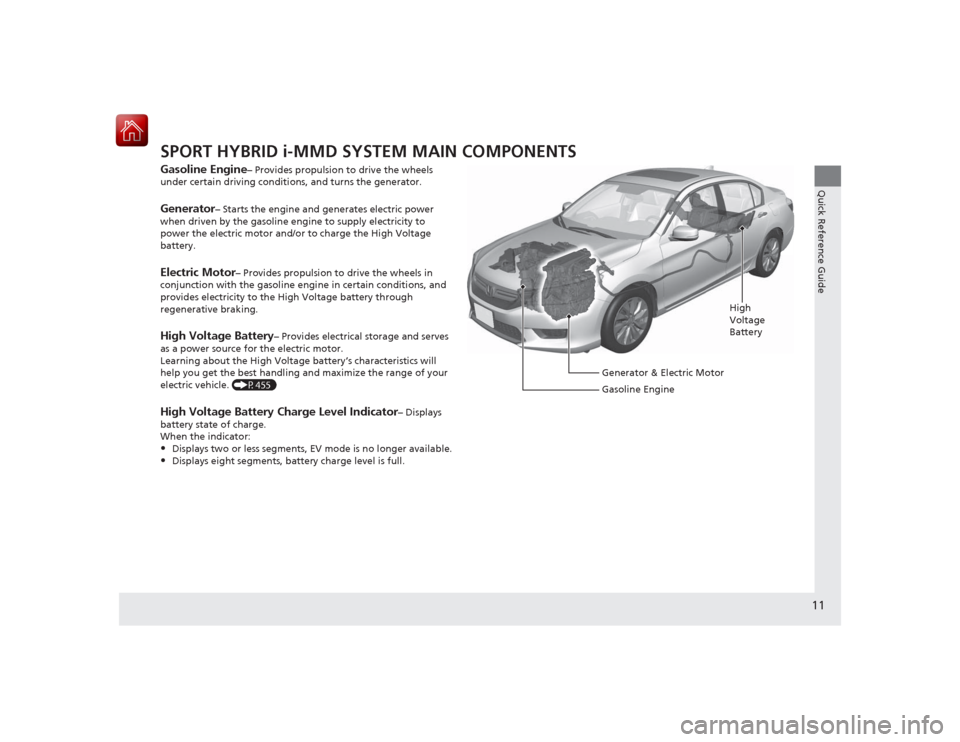
SPORT HYBRID i-MMD SYSTEM MAIN COMPONENTSGasoline Engine
– Provides propulsion to drive the wheels
under certain driving conditions, and turns the generator.
Generator
– Starts the engine and generates electric power
when driven by the gasoline engine to supply electricity to
power the electric motor and/o r to charge the High Voltage
battery.
Electric Motor
– Provides propulsion to drive the wheels in
conjunction with the gasoline engine in certain conditions, and
provides electricity to the High Vol tage battery through
regenerative braking.
High Voltage Battery
– Provides electrical storage and serves
as a power source for the electric motor.
Learning about the High Voltage battery’s characteristics will
help you get the best handling and maximize the range of your
electric vehicle. (P455)
High Voltage Battery Charge Level Indicator
– Displays
battery state of charge.
When the indicator:
•Displays two or less segments, EV mo de is no longer available.•Displays eight segments, battery charge level is full.
High
Voltage
Battery
Generator & Electric Motor
Gasoline Engine
Page 13 of 569
12Quick Reference Guide
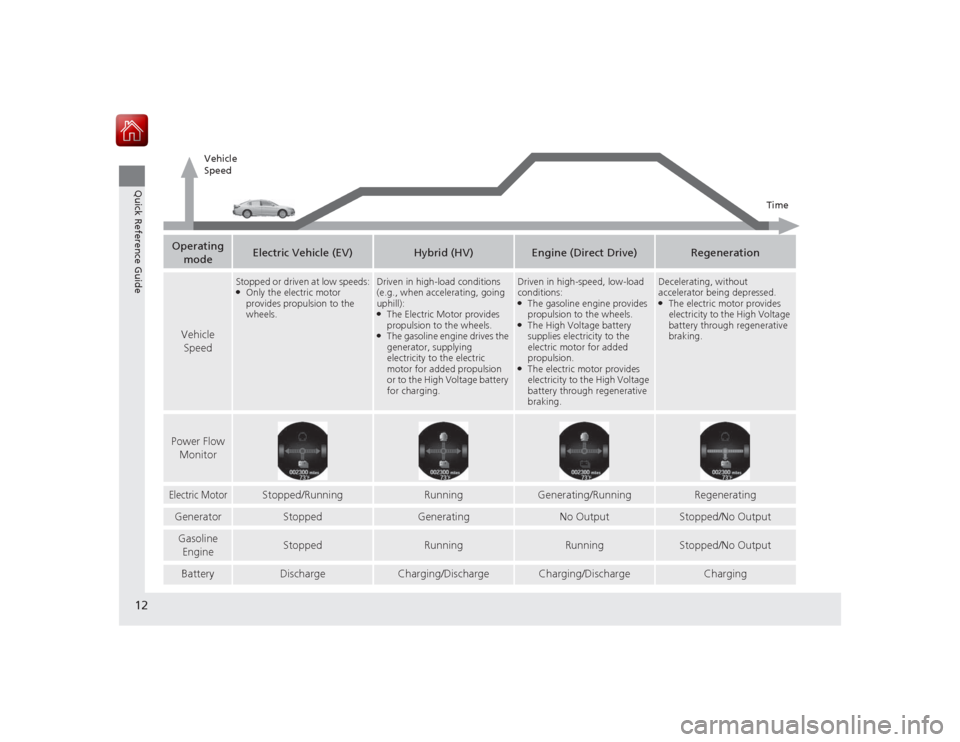
Operating mode
Electric Vehicle (EV)
Hybrid (HV)
Engine (Direct Drive)
Regeneration
Vehicle Speed
Stopped or driven at low speeds:●Only the electric motor
provides propulsion to the
wheels.
Driven in high-load conditions
(e.g., when accelerating, going
uphill):●The Electric Motor provides
propulsion to the wheels.●The gasoline engine drives the
generator, supplying
electricity to the electric
motor for added propulsion
or to the High Vol tage battery
for charging.
Driven in high-speed, low-load
conditions:●The gasoline engine provides
propulsion to the wheels.●The High Voltage battery
supplies electricity to the
electric motor for added
propulsion.●The electric motor provides
electricity to the High Voltage
battery through regenerative
braking.
Decelerating, without
accelerator being depressed.●The electric motor provides
electricity to the High Voltage
battery through regenerative
braking.
Power Flow
MonitorElectric Motor
Stopped/Running
Running
Generating/Running
Regenerating
Generator
Stopped
Generating
No Output
Stopped/No Output
Gasoline Engine
Stopped
Running
Running
Stopped/No Output
Battery
Discharge
Charging/Discharge
Charging/Discharge
Charging
Vehicle
Speed
Time
Page 15 of 569
14Quick Reference Guide
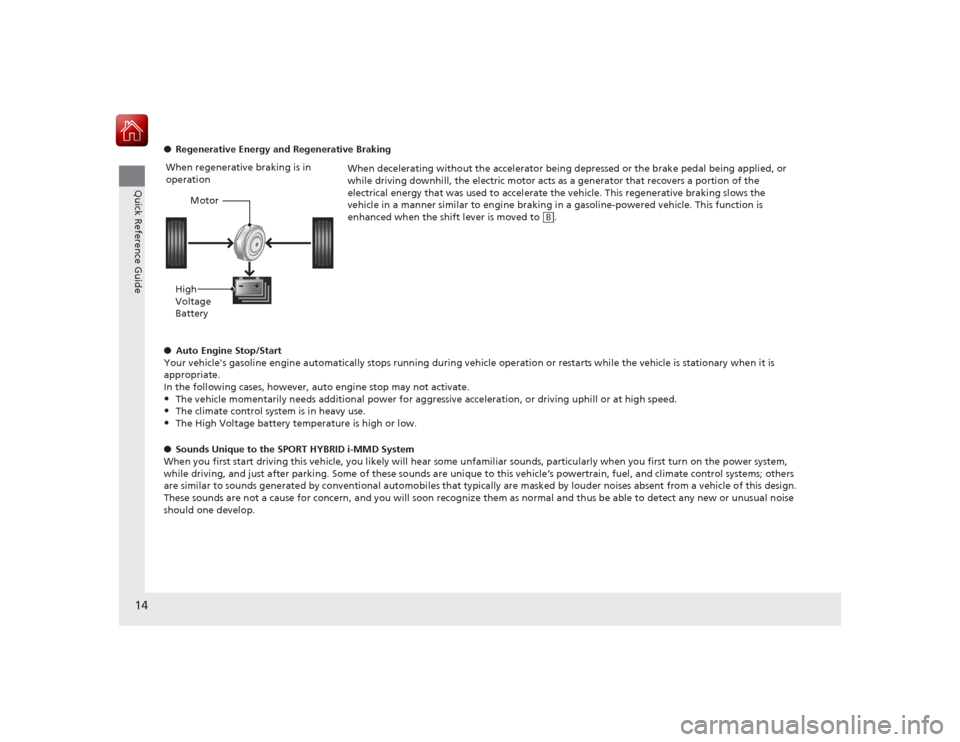
●Regenerative Energy and Regenerative Braking
When decelerating without the accelerator being depressed or the brake pedal being applied, or
while driving downhill, the electric motor acts as a generator that recovers a portion of the
electrical energy that was used to accelerate the vehicle. This regenerative braking slows the
vehicle in a manner similar to engine braking in a gasoline-powered vehicle. This function is
enhanced when the shift lever is moved to .
● Auto Engine Stop/Start
Your vehicle's gasoline engine automatically stops running during vehicle operation or restarts while the vehicle is stationary when it is
appropriate.
In the following cases, however, auto engine stop may not activate.•The vehicle momentarily needs additional po wer for aggressive acceleration, or driving uphill or at high speed.•The climate control system is in heavy use.•The High Voltage battery temperature is high or low.
● Sounds Unique to the SPORT HYBRID i-MMD System
When you first start driving this vehicle, you likely will hear some unfamiliar sounds, particularly when you first turn on the power system,
while driving, and just after parking. Some of these sounds are unique to this vehicle‘s powertrain, fuel, and climate control systems; others
are similar to sounds generated by conventional automob iles that typically are masked by louder noises absent from a vehicle of this design.
These sounds are not a cause for concern, and you will soon recognize them as normal and thus be able to detect any new or unusual noise
should one develop.When regenerative braking is in
operation
Motor
High
Voltage
Battery
B
Page 28 of 569
27Quick Reference Guide
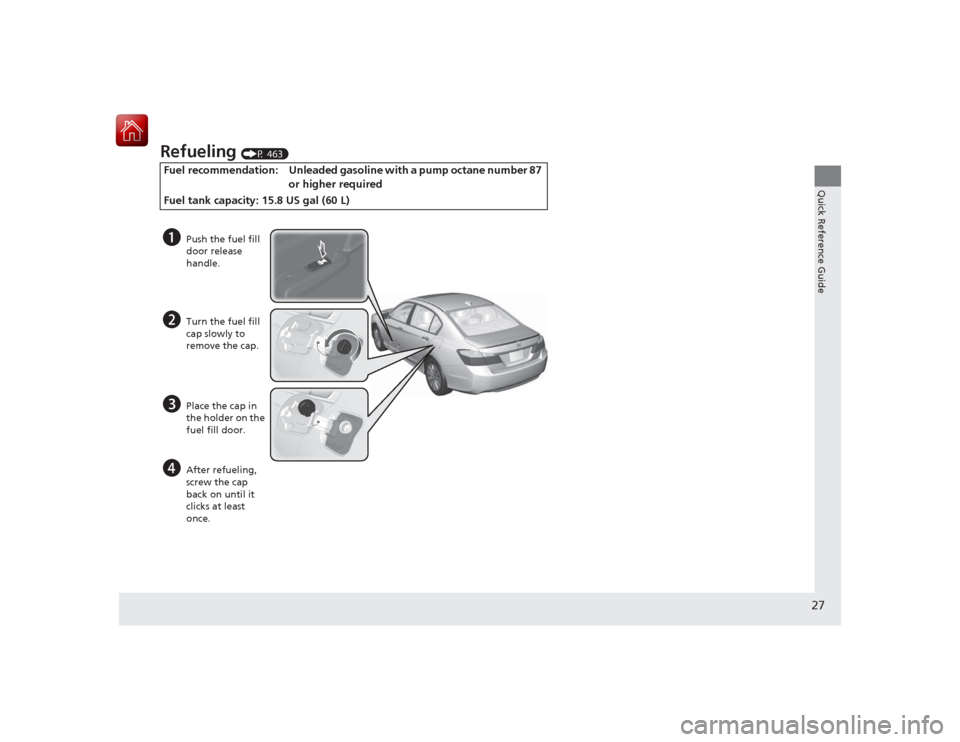
Refueling
(P 463)
Fuel recommendation: Unleaded gasoline with a pump octane number 87
or higher required
Fuel tank capacity: 15.8 US gal (60 L)a
Push the fuel fill
door release
handle.
b
Turn the fuel fill
cap slowly to
remove the cap.
c
Place the cap in
the holder on the
fuel fill door.
d
After refueling,
screw the cap
back on until it
clicks at least
once.
Page 424 of 569
423
uuWhen Driving uPrecautions While Driving
Driving
Precautions While DrivingAvoid driving in deep water and on flooded roads. This can damage the power
system or driveline, or cause electrical component failure.
If there is a strong impact with something under the vehicle, stop in a safe location.
Check the underside of the vehicle for damage or any fluid leaks.TransmissionAs with a conventional gasoline-powered vehicle with an automatic transmission,
this vehicle will creep.
Keep the brake pedal firmly depressed when stopped.
Quickly depressing the accelerator pedal while driving uphill may cause the vehicle
to react similar to an automatic transmission vehicle, unexpectedly increasing vehicle
speed. Depress the accelerator pedal carefully, especially on slippery roads and
curves.■
In Rain
■
Other Precautions
■
Creeping
■
Kickdown
1 Precautions While DrivingNOTICEDo not operate the shift lever while pressing the
accelerator pedal. You could damage the
transmission.
If the power mode is set to ACCESSORY while
driving, the power system will shut down and all
steering and brake power assist functions will stop,
making it difficult to control the vehicle.
Do not put the shift lever in
(N, as you will lose
regenerative braking (and acceleration) performance.
During the first 600 miles (1,000 km) of operation,
avoid sudden acceleration or full throttle operation so
as to not damage the powertrain.
Avoid hard braking for the first 200 miles (300 km).
You should also follow this when the brake pads are
replaced.
NOTICEIf you repeatedly turn the steering wheel at an
extremely low speed, or hold the steering wheel on
the full left or right position for a while, the electric
power steering (EPS) system heats up. The system
goes into a protective mode, and limits its
performance. The steering wheel becomes harder
and harder to operate. Once the system cools down,
the EPS system is restored.
Repeated operation under these conditions can
eventually damage the system.
Page 464 of 569
463Driving
RefuelingFuel Information■Fuel recommendation
Use of a lower octane gasoline can cause a persistent, heavy metallic knocking noise
that can lead to engine damage.■Top tier detergent gasoline
Because the level of detergency and additives in gasoline vary in the market, Honda
endorses the use of “TOP TIER Detergent Gasoline” where available to help
maintain the performance and reliability of your vehicle. TOP TIER Detergent
Gasoline meets a new gasoline standard jointly established by leading automotive
manufacturers to meet the needs of today’s advanced engines.
Qualifying gasoline retailers will, in most cases, identify their gasoline as having met
“TOP TIER Detergent Gasoline” standards at the retail location. This fuel is
guaranteed to contain the proper level of detergent additives and be free of metallic
additives. The proper level of detergent additives, and absence of harmful metallic
additives in gasoline, help avoid build-up of deposits in your engine and emission
control system.
For further important fuel-related information for your vehicle, or on information on
gasoline that does not contain MMT, visit www.hondacars.com. In Canada, visit
www.honda.ca for additional information on gasoline. For more information on top
tier gasoline, visit www.toptiergas.com .■Fuel tank capacity: 15.8 US gal (60 liters)Unleaded gasoline, pump octane number 87 or higher
1Fuel InformationNOTICEWe recommend quality gasoline containing
detergent additives that help prevent fuel system and
engine deposits. In addition, in order to maintain
good performance, fuel economy, and emissions
control, we strongly recommend the use of gasoline
that does NOT contain harmful manganese-based
fuel additives such as MMT, if such gasoline is
available.
Use of gasoline with these additives may adversely
affect performance, and cause the malfunction
indicator lamp on your instrument panel to come on.
If this happens, contact a dealer for service.
Some gasoline today is blended with oxygenates such
as ethanol. Your vehicle is designed to operate on
oxygenated gasoline containing up to 15% ethanol
by volume. Do not use gasoline containing methanol.
If you notice any undesirable operating symptoms, try
another service station or switch to another brand of
gasoline.
Page 465 of 569
464
uuRefueling uHow to Refuel
Driving
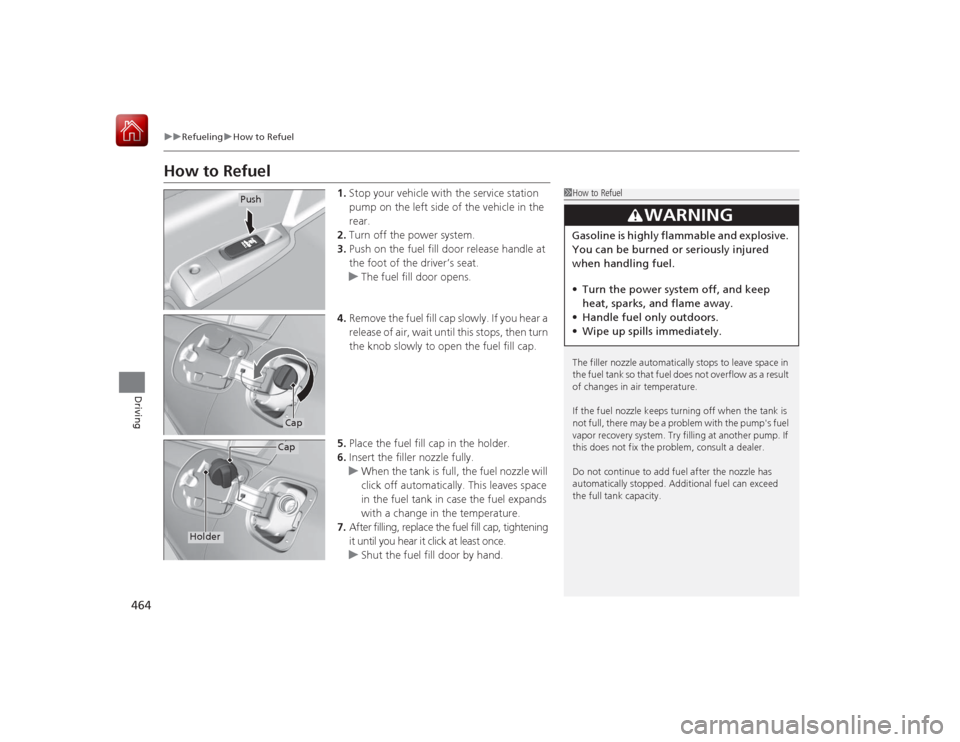
How to Refuel
1. Stop your vehicle with the service station
pump on the left side of the vehicle in the
rear.
2. Turn off the power system.
3. Push on the fuel fill door release handle at
the foot of the driver’s seat.
u The fuel fill door opens.
4. Remove the fuel fill cap slowly. If you hear a
release of air, wait until this stops, then turn
the knob slowly to open the fuel fill cap.
5. Place the fuel fill cap in the holder.
6. Insert the filler nozzle fully.
u When the tank is full, the fuel nozzle will
click off automatically. This leaves space
in the fuel tank in case the fuel expands
with a change in the temperature.
7. After filling, replace the fuel fill cap, tightening
it until you hear it click at least once.
u Shut the fuel fill door by hand.
1How to Refuel
The filler nozzle automatically stops to leave space in
the fuel tank so that fuel does not overflow as a result
of changes in air temperature.
If the fuel nozzle keeps turning off when the tank is
not full, there may be a problem with the pump's fuel
vapor recovery system. Try filling at another pump. If
this does not fix the problem, consult a dealer.
Do not continue to add fuel af ter the nozzle has
automatically stopped. Additional fuel can exceed
the full tank capacity.
3
WARNING
Gasoline is highly flammable and explosive.
You can be burned or seriously injured
when handling fuel.
• Turn the power system off, and keep
heat, sparks, and flame away.
• Handle fuel only outdoors.
• Wipe up spills immediately.
Push
CapCap
Holder
Page 470 of 569
469
uuBefore Performing Maintenance uSafety When Performing Maintenance
Maintenance
Safety When Performing MaintenanceSome of the most important safety precautions are given here.
However, we cannot warn you of every conc eivable hazard that can arise in
performing maintenance. Only you can decide whether or not you should perform
a given task.
• To reduce the possibility of fire or explosion, keep cigarettes, sparks, and flames
away from the 12-volt battery and all fuel related parts.
• Never leave rags, towels, or other flammable objects under the hood.
u Heat from the engine and exhaust can ignite them causing a fire.
• To clean parts, use a commercially available degreaser or parts cleaner, not
gasoline.
• Wear eye protection and protective clothing when working with the 12-volt
battery or compressed air.
• Engine exhaust contains carbon monoxide, which is poisonous and can kill you.
u Operate operate the engine only when there is sufficient ventilation.
• The vehicle must be in a stationary condition.
u Make sure your vehicle is parked on level ground, the parking brake is set, and
the power system is turned off.
• Be aware that hot parts can burn you.
u Make sure to let the power system including the engine and exhaust system
cool thoroughly before touching vehicle parts.
• Be aware that moving parts can injure you.
u Do not activate the power system unless instructed, and keep your hands and
limbs away from moving parts. When the power system is on, the engine can
automatically start, or the radiator fan may start operating without the engine
running.■
Maintenance Safety
■
Vehicle Safety
1Safety When Performing Maintenance
3
WARNING
Improperly maintaining this vehicle or
failing to correct a problem before driving
can cause a crash in which you can be
seriously hurt or killed.
Always follow th e inspection and
maintenance recommendations according
to the schedules in this owner's manual.
3
WARNING
Failure to properly fol low maintenance
instructions and precautions can cause you
to be seriously hurt or killed.
Always follow the procedures and
precautions in this owner's manual.
Page 510 of 569
509
Continued
Maintenance
CleaningInterior CareUse a damp cloth with a mixture of mild detergent and warm water to remove dirt.
Use a clean cloth to remove detergent residue.
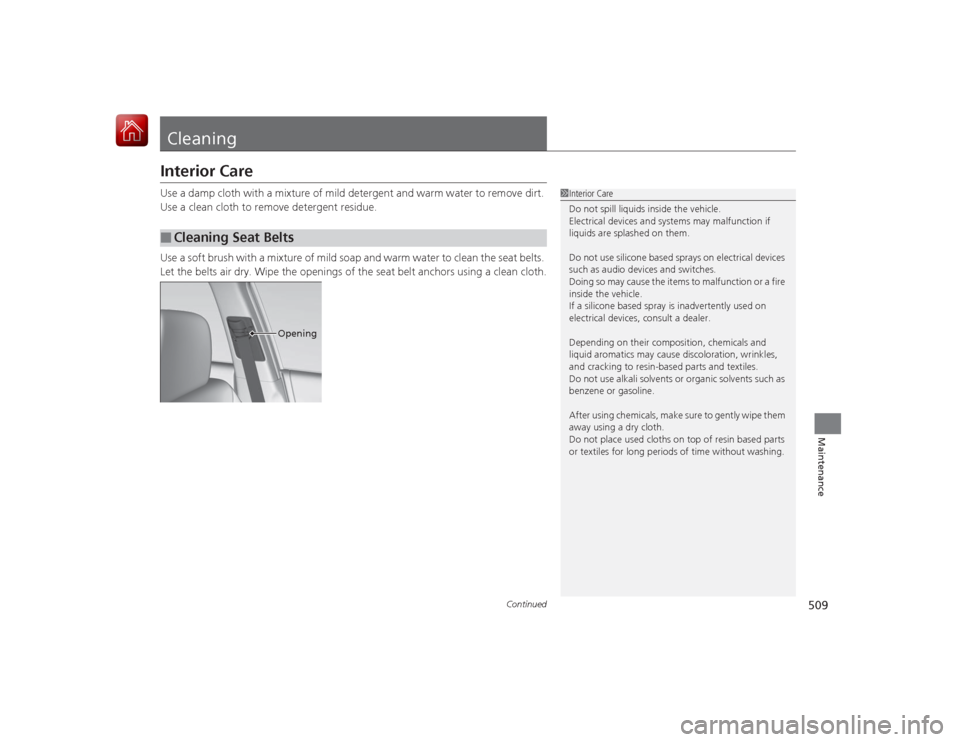
Use a soft brush with a mixture of mild soap and warm water to clean the seat belts.
Let the belts air dry. Wipe the openings of the seat belt anchors using a clean cloth.■
Cleaning Seat Belts
1Interior Care
Do not spill liquids inside the vehicle.
Electrical devices and systems may malfunction if
liquids are splashed on them.
Do not use silicone based sprays on electrical devices
such as audio devices and switches.
Doing so may cause the items to malfunction or a fire
inside the vehicle.
If a silicone based spray is inadvertently used on
electrical devices, consult a dealer.
Depending on their composition, chemicals and
liquid aromatics may cause discoloration, wrinkles,
and cracking to resin-based parts and textiles.
Do not use alkali solvents or organic solvents such as
benzene or gasoline.
After using chemicals, make sure to gently wipe them
away using a dry cloth.
Do not place used cloths on top of resin based parts
or textiles for long periods of time without washing.
Opening