airbag off HONDA ACCORD HYBRID 2019 Owners Manual
[x] Cancel search | Manufacturer: HONDA, Model Year: 2019, Model line: ACCORD HYBRID, Model: HONDA ACCORD HYBRID 2019Pages: 727, PDF Size: 24.78 MB
Page 6 of 727
4
Quick Reference Guide Quick Reference Guide
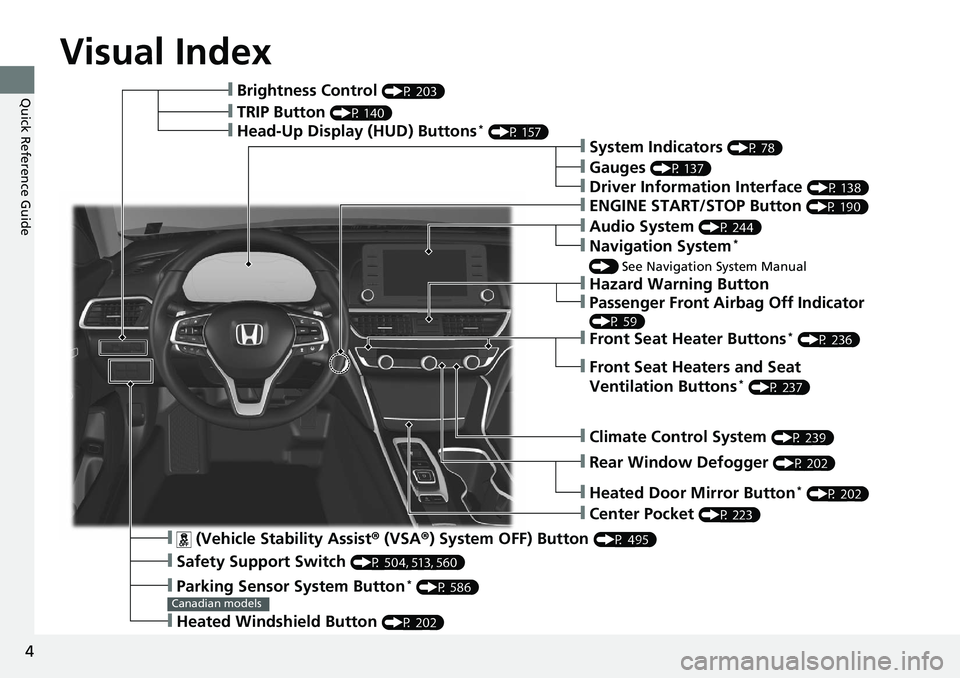
Visual Index
❙ (Vehicle Stability Assist ® (VSA ® ) System OFF) Button (P 495)
❙ Safety Support Switch (P 504, 513, 560)
❙ Parking Sensor System Button *
(P 586)
❙ Heated Windshield Button (P 202)Canadian models❙ Brightness Control (P 203)
❙ Head-Up Display (HUD) Buttons *
(P 157)
❙ System Indicators (P 78)
❙ Gauges (P 137)
❙ Driver Information Interface (P 138)
❙ ENGINE START/STOP Button (P 190)
❙ Climate Control System (P 239)
❙ Rear Window Defogger (P 202)
❙ Heated Door Mirror Button *
(P 202)
❙ Center Pocket (P 223)
❙ Hazard Warning Button❙ TRIP Button (P 140)
❙ Audio System (P 244)
❙ Navigation System *
() See Navigation System Manual
❙ Front Seat Heater Buttons *
(P 236)
❙ Front Seat Heaters and Seat
Ventilation Buttons *
(P 237)
❙ Passenger Front Airbag Off Indicator (P 59)
Page 42 of 727
uu Seat Belts u About Your Seat Belts
40
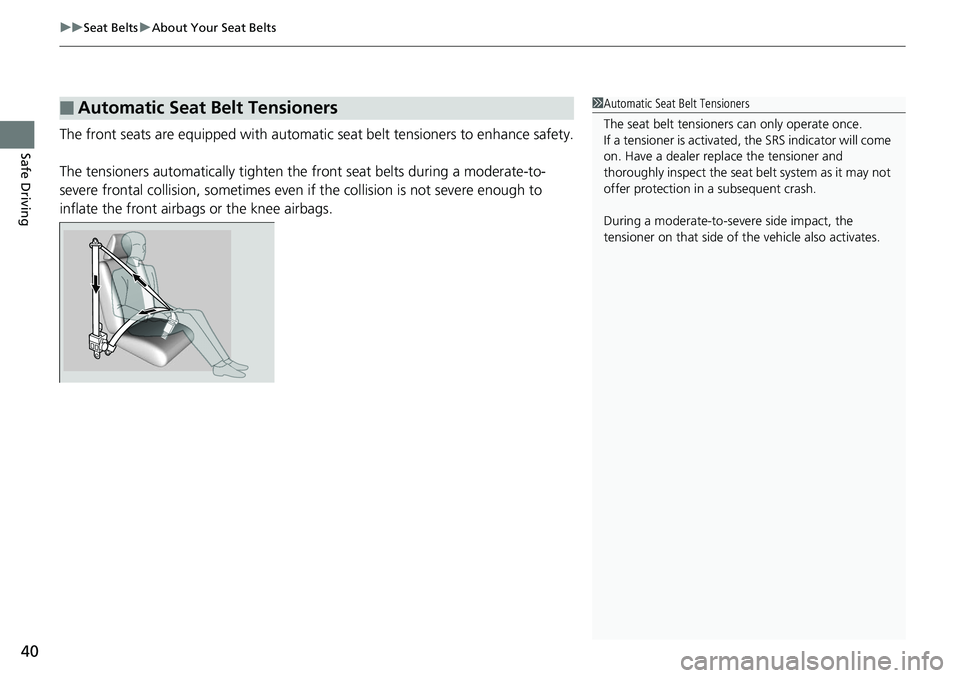
Safe Driving The front seats are equipped with automatic seat belt tensioners to enhance safety.
The tensioners automatically tighten th e front seat belts during a moderate-to-
severe frontal collision, sometimes even if the collision is no t severe enough to
inflate the front airbags or the knee airbags.
■ Automatic Seat Belt Tensioners 1 Automatic Seat Belt Tensioners
The seat belt tensioners can only operate once.
If a tensioner is activated, the SRS indicator will come
on. Have a dealer repl ace the tensioner and
thoroughly inspect the seat belt system as it may not
offer protection in a subsequent crash.
During a moderate-to-severe side impact, the
tensioner on that side of the vehicle also activates.
Page 48 of 727
46 uu Airbags u Airbag System Components
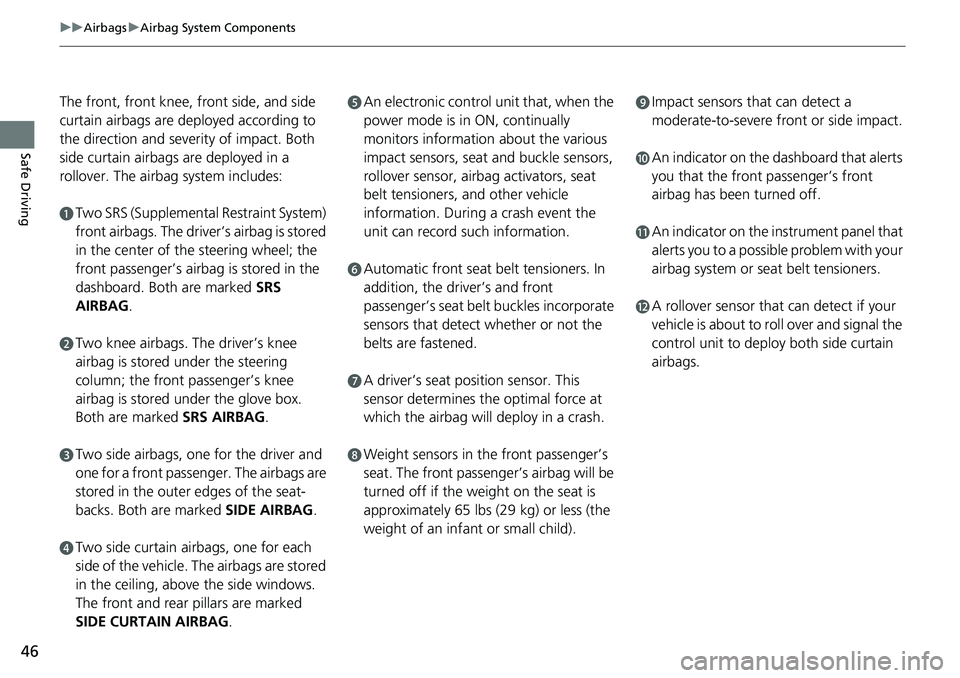
Safe Driving The front, front knee, front side, and side
curtain airbags are deployed according to
the direction and severity of impact. Both
side curtain airbags are deployed in a
rollover. The airbag system includes: a
Two SRS (Supplemental Restraint System)
front airbags. The driver’s airbag is stored
in the center of the steering wheel; the
front passenger’s airbag is stored in the
dashboard. Both are marked SRS
AIRBAG .b
Two knee airbags. Th e driver’s knee
airbag is stored under the steering
column; the front passenger’s knee
airbag is stored under the glove box.
Both are marked SRS AIRBAG .c
Two side airbags, one for the driver and
one for a front passenger. The airbags are
stored in the outer edges of the seat-
backs. Both are marked SIDE AIRBAG .
d
Two side curtain airbags, one for each
side of the vehicle. The airbags are stored
in the ceiling, above the side windows.
The front and rear pillars are marked
SIDE CURTAIN AIRBAG . e
An electronic control unit that, when the
power mode is in ON, continually
monitors information about the various
impact sensors, seat and buckle sensors,
rollover sensor, airbag activators, seat
belt tensioners, and other vehicle
information. During a crash event the
unit can record such information. f
Automatic front seat belt tensioners. In
addition, the driver’s and front
passenger’s seat belt buckles incorporate
sensors that detect whether or not the
belts are fastened. g
A driver’s seat position sensor. This
sensor determines the optimal force at
which the airbag will deploy in a crash. h
Weight sensors in the front passenger’s
seat. The front passenger’s airbag will be
turned off if the weight on the seat is
approximately 65 lbs (29 kg) or less (the
weight of an infant or small child). i
Impact sensors that can detect a
moderate-to-severe front or side impact. j
An indicator on the dashboard that alerts
you that the front passenger’s front
airbag has been turned off. k
An indicator on the instrument panel that
alerts you to a possible problem with your
airbag system or seat belt tensioners. l
A rollover sensor that can detect if your
vehicle is about to roll over and signal the
control unit to deploy both side curtain
airbags.
Page 51 of 727
Continued
49 uu Airbags u Front Airbags (SRS)
Safe Driving
Front airbags are designed to inflate durin g moderate-to-severe frontal collisions.
When the vehicle decelerates suddenly, the sensors send information to the control
unit which signals one or both front airbags to inflate.
A frontal collision can be either head-on or angled between two vehicles, or when a
vehicle crashes into a stationary object, such as a concrete wall.
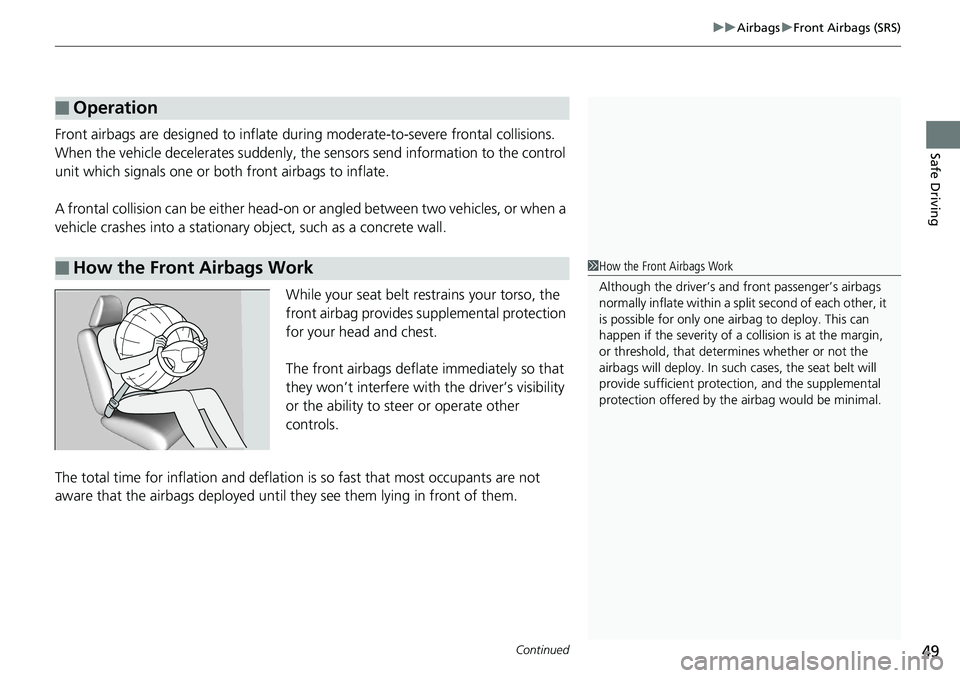
While your seat belt restrains your torso, the
front airbag provides supplemental protection
for your head and chest.
The front airbags deflate immediately so that
they won’t interfere with the driver’s visibility
or the ability to steer or operate other
controls.
The total time for inflation and deflation is so fast that most occupants are not
aware that the airbags deployed until th ey see them lying in front of them.■ Operation
■ How the Front Airbags Work 1 How the Front Airbags Work
Although the driver’s and fr ont passenger’s airbags
normally inflate within a spli t second of each other, it
is possible for only one airbag to deploy. This can
happen if the severity of a collision is at the margin,
or threshold, that determines whether or not the
airbags will deploy. In such cases, the seat belt will
provide sufficient protec tion, and the supplemental
protection offered by the airbag would be minimal.
Page 53 of 727
51 uu Airbags u Front Airbags (SRS)
Safe Driving
The airbags have advanced features to he lp reduce the likelihood of airbag related
injuries to smaller occupants.
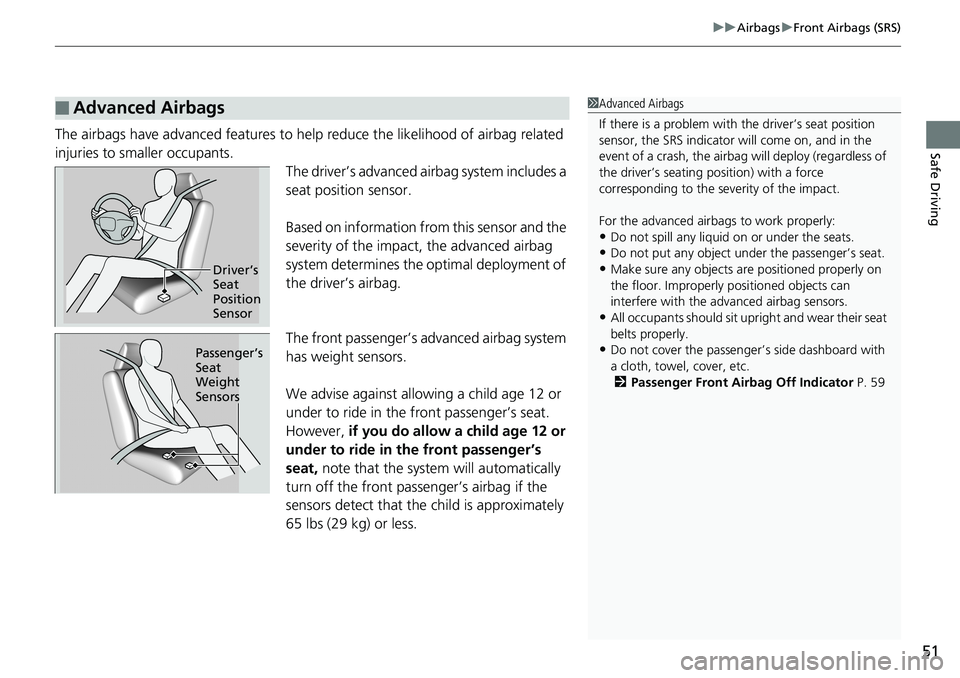
The driver’s advanced ai rbag system includes a
seat position sensor.
Based on information from this sensor and the
severity of the impact, the advanced airbag
system determines the optimal deployment of
the driver’s airbag.
The front passenger’s ad vanced airbag system
has weight sensors.
We advise against allowi ng a child age 12 or
under to ride in the front passenger’s seat.
However, if you do allow a child age 12 or
under to ride in the front passenger’s
seat, note that the system will automatically
turn off the front passenger’s airbag if the
sensors detect that the child is approximately
65 lbs (29 kg) or less. ■ Advanced Airbags 1 Advanced Airbags
If there is a problem with the driver’s seat position
sensor, the SRS indicator wi ll come on, and in the
event of a crash, the airbag will deploy (r egardless of
the driver’s seating position) with a force
corresponding to the se verity of the impact.
For the advanced airbags to work properly:
• Do not spill any liquid on or under the seats.
• Do not put any object under the passenger’s seat.
• Make sure any objects are positioned properly on
the floor. Improperly pos itioned objects can
interfere with the advanced airbag sensors.
• All occupants should sit upri ght and wear their seat
belts properly.
• Do not cover the passenger ’s side dashboard with
a cloth, towel, cover, etc.
2 Passenger Front Airbag Off Indicator P. 59Driver’s
Seat
Position
Sensor
Passenger’s
Seat
Weight
Sensors
Page 60 of 727
uu Airbags u Airbag System Indicators
58
Safe Driving ■ When side curtain airbags deploy in a frontal collision
One or both side curtain airbags may also inflate in a moderate-to-severe angled
frontal collision.
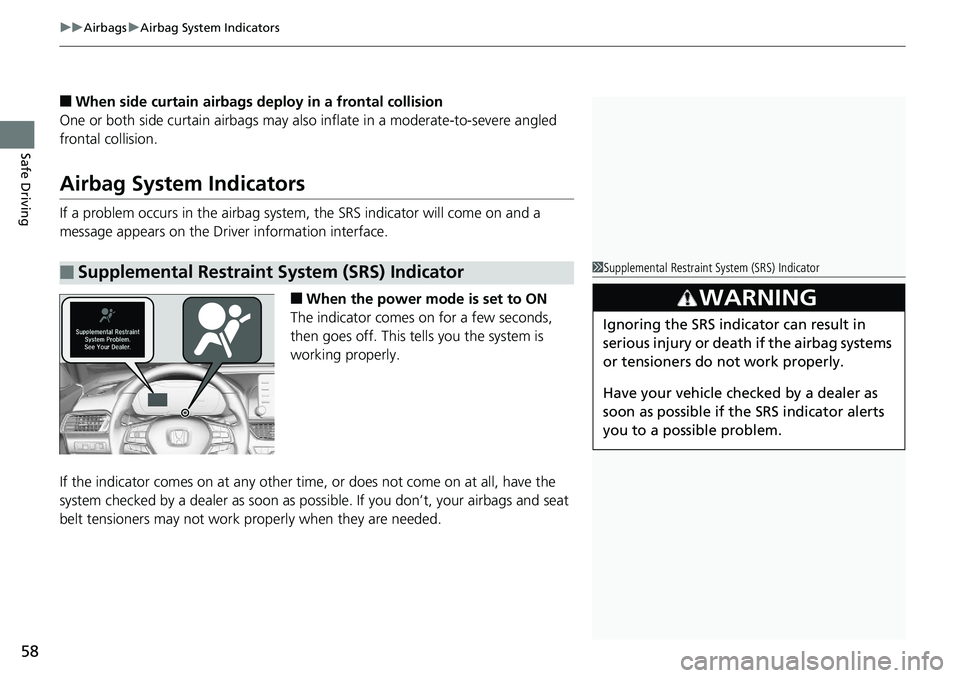
Airbag System Indicators If a problem occurs in the airbag syst em, the SRS indicator will come on and a
message appears on the Driver information interface.
■ When the power mode is set to ON
The indicator comes on for a few seconds,
then goes off. This tells you the system is
working properly.
If the indicator comes on at any other time, or does not come on at all, have the
system checked by a dealer as soon as possi ble. If you don’t, your airbags and seat
belt tensioners may not work properly when they are needed.■ Supplemental Restraint System (SRS) Indicator 1 Supplemental Restraint Sy stem (SRS) Indicator
3
WARNING Ignoring the SRS indicator can result in
serious injury or death if the airbag systems
or tensioners do not work properly.
Have your vehi cle checked by a dealer as
soon as possible if th e SRS indicator alerts
you to a possible problem.
Page 61 of 727
59uu Airbags u Airbag System Indicators
Safe Driving
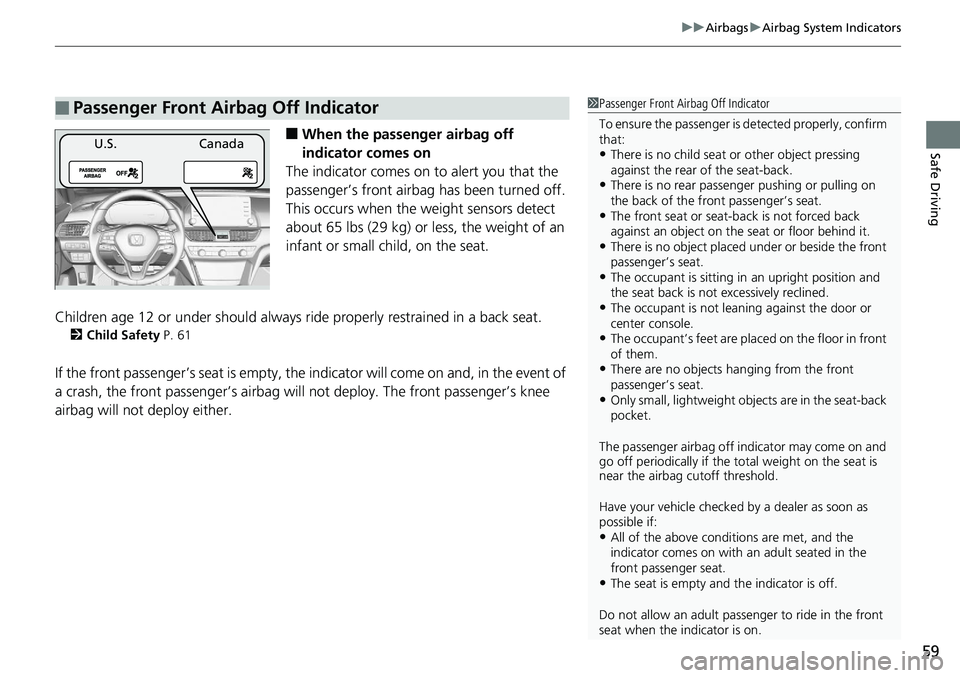
■ When the passenger airbag off
indicator comes on
The indicator comes on to alert you that the
passenger’s front airbag has been turned off.
This occurs when the weight sensors detect
about 65 lbs (29 kg) or less, the weight of an
infant or small child, on the seat.
Children age 12 or under should always ride properly restrained in a back seat. 2 Child Safety P. 61
If the front passenger’s seat is empty, the indicator will co me on and, in the event of
a crash, the front passenger’s airbag will not deploy. The front passenger’s knee
airbag will not deploy either.■ Passenger Front Airbag Off Indicator 1 Passenger Front Airbag Off Indicator
To ensure the passenger is detected properly, confirm
that:
• There is no child seat or other object pressing
against the rear of the seat-back.
• There is no rear passenger pushing or pulling on
the back of the front passenger’s seat.
• The front seat or seat-b ack is not forced back
against an object on the s eat or floor behind it.
• There is no object placed under or beside the front
passenger’s seat.
• The occupant is sitting in an upright position and
the seat back is not excessively reclined.
• The occupant is not leaning against the door or
center console.
• The occupant’s feet are plac ed on the floor in front
of them.
• There are no objects ha nging from the front
passenger’s seat.
• Only small, lightweight objects are in the seat-back
pocket.
The passenger airbag off indicator may come on and
go off periodically if the tota l weight on the seat is
near the airbag cutoff threshold.
Have your vehicle checked by a dealer as soon as
possible if:
• All of the above conditions are met, and the
indicator comes on with an adult seated in the
front passenger seat.
• The seat is empty and the indicator is off.
Do not allow an adult passe nger to ride in the front
seat when the indicator is on.U.S. Canada
Page 66 of 727
uu Child Safety u Safety of Infants and Small Children
64
Safe Driving If a child is at least one year old and has exceeded the weight an d height limitations
of a rearward facing child s eat, the child should be prope rly restrained in a firmly
secured forward facing child seat until they exceed the weight and height limitations
for the forward facing child seat.
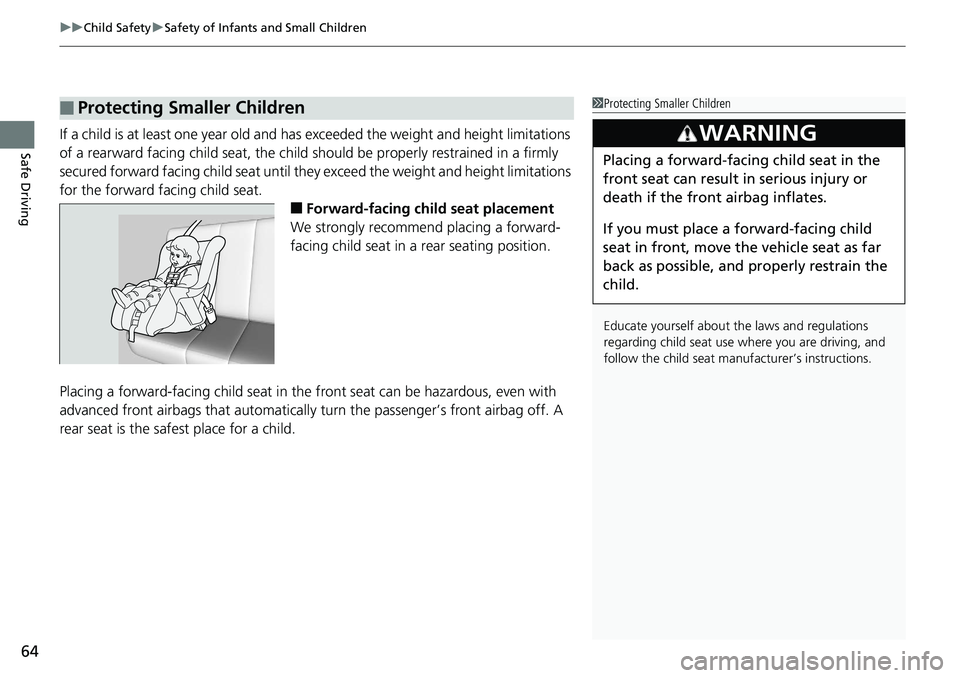
■ Forward-facing child seat placement
We strongly recommend placing a forward-
facing child seat in a rear seating position.
Placing a forward-facing child seat in the front seat can be hazardous, even with
advanced front airbags that automatically turn the passenger’s front airbag off. A
rear seat is the safest place for a child.■ Protecting Smaller Children 1 Protecting Smaller Children
Educate yourself about th e laws and regulations
regarding child seat use wh ere you are driving, and
follow the child seat manufacturer’s instructions.3
WARNING Placing a forward-facing child seat in the
front seat can result in serious injury or
death if the front airbag inflates.
If you must place a forward-facing child
seat in front, move the vehicle seat as far
back as possible, and properly restrain the
child.
Page 216 of 727
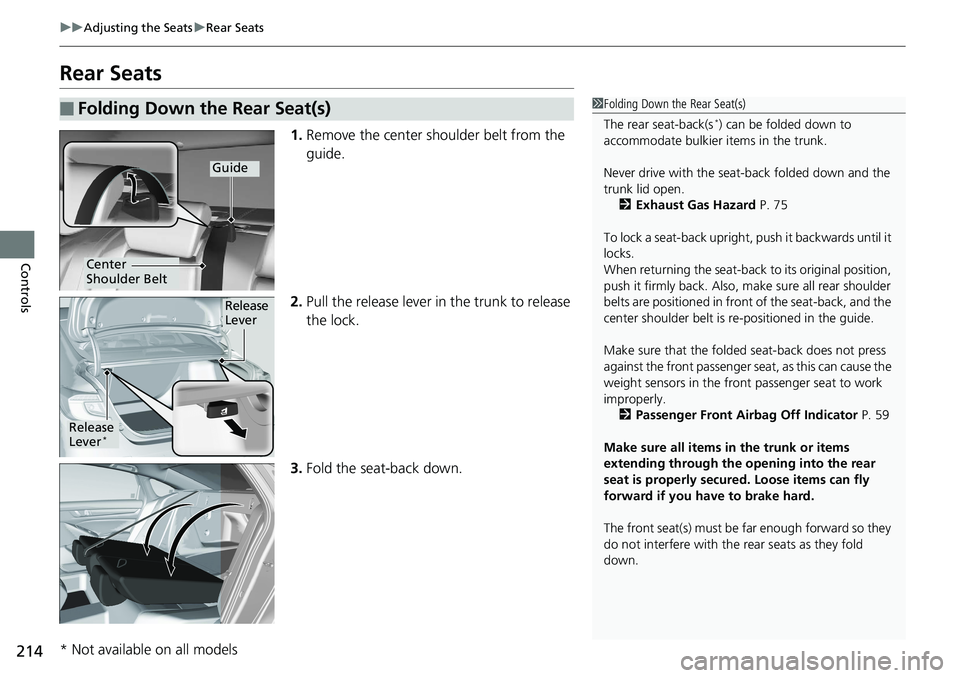
214 uu Adjusting the Seats u Rear Seats
Controls Rear Seats 1. Remove the center shoulder belt from the
guide.
2. Pull the release lever in the trunk to release
the lock.
3. Fold the seat-back down.■ Folding Down the Rear Seat(s) 1 Folding Down the Rear Seat(s)
The rear seat-back(s *
) can be folded down to
accommodate bulkier items in the trunk.
Never drive with the seat-back folded down and the
trunk lid open.
2 Exhaust Gas Hazard P. 75
To lock a seat-back upright, push it backwards until it
locks.
When returning the seat-back to its original position,
push it firmly back. Also, m ake sure all rear shoulder
belts are positioned in front of the seat-back, and the
center shoulder belt is re -positioned in the guide.
Make sure that the folded seat-back does not press
against the front passenger se at, as this can cause the
weight sensors in the front passenger seat to work
improperly.
2 Passenger Front Airbag Off Indicator P. 59
Make sure all items in the trunk or items
extending through the opening into the rear
seat is properly secured. Loose items can fly
forward if you have to brake hard.
The front seat(s) must be far enough forward so they
do not interfere with the rear seats as they fold
down.Guide
Center
Shoulder Belt
Release
Lever
Release
Lever *
* Not available on all models
Page 217 of 727
215uu Adjusting the Seats u Maintain a Proper Sitting Position
Controls
Maintain a Proper Sitting Position After all occupants have adjusted their s eats and head restrain ts, and put on their
seat belts, it is very important that they continue to sit uprigh t, well back in their
seats, with their feet on the floor, until the vehicle is safely parked and the power
mode is off.
Sitting improperly can increase the chance of injury during a crash. For example, if
an occupant slouches, lies down, turns si deways, sits forward, leans forward or
sideways, or puts one or both feet up, the chance of injury during a crash is greatly
increased.
In addition, an occupant who is out of posi tion in the front seat can be seriously or
fatally injured in a crash by striking interior parts of the vehicle or being struck by an
inflating front airbag. 1 Maintain a Proper Sitting Position
3
WARNING Sitting improperly or out of position can
result in serious injury or death in a crash.
Always sit upright, well back in the seat,
with your feet on the floor.